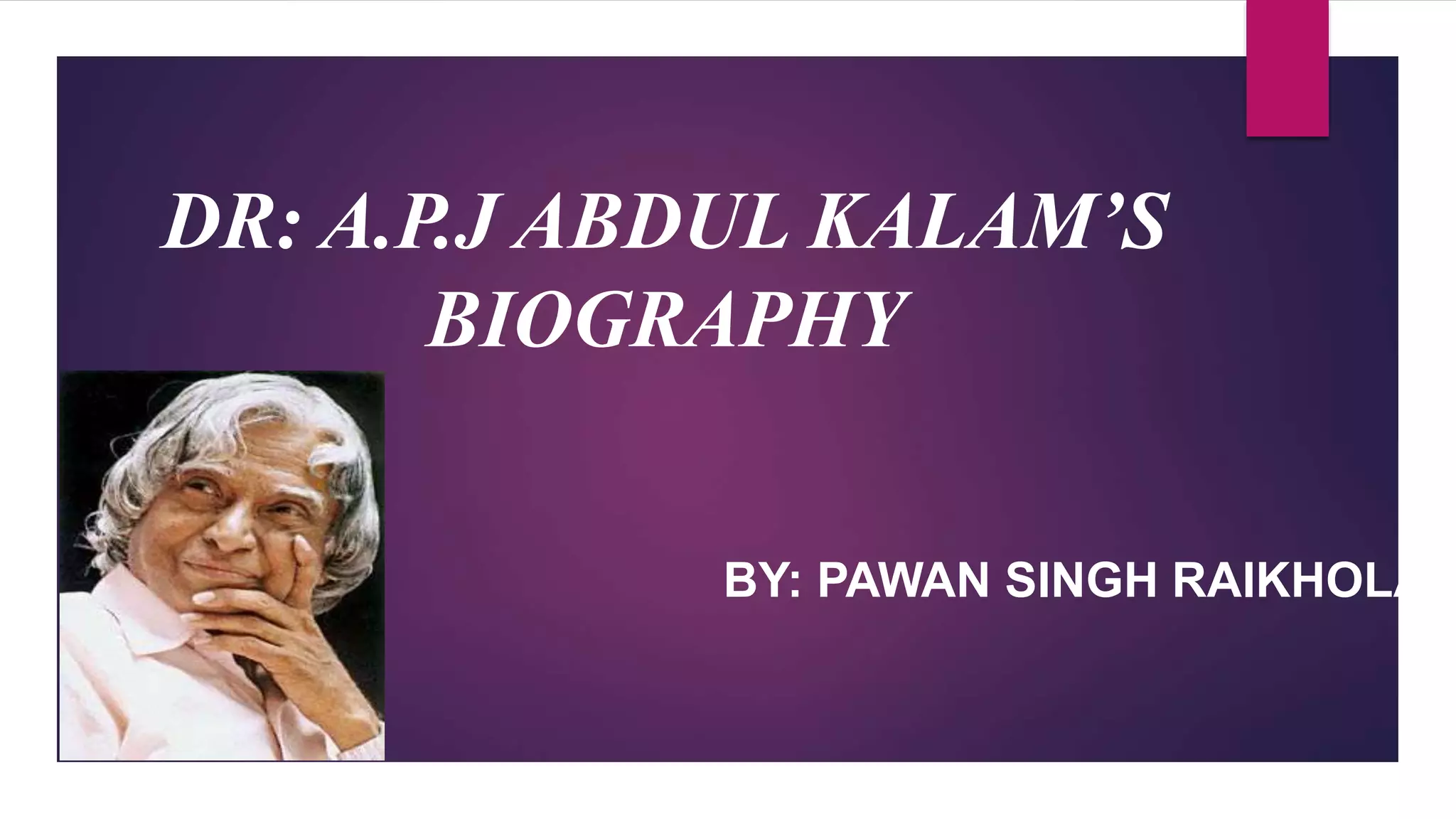
DR: A.P.J ABDUL KALAM’S
BIOGRAPHY
BY: PAWAN SINGH RAIKHOLA
ABOUT THE LEGEND
 Full name :Dr Avul Pakir Jainulabdeen Abdul Kalam
 Born on:15th Oct 1931,at Dhanushkodi in Rameswaram District, Tamil
Nadu
 Father: Jainulabdeen Marakayar,
 Mother:Ashiamma
 Has three siblings
CHILD HOOD
 A.P.J. Abdul Kalam wasborn to Jainulabdeen and Ashiamma
on October15, 1931. He came from a family whose
financial conditions were not good enough. As a means
to support his family’smegre income,Kalam took up oddjobs in
his childhood but never gave up on his education
EDUCATION
 Primary education was from Rameshwaram elementary school.
 Later he settled in schwartz, Ramanathapuram
 In 1950 he joined St Joseph college at Tiruchirapalli to do B.Sc.
 He joined DMIT in Aeronautical Engineering at MIT [Madras Institute of Technology] ,Madras (1954-1957)
 In 1958,after passing as a graduate, aeronautical engineer, he joined Hindustan Aeronautical
Limited(HAL),Bangalore as a trainee.
CAREER
 After graduating from MIT,Kalam tookup the position of chief scientist at the Aeronautical
Development Establishment of Defence Research
 Shifted to the Indian Space Research Organization (ISRO) where he was the project
director of India's first indigenous Satellite Launch Vehicle.,and Development Organization
(DRDO)
 From 1992 until 1999, Kalam was appointed as the Chief Scientific Adviser to the Prime
Minister and the Secretary of Defence Research and DevelopmentOrganisation.It was during this
time that Kalam served as the Chief Project Coordinator for Pokhran II nuclear tests, after
which he was fondly called the “Missile Manof India”.
MAJOR MISSLES
 The 5 projects were scheduled to be completed in a time frame of only 10 years and consisted of:
 (1) Nag - an anti-tank guided missile
 (2) Prithvi - a surface-to-surface battlefield missile
 (3) Akash - a swift, medium-range surface-to-air missile
 (4) Trishul - a quick-reaction surface-to-air missile with a shorter range
 (5) Agni - an intermediate range ballistic missile, the mightiest
PRESIDENCY
 Dr.A.P.J. Abdul Kalam was elected as the 11TH president of India,
succeeding K.R. Narayanan. He won the 2002 presidential election with
an electoral vote of 922,884, surpassing 107,366 votes won by Lakshmi
Sahgal. He served from 25 July 2002 to 25 July 2007.
Books & Documentaries OF
A.P.J.Abdul Kalam
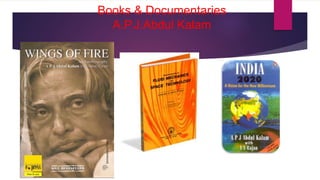
 Wings Of Fire: An Autobiography by A. P. J Abdul Kalam; 1999.
 India 2020: A Vision For the New Millennium: by A. P. J Abdul Kalam; 1998.
 The Luminous Sparks by A. P. J. Abdul Kalam; 2004.
 Mission India by A. P. J. Abdul Kalam
 Inspiring Thoughts by A. P. J. Abdul Kalam; 2007
 Developments in Fluid Mechanics and Space Technology by A.P.J. Abdul
Kalam
Books & Documentaries
A.P.J.Abdul Kalam
INTERESTING FACTS ABOUT KALAM
 Kalam begins his day by reading from the Bhagwad Gita.
 Kalam is leading a remarkable ascetic life.
 He works for about 18 hours each day.
 He plays the 'Rudra Veena'.
 Took leave just twice, when his parents died.
His Personality Traits
 Inherited Honesty and Faith in
Goodness from his parents
 Hard Working
 Determined
 Self disciplined
 Passionate for the work
 Artistic
 Highly spiritual
 Loving and caring
 Committed and dedicated for
work
 Positive thinker
AWARDS
2014 Doctor of Science
2012 Doctor of Laws
2011 IEEE Honorary Membership
2010 Doctor of Engineering
2009 Honorary Doctorate
2009 Hoover Medal
2009 International von Kármán Wings Award
2008 Doctor of Engineering
2008 Doctor of Science
2007 Honorary Doctorate of Science and Technology
2007 King Charles II Medal
2007 Honorary Doctorate of Science
2000 Ramanujan Award
1998 Veer Savarkar
1997 Indira Gandhi Award for National Integration
1997 Bharat Ratna
1990 Padma Vibhushan
1981 Padma Bhushan
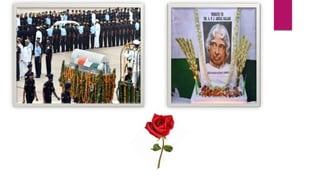
On 27 July 2015, Kalam travelled to Shillong to deliver a lecture on "Creating a Liveable Planet Earth" at
the Indian Institute of Management Shillong. At around 6:35 p.m. IST, only five minutes into his lecture,
he collapsed. He was rushed to the nearby Bethany Hospital in a critical condition; upon arrival, he
lacked a pulse or any other signs of life. Despite being placed in the intensive care unit, Kalam was
confirmed dead of a sudden cardiac arrest at 7:45 p.m. IST
A SALUTE TO
DR.A.P.J.ABDUL KALAM

A.P.J.Abdul Kalam

  • 1.
    DR: A.P.J ABDULKALAM’S BIOGRAPHY BY: PAWAN SINGH RAIKHOLA
  • 2.
    ABOUT THE LEGEND Full name :Dr Avul Pakir Jainulabdeen Abdul Kalam  Born on:15th Oct 1931,at Dhanushkodi in Rameswaram District, Tamil Nadu  Father: Jainulabdeen Marakayar,  Mother:Ashiamma  Has three siblings
  • 3.
    CHILD HOOD  A.P.J.Abdul Kalam wasborn to Jainulabdeen and Ashiamma on October15, 1931. He came from a family whose financial conditions were not good enough. As a means to support his family’smegre income,Kalam took up oddjobs in his childhood but never gave up on his education
  • 4.
    EDUCATION  Primary educationwas from Rameshwaram elementary school.  Later he settled in schwartz, Ramanathapuram  In 1950 he joined St Joseph college at Tiruchirapalli to do B.Sc.  He joined DMIT in Aeronautical Engineering at MIT [Madras Institute of Technology] ,Madras (1954-1957)  In 1958,after passing as a graduate, aeronautical engineer, he joined Hindustan Aeronautical Limited(HAL),Bangalore as a trainee.
  • 5.
    CAREER  After graduatingfrom MIT,Kalam tookup the position of chief scientist at the Aeronautical Development Establishment of Defence Research  Shifted to the Indian Space Research Organization (ISRO) where he was the project director of India's first indigenous Satellite Launch Vehicle.,and Development Organization (DRDO)  From 1992 until 1999, Kalam was appointed as the Chief Scientific Adviser to the Prime Minister and the Secretary of Defence Research and DevelopmentOrganisation.It was during this time that Kalam served as the Chief Project Coordinator for Pokhran II nuclear tests, after which he was fondly called the “Missile Manof India”.
  • 6.
    MAJOR MISSLES  The5 projects were scheduled to be completed in a time frame of only 10 years and consisted of:  (1) Nag - an anti-tank guided missile  (2) Prithvi - a surface-to-surface battlefield missile  (3) Akash - a swift, medium-range surface-to-air missile  (4) Trishul - a quick-reaction surface-to-air missile with a shorter range  (5) Agni - an intermediate range ballistic missile, the mightiest
  • 7.
    PRESIDENCY  Dr.A.P.J. AbdulKalam was elected as the 11TH president of India, succeeding K.R. Narayanan. He won the 2002 presidential election with an electoral vote of 922,884, surpassing 107,366 votes won by Lakshmi Sahgal. He served from 25 July 2002 to 25 July 2007.
  • 8.
    Books & DocumentariesOF A.P.J.Abdul Kalam  Wings Of Fire: An Autobiography by A. P. J Abdul Kalam; 1999.  India 2020: A Vision For the New Millennium: by A. P. J Abdul Kalam; 1998.  The Luminous Sparks by A. P. J. Abdul Kalam; 2004.  Mission India by A. P. J. Abdul Kalam  Inspiring Thoughts by A. P. J. Abdul Kalam; 2007  Developments in Fluid Mechanics and Space Technology by A.P.J. Abdul Kalam
  • 9.
  • 10.
    INTERESTING FACTS ABOUTKALAM  Kalam begins his day by reading from the Bhagwad Gita.  Kalam is leading a remarkable ascetic life.  He works for about 18 hours each day.  He plays the 'Rudra Veena'.  Took leave just twice, when his parents died.
  • 11.
    His Personality Traits Inherited Honesty and Faith in Goodness from his parents  Hard Working  Determined  Self disciplined  Passionate for the work  Artistic  Highly spiritual  Loving and caring  Committed and dedicated for work  Positive thinker
  • 12.
    AWARDS 2014 Doctor ofScience 2012 Doctor of Laws 2011 IEEE Honorary Membership 2010 Doctor of Engineering 2009 Honorary Doctorate 2009 Hoover Medal 2009 International von Kármán Wings Award 2008 Doctor of Engineering 2008 Doctor of Science 2007 Honorary Doctorate of Science and Technology 2007 King Charles II Medal 2007 Honorary Doctorate of Science 2000 Ramanujan Award 1998 Veer Savarkar 1997 Indira Gandhi Award for National Integration 1997 Bharat Ratna 1990 Padma Vibhushan 1981 Padma Bhushan
  • 13.
    On 27 July2015, Kalam travelled to Shillong to deliver a lecture on "Creating a Liveable Planet Earth" at the Indian Institute of Management Shillong. At around 6:35 p.m. IST, only five minutes into his lecture, he collapsed. He was rushed to the nearby Bethany Hospital in a critical condition; upon arrival, he lacked a pulse or any other signs of life. Despite being placed in the intensive care unit, Kalam was confirmed dead of a sudden cardiac arrest at 7:45 p.m. IST
  • 18.