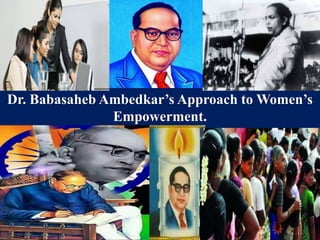
Dr. Babasaheb Ambedkar’s Approach to Women’s
Empowerment.
 Dr. Milind Ubale,
 Principal,
 Vasantrao Naik Mahavidyalaya,
 Jalna Road ,
 Aurangabad.(MS)
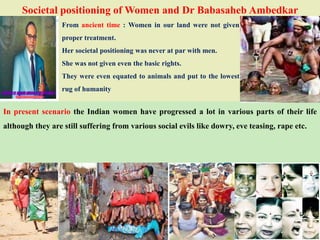
Societal positioning of Women and Dr Babasaheb Ambedkar
From ancient time : Women in our land were not given
proper treatment.
Her societal positioning was never at par with men.
She was not given even the basic rights.
They were even equated to animals and put to the lowest
rug of humanity
In present scenario the Indian women have progressed a lot in various parts of their life
although they are still suffering from various social evils like dowry, eve teasing, rape etc.
 It is a fact that in the glorious development
of Indian society.
 Indian women have march forward to the
developmental process and somewhere
treated equally with their male
counterparts
 People of India should have given the equal
rights and opportunity with men so as to
establish a shining India .
 Shining India where women can live freely
and equally irrespective of religion, caste,
creed, gender etc.
 To challenge the ideological foundation of graded system of caste hierarchy that
denied equality, freedom and human dignity to woman in Hindu Society.
 He stressed the need to safeguard the dignity and to respect the modesty of the
women folk.
 Dr. Babasaheb ideological was on the basis of political, economic and social
justice towards empowerment of the women in Indian Society.
Dr. Babasaheb’s mission
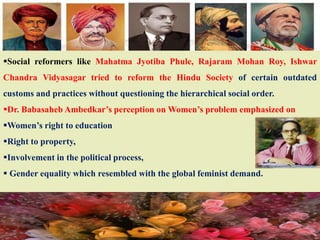
Social reformers like Mahatma Jyotiba Phule, Rajaram Mohan Roy, Ishwar
Chandra Vidyasagar tried to reform the Hindu Society of certain outdated
customs and practices without questioning the hierarchical social order.
Dr. Babasaheb Ambedkar’s perception on Women’s problem emphasized on
Women’s right to education
Right to property,
Involvement in the political process,
 Gender equality which resembled with the global feminist demand.
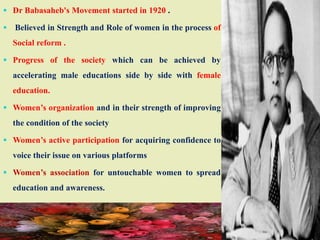
 Dr Babasaheb's Movement started in 1920 .
 Believed in Strength and Role of women in the process of
Social reform .
 Progress of the society which can be achieved by
accelerating male educations side by side with female
education.
 Women’s organization and in their strength of improving
the condition of the society
 Women’s active participation for acquiring confidence to
voice their issue on various platforms
 Women’s association for untouchable women to spread
education and awareness.
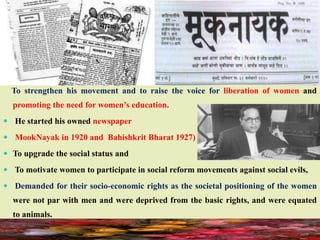
To strengthen his movement and to raise the voice for liberation of women and
promoting the need for women’s education.
 He started his owned newspaper
 MookNayak in 1920 and Bahishkrit Bharat 1927)
 To upgrade the social status and
 To motivate women to participate in social reform movements against social evils,
 Demanded for their socio-economic rights as the societal positioning of the women
were not par with men and were deprived from the basic rights, and were equated
to animals.
.
 In 1927 after getting nominated as a member of Bombay
Legislative Council
 Dr. Babasaheb urged the need to recognize the dignity of
women and supported maternity benefit bill for women
labourers.
 March 1927
 Dr. Babasaheb launched Mahad Satyagrahas in this
historic march thousands of Men/Women were
accompanied to assert their rights to take water from
Chawdar tank at Mahad.
 The movement was
 To liberate society from out worn traditions and evil
customs imposed ruthlessly and upheld religiously by a
vast society upto its weaker and helpless constituent and to
restore human rights and dignity to them.

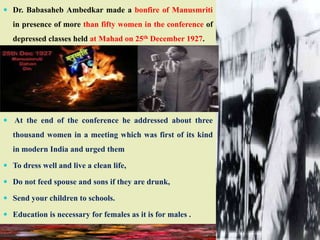
 Dr. Babasaheb Ambedkar made a bonfire of Manusmriti
in presence of more than fifty women in the conference of
depressed classes held at Mahad on 25th December 1927.
 At the end of the conference he addressed about three
thousand women in a meeting which was first of its kind
in modern India and urged them
 To dress well and live a clean life,
 Do not feed spouse and sons if they are drunk,
 Send your children to schools.
 Education is necessary for females as it is for males .
 The women’s association was established in January 1928
and Ramabai, (Dr. Babasaheb wife as its president.)
 Along with the depressed classes conference in Nagpur in
1930 women also had their separate conference.
 In the Kalaram temple entry satyagrahas at Nasik in 1930,
five hundred women participated and many of them were
arrested along with men and ill treated in jails.
 The encouragement of Babasaheb to empower women to
speak boldly was seen when Radhabai Vadale addressed a
press conference in 1931.
 She said “It is been to die a hundred times than live a life
full of humiliation.
 We will sacrifice our lives but we will win our rights.
 The credit for this self-respect and firm determinations of
women goes to Dr. Babasaheb.
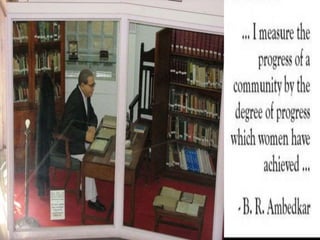
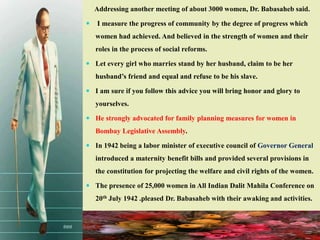
Addressing another meeting of about 3000 women, Dr. Babasaheb said.
 I measure the progress of community by the degree of progress which
women had achieved. And believed in the strength of women and their
roles in the process of social reforms.
 Let every girl who marries stand by her husband, claim to be her
husband’s friend and equal and refuse to be his slave.
 I am sure if you follow this advice you will bring honor and glory to
yourselves.
 He strongly advocated for family planning measures for women in
Bombay Legislative Assembly.
 In 1942 being a labor minister of executive council of Governor General
introduced a maternity benefit bills and provided several provisions in
the constitution for projecting the welfare and civil rights of the women.
 The presence of 25,000 women in All Indian Dalit Mahila Conference on
20th July 1942 .pleased Dr. Babasaheb with their awaking and activities.
Gaining inspiration from Dr. Babasaheb
 Many women wrote on various topics
 like planning Buddhist philosophy plays, and
autobiographies also participated in satyagrahas.
 Tulsabai Bansode started a newspaper this was :
 For creating awareness among poor, illiterate women and
inspired them to fight against the unjust social practices like
child marriages and devdasi system.
 Babasaheb evoked of women in the following words,” Never
wear such clothes which will degrade our personality and
character. Avoid wearing the jewellary on your body
everywhere.
 It is not fare to make hole on nose and wear ‘nath’.
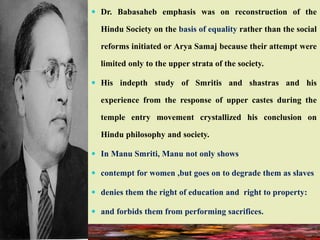
 Dr. Babasaheb emphasis was on reconstruction of the
Hindu Society on the basis of equality rather than the social
reforms initiated or Arya Samaj because their attempt were
limited only to the upper strata of the society.
 His indepth study of Smritis and shastras and his
experience from the response of upper castes during the
temple entry movement crystallized his conclusion on
Hindu philosophy and society.
 In Manu Smriti, Manu not only shows
 contempt for women ,but goes on to degrade them as slaves
 denies them the right of education and right to property:
 and forbids them from performing sacrifices.
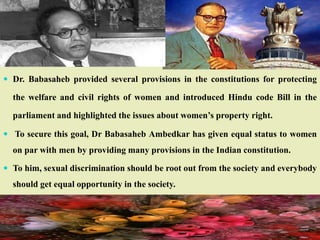
 Dr. Babasaheb provided several provisions in the constitutions for protecting
the welfare and civil rights of women and introduced Hindu code Bill in the
parliament and highlighted the issues about women’s property right.
 To secure this goal, Dr Babasaheb Ambedkar has given equal status to women
on par with men by providing many provisions in the Indian constitution.
 To him, sexual discrimination should be root out from the society and everybody
should get equal opportunity in the society.
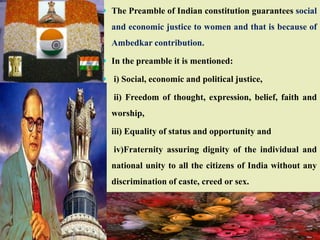
 The Preamble of Indian constitution guarantees social
and economic justice to women and that is because of
Ambedkar contribution.
 In the preamble it is mentioned:
 i) Social, economic and political justice,
 ii) Freedom of thought, expression, belief, faith and
worship,
 iii) Equality of status and opportunity and
 iv)Fraternity assuring dignity of the individual and
national unity to all the citizens of India without any
discrimination of caste, creed or sex.
 To improve women position and to compete with their male
counterparts there are few articles in Indian Constitution :
 For example
 Article14 – All are equal in the eyes of law and equally protected by
the law.
 It means equal rights and opportunities in political, economic and
social spheres.
 Article 15 prohibits discrimination on the ground of sex.
 Article 15(3) enables positive discrimination in favour of women.
 Article 16 mentions there shall be equality of opportunity for all
citizens in matters relating to employment or appointment to any
office without any discrimination on the basis of religion, caste,
creed and sex.
 Article 24 prohibits the employment of children below the age of 14
years in factories, mines or in any other hazardous employment.
Article 39 and 39(d) state Equal means of livelihood and equal
pay for equal work.
 As per article 41 the state shall guarantee within its economic
limits to all the citizens, the right to work, to education and
public assistance in certain cases.
 Article 42 the state makes provision for Human conditions of
work and maternity relief.
 Under article 44, the state provides a uniform Civil Code to all
the citizens throughout the territory of India.
 Article 46 – The state to promote with special care, the
educational and economic interests of weaker section of people
and to protect them from social injustice and all forms of
exploitation.
 Article 47 – The state to raise the level of nutrition and standard
of living of its people and the improvement of public health and
so on.
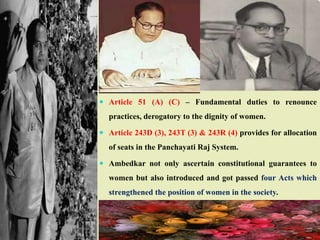
 Article 51 (A) (C) – Fundamental duties to renounce
practices, derogatory to the dignity of women.
 Article 243D (3), 243T (3) & 243R (4) provides for allocation
of seats in the Panchayati Raj System.
 Ambedkar not only ascertain constitutional guarantees to
women but also introduced and got passed four Acts which
strengthened the position of women in the society.
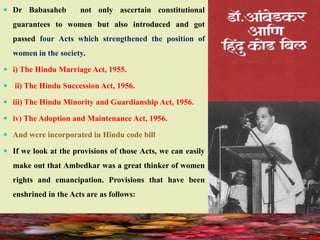
 Dr Babasaheb not only ascertain constitutional
guarantees to women but also introduced and got
passed four Acts which strengthened the position of
women in the society.
 i) The Hindu Marriage Act, 1955.
 ii) The Hindu Succession Act, 1956.
 iii) The Hindu Minority and Guardianship Act, 1956.
 iv) The Adoption and Maintenance Act, 1956.
 And were incorporated in Hindu code bill
 If we look at the provisions of those Acts, we can easily
make out that Ambedkar was a great thinker of women
rights and emancipation. Provisions that have been
enshrined in the Acts are as follows:
 The Hindu Marriage Act, 1955
 The Hindu Marriage Act, 1955 was amended in
1976 made the following provisions for women:
 1. The legitimization of illegitimate children
(Sec.16).
 2. Punishment-bigamy (Sec.26).
 3. Custody of children (Sec. 26).
 4. Marriageable age of females raised to 18 years.
 5. Provision for alimony (Sec. 25). The Act abolishes
the difference between a maiden and a widow.
 The Hindu Succession Act, 1956
 This Act contains the following provisions for women:
 1. A widow has a right to adopt a son or a daughter which
was not there in the Hindu Law.
 2. It also provided an opportunity to be independent and
dispose of her property by will as she wishes and desires
(Sec. 14).
 3. A uniform scheme of succession to the property of a
Hindu female, who dies, intestate after commencement of
the Act, was made in Section 15. Previously under the
uncodified law the succession to stridhan varied
according to the marital status of a woman.
The Hindu Minority and Guardianship Act, 1956:
 Following provisions are come under the purview of
this Act:
 1. The mother is empowered to change the guardian,
appointed by the father and may appoint a new
guardian by will.
 2. The father’s right to appoint a guardian for the
minor by will during the life time of the minor’s
mother is prohibited under this Act.
 The Adoption and Maintenance Act, 1956:
 This Act has the following provisions:
 1. This Act accepts adoption of a male and a female child without
any difference, whereas under the uncodified law a daughter
could not be adopted.
 2. This Acts permits a wife to adopt a child on her own right even
during her husband’s life time. She had no such right prior to
this enactment.
 3. In the uncodified law a spinster or a widow had no right to
adopt whereas this Act grants them the right to adopt.
 4. Under the old Hindu Law a wife need not be consulted while
adopting a child or while giving a child for adoption, whereas this
Act made it essential to consult her in both the cases.
 5. Section 11 lays down that, a father should adopt a daughter
atleast 21 years younger to him.
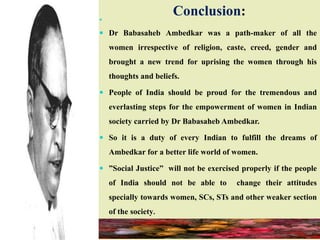
Conclusion:
 Dr Babasaheb Ambedkar was a path-maker of all the
women irrespective of religion, caste, creed, gender and
brought a new trend for uprising the women through his
thoughts and beliefs.
 People of India should be proud for the tremendous and
everlasting steps for the empowerment of women in Indian
society carried by Dr Babasaheb Ambedkar.
 So it is a duty of every Indian to fulfill the dreams of
Ambedkar for a better life world of women.
 ”Social Justice” will not be exercised properly if the people
of India should not be able to change their attitudes
specially towards women, SCs, STs and other weaker section
of the society.
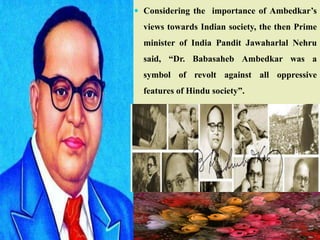
 Considering the importance of Ambedkar’s
views towards Indian society, the then Prime
minister of India Pandit Jawaharlal Nehru
said, “Dr. Babasaheb Ambedkar was a
symbol of revolt against all oppressive
features of Hindu society”.
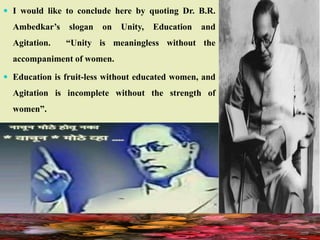
 I would like to conclude here by quoting Dr. B.R.
Ambedkar’s slogan on Unity, Education and
Agitation. “Unity is meaningless without the
accompaniment of women.
 Education is fruit-less without educated women, and
Agitation is incomplete without the strength of
women”.
DR B R Ambedkar

DR B R Ambedkar

  • 1.
    Dr. Babasaheb Ambedkar’sApproach to Women’s Empowerment.
  • 2.
     Dr. MilindUbale,  Principal,  Vasantrao Naik Mahavidyalaya,  Jalna Road ,  Aurangabad.(MS)
  • 4.
    Societal positioning ofWomen and Dr Babasaheb Ambedkar From ancient time : Women in our land were not given proper treatment. Her societal positioning was never at par with men. She was not given even the basic rights. They were even equated to animals and put to the lowest rug of humanity In present scenario the Indian women have progressed a lot in various parts of their life although they are still suffering from various social evils like dowry, eve teasing, rape etc.
  • 5.
     It isa fact that in the glorious development of Indian society.  Indian women have march forward to the developmental process and somewhere treated equally with their male counterparts  People of India should have given the equal rights and opportunity with men so as to establish a shining India .  Shining India where women can live freely and equally irrespective of religion, caste, creed, gender etc.
  • 6.
     To challengethe ideological foundation of graded system of caste hierarchy that denied equality, freedom and human dignity to woman in Hindu Society.  He stressed the need to safeguard the dignity and to respect the modesty of the women folk.  Dr. Babasaheb ideological was on the basis of political, economic and social justice towards empowerment of the women in Indian Society. Dr. Babasaheb’s mission
  • 7.
    Social reformers likeMahatma Jyotiba Phule, Rajaram Mohan Roy, Ishwar Chandra Vidyasagar tried to reform the Hindu Society of certain outdated customs and practices without questioning the hierarchical social order. Dr. Babasaheb Ambedkar’s perception on Women’s problem emphasized on Women’s right to education Right to property, Involvement in the political process,  Gender equality which resembled with the global feminist demand.
  • 8.
     Dr Babasaheb'sMovement started in 1920 .  Believed in Strength and Role of women in the process of Social reform .  Progress of the society which can be achieved by accelerating male educations side by side with female education.  Women’s organization and in their strength of improving the condition of the society  Women’s active participation for acquiring confidence to voice their issue on various platforms  Women’s association for untouchable women to spread education and awareness.
  • 9.
    To strengthen hismovement and to raise the voice for liberation of women and promoting the need for women’s education.  He started his owned newspaper  MookNayak in 1920 and Bahishkrit Bharat 1927)  To upgrade the social status and  To motivate women to participate in social reform movements against social evils,  Demanded for their socio-economic rights as the societal positioning of the women were not par with men and were deprived from the basic rights, and were equated to animals. .
  • 10.
     In 1927after getting nominated as a member of Bombay Legislative Council  Dr. Babasaheb urged the need to recognize the dignity of women and supported maternity benefit bill for women labourers.  March 1927  Dr. Babasaheb launched Mahad Satyagrahas in this historic march thousands of Men/Women were accompanied to assert their rights to take water from Chawdar tank at Mahad.  The movement was  To liberate society from out worn traditions and evil customs imposed ruthlessly and upheld religiously by a vast society upto its weaker and helpless constituent and to restore human rights and dignity to them. 
  • 11.
     Dr. BabasahebAmbedkar made a bonfire of Manusmriti in presence of more than fifty women in the conference of depressed classes held at Mahad on 25th December 1927.  At the end of the conference he addressed about three thousand women in a meeting which was first of its kind in modern India and urged them  To dress well and live a clean life,  Do not feed spouse and sons if they are drunk,  Send your children to schools.  Education is necessary for females as it is for males .
  • 12.
     The women’sassociation was established in January 1928 and Ramabai, (Dr. Babasaheb wife as its president.)  Along with the depressed classes conference in Nagpur in 1930 women also had their separate conference.  In the Kalaram temple entry satyagrahas at Nasik in 1930, five hundred women participated and many of them were arrested along with men and ill treated in jails.  The encouragement of Babasaheb to empower women to speak boldly was seen when Radhabai Vadale addressed a press conference in 1931.  She said “It is been to die a hundred times than live a life full of humiliation.  We will sacrifice our lives but we will win our rights.  The credit for this self-respect and firm determinations of women goes to Dr. Babasaheb.
  • 13.
    Addressing another meetingof about 3000 women, Dr. Babasaheb said.  I measure the progress of community by the degree of progress which women had achieved. And believed in the strength of women and their roles in the process of social reforms.  Let every girl who marries stand by her husband, claim to be her husband’s friend and equal and refuse to be his slave.  I am sure if you follow this advice you will bring honor and glory to yourselves.  He strongly advocated for family planning measures for women in Bombay Legislative Assembly.  In 1942 being a labor minister of executive council of Governor General introduced a maternity benefit bills and provided several provisions in the constitution for projecting the welfare and civil rights of the women.  The presence of 25,000 women in All Indian Dalit Mahila Conference on 20th July 1942 .pleased Dr. Babasaheb with their awaking and activities.
  • 14.
    Gaining inspiration fromDr. Babasaheb  Many women wrote on various topics  like planning Buddhist philosophy plays, and autobiographies also participated in satyagrahas.  Tulsabai Bansode started a newspaper this was :  For creating awareness among poor, illiterate women and inspired them to fight against the unjust social practices like child marriages and devdasi system.  Babasaheb evoked of women in the following words,” Never wear such clothes which will degrade our personality and character. Avoid wearing the jewellary on your body everywhere.  It is not fare to make hole on nose and wear ‘nath’.
  • 15.
     Dr. Babasahebemphasis was on reconstruction of the Hindu Society on the basis of equality rather than the social reforms initiated or Arya Samaj because their attempt were limited only to the upper strata of the society.  His indepth study of Smritis and shastras and his experience from the response of upper castes during the temple entry movement crystallized his conclusion on Hindu philosophy and society.  In Manu Smriti, Manu not only shows  contempt for women ,but goes on to degrade them as slaves  denies them the right of education and right to property:  and forbids them from performing sacrifices.
  • 17.
     Dr. Babasahebprovided several provisions in the constitutions for protecting the welfare and civil rights of women and introduced Hindu code Bill in the parliament and highlighted the issues about women’s property right.  To secure this goal, Dr Babasaheb Ambedkar has given equal status to women on par with men by providing many provisions in the Indian constitution.  To him, sexual discrimination should be root out from the society and everybody should get equal opportunity in the society.
  • 18.
     The Preambleof Indian constitution guarantees social and economic justice to women and that is because of Ambedkar contribution.  In the preamble it is mentioned:  i) Social, economic and political justice,  ii) Freedom of thought, expression, belief, faith and worship,  iii) Equality of status and opportunity and  iv)Fraternity assuring dignity of the individual and national unity to all the citizens of India without any discrimination of caste, creed or sex.
  • 19.
     To improvewomen position and to compete with their male counterparts there are few articles in Indian Constitution :  For example  Article14 – All are equal in the eyes of law and equally protected by the law.  It means equal rights and opportunities in political, economic and social spheres.  Article 15 prohibits discrimination on the ground of sex.  Article 15(3) enables positive discrimination in favour of women.  Article 16 mentions there shall be equality of opportunity for all citizens in matters relating to employment or appointment to any office without any discrimination on the basis of religion, caste, creed and sex.  Article 24 prohibits the employment of children below the age of 14 years in factories, mines or in any other hazardous employment.
  • 20.
    Article 39 and39(d) state Equal means of livelihood and equal pay for equal work.  As per article 41 the state shall guarantee within its economic limits to all the citizens, the right to work, to education and public assistance in certain cases.  Article 42 the state makes provision for Human conditions of work and maternity relief.  Under article 44, the state provides a uniform Civil Code to all the citizens throughout the territory of India.  Article 46 – The state to promote with special care, the educational and economic interests of weaker section of people and to protect them from social injustice and all forms of exploitation.  Article 47 – The state to raise the level of nutrition and standard of living of its people and the improvement of public health and so on.
  • 21.
     Article 51(A) (C) – Fundamental duties to renounce practices, derogatory to the dignity of women.  Article 243D (3), 243T (3) & 243R (4) provides for allocation of seats in the Panchayati Raj System.  Ambedkar not only ascertain constitutional guarantees to women but also introduced and got passed four Acts which strengthened the position of women in the society.
  • 22.
     Dr Babasahebnot only ascertain constitutional guarantees to women but also introduced and got passed four Acts which strengthened the position of women in the society.  i) The Hindu Marriage Act, 1955.  ii) The Hindu Succession Act, 1956.  iii) The Hindu Minority and Guardianship Act, 1956.  iv) The Adoption and Maintenance Act, 1956.  And were incorporated in Hindu code bill  If we look at the provisions of those Acts, we can easily make out that Ambedkar was a great thinker of women rights and emancipation. Provisions that have been enshrined in the Acts are as follows:
  • 23.
     The HinduMarriage Act, 1955  The Hindu Marriage Act, 1955 was amended in 1976 made the following provisions for women:  1. The legitimization of illegitimate children (Sec.16).  2. Punishment-bigamy (Sec.26).  3. Custody of children (Sec. 26).  4. Marriageable age of females raised to 18 years.  5. Provision for alimony (Sec. 25). The Act abolishes the difference between a maiden and a widow.
  • 24.
     The HinduSuccession Act, 1956  This Act contains the following provisions for women:  1. A widow has a right to adopt a son or a daughter which was not there in the Hindu Law.  2. It also provided an opportunity to be independent and dispose of her property by will as she wishes and desires (Sec. 14).  3. A uniform scheme of succession to the property of a Hindu female, who dies, intestate after commencement of the Act, was made in Section 15. Previously under the uncodified law the succession to stridhan varied according to the marital status of a woman.
  • 25.
    The Hindu Minorityand Guardianship Act, 1956:  Following provisions are come under the purview of this Act:  1. The mother is empowered to change the guardian, appointed by the father and may appoint a new guardian by will.  2. The father’s right to appoint a guardian for the minor by will during the life time of the minor’s mother is prohibited under this Act.
  • 26.
     The Adoptionand Maintenance Act, 1956:  This Act has the following provisions:  1. This Act accepts adoption of a male and a female child without any difference, whereas under the uncodified law a daughter could not be adopted.  2. This Acts permits a wife to adopt a child on her own right even during her husband’s life time. She had no such right prior to this enactment.  3. In the uncodified law a spinster or a widow had no right to adopt whereas this Act grants them the right to adopt.  4. Under the old Hindu Law a wife need not be consulted while adopting a child or while giving a child for adoption, whereas this Act made it essential to consult her in both the cases.  5. Section 11 lays down that, a father should adopt a daughter atleast 21 years younger to him.
  • 27.
    Conclusion:  Dr BabasahebAmbedkar was a path-maker of all the women irrespective of religion, caste, creed, gender and brought a new trend for uprising the women through his thoughts and beliefs.  People of India should be proud for the tremendous and everlasting steps for the empowerment of women in Indian society carried by Dr Babasaheb Ambedkar.  So it is a duty of every Indian to fulfill the dreams of Ambedkar for a better life world of women.  ”Social Justice” will not be exercised properly if the people of India should not be able to change their attitudes specially towards women, SCs, STs and other weaker section of the society.
  • 28.
     Considering theimportance of Ambedkar’s views towards Indian society, the then Prime minister of India Pandit Jawaharlal Nehru said, “Dr. Babasaheb Ambedkar was a symbol of revolt against all oppressive features of Hindu society”.
  • 29.
     I wouldlike to conclude here by quoting Dr. B.R. Ambedkar’s slogan on Unity, Education and Agitation. “Unity is meaningless without the accompaniment of women.  Education is fruit-less without educated women, and Agitation is incomplete without the strength of women”.