Drama production
Notes By : Ashish Richhariya
Course : FTNMP / BMM
Designation : Faculty at Thakur College Of Science & Commerce
Query : arichhariya30@gmail.com
Thakur College Of Science & Commerce,Mumbai
PPT BY : Mahek Joshi
Thakur College Of Science & Commerce,Mumbai
What is Drama?
• Drama is the mode of portraying fictional or non fictional events
through the performance of written dialogue: poetry or prose.
• Drama can be performed on stage, films or radio.
• Dramas are typically called plays, and their creators are called
playwriters or dramatists.
• Drama originates from δρᾶμα - drâma, a Greek word that means
to act or take action.
Thakur College Of Science & Commerce,Mumbai
Brief History of Drama
• 335 BC, drama has been performed since then.
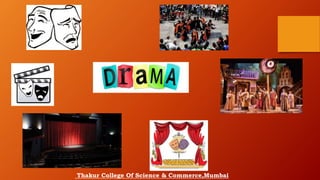
• The two iconic masks of drama, the laughing face and the crying
face, they are the symbols of ancient Greek muses, Thalia – the
muse of comedy and Melpomene – The muse of tragedy.
• Playwriters like, Aeschylus, Aristophanes, Euripides, Sophocles
have contributed their work in the history of Drama.
• Aristotle is known as the father of modern Greek drama.
Thakur College Of Science & Commerce,Mumbai
Greek Drama
• Ancient Greek took their entertainment very seriously, used drama as a way to
investigate the world they lived in and what it meant to be human.
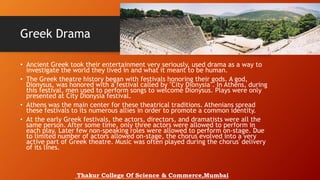
• The Greek theatre history began with festivals honoring their gods. A god,
Dionysus, was honored with a festival called by "City Dionysia". In Athens, during
this festival, men used to perform songs to welcome Dionysus. Plays were only
presented at City Dionysia festival.
• Athens was the main center for these theatrical traditions. Athenians spread
these festivals to its numerous allies in order to promote a common identity.
• At the early Greek festivals, the actors, directors, and dramatists were all the
same person. After some time, only three actors were allowed to perform in
each play. Later few non-speaking roles were allowed to perform on-stage. Due
to limited number of actors allowed on-stage, the chorus evolved into a very
active part of Greek theatre. Music was often played during the chorus' delivery
of its lines.
Thakur College Of Science & Commerce,Mumbai
Aristotle and Greek Drama
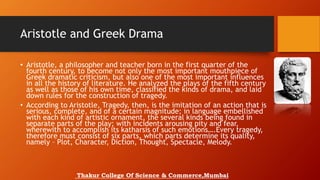
• Aristotle, a philosopher and teacher born in the first quarter of the
fourth century, to become not only the most important mouthpiece of
Greek dramatic criticism, but also one of the most important influences
in all the history of literature. He analyzed the plays of the fifth century
as well as those of his own time, classified the kinds of drama, and laid
down rules for the construction of tragedy.
• According to Aristotle, Tragedy, then, is the imitation of an action that is
serious, complete, and of a certain magnitude; in language embellished
with each kind of artistic ornament, the several kinds being found in
separate parts of the play; with incidents arousing pity and fear,
wherewith to accomplish its katharsis of such emotions….Every tragedy,
therefore must consist of six parts, which parts determine its quality,
namely – Plot, Character, Diction, Thought, Spectacle, Melody.
Thakur College Of Science & Commerce,Mumbai
Elements of Drama
• Plot
• Character
• Lighting
• Diction
• Thought
• Spectacle
• Melody
Thakur College Of Science & Commerce,Mumbai
Plot
• Refers to the action, basic storyline of the play.
Initial
Incident
Preliminary
events
Rising action Climax
Falling
actionDenouncement
Thakur College Of Science & Commerce,Mumbai
Character
• The people, sometimes animals and ideas portrayed by the actors
in the play. It is the characters who move the plot or the action.
Characterization is the way an author presents a character.
• These are the elements added to define a character.
Costume Make up Dialogue Diction
Thakur College Of Science & Commerce,Mumbai
Lighting
• Theatre stage lighting is designed to make the stage performance
visible to the audience, but the method used to light the stage
will impact on the way the stage picture is perceived and should
reinforce the overall dramatic impact of the production.
Thakur College Of Science & Commerce,Mumbai
Diction
• The word choices made by an author and the enunciation of the
actors delivering the line, is the diction.
• Diction also tells us the origin of the drama, hence enhancing the
quality of the drama by making it relatable or representative.
Phrasing
expressionLingo
Thakur College Of Science & Commerce,Mumbai
Thought
• What the audience learn from the play.
• The moral/story the audience takes back.
Moral or the
message
Thakur College Of Science & Commerce,Mumbai
Spectacle
• All the visual elements in the play, everything that the audience
sees; sets, costumes, lights, etc.
The vision
Thakur College Of Science & Commerce,Mumbai
Melody
• While music is often featured in drama, in this case Aristotle was
referring to the rhythm of the actor’s voice as they speak.
Thakur College Of Science & Commerce,Mumbai
Forms of Drama
• The main two forms of drama: Tragedy and Comedy.
• Tragedy, comedy, and satyr plays were the theatrical forms.
• Tragedy and comedy were viewed as completely separate genres.
Satyr plays dealt with the mythological subject in comic manner.
• Tragedy : Where violent action leads to misfortune for the main
character.
• Comedy : Comedy plays were derived from imitation. The main
motive was to represent humor.
Thakur College Of Science & Commerce,Mumbai
• Apart from Tragedy and Comedy, there are other forms of drama:
Tragic comedy and Melodrama.
• Tragicomedy is a literary genre that blends aspects of
both tragic and comic forms. Most often seen in dramatic
literature, the term can describe either a tragic play which
contains enough comic elements to lighten the overall mood or a
serious play with a happy ending.
• Melodrama deal with sensational and romantic topics that appeal
to the emotions of the common audience.
Tragicomedy
Melodrama
Thakur College Of Science & Commerce,Mumbai
Types of Drama
• These are three main types of Dramas :
Theatre/stage
Drama
Stage Drama
Television Drama
Thakur College Of Science & Commerce,Mumbai
Theatre Drama
• Theatre or theater is a collaborative form of performing art that
uses live performers, typically actors or actresses, to present the
experience of a real or imagined event before a live audience in a
specific place, often a stage. The performers may communicate
this experience to the audience through combinations of gesture,
speech, song, music, and dance.
• Some famous theatre dramas are: Hamlet by William Shakespeare,
Shakuntala by Kalidas.
Thakur College Of Science & Commerce,Mumbai
Street Drama
• Street theatre is a form of theatrical performance and presentation in
outdoor public spaces without a specific paying audience. These spaces
can be anywhere, including shopping centers, car parks, recreational
reserves, college or university campus and street corners. They are
especially seen in outdoor spaces where there are large numbers of
people. The actors who perform street theatre range from buskers to
organized theatre companies or groups that want to experiment with
performance spaces, or to promote their mainstream work. It was a
source of providing information to people when there were no sources of
providing information like television, radio etc. Nowadays, street play is
used to convey a message to the crowd watching it. Street play is
considered to be the rawest form of acting, because one does not have a
microphone or loud speakers
Thakur College Of Science & Commerce,Mumbai
Television Drama
• In films and television, drama is
a genre of narrative fiction (or semi-fiction) intended to be more
serious than humorous in tone. Drama of this kind is usually
qualified with additional terms that specify its particular
subgenre, such as "police crime drama", "political drama", "legal
drama", "historical drama", "domestic drama", "teen drama" or
"comedy-drama". These terms tend to indicate a
particular setting or subject-matter, or else they qualify the
otherwise serious tone of a drama with elements that encourage a
broader range of moods
Thakur College Of Science & Commerce,Mumbai
Indian Drama
• The earliest form of classical theatre of India was the Sanskrit
theatre which came into existence after the development
of Greek and Roman theatres in the west. One theory describes
this development as an offshoot of Alexander the Great's Indian
conquest. The invading army staged Greek-style plays and Indians
picked up the performance art. While some scholars argue that
traditional Indian theatre predated it, there is a recognition that
classical Greek theatre has helped transformed it.
• Indian Drama has its main origin from Natyashastra. Natyashastra
is the source to all the art forms.
Thakur College Of Science & Commerce,Mumbai
Stages of Production in Drama
• The production process for street play, theatre drama and
television drama differs in all the three stages: Pre production,
production and post production.
Pre
production
Production
Post
production
Thakur College Of Science & Commerce,Mumbai
Street Drama and Theatre
Drama
Pre production – Development;
Selecting or Preparing a script,
casting, rehearsals, arranging
props. Marketing.
Production – opening night and
the performance.
Post production – This stage has
bare minimum – collecting props!
Television Drama
Pre-production-
Developing/Selecting the script,
casting
Production – Shooting
Post Production – Editing,
marketing.
Thakur College Of Science & Commerce,Mumbai
Characterisation in Drama
• The act of changing voice, body language, movement, gesture etc when in role
is called characterization.
• All people are different. The actor must use their skills to portray a character
consistently throughout their performance. When creating characters you need
to consider the following:
• Voice: Does your character have an accent? What is the tone of their voice like?
How quickly do they speak? Do they have any vocal mannerisms that are
particular to them?
• Body language: This is what your character’s movements and way of using their
body says about them. A character who is very nervous and stressed may fidget
a lot or have their shoulders hunched up tight to indicate tension.
• Facial expression: Does your character move their face a lot? What does their
facial expression say about their character? Do they have a very expressive face
or do they try not to give much of themselves away?
Thakur College Of Science & Commerce,Mumbai

DRAMA PRODUCTION

  • 1.
    Drama production Notes By: Ashish Richhariya Course : FTNMP / BMM Designation : Faculty at Thakur College Of Science & Commerce Query : arichhariya30@gmail.com Thakur College Of Science & Commerce,Mumbai PPT BY : Mahek Joshi
  • 2.
    Thakur College OfScience & Commerce,Mumbai
  • 3.
    What is Drama? •Drama is the mode of portraying fictional or non fictional events through the performance of written dialogue: poetry or prose. • Drama can be performed on stage, films or radio. • Dramas are typically called plays, and their creators are called playwriters or dramatists. • Drama originates from δρᾶμα - drâma, a Greek word that means to act or take action. Thakur College Of Science & Commerce,Mumbai
  • 4.
    Brief History ofDrama • 335 BC, drama has been performed since then. • The two iconic masks of drama, the laughing face and the crying face, they are the symbols of ancient Greek muses, Thalia – the muse of comedy and Melpomene – The muse of tragedy. • Playwriters like, Aeschylus, Aristophanes, Euripides, Sophocles have contributed their work in the history of Drama. • Aristotle is known as the father of modern Greek drama. Thakur College Of Science & Commerce,Mumbai
  • 5.
    Greek Drama • AncientGreek took their entertainment very seriously, used drama as a way to investigate the world they lived in and what it meant to be human. • The Greek theatre history began with festivals honoring their gods. A god, Dionysus, was honored with a festival called by "City Dionysia". In Athens, during this festival, men used to perform songs to welcome Dionysus. Plays were only presented at City Dionysia festival. • Athens was the main center for these theatrical traditions. Athenians spread these festivals to its numerous allies in order to promote a common identity. • At the early Greek festivals, the actors, directors, and dramatists were all the same person. After some time, only three actors were allowed to perform in each play. Later few non-speaking roles were allowed to perform on-stage. Due to limited number of actors allowed on-stage, the chorus evolved into a very active part of Greek theatre. Music was often played during the chorus' delivery of its lines. Thakur College Of Science & Commerce,Mumbai
  • 6.
    Aristotle and GreekDrama • Aristotle, a philosopher and teacher born in the first quarter of the fourth century, to become not only the most important mouthpiece of Greek dramatic criticism, but also one of the most important influences in all the history of literature. He analyzed the plays of the fifth century as well as those of his own time, classified the kinds of drama, and laid down rules for the construction of tragedy. • According to Aristotle, Tragedy, then, is the imitation of an action that is serious, complete, and of a certain magnitude; in language embellished with each kind of artistic ornament, the several kinds being found in separate parts of the play; with incidents arousing pity and fear, wherewith to accomplish its katharsis of such emotions….Every tragedy, therefore must consist of six parts, which parts determine its quality, namely – Plot, Character, Diction, Thought, Spectacle, Melody. Thakur College Of Science & Commerce,Mumbai
  • 7.
    Elements of Drama •Plot • Character • Lighting • Diction • Thought • Spectacle • Melody Thakur College Of Science & Commerce,Mumbai
  • 8.
    Plot • Refers tothe action, basic storyline of the play. Initial Incident Preliminary events Rising action Climax Falling actionDenouncement Thakur College Of Science & Commerce,Mumbai
  • 9.
    Character • The people,sometimes animals and ideas portrayed by the actors in the play. It is the characters who move the plot or the action. Characterization is the way an author presents a character. • These are the elements added to define a character. Costume Make up Dialogue Diction Thakur College Of Science & Commerce,Mumbai
  • 10.
    Lighting • Theatre stagelighting is designed to make the stage performance visible to the audience, but the method used to light the stage will impact on the way the stage picture is perceived and should reinforce the overall dramatic impact of the production. Thakur College Of Science & Commerce,Mumbai
  • 11.
    Diction • The wordchoices made by an author and the enunciation of the actors delivering the line, is the diction. • Diction also tells us the origin of the drama, hence enhancing the quality of the drama by making it relatable or representative. Phrasing expressionLingo Thakur College Of Science & Commerce,Mumbai
  • 12.
    Thought • What theaudience learn from the play. • The moral/story the audience takes back. Moral or the message Thakur College Of Science & Commerce,Mumbai
  • 13.
    Spectacle • All thevisual elements in the play, everything that the audience sees; sets, costumes, lights, etc. The vision Thakur College Of Science & Commerce,Mumbai
  • 14.
    Melody • While musicis often featured in drama, in this case Aristotle was referring to the rhythm of the actor’s voice as they speak. Thakur College Of Science & Commerce,Mumbai
  • 15.
    Forms of Drama •The main two forms of drama: Tragedy and Comedy. • Tragedy, comedy, and satyr plays were the theatrical forms. • Tragedy and comedy were viewed as completely separate genres. Satyr plays dealt with the mythological subject in comic manner. • Tragedy : Where violent action leads to misfortune for the main character. • Comedy : Comedy plays were derived from imitation. The main motive was to represent humor. Thakur College Of Science & Commerce,Mumbai
  • 16.
    • Apart fromTragedy and Comedy, there are other forms of drama: Tragic comedy and Melodrama. • Tragicomedy is a literary genre that blends aspects of both tragic and comic forms. Most often seen in dramatic literature, the term can describe either a tragic play which contains enough comic elements to lighten the overall mood or a serious play with a happy ending. • Melodrama deal with sensational and romantic topics that appeal to the emotions of the common audience. Tragicomedy Melodrama Thakur College Of Science & Commerce,Mumbai
  • 17.
    Types of Drama •These are three main types of Dramas : Theatre/stage Drama Stage Drama Television Drama Thakur College Of Science & Commerce,Mumbai
  • 18.
    Theatre Drama • Theatreor theater is a collaborative form of performing art that uses live performers, typically actors or actresses, to present the experience of a real or imagined event before a live audience in a specific place, often a stage. The performers may communicate this experience to the audience through combinations of gesture, speech, song, music, and dance. • Some famous theatre dramas are: Hamlet by William Shakespeare, Shakuntala by Kalidas. Thakur College Of Science & Commerce,Mumbai
  • 19.
    Street Drama • Streettheatre is a form of theatrical performance and presentation in outdoor public spaces without a specific paying audience. These spaces can be anywhere, including shopping centers, car parks, recreational reserves, college or university campus and street corners. They are especially seen in outdoor spaces where there are large numbers of people. The actors who perform street theatre range from buskers to organized theatre companies or groups that want to experiment with performance spaces, or to promote their mainstream work. It was a source of providing information to people when there were no sources of providing information like television, radio etc. Nowadays, street play is used to convey a message to the crowd watching it. Street play is considered to be the rawest form of acting, because one does not have a microphone or loud speakers Thakur College Of Science & Commerce,Mumbai
  • 20.
    Television Drama • Infilms and television, drama is a genre of narrative fiction (or semi-fiction) intended to be more serious than humorous in tone. Drama of this kind is usually qualified with additional terms that specify its particular subgenre, such as "police crime drama", "political drama", "legal drama", "historical drama", "domestic drama", "teen drama" or "comedy-drama". These terms tend to indicate a particular setting or subject-matter, or else they qualify the otherwise serious tone of a drama with elements that encourage a broader range of moods Thakur College Of Science & Commerce,Mumbai
  • 21.
    Indian Drama • Theearliest form of classical theatre of India was the Sanskrit theatre which came into existence after the development of Greek and Roman theatres in the west. One theory describes this development as an offshoot of Alexander the Great's Indian conquest. The invading army staged Greek-style plays and Indians picked up the performance art. While some scholars argue that traditional Indian theatre predated it, there is a recognition that classical Greek theatre has helped transformed it. • Indian Drama has its main origin from Natyashastra. Natyashastra is the source to all the art forms. Thakur College Of Science & Commerce,Mumbai
  • 22.
    Stages of Productionin Drama • The production process for street play, theatre drama and television drama differs in all the three stages: Pre production, production and post production. Pre production Production Post production Thakur College Of Science & Commerce,Mumbai
  • 23.
    Street Drama andTheatre Drama Pre production – Development; Selecting or Preparing a script, casting, rehearsals, arranging props. Marketing. Production – opening night and the performance. Post production – This stage has bare minimum – collecting props! Television Drama Pre-production- Developing/Selecting the script, casting Production – Shooting Post Production – Editing, marketing. Thakur College Of Science & Commerce,Mumbai
  • 24.
    Characterisation in Drama •The act of changing voice, body language, movement, gesture etc when in role is called characterization. • All people are different. The actor must use their skills to portray a character consistently throughout their performance. When creating characters you need to consider the following: • Voice: Does your character have an accent? What is the tone of their voice like? How quickly do they speak? Do they have any vocal mannerisms that are particular to them? • Body language: This is what your character’s movements and way of using their body says about them. A character who is very nervous and stressed may fidget a lot or have their shoulders hunched up tight to indicate tension. • Facial expression: Does your character move their face a lot? What does their facial expression say about their character? Do they have a very expressive face or do they try not to give much of themselves away? Thakur College Of Science & Commerce,Mumbai