Learning Objectives
• Explain the differences between “acting” in everyday life
and acting in a performance.
• Identify the key differences between presentational and
representational acting, and discuss how each appears in
different times and cultures.
• Describe the typical journey actors undertake in their
training and preparation.
• Discuss the similarities and differences between acting for
the stage and acting for the camera.
Chapter 9: Actors
• Although everyone “acts,” acting for the stage involves more than mere
imitation; it requires interpretation, an awareness of being watched,
“stage presence,” and control.
• How one defines acting can depend on the context.
• Acting can be divided into two types—presentational (common in classical
traditions) and representational (more recent)—or can be a combination
of the two.
• Stanislavsky's acting techniques, involving such concepts as objectives and
emotional memory, have become the most commonly utilized for
representational acting.
• Alternatives to Stanislavsky's methods include poor theatre,
interculturalism, the Suzuki Method, and Viewpoints.
Key Concepts
• The actor's production process often begins with the
audition, moving through rehearsals, from blocking to
techs, to the actual performances.
• Acting for the stage is considerably different than acting for
the camera.
• Training is not necessary to become an actor, but is quite
essential for classical theatrical traditions.
• Although no two actors' experiences will be the same, an
actor's life is difficult and demanding.
Actors
• Mimesis: Imitation;
showing action
(Theatre/Acting)
Diegesis: Narration; the telling of action (This
American Life)
Competing Defintions
• Aristotle: Acting is the “imitation” (mimesis) of
action
– What the audience sees is “not happening” but
also “not-not happening”
• Today, there are two main “styles” of acting
– Presentational (external)
– Representation (internal)
Presentational Acting
• Presentational acting is the “presenting” of a
character, not the “representing” of a
character
• Actors “present” physical cues to the audience
as a means of characterization
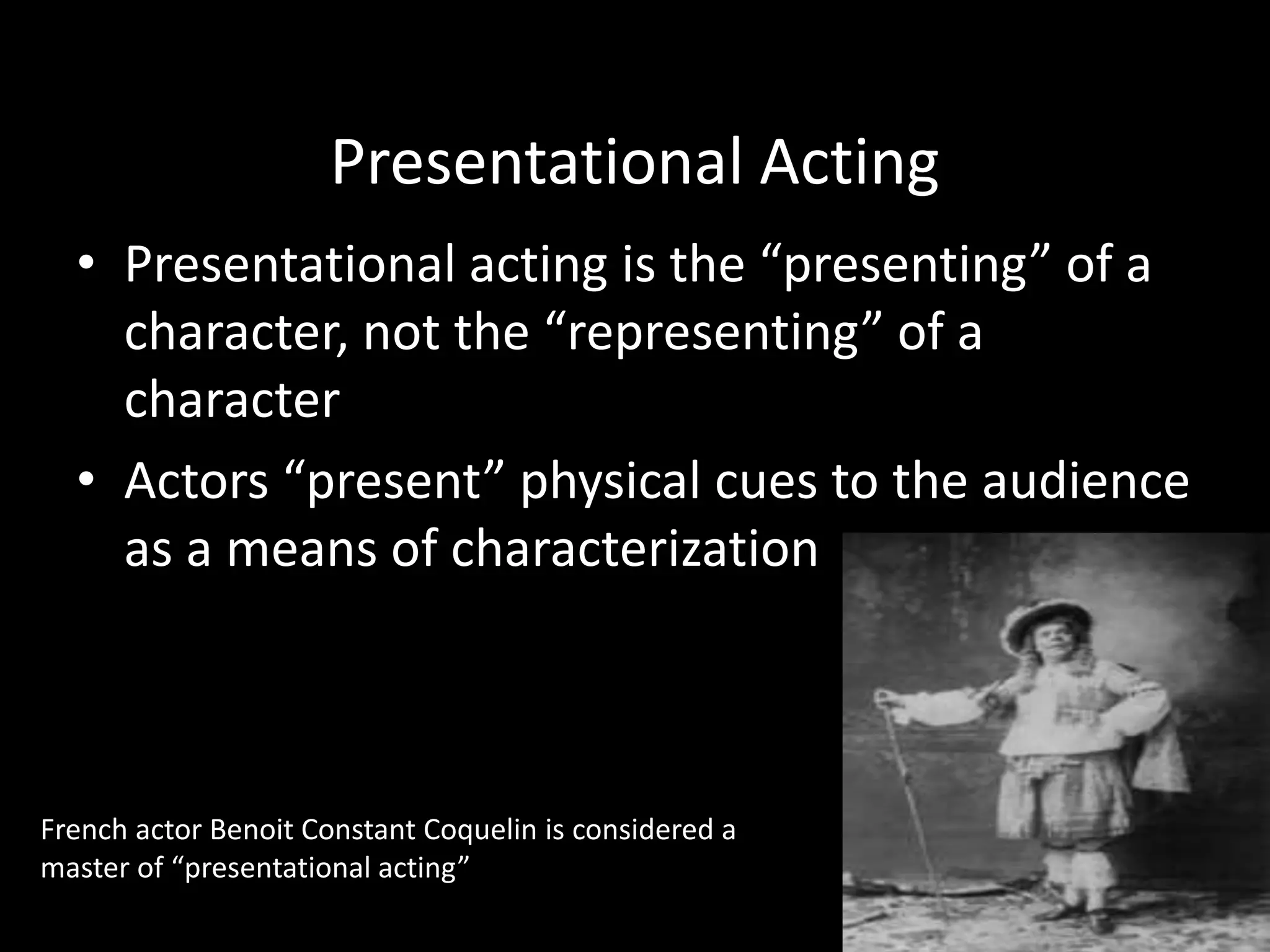
French actor Benoit Constant Coquelin is considered a
master of “presentational acting”
Presentational Acting
• Presentational acting…
– Acts from “the outside in”
– Was the primary style of performance from
ancient Greece until the mid-to-late 1700s
May 10th, 1849, a riot broke out in New york City
when two actors, British William Charles MacReady
(left) and Edwin Forrest were both playing
MacBeth. MacReady performed with a restrained,
representational style; Forrest played the part
loudly, athletically, and bombastically –
presentationally. Lots of people were super angry
about both.
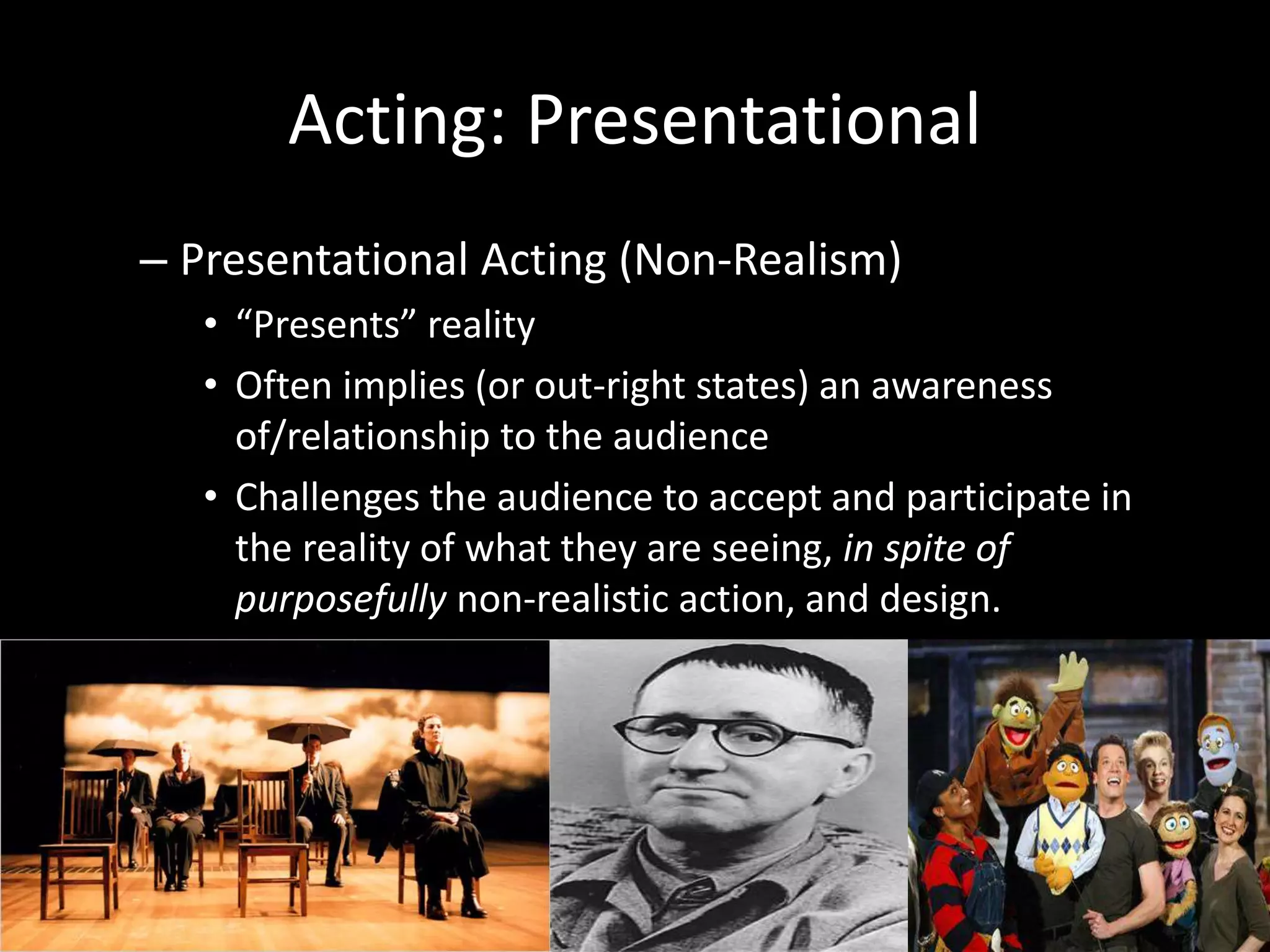
Acting: Presentational
– Presentational Acting (Non-Realism)
• “Presents” reality
• Often implies (or out-right states) an awareness
of/relationship to the audience
• Challenges the audience to accept and participate in
the reality of what they are seeing, in spite of
purposefully non-realistic action, and design.
Representational Acting
• As theatres shrunk, presentational acting
began to fall out of favor
• As theatre became more egalitarian, and
women began to have agency as actors,
presentational acting fell out of favor
Constantin Stanislavski is considered “the Father of Modern Acting”,
and revolutionized the theatre world when he created a method of
representational acting based on psychological truth.
Representational Acting
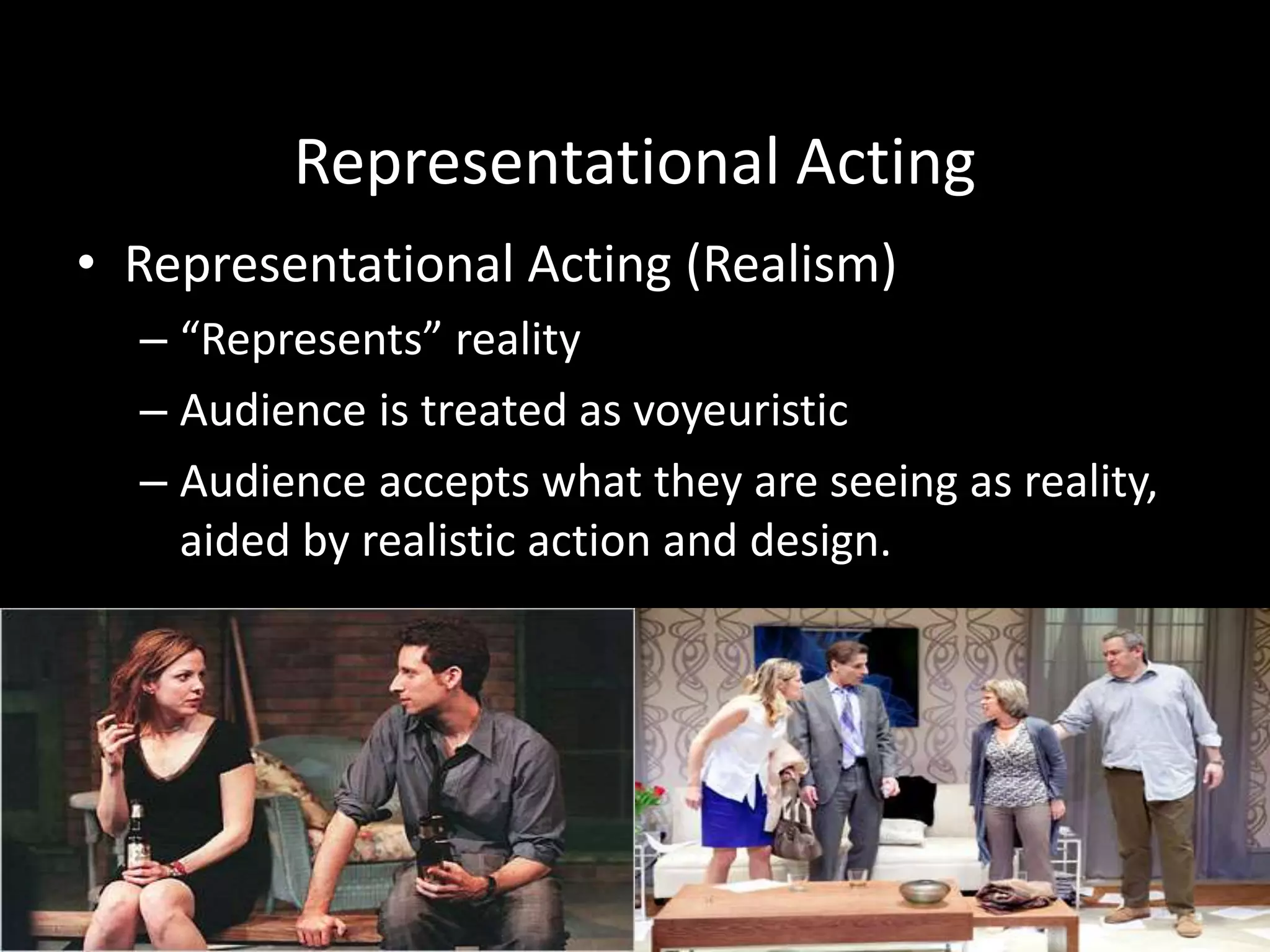
• Representational Acting (Realism)
– “Represents” reality
– Audience is treated as voyeuristic
– Audience accepts what they are seeing as reality,
aided by realistic action and design.
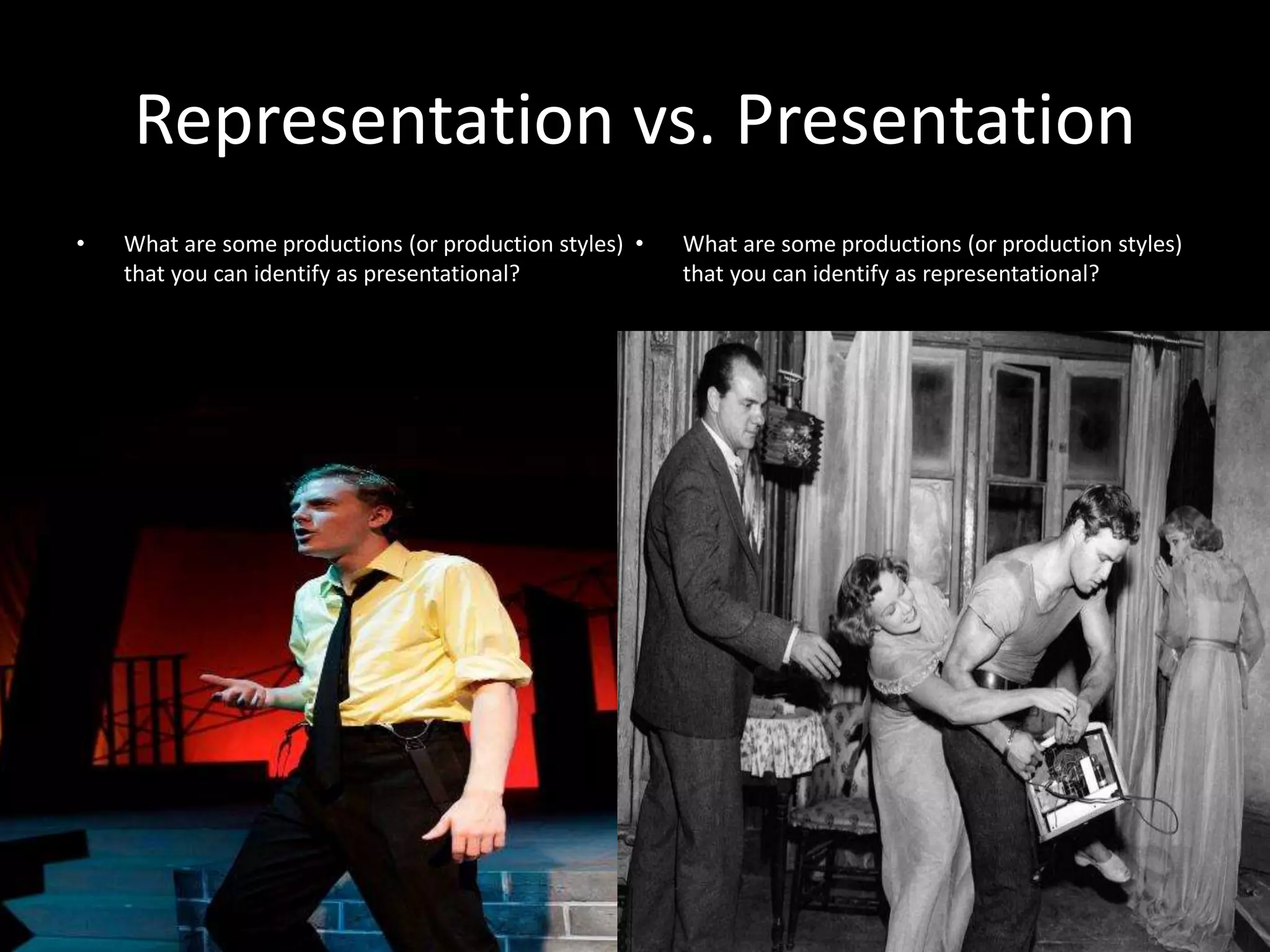
Representation vs. Presentation
• What are some productions (or production styles)
that you can identify as presentational?
• What are some productions (or production styles)
that you can identify as representational?
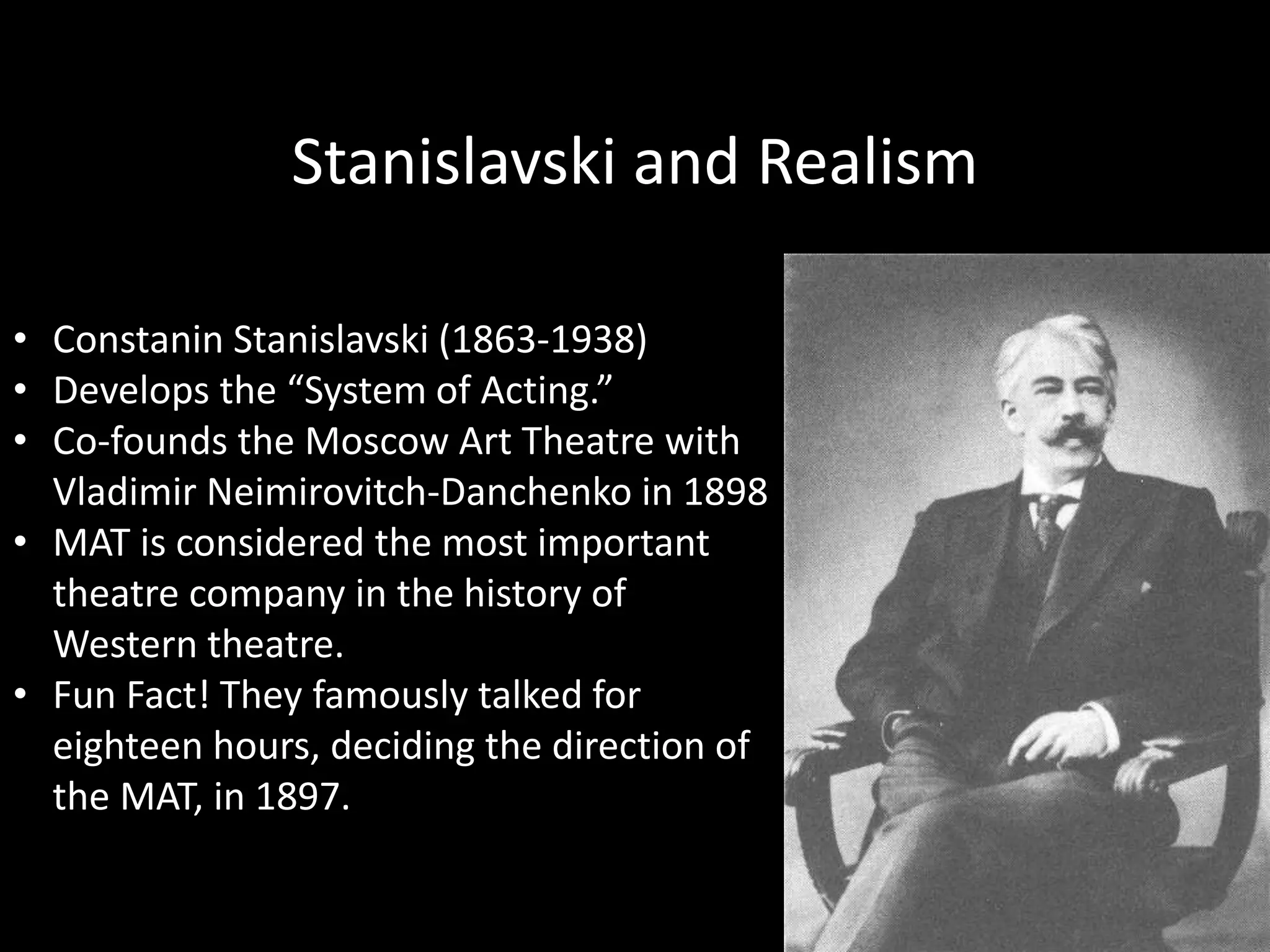
Stanislavski and Realism
• Constanin Stanislavski (1863-1938)
• Develops the “System of Acting.”
• Co-founds the Moscow Art Theatre with
Vladimir Neimirovitch-Danchenko in 1898
• MAT is considered the most important
theatre company in the history of
Western theatre.
• Fun Fact! They famously talked for
eighteen hours, deciding the direction of
the MAT, in 1897.
Stanislavski and Realism
• Life (Reality)
Stimulus Internal Feeling  External Expression (Action)
• Stage (Secondary Reality)
Stimulus External Expression (Action) Internal Feeling
Stanislavski and Realism
• Given Circumstances:
– The undeniably true facts provided by the playwright about…
– characters!
• Relationships
• status
• power
– settings!
• Time
• space
– Contexts…
• Physical
• Psychological
• Socioeconomical
Given Circumstances pressure, shape, affect, and influence your
actions.
Stanislavski and Realism
• Actions:
– 1) Specific and immediate
– 2) Transitive verbs in the infinitive form
– 3) Consistent with the given circumstances
– 4) Must compel action forward
– 5) Not emotions, conditions, or states of being
Stanislavski and Realism
• Objective (Simple/Super):
– “What are you fighting for?” – Uta Hagen
• The Magic If:
– “If I were this character, faced with these
circumstances, what would I do?”
• Obstacles:
– Anything that gets in the way of the character
achieving their objective.
Stanislavski and Realism
• Affective Memory:
– ability to recall the sensory detail from personal events in
order to achieve the physical recreation of an authentic
emotion
• Psychophysical Union:
– The mind and body are linked in a reciprocal relationship
– Relaxed mind, relaxed body and vice versa
– Psychophysical union: “the truth is that [the mind and body]
are inseparable: without the material of the living body,
there is no mind, and without feeling, these is no true
reason.” (Blair)
Non-Realistic Acting Styles
• The Method
– Grows out of Stanislavski’s 1922 visit to America
– Places enormous emphasis on “truthful”
emotions, opposed to action
– Taught by Uta Hagen, Stella Adler, Lee Strasberg,
Sanford Mesiner
– Most Hollywood actors have training in this style,
and it’s used very successfully in film
Non-Realistic Acting Styles
• Poor Theatre
– Jerzy Grotowski believed the theatre couldn’t and
shouldn’t compete with other forms or styles of
entertainment
– Uses only the body in space
– Very few sets, props
– Black clothing only
– Extremely athletic
Non-Realistic Acting Styles
• Intercultural
– Actors freely borrow styles and approaches from
other forms of theatre
– Creates a kind of cultural mixtape performance
– Used often by Peter Brook
Throne of Blood – the Samurai MacBeth play.
Non-Realistic Acting Styles
• Theatre of the Oppressed
• Everyone has a
“monologue” – a story, a
voice, a point of view
• Nobody’s “monologue” is
inherently more or less
important than someone
else
• When a person is unable to
voice their “monologue” –
that is oppression
The Actors’ Process
• Auditions!
– An awesome three minute headache!
– The least fair job interview you’ll ever go on!
– Two contrasting monologues, or one monologue
one song
– It’s about the performance of YOU.
The Actors’ Process
• Callbacks
– Directed readings from the play being performed
– Typically read with a variety of different actors
– Director is watching for your ability to take and
implement notes
– Perfectly legal to discriminate based on…
• Gender
• Race
• Size
• Physical Appearance
The Actors’ Process
• Rehearsals:
– Professional rehearsal schedules are typically 40-
50 hours per week, and last 2-3 weeks.
– University rehearsal schedules are typically 15-20
hours per week, and last 6-8 weeks.
The Actors’ Process
• Rehearsals:
– Rule of thumb: rehearse one hour for every
minute of the show (90 min play= 90 hours of
rehearsal)
– 10,000 hours of continuous training to become an
expert. (Gladwell)
The Actors’ Process
• Performances:
– Full-time Equity performance schedule:
• 8 shows per week
• 2 performances each Saturday and Sunday.
– University theatre productions:
• 1-2 weekends
• double show days are relatively rare.
The Actors’ Process
• Just like with directing and designing, an actor
must…
– Read and analyze the script
• Identify actions within the script
– Analyze the given circumstance
– Ask the “Magic If”
– Find a connection between him/herself and the
character
– Memorize and interpret lines and blocking
– Bring the “illusion of the first time” to the stage for
every performance

Acting

  • 1.
    Learning Objectives • Explainthe differences between “acting” in everyday life and acting in a performance. • Identify the key differences between presentational and representational acting, and discuss how each appears in different times and cultures. • Describe the typical journey actors undertake in their training and preparation. • Discuss the similarities and differences between acting for the stage and acting for the camera.
  • 2.
    Chapter 9: Actors •Although everyone “acts,” acting for the stage involves more than mere imitation; it requires interpretation, an awareness of being watched, “stage presence,” and control. • How one defines acting can depend on the context. • Acting can be divided into two types—presentational (common in classical traditions) and representational (more recent)—or can be a combination of the two. • Stanislavsky's acting techniques, involving such concepts as objectives and emotional memory, have become the most commonly utilized for representational acting. • Alternatives to Stanislavsky's methods include poor theatre, interculturalism, the Suzuki Method, and Viewpoints.
  • 3.
    Key Concepts • Theactor's production process often begins with the audition, moving through rehearsals, from blocking to techs, to the actual performances. • Acting for the stage is considerably different than acting for the camera. • Training is not necessary to become an actor, but is quite essential for classical theatrical traditions. • Although no two actors' experiences will be the same, an actor's life is difficult and demanding.
  • 5.
    Actors • Mimesis: Imitation; showingaction (Theatre/Acting) Diegesis: Narration; the telling of action (This American Life)
  • 6.
    Competing Defintions • Aristotle:Acting is the “imitation” (mimesis) of action – What the audience sees is “not happening” but also “not-not happening” • Today, there are two main “styles” of acting – Presentational (external) – Representation (internal)
  • 7.
    Presentational Acting • Presentationalacting is the “presenting” of a character, not the “representing” of a character • Actors “present” physical cues to the audience as a means of characterization French actor Benoit Constant Coquelin is considered a master of “presentational acting”
  • 8.
    Presentational Acting • Presentationalacting… – Acts from “the outside in” – Was the primary style of performance from ancient Greece until the mid-to-late 1700s May 10th, 1849, a riot broke out in New york City when two actors, British William Charles MacReady (left) and Edwin Forrest were both playing MacBeth. MacReady performed with a restrained, representational style; Forrest played the part loudly, athletically, and bombastically – presentationally. Lots of people were super angry about both.
  • 9.
    Acting: Presentational – PresentationalActing (Non-Realism) • “Presents” reality • Often implies (or out-right states) an awareness of/relationship to the audience • Challenges the audience to accept and participate in the reality of what they are seeing, in spite of purposefully non-realistic action, and design.
  • 10.
    Representational Acting • Astheatres shrunk, presentational acting began to fall out of favor • As theatre became more egalitarian, and women began to have agency as actors, presentational acting fell out of favor Constantin Stanislavski is considered “the Father of Modern Acting”, and revolutionized the theatre world when he created a method of representational acting based on psychological truth.
  • 11.
    Representational Acting • RepresentationalActing (Realism) – “Represents” reality – Audience is treated as voyeuristic – Audience accepts what they are seeing as reality, aided by realistic action and design.
  • 12.
    Representation vs. Presentation •What are some productions (or production styles) that you can identify as presentational? • What are some productions (or production styles) that you can identify as representational?
  • 13.
    Stanislavski and Realism •Constanin Stanislavski (1863-1938) • Develops the “System of Acting.” • Co-founds the Moscow Art Theatre with Vladimir Neimirovitch-Danchenko in 1898 • MAT is considered the most important theatre company in the history of Western theatre. • Fun Fact! They famously talked for eighteen hours, deciding the direction of the MAT, in 1897.
  • 14.
    Stanislavski and Realism •Life (Reality) Stimulus Internal Feeling  External Expression (Action) • Stage (Secondary Reality) Stimulus External Expression (Action) Internal Feeling
  • 15.
    Stanislavski and Realism •Given Circumstances: – The undeniably true facts provided by the playwright about… – characters! • Relationships • status • power – settings! • Time • space – Contexts… • Physical • Psychological • Socioeconomical Given Circumstances pressure, shape, affect, and influence your actions.
  • 16.
    Stanislavski and Realism •Actions: – 1) Specific and immediate – 2) Transitive verbs in the infinitive form – 3) Consistent with the given circumstances – 4) Must compel action forward – 5) Not emotions, conditions, or states of being
  • 17.
    Stanislavski and Realism •Objective (Simple/Super): – “What are you fighting for?” – Uta Hagen • The Magic If: – “If I were this character, faced with these circumstances, what would I do?” • Obstacles: – Anything that gets in the way of the character achieving their objective.
  • 18.
    Stanislavski and Realism •Affective Memory: – ability to recall the sensory detail from personal events in order to achieve the physical recreation of an authentic emotion • Psychophysical Union: – The mind and body are linked in a reciprocal relationship – Relaxed mind, relaxed body and vice versa – Psychophysical union: “the truth is that [the mind and body] are inseparable: without the material of the living body, there is no mind, and without feeling, these is no true reason.” (Blair)
  • 19.
    Non-Realistic Acting Styles •The Method – Grows out of Stanislavski’s 1922 visit to America – Places enormous emphasis on “truthful” emotions, opposed to action – Taught by Uta Hagen, Stella Adler, Lee Strasberg, Sanford Mesiner – Most Hollywood actors have training in this style, and it’s used very successfully in film
  • 20.
    Non-Realistic Acting Styles •Poor Theatre – Jerzy Grotowski believed the theatre couldn’t and shouldn’t compete with other forms or styles of entertainment – Uses only the body in space – Very few sets, props – Black clothing only – Extremely athletic
  • 21.
    Non-Realistic Acting Styles •Intercultural – Actors freely borrow styles and approaches from other forms of theatre – Creates a kind of cultural mixtape performance – Used often by Peter Brook Throne of Blood – the Samurai MacBeth play.
  • 22.
    Non-Realistic Acting Styles •Theatre of the Oppressed • Everyone has a “monologue” – a story, a voice, a point of view • Nobody’s “monologue” is inherently more or less important than someone else • When a person is unable to voice their “monologue” – that is oppression
  • 23.
    The Actors’ Process •Auditions! – An awesome three minute headache! – The least fair job interview you’ll ever go on! – Two contrasting monologues, or one monologue one song – It’s about the performance of YOU.
  • 24.
    The Actors’ Process •Callbacks – Directed readings from the play being performed – Typically read with a variety of different actors – Director is watching for your ability to take and implement notes – Perfectly legal to discriminate based on… • Gender • Race • Size • Physical Appearance
  • 25.
    The Actors’ Process •Rehearsals: – Professional rehearsal schedules are typically 40- 50 hours per week, and last 2-3 weeks. – University rehearsal schedules are typically 15-20 hours per week, and last 6-8 weeks.
  • 26.
    The Actors’ Process •Rehearsals: – Rule of thumb: rehearse one hour for every minute of the show (90 min play= 90 hours of rehearsal) – 10,000 hours of continuous training to become an expert. (Gladwell)
  • 27.
    The Actors’ Process •Performances: – Full-time Equity performance schedule: • 8 shows per week • 2 performances each Saturday and Sunday. – University theatre productions: • 1-2 weekends • double show days are relatively rare.
  • 28.
    The Actors’ Process •Just like with directing and designing, an actor must… – Read and analyze the script • Identify actions within the script – Analyze the given circumstance – Ask the “Magic If” – Find a connection between him/herself and the character – Memorize and interpret lines and blocking – Bring the “illusion of the first time” to the stage for every performance