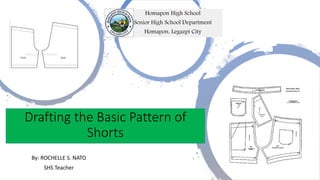
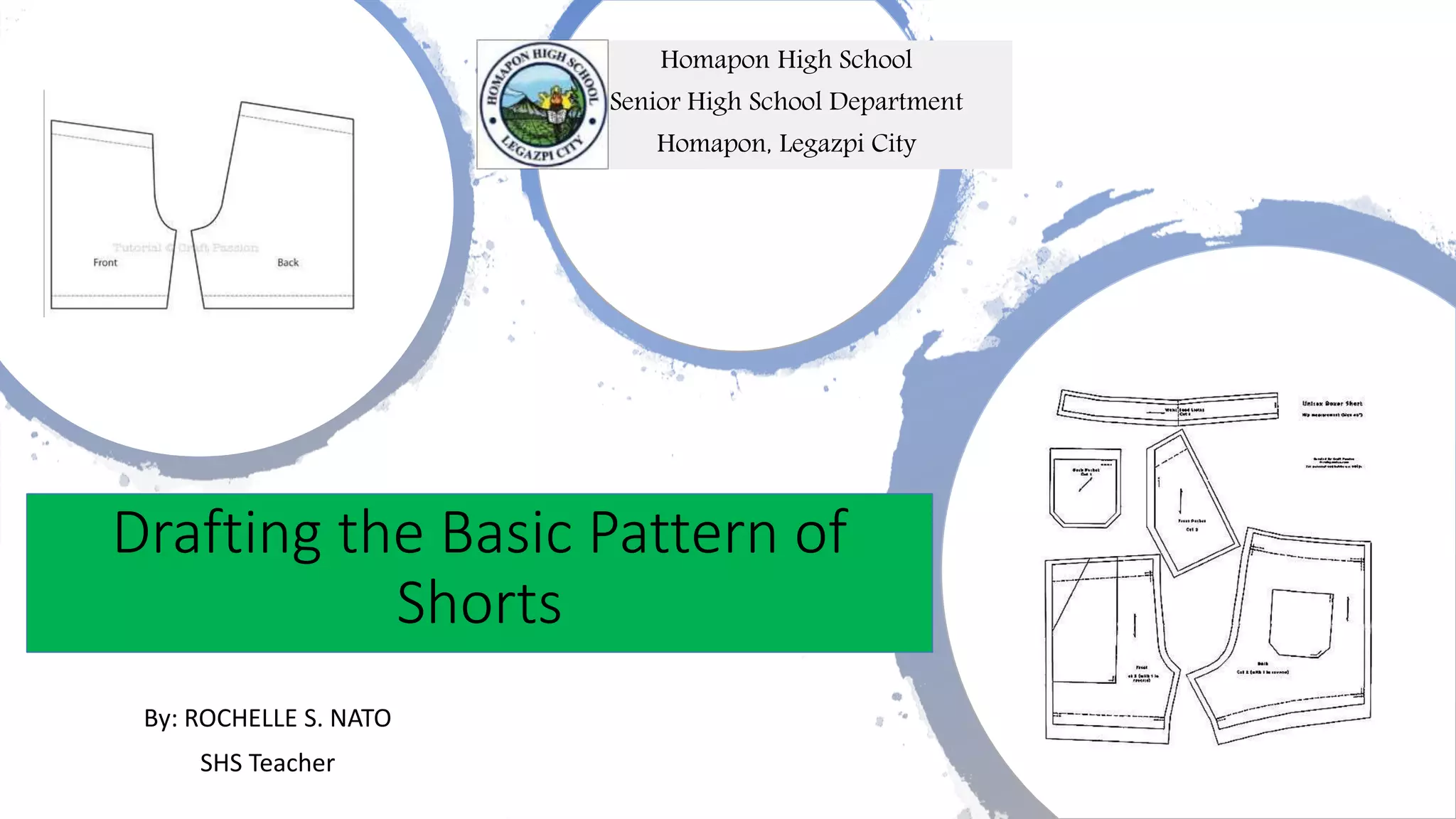
Drafting the Basic Pattern of
Shorts
By: ROCHELLE S. NATO
SHS Teacher
Homapon High School
Senior High School Department
Homapon, Legazpi City
Learning Objectives
At the end of this lesson, you should be
able to do the following:
1. Enumerate the measurement,
needed and procedure to followed in
drafting the
a. Front part of the short pants,
b. back part of the short pants
2. Discuss and illustrate the steps in
assembling the short
3. Draft short pants.
PROCEDURE IN
DRAFTING THE
SHORT PANTS
Measurement Needed:
1. Crotch as is
2. Waistline divide by 4
3. Length as is
4. 1st Hip divide by 4
5. 2nd Hip divide by 4
6. Bottom width divide by 2
Materials
Needed
1. Manila Paper
2. Tape Measure
3. Pencil with eraser
4. Tailor’s Chalk
5. L-Square
6. Hip Curve
7. Scissors
Procedure
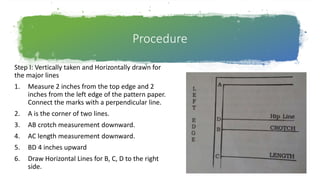
Step I: Vertically taken and Horizontally drawn for
the major lines
1. Measure 2 inches from the top edge and 2
inches from the left edge of the pattern paper.
Connect the marks with a perpendicular line.
2. A is the corner of two lines.
3. AB crotch measurement downward.
4. AC length measurement downward.
5. BD 4 inches upward
6. Draw Horizontal Lines for B, C, D to the right
side.
PROCEDURE
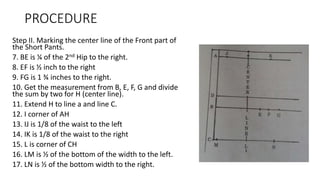
Step II. Marking the center line of the Front part of
the Short Pants.
7. BE is ¼ of the 2nd Hip to the right.
8. EF is ½ inch to the right
9. FG is 1 ¾ inches to the right.
10. Get the measurement from B, E, F, G and divide
the sum by two for H (center line).
11. Extend H to line a and line C.
12. I corner of AH
13. IJ is 1/8 of the waist to the left
14. IK is 1/8 of the waist to the right
15. L is corner of CH
16. LM is ½ of the bottom of the width to the left.
17. LN is ½ of the bottom width to the right.
PROCEDURE
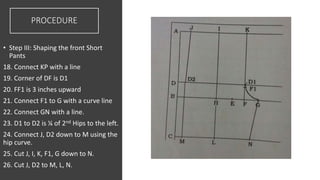
• Step III: Shaping the front Short
Pants
18. Connect KP with a line
19. Corner of DF is D1
20. FF1 is 3 inches upward
21. Connect F1 to G with a curve line
22. Connect GN with a line.
23. D1 to D2 is ¼ of 2nd Hips to the left.
24. Connect J, D2 down to M using the
hip curve.
25. Cut J, I, K, F1, G down to N.
26. Cut J, D2 to M, L, N.
DRAFTING THE BACK PART OF THE
SHORT PANTS
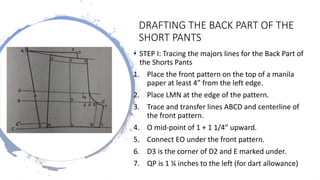
• STEP I: Tracing the majors lines for the Back Part of
the Shorts Pants
1. Place the front pattern on the top of a manila
paper at least 4” from the left edge.
2. Place LMN at the edge of the pattern.
3. Trace and transfer lines ABCD and centerline of
the front pattern.
4. O mid-point of 1 + 1 1/4” upward.
5. Connect EO under the front pattern.
6. D3 is the corner of D2 and E marked under.
7. QP is 1 ¼ inches to the left (for dart allowance)
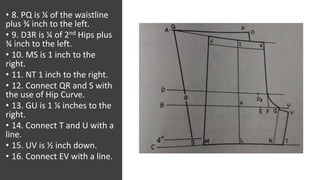
• 8. PQ is ¼ of the waistline
plus ¾ inch to the left.
• 9. D3R is ¼ of 2nd Hips plus
¾ inch to the left.
• 10. MS is 1 inch to the
right.
• 11. NT 1 inch to the right.
• 12. Connect QR and S with
the use of Hip Curve.
• 13. GU is 1 ¼ inches to the
right.
• 14. Connect T and U with a
line.
• 15. UV is ½ inch down.
• 16. Connect EV with a line.
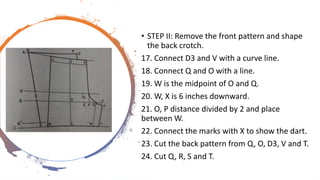
• STEP II: Remove the front pattern and shape
the back crotch.
17. Connect D3 and V with a curve line.
18. Connect Q and O with a line.
19. W is the midpoint of O and Q.
20. W, X is 6 inches downward.
21. O, P distance divided by 2 and place
between W.
22. Connect the marks with X to show the dart.
23. Cut the back pattern from Q, O, D3, V and T.
24. Cut Q, R, S and T.
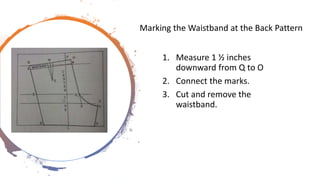
Marking the Waistband at the Back Pattern
1. Measure 1 ½ inches
downward from Q to O
2. Connect the marks.
3. Cut and remove the
waistband.
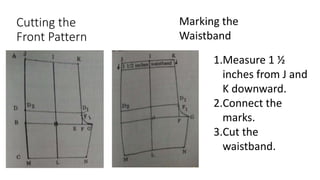
Cutting the
Front Pattern
Marking the
Waistband
1.Measure 1 ½
inches from J and
K downward.
2.Connect the
marks.
3.Cut the
waistband.
Let's do it!
•Draft pattern for
short pants.
Rubrics
Corresponding Points
A. Process (50%)
Follow the procedure properly
Completeness of the tools
Neatness
TOTAL
35
5
10
50
B. Product (30%)
Curved lines were smoothly drawn.
Perpendicular lines were projected perfectly.
Unnecessary marks were erased neatly.
Pattern were labeled clearly and properly.
Pattern was neatly drafted.
Total
6
6
6
6
6
30
C. Work Habits (20%)
Manipulated drafting tools properly.
Observed economy in the use of materials.
Maintained clean working area.
Worked on the target time.
Total
5
5
5
5
20
References
1. https://i.pinimg.com/originals/40/01/db/4001dbf21db428bea6db9
3076170393b.jpg
2. Clothing Technology Made Easy by: Carmelita B. Hilario page 192-
197

Drafting of basic pattern for shorts

  • 1.
    Drafting the BasicPattern of Shorts By: ROCHELLE S. NATO SHS Teacher Homapon High School Senior High School Department Homapon, Legazpi City
  • 2.
    Learning Objectives At theend of this lesson, you should be able to do the following: 1. Enumerate the measurement, needed and procedure to followed in drafting the a. Front part of the short pants, b. back part of the short pants 2. Discuss and illustrate the steps in assembling the short 3. Draft short pants.
  • 3.
    PROCEDURE IN DRAFTING THE SHORTPANTS Measurement Needed: 1. Crotch as is 2. Waistline divide by 4 3. Length as is 4. 1st Hip divide by 4 5. 2nd Hip divide by 4 6. Bottom width divide by 2
  • 4.
    Materials Needed 1. Manila Paper 2.Tape Measure 3. Pencil with eraser 4. Tailor’s Chalk 5. L-Square 6. Hip Curve 7. Scissors
  • 5.
    Procedure Step I: Verticallytaken and Horizontally drawn for the major lines 1. Measure 2 inches from the top edge and 2 inches from the left edge of the pattern paper. Connect the marks with a perpendicular line. 2. A is the corner of two lines. 3. AB crotch measurement downward. 4. AC length measurement downward. 5. BD 4 inches upward 6. Draw Horizontal Lines for B, C, D to the right side.
  • 6.
    PROCEDURE Step II. Markingthe center line of the Front part of the Short Pants. 7. BE is ¼ of the 2nd Hip to the right. 8. EF is ½ inch to the right 9. FG is 1 ¾ inches to the right. 10. Get the measurement from B, E, F, G and divide the sum by two for H (center line). 11. Extend H to line a and line C. 12. I corner of AH 13. IJ is 1/8 of the waist to the left 14. IK is 1/8 of the waist to the right 15. L is corner of CH 16. LM is ½ of the bottom of the width to the left. 17. LN is ½ of the bottom width to the right.
  • 7.
    PROCEDURE • Step III:Shaping the front Short Pants 18. Connect KP with a line 19. Corner of DF is D1 20. FF1 is 3 inches upward 21. Connect F1 to G with a curve line 22. Connect GN with a line. 23. D1 to D2 is ¼ of 2nd Hips to the left. 24. Connect J, D2 down to M using the hip curve. 25. Cut J, I, K, F1, G down to N. 26. Cut J, D2 to M, L, N.
  • 8.
    DRAFTING THE BACKPART OF THE SHORT PANTS • STEP I: Tracing the majors lines for the Back Part of the Shorts Pants 1. Place the front pattern on the top of a manila paper at least 4” from the left edge. 2. Place LMN at the edge of the pattern. 3. Trace and transfer lines ABCD and centerline of the front pattern. 4. O mid-point of 1 + 1 1/4” upward. 5. Connect EO under the front pattern. 6. D3 is the corner of D2 and E marked under. 7. QP is 1 ¼ inches to the left (for dart allowance)
  • 9.
    • 8. PQis ¼ of the waistline plus ¾ inch to the left. • 9. D3R is ¼ of 2nd Hips plus ¾ inch to the left. • 10. MS is 1 inch to the right. • 11. NT 1 inch to the right. • 12. Connect QR and S with the use of Hip Curve. • 13. GU is 1 ¼ inches to the right. • 14. Connect T and U with a line. • 15. UV is ½ inch down. • 16. Connect EV with a line.
  • 10.
    • STEP II:Remove the front pattern and shape the back crotch. 17. Connect D3 and V with a curve line. 18. Connect Q and O with a line. 19. W is the midpoint of O and Q. 20. W, X is 6 inches downward. 21. O, P distance divided by 2 and place between W. 22. Connect the marks with X to show the dart. 23. Cut the back pattern from Q, O, D3, V and T. 24. Cut Q, R, S and T.
  • 11.
    Marking the Waistbandat the Back Pattern 1. Measure 1 ½ inches downward from Q to O 2. Connect the marks. 3. Cut and remove the waistband.
  • 12.
    Cutting the Front Pattern Markingthe Waistband 1.Measure 1 ½ inches from J and K downward. 2.Connect the marks. 3.Cut the waistband.
  • 13.
    Let's do it! •Draftpattern for short pants. Rubrics Corresponding Points A. Process (50%) Follow the procedure properly Completeness of the tools Neatness TOTAL 35 5 10 50 B. Product (30%) Curved lines were smoothly drawn. Perpendicular lines were projected perfectly. Unnecessary marks were erased neatly. Pattern were labeled clearly and properly. Pattern was neatly drafted. Total 6 6 6 6 6 30 C. Work Habits (20%) Manipulated drafting tools properly. Observed economy in the use of materials. Maintained clean working area. Worked on the target time. Total 5 5 5 5 20
  • 14.