Drafting Pattern andCut Patterns for
Ladies Trousers
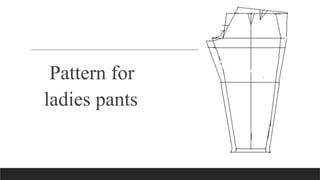
Pattern is a guide when cutting the fabric. It is a
simple pattern that fits the body with just enough ease
for freedom of movement.
This lesson provide us correct procedure in
drafting pattern for ladies trousers.
3.
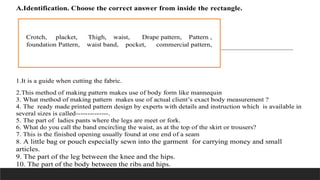
A.Identification. Choose thecorrect answer from inside the rectangle.
1.It is a guide when cutting the fabric.
2.This method of making pattern makes use of body form like mannequin
3. What method of making pattern makes use of actual client’s exact body measurement ?
4. The ready made printed pattern design by experts with details and instruction which is available in
several sizes is called--------------.
5. The part of ladies pants where the legs are meet or fork.
6. What do you call the band encircling the waist, as at the top of the skirt or trousers?
7. This is the finished opening usually found at one end of a seam
8. A little bag or pouch especially sewn into the garment for carrying money and small
articles.
9. The part of the leg between the knee and the hips.
10. The part of the body between the ribs and hips.
Crotch, placket, Thigh, waist, Drape pattern, Pattern ,
foundation Pattern, waist band, pocket, commercial pattern,
4.
B. Multiple choice.Write the letter of the correct answer in your notebook.
1. This type of facing where a piece of fabric that match the area to be faced in shape and
grain is attached or sewn.
a. Bias Facings c. Fitted facing
b. interfacing d. facing
2. A piece of fabric sewn to the garment edge, turned to the inside, and sewn in place by hand or
machine for the purpose of finishing the edge.
a . Bias Facings c. Fitted facing
b. interfacing d. facing
3. What do you call to a supporting fabric that is used to give shape of the body part and to
reinforce to particular areas of a garment, and is hidden between the fabric?
a . Bias Facings c. Fitted facing
b. interfacing d. facing
4. When cutting final pattern, how many centimeters should be allotted for allowance at all edges?
a. 1 cm c. 2.5 to 3 cm
b. I inch d. 1 ½ inch
5. Fabric for the trousers should -------------- to ensure that there will be no more shrinkage after it
has been cut and sewn.
a. preshrunk and pressed c. sun dried and hang
b. cut and sew d. pressed and cut
6.Lay outing and marking should be done in what side of the fabric?
a. front side b. back side
b. right side d. wrong side
7. When laying out pattern on the fabric, what part should be laid out first?
a. biggest c. smallest
b. most important d. most difficult
8.It is very important to make a--------------of an article to be made before the actual sewing.
a.Pattern c Copy
b.Picture d.Sample
9.You must first take the needed -------------of the different parts of the body in order
to make good fitting long pants.
a.pattern c.measurement
b.material d.allowance
10.This is an activity of arranging pattern pieces on the fabric.
a. putting c. arranging
b. lay outing d. cutting
11. The following are tools used in drafting pattern for long pants EXCEPT
a. pattern paper c. L-square
b. hip curve d. tape measure
12.Material use in making long pants.
a. pattern paper c. fabric
b. drafting tools d. cutting tools
6.
What I Needto Know
Patternmakingisanartofshaping the flatfabric toseveralcurvestoenhancebodyfigureof
thewearer.Itisalinkbetweendesignandactual product. Furthermore,
pattern isuse asaguidewhencuttinggarment. It isveryhelpfulfordressmakers because
ifservesasapreliminarysketchofthegarmentsheistryingtocreate. Italsogivesan
ideaofhowmuchfabricisneeded inacertainproject.Thusconstant practiceofthis
skillisnecessary. Producinggoodfoundationpatterndependsgreatlyuponone’s accuracy
intakingbodymeasurements.
7.
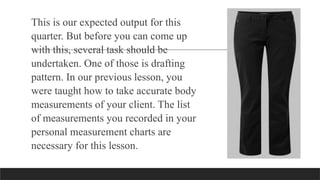
This is ourexpected output for this
quarter. But before you can come up
with this, several task should be
undertaken. One of those is drafting
pattern. In our previous lesson, you
were taught how to take accurate body
measurements of your client. The list
of measurements you recorded in your
personal measurement charts are
necessary for this lesson.
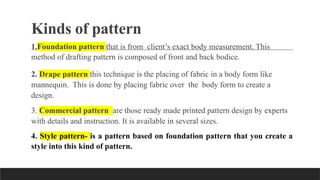
Kinds of pattern
1.Foundationpattern that is from client’s exact body measurement. This
method of drafting pattern is composed of front and back bodice.
2. Drape pattern this technique is the placing of fabric in a body form like
mannequin. This is done by placing fabric over the body form to create a
design.
3. Commercial pattern are those ready made printed pattern design by experts
with details and instruction. It is available in several sizes.
4. Style pattern- is a pattern based on foundation pattern that you create a
style into this kind of pattern.
11.
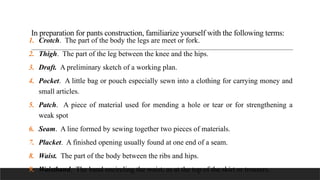
In preparation forpants construction, familiarize yourself with the following terms:
1. Crotch. The part of the body the legs are meet or fork.
2. Thigh. The part of the leg between the knee and the hips.
3. Draft. A preliminary sketch of a working plan.
4. Pocket. A little bag or pouch especially sewn into a clothing for carrying money and
small articles.
5. Patch. A piece of material used for mending a hole or tear or for strengthening a
weak spot
6. Seam. A line formed by sewing together two pieces of materials.
7. Placket. A finished opening usually found at one end of a seam.
8. Waist. The part of the body between the ribs and hips.
9. Waistband. The band encircling the waist, as at the top of the skirt or trousers.
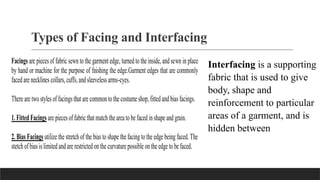
Types of Facingand Interfacing
Facings are piecesof fabric sewn to the garment edge, turned to the inside, and sewn in place
by hand or machine for the purpose of fnishing the edge.Garment edges that are commonly
faced are necklinescollars, cuffs,andsleevelessarms-cyes.
There are two styles of facingsthat are commontothe costume shop,fittedand biasfacings.
1.FittedFacings are piecesof fabric thatmatchthe areato be faced inshape andgrain.
2. Bias Facings utilize the stretch of the bias to shape the facing tothe edge being faced. The
stetch of biasislimitedandare restrictedonthe curvature possible ontheedge to be faced.
Interfacing is a supporting
fabric that is used to give
body, shape and
reinforcement to particular
areas of a garment, and is
hidden between
14.
Techniques in CuttingFinal Pattern
1. Cut out the pattern along the dotted guidelines, then put the pattern pieces together to make
sure they match before starting to cut your fabric. Correcting any cutting mistakes is essential so
that the seam lines will match up.
2. Add seam allowance (at least 1cm) to all edges and 2,5-3cm to the hems. Remember that you
can measure and adapt the length of the pants legs to suit your leg length. Depending on your
seating posture the pattern length can be more or less suited for you. If you want to make sure,
cut the pants slightly longer than you need. It is easier to shorten the leg length than making
them longer if necessary.
3. The waistband is cut as one piece unless the width of the fabric is too short. In this case you
have to cut it in two sections (remember to add seam allowance to the edges) and then join it in
the back.
4. Place the pattern pieces on top of the underside of the fabric. Cut along the lines of the
pattern, leaving 5/8 inch (1.6 cm) space for seams around every part of the pattern pieces. Mark
the pattern pieces with a number or letter if you feel you will lose track of which pieces will be
sewn together
15.
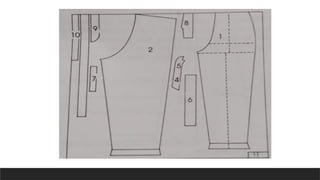
Laying Out PatternPieces for Ladies Trousers
Lay outing is an activity of arranging pattern pieces on the fabric.
The fabric for the trouser should be preshrunk and pressed to ensure
that there will be no more shrinkage after it has been cut and sewn,
Lay out and markings should be done at the wrong side of the fabric.
Use tailors chalk for marking. When laying out, pattern pieces on the
fabric be sure to lay out the biggest part first. Be sure that you are
following the grain when arranging pattern pieces. .
Use sharp pins to pin the pattern pieces to the fabric to prevent both
pattern and fabric from moving.
17.
Cutting the Fabric
1.Cut out the fabric using the pattern pieces as a guide.
2. Mark the pattern pieces front and back using a washable marking pen or
marking pencil. Also, pin the pieces. Use two pins to mark the front and
one pin to mark the back pieces.
3. Use scissors to cut the triangles or waistline markings. Cut them out as this
will help match pattern pieces.
4. Cut with the grain. Cut the waistband exactly on grain, twice the width of the
Grosgrain plus ¼inch, and 5 inches longer than the waist measurement. The
Waistband in plaid fabrics may be cut either on the lengthwise or on the
Crosswise grain, depending on the design.
5. Cut the lining after the first fitting in case the pattern has to be altered.
6. Edge finish then, cut out pattern pieces using a zigzag or serging stitch
18.
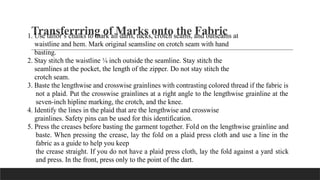
Transferrring of Marksonto the Fabric
1. Use tailor’s chalks to mark all darts, tucks, crotch seams, and outseams at
waistline and hem. Mark original seamsline on crotch seam with hand
basting.
2. Stay stitch the waistline ¼ inch outside the seamline. Stay stitch the
seamlines at the pocket, the length of the zipper. Do not stay stitch the
crotch seam.
3. Baste the lengthwise and crosswise grainlines with contrasting colored thread if the fabric is
not a plaid. Put the crosswise grainlines at a right angle to the lengthwise grainline at the
seven-inch hipline marking, the crotch, and the knee.
4. Identify the lines in the plaid that are the lengthwise and crosswise
grainlines. Safety pins can be used for this identification.
5. Press the creases before basting the garment together. Fold on the lengthwise grainline and
baste. When pressing the crease, lay the fold on a plaid press cloth and use a line in the
fabric as a guide to help you keep
the crease straight. If you do not have a plaid press cloth, lay the fold against a yard stick
and press. In the front, press only to the point of the dart.
19.
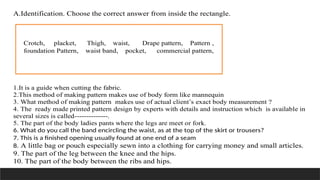
A.Identification. Choose thecorrect answer from inside the rectangle.
1.It is a guide when cutting the fabric.
2.This method of making pattern makes use of body form like mannequin
3. What method of making pattern makes use of actual client’s exact body measurement ?
4. The ready made printed pattern design by experts with details and instruction which is available in
several sizes is called--------------.
5. The part of the body ladies pants where the legs are meet or fork.
6. What do you call the band encircling the waist, as at the top of the skirt or trousers?
7. This is a finished opening usually found at one end of a seam
8. A little bag or pouch especially sewn into a clothing for carrying money and small articles.
9. The part of the leg between the knee and the hips.
10. The part of the body between the ribs and hips.
Crotch, placket, Thigh, waist, Drape pattern, Pattern ,
foundation Pattern, waist band, pocket, commercial pattern,
20.
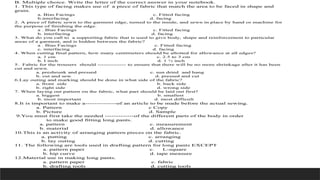
B. Multiple choice.Write the letter of the correct answer in your notebook.
1. This type of facing makes use of a piece of fabric that match the area to be faced in shape and
grain.
a. Bias Facings c. Fitted facing
b.interfacing d. facing
2. A piece of fabric sewn to the garment edge, turned to the inside, and sewn in place by hand or machine for
the purpose of finishing the edge.
a . Bias Facings c. Fitted facing
b. interfacing d. facing
3. What do you call to a supporting fabric that is used to give body, shape and reinforcement to particular
areas of a garment, and is hidden between the fabric?
a . Bias Facings c. Fitted facing
c. interfacing d. facing
4. When cutting final pattern, how many centimeters should be allotted for allowance at all edges?
a. 1 cm c. 2.5 to 3 cm
b. I inch d. 1 ½ inch
5. Fabric for the trousers should -------------- to ensure that there will be no more shrinkage after it has been
cut and sewn.
a. preshrunk and pressed c. sun dried and hang
b. cut and sew d. pressed and cut
6.Lay outing and marking should be done in what side of the fabric?
a. front side b. back side
b. right side d. wrong side
7. When laying out pattern on the fabric, what part should be laid out first?
a. biggest b. smallest
b. most important d. most difficult
8.It is important to make a--------------of an article to be made before the actual sewing.
a. Pattern c Copy
b. Picture d. Sample
9.You must first take the needed -------------of the different parts of the body in order
to make good fitting long pants.
a. pattern c. measurement
b. material d. allowance
10.This is an activity of arranging pattern pieces on the fabric.
a. putting c. arranging
b. lay outing d. cutting
11. The following are tools used in drafting pattern for long pants EXCEPT
a. pattern paper c. L-square
b. hip curve d. tape measure
12.Material use in making long pants.
a. pattern paper c. fabric
b. drafting tools d. cutting tools
21.
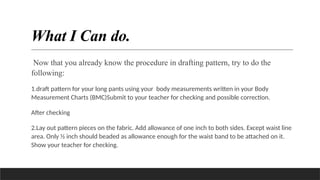
What I Cando.
Now that you already know the procedure in drafting pattern, try to do the
following:
1.draft pattern for your long pants using your body measurements written in your Body
Measurement Charts (BMC)Submit to your teacher for checking and possible correction.
After checking
2.Lay out pattern pieces on the fabric. Add allowance of one inch to both sides. Except waist line
area. Only ½ inch should beaded as allowance enough for the waist band to be attached on it.
Show your teacher for checking.
22.
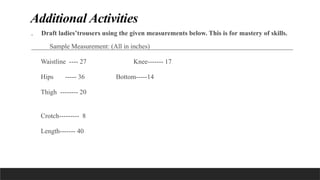
Additional Activities
. Draftladies’trousers using the given measurements below. This is for mastery of skills.
Sample Measurement: (All in inches)
Waistline ---- 27 Knee------- 17
Hips ----- 36 Bottom-----14
Thigh -------- 20
Crotch--------- 8
Length------- 40
23.
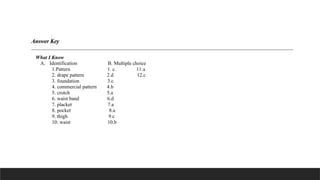
Answer Key
What IKnow
A. Identification B. Multiple choice
1.Pattern 1. c. 11.a
2. drape pattern 2.d 12.c
3. foundation 3.c
4. commercial pattern 4.b
5. crotch 5.a
6. waist band 6.d
7. placket 7.a
8. pocket 8.a
9. thigh 9.c
10. waist 10.b