Machine Drawing
Dr. Aman Soi
AP, ME, GGI, AMRITSAR
Drawing
•The art of representation of an object by
systematic lines on a paper is called drawing
Classification of Drawing
•Artistic Drawing
•Engineering Drawing
Principle of Drawing
To provide the correct information about drawings
to all concerned people, the drawing must be
prepared, following certain standard practices, as
recommended by Bureau of Indian Standards (BIS).
Requirements of machine Drawing,
• Engineering drawing used to convey the ideas
among people.
• Irrespective of language barriers, the drawings can
be effectively used in other countries, in addition to
the country where they are prepared.
• Engineering drawing is the universal language
of all engineers.
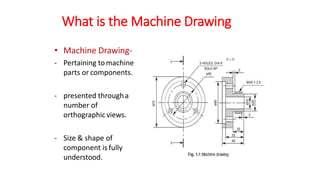
What is the Machine Drawing
• Machine Drawing-
- Pertaining tomachine
parts or components.
- presented througha
number of
orthographicviews.
- Size & shape of
component is fully
understood.
• Production Drawing – Referred as working drawing.
- Should furnish all dimensions, limits & special finishingprocesses
such as heat treatment, honing, lapping, surface finish,etc.
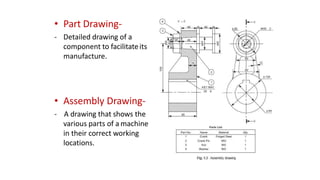
• Part Drawing-
- Detailed drawing of a
component to facilitateits
manufacture.
• Assembly Drawing-
- A drawing that shows the
various parts of a machine
in their correct working
locations.
• Designation of Sizes-
• Title Block –
(i) Title of the drawing
(ii) Sheet number
(iii) Scale
(iv) Symbol, denoting the method of projection
(v) Name of the firm / institute
(vi) Initials of staff drawn, checked and approved.
• Borders & Frames –
Minimum 20 mm for size A0 & A1.
Minimum 10 mm for size A2, A3,A4.
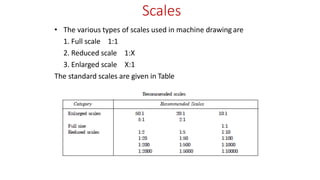
Scales
• The various types of scales used in machine drawing are
1. Full scale 1:1
2. Reduced scale 1:X
3. Enlarged scale X:1
The standard scales are given in Table
Dr Aman Soi, Machine Drawing, Part Drawing

Dr Aman Soi, Machine Drawing, Part Drawing

  • 1.
    Machine Drawing Dr. AmanSoi AP, ME, GGI, AMRITSAR
  • 2.
    Drawing •The art ofrepresentation of an object by systematic lines on a paper is called drawing
  • 3.
    Classification of Drawing •ArtisticDrawing •Engineering Drawing
  • 4.
    Principle of Drawing Toprovide the correct information about drawings to all concerned people, the drawing must be prepared, following certain standard practices, as recommended by Bureau of Indian Standards (BIS).
  • 5.
    Requirements of machineDrawing, • Engineering drawing used to convey the ideas among people. • Irrespective of language barriers, the drawings can be effectively used in other countries, in addition to the country where they are prepared. • Engineering drawing is the universal language of all engineers.
  • 6.
    What is theMachine Drawing • Machine Drawing- - Pertaining tomachine parts or components. - presented througha number of orthographicviews. - Size & shape of component is fully understood.
  • 7.
    • Production Drawing– Referred as working drawing. - Should furnish all dimensions, limits & special finishingprocesses such as heat treatment, honing, lapping, surface finish,etc.
  • 8.
    • Part Drawing- -Detailed drawing of a component to facilitateits manufacture. • Assembly Drawing- - A drawing that shows the various parts of a machine in their correct working locations.
  • 9.
  • 10.
    • Title Block– (i) Title of the drawing (ii) Sheet number (iii) Scale (iv) Symbol, denoting the method of projection (v) Name of the firm / institute (vi) Initials of staff drawn, checked and approved.
  • 11.
    • Borders &Frames – Minimum 20 mm for size A0 & A1. Minimum 10 mm for size A2, A3,A4.
  • 12.
    Scales • The varioustypes of scales used in machine drawing are 1. Full scale 1:1 2. Reduced scale 1:X 3. Enlarged scale X:1 The standard scales are given in Table