A Course Material on
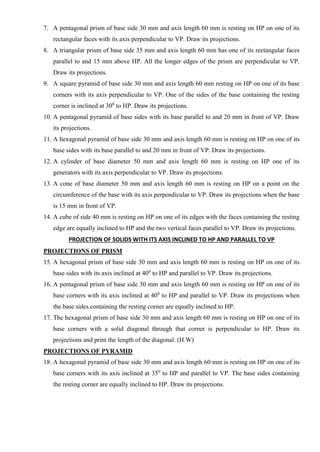
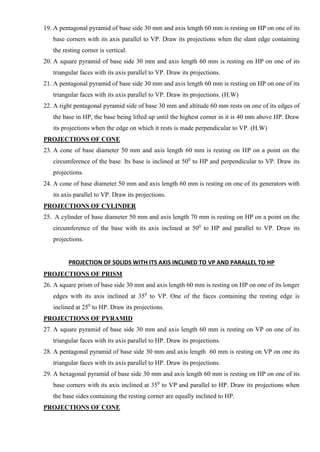
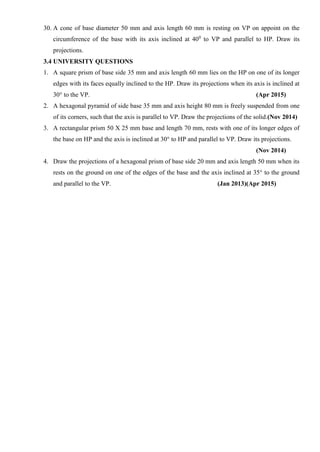
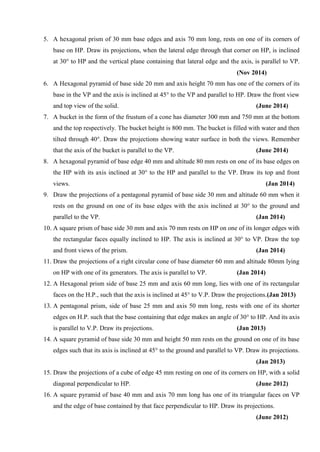
EEEnnngggiiinnneeeeeerrriiinnnggg GGGrrraaappphhhiiicccsss
Dr.V.KANDAVEL, B.E.,M.E.,Ph.D.,
Department of Mechanical Engineering
SSM INSTITUTE OF ENGINEERING AND TECHNOLOGY
(Approved by AICTE, Affiliated to Anna University, Accredited by NAAC)
Dindigul – Palani Highway, Dindigul – 624 002.
GE8152 ENGINEERING GRAPHICS L T P C
2 0 4 4
OBJECTIVES:
To develop in students, graphic skills for communication of concepts, ideas and design of
Engineering products.
T o expose them to existing national standards related to technical drawings.
CONCEPTS AND CONVENTIONS (Not for Examination) 1
Importance of graphics in engineering applications – Use of drafting instruments – BIS
conventions and specifications – Size, layout and folding of drawing sheets – Lettering and
dimensioning.
UNIT I PLANE CURVES AND FREEHAND SKETCHING 7+12
Basic Geometrical constructions, Curves used in engineering practices: Conics – Construction of
ellipse, parabola and hyperbola by eccentricity method – Construction of cycloid – construction of
involutes of square and circle – Drawing of tangents and normal to the above curves.
Visualization concepts and Free Hand sketching: Visualization principles –Representation of Three
Dimensional objects – Layout of views- Freehand sketching of multiple views from pictorial views of
objects
UNIT II PROJECTION OF POINTS, LINES AND PLANE SURFACE 6+12
Orthographic projection - principles-Principal planes-First angle projection-projection of points.
Projection of straight lines (only First angle projections) inclined to both the principal planes -
Determination of true lengths and true inclinations by rotating line method and traces
Projection of planes (polygonal and circular surfaces) inclined to both the principal planes by
rotating object method.
UNIT III PROJECTION OF SOLIDS 5+12
Projection of simple solids like prisms, pyramids, cylinder, cone and truncated solids when the axis is
inclined to one of the principal planes by rotating object method.
UNIT IV PROJECTION OF SECTIONED SOLIDS AND DEVELOPMENT OF
SURFACES 5+12
Sectioning of above solids in simple vertical position when the cutting plane is inclined to the one of
the principal planes and perpendicular to the other – obtaining true shape of section.
Development of lateral surfaces of simple and sectioned solids – Prisms, pyramids cylinders and cones.
UNIT V ISOMETRIC AND PERSPECTIVE PROJECTIONS 6+12
Principles of isometric projection – isometric scale –Isometric projections of simple solids and
truncated solids - Prisms, pyramids, cylinders, cones- combination of two solid objects in simple
vertical positions
Perspective projection of simple solids-Prisms, pyramids and cylinders by visual ray method.
TOTAL: 90 PERIODS
OUTCOMES:
On successful completion of this course, the student will be able to
 familiarize with the fundamentals and standards of Engineering graphics
 perform freehand sketching of basic geometrical constructions and multiple views of
objects.
 project orthographic projections of lines and plane surfaces.
 draw projections and solids and development of surfaces.
 visualize and to project isometric and perspective sections of simple solids.
TEXT BOOK:
1. Natrajan K.V., ―A text book of Engineering Graphics‖, Dhanalakshmi Publishers, Chennai, 2009.
2. Venugopal K. and Prabhu Raja V., ―Engineering Graphics‖, New Age International (P) Limited,
2008.
REFERENCES:
1. Bhatt N.D. and Panchal V.M., ―Engineering Drawing‖, Charotar Publishing House, 50
th
Edition, 2010.
2. Basant Agarwal and Agarwal C.M., ―Engineering Drawing‖, Tata McGraw Hill Publishing Company
Limited, New Delhi, 2008.
3. Gopalakrishna K.R., ―Engineering Drawing‖ (Vol. I&II combined), Subhas Stores, Bangalore, 2007.
4. Luzzader, Warren.J. and Duff,John M., ―Fundamentals of Engineering Drawing with an
introduction to Interactive Computer Graphics for Design and Production, Eastern Economy
Edition, Prentice Hall of India Pvt. Ltd, New Delhi, 2005.
5. N S Parthasarathy and Vela Murali, ―Engineering Graphics‖, Oxford University, Press, New Delhi,
2015.
6. Shah M.B., and Rana B.C., ―Engineering Drawing‖, Pearson, 2nd
Edition, 2009.
Publication of Bureau of Indian Standards:
1. IS 10711 – 2001: Technical products Documentation – Size and lay out of drawing
sheets.
2. IS 9609 (Parts 0 & 1) – 2001: Technical products Documentation – Lettering.
3. IS 10714 (Part 20) – 2001 & SP 46 – 2003: Lines for technical drawings.
4. IS 11669 – 1986 & SP 46 – 2003: Dimensioning of Technical Drawings.
5. IS 15021 (Parts 1 to 4) – 2001: Technical drawings – Projection Methods.
Special points applicable to University Examinations on Engineering Graphics:
1. There will be five questions, each of either or type covering all units of the syllabus.
2. All questions will carry equal marks of 20 each making a total of 100.
3. The answer paper shall consist of drawing sheets of A3 size only. The
students will be permitted to use appropriate scale to fit solution within A3 size.
4. The examination will be conducted in appropriate sessions on the same day
CONCEPTS AND CONVENTIONS (Not for Examination)
GRAPHIC LANGUAGE
A technical person can use the graphic language as powerful means of communication with
others for conveying ideas on technical matters. However, for effective exchange of ideas with
others, the engineer must have proficiency in (i) language, both written and oral, (ii) symbols
associated with basic sciences and (iii) the graphic language. Engineering drawing is a suitable
graphic language from which any trained person can visualize the required object. As an
engineering drawing displays the exact picture of an object, it obviously conveys the same ideas to
every trained eye.
Irrespective of language barriers, the drawings can be effectively used in other countries, in
addition to the country where they are prepared. Thus, the engineering drawing is the universal
language of all engineers.
Engineering drawing has its origin sometime in 500 BC in the regime of King Pharos of
Egypt when symbols were used to convey the ideas among people.
IMPORTANCE OF GRAPHIC LANGUAGE
The graphic language had its existence when it became necessary to build new structures
and create new machines or the like, in addition to representing the existing ones. In the absence of
graphic language, the ideas on technical matters have to be conveyed by speech or writing, both
are unreliable and difficult to understand by the shop floor people for manufacturing. This method
involves not only lot of time and labour, but also manufacturing errors. Without engineering
drawing, it would have been impossible to produce objects such as aircrafts, automobiles,
locomotives, etc., each requiring thousands of different components.
NEED FOR CORRECT DRAWINGS
The drawings prepared by any technical person must be clear, unmistakable in meaning
and there should not be any scope for more than one interpretation, or else litigation may arise. In a
number of dealings with contracts, the drawing is an official document and the success or failure of
a structure depends on the clarity of details provided on the drawing. Thus, the drawings should
not give any scope for mis-interpretation even by accident.
It would not have been possible to produce the machines/automobiles on a mass scale
where a number of assemblies and sub-assemblies are involved, without clear, correct and accurate
drawings. To achieve this, the technical person must gain a thorough knowledge of both the
principles and conventional practice of draughting. If these are not achieved and or practiced, the
drawings prepared by one may convey different meaning to others, causing unnecessary delays
and expenses in production shops.
DRAFTING INSTRUMENTS
Engineering drawings are prepared with the help of a set of drawing instruments. Accuracy
and speed in the execution of drawings depend upon the quality of instruments. It is desirable for
students to procure instruments of good quality. The following instruments are commonly used:
1. Drawing board
2. Minidrafter
3. Precision instrument box
4. 45° set square and 30°-60° set square
5. Engineers’ Scales or Scales of Engineering Drawing
6. Protractor
7. Irregular or French curves
8. Drawing pins or clips
9. Drawing paper
10. Pencils
11. Eraser
12. Duster
Size of Drawing Sheet
Engineering drawings are prepared on standard size drawing sheets. The correct shape and
size of the object can be visualized from the understanding of not only its views but also from the
various types of lines used, dimensions, notes, scale etc. To provide the correct information about
the drawings to all the people concerned, the drawings must be prepared, following certain
standard practices, as recommended by Bureau of Indian Standards (BIS).
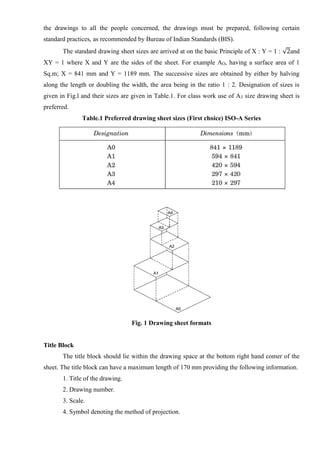
The standard drawing sheet sizes are arrived at on the basic Principle of X : Y = 1 : √2and
XY = 1 where X and Y are the sides of the sheet. For example AO, having a surface area of 1
Sq.m; X = 841 mm and Y = 1189 mm. The successive sizes are obtained by either by halving
along the length or doubling the width, the area being in the ratio 1 : 2. Designation of sizes is
given in Fig.l and their sizes are given in Table.1. For class work use of A3 size drawing sheet is
preferred.
Table.1 Preferred drawing sheet sizes (First choice) ISO-A Series
Fig. 1 Drawing sheet formats
Title Block
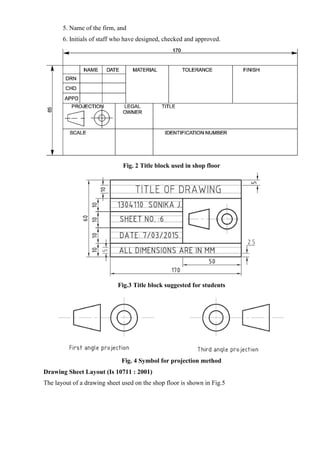
The title block should lie within the drawing space at the bottom right hand comer of the
sheet. The title block can have a maximum length of 170 mm providing the following information.
1. Title of the drawing.
2. Drawing number.
3. Scale.
4. Symbol denoting the method of projection.
5. Name of the firm, and
6. Initials of staff who have designed, checked and approved.
Fig. 2 Title block used in shop floor
Fig.3 Title block suggested for students
Fig. 4 Symbol for projection method
Drawing Sheet Layout (Is 10711 : 2001)
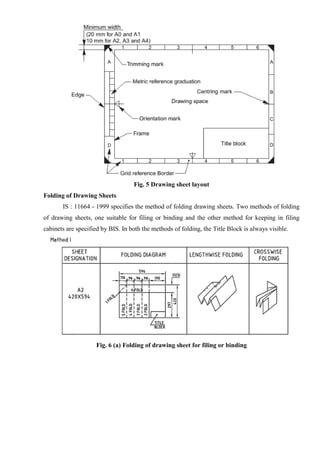
The layout of a drawing sheet used on the shop floor is shown in Fig.5
Fig. 5 Drawing sheet layout
Folding of Drawing Sheets
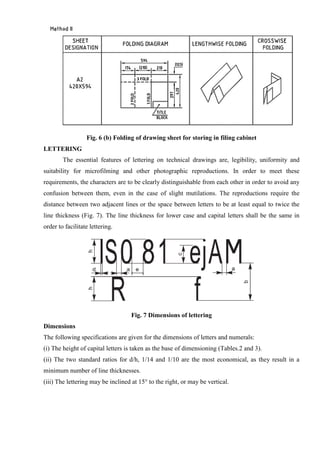
IS : 11664 - 1999 specifies the method of folding drawing sheets. Two methods of folding
of drawing sheets, one suitable for filing or binding and the other method for keeping in filing
cabinets are specified by BIS. In both the methods of folding, the Title Block is always visible.
Fig. 6 (a) Folding of drawing sheet for filing or binding
Fig. 6 (b) Folding of drawing sheet for storing in filing cabinet
LETTERING
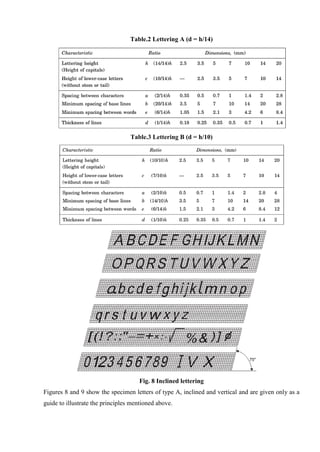
The essential features of lettering on technical drawings are, legibility, uniformity and
suitability for microfilming and other photographic reproductions. In order to meet these
requirements, the characters are to be clearly distinguishable from each other in order to avoid any
confusion between them, even in the case of slight mutilations. The reproductions require the
distance between two adjacent lines or the space between letters to be at least equal to twice the
line thickness (Fig. 7). The line thickness for lower case and capital letters shall be the same in
order to facilitate lettering.
Fig. 7 Dimensions of lettering
Dimensions
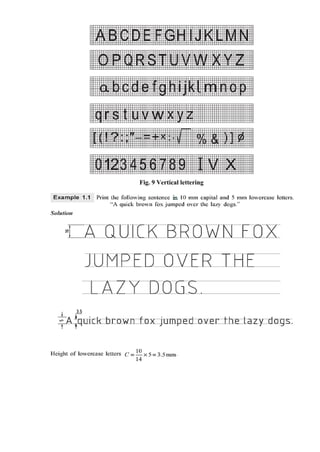
The following specifications are given for the dimensions of letters and numerals:
(i) The height of capital letters is taken as the base of dimensioning (Tables.2 and 3).
(ii) The two standard ratios for d/h, 1/14 and 1/10 are the most economical, as they result in a
minimum number of line thicknesses.
(iii) The lettering may be inclined at 15° to the right, or may be vertical.
Table.2 Lettering A (d = h/14)
Table.3 Lettering B (d = h/10)
Fig. 8 Inclined lettering
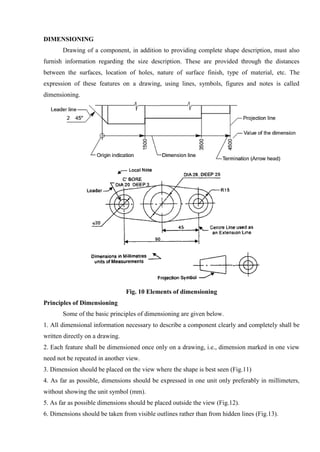
Figures 8 and 9 show the specimen letters of type A, inclined and vertical and are given only as a
guide to illustrate the principles mentioned above.
Fig. 9 Vertical lettering
DIMENSIONING
Drawing of a component, in addition to providing complete shape description, must also
furnish information regarding the size description. These are provided through the distances
between the surfaces, location of holes, nature of surface finish, type of material, etc. The
expression of these features on a drawing, using lines, symbols, figures and notes is called
dimensioning.
Fig. 10 Elements of dimensioning
Principles of Dimensioning
Some of the basic principles of dimensioning are given below.
1. All dimensional information necessary to describe a component clearly and completely shall be
written directly on a drawing.
2. Each feature shall be dimensioned once only on a drawing, i.e., dimension marked in one view
need not be repeated in another view.
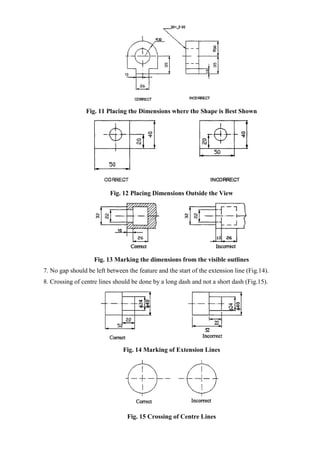
3. Dimension should be placed on the view where the shape is best seen (Fig.11)
4. As far as possible, dimensions should be expressed in one unit only preferably in millimeters,
without showing the unit symbol (mm).
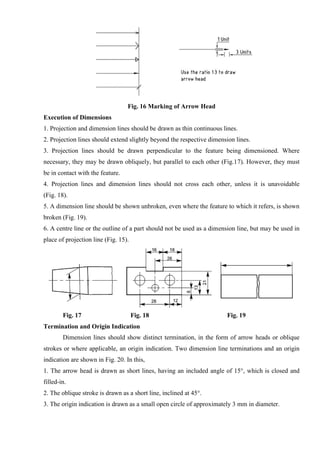
5. As far as possible dimensions should be placed outside the view (Fig.12).
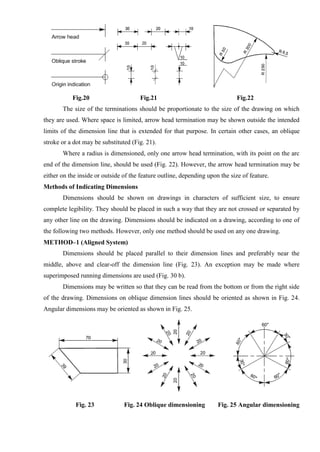
6. Dimensions should be taken from visible outlines rather than from hidden lines (Fig.13).
Fig. 11 Placing the Dimensions where the Shape is Best Shown
Fig. 12 Placing Dimensions Outside the View
Fig. 13 Marking the dimensions from the visible outlines
7. No gap should be left between the feature and the start of the extension line (Fig.14).
8. Crossing of centre lines should be done by a long dash and not a short dash (Fig.15).
Fig. 14 Marking of Extension Lines
Fig. 15 Crossing of Centre Lines
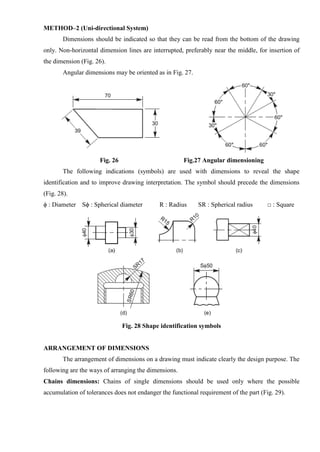
Fig. 16 Marking of Arrow Head
Execution of Dimensions
1. Projection and dimension lines should be drawn as thin continuous lines.
2. Projection lines should extend slightly beyond the respective dimension lines.
3. Projection lines should be drawn perpendicular to the feature being dimensioned. Where
necessary, they may be drawn obliquely, but parallel to each other (Fig.17). However, they must
be in contact with the feature.
4. Projection lines and dimension lines should not cross each other, unless it is unavoidable
(Fig. 18).
5. A dimension line should be shown unbroken, even where the feature to which it refers, is shown
broken (Fig. 19).
6. A centre line or the outline of a part should not be used as a dimension line, but may be used in
place of projection line (Fig. 15).
Fig. 17 Fig. 18 Fig. 19
Termination and Origin Indication
Dimension lines should show distinct termination, in the form of arrow heads or oblique
strokes or where applicable, an origin indication. Two dimension line terminations and an origin
indication are shown in Fig. 20. In this,
1. The arrow head is drawn as short lines, having an included angle of 15°, which is closed and
filled-in.
2. The oblique stroke is drawn as a short line, inclined at 45°.
3. The origin indication is drawn as a small open circle of approximately 3 mm in diameter.
Fig.20 Fig.21 Fig.22
The size of the terminations should be proportionate to the size of the drawing on which
they are used. Where space is limited, arrow head termination may be shown outside the intended
limits of the dimension line that is extended for that purpose. In certain other cases, an oblique
stroke or a dot may be substituted (Fig. 21).
Where a radius is dimensioned, only one arrow head termination, with its point on the arc
end of the dimension line, should be used (Fig. 22). However, the arrow head termination may be
either on the inside or outside of the feature outline, depending upon the size of feature.
Methods of Indicating Dimensions
Dimensions should be shown on drawings in characters of sufficient size, to ensure
complete legibility. They should be placed in such a way that they are not crossed or separated by
any other line on the drawing. Dimensions should be indicated on a drawing, according to one of
the following two methods. However, only one method should be used on any one drawing.
METHOD–1 (Aligned System)
Dimensions should be placed parallel to their dimension lines and preferably near the
middle, above and clear-off the dimension line (Fig. 23). An exception may be made where
superimposed running dimensions are used (Fig. 30 b).
Dimensions may be written so that they can be read from the bottom or from the right side
of the drawing. Dimensions on oblique dimension lines should be oriented as shown in Fig. 24.
Angular dimensions may be oriented as shown in Fig. 25.
Fig. 23 Fig. 24 Oblique dimensioning Fig. 25 Angular dimensioning
METHOD–2 (Uni-directional System)
Dimensions should be indicated so that they can be read from the bottom of the drawing
only. Non-horizontal dimension lines are interrupted, preferably near the middle, for insertion of
the dimension (Fig. 26).
Angular dimensions may be oriented as in Fig. 27.
Fig. 26 Fig.27 Angular dimensioning
The following indications (symbols) are used with dimensions to reveal the shape
identification and to improve drawing interpretation. The symbol should precede the dimensions
(Fig. 28).
ϕ : Diameter Sϕ : Spherical diameter R : Radius SR : Spherical radius □ : Square
Fig. 28 Shape identification symbols
ARRANGEMENT OF DIMENSIONS
The arrangement of dimensions on a drawing must indicate clearly the design purpose. The
following are the ways of arranging the dimensions.
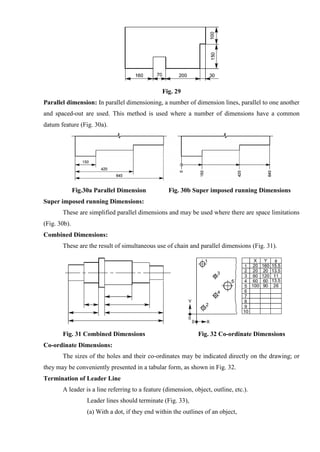
Chains dimensions: Chains of single dimensions should be used only where the possible
accumulation of tolerances does not endanger the functional requirement of the part (Fig. 29).
Fig. 29
Parallel dimension: In parallel dimensioning, a number of dimension lines, parallel to one another
and spaced-out are used. This method is used where a number of dimensions have a common
datum feature (Fig. 30a).
Fig.30a Parallel Dimension Fig. 30b Super imposed running Dimensions
Super imposed running Dimensions:
These are simplified parallel dimensions and may be used where there are space limitations
(Fig. 30b).
Combined Dimensions:
These are the result of simultaneous use of chain and parallel dimensions (Fig. 31).
Fig. 31 Combined Dimensions Fig. 32 Co-ordinate Dimensions
Co-ordinate Dimensions:
The sizes of the holes and their co-ordinates may be indicated directly on the drawing; or
they may be conveniently presented in a tabular form, as shown in Fig. 32.
Termination of Leader Line
A leader is a line referring to a feature (dimension, object, outline, etc.).
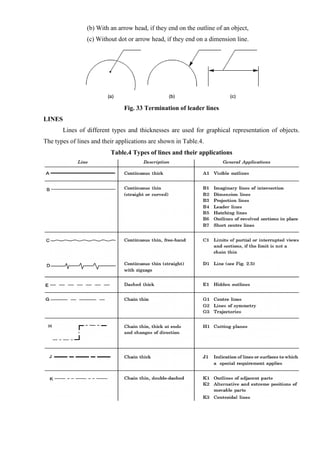
Leader lines should terminate (Fig. 33),
(a) With a dot, if they end within the outlines of an object,
(b) With an arrow head, if they end on the outline of an object,
(c) Without dot or arrow head, if they end on a dimension line.
Fig. 33 Termination of leader lines
LINES
Lines of different types and thicknesses are used for graphical representation of objects.
The types of lines and their applications are shown in Table.4.
Table.4 Types of lines and their applications
UNIT – I
PLANE CURVES AND FREE HAND SKETCHING
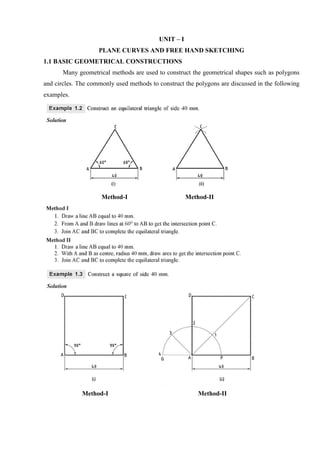
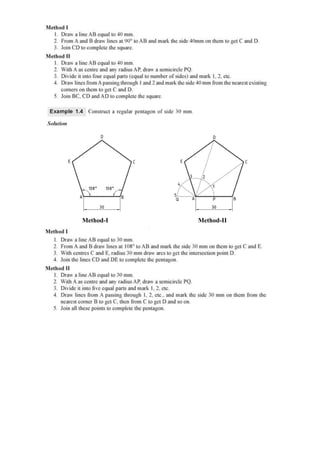
1.1 BASIC GEOMETRICAL CONSTRUCTIONS
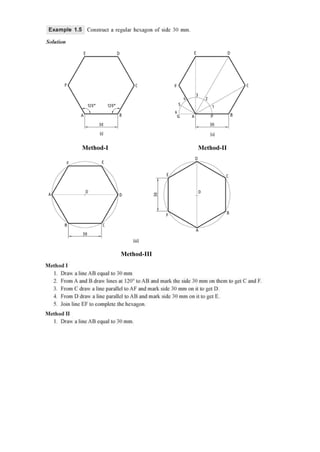
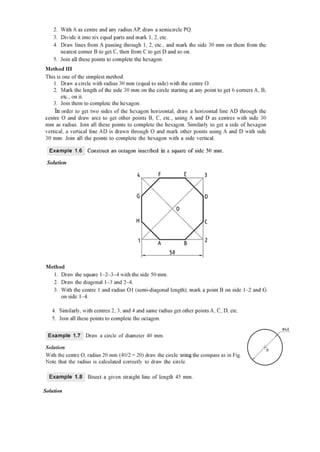
Many geometrical methods are used to construct the geometrical shapes such as polygons
and circles. The commonly used methods to construct the polygons are discussed in the following
examples.
Method-I Method-II
Method-I Method-II
Method-I Method-II
Method-I Method-II
Method-III
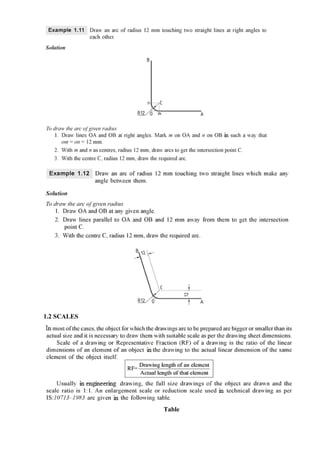
Solution
1.2 SCALES
Table
ENGINEERING CURVES
Frequently required engineering curves are conics, cycloids, involutes, and spirals.
1.3 CONIC SECTIONS
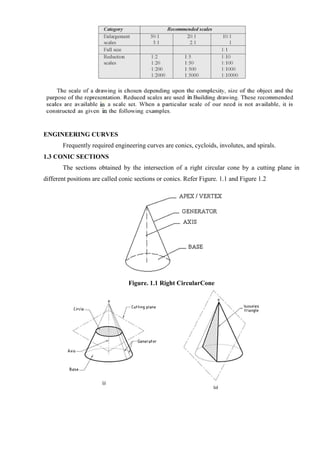
The sections obtained by the intersection of a right circular cone by a cutting plane in
different positions are called conic sections or conics. Refer Figure. 1.1 and Figure 1.2
Figure. 1.1 Right CircularCone
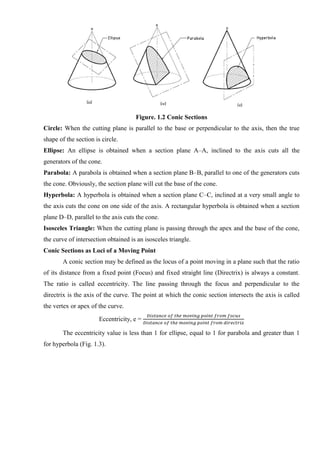
Figure. 1.2 Conic Sections
Circle: When the cutting plane is parallel to the base or perpendicular to the axis, then the true
shape of the section is circle.
Ellipse: An ellipse is obtained when a section plane A–A, inclined to the axis cuts all the
generators of the cone.
Parabola: A parabola is obtained when a section plane B–B, parallel to one of the generators cuts
the cone. Obviously, the section plane will cut the base of the cone.
Hyperbola: A hyperbola is obtained when a section plane C–C, inclined at a very small angle to
the axis cuts the cone on one side of the axis. A rectangular hyperbola is obtained when a section
plane D–D, parallel to the axis cuts the cone.
Isosceles Triangle: When the cutting plane is passing through the apex and the base of the cone,
the curve of intersection obtained is an isosceles triangle.
Conic Sections as Loci of a Moving Point
A conic section may be defined as the locus of a point moving in a plane such that the ratio
of its distance from a fixed point (Focus) and fixed straight line (Directrix) is always a constant.
The ratio is called eccentricity. The line passing through the focus and perpendicular to the
directrix is the axis of the curve. The point at which the conic section intersects the axis is called
the vertex or apex of the curve.
Eccentricity, e =
𝐷𝑖𝑠𝑡𝑎𝑛𝑐𝑒 𝑜𝑓 𝑡ℎ𝑒 𝑚𝑜𝑣𝑖𝑛𝑔 𝑝𝑜𝑖𝑛𝑡 𝑓𝑟𝑜𝑚 𝑓𝑜𝑐𝑢𝑠
𝐷𝑖𝑠𝑡𝑎𝑛𝑐𝑒 𝑜𝑓 𝑡ℎ𝑒 𝑚𝑜𝑣𝑖𝑛𝑔 𝑝𝑜𝑖𝑛𝑡 𝑓𝑟𝑜𝑚 𝑑𝑖𝑟𝑒𝑐𝑡𝑟𝑖𝑥
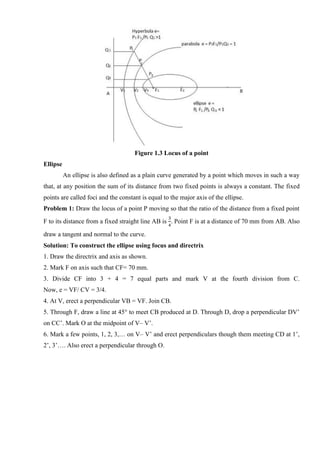
The eccentricity value is less than 1 for ellipse, equal to 1 for parabola and greater than 1
for hyperbola (Fig. 1.3).
Figure 1.3 Locus of a point
Ellipse
An ellipse is also defined as a plain curve generated by a point which moves in such a way
that, at any position the sum of its distance from two fixed points is always a constant. The fixed
points are called foci and the constant is equal to the major axis of the ellipse.
Problem 1: Draw the locus of a point P moving so that the ratio of the distance from a fixed point
F to its distance from a fixed straight line AB is
3
4
. Point F is at a distance of 70 mm from AB. Also
draw a tangent and normal to the curve.
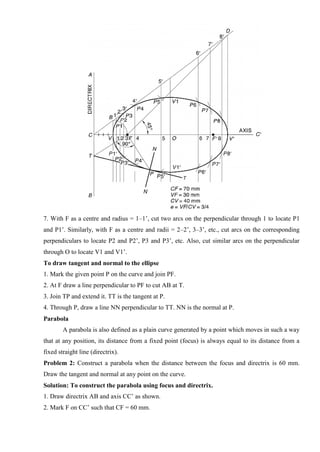
Solution: To construct the ellipse using focus and directrix
1. Draw the directrix and axis as shown.
2. Mark F on axis such that CF= 70 mm.
3. Divide CF into 3 + 4 = 7 equal parts and mark V at the fourth division from C.
Now, e = VF/ CV = 3/4.
4. At V, erect a perpendicular VB = VF. Join CB.
5. Through F, draw a line at 45° to meet CB produced at D. Through D, drop a perpendicular DV’
on CC’. Mark O at the midpoint of V– V’.
6. Mark a few points, 1, 2, 3,… on V– V’ and erect perpendiculars though them meeting CD at 1’,
2’, 3’…. Also erect a perpendicular through O.
7. With F as a centre and radius = 1–1’, cut two arcs on the perpendicular through 1 to locate P1
and P1’. Similarly, with F as a centre and radii = 2–2’, 3–3’, etc., cut arcs on the corresponding
perpendiculars to locate P2 and P2’, P3 and P3’, etc. Also, cut similar arcs on the perpendicular
through O to locate V1 and V1’.
To draw tangent and normal to the ellipse
1. Mark the given point P on the curve and join PF.
2. At F draw a line perpendicular to PF to cut AB at T.
3. Join TP and extend it. TT is the tangent at P.
4. Through P, draw a line NN perpendicular to TT. NN is the normal at P.
Parabola
A parabola is also defined as a plain curve generated by a point which moves in such a way
that at any position, its distance from a fixed point (focus) is always equal to its distance from a
fixed straight line (directrix).
Problem 2: Construct a parabola when the distance between the focus and directrix is 60 mm.
Draw the tangent and normal at any point on the curve.
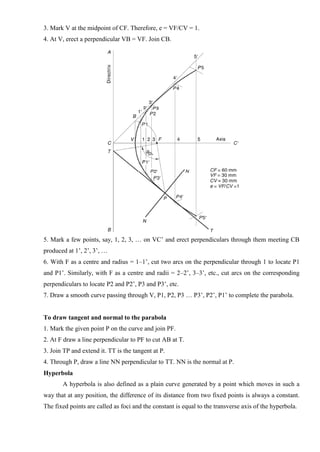
Solution: To construct the parabola using focus and directrix.
1. Draw directrix AB and axis CC’ as shown.
2. Mark F on CC’ such that CF = 60 mm.
3. Mark V at the midpoint of CF. Therefore, e = VF/CV = 1.
4. At V, erect a perpendicular VB = VF. Join CB.
5. Mark a few points, say, 1, 2, 3, … on VC’ and erect perpendiculars through them meeting CB
produced at 1’, 2’, 3’, …
6. With F as a centre and radius = 1–1’, cut two arcs on the perpendicular through 1 to locate P1
and P1’. Similarly, with F as a centre and radii = 2–2’, 3–3’, etc., cut arcs on the corresponding
perpendiculars to locate P2 and P2’, P3 and P3’, etc.
7. Draw a smooth curve passing through V, P1, P2, P3 … P3’, P2’, P1’ to complete the parabola.
To draw tangent and normal to the parabola
1. Mark the given point P on the curve and join PF.
2. At F draw a line perpendicular to PF to cut AB at T.
3. Join TP and extend it. TT is the tangent at P.
4. Through P, draw a line NN perpendicular to TT. NN is the normal at P.
Hyperbola
A hyperbola is also defined as a plain curve generated by a point which moves in such a
way that at any position, the difference of its distance from two fixed points is always a constant.
The fixed points are called as foci and the constant is equal to the transverse axis of the hyperbola.
Problem 3: Draw a hyperbola of e = 3/2 if the distance of the focus from the directrix = 50 mm.
Draw the tangent and normal at any point on the curve.
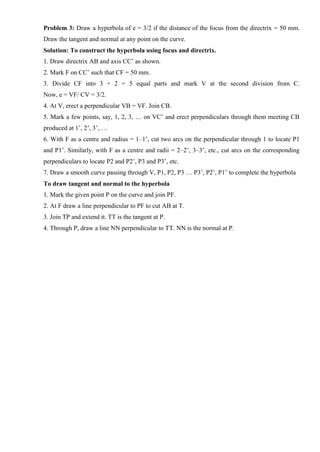
Solution: To construct the hyperbola using focus and directrix.
1. Draw directrix AB and axis CC’ as shown.
2. Mark F on CC’ such that CF = 50 mm.
3. Divide CF into 3 + 2 = 5 equal parts and mark V at the second division from C.
Now, e = VF/ CV = 3/2.
4. At V, erect a perpendicular VB = VF. Join CB.
5. Mark a few points, say, 1, 2, 3, … on VC’ and erect perpendiculars through them meeting CB
produced at 1’, 2’, 3’, …
6. With F as a centre and radius = 1–1’, cut two arcs on the perpendicular through 1 to locate P1
and P1’. Similarly, with F as a centre and radii = 2–2’, 3–3’, etc., cut arcs on the corresponding
perpendiculars to locate P2 and P2’, P3 and P3’, etc.
7. Draw a smooth curve passing through V, P1, P2, P3 … P3’, P2’, P1’ to complete the hyperbola
To draw tangent and normal to the hyperbola
1. Mark the given point P on the curve and join PF.
2. At F draw a line perpendicular to PF to cut AB at T.
3. Join TP and extend it. TT is the tangent at P.
4. Through P, draw a line NN perpendicular to TT. NN is the normal at P.
1.4 CYCLOIDAL CURVES
A cycloid is a curve generated by a point on the circumference of a circle rolling along a
straight line without slipping. The rolling circle is called a generating circle and the straight line is
called a directing line or base line. The point on the generating circle which traces the curve is
called the generating point.
The cycloid is called the epicycloid when the generating circle rolls along another circle
outside it.
Hypocycloid, opposite to the epicycloid, is obtained when the generating circle rolls along
another circle inside it.
The other circle along which the generating circle rolls is called the directing circle or the
base circle.
Problem 1: A wheel of diameter 60 cm rolls on a straight horizontal road. Draw the locus of a
point P on the periphery of the wheel, for one revolution of the wheel, if P is initially on the road.
Draw the tangent and normal at any point on the curve.
Solution: To construct the cycloid
1. Draw the base line P’–P” equal to the circumference of generating circle, i.e., π D = π x 60 cm =
188 cm. Take Scale: 1 : 10.
2. Draw the generating circle with C as a centre and radius = 30 cm, tangent to P’–P” at P’. Point P
is initially at P’.
3. Draw C–C’ parallel and equal to P’–P” to represent the locus of the centre of the generating
circle.
4. Obtain 12 equal divisions on the circle. Number the divisions as 1, 2, 3, etc., starting from P’ as
shown. Through 1, 2, 3, etc., draw lines parallel to P’ –P”.
5. Obtain 12 equal divisions on C–C’ and name them as C1, C2, C3, etc.
6. With C1, C2, C3, etc. as the centres and radius = CP’ = 30 mm, cut the arcs on the lines through
1, 2, 3, etc., to locate respectively P1, P2, P3, etc.
7. Join P’, P1, P2, P3, etc. by a smooth curve to complete the cycloid.
To draw tangent and normal to cycloid
1. With P as a centre and radius = CP’ (i.e., radius of generating circle), cut an arc on C–C’ at M.
2. From M, draw a normal MN to P’–P”.
3. Join NP for the required normal. Draw tangent T–T perpendicular to NP at P.
Problem 2: Draw an epicycloid, if a circle of 40 mm diameter rolls outside another circle of 120
mm diameter for one revolution. Draw the tangent and normal at any point on the curve.
Solution: We know that for one revolution of the generating circle along the directing circle, it
covers an arc of length equal to the circumference of the generating circle. It is impossible to
measure the length of an arc, so the subtended angle of it is calculated as follows.
Subtended angle, θ =
𝑟
𝑅
x 360o
r – Radius of generating circle
R – Radius of directing circle
∴ Included angle of the arc, θ =
20
60
x 360o
= 120°
1. With O as a centre and radius = 60 mm, draw the directing arc P’–P” of the included angle 120°.
2. Produce OP’ and locate C on it such that CP’ = radius of generating circle = 20 mm. With C as
centre and radius = CP’, draw a circle.
3. With O as a centre and radius = OC, draw an arc C–C’ such that ∠COC’ = 120°. Arc C–C’
represents the locus of centre of generating circle.
4. Divide the circle into 12 equal parts. With O as a centre and radii = O–1, O–2, O–3, etc., draw
the arcs through 1, 2, 3, etc., parallel to arc P’–P”.
5. Divide arc P’–P” into12 equal parts and produce them to cut the locus of centres at C1, C2,….
6. Taking C1 as centre, and radius equal to 20mm, draw an arc cutting the arc through 1 at P1.
Repeat this procedure with centres C2, C3,…, C12 to obtain points P2, P3,…., P12.
7. Join P1, P2, P3, etc by drawing a smooth curve to complete the epicycloid.
To draw tangent and normal to epicycloid
1. With P as a centre and radius = CP’ (i.e., radius of generating circle), cut an arc on C–C’ at M.
2. Join MO and then locate N at the intersection of P’–P”.
3. Join NP for the required normal. Draw tangent T–T perpendicular to NP at P.
Problem 3: A circle of diameter 40 mm rolls inside another circle of radius 60 mm. Draw the
hypocycloid traced by a point on the rolling circle initially in contact with the directing circle for
one revolution. Draw the tangent and normal at any point on the curve.
Solution: We know that for one revolution of the generating circle along the directing circle, it
covers an arc of length equal to the circumference of the generating circle. It is impossible to
measure the length of an arc, so the subtended angle of it is calculated as follows.
Subtended angle, θ =
𝑟
𝑅
x 360o
r – Radius of generating circle
R – Radius of directing circle
∴ Included angle of the arc, θ =
20
60
x 360o
= 120°
1. With O as a centre and radius = 60 mm, draw the directing arc P’–P” of included angle 120°.
2. On OP’, locate C such that CP’ = 20 mm. With C as a centre and radius = CP’, draw a circle.
3. With O as a centre and radius = OC, draw an arc C–C’ such that ∠COC’ = 120°. Arc C–C’
represents the locus of centre of generating circle.
4. Divide the circle into 12 equal parts. With O as a centre and radii = O–1, O–2, O–3, etc., draw
the arcs through 1, 2, 3, etc., parallel to arc P’–P”.
5. Divide arc P’–P” into12 equal parts and produce them to cut the locus of centres at C1, C2,….
6. Taking C1 as centre, and radius equal to 20mm, draw an arc cutting the arc through 1 at P1.
Repeat this procedure with centres C2, C3,…, C12 to obtain points P2, P3,…., P12.
7. Join P1, P2, P3, etc by drawing a smooth curve to complete the hypocycloid.
To draw tangent and normal to hypocycloid
1. With P as a centre and radius = CP’ (i.e., radius of generating circle), cut an arc on C–C’ at M.
2. Join MO and then extend it to the directing circle to locate N at the intersection of P’–P”.
3. Join NP for the required normal. Draw tangent T–T perpendicular to NP at P.
1.5 INVOLUTE
An involute is a spiral curve generated by a point on a cord or thread as it unwinds from a
polygon or a circle, the thread being kept tight and tangential to the circle or the sides of the
polygon.
Depending on whether the involute is traced over a circle or a polygon, the involute is
called an involute of circle or involute of polygon.
Problem 1: Draw the involute of a square of side 25 mm.
Steps for Construction of Involute of square:
1. Draw a Square ABCD of side 25mm. Assume a thread is unwound from end D in clockwise
direction.
2. A as center and radius 25 mm (= length of 1 side), draw an arc to cut BA produced at P1.
3. B as center and BP1 as radius (= length of 2 side), draw an arc from P1 to get P2.
4. C as center and CP2 as radius (= length of 3 side), draw an arc from P2 to get P3.
5. Similarly, D as center and DP3 as radius (= length of 4 side), draw an arc from P3 to get P4.
Normal and Tangent:
1. The given point M lies in the arc P3 P4 .The center of the arc P3 P4 is point B. Join B and M.
2. Extend BM which is required Normal. At M draw a perpendicular to the normal to obtain the
Tangent TT.
Problem 2: Draw the curve traced out by an end of a thin wire unwound from a regular hexagon
of side 20 mm, the wire being kept taut. Draw a tangent and normal at any point on the curve.
Steps for Construction of Involute of hexagon:
1. Draw a hexagon ABCDEF of side 20mm. Assume a thread is unwound from end F in clockwise
direction.
2. With centres A, B, etc., and radius 20 mm, 40 mm, etc., draw arcs to get P1, P2, etc.,
3. Join P1, P2, etc., to complete the hexagon.
Normal and Tangent:
1. Mark the point M on the arc P4 P5 .The center of the arc P4 P5 is point F. Join F and M.
2. Extend FM which is required Normal. At M draw a perpendicular to the normal to obtain the
Tangent TT.
Problem 3: Construct one convolution of an involute of a circle of diameter 40 mm. Draw tangent
and normal at a point on the involute 100 mm distant from the centre of the circle.
Steps for Construction of Involute of circle:
1. With 0 as centre and radius R of 20 mm, draw the given circle.
2. Taking P as the starting point, draw the tangent PQ equal in length to the circumference of the
circle.
3. Divide the line PQ and the circle into the same number of equal parts and number the points.
4. Draw tangents to the circle at the points 1, 2, 3 etc., and locate the points P1, P2, P3 etc., such
that 1-P1 = P-1’, 2-P2 = P-2’ etc.
5. A smooth curve through the points P, P1, P2 etc., is the required involute.
Normal and Tangent:
1.Mark the point M at a distance of 100 mm from the centre of the circle. Join it with centre O of
the circle.
2. Draw a semi-circle with diameter OM, i.e., with centre C which is the midpoint of OM to get the
intersection point N on the circle.
3. Draw a line from N passing through M which is the normal NMN to the curve.
4. Draw a line through M, perpendicular to NMN to get the tangent TT to the curve.
1.6 FREEHAND SKETCHING
An engineer or designer conceives an idea of a non-existing object three dimensionally,
which can be conveyed to another person only through a drawing. Initially the object is sketched
on paper as an isometric or perspective drawing, then that will be given dimensions.
Good practice in freehand sketching helps the engineer to think about the new design rather
than to think about the method of preparing the drawing. When the designer’s mind thinks an idea
that is sketched by him in freehand. An engineer who has a thorough idea in isometric and
orthographic projections can prepare the sketches easily.
Freehand Sketching Practice
1. For freehand sketching practice, soft grade pencil (HB), eraser and paper are required.
2. Papers with thin cross-section guidelines (ruled paper) may be used for sketching which helps
the inexperienced person to draw straight lines satisfactorily.
Fig. 1.4 Sketch on a ruled paper
Sketching a straight line
1. Mark the end points of the line to be sketched.
2. Observe the two points carefully and make some trial movements between the points without
sketching any line.
3. Sketch light and thin trial lines connecting the two points.
4. Complete the straight line by drawing a straight and dark line over the thin line.
Fig. 1.5 Steps to sketch a straight line
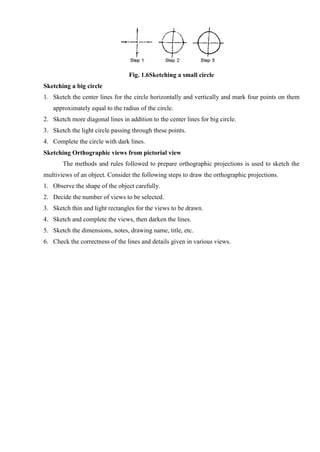
Sketching a small circle
1. Sketch the center lines for the circle horizontally and vertically and mark four points on them
approximately equal to the radius of the circle.
2. Sketch the light circle passing through these points.
3. Complete the circle with dark lines.
Fig. 1.6Sketching a small circle
Sketching a big circle
1. Sketch the center lines for the circle horizontally and vertically and mark four points on them
approximately equal to the radius of the circle.
2. Sketch more diagonal lines in addition to the center lines for big circle.
3. Sketch the light circle passing through these points.
4. Complete the circle with dark lines.
Sketching Orthographic views from pictorial view
The methods and rules followed to prepare orthographic projections is used to sketch the
multiviews of an object. Consider the following steps to draw the orthographic projections.
1. Observe the shape of the object carefully.
2. Decide the number of views to be selected.
3. Sketch thin and light rectangles for the views to be drawn.
4. Sketch and complete the views, then darken the lines.
5. Sketch the dimensions, notes, drawing name, title, etc.
6. Check the correctness of the lines and details given in various views.
Fig. 1.7 sketching a large circle
General Procedure to draw free hand sketches
1. Mark their directions in the Pictorial View.
2. Measure the overall Length L, Width W and Height H of the object.
3. Using L, W and H, mark spaces for the front and Right Side Views in the form of rectangles [2H
Pencil].
4. Mark the axes at the appropriate places [2H Pencil].
5. Sketch the details simultaneously in both Front and Right Side Views by drawing the
corresponding projects [2H Pencil].
6. Darken all the visible lines [HB Pencil].
7. Add the dimensions.
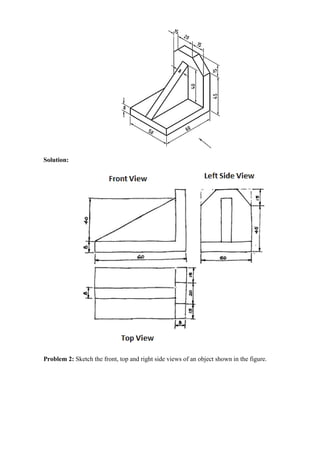
Problem 1: Sketch the front, top and left side views of an object shown in the figure.
Solution:
Problem 2: Sketch the front, top and right side views of an object shown in the figure.
Solution:
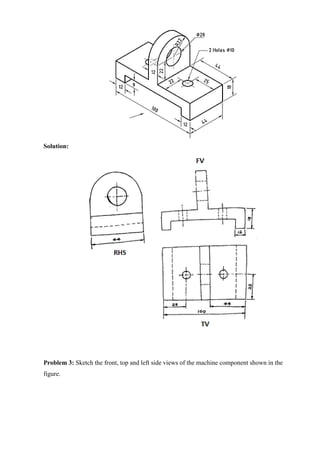
Problem 3: Sketch the front, top and left side views of the machine component shown in the
figure.
Solution:
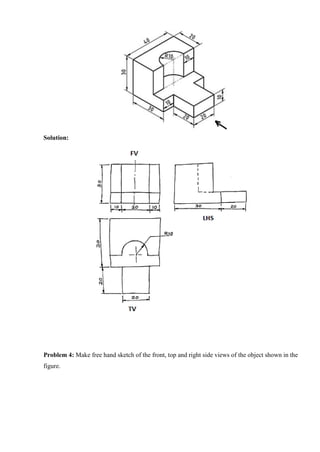
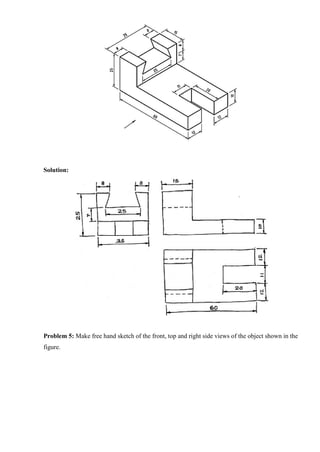
Problem 4: Make free hand sketch of the front, top and right side views of the object shown in the
figure.
Solution:
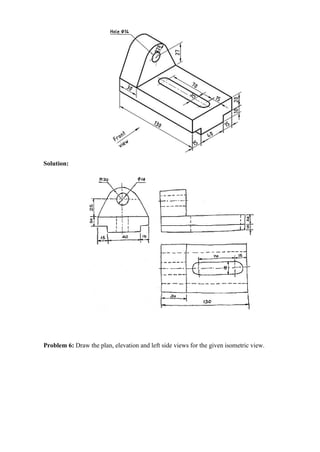
Problem 5: Make free hand sketch of the front, top and right side views of the object shown in the
figure.
Solution:
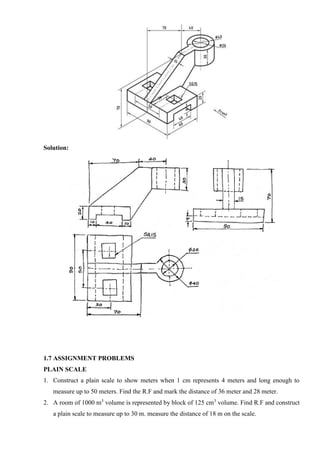
Problem 6: Draw the plan, elevation and left side views for the given isometric view.
Solution:
1.7 ASSIGNMENT PROBLEMS
PLAIN SCALE
1. Construct a plain scale to show meters when 1 cm represents 4 meters and long enough to
measure up to 50 meters. Find the R.F and mark the distance of 36 meter and 28 meter.
2. A room of 1000 m3
volume is represented by block of 125 cm3
volume. Find R.F and construct
a plain scale to measure up to 30 m. measure the distance of 18 m on the scale.
DIAGONAL SCALE
1. A distance between Coimbatore and Madurai is 200 km and its equivalent distance on the map
measures 10 cm. Draw the diagonal scale to indicate 223 km and 135 km.
2. A rectangular plot of land measuring 1.28 hectors represented on a map by a similar rectangle
of 8 sq.cm. Calculate R.F of scale. Draw diagonal scale to read single meter. Show a distance
of 438 m on it.
VERNIER SCALE
1. Draw a vernier scale of R.F = 1/25 to read centimeters up to 4 meters and on it,show lengths
2.39 m and 0.91 m.
2. A map of size 500 cm X 50 cm wide represents an area of 6250 sq.kms. Construct a vernier
scale to measure kilometers, hectometers and decameters and long enough to measure upto
7km. Indicate on it (a) 5.33 km (b) 59 decameters.
ELLIPSE
1. Draw the locus of a point P moving so that the ratio of the distance from a fixed point F to its
distance from a fixed straight line DD’ is ¾. Point F is at a distance of 35 mm from DD’. Also
draw a tangent and normal to the curve.
PARABOLA
2. Construct a parabola when the distance between the focus and directrix is 30 mm. Draw the
tangent and normal at any point on the curve.
HYPERBOLA
3. The vertex of the hyperbola is 65 mm from its focus. Draw the curve if the eccentricity is 3/2.
Draw also a tangent and normal at any point on the curve.
CYCLOID
4. A circle of 50 mm diameter rolls on a straight line without slipping. Trace the locus of a point
‘P’ on the circumference of the circle rolling for one revolution. Name the curve. Draw normal and
tangent to the curve at any point on the curve.
EPICYCLOID
5. Construct an epicycloids generated by a rolling circle of diameter 50 mm and a directing circle
of diameter 150 mm. Draw the tangent and normal to the curve at any point on the epicycloid.
HYPOCYCLOID
6. Draw a hypocycloid of a circle of 40 mm diameter which rolls inside another circle of 200 mm
diameter for one revolution. Draw a tangent and normal at any point on it.
7. Draw a hypocycloid when the radius of the directing circle is twice the radius of the generating
circle. The radius of the generating circle is equal to 35 mm.
SQUARE INVOLUTE
8. Draw the involute of a square of side 40 mm.
CIRCLE INVOLUTE
9. Construct one convolution of an involute of a circle of diameter 30 mm. Draw tangent and
normal at appoint on the involute 65 mm distant from the centre of the circle.
FREEHAND SKETCHING
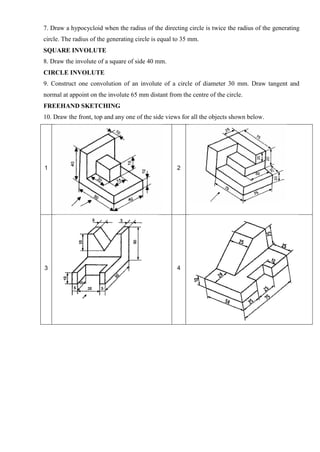
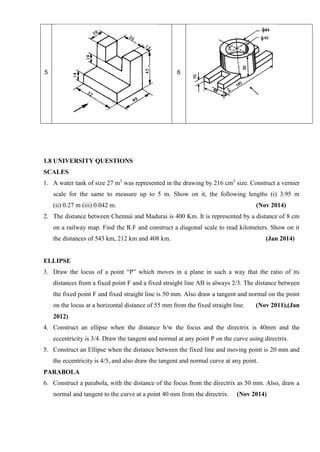
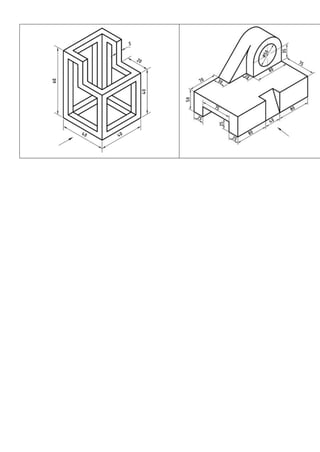
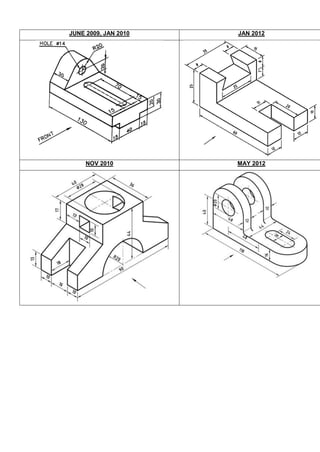
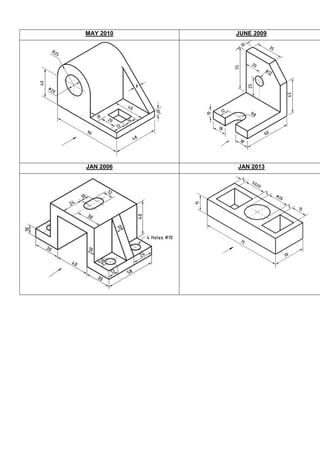
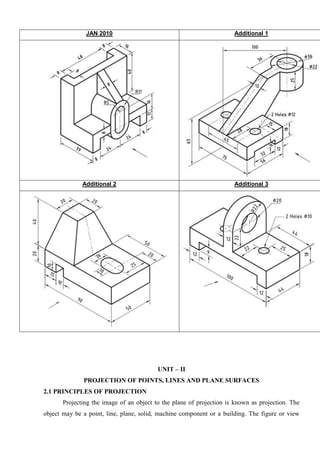
10. Draw the front, top and any one of the side views for all the objects shown below.
1 2
3 4
5 6
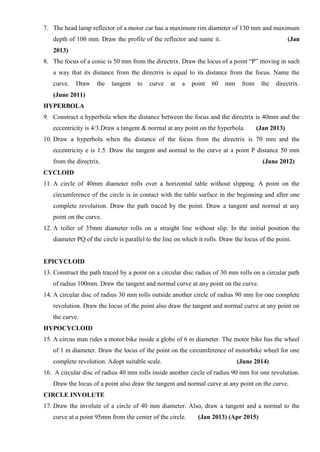
1.8 UNIVERSITY QUESTIONS
SCALES
1. A water tank of size 27 m3
was represented in the drawing by 216 cm3
size. Construct a vernier
scale for the same to measure up to 5 m. Show on it, the following lengths (i) 3.95 m
(ii) 0.27 m (iii) 0.042 m. (Nov 2014)
2. The distance between Chennai and Madurai is 400 Km. It is represented by a distance of 8 cm
on a railway map. Find the R.F and construct a diagonal scale to read kilometers. Show on it
the distances of 543 km, 212 km and 408 km. (Jan 2014)
ELLIPSE
3. Draw the locus of a point “P” which moves in a plane in such a way that the ratio of its
distances from a fixed point F and a fixed straight line AB is always 2/3. The distance between
the fixed point F and fixed straight line is 50 mm. Also draw a tangent and normal on the point
on the locus at a horizontal distance of 55 mm from the fixed straight line. (Nov 2011),(Jan
2012)
4. Construct an ellipse when the distance b/w the focus and the directrix is 40mm and the
eccentricity is 3/4. Draw the tangent and normal at any point P on the curve using directrix.
5. Construct an Ellipse when the distance between the fixed line and moving point is 20 mm and
the eccentricity is 4/5, and also draw the tangent and normal curve at any point.
PARABOLA
6. Construct a parabola, with the distance of the focus from the directrix as 50 mm. Also, draw a
normal and tangent to the curve at a point 40 mm from the directrix. (Nov 2014)
7. The head lamp reflector of a motor car has a maximum rim diameter of 130 mm and maximum
depth of 100 mm. Draw the profile of the reflector and name it. (Jan
2013)
8. The focus of a conic is 50 mm from the directrix. Draw the locus of a point “P” moving in such
a way that its distance from the directrix is equal to its distance from the focus. Name the
curve. Draw the tangent to curve at a point 60 mm from the directrix.
(June 2011)
HYPERBOLA
9. Construct a hyperbola when the distance between the focus and the directrix is 40mm and the
eccentricity is 4/3.Draw a tangent & normal at any point on the hyperbola. (Jan 2013)
10. Draw a hyperbola when the distance of the focus from the directrix is 70 mm and the
eccentricity e is 1.5. Draw the tangent and normal to the curve at a point P distance 50 mm
from the directrix. (June 2012)
CYCLOID
11. A circle of 40mm diameter rolls over a horizontal table without slipping. A point on the
circumference of the circle is in contact with the table surface in the beginning and after one
complete revolution. Draw the path traced by the point. Draw a tangent and normal at any
point on the curve.
12. A roller of 35mm diameter rolls on a straight line without slip. In the initial position the
diameter PQ of the circle is parallel to the line on which it rolls. Draw the locus of the point.
EPICYCLOID
13. Construct the path traced by a point on a circular disc radius of 30 mm rolls on a circular path
of radius 100mm. Draw the tangent and normal curve at any point on the curve.
14. A circular disc of radius 30 mm rolls outside another circle of radius 90 mm for one complete
revolution. Draw the locus of the point also draw the tangent and normal curve at any point on
the curve.
HYPOCYCLOID
15. A circus man rides a motor bike inside a globe of 6 m diameter. The motor bike has the wheel
of 1 m diameter. Draw the locus of the point on the circumference of motorbike wheel for one
complete revolution. Adopt suitable scale. (June 2014)
16. A circular disc of radius 40 mm rolls inside another circle of radius 90 mm for one revolution.
Draw the locus of a point also draw the tangent and normal curve at any point on the curve.
CIRCLE INVOLUTE
17. Draw the involute of a circle of 40 mm diameter. Also, draw a tangent and a normal to the
curve at a point 95mm from the center of the circle. (Jan 2013) (Apr 2015)
18. Draw the involute of a circle of diameter 50 mm when string is unwound in the clockwise
direction. Draw tangent and normal at a point located on the involute. (Jan 2012)
19. A coir is unwound from a drum of 30mm diameter, draw the locus of free end of the coir for
unwinding through an angle of 360°
20. A string of length 135 mm is wound around a circle diameter of 36 mm. It is unwound from
the circle, trace path of the end of string. Draw a tangent and normal curve at any point on the
curve.
SQUARE INVOLUTE
21. Draw the involute of a square of side 30 mm. Draw a tangent and normal at any point on the
involute. (Jan 2014)
22. Draw an involute of a square of side 35mm, Draw the tangent and normal at any point.
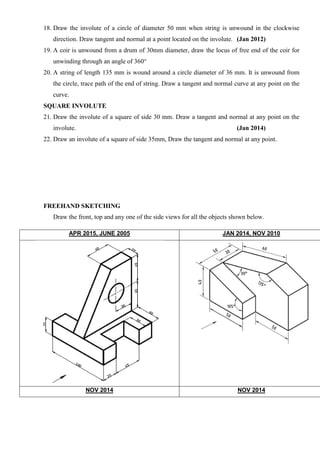
FREEHAND SKETCHING
Draw the front, top and any one of the side views for all the objects shown below.
APR 2015, JUNE 2005 JAN 2014, NOV 2010
NOV 2014 NOV 2014
JUNE 2009, JAN 2010 JAN 2012
NOV 2010 MAY 2012
MAY 2010 JUNE 2009
JAN 2006 JAN 2013
UNIT – II
PROJECTION OF POINTS, LINES AND PLANE SURFACES
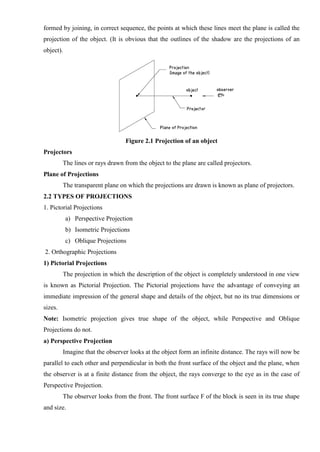
2.1 PRINCIPLES OF PROJECTION
Projecting the image of an object to the plane of projection is known as projection. The
object may be a point, line, plane, solid, machine component or a building. The figure or view
JAN 2010 Additional 1
Additional 2 Additional 3
formed by joining, in correct sequence, the points at which these lines meet the plane is called the
projection of the object. (It is obvious that the outlines of the shadow are the projections of an
object).
Figure 2.1 Projection of an object
Projectors
The lines or rays drawn from the object to the plane are called projectors.
Plane of Projections
The transparent plane on which the projections are drawn is known as plane of projectors.
2.2 TYPES OF PROJECTIONS
1. Pictorial Projections
a) Perspective Projection
b) Isometric Projections
c) Oblique Projections
2. Orthographic Projections
1) Pictorial Projections
The projection in which the description of the object is completely understood in one view
is known as Pictorial Projection. The Pictorial projections have the advantage of conveying an
immediate impression of the general shape and details of the object, but no its true dimensions or
sizes.
Note: Isometric projection gives true shape of the object, while Perspective and Oblique
Projections do not.
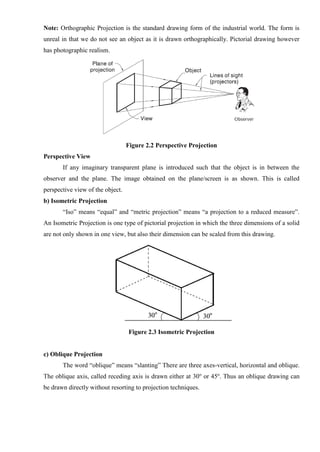
a) Perspective Projection
Imagine that the observer looks at the object form an infinite distance. The rays will now be
parallel to each other and perpendicular in both the front surface of the object and the plane, when
the observer is at a finite distance from the object, the rays converge to the eye as in the case of
Perspective Projection.
The observer looks from the front. The front surface F of the block is seen in its true shape
and size.
Note: Orthographic Projection is the standard drawing form of the industrial world. The form is
unreal in that we do not see an object as it is drawn orthographically. Pictorial drawing however
has photographic realism.
Figure 2.2 Perspective Projection
Perspective View
If any imaginary transparent plane is introduced such that the object is in between the
observer and the plane. The image obtained on the plane/screen is as shown. This is called
perspective view of the object.
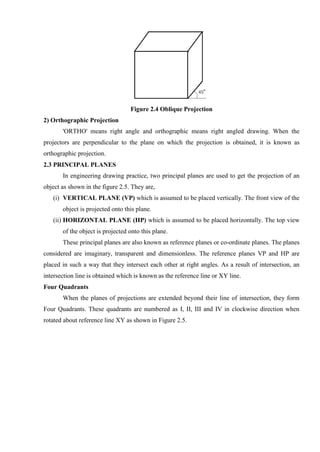
b) Isometric Projection
“Iso” means “equal” and “metric projection” means “a projection to a reduced measure”.
An Isometric Projection is one type of pictorial projection in which the three dimensions of a solid
are not only shown in one view, but also their dimension can be scaled from this drawing.
Figure 2.3 Isometric Projection
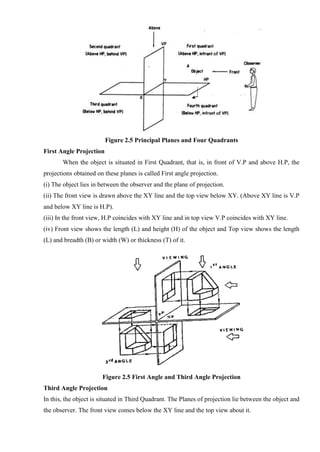
c) Oblique Projection
The word “oblique” means “slanting” There are three axes-vertical, horizontal and oblique.
The oblique axis, called receding axis is drawn either at 30o
or 45o
. Thus an oblique drawing can
be drawn directly without resorting to projection techniques.
Figure 2.4 Oblique Projection
2) Orthographic Projection
'ORTHO' means right angle and orthographic means right angled drawing. When the
projectors are perpendicular to the plane on which the projection is obtained, it is known as
orthographic projection.
2.3 PRINCIPAL PLANES
In engineering drawing practice, two principal planes are used to get the projection of an
object as shown in the figure 2.5. They are,
(i) VERTICAL PLANE (VP) which is assumed to be placed vertically. The front view of the
object is projected onto this plane.
(ii) HORIZONTAL PLANE (HP) which is assumed to be placed horizontally. The top view
of the object is projected onto this plane.
These principal planes are also known as reference planes or co-ordinate planes. The planes
considered are imaginary, transparent and dimensionless. The reference planes VP and HP are
placed in such a way that they intersect each other at right angles. As a result of intersection, an
intersection line is obtained which is known as the reference line or XY line.
Four Quadrants
When the planes of projections are extended beyond their line of intersection, they form
Four Quadrants. These quadrants are numbered as I, II, III and IV in clockwise direction when
rotated about reference line XY as shown in Figure 2.5.
Figure 2.5 Principal Planes and Four Quadrants
First Angle Projection
When the object is situated in First Quadrant, that is, in front of V.P and above H.P, the
projections obtained on these planes is called First angle projection.
(i) The object lies in between the observer and the plane of projection.
(ii) The front view is drawn above the XY line and the top view below XY. (Above XY line is V.P
and below XY line is H.P).
(iii) In the front view, H.P coincides with XY line and in top view V.P coincides with XY line.
(iv) Front view shows the length (L) and height (H) of the object and Top view shows the length
(L) and breadth (B) or width (W) or thickness (T) of it.
Figure 2.5 First Angle and Third Angle Projection
Third Angle Projection
In this, the object is situated in Third Quadrant. The Planes of projection lie between the object and
the observer. The front view comes below the XY line and the top view about it.
Notation followed:
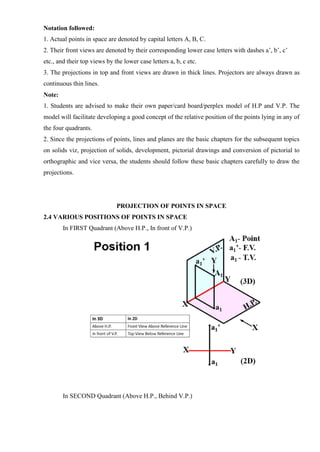
1. Actual points in space are denoted by capital letters A, B, C.
2. Their front views are denoted by their corresponding lower case letters with dashes a’, b’, c’
etc., and their top views by the lower case letters a, b, c etc.
3. The projections in top and front views are drawn in thick lines. Projectors are always drawn as
continuous thin lines.
Note:
1. Students are advised to make their own paper/card board/perplex model of H.P and V.P. The
model will facilitate developing a good concept of the relative position of the points lying in any of
the four quadrants.
2. Since the projections of points, lines and planes are the basic chapters for the subsequent topics
on solids viz, projection of solids, development, pictorial drawings and conversion of pictorial to
orthographic and vice versa, the students should follow these basic chapters carefully to draw the
projections.
PROJECTION OF POINTS IN SPACE
2.4 VARIOUS POSITIONS OF POINTS IN SPACE
In FIRST Quadrant (Above H.P., In front of V.P.)
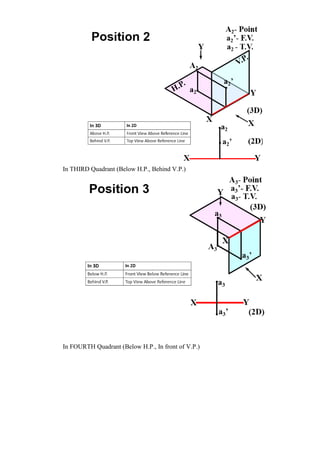
In SECOND Quadrant (Above H.P., Behind V.P.)
In THIRD Quadrant (Below H.P., Behind V.P.)
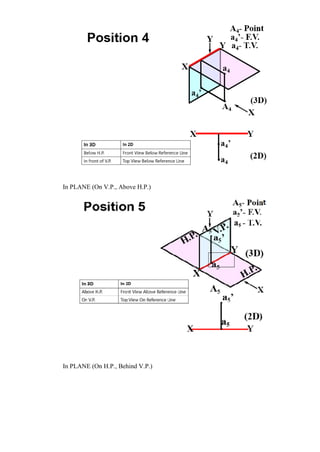
In FOURTH Quadrant (Below H.P., In front of V.P.)
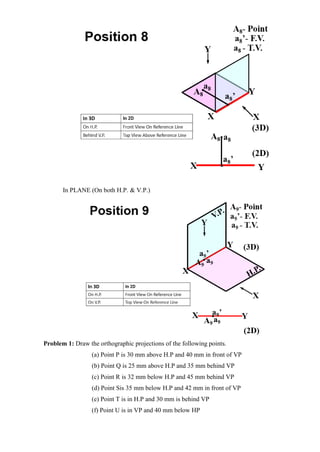
In PLANE (On V.P., Above H.P.)
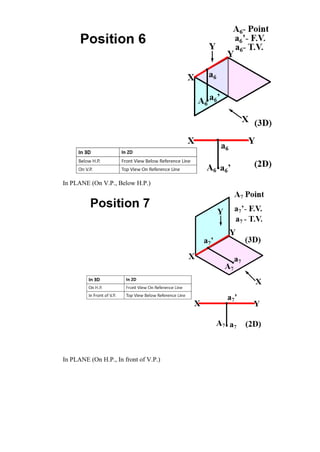
In PLANE (On H.P., Behind V.P.)
In PLANE (On V.P., Below H.P.)
In PLANE (On H.P., In front of V.P.)
In PLANE (On both H.P. & V.P.)
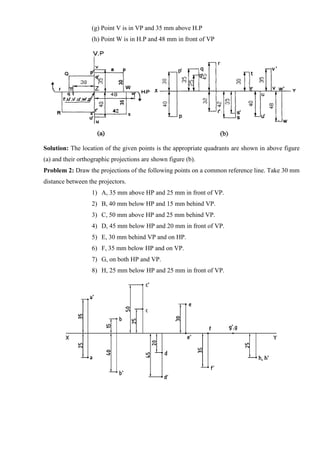
Problem 1: Draw the orthographic projections of the following points.
(a) Point P is 30 mm above H.P and 40 mm in front of VP
(b) Point Q is 25 mm above H.P and 35 mm behind VP
(c) Point R is 32 mm below H.P and 45 mm behind VP
(d) Point Sis 35 mm below H.P and 42 mm in front of VP
(e) Point T is in H.P and 30 mm is behind VP
(f) Point U is in VP and 40 mm below HP
(g) Point V is in VP and 35 mm above H.P
(h) Point W is in H.P and 48 mm in front of VP
Solution: The location of the given points is the appropriate quadrants are shown in above figure
(a) and their orthographic projections are shown figure (b).
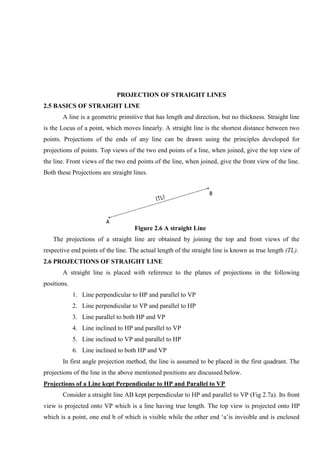
Problem 2: Draw the projections of the following points on a common reference line. Take 30 mm
distance between the projectors.
1) A, 35 mm above HP and 25 mm in front of VP.
2) B, 40 mm below HP and 15 mm behind VP.
3) C, 50 mm above HP and 25 mm behind VP.
4) D, 45 mm below HP and 20 mm in front of VP.
5) E, 30 mm behind VP and on HP.
6) F, 35 mm below HP and on VP.
7) G, on both HP and VP.
8) H, 25 mm below HP and 25 mm in front of VP.
PROJECTION OF STRAIGHT LINES
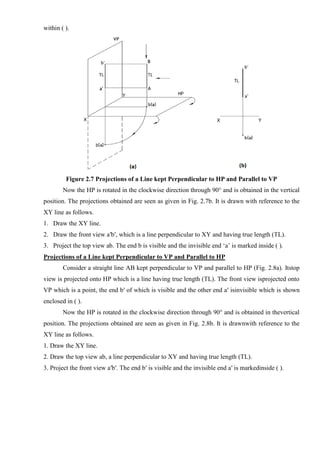
2.5 BASICS OF STRAIGHT LINE
A line is a geometric primitive that has length and direction, but no thickness. Straight line
is the Locus of a point, which moves linearly. A straight line is the shortest distance between two
points. Projections of the ends of any line can be drawn using the principles developed for
projections of points. Top views of the two end points of a line, when joined, give the top view of
the line. Front views of the two end points of the line, when joined, give the front view of the line.
Both these Projections are straight lines.
Figure 2.6 A straight Line
The projections of a straight line are obtained by joining the top and front views of the
respective end points of the line. The actual length of the straight line is known as true length (TL).
2.6 PROJECTIONS OF STRAIGHT LINE
A straight line is placed with reference to the planes of projections in the following
positions.
1. Line perpendicular to HP and parallel to VP
2. Line perpendicular to VP and parallel to HP
3. Line parallel to both HP and VP
4. Line inclined to HP and parallel to VP
5. Line inclined to VP and parallel to HP
6. Line inclined to both HP and VP
In first angle projection method, the line is assumed to be placed in the first quadrant. The
projections of the line in the above mentioned positions are discussed below.
Projections of a Line kept Perpendicular to HP and Parallel to VP
Consider a straight line AB kept perpendicular to HP and parallel to VP (Fig 2.7a). Its front
view is projected onto VP which is a line having true length. The top view is projected onto HP
which is a point, one end b of which is visible while the other end ‘a’is invisible and is enclosed
within ( ).
Figure 2.7 Projections of a Line kept Perpendicular to HP and Parallel to VP
Now the HP is rotated in the clockwise direction through 90° and is obtained in the vertical
position. The projections obtained are seen as given in Fig. 2.7b. It is drawn with reference to the
XY line as follows.
1. Draw the XY line.
2. Draw the front view a′b′, which is a line perpendicular to XY and having true length (TL).
3. Project the top view ab. The end b is visible and the invisible end ‘a’ is marked inside ( ).
Projections of a Line kept Perpendicular to VP and Parallel to HP
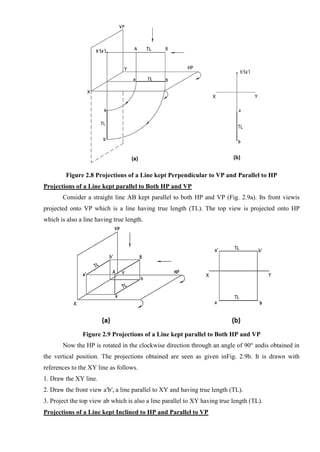
Consider a straight line AB kept perpendicular to VP and parallel to HP (Fig. 2.8a). Itstop
view is projected onto HP which is a line having true length (TL). The front view isprojected onto
VP which is a point, the end b′ of which is visible and the other end a′ isinvisible which is shown
enclosed in ( ).
Now the HP is rotated in the clockwise direction through 90° and is obtained in thevertical
position. The projections obtained are seen as given in Fig. 2.8b. It is drawnwith reference to the
XY line as follows.
1. Draw the XY line.
2. Draw the top view ab, a line perpendicular to XY and having true length (TL).
3. Project the front view a′b′. The end b′ is visible and the invisible end a′ is markedinside ( ).
Figure 2.8 Projections of a Line kept Perpendicular to VP and Parallel to HP
Projections of a Line kept parallel to Both HP and VP
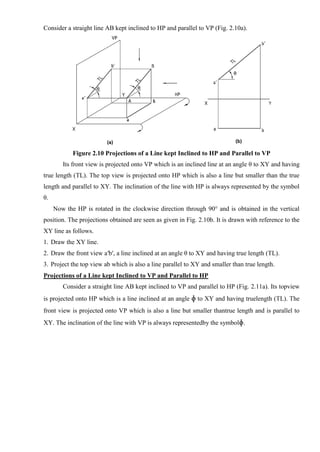
Consider a straight line AB kept parallel to both HP and VP (Fig. 2.9a). Its front viewis
projected onto VP which is a line having true length (TL). The top view is projected onto HP
which is also a line having true length.
Figure 2.9 Projections of a Line kept parallel to Both HP and VP
Now the HP is rotated in the clockwise direction through an angle of 90° andis obtained in
the vertical position. The projections obtained are seen as given inFig. 2.9b. It is drawn with
references to the XY line as follows.
1. Draw the XY line.
2. Draw the front view a′b′, a line parallel to XY and having true length (TL).
3. Project the top view ab which is also a line parallel to XY having true length (TL).
Projections of a Line kept Inclined to HP and Parallel to VP
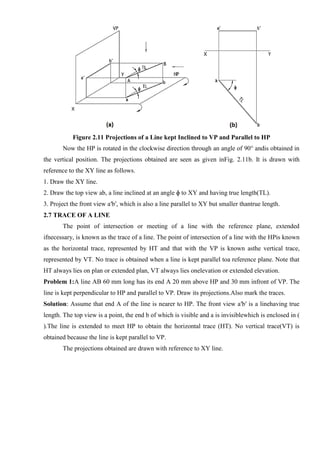
Consider a straight line AB kept inclined to HP and parallel to VP (Fig. 2.10a).
Figure 2.10 Projections of a Line kept Inclined to HP and Parallel to VP
Its front view is projected onto VP which is an inclined line at an angle θ to XY and having
true length (TL). The top view is projected onto HP which is also a line but smaller than the true
length and parallel to XY. The inclination of the line with HP is always represented by the symbol
θ.
Now the HP is rotated in the clockwise direction through 90° and is obtained in the vertical
position. The projections obtained are seen as given in Fig. 2.10b. It is drawn with reference to the
XY line as follows.
1. Draw the XY line.
2. Draw the front view a′b′, a line inclined at an angle θ to XY and having true length (TL).
3. Project the top view ab which is also a line parallel to XY and smaller than true length.
Projections of a Line kept Inclined to VP and Parallel to HP
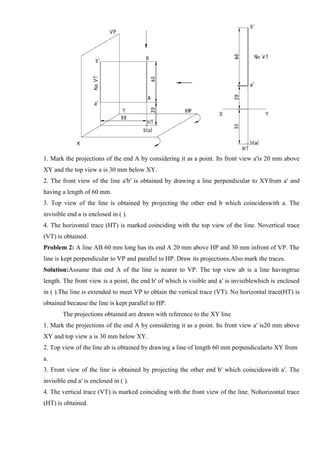
Consider a straight line AB kept inclined to VP and parallel to HP (Fig. 2.11a). Its topview
is projected onto HP which is a line inclined at an angle ɸ to XY and having truelength (TL). The
front view is projected onto VP which is also a line but smaller thantrue length and is parallel to
XY. The inclination of the line with VP is always representedby the symbolɸ.
Figure 2.11 Projections of a Line kept Inclined to VP and Parallel to HP
Now the HP is rotated in the clockwise direction through an angle of 90° andis obtained in
the vertical position. The projections obtained are seen as given inFig. 2.11b. It is drawn with
reference to the XY line as follows.
1. Draw the XY line.
2. Draw the top view ab, a line inclined at an angle ɸ to XY and having true length(TL).
3. Project the front view a′b′, which is also a line parallel to XY but smaller thantrue length.
2.7 TRACE OF A LINE
The point of intersection or meeting of a line with the reference plane, extended
ifnecessary, is known as the trace of a line. The point of intersection of a line with the HPis known
as the horizontal trace, represented by HT and that with the VP is known asthe vertical trace,
represented by VT. No trace is obtained when a line is kept parallel toa reference plane. Note that
HT always lies on plan or extended plan, VT always lies onelevation or extended elevation.
Problem 1:A line AB 60 mm long has its end A 20 mm above HP and 30 mm infront of VP. The
line is kept perpendicular to HP and parallel to VP. Draw its projections.Also mark the traces.
Solution: Assume that end A of the line is nearer to HP. The front view a′b′ is a linehaving true
length. The top view is a point, the end b of which is visible and a is invisiblewhich is enclosed in (
).The line is extended to meet HP to obtain the horizontal trace (HT). No vertical trace(VT) is
obtained because the line is kept parallel to VP.
The projections obtained are drawn with reference to XY line.
1. Mark the projections of the end A by considering it as a point. Its front view a′is 20 mm above
XY and the top view a is 30 mm below XY.
2. The front view of the line a′b′ is obtained by drawing a line perpendicular to XYfrom a′ and
having a length of 60 mm.
3. Top view of the line is obtained by projecting the other end b which coincideswith a. The
invisible end a is enclosed in ( ).
4. The horizontal trace (HT) is marked coinciding with the top view of the line. Novertical trace
(VT) is obtained.
Problem 2: A line AB 60 mm long has its end A 20 mm above HP and 30 mm infront of VP. The
line is kept perpendicular to VP and parallel to HP. Draw its projections.Also mark the traces.
Solution:Assume that end A of the line is nearer to VP. The top view ab is a line havingtrue
length. The front view is a point, the end b′ of which is visible and a′ is invisiblewhich is enclosed
in ( ).The line is extended to meet VP to obtain the vertical trace (VT). No horizontal trace(HT) is
obtained because the line is kept parallel to HP.
The projections obtained are drawn with reference to the XY line
1. Mark the projections of the end A by considering it as a point. Its front view a′ is20 mm above
XY and top view a is 30 mm below XY.
2. Top view of the line ab is obtained by drawing a line of length 60 mm perpendicularto XY from
a.
3. Front view of the line is obtained by projecting the other end b′ which coincideswith a′. The
invisible end a′ is enclosed in ( ).
4. The vertical trace (VT) is marked coinciding with the front view of the line. Nohorizontal trace
(HT) is obtained.
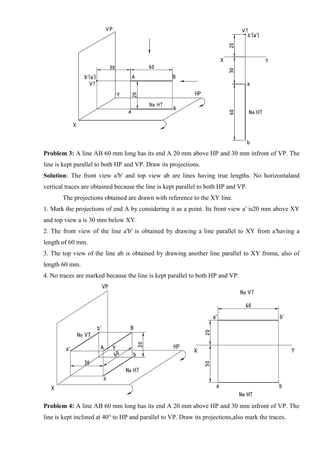
Problem 3: A line AB 60 mm long has its end A 20 mm above HP and 30 mm infront of VP. The
line is kept parallel to both HP and VP. Draw its projections.
Solution: The front view a′b′ and top view ab are lines having true lengths. No horizontaland
vertical traces are obtained because the line is kept parallel to both HP and VP.
The projections obtained are drawn with reference to the XY line.
1. Mark the projections of end A by considering it as a point. Its front view a′ is20 mm above XY
and top view a is 30 mm below XY.
2. The front view of the line a′b′ is obtained by drawing a line parallel to XY from a′having a
length of 60 mm.
3. The top view of the line ab is obtained by drawing another line parallel to XY froma, also of
length 60 mm.
4. No traces are marked because the line is kept parallel to both HP and VP.
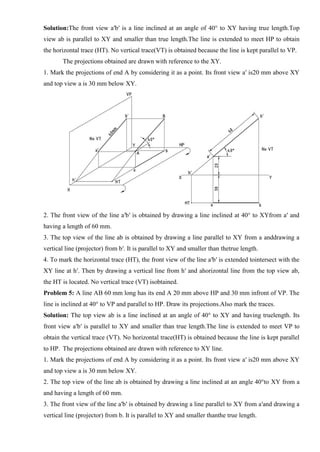
Problem 4: A line AB 60 mm long has its end A 20 mm above HP and 30 mm infront of VP. The
line is kept inclined at 40° to HP and parallel to VP. Draw its projections,also mark the traces.
Solution:The front view a′b′ is a line inclined at an angle of 40° to XY having true length.Top
view ab is parallel to XY and smaller than true length.The line is extended to meet HP to obtain
the horizontal trace (HT). No vertical trace(VT) is obtained because the line is kept parallel to VP.
The projections obtained are drawn with reference to the XY.
1. Mark the projections of end A by considering it as a point. Its front view a′ is20 mm above XY
and top view a is 30 mm below XY.
2. The front view of the line a′b′ is obtained by drawing a line inclined at 40° to XYfrom a′ and
having a length of 60 mm.
3. The top view of the line ab is obtained by drawing a line parallel to XY from a anddrawing a
vertical line (projector) from b′. It is parallel to XY and smaller than thetrue length.
4. To mark the horizontal trace (HT), the front view of the line a′b′ is extended tointersect with the
XY line at h′. Then by drawing a vertical line from h′ and ahorizontal line from the top view ab,
the HT is located. No vertical trace (VT) isobtained.
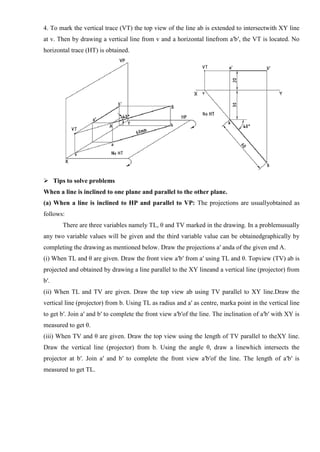
Problem 5: A line AB 60 mm long has its end A 20 mm above HP and 30 mm infront of VP. The
line is inclined at 40° to VP and parallel to HP. Draw its projections.Also mark the traces.
Solution: The top view ab is a line inclined at an angle of 40° to XY and having truelength. Its
front view a′b′ is parallel to XY and smaller than true length.The line is extended to meet VP to
obtain the vertical trace (VT). No horizontal trace(HT) is obtained because the line is kept parallel
to HP. The projections obtained are drawn with reference to XY line.
1. Mark the projections of end A by considering it as a point. Its front view a′ is20 mm above XY
and top view a is 30 mm below XY.
2. The top view of the line ab is obtained by drawing a line inclined at an angle 40°to XY from a
and having a length of 60 mm.
3. The front view of the line a′b′ is obtained by drawing a line parallel to XY from a′and drawing a
vertical line (projector) from b. It is parallel to XY and smaller thanthe true length.
4. To mark the vertical trace (VT) the top view of the line ab is extended to intersectwith XY line
at v. Then by drawing a vertical line from v and a horizontal linefrom a′b′, the VT is located. No
horizontal trace (HT) is obtained.
 Tips to solve problems
When a line is inclined to one plane and parallel to the other plane.
(a) When a line is inclined to HP and parallel to VP: The projections are usuallyobtained as
follows:
There are three variables namely TL, θ and TV marked in the drawing. In a problemusually
any two variable values will be given and the third variable value can be obtainedgraphically by
completing the drawing as mentioned below. Draw the projections a′ anda of the given end A.
(i) When TL and θ are given. Draw the front view a′b′ from a′ using TL and θ. Topview (TV) ab is
projected and obtained by drawing a line parallel to the XY lineand a vertical line (projector) from
b′.
(ii) When TL and TV are given. Draw the top view ab using TV parallel to XY line.Draw the
vertical line (projector) from b. Using TL as radius and a′ as centre, marka point in the vertical line
to get b′. Join a′ and b′ to complete the front view a′b′of the line. The inclination of a′b′ with XY is
measured to get θ.
(iii) When TV and θ are given. Draw the top view using the length of TV parallel to theXY line.
Draw the vertical line (projector) from b. Using the angle θ, draw a linewhich intersects the
projector at b′. Join a′ and b′ to complete the front view a′b′of the line. The length of a′b′ is
measured to get TL.
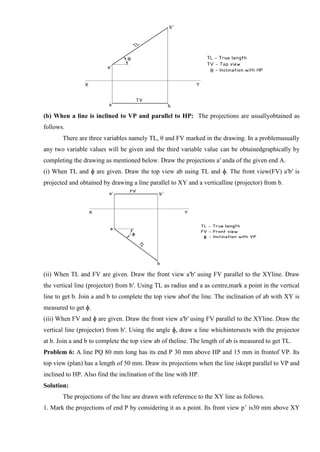
(b) When a line is inclined to VP and parallel to HP: The projections are usuallyobtained as
follows.
There are three variables namely TL, θ and FV marked in the drawing. In a problemusually
any two variable values will be given and the third variable value can be obtainedgraphically by
completing the drawing as mentioned below. Draw the projections a′ anda of the given end A.
(i) When TL and ɸ are given. Draw the top view ab using TL and ɸ. The front view(FV) a′b′ is
projected and obtained by drawing a line parallel to XY and a verticalline (projector) from b.
(ii) When TL and FV are given. Draw the front view a′b′ using FV parallel to the XYline. Draw
the vertical line (projector) from b′. Using TL as radius and a as centre,mark a point in the vertical
line to get b. Join a and b to complete the top view abof the line. The inclination of ab with XY is
measured to get ɸ.
(iii) When FV and ɸ are given. Draw the front view a′b′ using FV parallel to the XYline. Draw the
vertical line (projector) from b′. Using the angle ɸ, draw a line whichintersects with the projector
at b. Join a and b to complete the top view ab of theline. The length of ab is measured to get TL.
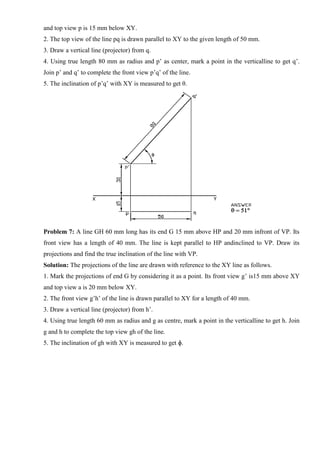
Problem 6: A line PQ 80 mm long has its end P 30 mm above HP and 15 mm in frontof VP. Its
top view (plan) has a length of 50 mm. Draw its projections when the line iskept parallel to VP and
inclined to HP. Also find the inclination of the line with HP.
Solution:
The projections of the line are drawn with reference to the XY line as follows.
1. Mark the projections of end P by considering it as a point. Its front view p’ is30 mm above XY
and top view p is 15 mm below XY.
2. The top view of the line pq is drawn parallel to XY to the given length of 50 mm.
3. Draw a vertical line (projector) from q.
4. Using true length 80 mm as radius and p’ as center, mark a point in the verticalline to get q’.
Join p’ and q’ to complete the front view p’q’ of the line.
5. The inclination of p’q’ with XY is measured to get θ.
Problem 7: A line GH 60 mm long has its end G 15 mm above HP and 20 mm infront of VP. Its
front view has a length of 40 mm. The line is kept parallel to HP andinclined to VP. Draw its
projections and find the true inclination of the line with VP.
Solution: The projections of the line are drawn with reference to the XY line as follows.
1. Mark the projections of end G by considering it as a point. Its front view g’ is15 mm above XY
and top view a is 20 mm below XY.
2. The front view g’h’ of the line is drawn parallel to XY for a length of 40 mm.
3. Draw a vertical line (projector) from h’.
4. Using true length 60 mm as radius and g as centre, mark a point in the verticalline to get h. Join
g and h to complete the top view gh of the line.
5. The inclination of gh with XY is measured to get ɸ.
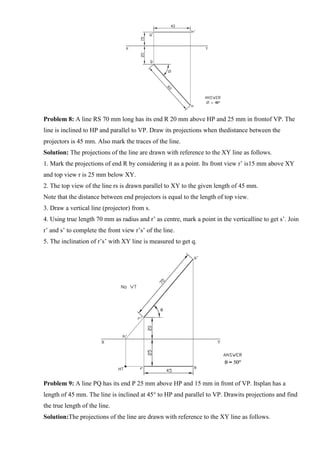
Problem 8: A line RS 70 mm long has its end R 20 mm above HP and 25 mm in frontof VP. The
line is inclined to HP and parallel to VP. Draw its projections when thedistance between the
projectors is 45 mm. Also mark the traces of the line.
Solution: The projections of the line are drawn with reference to the XY line as follows.
1. Mark the projections of end R by considering it as a point. Its front view r’ is15 mm above XY
and top view r is 25 mm below XY.
2. The top view of the line rs is drawn parallel to XY to the given length of 45 mm.
Note that the distance between end projectors is equal to the length of top view.
3. Draw a vertical line (projector) from s.
4. Using true length 70 mm as radius and r’ as centre, mark a point in the verticalline to get s’. Join
r’ and s’ to complete the front view r’s’ of the line.
5. The inclination of r’s’ with XY line is measured to get q.
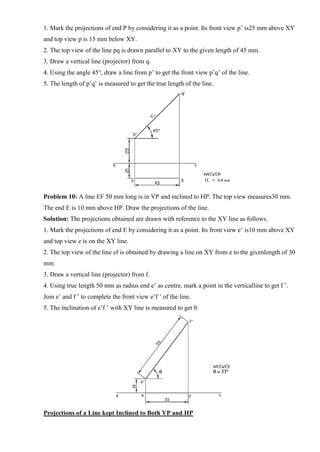
Problem 9: A line PQ has its end P 25 mm above HP and 15 mm in front of VP. Itsplan has a
length of 45 mm. The line is inclined at 45° to HP and parallel to VP. Drawits projections and find
the true length of the line.
Solution:The projections of the line are drawn with reference to the XY line as follows.
1. Mark the projections of end P by considering it as a point. Its front view p’ is25 mm above XY
and top view p is 15 mm below XY.
2. The top view of the line pq is drawn parallel to XY to the given length of 45 mm.
3. Draw a vertical line (projector) from q.
4. Using the angle 45°, draw a line from p’ to get the front view p’q’ of the line.
5. The length of p’q’ is measured to get the true length of the line.
Problem 10: A line EF 50 mm long is in VP and inclined to HP. The top view measures30 mm.
The end E is 10 mm above HP. Draw the projections of the line.
Solution: The projections obtained are drawn with reference to the XY line as follows.
1. Mark the projections of end E by considering it as a point. Its front view e’ is10 mm above XY
and top view e is on the XY line.
2. The top view of the line ef is obtained by drawing a line on XY from e to the givenlength of 30
mm.
3. Draw a vertical line (projector) from f.
4. Using true length 50 mm as radius end e’ as centre, mark a point in the verticalline to get f ’.
Join e’ and f ’ to complete the front view e’f ’ of the line.
5. The inclination of e’f ’ with XY line is measured to get θ.
Projections of a Line kept Inclined to Both VP and HP
When a line is placed inclined to both HP and VP, its projections obtained in top and front
views are smaller than the true length of the line and inclined to the XY line. So it is impossible to
project and draw the top or front view of the line directly. Any one of the following methods may
be used to draw the projections.
(i) Rotating line method
(ii) Rotating trapezoidal plane method
(iii) Auxiliary plane method
ROTATING LINE METHOD
Consider a line AB is placed inclined at θ to HP and ɸ to VP. Draw its projections
assuming that the line is placed in the first quadrant. The following steps are to find the top view
(plan) and front view (elevation) lengths and then, they are rotated to the required position to
represent the projections of the line in the given position.
Mark the projections of the end A by considering it as a point. Its front view a’ will be
obtained above XY and top view a will be obtained below the XY line.
Step 1: Assume that the line is kept inclined to HP and parallel to VP. Draw the front view a’b1’,
it is a line inclined at q to XY and having true length (TL). Project and get the top view ab1 length
which is parallel to XY line. Then this will be rotated to the required position (Fig. 2.12 (i)).
Step 2: Assume the line is kept inclined to VP and parallel to HP. Draw the top view ab2, it is a
line inclined atɸto XY and having true length (TL). Project and get the front view ab2’ length
which is parallel to XY line. Then this will be rotated to the required position (Fig. 2.12 (ii)).
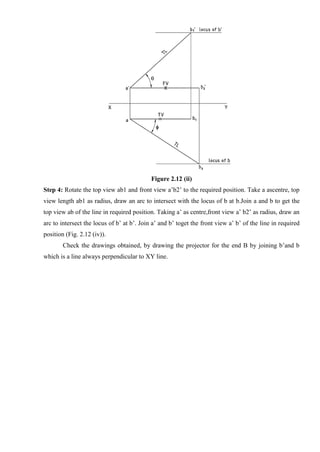
Figure 2.12 (i) Figure 2.12 (ii)
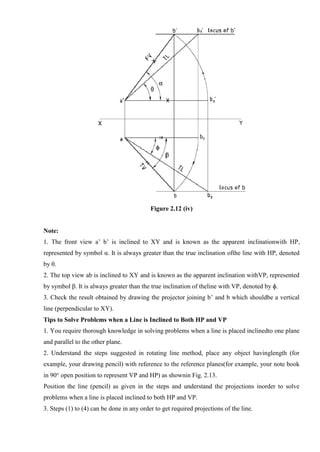
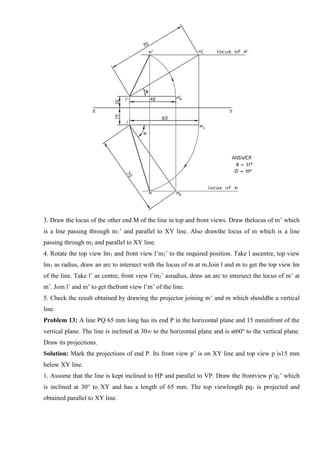
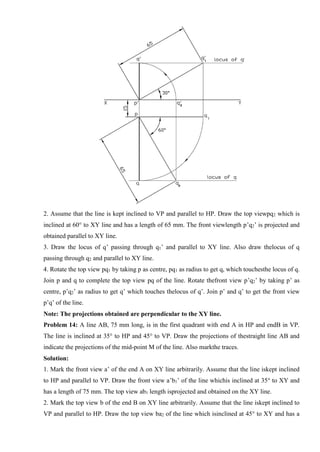
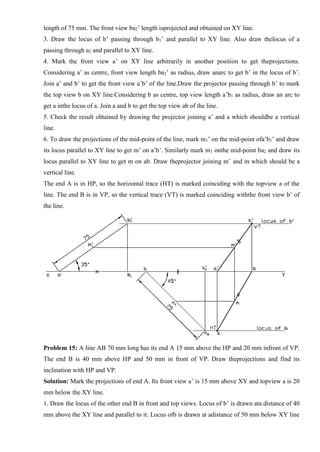
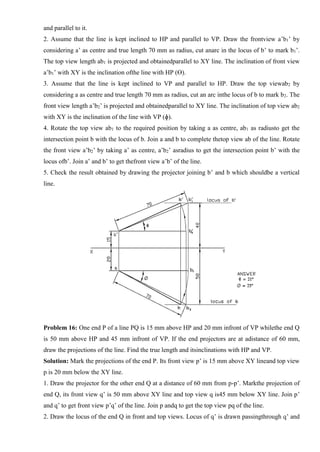
Step 3: Draw the locus of the other end B of the line in top and front views. Draw the locus of the
front view b’ as a line passing through b1’ and parallel to XY line. Draw the locus of the top view
b as a line passing through b2 and parallel to XY line (Fig. 2.12 (iii)). Note that step 1 and step 2
are shown together.
Figure 2.12 (ii)
Step 4: Rotate the top view ab1 and front view a’b2’ to the required position. Take a ascentre, top
view length ab1 as radius, draw an arc to intersect with the locus of b at b.Join a and b to get the
top view ab of the line in required position. Taking a’ as centre,front view a’ b2’ as radius, draw an
arc to intersect the locus of b’ at b’. Join a’ and b’ toget the front view a’ b’ of the line in required
position (Fig. 2.12 (iv)).
Check the drawings obtained, by drawing the projector for the end B by joining b’and b
which is a line always perpendicular to XY line.
Figure 2.12 (iv)
Note:
1. The front view a’ b’ is inclined to XY and is known as the apparent inclinationwith HP,
represented by symbol α. It is always greater than the true inclination ofthe line with HP, denoted
by θ.
2. The top view ab is inclined to XY and is known as the apparent inclination withVP, represented
by symbol β. It is always greater than the true inclination of theline with VP, denoted by ɸ.
3. Check the result obtained by drawing the projector joining b’ and b which shouldbe a vertical
line (perpendicular to XY).
Tips to Solve Problems when a Line is Inclined to Both HP and VP
1. You require thorough knowledge in solving problems when a line is placed inclinedto one plane
and parallel to the other plane.
2. Understand the steps suggested in rotating line method, place any object havinglength (for
example, your drawing pencil) with reference to the reference planes(for example, your note book
in 90° open position to represent VP and HP) as shownin Fig. 2.13.
Position the line (pencil) as given in the steps and understand the projections inorder to solve
problems when a line is placed inclined to both HP and VP.
3. Steps (1) to (4) can be done in any order to get required projections of the line.
Figure 2.13
SPECIAL CASES
1.Projections of a Line when θ+ ɸ= 90o
When the sum of inclinations with HP and VP is equal to 90° (θ+ ɸ= 90°), then the
linecontained by a plane will be perpendicular to both HP and VP. The top view aband frontview
a’b’of the line will be obtained perpendicular to XY line.
2.Projections of a Line when One End of the Line is in HP and the other in VP
This is considered a special case, when only one condition is given for both ends, oneend in
HP and another end in VP.
Consider a line AB having its end A in HP, (its position from VP not given) and
anotherend B in VP (its position from HP is not given).
The drawing procedure for this line is the same as in the previous problems, butsteps
involved in drawing the projections are drawn separately to get the final projections.
The vertical trace (VT) will coincide with the end touching the VP and the horizontaltrace
(HT) will coincide with the end touching the HP.
Problem 11:A line AB 80 mm long has its end A 20 mm above HP and 25 mm infront of VP. The
line is inclined at 45° to HP and 35° to VP. Draw its projections.
Solution: Mark the projections of end A by considering it as a point. Its front view a’ is20 mm
above XY and top view a is 25 mm below the XY line.
1. Assume that the line is kept inclined to HP and parallel to VP. Draw the frontview a’b1’, a line
inclined at 45° to XY line and having a length of 80 mm. Projectand get the top view ab1 length
which is parallel to XY line.
2. Assume that the line is kept inclined to VP and parallel to HP. Draw the top viewab2, a line
inclined at 35° to XY line and having a length of 80 mm. Project andget the front view ab2’ length
which is also parallel to XY line.
3. Draw the locus of the other end B of the line in top and front views. Draw thelocus of b’ which
is a line passing through b1’ and parallel to XY line. Also drawthe locus of b which is a line
passing through b2 and parallel to XY line.
4. Rotate the top view ab1 and front view a’b2’ to the required position. Take a ascentre, top view
length ab1 as radius, draw an arc to intersect the locus ofb at b.Join a and b to get the top view ab
of the line. Take a’ as centre, front view lengtha’b2’ as radius, draw an arc to intersect the locus of
a’ at b’. Join a’ and b’ to getthe front view a’b’ of the line.
5. Check the result obtained by drawing the projector joining b’ and b which shouldbe a vertical
line.
Problem 12:A line LM 70 mm long has its end L 10 mm above HP and 15 mm infrontof VP. The
top view and front view measures 60 mm and 40 mm respectively. Draw theprojections of the line
and determine its inclination with HP and VP.
Solution: Mark the projections of the end L by considering it as a point. Its front view l’ is 10 mm
above XY and top view l is 15 mm below XY line.
1. Assume that the line is kept inclined to HP and parallel to VP. In this case,considering the given
data the top view lm1 can be drawn parallel to XY and havinga length of 60 mm. Draw a vertical
line (projector) through m1. Using true length70 mm as radius and l’ as centre, draw an arc to
intersect the vertical line throughm1 to get m1’. Join l’ and m1’ which represents the true length of
the line. Theinclination of l’m1’ to XY is the inclination of the line with HP (ϴ).
2. Assume that the line is kept inclined to VP and parallel to HP. In this case,considering the given
data, the front view l’m2’ can be drawn parallel to XY andhaving a length of 40 mm. Draw a
vertical line (projector) through m2’. Using truelength 70 mm as radius and l as centre, draw an arc
to intersect the vertical linethrough m2’ to get m2. Join l and m2 which represents the true length of
the line.The inclination of lm2 to XY is the inclination of the line with VP (ɸ).
3. Draw the locus of the other end M of the line in top and front views. Draw thelocus of m’ which
is a line passing through m1’ and parallel to XY line. Also drawthe locus of m which is a line
passing through m2 and parallel to XY line.
4. Rotate the top view lm1 and front view l’m2’ to the required position. Take l ascentre, top view
lm1 as radius, draw an arc to intersect with the locus of m at m.Join l and m to get the top view lm
of the line. Take l’ as centre, front view l’m2’ asradius, draw an arc to intersect the locus of m’ at
m’. Join l’ and m’ to get thefront view l’m’ of the line.
5. Check the result obtained by drawing the projector joining m’ and m which shouldbe a vertical
line.
Problem 13: A line PQ 65 mm long has its end P in the horizontal plane and 15 mminfront of the
vertical plane. The line is inclined at 30∞ to the horizontal plane and is at60o
to the vertical plane.
Draw its projections.
Solution: Mark the projections of end P. Its front view p’ is on XY line and top view p is15 mm
below XY line.
1. Assume that the line is kept inclined to HP and parallel to VP. Draw the frontview p’q1’ which
is inclined at 30° to XY and has a length of 65 mm. The top viewlength pq1 is projected and
obtained parallel to XY line.
2. Assume that the line is kept inclined to VP and parallel to HP. Draw the top viewpq2 which is
inclined at 60° to XY line and has a length of 65 mm. The front viewlength p’q2’ is projected and
obtained parallel to XY line.
3. Draw the locus of q’ passing through q1’ and parallel to XY line. Also draw thelocus of q
passing through q2 and parallel to XY line.
4. Rotate the top view pq1 by taking p as centre, pq1 as radius to get q, which touchesthe locus of q.
Join p and q to complete the top view pq of the line. Rotate thefront view p’q2’ by taking p’ as
centre, p’q2’ as radius to get q’ which touches thelocus of q’. Join p’ and q’ to get the front view
p’q’ of the line.
Note: The projections obtained are perpendicular to the XY line.
Problem 14: A line AB, 75 mm long, is in the first quadrant with end A in HP and endB in VP.
The line is inclined at 35° to HP and 45° to VP. Draw the projections of thestraight line AB and
indicate the projections of the mid-point M of the line. Also markthe traces.
Solution:
1. Mark the front view a’ of the end A on XY line arbitrarily. Assume that the line iskept inclined
to HP and parallel to VP. Draw the front view a’b1’ of the line whichis inclined at 35° to XY and
has a length of 75 mm. The top view ab1 length isprojected and obtained on the XY line.
2. Mark the top view b of the end B on XY line arbitrarily. Assume that the line iskept inclined to
VP and parallel to HP. Draw the top view ba2 of the line which isinclined at 45° to XY and has a
length of 75 mm. The front view ba2’ length isprojected and obtained on XY line.
3. Draw the locus of b’ passing through b1’ and parallel to XY line. Also draw thelocus of a
passing through a2 and parallel to XY line.
4. Mark the front view a’ on XY line arbitrarily in another position to get theprojections.
Considering a’ as centre, front view length ba2’ as radius, draw anarc to get b’ in the locus of b’.
Join a’ and b’ to get the front view a’b’ of the line.Draw the projector passing through b’ to mark
the top view b on XY line.Considering b as centre, top view length a’b1 as radius, draw an arc to
get a inthe locus of a. Join a and b to get the top view ab of the line.
5. Check the result obtained by drawing the projector joining a’ and a which shouldbe a vertical
line.
6. To draw the projections of the mid-point of the line, mark m1’ on the mid-point ofa’b1’ and draw
its locus parallel to XY line to get m’ on a’b’. Similarly mark m1 onthe mid-point ba2 and draw its
locus parallel to XY line to get m on ab. Draw theprojector joining m’ and m which should be a
vertical line.
The end A is in HP, so the horizontal trace (HT) is marked coinciding with the topview a of the
line. The end B is in VP, so the vertical trace (VT) is marked coinciding withthe front view b’ of
the line.
Problem 15: A line AB 70 mm long has its end A 15 mm above the HP and 20 mm infront of VP.
The end B is 40 mm above HP and 50 mm in front of VP. Draw theprojections and find its
inclination with HP and VP.
Solution: Mark the projections of end A. Its front view a’ is 15 mm above XY and topview a is 20
mm below the XY line.
1. Draw the locus of the other end B in front and top views. Locus of b’ is drawn ata distance of 40
mm above the XY line and parallel to it. Locus ofb is drawn at adistance of 50 mm below XY line
and parallel to it.
2. Assume that the line is kept inclined to HP and parallel to VP. Draw the frontview a’b1’ by
considering a’ as centre and true length 70 mm as radius, cut anarc in the locus of b’ to mark b1’.
The top view length ab1 is projected and obtainedparallel to XY line. The inclination of front view
a’b1’ with XY is the inclination ofthe line with HP (ϴ).
3. Assume that the line is kept inclined to VP and parallel to HP. Draw the top viewab2 by
considering a as centre and true length 70 mm as radius, cut an arc inthe locus of b to mark b2. The
front view length a’b2’ is projected and obtainedparallel to XY line. The inclination of top view ab2
with XY is the inclination of the line with VP (ɸ).
4. Rotate the top view ab1 to the required position by taking a as centre, ab1 as radiusto get the
intersection point b with the locus of b. Join a and b to complete thetop view ab of the line. Rotate
the front view a’b2’ by taking a’ as centre, a’b2’ asradius to get the intersection point b’ with the
locus ofb’. Join a’ and b’ to get thefront view a’b’ of the line.
5. Check the result obtained by drawing the projector joining b’ and b which shouldbe a vertical
line.
Problem 16: One end P of a line PQ is 15 mm above HP and 20 mm infront of VP whilethe end Q
is 50 mm above HP and 45 mm infront of VP. If the end projectors are at adistance of 60 mm,
draw the projections of the line. Find the true length and itsinclinations with HP and VP.
Solution: Mark the projections of the end P. Its front view p’ is 15 mm above XY lineand top view
p is 20 mm below the XY line.
1. Draw the projector for the other end Q at a distance of 60 mm from p-p’. Markthe projection of
end Q, its front view q’ is 50 mm above XY line and top view q is45 mm below XY line. Join p’
and q’ to get front view p’q’ of the line. Join p andq to get the top view pq of the line.
2. Draw the locus of the end Q in front and top views. Locus of q’ is drawn passingthrough q’ and
parallel to XY line. Locus of q is drawn passing through q andparallel to XY line.
3. Rotate top view pq in the reverse order, take p as centre, top view length pq asradius, draw an
arc to get q1, on a line drawn parallel to XY line. Project q1 tolocus of q’ to get q1’. Join p’q1’
which has true length (TL) of the line. The inclinationof pq1’ with XY line is the true inclination of
the line with HP (ϴ).
4. Rotate the front view p’q’ in the reverse order, take p’ as centre, front view lengthp’q’ as radius,
draw an arc to get q2’, on a line drawn parallel to XY line. Projectq2’ to the locus of q to get q2.
Join pq2 which has true length (TL) of the line. Theinclination of pq2 with XY line is the
inclination of the line with VP (ɸ).
Problem 17: The end A of a line AB is 10 mm in front of VP and 20 mm above HP. Theline is
inclined at 30° to HP and front view is 45° with XY. Top view is 60 mm long.Complete the two
views. Find the true length and inclination with VP. Locate the traces.
Solution: Mark the projections of end A. Its front view a’ is 20 mm above XY and topview a is 10
mm below XY line.
1. Assume that the line is kept inclined to HP and parallel to VP. Draw its top viewab1 from a
which is parallel to the XY line for a length of 60 mm. Draw a verticalline (projector) from b1 and
draw a line from a’ inclined at 30° to XY line,intersecting at b1’. The front view length a’b1’ is the
true length (TL) of the line.
2. Draw the locus of b’ passing through b1’ and parallel to XY line. Draw the frontview a’b’ of the
line inclined at 45° to the XY line from a’ and intersecting thelocus of b’ at b’.
3. Draw the vertical line (projector) passing through b’. Rotate the top view ab1 bytaking a as
centre and ab1 as radius to intersect with the projector at b. Drawthe locus of b passing through b
and parallel to XY line.
4. Rotate the front view a’b’ in the reverse order. Take a’ as centre, front view a’b’ asradius and
draw an arc to get b2’, parallel to XY line. Project b2’ to the locus of bto get b2. Join ab2 which has
the true length (TL) of the line. The inclination ofab2 with the XY line is the true inclination of the
line with VP (ɸ).
To mark the traces
1. Extend the front view a’b’ to get the intersection point h’ with XY line.
2. Produce the top view ab to get the intersection point v with XY line.
3. Draw a vertical line from h’ to intersect with the top view to get horizontal trace(HT).
4. Draw another vertical line from v to intersect with the front view to get the verticaltrace (VT).
PROJECTION OF PLANE SURFACES
2.8 PLANE SURFACE
A plane figure has two dimensions viz. the length and breadth. It may be of any shape such
as triangular, square, pentagonal, hexagonal, circular etc. The possible orientations of the planes
with respect to the principal planes H.P and V.P of projection are:
1. Plane parallel to one of the principal planes and perpendicular to the other,
2. Plane perpendicular to both the principal planes,
3. Plane inclined to one of the principal planes and perpendicular to the other,
4. Plane inclined to both the principal planes.
1. Plane parallel to one of the principal planes and perpendicular to the other
When a plane is parallel to V.P the front view shows the true shape of the plane. The top
view appears as a line parallel to XY. Figure 2.14.a shows the projections of a square plane
ABCD, when it is parallel to V.P and perpendicular to H.P. The distances of one of the edges
above H.P and from the V.P are denoted by d1 and d2 respectively.
Figure 2.14.b shows the projections of the plane. Figure 2.14.c shows the projections of the plane,
when its edges are equally inclined to H.P.
Figure 2.14
Figure 2.15 shows the projections of a circular plane, parallel to H.P and perpendicular to V.P
Figure 2.15
2. Plane perpendicular to both H.P and V.P
When a plane is perpendicular to both H.P. and V.P, the projections of the plane appear as
straight lines. Figure 2.16 shows the projections of a rectangular plane ABCD, when one of its
longer edges is parallel to H.P. Here, the lengths of the front and top views are equal to the true
lengths of the edges.
Figure 2.16
3. Plane inclined to one of the principal planes and perpendicular to the other
When a plane is inclined to one plane and perpendicular to the other, the projections are
obtained in two stages.
Problem: Projections of a pentagonal plane ABCDE, inclined at ϴ to H.P and perpendicular to
V.P and resting on one of its edges on H.P.
Construction: (Fig.2.17)
Figure 2.17
4. Plane inclined to both H.P and V.P
If a plane is inclined to both H.P and V.P, it is said to be an oblique plane. Projections of
oblique planes are obtained in three stages.
Problem: A rectangular plane ABCD inclined to H.P by an angle ϴ, its shorter edge being parallel
to H.P and inclined to V.P by an angle ɸ. Draw its projections.
Construction: (Fig.2.18)
Figure 2.18
Problem 1: A square plane of side 40 mm has its surface parallel to VP and perpendicular to HP.
Draw its projections when one of the sides is inclined at 300
to HP.
Solution: When a plane is placed with its surface parallel to VP and perpendicular to HP, draw its
front view which will have the true shape and size. Project the top view which will be a line parallel
to XY.To draw the projections
1. Draw a line inclined at 30o
to XY. Arbitrarily mark the side 40mm of the square on this line
and construct the square. Name the corners as a’b’c’d’.
2. Project the top view of the plane by projecting all the corners from the front view which is a
line a(b)cd drawn parallel to the XY line.
Problem 2: A circular plate of diameter 50 mm has its surface parallel to HP and perpendicular to
VP. Its center is 20 mm above HP and 30 mm in front of VP. Draw its projections.
Solution: When a plane is placed with its surface parallel to HP and perpendicular to VP, draw its
top view which will have the true shape and size. Project the front view which will be a line
parallel to XY.To draw the projections
1. Mark the projections of the centre of the circle – its front view o’ is 20mm above XY and top
view o is 30mm below XY line.
2. Draw the top view of the plane with o as centre and 25mm radius. Project the front view of the
plane by projecting the top view which is a line passing through o’ and parallel to XY line.
Problem 3: A hexagonal plate of size 30 mm is placed with a side on VP and surface inclined at
450
to VP and perpendicular to HP. Draw the projections.
Solution:When a plane is placed with its surface inclined to VP and perpendicular to HP, its
projections are obtained in two steps.
Step 1:Assume that the plate has its surface parallel to VP and perpendicular to HP. Draw its e a
line parallel to XY.
Step 2:Reproduce the top view tilted to the given angle to VP and project the front view of the
plate which will be smaller than the true shape and size.
To draw the projections
1. Draw the top view of the rectangle considering that one of the shorter sides is perpendicular
to XY. Then, only while titling the surface to the required inclination with VP, this side of the
plate will rest on VP.
2. Project the top view of the plate by projecting the front view a’b’c’d’e’f’ to get the top view
a(b)f(c)e(d) as a line on XY line.
3. Tilt and reproduce the top view a(b)f(c)e(d) to get the required angle 45o
with XY in such a
way that the end a(b) is on the XY line.
4. Draw horizontal lines from a’b’c’d’e’and f’ and vertical lines from top view a1,b1,c1,d1,e1,and
f1 to get the required front view 𝑎1
′
, 𝑏1
′
, 𝑐1
′
, 𝑑1
′
, 𝑒1
′
𝑎𝑛𝑑 𝑓1
′
.
5. Join 𝑎1
′
, 𝑏1
′
, 𝑐1
′
, 𝑑1
′
, 𝑒1
′
𝑎𝑛𝑑 𝑓1
′
to get the front view of the hexagonal plate smaller than the true
shape and size.
Problem 4: A circular plate of diameter 50 mm is resting on HP on a point on the circumference
with its surface inclined at 450
to HP and perpendicular to VP. Draw its projections.
Solution: To draw the projections
1. Assume that the plate has its surface parallel to HP and perpendicular to VP. Draw its top view.
It is a circle of radius 25mm.
2. Project and get the front view which is a line on XY.
3. As the circle does not have any corners, divide the circle into equal parts, say 8, (students are
asked to divide the circle into a minimum of 12 parts) in such a way that 8 points are marked
on its circumference and project them to the front view.
4. Tilt and reproduce front view to the given angle of 45o
with XY line, in such a way that the end
a’ is on XY line.
5. Draw horizontal lines from a, b, c, etc. and vertical lines from𝑎1
′
, 𝑏1
′
, 𝑐1
′
, etc. to get the required
top view a1, b1, c1, etc.
6. Join a1, b1, c1, etc. by drawing a smooth curve to get the top view of the circle as an ellipse.
Problem 5: A rectangular plate of side 50 x 25 mm is resting on its shorter side on HP and
inclined at 30̊ to VP. Its surface is inclined at 60̊ to HP. Draw the projections.
Solution:In this position, the surface of the plane is inclined to both HP and VP, its projections are
obtained in three steps.
Step1: Assume that the plate has its surface parallel to HP and perpendicular to VP. Draw its top
view which will have the true shape and size. Project the front view which will be a line parallel to
the XY line.
Step 2: Reproduce the front view tilted to the given angle 𝜃 to HP and project the top view of the
plate which will be smaller than the shape and size.
Step 3: Reproduce the top view by considering the side of the plate the makes, the given angle
with VP. Project the front view of the plate which is also smaller than the true shape and size.
To draw the projections
1. Draw the top view of the rectangle considering that one of the shorter sides is perpendicular to
XY. Then only while tilting the surface to the required angle with HP, this side of the plate will
rest on HP.
2. The front view of the plate is projected and obtained on XY as a line a’(d’)b’(c’).
3. Tile and reproduce the front view a’(d’)b’(c’) to the given angle 60o
with XY in such a way
that the end a’(d’) is o XY line.
4. Draw horizontal lines from to view a, b, c and d vertical lines from front view 𝑎1
′
, 𝑏1
′
, 𝑐1
′
𝑎𝑛𝑑 𝑑1
′
to get the top view a1, b1, c1, d1 smaller than the true shape and size.
5. Reproduce the top view a1, b1, c1, d1 in such a way that the side a1, d1 is inclined to the given
angle 30o
to VP.
6. Draw horizontal lines from 𝑎1
′
, 𝑏1
′
, 𝑐1
′
𝑎𝑛𝑑 𝑑1
′
and vertical lines from top view a2, b2, c2 and d2
to get the required front view 𝑎2
′
, 𝑏2
′
, 𝑐2
′
𝑎𝑛𝑑 𝑑2
′
of the plate smaller than the true shape and size.
Problem 6: A hexagonal plate of side 30mm is resting on one of its sides on VP and inclined at
40o
to HP. Its surface is inclined at 35o
to VP. Draw its projections.
Solution:In this position, the surface of the plate is inclined to both VP and HP. Its projections are
obtained in three steps.
Step 1: Assume that the plate has its surface parallel to VP and perpendicular to HP. Draw its front
view which will have the true shape and size. Project the top view which will be a line parallel to
XY line.
Step 2: Reproduce the top view tilted to the given angle to VP and project the front view of the
plate which will be smaller than the true shape and size.
Step 3:Reproduce the front view by considering the side of the plate that makes the given angle
with HP. Project the top view of the plate which is also smaller than the true shape and size.
To draw the projections
1. Draw the front view of the hexagon considering one of the sides perpendicular to XY. Then
only while tilting the surface to the required angle with VP, this side of the plate will rest on
VP.
2. The top view of the plate is projected and obtained on XY as a line.
3. Tilt and reproduce the top view line to the given angle 35o
with XY in such a way that the end
a(b) is on the XY line.
4. Draw horizontal lines from front view a’, b’, c’, etc. and vertical lines from top view a1, b1, c1,
etc, to get the front view of the plate which is smaller than the true shape and size.
5. Reproduce the front view in such a way that the side a1b1 is inclined to the given angle 40o
to
HP. (Note that side d1e1 is also at the same angle).
6. Draw horizontal lines from a1, b1, c1, etc., and a`2, b`2, c`2, etc., to get the required top view of
the hexagonal plate which is smaller than the true shape and size.
Problem 7: A pentagonal plate of side 30 mm is resting on HP on one of its corners with its
surface inclined at 450
to HP. The side opposite to the resting corner is parallel to VP and farther
away from it. Draw its projections.
Solution:In this position, the surface of the plane is inclined to both HP and VP, its projections are
obtained in three steps.
Step1: Assume that the plate has its surface parallel to HP and perpendicular to VP. Draw its top
view which will have the true shape and size. Project the front view which will be a line parallel to
the XY line.
Step 2: Reproduce the front view tilted to the given angle 𝜃 to HP and project the top view of the
plate which will be smaller than the shape and size.
Step 3: Reproduce the top view by considering the side of the plate the makes, the given angle
with VP. Project the front view of the plate which is also smaller than the true shape and size.
To draw the projections
1. Draw the top view of the pentagonal plate considering that one of the sides is perpendicular to
XY. Then only while tilting the surface to the required angle with HP, a corner of the plate
will rest on HP. Name the corners as a, b, c, d and e.
2. The front view of the plate is projected and obtained on XY as a line a`(e`)b`(d`)c`.
3. Tilt and reproduce the front view a`(e`)b`(d`)c` to the given 450
with XY in such a way that the
corner c` is on XY line.
4. Draw horizontal lines from top view a, b, c, d and e and vertical lines from front view a1`, b1`,
c1`, d1`, and e1` to get the top view a1, b1, c1, d1, and e1, which is smaller than the true shape and
size of the plate.
5. Reproduce the top view a1, b1, c1, d1 and e1 in such a way that the side e1a1 is parallel to VP.
6. Draw horizontal lines from a1`, b1`, c1`, d1` and e1` and vertical lines from top view a2, b2, c2, d2
and e2 to get the required front view a2`, b2`, c2`, d2` and e2` of the plate which is also smaller
than the true shape and size.
Problem 8: A square plate ABCD of side 30 mm is resting on HP on one of its corners and the
diagonal AC inclined at 300
to HP. The diagonal BD of the plate is inclined at 450
to the VP and
parallel to the HP. Draw its projections.
Solution:In this position, the surface of the plane is inclined to both HP and VP, its projections are
obtained in three steps.
Step1: Assume that the plate has its surface parallel to HP and perpendicular to VP. Draw its top
view which will have the true shape and size. Project the front view which will be a line parallel to
the XY line.
Step 2: Reproduce the front view tilted to the given angle 𝜃 to HP and project the top view of the
plate which will be smaller than the shape and size.
Step 3: Reproduce the top view by considering the side of the plate the makes, the given angle
with VP. Project the front view of the plate which is also smaller than the true shape and size.
1. Draw the top view of the square plate considering that two of the sides are equally inclined to
XY. Then only while tilting the surface to the required angle with HP, a corner of the plate
will rest on HP. Name the corners as a, b, c, and d.
2. The front view of the plate is projected and obtained on XY as a line a`b`(d`)c`.
3. Tilt and reproduce the front view a`b`(d`)c` to the given angle 450
with XY in such a way that
the corner a` is on XY line.
4. Draw horizontal lines from top view a, b, c and d and vertical lines from front view a1` b1` c1`
and d1` to get the top view a1, b1, c1 and d1 which is smaller than the true shape and size of the
plate.
5. Reproduce the top view a1, b1, c1, and d1 is such a way that the diagonal b1d1 is inclined at 300
to VP.
6. Draw horizontal lines from a1`, b1`, c1` and d1` and vertical lines from top view a2, b2, c2 and d2
to get the required front view a2`, b2`, c2` and d2` of the plate which is smaller than the true
shape and size.
Problem 9: A circular plate of diameter 50 mm is resting on the HP on a point on the
circumference. Its surface is kept inclined at 450
to HP. Draw its projections when the line
representing its diameter and passing through the resting point is inclined at 300
to the VP.
Solution:In this position, the surface of the plane is inclined to both HP and VP, its projections are
obtained in three steps.
Step1: Assume that the plate has its surface parallel to HP and perpendicular to VP. Draw its top
view which will have the true shape and size. Project the front view which will be a line parallel to
the XY line.
Step 2: Reproduce the front view tilted to the given angle 𝜃 to HP and project the top view of the
plate which will be smaller than the shape and size.
Step 3: Reproduce the top view by considering the side of the plate the makes, the given angle
with VP. Project the front view of the plate which is also smaller than the true shape and size.
1. Assume that the circular plate has its surface parallel to HP and perpendicular to VP. Draw its
top view which is a circle of radius 25 mm.
2. Project and get the front view of the plate which is a line on XY.
3. Divide the circle into 8 equal parts and mark a, b, c, etc., and project them to get a’, b`, c`, etc.,
in front view.
4. Tilt and reproduce the front view a`-e` to the given angle 450
with XY is such a way that the
corner a` is on XY line.
5. Draw horizontal lines from top view a, b, c, etc., and vertical lines from front view a1`, b1`, c1`
etc., to get the top view a2, b2, c2, etc., and draw the ellipse.
6. Mark the true length of the diameter (i.e. 50mm) a2E2 on the line drawn 30o
to XY. Draw the
locus of the end E of the diameter a-e. Mark the diameter a2e2 on the locus and reproduce the
top view a2, b2, c2, etc, and draw the ellipse.
7. Raw horizontal lines from 𝑎2
′
, 𝑏2
′
, 𝑐2
′
, etc., and vertical lines from top view a2, b2, c2, etc., to get
the required front view 𝑎2
′
, 𝑏2
′
, 𝑐2
′
, etc., of the plate.
Problem 10: Draw the projection of a circle of 70mm diameter resting on the HP on a point A of
the circumference. The plane is inclined to the HP such that the top of it is an ellipse of minor axis
40mm. the top view of the VP. Determine the inclination of the plane with the HP.
Solution:To draw the projections. In this position, the surface of the plane is inclined to both HP
and VP, its projections are obtained in three steps.
Step1: Assume that the plate has its surface parallel to HP and perpendicular to VP. Draw its top
view which will have the true shape and size. Project the front view which will be a line parallel to
the XY line.
Step 2: Reproduce the front view tilted to the given angle 𝜃 to HP and project the top view of the
plate which will be smaller than the shape and size.
Step 3: Reproduce the top view by considering the side of the plate the makes, the given angle
with VP. Project the front view of the plate which is also smaller than the true shape and size.
1. Assume that the circular plane has its surface parallel to HP and perpendicular to VP. Draw its
top view which is a circle of radius 35mm.
2. Project and get the front view of the plane which is a line on XY.
3. Divide the circle into 8 equal parts and mark a, b, c, etc., and project them to get a`, b` c` etc.,
in front view.
4. Mark a1` arbitrarily on XY and draw a vertical line at 40mm (minor axis) away from it. Mark
the front view a1`,-e1` from a1` and get the inclination of the plane with HP.
5. Draw horizontal lines from top view a, b, c view etc., and vertical lines from front a1`, b1`, c1`,
etc., to get the top view a1, b1, c1, etc., and join them to get the ellipse.
6. Draw a line inclined at 45o
to XY and mark the diameter a2e2 on it and reproduce the top view
to get a2, b2, c2, etc., and draw the ellipse.
7. Draw horizontal lines from a1`, b1`, c1` etc., and vertical lines from top view a2, b2, c2, etc., to
get the required front view a2`, b2`, c2`, etc., of the plane.
2.9 ASSIGNMENT PROBLEMS
PROJECTION OF LINES
1. A line AB 55 mm long has its end A 25 mm above HP and in VP. The line is inclined at 450
to
HP. Draw its projections.
2. A line AB 55 mm long has its end A 25 mm in front of VP and in HP. The line is inclined at
450
to VP. Draw its projections.
3. A line AB 75 mm long has its end A in both HP and VP. The line is kept inclined at 450
to HP
and 300
to VP. Draw its projections.
4. A line AB 85 mm long has its end A 25 mm away from both the reference planes and is in the
first quadrant. The line is inclined at 500
to HP and 300
to VP. Draw its projections and mark
the traces of the line.
5. A line AB 65 mm long has its end A 25 mm above HP and 15 mm in front of VP. The line is
inclined at 350
to HP and 550
to VP. Draw its projections.
6. One end A of a line AB, 75 mm long is 20 mm above HP and 25 mm in front of VP. The line
inclined at 300
to HP and the top view makes 450
with VP. Draw the projections of the line and
find the true inclinations with the vertical plane. [Ans:Ø = 380]
7. A line AB 85 mm long has its end A 60 mm above HP and 65 mm in front of VP. The end B is
25 mm above HP and 20 mm in front of the VP. Draw the projections and find its inclinations
with HP and VP. Mark its traces. [Ans:θ = 240, Ø = 320]
8. A line AB measuring 75 mm long has one of its ends 50 mm in front of VP and 15 mm above
HP. The top view of the line is 50 mm long. Draw and measure the front view. The other end is
15 mm in front of VP and is above HP. Determine the true inclinations and traces.
9. A line AB, 80 mm long has one of its end 60 mm above HP and 20 mm in front of VP. The
other end is 15 mm above HP and in front of VP. The front view of the line is 65 mm long.
Draw the top view and find the true inclinations and traces.
10. A line AB has its end A in HP and 40 mm in front of VP. Its front view is inclined at 500
to XY
and has a length of 70 mm. The other end B is in VP. Draw its projections.
11. The mid-point of a straight line AB 90 mm long is 60 mm above HP and 50 mm in front of VP.
It is inclined at 300
to HP and 450
to VP. Draw its projections.
PROJECTION OF PLANE SURFACES
12. A pentagonal plate of side 30 mm is resting on one of its edge on HP which is inclined at 45̊ to
VP. Its surface inclined at 30̊ to HP. Draw its projections.
13. A hexagonal plate of side 30mm is resting on a shorter side on HP and inclined at 30̊ to VP. Its
surface inclined at 60̊ to HP. Draw its projections.
14. A square plate ABCD of side 30 mm is resting on HP on one of its corners and the diagonal
AC inclined at 30̊ to HP. The diagonal BD of the plate is inclined at 45̊ to the VP and parallel
to the HP. Draw its projections.
15. A rectangular plate of sides 60mm x 30mm has its shorter side in VP and inclined at 30̊ to HP.
Project its top view, if its front view is a square of 30 mm long sides.
16. Draw the projection of the circle of 70 mm diameter resting on HP on a point A of the
circumference. The plane is inclined at 50̊ to HP. The top view of the diameter through the
resting point is making an angle of 45̊ with VP.
17. 10. A circular lamina of 60 mm diameter rests on HP on a point 1 on the circumference. The
lamina is inclined to HP such that the top view of it is an ellipse of minor axis 35 mm. The top
view of the diameter through the point makes an angle of 45̊ with VP. i) Draw the projections.
ii) Determine the angle made by the lamina with HP. (Ans: ϴ = 54o
)
18. A hexagonal lamina of 20 mm side rests on one of its corners on the HP. The diagonal passing
through this corner is inclined at 45̊ to the HP. The lamina is then rotated through 90̊ such that
the top view of this diagonal is perpendicular to the VP and the surface is still inclined at 45̊ to
the HP. Draw the projections of the lamina.
19. A hexagonal lamina of 25 mm side resting on HP such that one of its corners touches both HP
and VP. It makes 30̊ with HP and 60̊ with VP. Draw the projections.
2.10 UNIVERSITY QUESTIONS
1. Draw the projections of the following points on a common reference line.
A) P 35mm behind the VP and 20mm below the HP.
B) Q 40mm in front the VP and 30mm above the HP.
C) R 50mm behind the VP and 15mm above the HP.
D) S 40mm below the HP and in the VP.
E) T 30 mm in front of the VP and 50mm below the HP. (Jan 2013)
PROJECTION OF LINES
2. A line NS, 80 mm long has its end N, 10 mm above the HP and 15 mm in front of the VP. The
other end S is 65 mm above the HP and 50 mm in front of the VP. Draw the projections of the
line and find its true inclinations with the HP and VP. (Apr/May 2015)
3. One end P of line PQ, 80 mm long is 10 mm above HP and 15 mm in front of VP. The line is
inclined at 40° to HP and the top view of the line is making 50° with VP. Draw the projections
of the line and find its true inclination with the VP. (Nov 2014)
4. The front view of the line AB of length 70 mm is inclined at 30° to xy line and measures
45mm. The end A is 20 mm above HP and 25 mm in front of VP. Draw the projections of the
line and find the inclinations with HP and VP. (Nov
2014)
5. A straight line AB of 50 mm length has its end point A 15 mm above the HP and the end B 20
mm in front of the VP. The top view of the line is 40 mm long and the elevation is 35 mm
long. Draw the projections of the line and find the true inclinations of the line with VP and the
HP.
(June 2014)
6. One end P of a line PQ, 55 mm long is 35 mm in front of the VP and 25 mm above the HP.
The line is inclined at 40° to the HP and 30° to the VP. Draw the projections of PQ. (Jan 2014)
7. A straight line AB of length 100 mm has its end A 10 mm in front of VP and B 20 mm above
HP. The front view and top view of the line measure 80 mm and 60 mm respectively. Draw the
projections of the line and obtain the true angles of inclination with HP and VP(Jan 2014)
8. The top view of 75 mm long line AB measures 65 mm while the length of its front view is 50
mm. It’s one end A is in H.P. and 12 mm in front of the V.P. Draw the projections of AB and
determine its inclinations with the H.P. and the V.P. (Jan 2013)
9. The end P of a line PQ, 70 mm long is 15 mm above the HP and 20 mm in front of the VP. Its
plan is inclined at 45° to the VP. Draw the projections of the line and find its true inclinations
with the VP and the HP. (Jan 2013)
10. The projections of a line AB are perpendicular to xy. The end A is in HP and 50 mm in front of
VP and the end B is in VP and 40 mm above HP. Draw its projections, determine its true
length and the inclinations with the HP and VP. (June 2012)
11. The front view of a line AB 90 mm long is inclined at 45° to XY line. The front view measures
65 mm long. Point A is located 15 mm above H.P. and is in V.P. Draw the projections and find
its true inclinations. (Jan 2012)
12. A line PQ measuring 70 mm is inclined to H.P. at 30° and to V.P. at 45° with the end P 20 mm
above H.P. and 15 mm in front of V.P. Draw its projections. (Jan 2012)
13. A line AB has its end A 15 mm above H.P. and 20 mm in front of V.P. The end B is 60 mm
above H.P. and the line is inclined at 30° to H.P. The distance between the end projectors of
the line is 55 mm. Draw the projections and find its inclination with V.P. (Nov 2011)
14. The end P of a line PQ is 30 mm above HP and 35 mm in front of VP. The line is inclined at
35° to the HP. Its top view is 70 mm long and inclined at 40° to XY. Draw the projections of
the straight line. Find the true length and inclination of the line with the VP. (Apr 2011)
15. The top view of a line AB has points a and b, 10 mm and 50 mm below the xy line and the
front view has points a’ and b’ 40 mm and 15 mm above xy line respectively. Determine the
true length and inclinations of the line with HP and VP. Take the distance between the end
projectors as 70mm. (Nov 2010)
16. A line LM 70 mm long, has its end L 10 mm above H.P and 15 mm in front of V.P. Its top and
front views measure 60 mm and 40 mm respectively. Draw the projections of the straight line
and find its inclinations with HP and VP. (Apr 2010)
17. Aline PF, 65 mm has its end P, 15 mm above the HP and 15 mm in front of the VP. It is
inclined at 55° to the HP and 35° to the VP. Draw its projections. (June 2009)
18. A straight line ST has its end S, 10 mm in front of the VP and nearer to it. The mid-point m of
the line is 50 mm in front of the VP and 40 mm above HP. The front and top view measures 90
mm and 120 mm respectively. Draw the projections of the line. Also find its true length and
true inclinations with the HP and the VP. (Jan 2009)
19. A straight line AB has its end A 20 mm above HP and 25 mm in front of VP. The other end B
is 60 mm above HP and 65 mm in front of VP. The ends of the line are on the same projector.
Draw its projections. Find the true length, true inclinations of the line with HP and VP also
mark traces. (June 2007)
PROJECTION OF PLANE SURFACES
20. A rectangular plate measuring 55 x 30 mm is resting on its shorter side on the HP inclined at
30° to the VP. Its surface is inclined at 60° to the HP. Draw its projections. (Apr 2015)
21. A rectangular lamina of size 60 mm X 30 mm is seen as square in the top view, when it rests
on one of its edges on HP and perpendicular to VP. Draw the projections of the lamina and find
the true inclinations of its surface with HP. Draw the front view of the lamina, when the edge
about which is tilted, is inclined at 45° to VP. (Nov 2014)
22. A regular circular lamina of 60 mm diameter rests on HP such that the surface of the lamina is
inclined at 30° HP. Obtain its projection when the top view of the diameter passing through the
point on HP makes 45° to VP. (Nov 2014)
23. An isosceles triangular plate ABC has its base edge AB 60 mm long and on the ground
inclined at 30° to VP. The length of the altitude of the plate is 80 mm. The plate is placed so
that the edge AC lies in a plane perpendicular to both the HP and VP. Draw the projections of
the plate and find out the angles of inclination of the plate with the HP and VP.
(June 2014)
24. A hexagonal plate of side 20 mm rests on the HP on one of its sides inclined at 45° to the VP.
The surface of the plate makes an angle of 30° with the HP. Draw the front and top views of
the plate. (Jan 2014)
25. A hexagonal lamina of side 30 mm is resting on HP on one of its corners with the sides
containing the corner being equally inclined to HP. The surface of the lamina makes an angle
of 30° with HP. Draw the top view and front view of the lamina if the plan of the diagonal
passing through that corner is inclined at 50° to xy – line. (Jan 2014)
26. Draw the projections of a regular hexagon of 25 mm side having one of its sides in the H.P.
and inclined at 60° to the V.P., and its surface making an angle of 45° with the H.P. (Jan 2013)
27. A circular plate of diameter 70 mm has the end P of the diameter PQ in the HP and the plate is
inclined at 40° to the HP, Draw its projection
(i) The diameters PQ appears to be inclined at 45° to the VP in the top view
(ii) The diameter PQ makes 45° with the VP (Jan 2013)
28. A square lamina PQRS of side 40mm rests on the ground on its corner P in such a way that the
diagonal PR is inclined at 45° to HP and also apparently inclined at 30° to VP. Draw its
projections. (June 2007)(June 2012)
29. A hexagonal lamina of side 30 mm rests on one of its edges on H.P. This edge is parallel to
V.P. The surface of the lamina is inclined 60° to H.P. Draw its projections. (Jan 2012)
30. A rectangular plate of side 50 x 25 mm is resting on its shorter side on H.P. and inclined at 30°
to V.P. Its surface is inclined at 60° to H.P. Draw its projections. (Jan 2012)
31. A regular hexagonal lamina of 40 mm side is resting on one of its corner on H.P. Its surface is
inclined at 45° to H.P. The plan of diagonal through the corner which is on H.P. makes an
angle of 45° with XY. Draw its projections. (Nov 2011)
32. A circular plate of 60 mm diameter has a hexagonal hole of 20 mm sides centrally punched.
Draw the projections of the lamina resting on the HP with its surface inclined at 30° to the HP
and the diameter through the point on which the lamina rests on HP is inclined at 50° to VP.
Any two parallel sides of the hexagonal hole are perpendicular to the diameter of the circular
plate passing through the point on which it rests. Draw the projections. (Apr 2011)
33. A circular lamina of 60 mm diameter is kept 35° inclined to HP and perpendicular to VP, so
that the centre of the lamina is 40 mm in front of VP and the lowest of the circular edge is 15
mm above HP. Draw the projections of the lamina. (Nov 2010)
34. A thin rectangular plate of side 40 mm X 20 mm has its shorter side in the HP and inclined at
an angle of 30° to the VP. Project its front view when its top view is a perfect square of 20 mm
side. (Apr 2010)
35. A pentagon of side 30 mm rests on the ground on one of its corners with the sides containing
the corner being equally inclined to the ground. The side opposite to the corner on which it
rests is inclined at 30° to the VP and is parallel to the HP. The surface of the pentagon makes
50° with the ground. Draw the top and front views of the pentagon. (June 2009)
36. A regular pentagon of 30 mm side, is resting on one of its edges on HP, which is inclined at
45° to VP. Its surface is inclined at 30° to HP. Draw its projections. (Jan 2009)
UNIT – III
PROJECTIONS OF SOLIDS
An object having three dimensions, i.e., length, breadth and height is called as solid. In
orthographic projection, minimums of two views are necessary to represent a solid. Front view is
used to represent length and height and the top view is used to represent length and breadth.
Sometimes the above two views are not sufficient to represent the details. So a third view called as
side view either from left or from right is necessary.
3.1 CLASSIFICATION OF SOLIDS
Solids are classified into two groups. They are
1. Polyhedra
2. Solids of Revolution
Polyhedra
A solid, which is bounded by plane surfaces or faces, is called a polyhedron. Polyhedra are
classified into three sub groups; these are
1. Regular Polyhedra
2. Prisms
3. Pyramids
Regular Polyhedra
Polyhedra are regular if all their plane surfaces are regular polygons of the same shape and
size. The regular plane surfaces are called "Faces" and the lines connecting adjacent faces are
called "edges".
Tetrahedron
Octahedron
Hexahedron
Prisms
A prism has two equal and similar end faces called the top face and the bottom face or
(base) joined by the other faces, which may be rectangles or parallelograms.
Triangular prism
Square Prism
Rectangular Prism
Pentagonal Prism
Hexagonal Prism
Pyramids
A pyramid has a plane figure as at its base and an equal number of isosceles triangular
faces that meet at a common point called the "vertex" or "apex". The line joining the apex and a
comer of its base is called the slant edge. Pyramids are named according to the shapes of their
bases.
Triangular Pyramid
Square Pyramid
Rectangular Pyramid
Pentagonal Pyramid
Hexagonal Pyramid
Solids of Revolution
If a plane surface is revolved about one of its edges, the solid generated is called a Solid of
Revolution. The commonly obtained solids of revolution are 1. Sphere 2. Cone 3. Cylinder
Sphere
A sphere can be generated by the revolution of a semi-circle about its diameter that remains
fixed.
Cone
A cone can be generated by the revolution of a right-angled triangle about one of its
perpendicular sides, which remains fixed. A cone has a circular base and an apex. The line joining
apex and the centre of the base is called the “Axis’" of the cone.
Cylinder
A right circular cylinder is a solid generated by the revolution of a rectangular surface
about one of its sides, which remains fixed. It has two circular faces. The line joining the centres of
the top and the bottom faces is called “Axis”.
Solids of Revolution
Oblique Solids
An oblique solid has its axis inclined to its base or HP, when it rests on the HP on its base.
Oblique prisms
Oblique pyramids
Oblique Cylinder
Oblique Cone
Frustum of a pyramid or cone
When a pyramid or a cone is cut by a plane parallel to its base, thus removing the top
portion, the remaining portion is called its frustum.
Truncated
When a solid is cut by a plane inclined to the base, it is said to be truncated.
Frustum of a Solid and Truncated Solids
3.2 POSITION OF A SOLID WITH RESPECT TO THE REFERENCE PLANES
The position of solid in space may be specified by the location of either the axis, base,
edge, diagonal or face with the principal planes of projection. The following are the positions of a
solid considered.
1. Axis perpendicular to HP and parallel to VP.
2. Axis perpendicular to VP and parallel to HP.
3. Axis parallel to both HP and VP.
4. Axis inclined to HP and parallel to VP.
5. Axis inclined to VP and parallel to HP.
6. Axis inclined to both the principal planes.
The position of solid with reference to the principal planes may also be grouped as follows:
1. Solid resting on its base.
2. Solid resting on anyone of its faces, edges of faces, edges of base, generators, slant edges, etc.
3. Solid suspended freely from one of its comers, etc.
Understanding Projections of Solid
1. Any one of the solids given above is kept in first quadrant to draw its projections (TV, FV
etc.).
2. There are six different positions in which a solid can be placed with reference to its axis and
reference planes (VP & HP).
3. Your ability to visualize the solid and imagining the correct position is necessary to understand
and draw the projections of the solid.
Tips to draw visible and hidden edges
1. Read the given problem carefully and understand the FV and TV in that position and follow
the steps as given against each position.
2. Draw one of the views and project the other view.
3. All boundary edges in any view are always visible.
4. Edges in upper half of a solid, i.e. above axis in front view, is always visible in top view. Other
edges are drawn in dashed lines.
5. Edges in front half of a solid, i.e. in front of axis in top view, is always visible in front view.
Other edges are drawn in dashed lines.
Projections of Solid with its Axis perpendicular to HP and parallel to VP
When the axis of a solid is perpendicular to H.P, the top view must be drawn first because
it shows the true shape and size of the base of the solid, and then the front view is projected from
it.
Example 1: A square prism of base side 30 mm and axis length 60 mm is resting on HP on one of
its bases with a side of base inclined at 30o
to VP. Draw its projections.
Solution: The axis of the given prism is perpendicular to HP and parallel to VP. The top view is
drawn first and front view is projected from it.
To draw the top view
1. Draw a line inclined at 30o
to XY line, on that line arbitrarily mark a side 30 mm and construct
the square.
2. Name the top base corners as a, b, c and d which are visible and the bottom corners as p, q, r,
and s which are invisible and marked inside the square.
To draw the front view
1. Project the front view of the prism by projecting the various corners of the solid. Since the
bottom base corners are on HP projectors are drawn from p, q, r and s to mark p’, q’, r’ and s’ on
XY line.
2. The top base corners are obtained at a height 60 mm which is the axis length of the solid. Draw
a thin construction line at this height and project the top base corners a, b, c and d to mark a’, b’,
c’, and d’.
3. Draw lines joining the top base corners and bottom base corners. Join the visible longer edges
a’p’, b’q’, c’r’ with continuous thick lines and the invisible edge d’s’ is drawn with dotted line or
hidden line or dashed line.
Projections of a Solid kept with its axis perpendicular to VP and parallel to HP
Example 2:
1. Consider a square prism having its axis perpendicular to VP and parallel to HP.
2. Front view is a square, note that the front and rear bases are coinciding.
3. Top view is a rectangle with visible and hidden longer edges of the prism.
Projections of a Solid kept with its axis parallel to both HP and VP
Example 3:
1. Consider a square prism having its axis parallel to both HP and VP.
2. Side view is a square, note that the left and right bases are coinciding.
3. Top view is a rectangle with visible and hidden longer edges of the prism.
4. Front view is also a rectangle with visible and hidden longer edges of the prism.
Problem 1: A rectangular prism of base sides 40 × 20 mm and axis length 60 mm is resting on HP
on one of its bases, with a longer base side inclined at 35° to VP. Draw its projections.
Solution:
1. When the axis of the solid is perpendicular to HP and parallel to VP, Draw the TV and project
the FV.
2. Draw the TV which is rectangle with a side inclined at 35º to XY.
3. Project and get the FV as a rectangle showing the visible and hidden edges.
4. Note that hidden edges are shown in dashed lines.
Problem 2: A hexagonal prism of base side 30 mm and axis length 60 mm is resting on HP on one
of its rectangular faces with its axis perpendicular to VP. Draw its projections.
Solution:
1. When the solid axis is perpendicular to VP and parallel to HP, Draw the FV and project the
TV.
2. Draw the FV which is a hexagon with a side on XY.
3. Project and get the TV as a rectangle showing visible and hidden edges.
Note: When a visible edge coincides with a hidden edge, only the visible edge is drawn.
Problem 3: A triangular prism of base side 35 mm and axis length 60 mm has one of its
rectangular faces parallel to and 20 mm above HP. Draw its projections when the longer edges are
parallel to VP.
Solution:
1. When the axis of the solid is parallel to both HP and VP, Draw the Side view and project TV
and FV.
2. Draw the left side view (LSV) which is a triangle with a side parallel to XY.
3. Project the TV which is a rectangle.
4. Project the FV which is also a rectangle.
Projections of a Solid kept with its axis inclined to HP and parallel to VP
1. Whenever the axis of the solid is kept inclined to HP and parallel to VP, the projections of the
solid is drawn using the following methods.
a. Change of position method
b. Auxiliary plane method or change of reference line method
2. Change of position method is simple and commonly used to draw the projections.
Change of position method
Change of position method has 2 steps
Step 1: Assume the axis of the solid is kept perpendicular to HP and parallel to VP, draw the TV
and project the FV. Care is taken to draw the polygon in TV.
Step 2: Tilt and reproduce the FV obtained in STEP 1 and project the TV. Show the visible and
hidden edges to complete the projections.
Problem 4: A pentagonal prism of base side 30 mm axis length 60 mm is resting on HP on one of
its base sides with its axis inclined at 50° to HP and parallel to VP. Draw its projections.
Solution:
Step1: Assume the axis perpendicular to HP and parallel to VP. Draw the TV and project the FV.
Note that one of the sides of the pentagon is taken perpendicular to XY.
Step 2: Tilt and reproduce the FV of STEP 1, axis at 50º to XY and project the TV. Show the
visible and hidden edges to complete the projections.
Problem 5:A square pyramid of base side 30 mm, axis length 60 mm is resting on one of its base
corners with its axis inclined at 50º to HP and parallel to VP. Draw its projections when the base
sides containing the resting corner are equally inclined to HP.
Solution:
Step1: Assume the axis perpendicular to HP and parallel to VP. Draw the TV and project the FV.
Note that two sides of the square are drawn equally inclined to XY.
Step 2: Tilt and reproduce the FV of STEP 1, axis at 50º to XY and project the TV. Show the
visible and hidden edges to complete the projections.
Problem 6:A cylinder of base diameter 40 mm and axis length 60 mm is resting on HP on a point
on the circumference of the base. Draw its projections when the bases are inclined at 40º to HP and
perpendicular to VP.
Solution:
Step1: Assume the axis of the cylinder perpendicular to HP and parallel to VP. Draw TV and
project FV. Divide the circle into 8 equal parts to show 8 generators.
Step 2: Tilt and reproduce the FV of STEP 1, axis at 40º to XY and project the TV. Show the
visible and hidden portion of the bottom base. Note that generators are shown in thin lines.
Problem 7:A cone of base diameter 50 mm and axis length 60 mm is placed with a generator
parallel to and 15 mm above HP. Draw its projections when the axis is parallel to HP.
Solution:
Step1: Assume the axis of the cone perpendicular to HP and parallel to VP. Draw TV and project
FV. Divide the circle into 8 equal parts to show 8 generators.
Step 2: Tilt and reproduce the FV of STEP 1 with a generator parallel to and 15mm above XY and
project the TV. Note that generators are shown in thin lines.
Projections of a Solid kept with its axis inclined to VP and parallel to HP
1. Whenever the axis of the solid is kept inclined to VP and parallel to HP, the projections of the
solid is drawn using the following methods.
a) Change of position method
b) Auxiliary plane method or change of reference line method
2. Change of position method is simple and commonly used to draw the projections.
Change of position method
Change of position method has 2 steps
Step 1: Assume the axis of the solid is kept perpendicular to VP and parallel to HP, draw the FV
and project the TV.
Step 2: Reproduce the TV obtained in STEP 1 to the required inclination of the axis with XY and
project the FV. Show the visible and hidden edges to complete the projections.
Problem 8: A pentagonal prism of base side 30 mm axis length 60 mm is resting on HP on one of
its rectangular faces with its axis inclined at 40° to VP. Draw its projections.
Solution:
Step 1: Assume the axis perpendicular to VP and parallel to HP. Draw the FV and project the TV.
Step 2: Reproduce the TV of STEP 1 at 40º to XY and project the FV. Show the visible and
hidden edges to complete the projections.
Problem 9:Draw the projections of a cylinder 60 mm diameter and 75 mm long, lying on the
ground with its axis inclined at 60º to VP. Draw its projections.
Solution:
Step1: Assume the axis perpendicular to VP and parallel to HP. Draw the FV and project the TV.
Divide the circle into 8 equal parts to show 8 generators.
Step 2: Reproduce the TV of STEP 1 at 60º to XY and project the FV. Show the visible and
hidden edges to complete the projections.
Problem 10:A hexagonal pyramid of base side 30 mm and axis length 60 mm is resting on VP on
one of its triangular faces with its axis parallel to HP. Draw its projections.
Solution:
Step1: Assume the axis perpendicular to VP and parallel to HP. Draw the FV and project the
TV.Note that one of the sides of the hexagon is taken perpendicular to XY.
Step 2: Reproduce the TV of STEP 1 and project the FV. Show the visible and hidden edges. Note
that one of the triangular faces is on VP.
Problem 11:A cone of base diameter 50 mm and axis length 60 mm is resting on VP on one of its
generators with its axis parallel to HP. Draw its projections.
Solution:
Step1: Assume the axis perpendicular to VP and parallel to HP. Draw the FV and project the TV.
Divide the circle into 8 equal parts to show 8 generators.
Step 2: Reproduce the TV of STEP 1 such that one of the generators is on XY and project the FV.
Note that generators are shown in thin lines.
Problem 12: A pentagonal prism, side of base 25 mm and axis 50 mm long, rests with one of its
edges on HP such that the base containing that edge makes an angle of 30° to HP and its axis is
parallel to VP. Draw its projections.
1. Simple Position:When the prism has to rest with one of its edges (i.e., the base edge) on HP,
assume the prism in simple position such that its base is on HP and an edge of the base is
perpendicular to VP, preferably on the right side for tilting it to the given final position.
For this simple position, draw the Top View first. Now in the top view, (3)(4) is
perpendicular to XY and on the right side. Draw the front view, in which the edge 3' (4') appears as
a point.
2. Second (Final) Front View: Prism has to rest with one of its edges on HP and its base makes
30° to HP. Hence, tilt first front view such that 3' (4') is on XY and its base is inclined at 30o
to
XY. Thus obtain second front view.
3. Second (Final) Top View: Draw the projectors from the final front view. Draw horizontal lines
from the first top view to cut the corresponding projectors from final front view. Thus obtain the
final top view. The axis is parallel to XY in this view.
4. Visible and invisible edges in Final Top View: Draw boundary lines by thick lines in final top
view. Look at the final front view in the direction of arrow. Edges a'l', a'b' and a'(e') are visible.
Hence, draw all1, a1b1, and a1e1as thick lines. 3' (4') is invisible. Hence, draw (31) (41) as thin
dashed lines.
In a view, the line connecting a visible point and an invisible point should be shown by thin
dashed line. Hence join (31) 21, (31) c1, (41) 51 and (41) d1 by dashed lines.
Problem 13:A right pentagonal pyramid of base side 20 mm and altitude 60 mm rests on one of its
edges of the base in HP. the base being lifted up until the highest corner in it is 20 mm above HP.
Draw the projections of the pyramid when the edge on which it rests is made perpendicular to VP.
Solution:
1. Draw the top view with an edge of the base perpendicular to XY. Project corresponding front
views.
2. Draw a locus line 20mm above XY. Fix the base edge point r’ on XY. Draw an arc with r' as
centre and r' p' as radius to cut the locus line at p'. Complete second front view. Projectthe
corresponding second top view. Mark (s1) & (r1).
Problem 14:A hexagonal pyramid of 26 mm side of base and 70 mm height rests on HP on one of
its base edges such that the triangular face containing the resting edge is perpendicular to both HP
and VP. Draw its projections.
1. Simple Position: Draw the top view with the base on HP and one of the base edges
perpendicular to VP. Project the front view.
2. Second Position: The triangular face AFO containing the resting edge AF should be
perpendicular to both HP and VP. Therefore, tilt the front view so that the triangular face a'(f ’) o’
is vertical, i.e., perpendicular to HP. Complete the projections as shown.
Problem 15: A hexagonal pyramid side of base 25 mm, axis 50 mm long lies with one of its
triangular faces on the HP and its axis is parallel to the VP. Draw its projections.
Problem 16: A pentagonal pyramid side of base 20 mm and axis 45mm long rests with one of its
corners on HP such that the base is inclined at an angle of 60° to HP and one side of base
perpendicular to VP. Draw its projections
Simple Position:The pyramid rests with its base on HP such that one of its edge of the base is
perpendicular to VP. For this simple position, draw the top view first. Project the corresponding
front view.
Final Front View:In front view, c' appears as a point and in the right side. Redraw this front view
such thatc' is on XY and base is making 60° with respect to XY and obtain final front view.
Final Top View:Project corresponding final top view, in which the edges (c1) b1, (c1) dl and (c1)
o1 are invisible and shown by dashed lines.
Problem 17: A cube of 30 mm sides is held on one of its corners on HP such that the bottom
square face containing that corner is inclined at 300
to HP. Two of its adjacent base edges
containing the corner on which it rests are equally inclined to VP. Draw the top and front views of
the cube.
Solution:
The procedure of obtaining the projections is shown in figure.
InStep-1, the projections of the cube is drawn in the simple position. The cube is assumed to lie
with one of its faces completely on HP such that two vertical faces make equal inclinations with
VP.
Draw a square abcd to represent the top view of the cube such that two of its sides make
equal inclinations with the XY line, i.e., with VP. Let (a1), (b1), (c1) and (d1) be the four corners of
the bottom face of the cube which coincide in the top view with the corners a, b, c and d of the top
face.
Project the front view of the cube. The bottom face a1’b1’c1’ (d1’) in the front view
coincide with the XY line. Now the cube is tilted on the bottom right corner c1’ (step-2) such that
the bottom face a1’b1’c1’(d1’) is inclined at 300
to HP. Reproduce the front view with face a1’b1’c1’
(d1’) inclined at 300
to the XY line.
Draw the vertical projectors through all the corners in the reproduced front view and
horizontal projectors through the corners of the first top view. These projectors intersect each
other to give the corresponding corners in the top view
Problem 18: A hexagonal pyramid has an altitude of 60 mm and side base 30mm. The pyramid
rests on one of its side of the base on HP such that the triangular face containing that side is
perpendicular to HP. Draw the front and top views
Solution:
The solution the problem is shown in above figure.
In step-1,the pyramid is drawn in the simple position with base edge cd perpendicular to XY line.
In Step-2,the Front view is tilted about cd such that line o’c’d’ is made perpendicular to XY line.
The final top view is obtained by drawing projectors from the top view of step 1 and front view in
step-2.
3.3 ASSIGNMENT PROBLEMS
PROJECTION OF SOLIDS WITH ITS AXIS PERPENDICULAR TO HP AND PARALLEL TO VP
1. A square pyramid of base side 30 mm and axis length 60 mm is resting on HP on its base with
a side of base inclined at 300
to VP. Draw its projections.
2. A pentagonal prism of base side 30 mm and axis length 60 mm is resting on one of its bases
with a side of base parallel to VP. Draw its projections.
3. A hexagonal pyramid of base side 30 mm and axis length 60 mm is resting on HP on its base
with two of its base sides perpendicular to VP. Draw its projections.
4. A cylinder of base diameter 50 mm and axis length 60 mm is resting on HP on its base with its
axis 45 mm in front of VP. Draw its projections.
5. A cone of base diameter 50 mm and axis length 60 mm is resting on HP on its base. Draw its
projections.
6. A cube of side 40 mm is resting on HP on one of its faces with a vertical face inclined at 250
to
VP. Draw its projections.
PROJECTION OF SOLIDS WITH ITS AXIS PERPENDICULAR TO VP AND
PARALLEL TO HP
7. A pentagonal prism of base side 30 mm and axis length 60 mm is resting on HP on one of its
rectangular faces with its axis perpendicular to VP. Draw its projections.
8. A triangular prism of base side 35 mm and axis length 60 mm has one of its rectangular faces
parallel to and 15 mm above HP. All the longer edges of the prism are perpendicular to VP.
Draw its projections.
9. A square pyramid of base side 30 mm and axis length 60 mm resting on HP on one of its base
corners with its axis perpendicular to VP. One of the sides of the base containing the resting
corner is inclined at 300
to HP. Draw its projections.
10. A pentagonal pyramid of base sides with its base parallel to and 20 mm in front of VP. Draw
its projections.
11. A hexagonal pyramid of base side 30 mm and axis length 60 mm is resting on HP on one of its
base sides with its base parallel to and 20 mm in front of VP. Draw its projections.
12. A cylinder of base diameter 50 mm and axis length 60 mm is resting on HP one of its
generators with its axis perpendicular to VP. Draw its projections.
13. A cone of base diameter 50 mm and axis length 60 mm is resting on HP on a point on the
circumference of the base with its axis perpendicular to VP. Draw its projections when the base
is 15 mm in front of VP.
14. A cube of side 40 mm is resting on HP on one of its edges with the faces containing the resting
edge are equally inclined to HP and the two vertical faces parallel to VP. Draw its projections.
PROJECTION OF SOLIDS WITH ITS AXIS INCLINED TO HP AND PARALLEL TO VP
PROJECTIONS OF PRISM
15. A hexagonal prism of base side 30 mm and axis length 60 mm is resting on HP on one of its
base sides with its axis inclined at 400
to HP and parallel to VP. Draw its projections.
16. A pentagonal prism of base side 30 mm and axis length 60 mm is resting on HP on one of its
base corners with its axis inclined at 400
to HP and parallel to VP. Draw its projections when
the base sides containing the resting corner are equally inclined to HP.
17. The hexagonal prism of base side 30 mm and axis length 60 mm is resting on HP on one of its
base corners with a solid diagonal through that corner is perpendicular to HP. Draw its
projections and print the length of the diagonal. (H.W)
PROJECTIONS OF PYRAMID
18. A hexagonal pyramid of base side 30 mm and axis length 60 mm is resting on HP on one of its
base corners with its axis inclined at 350
to HP and parallel to VP. The base sides containing
the resting corner are equally inclined to HP. Draw its projections.
19. A pentagonal pyramid of base side 30 mm and axis length 60 mm is resting on HP on one of its
base corners with its axis parallel to VP. Draw its projections when the slant edge containing
the resting corner is vertical.
20. A square pyramid of base side 30 mm and axis length 60 mm is resting on HP on one of its
triangular faces with its axis parallel to VP. Draw its projections.
21. A pentagonal pyramid of base side 30 mm and axis length 60 mm is resting on HP on one of its
triangular faces with its axis parallel to VP. Draw its projections. (H.W)
22. A right pentagonal pyramid side of base 30 mm and altitude 60 mm rests on one of its edges of
the base in HP, the base being lifted up until the highest corner in it is 40 mm above HP. Draw
its projections when the edge on which it rests is made perpendicular to VP. (H.W)
PROJECTIONS OF CONE
23. A cone of base diameter 50 mm and axis length 60 mm is resting on HP on a point on the
circumference of the base. Its base is inclined at 500
to HP and perpendicular to VP. Draw its
projections.
24. A cone of base diameter 50 mm and axis length 60 mm is resting on one of its generators with
its axis parallel to VP. Draw its projections.
PROJECTIONS OF CYLINDER
25. A cylinder of base diameter 50 mm and axis length 70 mm is resting on HP on a point on the
circumference of the base with its axis inclined at 500
to HP and parallel to VP. Draw its
projections.
PROJECTION OF SOLIDS WITH ITS AXIS INCLINED TO VP AND PARALLEL TO HP
PROJECTIONS OF PRISM
26. A square prism of base side 30 mm and axis length 60 mm is resting on HP on one of its longer
edges with its axis inclined at 350
to VP. One of the faces containing the resting edge is
inclined at 250
to HP. Draw its projections.
PROJECTIONS OF PYRAMID
27. A square pyramid of base side 30 mm and axis length 60 mm is resting on VP on one of its
triangular faces with its axis parallel to HP. Draw its projections.
28. A pentagonal pyramid of base side 30 mm and axis length 60 mm is resting on VP on one its
triangular faces with its axis parallel to HP. Draw its projections.
29. A hexagonal pyramid of base side 30 mm and axis length 60 mm is resting on HP on one of its
base corners with its axis inclined at 350
to VP and parallel to HP. Draw its projections when
the base sides containing the resting corner are equally inclined to HP.
PROJECTIONS OF CONE
30. A cone of base diameter 50 mm and axis length 60 mm is resting on VP on appoint on the
circumference of the base with its axis inclined at 400
to VP and parallel to HP. Draw its
projections.
3.4 UNIVERSITY QUESTIONS
1. A square prism of base side 35 mm and axis length 60 mm lies on the HP on one of its longer
edges with its faces equally inclined to the HP. Draw its projections when its axis is inclined at
30° to the VP. (Apr 2015)
2. A hexagonal pyramid of side base 35 mm and axis height 80 mm is freely suspended from one
of its corners, such that the axis is parallel to VP. Draw the projections of the solid.(Nov 2014)
3. A rectangular prism 50 X 25 mm base and length 70 mm, rests with one of its longer edges of
the base on HP and the axis is inclined at 30° to HP and parallel to VP. Draw its projections.
(Nov 2014)
4. Draw the projections of a hexagonal prism of base side 20 mm and axis length 50 mm when its
rests on the ground on one of the edges of the base and the axis inclined at 35° to the ground
and parallel to the VP. (Jan 2013)(Apr 2015)
5. A hexagonal prism of 30 mm base edges and axis 70 mm long, rests on one of its corners of
base on HP. Draw its projections, when the lateral edge through that corner on HP, is inclined
at 30° to HP and the vertical plane containing that lateral edge and the axis, is parallel to VP.
(Nov 2014)
6. A Hexagonal pyramid of base side 20 mm and axis height 70 mm has one of the corners of its
base in the VP and the axis is inclined at 45° to the VP and parallel to HP. Draw the front view
and top view of the solid. (June 2014)
7. A bucket in the form of the frustum of a cone has diameter 300 mm and 750 mm at the bottom
and the top respectively. The bucket height is 800 mm. The bucket is filled with water and then
tilted through 40°. Draw the projections showing water surface in both the views. Remember
that the axis of the bucket is parallel to the VP. (June 2014)
8. A hexagonal pyramid of base edge 40 mm and altitude 80 mm rests on one of its base edges on
the HP with its axis inclined at 30° to the HP and parallel to the VP. Draw its top and front
views. (Jan 2014)
9. Draw the projections of a pentagonal pyramid of base side 30 mm and altitude 60 mm when it
rests on the ground on one of its base edges with the axis inclined at 30° to the ground and
parallel to the VP. (Jan 2014)
10. A square prism of base side 30 mm and axis 70 mm rests on HP on one of its longer edges with
the rectangular faces equally inclined to HP. The axis is inclined at 30° to VP. Draw the top
and front views of the prism. (Jan 2014)
11. Draw the projections of a right circular cone of base diameter 60 mm and altitude 80mm lying
on HP with one of its generators. The axis is parallel to VP. (Jan 2014)
12. A Hexagonal prism side of base 25 mm and axis 60 mm long, lies with one of its rectangular
faces on the H.P., such that the axis is inclined at 45° to V.P. Draw the projections.(Jan 2013)
13. A pentagonal prism, side of base 25 mm and axis 50 mm long, rests with one of its shorter
edges on H.P. such that the base containing that edge makes an angle of 30° to HP. And its axis
is parallel to V.P. Draw its projections. (Jan 2013)
14. A square pyramid of base side 30 mm and height 50 mm rests on the ground on one of its base
edges such that its axis is inclined at 45° to the ground and parallel to VP. Draw its projections.
(Jan 2013)
15. Draw the projections of a cube of edge 45 mm resting on one of its corners on HP, with a solid
diagonal perpendicular to HP. (June 2012)
16. A square pyramid of base 40 mm and axis 70 mm long has one of its triangular faces on VP
and the edge of base contained by that face perpendicular to HP. Draw its projections.
(June 2012)
17. A hexagonal prism of side base 25 mm and axis 60 mm long, is freely suspended from a corner
of the base. Draw the projections. (Jan 2012)
18. A cylinder, diameter of base 60 mm and height 70 mm, is having a point of its periphery of
base on HP. With axis of the cylinder inclined to H.P. at 45° and parallel to V.P. Draw the
projections of the cylinder. (Jan 2012)
19. Draw the projections of a pentagonal prism of 30 mm base edges and axis 60 mm long when
the axis is inclined at 75° to the H.P. and parallel to the V.P. with an edge of the base on the
H.P. (Jan 2012)
20. A right regular hexagonal pyramid, edge of base 25 mm and height 50 mm, rests on one of its
base edges on H.P. with its axis parallel to V.P. Draw the projections of the pyramid when its
base makes an angle of 45° to the H.P. (Jan 2012)
21. A cone, diameter of base 55 mm and height 60 mm, is resting on H.P. on one of its generators
with axis parallel to V.P. Draw the projections of the cone. (Apr 2011)
22. Draw the top view and front views of a rectangular pyramid of sides of base 20 X 25 mm and
height 35 mm when it lies with one of its triangular faces containing the longer edge of the
base on HP. This longer edge containing the triangular face lying on HP is perpendicular to
VP. (Apr 2011)
23. A hexagonal prism of base side 25 mm and height 60 mm rests with one of its rectangular
faces on HP. If the axis is inclined at 35° to VP, draw its projections. (Nov 2010)
24. A regular pentagonal pyramid has an altitude of 65 mm and base side 30 mm. The pyramid
rests with one of its sides of the base on HP such that the triangular face containing that side is
perpendicular to both HP and VP. Draw its projections. (Nov 2010)
25. A pentagonal prism, side of base 25 mm and axis 50 mm long, rests with one of its edges on
H.P. such that the base containing that edge makes an angle of 30° to H.P. and its axis is
parallel to V.P. Draw its projections. (Apr
2010)
26. A hexagonal pyramid, side of base 25 mm and axis 50 mm long, rests with one of the edges of
its base on HP and its axis is inclined at 30° to HP and parallel to VP. Draw its projections.
(Apr 2010)
27. A pentagonal prism of side of base 25 and axis 55 long is resting on a lateral edge on HP. The
rectangular face containing that edge is inclined at 30° to HP, when the axis inclined 40° to
V.P. (Nov 2006)
UNIT – IV
PROJECTION OF SECTIONED SOLIDS AND DEVELOPMENT OF SURFACES
4.1 SECTION OF SOLIDS
When an object has more invisible details and a complicated shape, a section plane or
cutting plane may be assumed suitably to cut the object. As a result of cutting, a portion which is
usually of the smaller size between the observer and the cutting plane is assumed to be removed.
The cutting planes are generally in any one of the following positions:
i. Cutting plane perpendicular to HP and parallel to VP
ii. Cutting plane perpendicular to VP and parallel to HP
iii. Cutting plane perpendicular to both HP and VP
iv. Cutting plane inclined to HP and perpendicular to VP
v. Cutting plane inclined to VP and perpendicular to HP
The cutting plane or section plane is always represented by their traces. The cutting plane is
an imaginary plane. The view of an object with cut portion is projected on to a reference plane and
is known as the sectional view. The cut portion is observed as a straight line when it is projected
on to a reference plane to which the cutting plane is perpendicular.
Fig 4.1 Elements in section of solids
The actual shape of the cut portion is known as true shape of the section. It is projected and
obtained in a principal reference plane or auxiliary plane which is parallel to the cutting plane. In a
view, where the cut portion is not seen as its true shape is known as apparent section.
The cut portion projected and obtained in the apparent section or true shape of section is
represented by uniformly spaced hatching lines. The hatching lines are approximately inclined at
45o
to the principal outer lines. They have a uniform space of 2 to 3 mm between them.
Consider an illustration given in the above figure, when a cutting plane cuts a solid the cut
portion is removed and the section with new corners or points are obtained on the sides or edges of
the solid. These points are obtained in the projections and joined in proper sequence to draw the
section in that view.
Problem 1: A square prism of base side on 30 mm and axis length 60 mm is resting on HP on one
of its bases with a base side inclined at 25° to VP. It is cut by a plane inclined at 40° to HP and
perpendicular to VP and is bisecting the axis of the prism. Draw its front view, sectional top view
and true shape of section.
Solution: Draw the projections of the prism in the given position. The top view is drawn and the
front view is projected.
To draw the cutting plane, front view and sectional top view
1. Draw the Vertical Trace (VT) of the cutting plane inclined at 40o
to XY line and passing through
the midpoint of the axis.
2. As a result of cutting, longer edge a' p' is cut, the end a' has been removed and the new
corner l' is obtained.
3. Similarly 2' is obtained on longer edge b’q’, 3’ on c’ r’ and 4’ on d’s’.
4. Show the remaining portion in front view by drawing dark lines.
5. Project the new points 1', 2', 3' and 4' to get 1, 2, 3 and 4 in the top view of the prism,
which are coinciding with the bottom end of the longer edges p, q, r and s respectively.
6. Show the sectional top view or apparent section by joining 1, 2, 3 and 4 by drawing
hatching lines.
To draw the true shape of a section
1. Consider an auxiliary inclined plane parallel to the cutting plane and draw the new reference line
X1Y1 parallel to VT of the cutting plane at an arbitrary distance from it.
2. Draw projectors passing through 1', 2', 3' and 4' perpendicular to X1Y1 line.
3. The distance of point 1 in top view from XY line is measured and marked from X1Y1 in the
projector passing through l' to get 11. This is repeated to get the other points 21, 31 and 41.
4. Join these points to get the true shape of section as shown by drawing the hatching lines.
Problem 2: A square pyramid of base side 30 mm and axis length 60 mm is resting on HP on its
base with one side of base inclined at 30° to VP. It is cut by a plane inclined at 45° to HP and
perpendicular to VP and passes through the axis at a distance 25 mm from the apex. Draw its front
view, sectional top view and true shape of the section.
Solution:
1. Draw the TV and project the FV of the pyramid. Draw the trace of the cutting plane at 45º to
XY.
2. Mark the new corners in FV and project them to TV to get apparent section.
3. Draw new reference line X1Y1 anduse the distance of new corners in TV from XY and mark
from X1Y1, then join them to get the true shape of section.
Problem 3: A pentagonal pyramid of base side 40 mm and axis length 80mm is resting on HP on
its base with one of its base side parallel to VP. It is cut by a plane inclined at 30° to HP and
perpendicular to VP and is bisecting the axis. Draw its front view, sectional top view, and the true
shape of section.
Solution: Draw the projection of the pyramid in the given position. The top view is drawn and the
front view is projected.
To draw the cutting plane, front view and sectional top view
1. Draw the VT of the cutting plane inclined at 30° to XY line and passing through the midpoint of
the axis.
2. As a result of cutting, new comers 1', 2', 3', 4' and 5' are obtained on slant edges a’o', b’o', c’o’,
d’o’ and e’o’ respectively.
3. Showthe remaining portion in front view by drawing dark lines.
4. Project the new points to get 1,2,3,4 and 5 in the top view on the respective slant edges.
5. Notethat 2' is extended horizontally to meet the extreme slant edge a’o’ at m', it is projected to
meet ao in top view at m. Considering o as centre, om as radius, draw an arc to get 2 on bo.
6. Join these points and show the sectional top view by drawing hatching lines.
To draw true shape of section
1. Draw new reference line X1Y1 parallel to the VT of the cutting plane.
2. Projectors from 1', 2' etc. are drawn perpendicular to X1Y1line.
3. The distance ofpoint 1 in top view from XY line is measured and marked from X1Y1in the
projector passing through 1' to get 11. This is repeated to get 21, 31,etc.
4. Join these points and draw hatching lines to show the true shape of section.
Problem 4: A hexagonal pyramid side of base 30 mm and altitude 70 mm rests with its base on
HP with a side of base parallel to VP. It is cut by a cutting plane inclined at 350
to HP and
perpendicular to VP and is bisecting the axis. Draw the sectional plan of the pyramid and the true
shape of the section.
Solution: Draw the projection of the pyramid in the given position. The top view is drawn and the
front view is projected.
To draw the cutting plane, front view and sectional top view
1. Draw the VT of the cutting plane inclined at 30° to XY line and passing through the midpoint of
the axis.
2. As a result of cutting, new comers 1', 2', etc., are obtained on slant edges a’o', b’o', etc.,
respectively.
3. Show the remaining portion in front view by drawing dark lines.
4. Project the new points to get 1, 2, etc., in the top view on the respective slant edges.
5. Join these points and show the sectional top view by drawing hatching lines.
To draw true shape of section
1. Draw new reference line X1Y1 parallel to the VT of the cutting plane.
2. Projectors from 1', 2' etc. are drawn perpendicular to X1Y1line.
3. The distance of point 1 in top view from XY line is measured and marked from X1Y1in the
projector passing through 1' to get 11. This is repeated to get 21, 31,etc.
4. Join these points and draw hatching lines to show the true shape of section.
Problem 5: A hexagonal prism of base side 30 mm and axis length 60 mm is resting on HP
on one of its bases with two ofthe vertical faces perpendicular to VP. It is cut by a plane
inclined at 60o
to HP and perpendicular to VP and passing through a point at a distance 12
mm from the top base. Draw its front view, sectional top view and true shape of section.
Solution: Draw the projections of the prism in the given position. The top view is drawn and the
front view is projected.
To draw the cutting plane, front view and sectional top view
1. Draw the VT of the cutting plane inclined at 60° to XY and passing through a point in the axis at
a distance 12 mm from the top base.
2. New points 1', 2', etc. are marked as mentioned earlier. Note that the cutting plane cuts
the top base, the new point 3' is marked on base side b' c' and 4' marked on (d')( e')which is
invisible.
3. Project the new points 1', 2', etc. to get 1,2, etc. in the top view.
4. Join these points and draw the hatching lines to show the sectional top view.
To draw true shape of section
I. Draw new reference line X1Y1parallel to the VT of the cutting plane.
2. Draw the projectors passing through 1', 2', etc. perpendicular to X1Y1line.
3. The distance of point 1 in top view from XY line is measured and marked from X1Y1in the
projector passing through l' to get 11. This is repeated to get other points 21, 31 etc.
4. Join these points to get the true shape of section and this is shown by hatching lines.
Problem 6: A cylinder of base diameter 45 mm and height 65 mm rests on its base on HP. It is cut
by a plane perpendicular to VP and inclined at 30° to HP and meets the axis at a distance 30 mm
from base. Draw the front view, sectional top view, and the true shape of section.
Solution: Draw the projections of the cylinder. The top view is drawn and the front view is
projected. Consider generators by dividing the circle into equal number of parts and project them
to the front view.
To draw the cutting plane, front view and sectional top view
1. Draw the VT of the cutting plane inclined at 30° to XY line and passing through a point on the
axis at a distance 30 mm from base.
2. The new point 1', 2' etc. are marked on the generators a'p', b' q' etc.
3. Project the new points to the top view to get 1, 2, etc. which are coinciding with p, q, etc. on the
base circle.
4. Join these points and draw the hatching lines to show the sectional top view.
To draw true shape of section
1. Draw X1Y1line parallel to VTofthe cutting plane.
2. Draw the projectors through 1', 2', etc. perpendicular to X1Y1line.
3. The distance ofpoint 1 in top view from XY line is measured and marked from X1Y1 in the
projector passing through l' to get 11. This is repeated to get other points 21, 31 etc.
4. Join these points by drawing smooth curve to get the true shape of section and this is shown by
hatching lines.
Problem 7: A cylinder of base diameter 50 mm and height 60 mm rests on its base on HP. It is cut
by a plane perpendicular to VP and inclined at 450
to HP. The cutting plane meets the axis at a
distance 15 mm from the top base. Draw the sectional plan and true shape of section.
Solution: Draw the projections of the cylinder. The top view is drawn and the front view is
projected. Consider generators by dividing the circle into equal number of parts and project them
to the front view.
To draw the cutting plane, front view and sectional top view
1. Draw the VT of the cutting plane inclined at 30° to XY line and passing through a point on the
axis at a distance 30 mm from base.
2. The new point 1', 2' etc. are marked on the generators a' p', b' q', etc. Note that the cutting plane
cuts the top base, the new point 4’ and 5’ are marked on the top base.
3. Project the new points to the top view to get 1, 2, etc. which are coinciding with p, q, etc. on the
base circle.
4. Join these points and draw the hatching lines to show the sectional top view.
To draw true shape of section
1. Draw X1Y1 line parallel to VT of the cutting plane.
2. Draw the projectors through 1', 2', etc. perpendicular to X1Y1line.
3. The distance of point 1 in top view from XY line is measured and marked from X1Y1 in the
projector passing through l' to get 11. This is repeated to get other points 21, 31 etc.
4. Join these points by drawing smooth curve to get the true shape of section and this is shown by
hatching lines.
Problem 8: A cone of base diameter 50 mm and axis length 75 mm, resting on HP on its base is
cut by a plane inclined at 45° to HP and perpendicular to VP and is bisecting the axis. Draw the
front view and sectional top view and true shape of this section.
Solution: Draw the projections ofthe cone. Consider generators by dividing the circle into
equalnumber ofparts and project them to the front view.
To draw the cutting plane, front view and sectional top view
1. Draw the VT of the cutting plane inclined at 45° to the XY line and passing through the
midpoint of the axis.
2. New points 1', 2' etc. are marked on the generators a' o', h' o', etc.
3. Project the new points to the top view to get 1,2, etc. on the generators ao, bo, etc.
4. Note that the new point 3' is produced to mark m' on a' 0' and is projected to get m on ao.
Considering o as centre and om as radius, draw an arc to get 3 on co in the top view. The same
method is repeated to get 7 on go.
5. Join these points by drawing smooth curve and draw the hatching lines to show the sectional,
top view.
To draw true shape of section
1. Draw X1Y1 line parallel to VT of the cutting plane.
2. Draw the projectors through 1', 2' etc. perpendicular to X1Y1 line.
3. The distance of point 1 in top view from XY line is measured and marked from X1Y1 in the
projector passing through l' to get 11. This is repeated to get other points 21, 31 etc.
4. Join these points by drawing smooth curve to get the true shape of section and is shown by
hatching lines.
Problem 9: A cone of base diameter 50 mm and axis length 60 mm stands with its base on HP.
Draw the true shape of section made by a plane perpendicular to VP and inclined to the HP at 500
and passing through a point on the base circle of the cone.
Solution: In this problem cutting plane method or circle method is used to draw the section. Draw
the projection of the cone.
To draw the cutting plane, front view and sectional top view
1. Draw the VT of the cutting plane inclined at 50° to the XY line and passing through the left
extreme point on the base.
2. Mark few points 1', 2' etc. on the new edge obtained at arbitrary distances.
3. Consider cutting planes passing through 1’, 2’ etc. parallel to the base and the cut sections are
seen as circles in top view. These new points are projected to the top view to get 1,2,21 etc. for
example cutting plane passing through 2’ is drawn as a circle of diameter mn in top view with o as
centre. Project 2’ to get 2 and 21 on that circle.
4. Join these points by drawing smooth curve and draw the hatching lines to show the sectional,
top view.
To draw true shape of section
1. Draw X1Y1 line parallel to VT of the cutting plane.
2. Draw the projectors through 1', 2' etc. perpendicular to X1Y1 line.
3. The distance of point 1 in top view from XY line is measured and marked from X1Y1 in the
projector passing through l' to get 11. This is repeated to get other points 21, 211, 31, 311 etc.
4. Join these points by drawing smooth curve to get the true shape of section and is shown by
hatching lines.
Problem 10: A cube of 60 mm side has its base edges equally inclined to VP. It is cut by a
sectional plane perpendicular to VP, so that the true shape of cut section is a regular hexagon.
Locate the plane and determine the angle of inclination of the VT with the reference line XY.
Draw the sectional top view.
Solution:
1. Draw TV and project FV of cube. Note that in TV, two sides are taken equally inclined to XY.
2. Draw trace of cutting plane passing through the midpoint of six edges as shown. Mark the new
corners in front view and project them to top view.
3. Draw new reference line X1Y1 anduse the distance of new corners in TV from XY and mark
from X1Y1, then join them to get the true shape of section as a hexagon.
Problem 11: A cone of base diameter 60 mm and axis length 80 mm is resting on HP on its base.
It is cut by a plane perpendicular to VP and parallel to a contour generator and is bisecting the axis.
Draw the front view, sectional top view and the true shape section.
Solution:
1. Draw TV and project FV, assume 8 generators. Draw trace of the cutting plane parallel the
extreme generator and passing through the midpoint of the axis.
2. Mark new corners in FV and project them to TV.
3. Draw new reference line X1Y1 anduse the distance of new corners in TV from XY and mark
from X1Y1 and join them to get the true shape of section as a parabola.
Problem 12: A pentagonal prism of base side 30 mm and axis length 60 mm is resting on HP on
one of its rectangular faces, with its axis perpendicular to VP. It is cut by a plane inclined at 50° to
VP and perpendicular to HP and passing through a point 25 mm from rear base of the prism. Draw
its top view, sectional front view and true shape of section.
Solution: To draw the cutting plane, top view and sectional front view
1. Draw the projections of the prism. Draw the HT of the cutting plane at 50° to XY and passing
through the point on the axis at a distance of 25 mm from the rear base.
2. Mark the new points 1 on ap, 2 on bq etc.
3. Show the remaining portion in top view by drawing dark lines.
4. Project the new point 1, 2, etc. to the front view to get 1', 2' etc. which are coinciding with the
rear end of the longer edges p', q' etc.
5. Show the sectional front view byjoining 1', 2' etc. and draw hatching lines.
To draw the true shape ofsection
1. Consider an AVP and draw X1Y1 line parallel to HT of the cutting plane.
2. Draw projectors through 1, 2 etc. perpendicular to X1Y1 line.
3. The distance of point 1’ in front view from XY line is measured and marked from X1Y1 in the
projector passing through l to get 11’. This is repeated to get other points 21
’
, 31
’
etc.
4. Join them and show the true shape ofsection by drawing hatching lines.
Problem 13: A cylinder of base diameter 50 mm and axis length 60 mm is resting on HP on one
its generators with its axis perpendicular to VP. It is cut by a plane inclined 35° to VP and
perpendicular to HP and is bisecting the axis ofthe cylinder. Draw its top view, sectional front
view and true shape of section.
Solution: Draw the projections of the cylinder. Consider generators by dividing the circle into
equal number of parts and project them to the top view.
To draw the cutting plane, top view and sectional front view
1. Draw the HT of the cutting plane inclined at 30o
to XY and passing through the midpoint of the
axis.
2. The new points 1, 2, etc. are marked on generators ap, hq, etc.
3. Project the new points to the front view to get 1', 2' etc. which are coinciding with p’, q’, etc. on
the base circle.
4. Join them and draw hatching lines to show the sectional front view.
To draw the true shape ofsection
1. Draw X1Y1 line parallel to HT of the cutting plane.
2. Draw projectors through 1, 2, etc. perpendicular to X1Y1 line.
3. The distance of point 1’ in front view from XY line is measured and marked from X1Y1 in the
projector passing through l to get 11’. This is repeated to get other points 21’, 31’etc.
4. Join them by drawing smooth curve and show the true shape of section by drawing hatching
lines.
Problem 14: A pentagonal pyramid of base side 30 mm and axis length 60 mm is resting on HP on
its base with a side of base parallel to VP. It is cut by a plane inclined at 45° to VP and
perpendicular to HP and is 12 mm away from the axis. Draw its top view, sectional front view and
true shape of section.
Solution:
1. Draw TV and project FV. Draw trace of the cutting plane which touching a circle of radius 12
mm with the centre of the pentagon.
2. Mark new corners in TV and project them to FV.
3. Draw new reference line X1Y1 anduse the distance of new corners in FV from XY and mark
from X1Y1, then join them to get the true shape of section.
Problem 15: A cone of base diameter 60 mm and axis length 70 mm is resting on HP on its base.
It is cut by a plane inclined at 45° to VP and perpendicular to HP that cuts the cone at a distance 10
mm from the axis and in front of it. Draw its top view, sectional front view and true shape of
section.
Solution:
1. Draw TV, project FV and assume 8 generators. Draw trace of the cutting plane at 45º to XY
and 10mm away from axis (i.e. centre of circle in TV).
2. Mark new corners in TV and project them to FV.
3. Draw new reference line X1Y1 anduse distance of new corners in FV from XY and mark from
X1Y1 and join them to get the true shape of section as a hyperbola.
Problem 16: A cube of 45 mm side rests with a face on HP such that one of its vertical faces is
inclined at 30° to VP. A section plane, parallel to VP cuts the cube at a distance of 15 mm from the
vertical edge nearer to the observer. Draw its top and sectional front view.
Solution:
1. Draw the projections of the cube and the Horizontal Trace (HT) of the cutting plane parallel to
XY and 15 mm from the vertical edge nearer to the observer.
2. Mark the new points 1, 2 in the top face edge as ab and bc and similarly 3, 4 in the bottom face
edge as qr and pq which are invisible in top view.
3. Project these new points to the front view to get 1', 2 ' in top face and 3', 4' in bottom face.
4. Join them and draw hatching lines to show the sectional front view which also shows the true
shape of section.
Tips to draw Sections
1. Draw the projections of the solid, then draw the trace of the cutting plane. Carefully mark the
new corners on the edges cut by the cutting plane, then project them to the other view.
2. When a solid is resting on HP on its base and the cutting plane passes through a base in front
view, then two points will be obtained on that base, the point in the front and behind are
coinciding and are marked clearly in top view.
Tips to draw Section of a Cone
1. Draw the projections of the cone, then draw the trace of the cutting plane. Carefully mark the
new corners on the generators cut by the cutting plane, then project them to the other view.
2. When a cone is resting on HP on its base and the cutting plane is inclined to HP and
perpendicular to VP, cuts all generators, the true shape obtained will be an ellipse.
3. When the cutting plane is inclined to HP and perpendicular to VP cuts a few generators and
also cuts the base of cone, the true shape obtained will be a parabola.
4. When the cutting plane parallel to the axis of the cone, true shape obtained will be a hyperbola.
4.2 DEVLOPMENT OF SURFACES
A layout of the complete surface of a three dimensional object on a plane is called the
development of the surface or flat pattern of the object. The development of surfaces is very
important in the fabrication of articles made of sheet metal.
The objects such as containers, boxes, boilers, hoppers, vessels, funnels, trays etc., are
made of sheet metal by using the principle of development of surfaces.
In making the development of a surface, an opening of the surface should be determined
first. Every line used in making the development must represent the true length of the line (edge)
on the object.
The steps to be followed for making objects, using sheet metal are given below:
1. Draw the orthographic views of the object to full size.
2. Draw the development on a sheet of paper.
3. Transfer the development to the sheet metal.
4. Cut the development from the sheet.
5. Form the shape of the object by bending.
6. Join the closing edges.
Note: In actual practice, allowances have to be given for extra material required for joints and
bends. These allowances are not considered in the topics presented in this chapter.
4.3 METHODS OF DEVELOPMENT
The method to be followed for making the development of a solid depends upon the nature of its
lateral surfaces. Based on the classification of solids, the following are the methods of
development.
1. Parallel-line Development
It is used for developing prisms and single curved surfaces like cylinders in which all the edges /
generators of lateral surfaces are parallel to each other.
2. Radial-line Development
It is employed for pyramids and single curved surfaces like cones in which the apex is taken as
centre and the slant edge or generator (which are the true lengths) as radius for its development.
Development of Prism
To draw the development of a square prism of side of base 30 mm and height 50 mm.
Construction:
1. Assume the prism is resting on its base on H.P. with an edge of the base parallel to V.P and
draw the orthographic views of the square prism.
2. Draw the stretch-out line 1-1 (equal in length to the circumference of the square prism) and
mark off the sides of the base along this line in succession i.e. 1-2, 2-3, 3-4 and 4-1.
3. Erect perpendiculars through 1, 2, 3 etc., and mark the edges (folding lines) 1-A, 2-B, etc., equal
to the height of the prism 50 mm.
4. Add the bottom and top bases 1234 and ABCD by the side of any of the base edges.
Development of a Cylinder
Construction:
Figure shows the development of a cylinder. In this the length of the rectangle representing
the development of the lateral surface of the cylinder is equal to the circumference (πd here d is the
diameter of the cylinder) of the circular base.
Development of a square pyramid with side of base 30 mm and height 60 mm.
Construction:
1. Draw the views of the pyramid assuming that it is resting on H.P and with an edge of the base
parallel to V.P.
2. Determine the true length o-a of the slant edge.
Note: In the orientation given for the solid, all the slant edges are inclined to both H.P and V.P.
Hence, neither the front view nor the top view provides the true length of the slant edge. To
determine the true length of the slant edge, say OA, rotate oa till it is parallel to xy to the position
oa1. Through a1’ draw a projector to meet the line xy at a1’. Then o1’ a1’ represents the true length
of the slant edge OA. This method of determining the true length is also known as rotation method.
3. With centre o and radius o’ a1’ draw an arc.
4. Starting from A along the arc, mark the edges of the base i.e. AB, BC, CD and DA.
5. Join O to A, B, C, etc., representing the lines of folding and thus completing the development.
Development of Pentagonal Pyramid.
Construction:
1. Draw the orthographic views of the pyramid ABCDE with its base on H.P and axis parallel to
V.P.
2. With centre o of the pyramid and radius equal to the true length of the slant edge draw an arc.
3. Mark off the edges starting from A along the arc and join them to o representing the lines of
folding.
4. Add the base at a suitable location.
Development of a Cone
Construction:
The development of the lateral surface of a cone is a sector of a circle. The radius and
length of the arc are equal to the slant height and circumference of the base of the cone
respectively.
The included angle of the sector is given by, θ =
r
s
× 360o
where ‘r’ is the radius of the base of the cone and ‘s’ is the true length.
Problem 1: A Pentagonal prism of side of base 20 mm and height 50 mm stands vertically on its
base with a rectangular face perpendicular to V.P. A cutting plane perpendicular to V.P and
inclined at 60o
to the axis passes through the edges of the top base of the prism. Develop the lower
portion of the lateral surface of the prism.
Construction:
1. Draw the projections of the prism.
2. Draw the trace (V.T) of the cutting plane intersecting the edges at points 1, 2, 3, etc.
3. Draw the stretch-out AA and mark-off the sides of the base along this in succession i.e., AB,
BC, CD, DE and EA.
4. Erect perpendiculars through A, B, C etc., and mark the edges AA1, BB1 equal to the height of
the prism.
5. Project the points 1’, 2’, 3’ etc., and obtain 1, 2, 3 etc., respectively on the corresponding edges
in the development.
6. Join the points 1, 2, 3 etc., by straight lines and darken the sides corresponding to the truncated
portion of the solid.
Note:
1. Generally, the opening is made along the shortest edge to save time and soldering.
2. Stretch-out line is drawn in-line with bottom base of the front view to save time in drawing the
development.
3. AA1-A1A is the development of the complete prism.
4. Locate the points of intersection 1’, 2’, etc., between VT and the edges of the prism and draw
horizontal lines through them and obtain 1, 2, etc., on the corresponding edges in the development
5. Usually, the lateral surfaces of solids are developed and the ends or bases are omitted in the
developments. They can be added whenever required easily.
Problem 2: A hexagonal prism of side of base 30 mm and axis 70 mm long is resting on its base
on HP. such that a rectangular face is parallel to VP. It is cut by a section plane perpendicular to
VP and inclined at 30o
to HP. The section plane is passing through the top end of an extreme
lateral edge of the prism. Draw the development of the lateral surface of the cut prism.
Construction:
1. Draw the projections of the prism.
2. Draw the section plane VT.
3. Draw the development AA1-A1A of the complete prism following the stretch out line principle.
4. Locate the point of intersection 1’, 2’ etc., between VT and the edges of the prism.
5. Draw horizontal lines through 1’, 2’ etc., and obtain 1, 2, etc., on the corresponding edges in the
development.
6. Join the points 1, 2, etc., by straight lines and darken the sides corresponding to the retained
portion of the solid.
Problem 3: A pentagonal prism of base side 30 mm and axis length 60 mm rests with its base on
HP and an edge of the base is inclined at 40° to VP. It is cut by a plane perpendicular to VP,
inclined at 40° to HP and passing through a point on the axis, at a distance of 30 mm from the
base. Develop the remaining surfaces of the truncated prism.
Construction
1. Draw TV, project FV and the cutting plane at 40º to XY. Mark new corners on the longer edges.
2. Draw two stretch-out lines, length equal to perimeter of base, parallel to each other, gap
between them equal to axis length and faces are marked on it.
3. Project and mark new corners on the development.
4. Since top base is removed, bottom base, pentagon, is drawn.
Problem 4: Draw the development of the lower portion of a cylinder of diameter 50 mm and axis
70 mm when sectioned by a plane inclined at 40º to HP and perpendicular to VP and bisecting the
axis.
Construction:
1. Draw TV and divide it into 8 parts, project FV and draw the cutting plane at 40º to XY.
2. Mark new corners on generators.
3. Draw two stretch-out lines, length equal to circumference of base, parallel to each other, gap
between them equal to axis length and show the 8 generators by dividing it into equal parts.
4. Project new corners to development.
5. Since the top base is removed, bottom base circle is drawn.
Problem 5:A vertical chimney of circular cross section of 400 mm diameter joins the roof of a
room sloping at 35º to the horizontal. The shortest length of the chimney is 800 mm. Determine the
shape of the sheet metal from which the chimney can be made. Use 1:10 scale.
Construction:
1. Understand the shape of the chimney from the figure. The cutting plane is at 35º to XY as
shown.
2. Use the same procedure as discussed in the previous problem to draw the development.
3. Draw TV, project FV of the chimney. Draw trace of the cutting plane at 35º to XY as shown.
Mark the new corners in FV.
4. Draw the development as discussed earlier and project the new corners to the development.
Problem 6: A cube of 40 mm edge stands on one of its faces on HP with a vertical face making
45° to VP. A horizontal hole of 20 mm diameter is drilled centrally through the cube, such that the
hole passes through the opposite vertical edge of the cube. Obtain the development of the lateral
surface of the cube with the hole.
Construction:
1. Draw TV, project FV of cube. Draw the hole in FV as shown.
2. Divide the circle in to 8 equal parts and project the points to the top view.
3. Draw development of cube and mark the position of the points from TV to the
development, then project them as shown.
4. Join all points to complete the development of hole as an ellipse.
Problem 7: A square pyramid of side of base 45 mm, altitude 70 mm and resting with its base on
HP with two sides of the base parallel to VP. The pyramid is cut by a section plane which is
perpendicular to VP and inclined at 40° to the HP and bisects the axis of the pyramid. Draw the
development of lateral surface of the truncated pyramid.
Construction:
1. Draw TV, project FV of prism, the draw cutting plane and mark new corners.
2. An arc with true length of slant edge as radius and O as center is drawn. The base sides are
marked along the arc and the triangular faces are drawn.
3. Measure true distance of new corners from o’ and mark from O to complete development of
remaining portion of lateral surfaces.
Problem 8: A cone of base diameter 40 mm and axis length 50 mm is resting on HP on its base cut
by a plane inclined at 30° to HP and perpendicular to VP and is passing through a point on the
circumference of the base. Draw the development of the remaining upper portion of the cone.
Construction:
1. Draw TV and divide 8 parts, project FV and draw the cutting plane at 30º to XY. Mark the new
corners on the generators. An arc with true length of generator as radius and o as center is
drawn for the subtended angle as given below.
2. An arc with true length of generator as radius and o as center is drawn for the subtended angle
3. The chord length of each segment is marked along the arc and draw the generators.
4. Measure true distance of new corners from o’ and mark from O to complete development of
remaining portion of lateral surfaces.
Problem 9: A cone of base diameter 60 mm and height 70 mm is resting on its base on HP. It is
cut by a plane perpendicular to both the HP and VP at a distance 15 mm to the left of the axis.
Draw the development of the lateral surface of the right remaining portion.
Construction:
1. Draw TV and divide 8 parts, project FV. Draw the cutting plane perpendicular to both HP and
VP at 15mm to the left of axis. Mark the new corners on generators in FV and project to TV.
2. An arc with true length of generator as radius and o as center is drawn for the subtended angle
3. The chord length of each segment is marked along the arc and draw the generators.
4. Measure true distance of new corners from o’ and mark from O to complete development of
remaining portion of lateral surfaces.
Problem 10: Draw the development of the lateral surface of a funnel consisting of cylinder and a
frustum of a cone. The diameter of the cylinder is 20 mm and the top diameter of the funnel is 70
mm. The height of frustum and cylinder are each equal to 40 mm.
Construction:
1. Draw FV of the funnel, note that the upper portion is a frustum of a cone and lower portion is a
cylinder.The frustum of the cone is produced to get as a cone to draw the development.
2. Draw the development of cylindrical portion as discussed earlier.
Tips to draw Development of Surfaces
• Draw the projections of the solid, then draw the trace of the cutting plane. Carefully mark the
new corners on the edges/generators which are cut by the cutting plane.
• First draw the development with 2H pencil. Then project and mark new points on the
development and darken the remaining portion with HB pencil to complete the development.
• To draw the development of the lateral surfaces, bases need not be shown.
4.4 ASSIGNMENT PROBLEMS
SECTION OF SOLIDS
1. A hexagonal prism of base side 30 mm and axis length 60 mm is resting on HP on one of its
rectangular faces with its axis perpendicular to VP. It is cut by a plane inclined at 45o
to HP
and perpendicular to VP and is 12 mm away from the axis. Draw its front view, sectional top
view and true shape of section.
2. A hexagonal pyramid of base side 30 mm and axis length 60 mm is resting on HP on its base
with two of its base sides being perpendicular to VP. It is cut by a plane perpendicular to VP
and parallel to and 25 mm above the HP. Draw its front view and sectional top view.
3. A cone of base diameter 50 mm and axis length 60 mm is resting on HP on its base. It is cut by
a plane perpendicular to VP and inclined at 750
to HP and is passing through the apex of the
cone. Draw its front view, sectional top view and true shape of section.
4. A cylinder of base diameter 50 mm and axis length 60 mm is resting on HP on one of its
generators with its axis perpendicular to VP. It is cut by a plane inclined at 50o
to HP and
perpendicular to VP and is 15 mm away from the axis. Draw the front view, sectional top view
and true shape of the section.
5. A cube of side 40 mm is resting on HP on one of its faces with a vertical face inclined at 300
to
VP. It is cut by a plane inclined at 500
and perpendicular to HP, and 15 mm away from the axis.
Draw its top view, sectional front view and true shape of section.
6. A cone of base diameter 50 mm and axis length 60 mm is resting on HP on its base. It is cut by
a plane inclined at 400
to VP and perpendicular to HP that cuts the cone at a distance 10 mm
from the axis and in front of it. Draw its top view, sectional front view and true shape of
section.
7. A cone of base diameter 50 mm and axis length 60 mm is resting on HP on its base. It is cut by
a plane perpendicular to HP and parallel to VP and 15 mm in front of the axis. Draw its top
view, sectional front view.
DEVELOPMENT OF SURFACES
Development of lateral surfaces of vertical prism, truncated by section plane inclined to HP
alone.
8. A square prism of base side 30 mm and axis length 60 mm is resting on HP on its base with a
side of base inclined at 300
to VP. It is cut by a plane inclined at 400
to HP and perpendicular to
VP and is bisecting the axis. Draw the development of the remaining portion of the prism.
9. A pentagonal prism of base side 30 mm and axis length 60 mm is resting on HP on its base
with a side of base is parallel to VP. It is cut by a plane inclined at 350
to HP and perpendicular
to VP and meets the axis at a distance 35 mm from the base. Draw the development of the
lower portion of the prism.
10. A hexagonal prism of base side 30 mm and axis length 60 mm is resting on HP on its base with
two of its vertical faces perpendicular to VP. It is cut by a plane inclined at 500
to HP and
perpendicular to VP and meets the axis of prism at a distance 10 mm from the top end. Draw
the development of the lateral surface of the prism.
Development of lateral surfaces of vertical cylinder, truncated by section plane inclined to
HP alone.
11. A cylinder of base diameter 50 mm and axis length 60 mm is resting on HP on its base, cut by
a plane inclined at 550
to HP and perpendicular to VP. The cutting plane is passing through a
point on the axis at a distance 30 mm from the top end. Draw the development of the lateral
surface of the remaining portion of the cylinder.
Development of surfaces of vertical cylinder and prism with cylindrical cut outs
perpendicular to the axis.
12. A cylinder of base diameter 50 mm and axis length 70 mm is resting on HP on its base. A
cylindrical hole of 40 mm diameter is drilled on the surface of the cylinder. The axis of the
hole intersects with the axis of the cylinder at right angles and bisects the axis of this cylinder.
Draw the development of the lateral surface of the cylinder.
13. A hexagonal prism of base side 30 mm and axis length 65 mm is resting on HP on its base,
with two of the vertical faces being parallel to VP. A circular hole of diameter 40 mm is drilled
completely through the prism such that the axis of the hole is perpendicular to VP and bisects
the axis of the prism. Draw the development of the lateral surface of the prism showing the
shape of the holes formed on it.
Development of lateral surfaces of vertical pyramid, truncated by surfaces of inclined to
HP alone.
14. A square pyramid of base side 30 mm and altitude 65 mm is resting on HP on its base with a
side of base inclined at 250
to VP. It is cut by a plane inclined at 350
to HP and perpendicular to
VP and bisects the axis. Draw the development of the remaining lower portion of the pyramid.
15. A hexagonal pyramid of side 30 mm and altitude 60 mm is resting on HP on its base with two
of the base sides are perpendicular to VP. The pyramid is cut by a plane inclined at 300
to HP
and perpendicular to VP and is bisecting the axis. Draw the development of the remaining
portion of the pyramid.
16. A pentagonal pyramid of base side 30 mm and axis length 60 mm is resting on Hp on its base
with a side of base is perpendicular to VP. It is cut by a plane perpendicular to VP and parallel
to HP and meets the axis at a distance 25 mm from the vertex. Draw the development of the
remaining portion of the pyramid.
Development of lateral surfaces of vertical cone, truncated by surfaces of inclined to HP
alone.
17. A cone of base diameter 50 mm and axis length 70 mm rests with its base on HP. A section
Plane perpendicular to VP and inclined at 350
to HP bisects the axis of the cone. Draw the
development of the truncated cone.
18. Draw the development of lateral surface of the frustum of a cone of base diameter 60 mm, top
base diameter 25 mm and height 50 mm.
19. A hexagonal pyramid of base side 30 mm and axis 70 mm rest on its base with base edge
parallel to VP. A circular hole of diameter 30 mm is completely drilled through the pyramid
such that the axis of the hole is perpendicular to VP and intersects the axis of the pyramid 20
mm above the base. Draw the development of lateral surfaces of the pyramid showing the true
shape of the hole formed on it.
20. A cone of base diameter 60 mm and height 70 mm is resting on its base on HP it is cut by a
plane perpendicular to the VP and parallel to HP at a distance 20 mm from the vertex. It is also
cut by a plane incline d at 400
to the base and meeting the axis at a point 20 mm above the
base. Draw the development of the lateral surface of the cut cone.
4.5 UNIVERSITY QUESTIONS
SECTION OF SOLIDS
1. A square pyramid of base side 25 mm and height 40 mm rests on HP with its base edges
equally inclined to VP. It is cut by a plane perpendicular to VP and inclined at 30° to HP
meeting the axis at 21 mm from the base. Draw the sectional top view and true shape of the
section. (Apr 2011) (Apr 2015)
2. A right regular hexagonal pyramid side of base 30 mm and height 80 mm is resting on its base
on the HP with two of its adjacent lateral faces equally inclined to VP. It is cut by a horizontal
section plane and an inclined plane thereafter. The two section planes meet at the midpoint of
the axis in the front view. The inclined section plane makes 70° with the HP & perpendicular
to the VP. Draw the projections indicating the cut surfaces. Also represent the true shape of the
cut portion corresponding to the inclined section plane. (Nov 2014)
3. A rectangular pyramid of base 30 mm X 50 mm and axis 50 mm is resting on its base with the
longer edge of the base parallel to the VP. It is cut by a section plane perpendicular to the VP,
inclined at 30° to the HP and passing through a point on the axis 20 mm from the apex. Draw
the front view, the sectional top view and the true shape of such a section of the pyramid.
(June 2014)
4. A cube of side 30 mm rests on the HP on its end with the vertical faces equally inclined to the
VP. It is cut by a plane perpendicular to the VP and inclined at 30° to the HP meeting the axis
at 25 mm above the base. Draw its front view, sectional top view and the true shape of the
section. (Jan 2014)
5. A cylinder of diameter 50 mm and height 60 mm rests on its base on HP. It is cut by a plane
perpendicular to VP and inclined at 45° to HP. The cutting plane meets axis at a distance of 15
mm from the top. Draw the sectional plan, elevation and the true shape of the section.
(Jan 2014)
6. A hexagonal pyramid base 30 mm side and axis 70 mm long is resting on its slant edge of the
face on the horizontal plane. A section plane perpendicular to the V.P., inclined to the H.P.
passes through the highest corner of the base and intersecting the axis at 25 mm from the base.
Draw the projections of the solid and determine the inclination of the section plane with the
H.P. (Jan 2013)
7. A cylinder of diameter 60 mm and height 80 mm has a central hexagonal slot of side 20 mm
running right through the length. The cylinder is lying on the HP with its axis perpendicular to
the VP. A vertical cutting plane cuts the cylinder in such a way that it meets the bases at 6 mm
from diametrically opposite ends. Draw the sectional front view and the true shape of the
section. (Jan 2013)
8. A vertical cylinder 40 mm diameter is cut by a vertical section plane making 30° to VP in such
a way that the true shape of the section is a rectangle of 25 mm and 60 mm sides. Draw the
projections and true shape of the section. (June 2012)
9. A cone of base 75 mm diameter and axis 80 mm long is resting on its base on H.P. It is cut by a
section plane perpendicular to the V.P. and parallel to and 12 mm away from one of its
generators. Draw its front view, sectional top view and true shape of the section. (Jan 2012)
10. A square pyramid base 40 mm side and axis 65 mm long has its base on H.P. and all the edges
of the base are equally inclined to V.P. It is cut by a section plane perpendicular to V.P. and
inclined at 45° to H.P. and bisecting the axis. Draw its sectional top view, and true shape of the
section. (Jan 2012)
11. A cylinder is resting on its base upon HP. It is cut by a plane inclined at 45° to HP, cutting the
axis at a point 15 mm from the top. If the diameter of the cylinder is 45 mm and height is 60
mm. Draw the projections of the sectioned cylinder and true shape of section. (Nov 2010)
12. A square prism, side of base 30 mm and axis 60 mm long, rests with its base on HP and one of
its rectangular faces is inclined at 30° to VP. A sectional plane perpendicular to VP and
inclined at 60° to HP cuts the axis of the prism at a point 20 mm from its top end. Draw the
sectional top view and true shape of section. (Apr 2010)
13. A cone of base 50 diameter and 65 height is resting on its base on HP. It is cut by a section
plane such that the true shape produced is a parabola of base 35. Draw the sectional views and
find its true shape. (Nov 2006)
DEVELOPMENT OF SURFACES
14. A cylinder of 45 diameter and 70 long is resting on one of its base on HP. It is cut by a section
plane inclined at 60° with HP and passing through a point on the axis at 15 from one end. Draw
the development of the truncated cylinder. (June 2006) (Apr 2015)
15. A pentagonal pyramid side of base 30 mm and height 80 mm stands on its base on HP with one
of base edges parallel to VP. A through circular hole of 30 mm diameter is drilled through the
pyramid such that the axis of the hole is perpendicular to VP and intersects the axis of the
pyramid 20 mm above the base. Draw the development of the lateral surface of the pyramid
showing true shape of the holes formed on it. (Nov 2014)
16. Draw the development of the lateral surface of a right regular hexagonal prism of 25 mm base
edge and 60 mm height. An ant moves on its surface from a corner on the base to the
diametrically opposite corner on the top face, by the shortest route along the front side. Sketch
the path in the elevation. (June 2014)
17. A circular hole of diameter 30 mm is drilled through a vertical cylinder of diameter 50 mm and
height 65 mm. The axis of the hole is perpendicular to the VP and meets the axis of the
cylinder at right angles at a height of 30 mm above the base. Draw the development of the
lateral surface of the cylinder. (Nov 2011)(Jan 2014)
18. A lamp shade is formed by cutting a cone of base diameter 144 mm and height 174 mm by a
horizontal plane at a distance of 72 mm from the apex and another plane inclined at 30° to HP,
passing through one of the extremities of the base. Draw the development of the shade. Adopt
suitable scale. (Jan 2014) (Nov 2014)
19. A cone of base 50 mm diameter and axis 60 mm long is resting on its base on H.P. It is cut by a
sectional plane, perpendicular to V.P. and parallel to an extreme generator and passing through
a point on the axis at a distance of 20 mm from the apex. Draw the development of the retained
solid. (Jan 2013)
20. A pentagonal pyramid, side of base 30 mm and height 52 mm, stands with its base on HP and
an edge of the base is parallel to VP and nearer to it. It is cut by a plane perpendicular to VP,
inclined at 40° to HP and passing through a point on the axis, 32 mm above the base. Draw the
sectional top view. Develop the lateral surfaces of the truncated pyramid. (Jan 2013)
21. A rectangular pyramid 60 mm X 50 mm and height 75 mm is resting on its base on HP with its
longer base edges parallel to VP. It is sectioned by a plane perpendicular to VP, inclined at 65°
to HP and passing through the mid-point of the axis, develop the lateral surfaces of the cut
pyramid. (June 2012)
22. A regular hexagonal pyramid side of base 30 mm and height 60 mm is resting vertically on its
base on H.P. such that two of its sides of the base are perpendicular to the V.P. It is cut by a
plane inclined at 40° to H.P. and perpendicular to V.P. The cutting plane bisects the axis of the
pyramid. Obtain the development of the lateral surface of the truncated pyramid.
(Jan 2012)
23. Draw the development of the lateral surface of the lower portion of a cylinder diameter 50 mm
and axis 70 mm. The solid is cut by a section plane inclined at 40° to H.P. and perpendicular to
V.P. and passing through the midpoint of the axis. (Jan 2012)
24. Draw the development of the lower portion of a cylinder of diameter 50 mm and axis 70 mm
when sectioned by a plane inclined at 40° to HP. and perpendicular to VP and bisecting the
axis. (Apr 2011)
25. A right circular cone, 70 mm base and 70 mm height, rests on its base on the ground plane. A
section plane perpendicular to VP and inclined at 35° to HP cuts the cone, bisecting its axis.
Draw the development of the lateral surface of the cone. (Nov 2010)
26. A hexagonal prism, edge of base 20 mm and axis 50 mm long, rests with its base on HP such
that one of its rectangular faces is parallel to VP. It is cut by a plane perpendicular to VP,
inclined at 45° to HP and passing through the right corner of the top surface of the prism. Draw
the development of the lateral surface of the truncated prism. (Apr 2010)
UNIT - V
ISOMETRIC AND PERSPECTIVE PROJECTION
5.1 ISOMETRIC PROJECTION
When a solid is resting in its simple position, the front or top view, taken separately, gives
an incomplete idea of the form of the object. When the solid is tilted from its simple position such
that its axis is inclined to both H.P and V.P, the front view or the top view or sometimes both, give
an „air idea of the pictorial form of the object, i.e., all the surfaces are visualized in a single
orthographic view.
“Iso” means “equal” and “metric projection” means “a projection to a reduced measure”. An
isometric projection is one type of pictorial projection in which the three dimensions of a solid are
not only shown in one view, but also their dimension can be scaled from this drawing.
Isometric view or projection shows all three dimensions of an object which are useful to
understand and visualize an object. There are 3 isometric axes with an angle of 120º between them.
Any line drawn parallel to an isometric axis is called isometric line.
5.2 ISOMETRIC VIEW AND ISOMETRIC PROJECTION
Isometric Projection Isometric View
To draw isometric view true dimensions are used, isometric view is used for single solid.
To draw isometric projection, isometric dimensions are used which is 0.82× True length. Isometric
projection is used for combination of solids. Consider isometric projection and isometric view of a
rectangular prism shown in fig.
BOX METHOD
Box method is used to draw isometric view or projection of an object. A rectangular or square box
of suitable size is used to enclose the object in such a way that some of the corners or edges touch
the box sides. Construct the isometric view/projection of the box using the isometric axes.
5.3 ISOMETRICSCALE
Isometric projection is drawn using isometric scale, which converts true lengths into isometric
lengths (foreshortened)
 Draw a horizontalline AB.
 FromAdrawalineACat45o torepresentactualortruelengthandanotherlineADat30o toABto
measureisometric length.
 On ACmarkthe point0,1,2 etc.torepresentactuallengths.
 Fromthese points drawverticalsto meetADat0’, 1’, 2’ etc. ThelengthA1’ representsthe
isometricscale length ofA1 andso on.
Problem 1: Draw the isometric view of a square prism of side of base 30 mm and height 55 mm
when its axis is vertical.
Construction:
1. Draw the complete orthographic views of the square prism.
2. Draw a horizontal line nearby and mark a point "a1" on it.
3. Draw the two inclined isometric axes at a1 as shown (the axes are inclined at 30° to the
horizontal line and at 120° to each other).
4. With a1 as center and radius equal to 30 mm draw two arcs, one each on the two isometric
lines, cutting them at b1 and d1 respectively.
5. Draw lines from b1 and d1 parallel to a1d1 and a1b1 respectively. Name the point of intersection
of these lines as c1.
6. Draw vertical lines from a1, b1, c1 and d1. Mark a length of 55 mm on each of the vertical lines
and name the top ends respectively as a, b, c and d.
7. Join ab, bc, cd and da to get the isometric view of the square prism.
8. Darken the visual entities (i.e. the visible edges of the prism in the isometric view).
Problem 2: A hexagonal prism of base side 30 mm and axis length 60 mm is resting on HP on its
base with a side of base parallel to VP. Draw the isometric view of the prism.
Construction:
1. Draw the TV and project the FV of the prism.
2. A rectangular box of exact size is used to enclose the prism in TV such a way that some of the
corners or edges touch box sides.
3. Draw two isometric axes at 30° and construct the box in isometric.
4. Measure the corners of the prism from TV and mark them on the sides of the box in isometric.
5. Darken the top, left and right edges of the prism to complete the isometric view.
Problem 3: Draw the isometric view of a hexagonal prism of base side 30 mm and axis length 60
mm rests on HP on one of its rectangular faces with its axis perpendicular to VP.
Construction:
1. Draw FV and TV of the prism.
2. A rectangular box of exact size is constructed horizontally to enclose the prism in such a way
that some of the corners or edges touch the box sides.
3. Draw one isometric axis at 30° and another vertical to construct the box horizontally in
isometric
4. Measure the corners of the prism from FV and mark them on the sides of the box.
5. Darken the right, left and top edges of the prism to complete the isometric view.
Problem 4: Draw the isometric view of a hexagonal pyramid of side of base 25 mm and height 60
mm, when it is resting on the HP, such that an edge of the base is parallel to the VP.
Construction:
1. Draw the orthographic views of the hexagonal pyramid. Enclose the top view in a box pqrs as
shown.
2. Draw a horizontal line nearby and mark a point “p” on it.
3. Draw the two inclined isometric axes at “p” as shown (the axes are inclined at 30° to the
horizontal line and at 120° to each other).
4. With “p” as centre and radius equal to pq, draw arcs on both the isometric lines to cut them at
“q” and “s” as shown.
5. Draw lines from “s” and “q” parallel to pq and ps respectively to intersect at 'r'.
6. Mark distances equal to pa and qb in the top view, on line pq in the isometric view as shown.
7. Mark a distance equal to pf in the top view, on line pq in the isometric view as shown.
8. Draw lines from “a” and “b” parallel to ps to meet sr at “e” and “d” respectively.
9. Draw a line from “f” parallel to pq to meet qr at “c”.
10. Join ab, bc, cd, de, ef, and fa.
11. Locate a point “o” on fc in the isometric view at a distance "y" from the point “f”.
12. Draw a vertical line from “o” and mark a point “o' “on it 60mm from “o”.
13. Join ao', bo', co', do', eo' and fo' to get the isometric view of the hexagonal pyramid.
14. Darken the visual entities (i.e. the visible edges of the pyramid in the isometric view).
FOUR CENTRE METHOD
4-Centre method is used to draw an ellipse in isometric for a circle. Construct the rhombus in
isometric using circle diameter as sides. Draw arcs using 4-centres m, n, 1 and 3 with radius shown
fig. For isometric projection, isometric scale is used to draw the rhombus.
Problem 5: Draw the isometric view of a vertical cylinder of base diameter 50 mm and axis length
60 mm.
Construction:
1. Draw TV and FV of the cylinder.
2. A square box of exact size is used to enclose the cylinder.
3. Construct the box in isometric.
4. Use 4-centre method to draw the top base as an ellipse in isometric and repeat the same
procedure for bottom base.
5. Draw left and right extreme generators.
6. Darken the top, left and right visible portion of the cylinder to complete the isometric view.
Problem 6: Draw the isometric view of a vertical cylinder of base diameter 50 mm and axis length
60 mm.
Construction:
1. Draw FV and TV of the cylinder.
2. A square box of exact size is used to enclose the cylinder.
3. Construct the box horizontally in isometric.
4. Use 4-centre method to draw the front base as an ellipse in isometric and repeat the same
procedure for rear base.
5. Draw top and bottom generators.
6. Darken the top, left and right visible portion of the cylinder to complete the isometric view.
Problem 7: Draw the isometric view of a cone of base 45 mm diameter and height 65mm when it
rests with its base on the HP.
Construction:
1. Draw the orthographic views of the cone.
2. Draw a box pqrs to enclose the top view. Draw a horizontal line nearby and mark a point “p”
on it.
3. Draw the two inclined isometric axes at “p” as shown (the axes are inclined at 30° to the
horizontal line and at 120° to each other).
4. With “p” as centre and radius equal to ps (or pq) taken from the top view, draw arcs on both
the lines. Name the points of intersection as “s” and “q” as shown.
5. Draw lines from “s” and “q” respectively parallel to pq and ps, to meet at “r”.
6. Locate a, b, c and d as the midpoints of ps, pq, qr and rs respectively.
7. Join ar, rb, pc and pd. Let ar and pd intersect at “e” and rb and pc at “f”.
8. With “r” as center and radius equal to ra, draw arc ab. Similarly with “f” as centre and radius
fb, draw arc bc.
9. With “p” as center and radius equal to pd, draw arc cd. Similarly with “e” as center and radius
ed, draw arc da.
10. Draw lines from “b” and “c” respectively parallel to qr and pq, to meet at “o1” as shown.
11. Draw a vertical line at “o1” and mark a point “o” on it such that oo1=65mm.
12. Draw generators from “o” to the ellipse as shown.
13. Darken the visual entities as shown.
Problem 8: A pentagonal pyramid of base side 30 mm and axis length 65 mm is resting on HP on
its base with a side of base perpendicular to VP. It is cut by a plane inclined at 30° to HP and
perpendicular to VP and passes through a point at a distance 30 mm from the apex. Draw the
isometric view of the remaining portion of the pyramid.
Construction:
1. Draw TV, FV of pyramid and cutting plane at 30° to XY.
2. Draw a rectangle to enclose base of pyramid in TV and rhombus in isometric to mark base
corners.
3. Produce a new corner to touch the side of rectangle like m, then mark it on the sides of
rhombus.
4. Draw a line from m parallel to an isometric axes.
5. Measure the horizontal distance from TV and mark in isometric, similarly get other new points
in isometric.
6. Darken the visible edges to complete the isometric view.
Problem 9: Draw the isometric projection of a frustum of a cone of base diameter 60 mm, top
base diameter 35 mm and axis length 50 mm rests on HP on its base.
Construction:
1. Draw TV and FV of the frustum of cone using isometric scale.
2. A square box of exact size is used in TV to enclose the frustum and construct the box in
isometric.
3. Use 4-centre method to draw bottom base in isometric.
4. Draw another square to enclose top base of frustum in TV and locate it in isometric as shown.
5. Repeat the 4-centre method to complete top base in isometric.
6. Draw extreme generators and darken visible portion of the solid to complete isometric
projection.
Problem 10: Draw the isometric projection of a hexagonal prism of side of base 40 mm and height
60 mm with a right circular cone of base 40 mm as diameter and altitude 50 mm, resting on its top
such that the axes of both solids are collinear.
Construction:
1. Draw the TV and FV of the prism using isometric scale.
2. A rectangular box of exact size is used to enclose the prism.
3. Construct the box in isometric.
4. Measure the corners from TV and mark them on the sides of the box.
5. Repeat the procedure for cone but construct it above the prism.
6. Darken the top, left and right edges of the prism and the visible portion of the objects to
complete the isometric projection.
Problem 11: A square pyramid having a side of 50 mm base and 75 mm as axis height stands
centrally on circular block of 100 mm diameter and 50 mm thick. The base edges of the pyramid
are parallel to VP. Draw the isometric projection of the two objects.
Construction:
1. Draw the TV and FV of the cylinder using isometric scale.
2. A square box of exact size is used to enclose the cylinder.
3. Construct the box in isometric.
4. Use 4-centre method to draw top base in isometric and repeat the same procedure for bottom
base.
5. Repeat the procedure for square pyramid but construct it above the cylinder.
6. Darken the visible portion of the cylinder and square pyramid to complete isometric projection.
Problem 12: A sphere of diameter 40 mm rests centrally on top of a cube of side 50 mm. Draw the
isometric projection of the solids.
Construction:
1. Draw the TV and FV of the cube using isometric scale.
2. Construct the cube in isometric which is of same size as the box.
3. Note that isometric projection of a sphere is a circle of true diameter.
4. Mark the centre of the circle above the top face of cube at a height of 0.82 × radius. Then draw
the circle with this centre with TRUE radius.
5. Darken the circle and visible portion of the cube to complete isometric projection.
Problem 13: A sphere of diameter 45mm is kept on the top face of a square prism of side of base
45mm and height 15mm. The prism is resting on the top face of a cylinder of 60mm diameter and
20mm height. Draw the isometric view of the combination of solids.
Construction:
1. Draw the orthographic views of the compound solid. Draw a box pqrs to enclose the top view
as shown.
2. Draw a horizontal line nearby and mark a point on it as shown.
3. Draw the two inclined isometric axes at the point as shown (the axes are inclined at 30° to the
horizontal line and at 120° to each other).
4. Construct a box pqrs as shown.
5. Mark the mid points on pq, qr, rs and sp and join them as shown.
6. Draw an ellipse using the four-centre method, to represent the isometric view of the circular
top view of the cylinder.
7. Similarly construct an ellipse at the bottom face of the box pqrs. Join the two ellipses to get the
isometric view of the cylinder.
8. Draw the isometric view of the square prism on the top face of the isometric view of the
cylinder, as shown.
9. Mark a point o1 on the top face of the prism as shown. Draw a vertical line from o1 and mark a
point o on it so that oo1=22.5mm.
10. With “o” as center and radius equal to oo1 draw a circle.
11. Darken the visual entities to get the isometric view of the compound solid.
Problem 14: A hemisphere of 50 mm diameter is nailed to the top face of the frustum of a
hexagonal pyramid. The edges of the top and bottom faces of the frustum are 20 mm and 35 mm
each respectively and the height of the frustum is 55 mm. The axes of both the solids coincide.
Draw the isometric view of the compound solid.
Construction:
1. Draw the orthographic views of the compound solid.
2. Draw a horizontal line nearby and mark a point "q" on it.
3. Draw the two inclined isometric axes at “q” as shown (the axes are inclined at 30° to the
horizontal line and at 120° to each other).
4. With “q” as center draw arcs to cut the two isometric lines at “p” and “r” such that qp and qr
are correspondingly equal to pq and qr of the top view.
5. Draw two isometric lines from “p” and “r” respectively parallel to qr and pq so that they meet
at “s”.
6. Mark distances qm and nr taken from the top view on qr as shown. Next mark “i” on rs to
correspond to the “i” in the top view. Similarly mark “j” and “k” to correspond to “n” and “m”;
finally mark “l” corresponding to “i”.
7. Join ij, kl, lm and ni.
8. Draw the diagonal pr as shown and mark its midpoint as o1.
9. Draw a vertical line from o1 and mark a point o2 on it so that o1o2 equals 55mm.
10. Draw two isometric lines bd and ca at o2 parallel to pq and qr, as shown and correspondingly
equal to bd and ca of the top view.
11. Construct a hexagon in the plane of bd and ca, as shown, to represent the top face of the
frustum.
12. Join the corresponding vertices of the top and bottom hexagons.
13. Mark a point “o3” on the vertical line through “o2”, such that o2o3 equals 25 mm.
14. Draw a horizontal line through “o3”.
15. Construct an isometric circle efgh and draw an arc below it to complete the isometric view of
the hemisphere, as shown. Darken the visual entities as shown.
16. Darken the visual entities as shown.
Problem 15: A cone of diameter 50 mm base and height 40 mm rests centrally on top of a square
block of 80 mm side and 20 mm thick. Draw the isometric projection of the two solids.
HINTS TO DRAW ISOMETRIC VIEW/PROJECTION
 Draw the TV and FV of the solid and are used to complete isometric view/projection. But it is
not compulsory to draw TV & FV, box can be directly constructed to draw the isometric
view/projection.
 Hidden lines used for invisible edges are not drawn in isometric view/projection.
 Always isometric dimensions are used to draw the isometric drawing of combination of solids
involving sphere or spherical shape.
 Isometric projection of a sphere is always a circle of TRUE radius/diameter.
 In isometric view/projection, marking and dimensioning may be omitted and the drawing of
the three dimensional objects is shown clearly by using dark lines for visible edges.
PERSPECTIVE PROJECTION
5.4 PERSPECTIVE PROJECTION
Perspective projection is a method of graphic representation of an object on a single plane
called picture plane as seen by an observer stationed at a particular position relative to the object.
As the object is placed behind the picture plane and the observer is stationed in front of the picture
plane, visual rays from the eye of the observer to the object are cut by the picture plane. The visual
rays locate the position of the object on the picture plane. This type of projection is called
perspective projection. This is also known as scenographic projection or convergent projection.
Method of preparing a perspective view differs from the various other methods of
projections discussed earlier. Here, the projectors or visual rays intersect at a common point known
as station point. A perspective projection of a street with posts holding lights, as viewed by an
observer from a station point, is shown in figure 1.
The observer sees the object through a transparent vertical plane called picture plane as
shown in figure 1.a. The view obtained on the Picture plane is shown in figure 1.b. In this view,
the true shape and size of the street will not be seen as the object is viewed from a station point to
which the visual rays converge. This method of projection is theoretically very similar to the
optical system in photography and is extensively employed by architects to show the appearance of
a building or by artist-draftsman in the preparation of illustrations of huge machinery or
equipment.
Figure 1. Perspective view of a street
5.5 NOMENCLATURE OF PERSPECTIVE PROJECTION
The elements of perspective projection are shown in Figure 2. The important terms used in
the perspective projections are defined below.
1. Ground Plane (GP): This is the plane on which the object is assumed to be placed.
2. Auxiliary Ground Plane (AGP): This is any plane parallel to the ground plane.
3. Station Point (SP): This is the position of the observer's eye from where the object is viewed.
4. Picture Plane (PP): This is the transparent vertical plane positioned in between the station
point and the object to be viewed. Perspective view is formed on this vertical plane.
5. Ground Line (GL): This is the line of intersection of the picture plane with the ground plane.
6. Auxiliary Ground Line (AGL): This is the line of intersection of the picture plane with the
auxiliary ground plane.
7. Horizon Plane (HP): This is the imaginary horizontal plane perpendicular to the picture plane
and passing through the station point. This plane lies at the level of the observer.
Figure 2. Elements of perspective view
8. Horizon Line (HL): This is the line of intersection of the horizon plane with the picture plane.
This plane is parallel to the ground line.
9. Axis of Vision (AV): This is the line drawn perpendicular to the picture plane and passing
through the station point. The axis of vision is also called the line of sight or perpendicular
axis.
10. Centre of Vision (CV): This is the point through which the axis of vision pierces the picture
plane. This is also the point of intersection of horizon line with the axis of vision.
11. Central Plane (CP): This is the imaginary plane perpendicular to both the ground plane and
the picture plane. It passes through the center of vision and the station point while containing
the axis of vision.
12. Visual Rays (VR): These are imaginary lines or projectors joining the station point to the
various points on the object. These rays converge to a point.’
Orthographic Representation of Perspective Elements
Figure 3 shows orthographic views of the perspective elements in Third Angle Projection.
Figure 3. Orthographic Representation
Top View: GP, HP and AGP will be rectangles, but are not shown. PP is seen as a horizontal line.
Object is above PP. Top view SP of station point is below PP. Top view of center of vision is CV.
Line CV-SP represents the Perpendicular Axis CP.
Front View: It shows GL and Ill- representing GP and HP respectively. CV, SP coincide each
other on HL.CP is seen as a vertical line through SP’. PP will be seen as a rectangle, but is not
shown.
Perspective projection, when drawn, will be seen above / around GL. Mark any convenient
distance between PP and GL, i.e., greater than (x + y) as shown.
5.6 METHODS OF PERSPECTIVE PROJECTION
Visual Ray Method
In this method, points on the perspective projection are obtained by drawing visual rays
from SP to both top view and either front view or side view of the object. Top and side views are
drawn in Third Angle Projection.
Perspective projection of a line is drawn by first marking the perspective projection of its
ends (which are points) and then joining them. Perspective projection of a solid is drawn by first
obtaining the perspective projection of each comer and then joining them in correct sequence.
Vanishing Point Method
Vanishing Point: It is an imaginary point infinite distance away from the station point. The point
at which the visual ray from the eye to that infinitely distant vanishing point pierces the picture
plane is termed as the Vanishing Point.
When the observer views an object, all its parallel edges converge to one/two/three points
depending on the locations of the object and the observer.
Problem 1: A square lamina of 30 mm side lies on the ground plane. One of its corners is touching
the PP and edge is inclined at 60° to PP. The station point is 30 mm in front of PP, 45 mm above
GP and lies in a central plane which is at a distance of 30 mm to the right of the corner touching
the PP. Draw the perspective projection of the lamina.
Solution:
Top View
1. Draw the top view of the lamina as a square 30 mm side that the corner b is touching PP and the
edge bc is inclined at 60° to PP
2. Draw CP, 30 mm from b on right side. Along CP mark SP 30 mm below PP.
3. Join SP with all the four corners of the square lamina in the top view.
4. Obtain the corresponding piercing points on PP.
Front View
5. Draw GL and obtain the front view of the lamina on it (a’d’b’c’).
6. Draw HL 45 mm above GL and obtain SP’ on it.
7. Joint SP’ with all the corners of the lamina in the front view.
Perspective Projection
8. Since the comer b touches the picture plane, its perspective will be in its true position.
9. Since the lamina lies on the ground plane, b’ is on GL and is also the perspective projection of
B.
10. From a1 draw vertical to intersect a’ SP’ at A. Similarly obtain B, C and D. Join ABCD and
complete the perspective projection.
Problem 2: A hexagonal lamina of 45 mm edge lies on the ground. The corner which is nearest to
PPP is 25 mm behind it and an edge containing that corner is making 50° to PP. The station point
is 50 mm in front of PP, 60 mm above Ground plane and lies in a central plane which is 80 mm to
the left of the corner nearest to PP. Draw the perspective view of the lamina by visual ray method.
Solution: The solution to the problem is illustrated in the below figure.
The perspective is drawn using the top and Front view
1. First the Front view and top view of the hexagonal lamina is drawn in the third angle
projection.
2. Construct the hexagon in the top view keeping point a 25 mm above PP and edge ab inclined at
50° to PP. Label the corners of the hexagon in the top view as a, b, c, d, e, and f.
3. Project the front view on to the GL and obtain the points a’, b’ c’, d’, e’ and f ’.
4. Locate SP 80 mm left of point a and 50 mm below PP.
5. Locate SP’ 60 mm above GL by drawing projector from SP.
6. Draw line from SP and passing through point a, b, c, d, e, and f in the top view.
7. Label the intersection points of these lines on PP as a1, b1, c1,.…, f1, respectively.
8. Draw line from SP’ and passing through point a’, b’ c’, d’ e’ and f’ in the front view.
9. Draw vertical projectors from a1, b1, c1, d1, e1 and f1 so as to intersect the lines SP’- a’, SP’- b’,
…, SP’- f ’ at points A, B, C, D, E, and F. Joint A-B-C-D-E-F to obtain the perspective.
Problem 3: A pentagonal lamina of40 mm side lies on the ground. The corner which is nearest to
PP is 15 mm behind it and an edge containing that corner is making 45° with PP. The station point
is 40 mm in front of PP, 50 mm above GP and lies in a central plane which is at a distance of 70
mm to the left of the corner nearest to the PP. Draw the perspective projection of the lamina.
Perspective projection is drawn by Visual Ray Method using top and front views
Problem 4: Draw the perspective view of a square pyramid of base 30 mm, side and height of
apex 45 mm rests on GP. The nearest edge of the base is parallel to and 20 mm behind the picture
plane. The station point is situated at a distance of 70 mm in front of the PP and 40 mm to the right
of the axis of the pyramid and 60 mm above the ground.
Solution:
1. Understand and visualize the reference planes and object placed on GP.
2. Understand and draw the line of intersection of the planes, object and observer in TV and FV.
3. Draw the rays connecting object corners and SP in TV and FV.
4. Draw the visual rays connecting object corners and SP in TV and FV.
5. Mark piercing points of the visual rays in top view and project and mark them to the
corresponding rays in front view.
6. Join the points, draw the visible and hidden edges to complete the perspective projection of the
pyramid.
Problem 5: A square prism, side of base 40 mm and height 60 mm rests with its base on the
ground such that one of its rectangular faces is parallel to and 10 mm behind the picture plane. The
station point is 30 mm in front of PP, 88 mm above the ground plane and lies in a central plane 45
mm to the right of the center of the prism. Draw the perspective projection of the square prism.
Solution:
Top View
1. Draw the top view of the prism as a square of side 40 mm such that ab is parallel to and 10 mm
above PP.
2. Locate SP and draw the top view of the visual rays and mark the piercing points.
Front View
3. Draw front view of the prism for given position.
4. Locate SP’ and draw front view of the visual rays.
5. From piercing points erect vertical lines to cut the corresponding visual rays in the front view.
Thus obtain all comers in the perspective projection.
To mark the visible and invisible edges in the perspective
6. Draw the boundary lines as thick lines.
7. The faces ab (b1) (al) and bc (cl) (b1) are nearer to s and visible. Hence draw BB1, BA and
BC as thick lines.
8. Edge d (d1) is farther away from SP. Hence draw DD1, D1A1 and D1C1 as dashed lines.
Problem 6: A square prism 30 mm side and 50 mm long is lying on the ground plane on one of its
rectangular faces in such a way that one of its square faces is parallel to and 10 mm behind the
picture plane. The station point is located 50 mm in front of the picture plane and 40 mm above the
ground plane. The central plane is 45 mm away from the axis of the prism towards the left. Draw
the perspective view of the prism.
1. Draw the top view of the picture plane (PP) and mark the ground line (GL) at a convenient
distance from the line PP. Draw the horizon line (HL) at a distance of 40 mm above the GL.
2. Draw the top view of the square prism keeping the face (a d h e) parallel to and 10 mm behind
the PP. Mark the central plane (CP) 45 mm away from the axis of the prism towards the left
side. Locate the top view of the station point (SP) at a distance of 50 mm in front of the PP and
on CP. Also mark the front view of the station point (SP’) on the HL.
3. Draw visual rays from (SP) to the various comers of the top view of the prism, piercing the
PP at a1, b1, c1, etc.,
4. Draw the front view of the prism a'd'h'e' on the GL and visual rays from (SP’) to all comers of
the front view.
5. Draw vertical lines from the points a1, b1, c1, etc. to intersect the corresponding visual rays
drawn from a', b', c', etc. from the front view to get the points A'B'C', etc. Join the points to get
the required perspective.
Note: If the hidden edges are to be shown, they should be represented by short dashes. In the
figure, F'G', C'G' and G'H' are hidden. If square faces of an object are parallel to PP, in the
perspective view these square faces will also be square but of reduced dimensions
Tips to draw Perspective Projection
1. The visible and invisible edges are usually identified through visualization.
2. The visible edges are marked by considering the edges in the front portion of the solid which
lie within the cone angle formed by the visual rays in top view with SP.
3. The details printed in figure are neglected by the users while preparing the fair drawing of
perspective.
4. Complete the perspective projection by drawing dark lines for the visible portion of the object.
5.7 ASSIGNMENT PROBLEMS
ISOMETRIC PROJECTIONS
1. Draw the isometric view of a regular hexagon of side 30 mm placed with its surface parallel to
HP and a side perpendicular to VP.
2. Draw the isometric view of a circular lamina of diameter 40 mm placed with surface parallel to
HP.
3. Draw the isometric view of a regular hexagon of side 30 mm placed with its surface parallel to
VP and a side perpendicular to HP.
4. Draw the isometric view of a circular lamina of diameter 40 mm placed with its surface
parallel to VP.
5. Draw the isometric projection of a circle of diameter 40 mm by placing its surface (i) parallel
to HP (ii) parallel to VP.
ISOMETRIC PROJECTION OF SOLIDS LIKE PRISM, PYRAMID, CYLINDER AND
CONE.
6. A hexagonal prism of base side 30 mm and axis length 60 mm is resting on HP on its base with
a side of base parallel to VP. Draw the isometric view of the prism.
7. Draw the isometric view of a hexagonal pyramid of base side 30 mm and axis length 60 mm
that is resting on HP on its base.
8. Draw the isometric view of a vertical cylinder of base diameter 50 mm and axis length 60 mm.
9. Draw the isometric view of a cone of base diameter 50 mm and axis length 60 mm resting on
HP on its base.
10. Draw the isometric projection of a frustum of a cone of base diameter 60 mm, top base
diameter and axis length 50 mm rests on HP on its base.
[Note: The top and front views are always constructed with isometric lengths to draw the isometric
projection]
ISOMETRIC PROJECTION - WHEN PYRAMID IS IN SIMPLE VERTICAL POSITION,
BY A CUTTING PLANE INCLINED TO HP.
11. A pentagonal pyramid of base side 30 mm and axis length 65 mm is resting on HP on its base
with a side of base perpendicular to VP. It is cut by a plane inclined at 300
to HP and
perpendicular to VP and passes through a point at a distance 30 mm from the apex. Draw the
isometric view of the remaining portion of the pyramid.
ISOMETRIC PROJECTION - WHEN CONE IS IN SIMPLE VERTICAL POSITION, BY
A CUTTING PLANE INCLINED TO HP.
12. A cone of base diameter 50 mm and height 70 mm stands on HP with its base. It is cut by a
cutting plane inclined at 300
to HP cutting the axis of the cone at a height of 40 mm from its
base. Draw the isometric view of the remaining part of the cone.
ISOMETRIC PROJECTION OF COMBINATION OF ANY TWO SOLIDS.
13. A square pyramid of side 30 mm, axis length 50 mm is centrally placed on top of a cube of side
50 mm. Draw the isometric projection of the solids.
[Note: The top and front views of the solids are always drawn in isometric dimensions to draw the
isometric projection of the solids]
14. A cone of base diameter 40 mm and axis length 50 mm is mounted centrally on the top of a
square slab of side 60 mm and thickness 15 mm. Draw the isometric projection of the solids.
15. Draw the isometric projection of a hexagonal prism of side of base 35 mm and altitude 50 mm
surmounting a tetrahedron of side 45 mm such that the axes of the solid are collinear and at
least one of the edges of the two solids are parallel.
16. A cone of base diameter 30 mm and height 40 mm rests centrally over a frustum of a
hexagonal pyramid of base side 40 mm, top base side 25 mm and height 60 mm. Draw the
isometric projection of the solids.
17. A frustum of a cone having 25 mm as top diameter, 50 mm as bottom diameter and 50 mm axis
length is placed vertically on a cylindrical block of 75 mm diameter and is 25 mm thick such
that both the solids have the common axis. Draw the isometric projection of the combination of
these solids.
18. A sphere of diameter 40 mm rests centrally on top of a cube of side 50 mm. Draw the isometric
projection of the solids.
PERSPECTIVE PROJECTION
1. A rectangular prism 80 X 60 X 30 mm is placed on the ground behind the PP with the longest
edges vertical and the shortest edges receding to the left at an angle of 40o
to the PP. The
nearest vertical edge is 10 mm behind the PP and 15 mm to the left of the observer who is at a
distance of 150 mm in front of the PP. The height of the observer above the ground is 120 mm.
Draw the perspective view of the Prism.
2. A square prism of base side 30 mm and height 50 mm rests with its base on the ground and one
of the rectangular faces inclined at 30o
to the picture plane. The nearest vertical edge touches
the PP. The station point is 45 mm in front of the PP, 60 mm above the ground and opposite to
the nearest vertical edge touches the PP. Draw the perspective view of the prism.
3. Draw the perspective view of a cube of 25 mm edge, resting on ground on one of its faces. It
has one of its vertical edges in the picture plane and all its vertical faces are equally inclined to
the picture plane. The station point is 55 mm in front of the picture plane, 40 mm above the
ground and lies in the central plane which is 10 mm to the left of the center of the cube.
4. A hexagonal prism, side of base 25 mm and height 50 mm with its base on the ground plane
such that one of its rectangular faces is inclined at 30o
to the picture plane and the vertical edge
nearer to PP is 15 mm behind it. The station point is 45 mm in front of the PP, 70 mm above
the GP and lies in a central plane which is 15 mm to the left of the vertical edge nearer to the
PP. Draw the perspective projection of the prism.
5. A square pyramid of 25 mm base edge and 50 mm axis rests on the ground with its base edges
equally inclined to PP. The station point is 50 mm above the ground, 45 mm in front of PP and
10 mm to the left of nearest corner. Draw the perspective projection of the solid.
6. A hexagonal pyramid of base side 25 mm and axis length 50 mm is resting on GP on its base
with a side of base is parallel to and 20 mm behind PP. The station point is 60 mm above the
GP and 80 mm in front of PP and lies in a central plane which is 50 mm to the left of the axis
of the pyramid. Draw the perspective view of the pyramid.
7. A frustum of square pyramid of base edge 26 mm and top edge 20 mm. The height of the
frustum is 35 mm. It rests on its base on the ground, with the base edges equally inclined to PP.
The axis of the frustum is 30 mm to the right of the eye. The eye is 55 mm in front of PP and
50 mm above the ground. The nearest base corner is 10 mm behind the PP. Draw the
perspective projection of the frustum.
8. A square pyramid of base side 30 mm and axis 60 mm long rests on the ground vertically with
a base corner touching PP and the base edges equally inclined to PP and behind it. The station
point is 50 mm in front of PP and 70 mm above the ground. The central plane is 13 mm to the
left of the axis of the solid. Draw the perspective projection of the pyramid.
9. A rectangular pyramid of base 30 mm X 20 mm sides and height 40 mm rests on its base on
the ground such that one of its base corners is touching the PP and the shorter edge of the base
through this corner is inclined at 30o
to PP. The station point is 30 mm in front of PP and 50
mm above the ground and 30 mm to the left of the axis of the pyramid. Draw the perspective
projection of the solid.
10. A cube of 35 mm edge lies with a face on the ground and an edge on PP. All the vertical faces
are equally inclined to PP and 60 mm from the ground. The edge of the cube in contact with
the picture plane is situated 10 mm to the right of the SP. Draw the perspective projection of
the cube, if the station point is 80 mm below picture plane.
5.8 UNIVERSITY QUESTIONS
ISOMETRIC PROJECTION
1. A pentagonal pyramid of base edge 20 mm and height 60 mm rests on its base on the HP with
base edge parallel to the VP and further away from the VP. A section plane perpendicular to
the VP and inclined at 45° to the HP cuts the axis of the pyramid at appoint 33 mm from the
vertex. Draw the isometric view of the truncated pyramid such that the cut surface is visible.
(Nov 2015)
2. Draw the isometric view of a frustum of a hexagonal pyramid when it is resting on its base on
the HP with two sides of the base parallel to the VP. The side of base is 20 mm and top 8 mm.
The height of the frustum is 55mm. (Apr 2015)
3. A cube of size 40 mm is resting on the ground on one of its faces, surmounting centrally a
sphere of radius 30 mm. Draw the isometric projection set up and also show the isometric
length scale. (Nov 2014)
4. A frustum of the conical solid of base diameter 50 mm and top diameter 26mm and 50 mm
height is placed centrally over a cylindrical block of 76 mm base diameter and axis 25 mm
long. The axes of the two solids are collinear. Draw the isometric view of the combined solid.
(Nov 2014)
5. A sphere of 18 mm is placed centrally over a hexagonal slab of side 24 mm and thickness 25
mm. Draw the isometric view of the combination. (Nov 2010)(June 2014)
6. Draw the isometric projection of a sphere of diameter 16 mm kept centrally over a frustum of a
square pyramid of height 25 mm. The frustum has a base side 35 mm and top of side 20 mm.
Take isometric length from an isometric scale drawn. (Jan 2014)
7. A sphere of radius 50 mm is kept centrally over a frustum of square pyramid of side 120 mm at
the bottom and 80 mm at the top and height 100 mm draw the isometric view of the assembly.
(Jan 2014)
8. A pentagonal pyramid, with edge of base 40 mm and axis 70 mm long, is resting on its base on
H.P. One of the base edges of the pyramid is perpendicular to V.P. A section plane,
perpendicular to V.P. and inclined to H.P. at 30°, passes through the axis, at a height of 30 mm
from the base. Draw the isometric projection of the truncated pyramid. (Jan 2013)
9. A hexagonal prism of base side 20 mm and height 40 mm has a square hole of side 16 mm at
the centre. The axes of the square and hexagonal prism coincide. One of the faces of the square
hole is parallel to a face of the hexagonal prism. Draw the isometric projection of the prism
with hole to full scale. (Jan 2013)
10. A cylinder of diameter of base 60 mm and height 70 mm rests with its base in HP. A section
plane perpendicular to VP and incline at 45° to HP cuts the cylinder such that it passes through
a point on the axis 50 mm above the base. Draw the isometric projection of the truncated
cylinder showing the cut surface. (Apr 2011) (June 2012)
11. A cone of diameter of base 60 mm and height 65 mm rests with its base on H.P. A cutting
plane perpendicular to V.P. and inclined at 30° to H.P. cuts the cone such that it passes through
a point on the axis at a distance of 30 mm above the base of the cone. Draw the isometric
projection of the truncated cone showing the cut surface. (Jan 2012)
12. A hexagonal prism of base edge, 20 mm and height 60 mm rests on the H.P. on its base with
two of its rectangular face parallel to V.P. It is cut by a plane inclined at 30° to H.P. cutting the
axis of the prism at a height of 45 mm from its base. Draw the isometric view of the truncated
prism. (Nov 2011)
13. Draw the isometric projection of a sphere of diameter 50 mm resting centrally on the top of a
cube of side 60 mm. (Apr 2010)
14. Draw the isometric projection of a pentagonal pyramid of base side 20 and height 60 resting on
its base on the HP with one of its base edge parallel to VP. It is cut by a plane perpendicular to
the VP and inclined at 45° to HP. The plane passes through a point on the axis located at 30
from the apex. (Nov 2006)
PERSPECTIVE PROJECTION
15. A square prism of base 25 X 25 mm and height 40 mm is resting on the GP on its square base
with a right side rectangular face making 60° with picture plane. The corner nearest to the PP is
40 mm to the left of the station point and 20 mm behind the PP. The station point is 60 mm
above the GP and 50 mm in front of the PP. Draw the perspective view of the prism by using
visual ray method. (Jan 2012) (Apr 2015)
16. Draw the perspective view of a rectangular prism of 80 cm X 48 cm X 36 cm size, lying on its
80 cm X 48 cm rectangular face on the ground plane, with a vertical edge touching the picture
plane and the end faces inclined at 60° with picture plane. The station point is 80 cm in front of
the picture plane, 64 cm above the ground plane and it lies in a central plane, which passes
through the centre prism. (June 2014)
17. Draw the perspective view of a pentagonal prism of base side 20 mm and height 40 mm when
it rests on its base on the ground plane with one of its rectangular faces parallel to and 20 mm
behind picture plane. The station point is 45 mm in front of the PP and 60 mm above the GP.
The observer is 20 mm to the left of the axis. Draw the perspective by visual ray method. Use
the top view and front view. (Jan 2014)
18. A square pyramid of base edge 20 mm and altitude 40 mm rests on its base on the ground with
a base edge parallel to the picture plane. The axis of the pyramid is 25 mm behind the PP and
25 mm to the right of the eye. The eye is 50 mm in front of the PP and 50 mm above the
ground. Draw the perspective view of the pyramid. (Jan 2014)
19. A rectangular lamina of size 30 mm X 50 mm rests on the ground with one edge on PP and the
remaining portion behind PP. The station point is 60 mm above GP and 30 mm in front of PP
and lies on a central plane 35 mm to the left of the nearest edge of the lamina. Draw the
perspective view of the lamina. (Jan 2013)
20. Draw the perspective view of a square prism base side 20 mm height 35 mm resting on its base
on the ground with a rectangular face parallel to the picture plane. The axis of the prism is 25
mm behind the picture plane and 25 mm to the right of the eye. The eye is 50 mm in front of
picture plane and 50 mm above the ground. (June 2012)
21. A rectangular pyramid, base 30 mm X 20 mm and axis 35 mm long, is placed on the ground
plane on its base, with the longer edge of the base parallel to and 30 mm behind the picture
plane. The central plane is 30 mm to the left of the apex and station point is 50 mm in front of
the picture plane and 25 mm above the ground plane. Draw the perspective view of the
pyramid. (Apr 2011)(Jan 2012)
22. A square prism of 55 mm edge of base and 70 mm height is placed on the ground behind the
PP with its axis vertical and one of the edges of the base receding to the left at an angle of 40°
to the PP. The nearest vertical edge of the solid is 20 mm behind PP and 25 mm to the left of
the observer who is at a distance of 120 mm in front of PP. The height of the observer above
the ground is 100 mm. Draw the perspective view of the prism.
(Nov 2011)
23. A hexagonal prism of base side 20 mm and axis length 50 mm rests on the ground plane on one
of its rectangular faces with its axis inclined at 35° to the picture plane. A corner of the base is
touching the PP. The station point is 60 mm in front of the PP and lies in a central plane that
bisects the axis. The station point is 45 mm above the ground plane. Draw the perspective view
of the prism. (Nov 2010)
24. A square prism, sides of base 40 mm and height 60 mm, rests with its base on the ground such
that one of its rectangular faces is parallel to and 10mm behind the picture plane. The station
point is 30 mm in front of PP, 80 mm above the ground plane and lies in a central plane 45 mm
to the right of the centre of the prism. Draw the perspective projection of the square prism.
(Apr 2010)
25. A cube of side 40 rests on the ground on its base with all the vertical faces equally inclined to
picture plane. One vertical edge is touching the picture plane and is 20 to the left of the station
point which is 75 above ground and 50 in front of picture plane. Draw the perspective view of
the cube. (Nov 2006)
26. A cylinder 30 mm diameter and 50 mm length, lies on the ground on one of its generators with
its axis perpendicular to the PP. The nearest point of the solid is 20 mm on the right of station
point and 20 mm behind PP. Draw the perspective view of the cylinder if the station point is 50
mm above GP and 100 mm in front of PP. (Nov 2014)
27. A cylinder of 60 mm diameter and axis 70 mm long lies on the ground on its generator such
that the axis inclined at 30° to the picture plane. Draw its perspective view when one of the end
points touches the picture plane. The station point lies in the central plane which is bisecting
the axis and is 160 mm in front of the picture plane. The horizon level is at 70 mm height.
(Nov 2014)
B.E./ B.Tech. Degree Examinations, November /
December 2010
Regulation
s 2008
First
Semest
er
Common to all
branches
GE 2111 Engineering
Graphics
Time: Three Hours Maximum: 100 marks
Answer ALL
questions
(5 X 20 = 100
marks)
1. (a) A circle of 50 mm diameter rolls along a line. A point on the circumference
of the circle is in contact with the line in the beginning and after one
complete revolution. Draw the cycloidal path of the point. Draw a tangent
and normal at any point on the curve. (20)
(OR)
1. (b) Make free hand sketches of the front, top and right side views of the object
shown below.
(20)
2. (a) A line AB, 90 mm long, is inclined at 450 to the HP and its top view
makes an angle of 600 with the VP. The end A is in HP and 12 mm
in front of the
VP. Draw its front view and find its true inclination with the VP.
(20) (OR)
2. (b) A rectangular plate 70 X 40 mm has one of its shorter edges in the VP
inclined at 400 to the HP. Draw its top view, if its front view is a square of
side 40 mm.
(20)
3. (a) A pentagonal prism of edge of base 30 mm and axis 70 mm long
rests with one of its rectangular faces on HP and the ends inclined at
300 to VP. Draw
its projections.
(20)
(
O
R
)
3. (b) Draw the projections of a hexagonal pyramid with side of the base
30 mm and axis 70 mm long, when it is resting with one of the
base sides on HP such that the triangular face containing that side
is perpendicular to HP
and axis is parallel to VP.
(20)
4. (a) A cone, diameter of base 60 mm and height 60 mm, is resting on HP on its
base. It is cut by a plane inclined to HP at 300 and perpendicular to VP. The
cutting plane passes through one of the extreme generators at a height of
10 mm above the base. Draw the front view, sectional top view and the true
shape of the section. (20)
4. (b)
(OR)
A cone of base 60 mm and height 80 mm is resting with its base on HP. An
insect starts from a point on the circumference of the base, goes round the
solid and reaches the starting point in the shortest path. Find the distance
traveled by the insect and also the projections of the path followed by it. (20)
5. (a) Draw the isometric projection of a frustum of a hexagonal pyramid when it
is resting on its base on the HP with two sides of the base parallel to the
VP. The side of base is 20 mm and the top 8 mm. The height of the frustum
is 55 mm. (20)
(OR)
5. (b) A rectangular prism of base 30 x 15 mm and height 40 rests on the ground
on one its base ends with one of the lateral edges touching the PP and the
shortest edge of the base inclined at an angle of 400 to the PP. The nearest
vertical edge is 15 mm to the left of the station point which is at a distance
of 55 mm in front of the PP and 30 mm above the ground. Draw the
perspective view of the prism. (20)
University Question Paper
B.E./ B.Tech. Degree Examinations, January 2011
First Semester
Common to all branches
185101 Engineering Graphics
(Regulations 2010)
Time: Three Hours Maximum: 100 marks
Answer ALL questions
(5 X 20 = 100 marks)
1. (a) Draw a hypocycloid of a circle of 40 mm diameter that rolls inside another
circle of 200 mm diameter for one revolution. Draw tangent and Normal at
any point on the curve (20)
(OR)
1. (b) Make free hand sketches of the front, top and right side views of the object
shown below.
(20)
2. (a) A line LM 70 mm long has its end L 10 mm above HP and 15 mm in front
of VP. Its top view and front view measures 60 mm and 40 mm
respectively. Draw the projections of the line and determine its inclinations
with HP and VP. (20)
(OR)
2. (b) A hexagonal plate of side 25 mm is resting on HP such that one of its
corners touches both HP and VP. Its surface makes 30 degrees with HP and
60 degrees with VP. Draw the projections of the plate. (20)
3. (a) A Pentagonal prism, side of base 25 mm and axis 50 mm long rests with
one of its shorter edges on HP such that the base containing that edge
makes an angle of 300 to HP and its axis is parallel to VP. Draw its
projections. (20)
(OR)
3. (b) A Hexagonal pyramid of 26 mm side of base and 70 mm height rests on HP (20)
on one of its base edges such that the triangular face containing the resting
edge is perpendicular to both HP and VP. Draw its projections.
4. (a) Square prism side of base 30 mm and axis 60 mm long rests with its base
on HP and one of its rectangular faces is inclined at 300 to VP. A sectional
plane perpendicular to VP and inclined at 600 to HP cuts the axis of the
prism at a point 20 mm from its top end. Draw the sectional top view and
the true shape of the section. (20)
(OR)
4. (b) A monument is in the form of frustum of a square pyramid of base 1.2 m
side, top 0.5 m side and height 1.0 m. An electrical connection is to be made
along the surface of this monument between one of the base and
diagonally opposite corner on the top. Find the shortest length of the wire
required and show the position of the wire in the top and front views. (20)
5. (a) A hexagonal prism side of base 25 mm and height 50 mm rests on HP and
one of the edges of its base is parallel to VP. A section plane perpendicular
to VP and inclined at 500 to HP bisects the axis of the prism. Draw the
isometric projection of the truncated prism. (20)
(OR)
5. (b) A square prism of base side 30 mm and height 50 mm rests with its base on
the ground and one of the rectangular faces inclined at 300 to the PP. The
nearest vertical edge touches the PP. The station point is 60 mm above the
GP, 45 mm in front of the PP and opposite to the nearest vertical edge that
touches the PP. Draw the perspective view of the square prism. (20)
University Question Paper
B.E./ B.Tech. Degree Examinations, January 2011
Regulations 2010
First Semester
Common to all branches
185101 Engineering Graphics
Time: Three Hours Maximum: 100 marks
Answer ALL questions
(5 X 20 = 100 marks)
1. (a) A circular wheel of 50 mm diameter rolls without slipping along a straight
line. Draw the curve traced by a point ‘P’ on its rim for one revolution of
the wheel. Draw tangent and normal at any point M on the curve. (20)
(OR)
1. (b) Draw by free hand the front view, top view and suitable side view of the
object shown below.
(20)
2. (a) The end A of a line AB is 16 mm above HP and 20 mm in front of VP, while the
end B is 60 mm above HP and 50 mm in front of VP. If the end projectors
are at a distance of 70 mm, find the true length and true inclinations of the
line. Also draw the traces. (20)
(OR)
2. (b) A Pentagonal lamina of side 35 mm is resting upon its edge on HP, so that
the surface is inclined at 450 to HP. The line joining the midpoint of the
resting edge to the opposite corner is inclined at 300 to the VP such that the
resting edge is away from VP. Draw the projections of the lamina. (20)
3. (a) A Hexagonal prism of base side 35 mm and height 60 mm rests with one of its
rectangular faces on HP. If the axis is inclined at 300 to VP draw its
projections. (20)
(OR)
3. (b) A Pentagonal pyramid has an altitude of 60 mm and base side 35 mm. The (20)
pyramid rests with one of its sides of the base on HP such that the
triangular face containing that side is perpendicular to both HP and VP.
4. (a) A Pentagonal pyramid of base side 40 mm and height 80 mm rests on the
base such that one base edge is perpendicular to VP. It is cut by a section
plane inclined at 450 to HP and passing through the mid point of the axis
removing the apex. Draw the front view, sectional top view and true shape
of the section.
(20)
(OR)
4. (b) A Cone of base diameter 80 mm and axis height 80 mm rests on the HP on
its base. A square hole of side 40 mm is cut horizontally through the cone
such that the axis of the hole and the square intersect at a height of 16 mm
from the base. If the sides of the hole are equally inclined to the HP, draw
the development of the lateral surface of the cone. (20)
5. (a) Draw the isometric view of the frustum of a hexagonal pyramid when it is
resting on its base on the HP with two sides of the base parallel to the VP.
The pyramid has base side of 30 mm and top side of 10 mm. the height of
the frustum is 60 mm. (20)
(OR)
5. (b) Draw the perspective view of a Pentagonal prism of base side 30 mm and
height 50 mm when it rests on its base on the ground plane with one of its
rectangular faces parallel to and 20 mm behind the picture plane. The
station point is 45 mm in front of the picture plane and 60 mm above the
GP. The observer is 20 mm to the left of the axis. Using the top view and
the end view draw the perspective view of the prism using visual ray
method (20)
a point located on the involute. (20)
(OR)
1. (b) Make free hand sketches of the front, top and right side views of the object
shown below.
University Question Paper
B.E./ B.Tech. Degree Examinations, January 2012
Regulations 2008
First Semester
Common to all branches
GE 2111 Engineering Graphics
Time: Three Hours Maximum: 100 marks
Answer ALL questions
(5 X 20 = 100 marks)
1. (a) Draw the involute of a circle of diameter 50 mm when a string is
unwound in the clockwise direction. Draw a tangent and normal at
(20)
2. (a) The front view of a line AB 90 mm long is inclined at 45° to XY line.
The front view measures 65 mm long. Point A is located 15 mm above
H.P. and is in V.P. Draw the projections and find its true inclinations
(20)
(OR)
2. (b) A hexagonal lamina of side 30 mm rests on one of its edges on H.P.
This edge is parallel to V.P. The surface of the lamina is inclined 60°
to H.P. Draw its projections (20)
3. (a) A hexagonal prism of side of base 25 mm and axis 60 mm long, is
freely suspended from a corner of the base. Draw the projections by
the change of Position method. (20)
(OR)
3. (b) A cylinder, diameter of base 60 mm and height 70 mm, is having a
point of its periphery of base on H.P. with axis of the cylinder
inclined to H.P. at 45° and parallel to V.P. Draw the projections of
the cylinder (20)
4. (a) A cone of base 75 mm diameter and axis 80 mm long is resting on its
base on the H.P. It is cut by a section plane perpendicular to the V.P.
and parallel to and 12 mm away from one of its end generators.
Draw its front view, sectional top view and true shape of the section (20)
(OR)
4. (b) A regular hexagonal pyramid side of base 30 mm and height 60 mm
is resting vertically on its base on H.P. such that two of its sides of
the base are perpendicular to V.P. It is cut by a plane inclined at 40°
to H.P. and perpendicular to V.P. The cutting plane bisects the axis
of the pyramid. Obtain the development of the lateral surface of the
truncated pyramid (20)
5. (a) A cone of diameter of base 60 mm and height 65 mm rests with its
base on H.P. A cutting plane perpendicular to V.P. and inclined at
30° to H.P. cuts the cone such that it passes through a point on the
axis at a distance of 30 mm above the base of the cone. Draw the
isometric projection of the truncated cone showing the cut surface (20)
(OR)
5. (b) A square prism of base 25 x 25 mm and height 40 mm is resting on
the GP on its square base with a right side rectangular face making
60° with Picture Plane. The corner nearest to the PP is 40 mm to the
left of the station point and 20 mm behind the PP. The station point
is 60 mm above the GP and 50 mm in front of the PP. Draw the
perspective view of the prism by using Visual Hay Method (20)
University Question Paper
B.E./ B.Tech. Degree Examinations, January 2012
Regulations 2008
First Semester
Common to all branches
GE 2111 Engineering Graphics
Time: Three Hours Maximum: 100 marks
Answer ALL questions
(5 X 20 = 100 marks)
1. (a) Draw the locus of a point P which moves in a plane in such a way that
the ratio of its distances from a fixed point F and a fixed straight line
AB is always 2/3. The distance between the fixed point F and fixed
straight line is 50 mm. Also draw a tangent and normal on a point on
the locus at a horizontal distance of 55 mm from the fixed straight line (20)
(OR)
1. (b) Draw the free hand sketches of the Front View, Top view and Right
side view of the machine component given below in figure.
(20)
2. (a) A line PQ measuring 70 mm is inclined to H.P. at 30° and to V.P. at
45° with the end P 20 mm above H.P. and 15 mm in front of VP,
Draw its projections (20)
(OR)
2. (b) A rectangular plate of side 50 x 25 mm is resting on its shorter side
on H.P. and inclined at 30° to V.P. Its surface is inclined at 60° to
H.P. Draw its projections. (20)
3. (a) Draw the projections of a pentagonal prism of 30 mm base edges and
axis 60 mm long when the axis is inclined at 75° to the H.P. and parallel to
the V.P. with an edge of the base on the H.P.. (20)
3. (b)
(OR)
A right regular hexagonal pyramid, edge of base 25 mm and height
50 mm, rests on one of its base edges on H.P. with its axis parallel to
V.P. Draw the projections of the pyramid when its base makes an
angle of 45° to the H.P. (20)
4. (a) A square pyramid base 40 mm side and axis 65 mm long has its
base on H.P. and all the edges of the base are equally inclined to V.P.
It is cut by a section plane perpendicular to V.P. and inclined at 45°
to H.P. and bisecting the axis. Draw its sectional top view, and the
true shape of the section. (20)
4. (b)
(OR)
Draw the development of the lateral surface of the lower portion of
a cylinder of diameter 50 mm and axis 70 mm. The solid is cut by a
section plane inclined at 40° to H.P. and perpendicular to V.P. and
passing through the midpoint of the axis. (20)
5. (a) Draw the isometric projection of the object from the views shown in
figure
(OR)
(20)
5. (b) A rectangular pyramid, base 30 mm x 20 mm and axis 35 mm long,
is placed on the ground plane on its base, with the longer edge of
the base parallel to and 30 mm behind the picture plane. The central
plane is 30 mm to the left of the apex and station point is 50 mm in
front of the picture plane and 25 mm above the ground plane. Draw
the perspective view of the pyramid. (20)
University Question Paper
B.E./ B.Tech. Degree Examinations, May / June 2012
Regulations 2008
First Semester
Common to all branches
GE 2111 Engineering Graphics
Time: Three Hours Maximum: 100 marks
Answer ALL questions
(5 X 20 = 100 marks)
1. (a) Draw a hyperbola when the distance of the focus from the directrix is
70 mm and the eccentricity e is l.5. Draw the tangent and normal to
the curve at a point P distance 50 mm from the directrix (20)
(OR)
1. (b) Make a freehand sketch of the following three views, of the block
shown pictorially in figure. (i) Front view (ii) Top view and (iii) Side
view from the right. .
(20)
2. (a) The projections of a line AB are perpendicular to xy. The end A is in
HP and 50 mm in front of VP and the end B is in VP and 40 mm
above HP. Draw its projections, determine its true length and the
inclinations with the HP and VP. (20)
(OR)
2. (b) A square lamina PQRS of side 40 mm rests on the ground on its
corner P in such a way that the diagonal PR is inclined at 45° to HP
and also apparently inclined at 30° to VP. Draw its projections (20)
3. (a) Draw the projections of a cube of edge 45 mm resting on one of its
corners on HP, with a solid diagonal perpendicular to HP. (20)
(OR)
3. (b) A square pyramid of base 40 mm and axis 70 mm long has one of its
triangular faces on VP and the edge of base contained by that face
perpendicular to HP. Draw its projections (20)
4. (a) A vertical cylinder 40 mm diameter is cut by a vertical section plane
making 30° to VP in such a way that the true shape of the section is a
rectangle of 25 mm and 60 mm sides. Draw the projections and true
shape of the section.
(20)
(OR)
4. (b) A rectangular pyramid 60 mm x 50 mm and height 75 mill is
resting on its base on HP with its longer base edges parallel to
VP. It is sectioned by a plane perpendicular to VP, inclined at 65°
to HP and passing through the mid-point of the axis. Develop
the lateral surfaces of the cut pyramid
(20)
5. (a) A cylinder of diameter of base GO mm and height 70 mm rests with its
base in HP. A section plane perpendicular to VP and inclined at
45° to HP cuts the cylinder such that it passes through a point on the axis
50 mm above the base. Draw the isometric projection of the
truncated cylinder showing the cut surface. (20)
(OR)
5. (b) Draw the perspective view of a square prism base side 20 mm height
35 mm resting on its base on the ground with a rectangular face
parallel to the picture plan. The axis of the prism is 25 mm behind the
picture plane and 25 mm to the right of the eye. The eye is 50 mm
in front of picture plane and 50 mm above the ground.
(20)
# Practice alone doesn’t make one perfect, only perfect practice ensure perfection#
*Small things make perfect, but perfect is not a small things*
***All the best***
Dr.V.Kandavel, AsP/Mech, SSMIET, Dgl-2

Engineering Graphics course material R 17 vk-ssm

  • 1.
    A Course Materialon EEEnnngggiiinnneeeeeerrriiinnnggg GGGrrraaappphhhiiicccsss Dr.V.KANDAVEL, B.E.,M.E.,Ph.D., Department of Mechanical Engineering SSM INSTITUTE OF ENGINEERING AND TECHNOLOGY (Approved by AICTE, Affiliated to Anna University, Accredited by NAAC) Dindigul – Palani Highway, Dindigul – 624 002.
  • 2.
    GE8152 ENGINEERING GRAPHICSL T P C 2 0 4 4 OBJECTIVES: To develop in students, graphic skills for communication of concepts, ideas and design of Engineering products. T o expose them to existing national standards related to technical drawings. CONCEPTS AND CONVENTIONS (Not for Examination) 1 Importance of graphics in engineering applications – Use of drafting instruments – BIS conventions and specifications – Size, layout and folding of drawing sheets – Lettering and dimensioning. UNIT I PLANE CURVES AND FREEHAND SKETCHING 7+12 Basic Geometrical constructions, Curves used in engineering practices: Conics – Construction of ellipse, parabola and hyperbola by eccentricity method – Construction of cycloid – construction of involutes of square and circle – Drawing of tangents and normal to the above curves. Visualization concepts and Free Hand sketching: Visualization principles –Representation of Three Dimensional objects – Layout of views- Freehand sketching of multiple views from pictorial views of objects UNIT II PROJECTION OF POINTS, LINES AND PLANE SURFACE 6+12 Orthographic projection - principles-Principal planes-First angle projection-projection of points. Projection of straight lines (only First angle projections) inclined to both the principal planes - Determination of true lengths and true inclinations by rotating line method and traces Projection of planes (polygonal and circular surfaces) inclined to both the principal planes by rotating object method. UNIT III PROJECTION OF SOLIDS 5+12 Projection of simple solids like prisms, pyramids, cylinder, cone and truncated solids when the axis is inclined to one of the principal planes by rotating object method. UNIT IV PROJECTION OF SECTIONED SOLIDS AND DEVELOPMENT OF SURFACES 5+12 Sectioning of above solids in simple vertical position when the cutting plane is inclined to the one of the principal planes and perpendicular to the other – obtaining true shape of section. Development of lateral surfaces of simple and sectioned solids – Prisms, pyramids cylinders and cones. UNIT V ISOMETRIC AND PERSPECTIVE PROJECTIONS 6+12 Principles of isometric projection – isometric scale –Isometric projections of simple solids and truncated solids - Prisms, pyramids, cylinders, cones- combination of two solid objects in simple vertical positions Perspective projection of simple solids-Prisms, pyramids and cylinders by visual ray method. TOTAL: 90 PERIODS
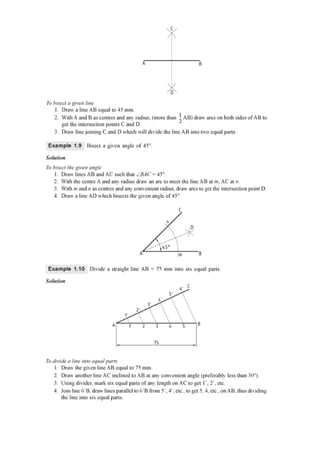
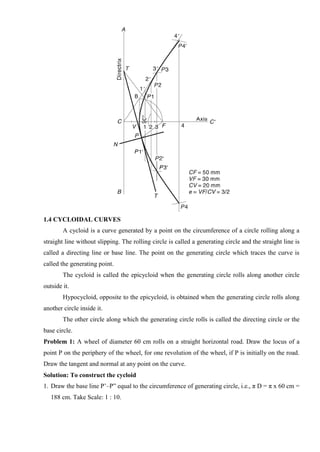
  • 3.
    OUTCOMES: On successful completionof this course, the student will be able to  familiarize with the fundamentals and standards of Engineering graphics  perform freehand sketching of basic geometrical constructions and multiple views of objects.  project orthographic projections of lines and plane surfaces.  draw projections and solids and development of surfaces.  visualize and to project isometric and perspective sections of simple solids. TEXT BOOK: 1. Natrajan K.V., ―A text book of Engineering Graphics‖, Dhanalakshmi Publishers, Chennai, 2009. 2. Venugopal K. and Prabhu Raja V., ―Engineering Graphics‖, New Age International (P) Limited, 2008. REFERENCES: 1. Bhatt N.D. and Panchal V.M., ―Engineering Drawing‖, Charotar Publishing House, 50 th Edition, 2010. 2. Basant Agarwal and Agarwal C.M., ―Engineering Drawing‖, Tata McGraw Hill Publishing Company Limited, New Delhi, 2008. 3. Gopalakrishna K.R., ―Engineering Drawing‖ (Vol. I&II combined), Subhas Stores, Bangalore, 2007. 4. Luzzader, Warren.J. and Duff,John M., ―Fundamentals of Engineering Drawing with an introduction to Interactive Computer Graphics for Design and Production, Eastern Economy Edition, Prentice Hall of India Pvt. Ltd, New Delhi, 2005. 5. N S Parthasarathy and Vela Murali, ―Engineering Graphics‖, Oxford University, Press, New Delhi, 2015. 6. Shah M.B., and Rana B.C., ―Engineering Drawing‖, Pearson, 2nd Edition, 2009. Publication of Bureau of Indian Standards: 1. IS 10711 – 2001: Technical products Documentation – Size and lay out of drawing sheets. 2. IS 9609 (Parts 0 & 1) – 2001: Technical products Documentation – Lettering. 3. IS 10714 (Part 20) – 2001 & SP 46 – 2003: Lines for technical drawings. 4. IS 11669 – 1986 & SP 46 – 2003: Dimensioning of Technical Drawings. 5. IS 15021 (Parts 1 to 4) – 2001: Technical drawings – Projection Methods. Special points applicable to University Examinations on Engineering Graphics: 1. There will be five questions, each of either or type covering all units of the syllabus. 2. All questions will carry equal marks of 20 each making a total of 100. 3. The answer paper shall consist of drawing sheets of A3 size only. The students will be permitted to use appropriate scale to fit solution within A3 size. 4. The examination will be conducted in appropriate sessions on the same day
  • 4.
    CONCEPTS AND CONVENTIONS(Not for Examination) GRAPHIC LANGUAGE A technical person can use the graphic language as powerful means of communication with others for conveying ideas on technical matters. However, for effective exchange of ideas with others, the engineer must have proficiency in (i) language, both written and oral, (ii) symbols associated with basic sciences and (iii) the graphic language. Engineering drawing is a suitable graphic language from which any trained person can visualize the required object. As an engineering drawing displays the exact picture of an object, it obviously conveys the same ideas to every trained eye. Irrespective of language barriers, the drawings can be effectively used in other countries, in addition to the country where they are prepared. Thus, the engineering drawing is the universal language of all engineers. Engineering drawing has its origin sometime in 500 BC in the regime of King Pharos of Egypt when symbols were used to convey the ideas among people. IMPORTANCE OF GRAPHIC LANGUAGE The graphic language had its existence when it became necessary to build new structures and create new machines or the like, in addition to representing the existing ones. In the absence of graphic language, the ideas on technical matters have to be conveyed by speech or writing, both are unreliable and difficult to understand by the shop floor people for manufacturing. This method involves not only lot of time and labour, but also manufacturing errors. Without engineering drawing, it would have been impossible to produce objects such as aircrafts, automobiles, locomotives, etc., each requiring thousands of different components. NEED FOR CORRECT DRAWINGS The drawings prepared by any technical person must be clear, unmistakable in meaning and there should not be any scope for more than one interpretation, or else litigation may arise. In a number of dealings with contracts, the drawing is an official document and the success or failure of a structure depends on the clarity of details provided on the drawing. Thus, the drawings should not give any scope for mis-interpretation even by accident. It would not have been possible to produce the machines/automobiles on a mass scale where a number of assemblies and sub-assemblies are involved, without clear, correct and accurate drawings. To achieve this, the technical person must gain a thorough knowledge of both the principles and conventional practice of draughting. If these are not achieved and or practiced, the
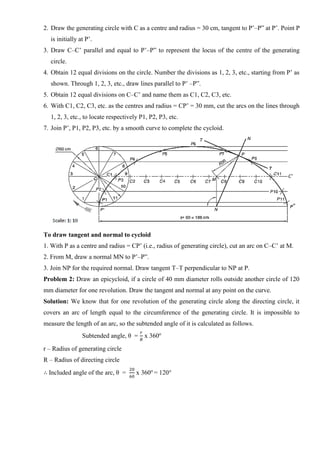
  • 5.
    drawings prepared byone may convey different meaning to others, causing unnecessary delays and expenses in production shops. DRAFTING INSTRUMENTS Engineering drawings are prepared with the help of a set of drawing instruments. Accuracy and speed in the execution of drawings depend upon the quality of instruments. It is desirable for students to procure instruments of good quality. The following instruments are commonly used: 1. Drawing board 2. Minidrafter 3. Precision instrument box 4. 45° set square and 30°-60° set square 5. Engineers’ Scales or Scales of Engineering Drawing 6. Protractor 7. Irregular or French curves 8. Drawing pins or clips 9. Drawing paper 10. Pencils 11. Eraser 12. Duster Size of Drawing Sheet Engineering drawings are prepared on standard size drawing sheets. The correct shape and size of the object can be visualized from the understanding of not only its views but also from the various types of lines used, dimensions, notes, scale etc. To provide the correct information about
  • 6.
    the drawings toall the people concerned, the drawings must be prepared, following certain standard practices, as recommended by Bureau of Indian Standards (BIS). The standard drawing sheet sizes are arrived at on the basic Principle of X : Y = 1 : √2and XY = 1 where X and Y are the sides of the sheet. For example AO, having a surface area of 1 Sq.m; X = 841 mm and Y = 1189 mm. The successive sizes are obtained by either by halving along the length or doubling the width, the area being in the ratio 1 : 2. Designation of sizes is given in Fig.l and their sizes are given in Table.1. For class work use of A3 size drawing sheet is preferred. Table.1 Preferred drawing sheet sizes (First choice) ISO-A Series Fig. 1 Drawing sheet formats Title Block The title block should lie within the drawing space at the bottom right hand comer of the sheet. The title block can have a maximum length of 170 mm providing the following information. 1. Title of the drawing. 2. Drawing number. 3. Scale. 4. Symbol denoting the method of projection.
  • 7.
    5. Name ofthe firm, and 6. Initials of staff who have designed, checked and approved. Fig. 2 Title block used in shop floor Fig.3 Title block suggested for students Fig. 4 Symbol for projection method Drawing Sheet Layout (Is 10711 : 2001) The layout of a drawing sheet used on the shop floor is shown in Fig.5
  • 8.
    Fig. 5 Drawingsheet layout Folding of Drawing Sheets IS : 11664 - 1999 specifies the method of folding drawing sheets. Two methods of folding of drawing sheets, one suitable for filing or binding and the other method for keeping in filing cabinets are specified by BIS. In both the methods of folding, the Title Block is always visible. Fig. 6 (a) Folding of drawing sheet for filing or binding
  • 9.
    Fig. 6 (b)Folding of drawing sheet for storing in filing cabinet LETTERING The essential features of lettering on technical drawings are, legibility, uniformity and suitability for microfilming and other photographic reproductions. In order to meet these requirements, the characters are to be clearly distinguishable from each other in order to avoid any confusion between them, even in the case of slight mutilations. The reproductions require the distance between two adjacent lines or the space between letters to be at least equal to twice the line thickness (Fig. 7). The line thickness for lower case and capital letters shall be the same in order to facilitate lettering. Fig. 7 Dimensions of lettering Dimensions The following specifications are given for the dimensions of letters and numerals: (i) The height of capital letters is taken as the base of dimensioning (Tables.2 and 3). (ii) The two standard ratios for d/h, 1/14 and 1/10 are the most economical, as they result in a minimum number of line thicknesses. (iii) The lettering may be inclined at 15° to the right, or may be vertical.
  • 10.
    Table.2 Lettering A(d = h/14) Table.3 Lettering B (d = h/10) Fig. 8 Inclined lettering Figures 8 and 9 show the specimen letters of type A, inclined and vertical and are given only as a guide to illustrate the principles mentioned above.
  • 11.
    Fig. 9 Verticallettering
  • 12.
    DIMENSIONING Drawing of acomponent, in addition to providing complete shape description, must also furnish information regarding the size description. These are provided through the distances between the surfaces, location of holes, nature of surface finish, type of material, etc. The expression of these features on a drawing, using lines, symbols, figures and notes is called dimensioning. Fig. 10 Elements of dimensioning Principles of Dimensioning Some of the basic principles of dimensioning are given below. 1. All dimensional information necessary to describe a component clearly and completely shall be written directly on a drawing. 2. Each feature shall be dimensioned once only on a drawing, i.e., dimension marked in one view need not be repeated in another view. 3. Dimension should be placed on the view where the shape is best seen (Fig.11) 4. As far as possible, dimensions should be expressed in one unit only preferably in millimeters, without showing the unit symbol (mm). 5. As far as possible dimensions should be placed outside the view (Fig.12). 6. Dimensions should be taken from visible outlines rather than from hidden lines (Fig.13).
  • 13.
    Fig. 11 Placingthe Dimensions where the Shape is Best Shown Fig. 12 Placing Dimensions Outside the View Fig. 13 Marking the dimensions from the visible outlines 7. No gap should be left between the feature and the start of the extension line (Fig.14). 8. Crossing of centre lines should be done by a long dash and not a short dash (Fig.15). Fig. 14 Marking of Extension Lines Fig. 15 Crossing of Centre Lines
  • 14.
    Fig. 16 Markingof Arrow Head Execution of Dimensions 1. Projection and dimension lines should be drawn as thin continuous lines. 2. Projection lines should extend slightly beyond the respective dimension lines. 3. Projection lines should be drawn perpendicular to the feature being dimensioned. Where necessary, they may be drawn obliquely, but parallel to each other (Fig.17). However, they must be in contact with the feature. 4. Projection lines and dimension lines should not cross each other, unless it is unavoidable (Fig. 18). 5. A dimension line should be shown unbroken, even where the feature to which it refers, is shown broken (Fig. 19). 6. A centre line or the outline of a part should not be used as a dimension line, but may be used in place of projection line (Fig. 15). Fig. 17 Fig. 18 Fig. 19 Termination and Origin Indication Dimension lines should show distinct termination, in the form of arrow heads or oblique strokes or where applicable, an origin indication. Two dimension line terminations and an origin indication are shown in Fig. 20. In this, 1. The arrow head is drawn as short lines, having an included angle of 15°, which is closed and filled-in. 2. The oblique stroke is drawn as a short line, inclined at 45°. 3. The origin indication is drawn as a small open circle of approximately 3 mm in diameter.
  • 15.
    Fig.20 Fig.21 Fig.22 Thesize of the terminations should be proportionate to the size of the drawing on which they are used. Where space is limited, arrow head termination may be shown outside the intended limits of the dimension line that is extended for that purpose. In certain other cases, an oblique stroke or a dot may be substituted (Fig. 21). Where a radius is dimensioned, only one arrow head termination, with its point on the arc end of the dimension line, should be used (Fig. 22). However, the arrow head termination may be either on the inside or outside of the feature outline, depending upon the size of feature. Methods of Indicating Dimensions Dimensions should be shown on drawings in characters of sufficient size, to ensure complete legibility. They should be placed in such a way that they are not crossed or separated by any other line on the drawing. Dimensions should be indicated on a drawing, according to one of the following two methods. However, only one method should be used on any one drawing. METHOD–1 (Aligned System) Dimensions should be placed parallel to their dimension lines and preferably near the middle, above and clear-off the dimension line (Fig. 23). An exception may be made where superimposed running dimensions are used (Fig. 30 b). Dimensions may be written so that they can be read from the bottom or from the right side of the drawing. Dimensions on oblique dimension lines should be oriented as shown in Fig. 24. Angular dimensions may be oriented as shown in Fig. 25. Fig. 23 Fig. 24 Oblique dimensioning Fig. 25 Angular dimensioning
  • 16.
    METHOD–2 (Uni-directional System) Dimensionsshould be indicated so that they can be read from the bottom of the drawing only. Non-horizontal dimension lines are interrupted, preferably near the middle, for insertion of the dimension (Fig. 26). Angular dimensions may be oriented as in Fig. 27. Fig. 26 Fig.27 Angular dimensioning The following indications (symbols) are used with dimensions to reveal the shape identification and to improve drawing interpretation. The symbol should precede the dimensions (Fig. 28). ϕ : Diameter Sϕ : Spherical diameter R : Radius SR : Spherical radius □ : Square Fig. 28 Shape identification symbols ARRANGEMENT OF DIMENSIONS The arrangement of dimensions on a drawing must indicate clearly the design purpose. The following are the ways of arranging the dimensions. Chains dimensions: Chains of single dimensions should be used only where the possible accumulation of tolerances does not endanger the functional requirement of the part (Fig. 29).
  • 17.
    Fig. 29 Parallel dimension:In parallel dimensioning, a number of dimension lines, parallel to one another and spaced-out are used. This method is used where a number of dimensions have a common datum feature (Fig. 30a). Fig.30a Parallel Dimension Fig. 30b Super imposed running Dimensions Super imposed running Dimensions: These are simplified parallel dimensions and may be used where there are space limitations (Fig. 30b). Combined Dimensions: These are the result of simultaneous use of chain and parallel dimensions (Fig. 31). Fig. 31 Combined Dimensions Fig. 32 Co-ordinate Dimensions Co-ordinate Dimensions: The sizes of the holes and their co-ordinates may be indicated directly on the drawing; or they may be conveniently presented in a tabular form, as shown in Fig. 32. Termination of Leader Line A leader is a line referring to a feature (dimension, object, outline, etc.). Leader lines should terminate (Fig. 33), (a) With a dot, if they end within the outlines of an object,
  • 18.
    (b) With anarrow head, if they end on the outline of an object, (c) Without dot or arrow head, if they end on a dimension line. Fig. 33 Termination of leader lines LINES Lines of different types and thicknesses are used for graphical representation of objects. The types of lines and their applications are shown in Table.4. Table.4 Types of lines and their applications
  • 19.
    UNIT – I PLANECURVES AND FREE HAND SKETCHING 1.1 BASIC GEOMETRICAL CONSTRUCTIONS Many geometrical methods are used to construct the geometrical shapes such as polygons and circles. The commonly used methods to construct the polygons are discussed in the following examples. Method-I Method-II Method-I Method-II
  • 20.
  • 21.
  • 22.
  • 24.
  • 25.
    ENGINEERING CURVES Frequently requiredengineering curves are conics, cycloids, involutes, and spirals. 1.3 CONIC SECTIONS The sections obtained by the intersection of a right circular cone by a cutting plane in different positions are called conic sections or conics. Refer Figure. 1.1 and Figure 1.2 Figure. 1.1 Right CircularCone
  • 26.
    Figure. 1.2 ConicSections Circle: When the cutting plane is parallel to the base or perpendicular to the axis, then the true shape of the section is circle. Ellipse: An ellipse is obtained when a section plane A–A, inclined to the axis cuts all the generators of the cone. Parabola: A parabola is obtained when a section plane B–B, parallel to one of the generators cuts the cone. Obviously, the section plane will cut the base of the cone. Hyperbola: A hyperbola is obtained when a section plane C–C, inclined at a very small angle to the axis cuts the cone on one side of the axis. A rectangular hyperbola is obtained when a section plane D–D, parallel to the axis cuts the cone. Isosceles Triangle: When the cutting plane is passing through the apex and the base of the cone, the curve of intersection obtained is an isosceles triangle. Conic Sections as Loci of a Moving Point A conic section may be defined as the locus of a point moving in a plane such that the ratio of its distance from a fixed point (Focus) and fixed straight line (Directrix) is always a constant. The ratio is called eccentricity. The line passing through the focus and perpendicular to the directrix is the axis of the curve. The point at which the conic section intersects the axis is called the vertex or apex of the curve. Eccentricity, e = 𝐷𝑖𝑠𝑡𝑎𝑛𝑐𝑒 𝑜𝑓 𝑡ℎ𝑒 𝑚𝑜𝑣𝑖𝑛𝑔 𝑝𝑜𝑖𝑛𝑡 𝑓𝑟𝑜𝑚 𝑓𝑜𝑐𝑢𝑠 𝐷𝑖𝑠𝑡𝑎𝑛𝑐𝑒 𝑜𝑓 𝑡ℎ𝑒 𝑚𝑜𝑣𝑖𝑛𝑔 𝑝𝑜𝑖𝑛𝑡 𝑓𝑟𝑜𝑚 𝑑𝑖𝑟𝑒𝑐𝑡𝑟𝑖𝑥 The eccentricity value is less than 1 for ellipse, equal to 1 for parabola and greater than 1 for hyperbola (Fig. 1.3).
  • 27.
    Figure 1.3 Locusof a point Ellipse An ellipse is also defined as a plain curve generated by a point which moves in such a way that, at any position the sum of its distance from two fixed points is always a constant. The fixed points are called foci and the constant is equal to the major axis of the ellipse. Problem 1: Draw the locus of a point P moving so that the ratio of the distance from a fixed point F to its distance from a fixed straight line AB is 3 4 . Point F is at a distance of 70 mm from AB. Also draw a tangent and normal to the curve. Solution: To construct the ellipse using focus and directrix 1. Draw the directrix and axis as shown. 2. Mark F on axis such that CF= 70 mm. 3. Divide CF into 3 + 4 = 7 equal parts and mark V at the fourth division from C. Now, e = VF/ CV = 3/4. 4. At V, erect a perpendicular VB = VF. Join CB. 5. Through F, draw a line at 45° to meet CB produced at D. Through D, drop a perpendicular DV’ on CC’. Mark O at the midpoint of V– V’. 6. Mark a few points, 1, 2, 3,… on V– V’ and erect perpendiculars though them meeting CD at 1’, 2’, 3’…. Also erect a perpendicular through O.
  • 28.
    7. With Fas a centre and radius = 1–1’, cut two arcs on the perpendicular through 1 to locate P1 and P1’. Similarly, with F as a centre and radii = 2–2’, 3–3’, etc., cut arcs on the corresponding perpendiculars to locate P2 and P2’, P3 and P3’, etc. Also, cut similar arcs on the perpendicular through O to locate V1 and V1’. To draw tangent and normal to the ellipse 1. Mark the given point P on the curve and join PF. 2. At F draw a line perpendicular to PF to cut AB at T. 3. Join TP and extend it. TT is the tangent at P. 4. Through P, draw a line NN perpendicular to TT. NN is the normal at P. Parabola A parabola is also defined as a plain curve generated by a point which moves in such a way that at any position, its distance from a fixed point (focus) is always equal to its distance from a fixed straight line (directrix). Problem 2: Construct a parabola when the distance between the focus and directrix is 60 mm. Draw the tangent and normal at any point on the curve. Solution: To construct the parabola using focus and directrix. 1. Draw directrix AB and axis CC’ as shown. 2. Mark F on CC’ such that CF = 60 mm.
  • 29.
    3. Mark Vat the midpoint of CF. Therefore, e = VF/CV = 1. 4. At V, erect a perpendicular VB = VF. Join CB. 5. Mark a few points, say, 1, 2, 3, … on VC’ and erect perpendiculars through them meeting CB produced at 1’, 2’, 3’, … 6. With F as a centre and radius = 1–1’, cut two arcs on the perpendicular through 1 to locate P1 and P1’. Similarly, with F as a centre and radii = 2–2’, 3–3’, etc., cut arcs on the corresponding perpendiculars to locate P2 and P2’, P3 and P3’, etc. 7. Draw a smooth curve passing through V, P1, P2, P3 … P3’, P2’, P1’ to complete the parabola. To draw tangent and normal to the parabola 1. Mark the given point P on the curve and join PF. 2. At F draw a line perpendicular to PF to cut AB at T. 3. Join TP and extend it. TT is the tangent at P. 4. Through P, draw a line NN perpendicular to TT. NN is the normal at P. Hyperbola A hyperbola is also defined as a plain curve generated by a point which moves in such a way that at any position, the difference of its distance from two fixed points is always a constant. The fixed points are called as foci and the constant is equal to the transverse axis of the hyperbola.
  • 30.
    Problem 3: Drawa hyperbola of e = 3/2 if the distance of the focus from the directrix = 50 mm. Draw the tangent and normal at any point on the curve. Solution: To construct the hyperbola using focus and directrix. 1. Draw directrix AB and axis CC’ as shown. 2. Mark F on CC’ such that CF = 50 mm. 3. Divide CF into 3 + 2 = 5 equal parts and mark V at the second division from C. Now, e = VF/ CV = 3/2. 4. At V, erect a perpendicular VB = VF. Join CB. 5. Mark a few points, say, 1, 2, 3, … on VC’ and erect perpendiculars through them meeting CB produced at 1’, 2’, 3’, … 6. With F as a centre and radius = 1–1’, cut two arcs on the perpendicular through 1 to locate P1 and P1’. Similarly, with F as a centre and radii = 2–2’, 3–3’, etc., cut arcs on the corresponding perpendiculars to locate P2 and P2’, P3 and P3’, etc. 7. Draw a smooth curve passing through V, P1, P2, P3 … P3’, P2’, P1’ to complete the hyperbola To draw tangent and normal to the hyperbola 1. Mark the given point P on the curve and join PF. 2. At F draw a line perpendicular to PF to cut AB at T. 3. Join TP and extend it. TT is the tangent at P. 4. Through P, draw a line NN perpendicular to TT. NN is the normal at P.
  • 31.
    1.4 CYCLOIDAL CURVES Acycloid is a curve generated by a point on the circumference of a circle rolling along a straight line without slipping. The rolling circle is called a generating circle and the straight line is called a directing line or base line. The point on the generating circle which traces the curve is called the generating point. The cycloid is called the epicycloid when the generating circle rolls along another circle outside it. Hypocycloid, opposite to the epicycloid, is obtained when the generating circle rolls along another circle inside it. The other circle along which the generating circle rolls is called the directing circle or the base circle. Problem 1: A wheel of diameter 60 cm rolls on a straight horizontal road. Draw the locus of a point P on the periphery of the wheel, for one revolution of the wheel, if P is initially on the road. Draw the tangent and normal at any point on the curve. Solution: To construct the cycloid 1. Draw the base line P’–P” equal to the circumference of generating circle, i.e., π D = π x 60 cm = 188 cm. Take Scale: 1 : 10.
  • 32.
    2. Draw thegenerating circle with C as a centre and radius = 30 cm, tangent to P’–P” at P’. Point P is initially at P’. 3. Draw C–C’ parallel and equal to P’–P” to represent the locus of the centre of the generating circle. 4. Obtain 12 equal divisions on the circle. Number the divisions as 1, 2, 3, etc., starting from P’ as shown. Through 1, 2, 3, etc., draw lines parallel to P’ –P”. 5. Obtain 12 equal divisions on C–C’ and name them as C1, C2, C3, etc. 6. With C1, C2, C3, etc. as the centres and radius = CP’ = 30 mm, cut the arcs on the lines through 1, 2, 3, etc., to locate respectively P1, P2, P3, etc. 7. Join P’, P1, P2, P3, etc. by a smooth curve to complete the cycloid. To draw tangent and normal to cycloid 1. With P as a centre and radius = CP’ (i.e., radius of generating circle), cut an arc on C–C’ at M. 2. From M, draw a normal MN to P’–P”. 3. Join NP for the required normal. Draw tangent T–T perpendicular to NP at P. Problem 2: Draw an epicycloid, if a circle of 40 mm diameter rolls outside another circle of 120 mm diameter for one revolution. Draw the tangent and normal at any point on the curve. Solution: We know that for one revolution of the generating circle along the directing circle, it covers an arc of length equal to the circumference of the generating circle. It is impossible to measure the length of an arc, so the subtended angle of it is calculated as follows. Subtended angle, θ = 𝑟 𝑅 x 360o r – Radius of generating circle R – Radius of directing circle ∴ Included angle of the arc, θ = 20 60 x 360o = 120°
  • 33.
    1. With Oas a centre and radius = 60 mm, draw the directing arc P’–P” of the included angle 120°. 2. Produce OP’ and locate C on it such that CP’ = radius of generating circle = 20 mm. With C as centre and radius = CP’, draw a circle. 3. With O as a centre and radius = OC, draw an arc C–C’ such that ∠COC’ = 120°. Arc C–C’ represents the locus of centre of generating circle. 4. Divide the circle into 12 equal parts. With O as a centre and radii = O–1, O–2, O–3, etc., draw the arcs through 1, 2, 3, etc., parallel to arc P’–P”. 5. Divide arc P’–P” into12 equal parts and produce them to cut the locus of centres at C1, C2,…. 6. Taking C1 as centre, and radius equal to 20mm, draw an arc cutting the arc through 1 at P1. Repeat this procedure with centres C2, C3,…, C12 to obtain points P2, P3,…., P12. 7. Join P1, P2, P3, etc by drawing a smooth curve to complete the epicycloid. To draw tangent and normal to epicycloid 1. With P as a centre and radius = CP’ (i.e., radius of generating circle), cut an arc on C–C’ at M. 2. Join MO and then locate N at the intersection of P’–P”. 3. Join NP for the required normal. Draw tangent T–T perpendicular to NP at P. Problem 3: A circle of diameter 40 mm rolls inside another circle of radius 60 mm. Draw the hypocycloid traced by a point on the rolling circle initially in contact with the directing circle for one revolution. Draw the tangent and normal at any point on the curve. Solution: We know that for one revolution of the generating circle along the directing circle, it covers an arc of length equal to the circumference of the generating circle. It is impossible to measure the length of an arc, so the subtended angle of it is calculated as follows. Subtended angle, θ = 𝑟 𝑅 x 360o r – Radius of generating circle
  • 34.
    R – Radiusof directing circle ∴ Included angle of the arc, θ = 20 60 x 360o = 120° 1. With O as a centre and radius = 60 mm, draw the directing arc P’–P” of included angle 120°. 2. On OP’, locate C such that CP’ = 20 mm. With C as a centre and radius = CP’, draw a circle. 3. With O as a centre and radius = OC, draw an arc C–C’ such that ∠COC’ = 120°. Arc C–C’ represents the locus of centre of generating circle. 4. Divide the circle into 12 equal parts. With O as a centre and radii = O–1, O–2, O–3, etc., draw the arcs through 1, 2, 3, etc., parallel to arc P’–P”. 5. Divide arc P’–P” into12 equal parts and produce them to cut the locus of centres at C1, C2,…. 6. Taking C1 as centre, and radius equal to 20mm, draw an arc cutting the arc through 1 at P1. Repeat this procedure with centres C2, C3,…, C12 to obtain points P2, P3,…., P12. 7. Join P1, P2, P3, etc by drawing a smooth curve to complete the hypocycloid. To draw tangent and normal to hypocycloid 1. With P as a centre and radius = CP’ (i.e., radius of generating circle), cut an arc on C–C’ at M. 2. Join MO and then extend it to the directing circle to locate N at the intersection of P’–P”. 3. Join NP for the required normal. Draw tangent T–T perpendicular to NP at P. 1.5 INVOLUTE An involute is a spiral curve generated by a point on a cord or thread as it unwinds from a polygon or a circle, the thread being kept tight and tangential to the circle or the sides of the polygon. Depending on whether the involute is traced over a circle or a polygon, the involute is called an involute of circle or involute of polygon. Problem 1: Draw the involute of a square of side 25 mm. Steps for Construction of Involute of square:
  • 35.
    1. Draw aSquare ABCD of side 25mm. Assume a thread is unwound from end D in clockwise direction. 2. A as center and radius 25 mm (= length of 1 side), draw an arc to cut BA produced at P1. 3. B as center and BP1 as radius (= length of 2 side), draw an arc from P1 to get P2. 4. C as center and CP2 as radius (= length of 3 side), draw an arc from P2 to get P3. 5. Similarly, D as center and DP3 as radius (= length of 4 side), draw an arc from P3 to get P4. Normal and Tangent: 1. The given point M lies in the arc P3 P4 .The center of the arc P3 P4 is point B. Join B and M. 2. Extend BM which is required Normal. At M draw a perpendicular to the normal to obtain the Tangent TT. Problem 2: Draw the curve traced out by an end of a thin wire unwound from a regular hexagon of side 20 mm, the wire being kept taut. Draw a tangent and normal at any point on the curve.
  • 36.
    Steps for Constructionof Involute of hexagon: 1. Draw a hexagon ABCDEF of side 20mm. Assume a thread is unwound from end F in clockwise direction. 2. With centres A, B, etc., and radius 20 mm, 40 mm, etc., draw arcs to get P1, P2, etc., 3. Join P1, P2, etc., to complete the hexagon. Normal and Tangent: 1. Mark the point M on the arc P4 P5 .The center of the arc P4 P5 is point F. Join F and M. 2. Extend FM which is required Normal. At M draw a perpendicular to the normal to obtain the Tangent TT. Problem 3: Construct one convolution of an involute of a circle of diameter 40 mm. Draw tangent and normal at a point on the involute 100 mm distant from the centre of the circle.
  • 37.
    Steps for Constructionof Involute of circle: 1. With 0 as centre and radius R of 20 mm, draw the given circle. 2. Taking P as the starting point, draw the tangent PQ equal in length to the circumference of the circle. 3. Divide the line PQ and the circle into the same number of equal parts and number the points. 4. Draw tangents to the circle at the points 1, 2, 3 etc., and locate the points P1, P2, P3 etc., such that 1-P1 = P-1’, 2-P2 = P-2’ etc. 5. A smooth curve through the points P, P1, P2 etc., is the required involute. Normal and Tangent: 1.Mark the point M at a distance of 100 mm from the centre of the circle. Join it with centre O of the circle. 2. Draw a semi-circle with diameter OM, i.e., with centre C which is the midpoint of OM to get the intersection point N on the circle. 3. Draw a line from N passing through M which is the normal NMN to the curve. 4. Draw a line through M, perpendicular to NMN to get the tangent TT to the curve. 1.6 FREEHAND SKETCHING An engineer or designer conceives an idea of a non-existing object three dimensionally, which can be conveyed to another person only through a drawing. Initially the object is sketched on paper as an isometric or perspective drawing, then that will be given dimensions.
  • 38.
    Good practice infreehand sketching helps the engineer to think about the new design rather than to think about the method of preparing the drawing. When the designer’s mind thinks an idea that is sketched by him in freehand. An engineer who has a thorough idea in isometric and orthographic projections can prepare the sketches easily. Freehand Sketching Practice 1. For freehand sketching practice, soft grade pencil (HB), eraser and paper are required. 2. Papers with thin cross-section guidelines (ruled paper) may be used for sketching which helps the inexperienced person to draw straight lines satisfactorily. Fig. 1.4 Sketch on a ruled paper Sketching a straight line 1. Mark the end points of the line to be sketched. 2. Observe the two points carefully and make some trial movements between the points without sketching any line. 3. Sketch light and thin trial lines connecting the two points. 4. Complete the straight line by drawing a straight and dark line over the thin line. Fig. 1.5 Steps to sketch a straight line Sketching a small circle 1. Sketch the center lines for the circle horizontally and vertically and mark four points on them approximately equal to the radius of the circle. 2. Sketch the light circle passing through these points. 3. Complete the circle with dark lines.
  • 39.
    Fig. 1.6Sketching asmall circle Sketching a big circle 1. Sketch the center lines for the circle horizontally and vertically and mark four points on them approximately equal to the radius of the circle. 2. Sketch more diagonal lines in addition to the center lines for big circle. 3. Sketch the light circle passing through these points. 4. Complete the circle with dark lines. Sketching Orthographic views from pictorial view The methods and rules followed to prepare orthographic projections is used to sketch the multiviews of an object. Consider the following steps to draw the orthographic projections. 1. Observe the shape of the object carefully. 2. Decide the number of views to be selected. 3. Sketch thin and light rectangles for the views to be drawn. 4. Sketch and complete the views, then darken the lines. 5. Sketch the dimensions, notes, drawing name, title, etc. 6. Check the correctness of the lines and details given in various views.
  • 40.
    Fig. 1.7 sketchinga large circle General Procedure to draw free hand sketches 1. Mark their directions in the Pictorial View. 2. Measure the overall Length L, Width W and Height H of the object. 3. Using L, W and H, mark spaces for the front and Right Side Views in the form of rectangles [2H Pencil]. 4. Mark the axes at the appropriate places [2H Pencil]. 5. Sketch the details simultaneously in both Front and Right Side Views by drawing the corresponding projects [2H Pencil]. 6. Darken all the visible lines [HB Pencil]. 7. Add the dimensions. Problem 1: Sketch the front, top and left side views of an object shown in the figure.
  • 41.
    Solution: Problem 2: Sketchthe front, top and right side views of an object shown in the figure.
  • 42.
    Solution: Problem 3: Sketchthe front, top and left side views of the machine component shown in the figure.
  • 43.
    Solution: Problem 4: Makefree hand sketch of the front, top and right side views of the object shown in the figure.
  • 44.
    Solution: Problem 5: Makefree hand sketch of the front, top and right side views of the object shown in the figure.
  • 45.
    Solution: Problem 6: Drawthe plan, elevation and left side views for the given isometric view.
  • 46.
    Solution: 1.7 ASSIGNMENT PROBLEMS PLAINSCALE 1. Construct a plain scale to show meters when 1 cm represents 4 meters and long enough to measure up to 50 meters. Find the R.F and mark the distance of 36 meter and 28 meter. 2. A room of 1000 m3 volume is represented by block of 125 cm3 volume. Find R.F and construct a plain scale to measure up to 30 m. measure the distance of 18 m on the scale.
  • 47.
    DIAGONAL SCALE 1. Adistance between Coimbatore and Madurai is 200 km and its equivalent distance on the map measures 10 cm. Draw the diagonal scale to indicate 223 km and 135 km. 2. A rectangular plot of land measuring 1.28 hectors represented on a map by a similar rectangle of 8 sq.cm. Calculate R.F of scale. Draw diagonal scale to read single meter. Show a distance of 438 m on it. VERNIER SCALE 1. Draw a vernier scale of R.F = 1/25 to read centimeters up to 4 meters and on it,show lengths 2.39 m and 0.91 m. 2. A map of size 500 cm X 50 cm wide represents an area of 6250 sq.kms. Construct a vernier scale to measure kilometers, hectometers and decameters and long enough to measure upto 7km. Indicate on it (a) 5.33 km (b) 59 decameters. ELLIPSE 1. Draw the locus of a point P moving so that the ratio of the distance from a fixed point F to its distance from a fixed straight line DD’ is ¾. Point F is at a distance of 35 mm from DD’. Also draw a tangent and normal to the curve. PARABOLA 2. Construct a parabola when the distance between the focus and directrix is 30 mm. Draw the tangent and normal at any point on the curve. HYPERBOLA 3. The vertex of the hyperbola is 65 mm from its focus. Draw the curve if the eccentricity is 3/2. Draw also a tangent and normal at any point on the curve. CYCLOID 4. A circle of 50 mm diameter rolls on a straight line without slipping. Trace the locus of a point ‘P’ on the circumference of the circle rolling for one revolution. Name the curve. Draw normal and tangent to the curve at any point on the curve. EPICYCLOID 5. Construct an epicycloids generated by a rolling circle of diameter 50 mm and a directing circle of diameter 150 mm. Draw the tangent and normal to the curve at any point on the epicycloid. HYPOCYCLOID 6. Draw a hypocycloid of a circle of 40 mm diameter which rolls inside another circle of 200 mm diameter for one revolution. Draw a tangent and normal at any point on it.
  • 48.
    7. Draw ahypocycloid when the radius of the directing circle is twice the radius of the generating circle. The radius of the generating circle is equal to 35 mm. SQUARE INVOLUTE 8. Draw the involute of a square of side 40 mm. CIRCLE INVOLUTE 9. Construct one convolution of an involute of a circle of diameter 30 mm. Draw tangent and normal at appoint on the involute 65 mm distant from the centre of the circle. FREEHAND SKETCHING 10. Draw the front, top and any one of the side views for all the objects shown below. 1 2 3 4
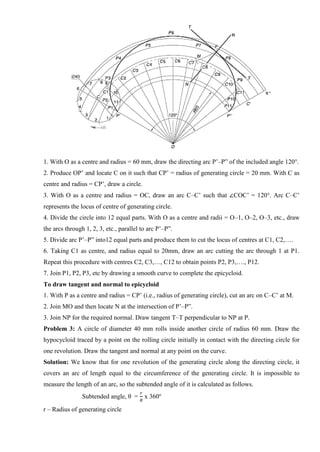
  • 49.
    5 6 1.8 UNIVERSITYQUESTIONS SCALES 1. A water tank of size 27 m3 was represented in the drawing by 216 cm3 size. Construct a vernier scale for the same to measure up to 5 m. Show on it, the following lengths (i) 3.95 m (ii) 0.27 m (iii) 0.042 m. (Nov 2014) 2. The distance between Chennai and Madurai is 400 Km. It is represented by a distance of 8 cm on a railway map. Find the R.F and construct a diagonal scale to read kilometers. Show on it the distances of 543 km, 212 km and 408 km. (Jan 2014) ELLIPSE 3. Draw the locus of a point “P” which moves in a plane in such a way that the ratio of its distances from a fixed point F and a fixed straight line AB is always 2/3. The distance between the fixed point F and fixed straight line is 50 mm. Also draw a tangent and normal on the point on the locus at a horizontal distance of 55 mm from the fixed straight line. (Nov 2011),(Jan 2012) 4. Construct an ellipse when the distance b/w the focus and the directrix is 40mm and the eccentricity is 3/4. Draw the tangent and normal at any point P on the curve using directrix. 5. Construct an Ellipse when the distance between the fixed line and moving point is 20 mm and the eccentricity is 4/5, and also draw the tangent and normal curve at any point. PARABOLA 6. Construct a parabola, with the distance of the focus from the directrix as 50 mm. Also, draw a normal and tangent to the curve at a point 40 mm from the directrix. (Nov 2014)
  • 50.
    7. The headlamp reflector of a motor car has a maximum rim diameter of 130 mm and maximum depth of 100 mm. Draw the profile of the reflector and name it. (Jan 2013) 8. The focus of a conic is 50 mm from the directrix. Draw the locus of a point “P” moving in such a way that its distance from the directrix is equal to its distance from the focus. Name the curve. Draw the tangent to curve at a point 60 mm from the directrix. (June 2011) HYPERBOLA 9. Construct a hyperbola when the distance between the focus and the directrix is 40mm and the eccentricity is 4/3.Draw a tangent & normal at any point on the hyperbola. (Jan 2013) 10. Draw a hyperbola when the distance of the focus from the directrix is 70 mm and the eccentricity e is 1.5. Draw the tangent and normal to the curve at a point P distance 50 mm from the directrix. (June 2012) CYCLOID 11. A circle of 40mm diameter rolls over a horizontal table without slipping. A point on the circumference of the circle is in contact with the table surface in the beginning and after one complete revolution. Draw the path traced by the point. Draw a tangent and normal at any point on the curve. 12. A roller of 35mm diameter rolls on a straight line without slip. In the initial position the diameter PQ of the circle is parallel to the line on which it rolls. Draw the locus of the point. EPICYCLOID 13. Construct the path traced by a point on a circular disc radius of 30 mm rolls on a circular path of radius 100mm. Draw the tangent and normal curve at any point on the curve. 14. A circular disc of radius 30 mm rolls outside another circle of radius 90 mm for one complete revolution. Draw the locus of the point also draw the tangent and normal curve at any point on the curve. HYPOCYCLOID 15. A circus man rides a motor bike inside a globe of 6 m diameter. The motor bike has the wheel of 1 m diameter. Draw the locus of the point on the circumference of motorbike wheel for one complete revolution. Adopt suitable scale. (June 2014) 16. A circular disc of radius 40 mm rolls inside another circle of radius 90 mm for one revolution. Draw the locus of a point also draw the tangent and normal curve at any point on the curve. CIRCLE INVOLUTE 17. Draw the involute of a circle of 40 mm diameter. Also, draw a tangent and a normal to the curve at a point 95mm from the center of the circle. (Jan 2013) (Apr 2015)
  • 51.
    18. Draw theinvolute of a circle of diameter 50 mm when string is unwound in the clockwise direction. Draw tangent and normal at a point located on the involute. (Jan 2012) 19. A coir is unwound from a drum of 30mm diameter, draw the locus of free end of the coir for unwinding through an angle of 360° 20. A string of length 135 mm is wound around a circle diameter of 36 mm. It is unwound from the circle, trace path of the end of string. Draw a tangent and normal curve at any point on the curve. SQUARE INVOLUTE 21. Draw the involute of a square of side 30 mm. Draw a tangent and normal at any point on the involute. (Jan 2014) 22. Draw an involute of a square of side 35mm, Draw the tangent and normal at any point. FREEHAND SKETCHING Draw the front, top and any one of the side views for all the objects shown below. APR 2015, JUNE 2005 JAN 2014, NOV 2010 NOV 2014 NOV 2014
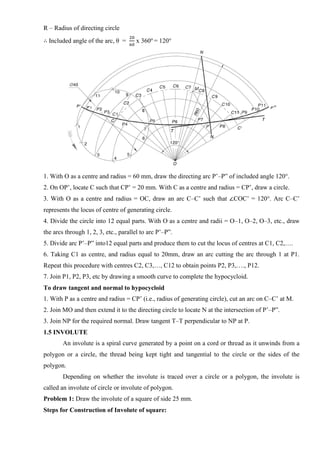
  • 53.
    JUNE 2009, JAN2010 JAN 2012 NOV 2010 MAY 2012
  • 54.
    MAY 2010 JUNE2009 JAN 2006 JAN 2013
  • 55.
    UNIT – II PROJECTIONOF POINTS, LINES AND PLANE SURFACES 2.1 PRINCIPLES OF PROJECTION Projecting the image of an object to the plane of projection is known as projection. The object may be a point, line, plane, solid, machine component or a building. The figure or view JAN 2010 Additional 1 Additional 2 Additional 3
  • 56.
    formed by joining,in correct sequence, the points at which these lines meet the plane is called the projection of the object. (It is obvious that the outlines of the shadow are the projections of an object). Figure 2.1 Projection of an object Projectors The lines or rays drawn from the object to the plane are called projectors. Plane of Projections The transparent plane on which the projections are drawn is known as plane of projectors. 2.2 TYPES OF PROJECTIONS 1. Pictorial Projections a) Perspective Projection b) Isometric Projections c) Oblique Projections 2. Orthographic Projections 1) Pictorial Projections The projection in which the description of the object is completely understood in one view is known as Pictorial Projection. The Pictorial projections have the advantage of conveying an immediate impression of the general shape and details of the object, but no its true dimensions or sizes. Note: Isometric projection gives true shape of the object, while Perspective and Oblique Projections do not. a) Perspective Projection Imagine that the observer looks at the object form an infinite distance. The rays will now be parallel to each other and perpendicular in both the front surface of the object and the plane, when the observer is at a finite distance from the object, the rays converge to the eye as in the case of Perspective Projection. The observer looks from the front. The front surface F of the block is seen in its true shape and size.
  • 57.
    Note: Orthographic Projectionis the standard drawing form of the industrial world. The form is unreal in that we do not see an object as it is drawn orthographically. Pictorial drawing however has photographic realism. Figure 2.2 Perspective Projection Perspective View If any imaginary transparent plane is introduced such that the object is in between the observer and the plane. The image obtained on the plane/screen is as shown. This is called perspective view of the object. b) Isometric Projection “Iso” means “equal” and “metric projection” means “a projection to a reduced measure”. An Isometric Projection is one type of pictorial projection in which the three dimensions of a solid are not only shown in one view, but also their dimension can be scaled from this drawing. Figure 2.3 Isometric Projection c) Oblique Projection The word “oblique” means “slanting” There are three axes-vertical, horizontal and oblique. The oblique axis, called receding axis is drawn either at 30o or 45o . Thus an oblique drawing can be drawn directly without resorting to projection techniques.
  • 58.
    Figure 2.4 ObliqueProjection 2) Orthographic Projection 'ORTHO' means right angle and orthographic means right angled drawing. When the projectors are perpendicular to the plane on which the projection is obtained, it is known as orthographic projection. 2.3 PRINCIPAL PLANES In engineering drawing practice, two principal planes are used to get the projection of an object as shown in the figure 2.5. They are, (i) VERTICAL PLANE (VP) which is assumed to be placed vertically. The front view of the object is projected onto this plane. (ii) HORIZONTAL PLANE (HP) which is assumed to be placed horizontally. The top view of the object is projected onto this plane. These principal planes are also known as reference planes or co-ordinate planes. The planes considered are imaginary, transparent and dimensionless. The reference planes VP and HP are placed in such a way that they intersect each other at right angles. As a result of intersection, an intersection line is obtained which is known as the reference line or XY line. Four Quadrants When the planes of projections are extended beyond their line of intersection, they form Four Quadrants. These quadrants are numbered as I, II, III and IV in clockwise direction when rotated about reference line XY as shown in Figure 2.5.
  • 59.
    Figure 2.5 PrincipalPlanes and Four Quadrants First Angle Projection When the object is situated in First Quadrant, that is, in front of V.P and above H.P, the projections obtained on these planes is called First angle projection. (i) The object lies in between the observer and the plane of projection. (ii) The front view is drawn above the XY line and the top view below XY. (Above XY line is V.P and below XY line is H.P). (iii) In the front view, H.P coincides with XY line and in top view V.P coincides with XY line. (iv) Front view shows the length (L) and height (H) of the object and Top view shows the length (L) and breadth (B) or width (W) or thickness (T) of it. Figure 2.5 First Angle and Third Angle Projection Third Angle Projection In this, the object is situated in Third Quadrant. The Planes of projection lie between the object and the observer. The front view comes below the XY line and the top view about it.
  • 60.
    Notation followed: 1. Actualpoints in space are denoted by capital letters A, B, C. 2. Their front views are denoted by their corresponding lower case letters with dashes a’, b’, c’ etc., and their top views by the lower case letters a, b, c etc. 3. The projections in top and front views are drawn in thick lines. Projectors are always drawn as continuous thin lines. Note: 1. Students are advised to make their own paper/card board/perplex model of H.P and V.P. The model will facilitate developing a good concept of the relative position of the points lying in any of the four quadrants. 2. Since the projections of points, lines and planes are the basic chapters for the subsequent topics on solids viz, projection of solids, development, pictorial drawings and conversion of pictorial to orthographic and vice versa, the students should follow these basic chapters carefully to draw the projections. PROJECTION OF POINTS IN SPACE 2.4 VARIOUS POSITIONS OF POINTS IN SPACE In FIRST Quadrant (Above H.P., In front of V.P.) In SECOND Quadrant (Above H.P., Behind V.P.)
  • 61.
    In THIRD Quadrant(Below H.P., Behind V.P.) In FOURTH Quadrant (Below H.P., In front of V.P.)
  • 62.
    In PLANE (OnV.P., Above H.P.) In PLANE (On H.P., Behind V.P.)
  • 63.
    In PLANE (OnV.P., Below H.P.) In PLANE (On H.P., In front of V.P.)
  • 64.
    In PLANE (Onboth H.P. & V.P.) Problem 1: Draw the orthographic projections of the following points. (a) Point P is 30 mm above H.P and 40 mm in front of VP (b) Point Q is 25 mm above H.P and 35 mm behind VP (c) Point R is 32 mm below H.P and 45 mm behind VP (d) Point Sis 35 mm below H.P and 42 mm in front of VP (e) Point T is in H.P and 30 mm is behind VP (f) Point U is in VP and 40 mm below HP
  • 65.
    (g) Point Vis in VP and 35 mm above H.P (h) Point W is in H.P and 48 mm in front of VP Solution: The location of the given points is the appropriate quadrants are shown in above figure (a) and their orthographic projections are shown figure (b). Problem 2: Draw the projections of the following points on a common reference line. Take 30 mm distance between the projectors. 1) A, 35 mm above HP and 25 mm in front of VP. 2) B, 40 mm below HP and 15 mm behind VP. 3) C, 50 mm above HP and 25 mm behind VP. 4) D, 45 mm below HP and 20 mm in front of VP. 5) E, 30 mm behind VP and on HP. 6) F, 35 mm below HP and on VP. 7) G, on both HP and VP. 8) H, 25 mm below HP and 25 mm in front of VP.
  • 66.
    PROJECTION OF STRAIGHTLINES 2.5 BASICS OF STRAIGHT LINE A line is a geometric primitive that has length and direction, but no thickness. Straight line is the Locus of a point, which moves linearly. A straight line is the shortest distance between two points. Projections of the ends of any line can be drawn using the principles developed for projections of points. Top views of the two end points of a line, when joined, give the top view of the line. Front views of the two end points of the line, when joined, give the front view of the line. Both these Projections are straight lines. Figure 2.6 A straight Line The projections of a straight line are obtained by joining the top and front views of the respective end points of the line. The actual length of the straight line is known as true length (TL). 2.6 PROJECTIONS OF STRAIGHT LINE A straight line is placed with reference to the planes of projections in the following positions. 1. Line perpendicular to HP and parallel to VP 2. Line perpendicular to VP and parallel to HP 3. Line parallel to both HP and VP 4. Line inclined to HP and parallel to VP 5. Line inclined to VP and parallel to HP 6. Line inclined to both HP and VP In first angle projection method, the line is assumed to be placed in the first quadrant. The projections of the line in the above mentioned positions are discussed below. Projections of a Line kept Perpendicular to HP and Parallel to VP Consider a straight line AB kept perpendicular to HP and parallel to VP (Fig 2.7a). Its front view is projected onto VP which is a line having true length. The top view is projected onto HP which is a point, one end b of which is visible while the other end ‘a’is invisible and is enclosed
  • 67.
    within ( ). Figure2.7 Projections of a Line kept Perpendicular to HP and Parallel to VP Now the HP is rotated in the clockwise direction through 90° and is obtained in the vertical position. The projections obtained are seen as given in Fig. 2.7b. It is drawn with reference to the XY line as follows. 1. Draw the XY line. 2. Draw the front view a′b′, which is a line perpendicular to XY and having true length (TL). 3. Project the top view ab. The end b is visible and the invisible end ‘a’ is marked inside ( ). Projections of a Line kept Perpendicular to VP and Parallel to HP Consider a straight line AB kept perpendicular to VP and parallel to HP (Fig. 2.8a). Itstop view is projected onto HP which is a line having true length (TL). The front view isprojected onto VP which is a point, the end b′ of which is visible and the other end a′ isinvisible which is shown enclosed in ( ). Now the HP is rotated in the clockwise direction through 90° and is obtained in thevertical position. The projections obtained are seen as given in Fig. 2.8b. It is drawnwith reference to the XY line as follows. 1. Draw the XY line. 2. Draw the top view ab, a line perpendicular to XY and having true length (TL). 3. Project the front view a′b′. The end b′ is visible and the invisible end a′ is markedinside ( ).
  • 68.
    Figure 2.8 Projectionsof a Line kept Perpendicular to VP and Parallel to HP Projections of a Line kept parallel to Both HP and VP Consider a straight line AB kept parallel to both HP and VP (Fig. 2.9a). Its front viewis projected onto VP which is a line having true length (TL). The top view is projected onto HP which is also a line having true length. Figure 2.9 Projections of a Line kept parallel to Both HP and VP Now the HP is rotated in the clockwise direction through an angle of 90° andis obtained in the vertical position. The projections obtained are seen as given inFig. 2.9b. It is drawn with references to the XY line as follows. 1. Draw the XY line. 2. Draw the front view a′b′, a line parallel to XY and having true length (TL). 3. Project the top view ab which is also a line parallel to XY having true length (TL). Projections of a Line kept Inclined to HP and Parallel to VP
  • 69.
    Consider a straightline AB kept inclined to HP and parallel to VP (Fig. 2.10a). Figure 2.10 Projections of a Line kept Inclined to HP and Parallel to VP Its front view is projected onto VP which is an inclined line at an angle θ to XY and having true length (TL). The top view is projected onto HP which is also a line but smaller than the true length and parallel to XY. The inclination of the line with HP is always represented by the symbol θ. Now the HP is rotated in the clockwise direction through 90° and is obtained in the vertical position. The projections obtained are seen as given in Fig. 2.10b. It is drawn with reference to the XY line as follows. 1. Draw the XY line. 2. Draw the front view a′b′, a line inclined at an angle θ to XY and having true length (TL). 3. Project the top view ab which is also a line parallel to XY and smaller than true length. Projections of a Line kept Inclined to VP and Parallel to HP Consider a straight line AB kept inclined to VP and parallel to HP (Fig. 2.11a). Its topview is projected onto HP which is a line inclined at an angle ɸ to XY and having truelength (TL). The front view is projected onto VP which is also a line but smaller thantrue length and is parallel to XY. The inclination of the line with VP is always representedby the symbolɸ.
  • 70.
    Figure 2.11 Projectionsof a Line kept Inclined to VP and Parallel to HP Now the HP is rotated in the clockwise direction through an angle of 90° andis obtained in the vertical position. The projections obtained are seen as given inFig. 2.11b. It is drawn with reference to the XY line as follows. 1. Draw the XY line. 2. Draw the top view ab, a line inclined at an angle ɸ to XY and having true length(TL). 3. Project the front view a′b′, which is also a line parallel to XY but smaller thantrue length. 2.7 TRACE OF A LINE The point of intersection or meeting of a line with the reference plane, extended ifnecessary, is known as the trace of a line. The point of intersection of a line with the HPis known as the horizontal trace, represented by HT and that with the VP is known asthe vertical trace, represented by VT. No trace is obtained when a line is kept parallel toa reference plane. Note that HT always lies on plan or extended plan, VT always lies onelevation or extended elevation. Problem 1:A line AB 60 mm long has its end A 20 mm above HP and 30 mm infront of VP. The line is kept perpendicular to HP and parallel to VP. Draw its projections.Also mark the traces. Solution: Assume that end A of the line is nearer to HP. The front view a′b′ is a linehaving true length. The top view is a point, the end b of which is visible and a is invisiblewhich is enclosed in ( ).The line is extended to meet HP to obtain the horizontal trace (HT). No vertical trace(VT) is obtained because the line is kept parallel to VP. The projections obtained are drawn with reference to XY line.
  • 71.
    1. Mark theprojections of the end A by considering it as a point. Its front view a′is 20 mm above XY and the top view a is 30 mm below XY. 2. The front view of the line a′b′ is obtained by drawing a line perpendicular to XYfrom a′ and having a length of 60 mm. 3. Top view of the line is obtained by projecting the other end b which coincideswith a. The invisible end a is enclosed in ( ). 4. The horizontal trace (HT) is marked coinciding with the top view of the line. Novertical trace (VT) is obtained. Problem 2: A line AB 60 mm long has its end A 20 mm above HP and 30 mm infront of VP. The line is kept perpendicular to VP and parallel to HP. Draw its projections.Also mark the traces. Solution:Assume that end A of the line is nearer to VP. The top view ab is a line havingtrue length. The front view is a point, the end b′ of which is visible and a′ is invisiblewhich is enclosed in ( ).The line is extended to meet VP to obtain the vertical trace (VT). No horizontal trace(HT) is obtained because the line is kept parallel to HP. The projections obtained are drawn with reference to the XY line 1. Mark the projections of the end A by considering it as a point. Its front view a′ is20 mm above XY and top view a is 30 mm below XY. 2. Top view of the line ab is obtained by drawing a line of length 60 mm perpendicularto XY from a. 3. Front view of the line is obtained by projecting the other end b′ which coincideswith a′. The invisible end a′ is enclosed in ( ). 4. The vertical trace (VT) is marked coinciding with the front view of the line. Nohorizontal trace (HT) is obtained.
  • 72.
    Problem 3: Aline AB 60 mm long has its end A 20 mm above HP and 30 mm infront of VP. The line is kept parallel to both HP and VP. Draw its projections. Solution: The front view a′b′ and top view ab are lines having true lengths. No horizontaland vertical traces are obtained because the line is kept parallel to both HP and VP. The projections obtained are drawn with reference to the XY line. 1. Mark the projections of end A by considering it as a point. Its front view a′ is20 mm above XY and top view a is 30 mm below XY. 2. The front view of the line a′b′ is obtained by drawing a line parallel to XY from a′having a length of 60 mm. 3. The top view of the line ab is obtained by drawing another line parallel to XY froma, also of length 60 mm. 4. No traces are marked because the line is kept parallel to both HP and VP. Problem 4: A line AB 60 mm long has its end A 20 mm above HP and 30 mm infront of VP. The line is kept inclined at 40° to HP and parallel to VP. Draw its projections,also mark the traces.
  • 73.
    Solution:The front viewa′b′ is a line inclined at an angle of 40° to XY having true length.Top view ab is parallel to XY and smaller than true length.The line is extended to meet HP to obtain the horizontal trace (HT). No vertical trace(VT) is obtained because the line is kept parallel to VP. The projections obtained are drawn with reference to the XY. 1. Mark the projections of end A by considering it as a point. Its front view a′ is20 mm above XY and top view a is 30 mm below XY. 2. The front view of the line a′b′ is obtained by drawing a line inclined at 40° to XYfrom a′ and having a length of 60 mm. 3. The top view of the line ab is obtained by drawing a line parallel to XY from a anddrawing a vertical line (projector) from b′. It is parallel to XY and smaller than thetrue length. 4. To mark the horizontal trace (HT), the front view of the line a′b′ is extended tointersect with the XY line at h′. Then by drawing a vertical line from h′ and ahorizontal line from the top view ab, the HT is located. No vertical trace (VT) isobtained. Problem 5: A line AB 60 mm long has its end A 20 mm above HP and 30 mm infront of VP. The line is inclined at 40° to VP and parallel to HP. Draw its projections.Also mark the traces. Solution: The top view ab is a line inclined at an angle of 40° to XY and having truelength. Its front view a′b′ is parallel to XY and smaller than true length.The line is extended to meet VP to obtain the vertical trace (VT). No horizontal trace(HT) is obtained because the line is kept parallel to HP. The projections obtained are drawn with reference to XY line. 1. Mark the projections of end A by considering it as a point. Its front view a′ is20 mm above XY and top view a is 30 mm below XY. 2. The top view of the line ab is obtained by drawing a line inclined at an angle 40°to XY from a and having a length of 60 mm. 3. The front view of the line a′b′ is obtained by drawing a line parallel to XY from a′and drawing a vertical line (projector) from b. It is parallel to XY and smaller thanthe true length.
  • 74.
    4. To markthe vertical trace (VT) the top view of the line ab is extended to intersectwith XY line at v. Then by drawing a vertical line from v and a horizontal linefrom a′b′, the VT is located. No horizontal trace (HT) is obtained.  Tips to solve problems When a line is inclined to one plane and parallel to the other plane. (a) When a line is inclined to HP and parallel to VP: The projections are usuallyobtained as follows: There are three variables namely TL, θ and TV marked in the drawing. In a problemusually any two variable values will be given and the third variable value can be obtainedgraphically by completing the drawing as mentioned below. Draw the projections a′ anda of the given end A. (i) When TL and θ are given. Draw the front view a′b′ from a′ using TL and θ. Topview (TV) ab is projected and obtained by drawing a line parallel to the XY lineand a vertical line (projector) from b′. (ii) When TL and TV are given. Draw the top view ab using TV parallel to XY line.Draw the vertical line (projector) from b. Using TL as radius and a′ as centre, marka point in the vertical line to get b′. Join a′ and b′ to complete the front view a′b′of the line. The inclination of a′b′ with XY is measured to get θ. (iii) When TV and θ are given. Draw the top view using the length of TV parallel to theXY line. Draw the vertical line (projector) from b. Using the angle θ, draw a linewhich intersects the projector at b′. Join a′ and b′ to complete the front view a′b′of the line. The length of a′b′ is measured to get TL.
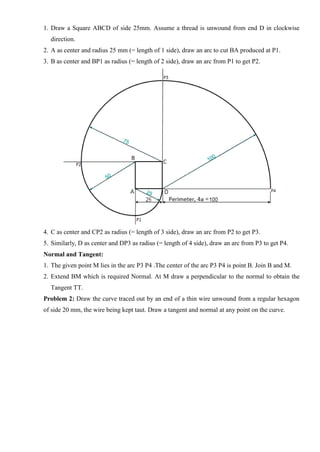
  • 75.
    (b) When aline is inclined to VP and parallel to HP: The projections are usuallyobtained as follows. There are three variables namely TL, θ and FV marked in the drawing. In a problemusually any two variable values will be given and the third variable value can be obtainedgraphically by completing the drawing as mentioned below. Draw the projections a′ anda of the given end A. (i) When TL and ɸ are given. Draw the top view ab using TL and ɸ. The front view(FV) a′b′ is projected and obtained by drawing a line parallel to XY and a verticalline (projector) from b. (ii) When TL and FV are given. Draw the front view a′b′ using FV parallel to the XYline. Draw the vertical line (projector) from b′. Using TL as radius and a as centre,mark a point in the vertical line to get b. Join a and b to complete the top view abof the line. The inclination of ab with XY is measured to get ɸ. (iii) When FV and ɸ are given. Draw the front view a′b′ using FV parallel to the XYline. Draw the vertical line (projector) from b′. Using the angle ɸ, draw a line whichintersects with the projector at b. Join a and b to complete the top view ab of theline. The length of ab is measured to get TL. Problem 6: A line PQ 80 mm long has its end P 30 mm above HP and 15 mm in frontof VP. Its top view (plan) has a length of 50 mm. Draw its projections when the line iskept parallel to VP and inclined to HP. Also find the inclination of the line with HP. Solution: The projections of the line are drawn with reference to the XY line as follows. 1. Mark the projections of end P by considering it as a point. Its front view p’ is30 mm above XY
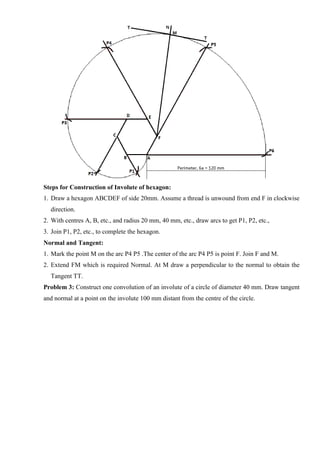
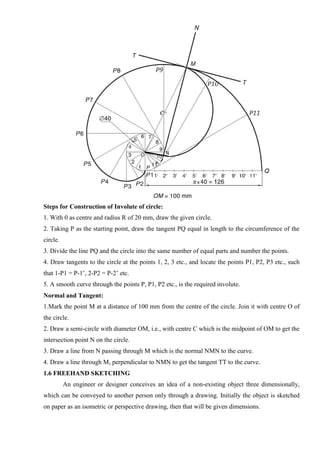
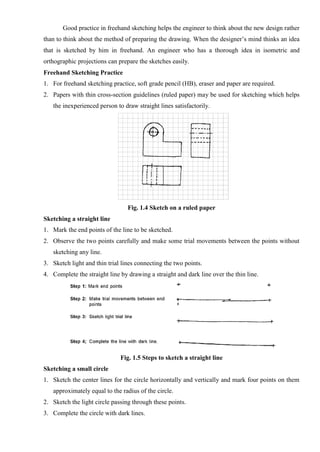
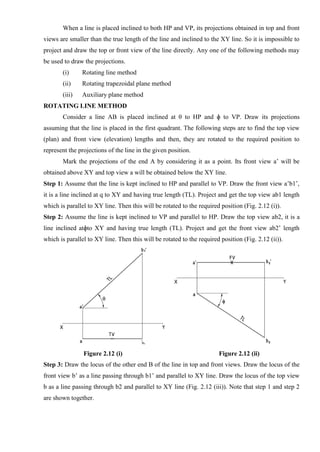
  • 76.
    and top viewp is 15 mm below XY. 2. The top view of the line pq is drawn parallel to XY to the given length of 50 mm. 3. Draw a vertical line (projector) from q. 4. Using true length 80 mm as radius and p’ as center, mark a point in the verticalline to get q’. Join p’ and q’ to complete the front view p’q’ of the line. 5. The inclination of p’q’ with XY is measured to get θ. Problem 7: A line GH 60 mm long has its end G 15 mm above HP and 20 mm infront of VP. Its front view has a length of 40 mm. The line is kept parallel to HP andinclined to VP. Draw its projections and find the true inclination of the line with VP. Solution: The projections of the line are drawn with reference to the XY line as follows. 1. Mark the projections of end G by considering it as a point. Its front view g’ is15 mm above XY and top view a is 20 mm below XY. 2. The front view g’h’ of the line is drawn parallel to XY for a length of 40 mm. 3. Draw a vertical line (projector) from h’. 4. Using true length 60 mm as radius and g as centre, mark a point in the verticalline to get h. Join g and h to complete the top view gh of the line. 5. The inclination of gh with XY is measured to get ɸ.
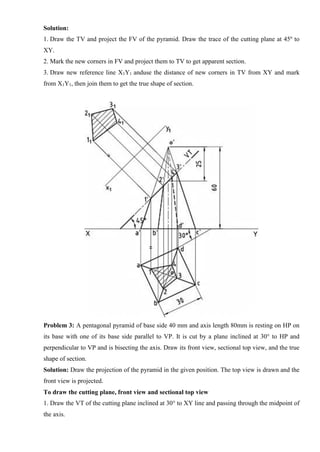
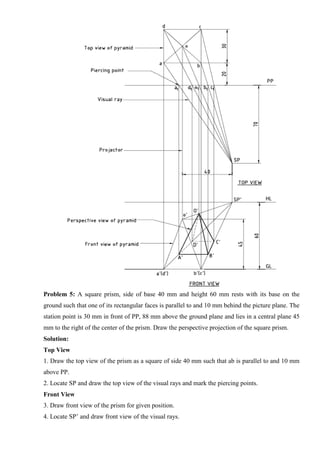
  • 77.
    Problem 8: Aline RS 70 mm long has its end R 20 mm above HP and 25 mm in frontof VP. The line is inclined to HP and parallel to VP. Draw its projections when thedistance between the projectors is 45 mm. Also mark the traces of the line. Solution: The projections of the line are drawn with reference to the XY line as follows. 1. Mark the projections of end R by considering it as a point. Its front view r’ is15 mm above XY and top view r is 25 mm below XY. 2. The top view of the line rs is drawn parallel to XY to the given length of 45 mm. Note that the distance between end projectors is equal to the length of top view. 3. Draw a vertical line (projector) from s. 4. Using true length 70 mm as radius and r’ as centre, mark a point in the verticalline to get s’. Join r’ and s’ to complete the front view r’s’ of the line. 5. The inclination of r’s’ with XY line is measured to get q. Problem 9: A line PQ has its end P 25 mm above HP and 15 mm in front of VP. Itsplan has a length of 45 mm. The line is inclined at 45° to HP and parallel to VP. Drawits projections and find the true length of the line. Solution:The projections of the line are drawn with reference to the XY line as follows.
  • 78.
    1. Mark theprojections of end P by considering it as a point. Its front view p’ is25 mm above XY and top view p is 15 mm below XY. 2. The top view of the line pq is drawn parallel to XY to the given length of 45 mm. 3. Draw a vertical line (projector) from q. 4. Using the angle 45°, draw a line from p’ to get the front view p’q’ of the line. 5. The length of p’q’ is measured to get the true length of the line. Problem 10: A line EF 50 mm long is in VP and inclined to HP. The top view measures30 mm. The end E is 10 mm above HP. Draw the projections of the line. Solution: The projections obtained are drawn with reference to the XY line as follows. 1. Mark the projections of end E by considering it as a point. Its front view e’ is10 mm above XY and top view e is on the XY line. 2. The top view of the line ef is obtained by drawing a line on XY from e to the givenlength of 30 mm. 3. Draw a vertical line (projector) from f. 4. Using true length 50 mm as radius end e’ as centre, mark a point in the verticalline to get f ’. Join e’ and f ’ to complete the front view e’f ’ of the line. 5. The inclination of e’f ’ with XY line is measured to get θ. Projections of a Line kept Inclined to Both VP and HP
  • 79.
    When a lineis placed inclined to both HP and VP, its projections obtained in top and front views are smaller than the true length of the line and inclined to the XY line. So it is impossible to project and draw the top or front view of the line directly. Any one of the following methods may be used to draw the projections. (i) Rotating line method (ii) Rotating trapezoidal plane method (iii) Auxiliary plane method ROTATING LINE METHOD Consider a line AB is placed inclined at θ to HP and ɸ to VP. Draw its projections assuming that the line is placed in the first quadrant. The following steps are to find the top view (plan) and front view (elevation) lengths and then, they are rotated to the required position to represent the projections of the line in the given position. Mark the projections of the end A by considering it as a point. Its front view a’ will be obtained above XY and top view a will be obtained below the XY line. Step 1: Assume that the line is kept inclined to HP and parallel to VP. Draw the front view a’b1’, it is a line inclined at q to XY and having true length (TL). Project and get the top view ab1 length which is parallel to XY line. Then this will be rotated to the required position (Fig. 2.12 (i)). Step 2: Assume the line is kept inclined to VP and parallel to HP. Draw the top view ab2, it is a line inclined atɸto XY and having true length (TL). Project and get the front view ab2’ length which is parallel to XY line. Then this will be rotated to the required position (Fig. 2.12 (ii)). Figure 2.12 (i) Figure 2.12 (ii) Step 3: Draw the locus of the other end B of the line in top and front views. Draw the locus of the front view b’ as a line passing through b1’ and parallel to XY line. Draw the locus of the top view b as a line passing through b2 and parallel to XY line (Fig. 2.12 (iii)). Note that step 1 and step 2 are shown together.
  • 80.
    Figure 2.12 (ii) Step4: Rotate the top view ab1 and front view a’b2’ to the required position. Take a ascentre, top view length ab1 as radius, draw an arc to intersect with the locus of b at b.Join a and b to get the top view ab of the line in required position. Taking a’ as centre,front view a’ b2’ as radius, draw an arc to intersect the locus of b’ at b’. Join a’ and b’ toget the front view a’ b’ of the line in required position (Fig. 2.12 (iv)). Check the drawings obtained, by drawing the projector for the end B by joining b’and b which is a line always perpendicular to XY line.
  • 81.
    Figure 2.12 (iv) Note: 1.The front view a’ b’ is inclined to XY and is known as the apparent inclinationwith HP, represented by symbol α. It is always greater than the true inclination ofthe line with HP, denoted by θ. 2. The top view ab is inclined to XY and is known as the apparent inclination withVP, represented by symbol β. It is always greater than the true inclination of theline with VP, denoted by ɸ. 3. Check the result obtained by drawing the projector joining b’ and b which shouldbe a vertical line (perpendicular to XY). Tips to Solve Problems when a Line is Inclined to Both HP and VP 1. You require thorough knowledge in solving problems when a line is placed inclinedto one plane and parallel to the other plane. 2. Understand the steps suggested in rotating line method, place any object havinglength (for example, your drawing pencil) with reference to the reference planes(for example, your note book in 90° open position to represent VP and HP) as shownin Fig. 2.13. Position the line (pencil) as given in the steps and understand the projections inorder to solve problems when a line is placed inclined to both HP and VP. 3. Steps (1) to (4) can be done in any order to get required projections of the line.
  • 82.
    Figure 2.13 SPECIAL CASES 1.Projectionsof a Line when θ+ ɸ= 90o When the sum of inclinations with HP and VP is equal to 90° (θ+ ɸ= 90°), then the linecontained by a plane will be perpendicular to both HP and VP. The top view aband frontview a’b’of the line will be obtained perpendicular to XY line. 2.Projections of a Line when One End of the Line is in HP and the other in VP This is considered a special case, when only one condition is given for both ends, oneend in HP and another end in VP. Consider a line AB having its end A in HP, (its position from VP not given) and anotherend B in VP (its position from HP is not given). The drawing procedure for this line is the same as in the previous problems, butsteps involved in drawing the projections are drawn separately to get the final projections. The vertical trace (VT) will coincide with the end touching the VP and the horizontaltrace
  • 83.
    (HT) will coincidewith the end touching the HP. Problem 11:A line AB 80 mm long has its end A 20 mm above HP and 25 mm infront of VP. The line is inclined at 45° to HP and 35° to VP. Draw its projections. Solution: Mark the projections of end A by considering it as a point. Its front view a’ is20 mm above XY and top view a is 25 mm below the XY line. 1. Assume that the line is kept inclined to HP and parallel to VP. Draw the frontview a’b1’, a line inclined at 45° to XY line and having a length of 80 mm. Projectand get the top view ab1 length which is parallel to XY line. 2. Assume that the line is kept inclined to VP and parallel to HP. Draw the top viewab2, a line inclined at 35° to XY line and having a length of 80 mm. Project andget the front view ab2’ length which is also parallel to XY line. 3. Draw the locus of the other end B of the line in top and front views. Draw thelocus of b’ which is a line passing through b1’ and parallel to XY line. Also drawthe locus of b which is a line passing through b2 and parallel to XY line. 4. Rotate the top view ab1 and front view a’b2’ to the required position. Take a ascentre, top view length ab1 as radius, draw an arc to intersect the locus ofb at b.Join a and b to get the top view ab of the line. Take a’ as centre, front view lengtha’b2’ as radius, draw an arc to intersect the locus of a’ at b’. Join a’ and b’ to getthe front view a’b’ of the line. 5. Check the result obtained by drawing the projector joining b’ and b which shouldbe a vertical line.
  • 84.
    Problem 12:A lineLM 70 mm long has its end L 10 mm above HP and 15 mm infrontof VP. The top view and front view measures 60 mm and 40 mm respectively. Draw theprojections of the line and determine its inclination with HP and VP. Solution: Mark the projections of the end L by considering it as a point. Its front view l’ is 10 mm above XY and top view l is 15 mm below XY line. 1. Assume that the line is kept inclined to HP and parallel to VP. In this case,considering the given data the top view lm1 can be drawn parallel to XY and havinga length of 60 mm. Draw a vertical line (projector) through m1. Using true length70 mm as radius and l’ as centre, draw an arc to intersect the vertical line throughm1 to get m1’. Join l’ and m1’ which represents the true length of the line. Theinclination of l’m1’ to XY is the inclination of the line with HP (ϴ). 2. Assume that the line is kept inclined to VP and parallel to HP. In this case,considering the given data, the front view l’m2’ can be drawn parallel to XY andhaving a length of 40 mm. Draw a vertical line (projector) through m2’. Using truelength 70 mm as radius and l as centre, draw an arc to intersect the vertical linethrough m2’ to get m2. Join l and m2 which represents the true length of the line.The inclination of lm2 to XY is the inclination of the line with VP (ɸ).
  • 85.
    3. Draw thelocus of the other end M of the line in top and front views. Draw thelocus of m’ which is a line passing through m1’ and parallel to XY line. Also drawthe locus of m which is a line passing through m2 and parallel to XY line. 4. Rotate the top view lm1 and front view l’m2’ to the required position. Take l ascentre, top view lm1 as radius, draw an arc to intersect with the locus of m at m.Join l and m to get the top view lm of the line. Take l’ as centre, front view l’m2’ asradius, draw an arc to intersect the locus of m’ at m’. Join l’ and m’ to get thefront view l’m’ of the line. 5. Check the result obtained by drawing the projector joining m’ and m which shouldbe a vertical line. Problem 13: A line PQ 65 mm long has its end P in the horizontal plane and 15 mminfront of the vertical plane. The line is inclined at 30∞ to the horizontal plane and is at60o to the vertical plane. Draw its projections. Solution: Mark the projections of end P. Its front view p’ is on XY line and top view p is15 mm below XY line. 1. Assume that the line is kept inclined to HP and parallel to VP. Draw the frontview p’q1’ which is inclined at 30° to XY and has a length of 65 mm. The top viewlength pq1 is projected and obtained parallel to XY line.
  • 86.
    2. Assume thatthe line is kept inclined to VP and parallel to HP. Draw the top viewpq2 which is inclined at 60° to XY line and has a length of 65 mm. The front viewlength p’q2’ is projected and obtained parallel to XY line. 3. Draw the locus of q’ passing through q1’ and parallel to XY line. Also draw thelocus of q passing through q2 and parallel to XY line. 4. Rotate the top view pq1 by taking p as centre, pq1 as radius to get q, which touchesthe locus of q. Join p and q to complete the top view pq of the line. Rotate thefront view p’q2’ by taking p’ as centre, p’q2’ as radius to get q’ which touches thelocus of q’. Join p’ and q’ to get the front view p’q’ of the line. Note: The projections obtained are perpendicular to the XY line. Problem 14: A line AB, 75 mm long, is in the first quadrant with end A in HP and endB in VP. The line is inclined at 35° to HP and 45° to VP. Draw the projections of thestraight line AB and indicate the projections of the mid-point M of the line. Also markthe traces. Solution: 1. Mark the front view a’ of the end A on XY line arbitrarily. Assume that the line iskept inclined to HP and parallel to VP. Draw the front view a’b1’ of the line whichis inclined at 35° to XY and has a length of 75 mm. The top view ab1 length isprojected and obtained on the XY line. 2. Mark the top view b of the end B on XY line arbitrarily. Assume that the line iskept inclined to VP and parallel to HP. Draw the top view ba2 of the line which isinclined at 45° to XY and has a
  • 87.
    length of 75mm. The front view ba2’ length isprojected and obtained on XY line. 3. Draw the locus of b’ passing through b1’ and parallel to XY line. Also draw thelocus of a passing through a2 and parallel to XY line. 4. Mark the front view a’ on XY line arbitrarily in another position to get theprojections. Considering a’ as centre, front view length ba2’ as radius, draw anarc to get b’ in the locus of b’. Join a’ and b’ to get the front view a’b’ of the line.Draw the projector passing through b’ to mark the top view b on XY line.Considering b as centre, top view length a’b1 as radius, draw an arc to get a inthe locus of a. Join a and b to get the top view ab of the line. 5. Check the result obtained by drawing the projector joining a’ and a which shouldbe a vertical line. 6. To draw the projections of the mid-point of the line, mark m1’ on the mid-point ofa’b1’ and draw its locus parallel to XY line to get m’ on a’b’. Similarly mark m1 onthe mid-point ba2 and draw its locus parallel to XY line to get m on ab. Draw theprojector joining m’ and m which should be a vertical line. The end A is in HP, so the horizontal trace (HT) is marked coinciding with the topview a of the line. The end B is in VP, so the vertical trace (VT) is marked coinciding withthe front view b’ of the line. Problem 15: A line AB 70 mm long has its end A 15 mm above the HP and 20 mm infront of VP. The end B is 40 mm above HP and 50 mm in front of VP. Draw theprojections and find its inclination with HP and VP. Solution: Mark the projections of end A. Its front view a’ is 15 mm above XY and topview a is 20 mm below the XY line. 1. Draw the locus of the other end B in front and top views. Locus of b’ is drawn ata distance of 40 mm above the XY line and parallel to it. Locus ofb is drawn at adistance of 50 mm below XY line
  • 88.
    and parallel toit. 2. Assume that the line is kept inclined to HP and parallel to VP. Draw the frontview a’b1’ by considering a’ as centre and true length 70 mm as radius, cut anarc in the locus of b’ to mark b1’. The top view length ab1 is projected and obtainedparallel to XY line. The inclination of front view a’b1’ with XY is the inclination ofthe line with HP (ϴ). 3. Assume that the line is kept inclined to VP and parallel to HP. Draw the top viewab2 by considering a as centre and true length 70 mm as radius, cut an arc inthe locus of b to mark b2. The front view length a’b2’ is projected and obtainedparallel to XY line. The inclination of top view ab2 with XY is the inclination of the line with VP (ɸ). 4. Rotate the top view ab1 to the required position by taking a as centre, ab1 as radiusto get the intersection point b with the locus of b. Join a and b to complete thetop view ab of the line. Rotate the front view a’b2’ by taking a’ as centre, a’b2’ asradius to get the intersection point b’ with the locus ofb’. Join a’ and b’ to get thefront view a’b’ of the line. 5. Check the result obtained by drawing the projector joining b’ and b which shouldbe a vertical line. Problem 16: One end P of a line PQ is 15 mm above HP and 20 mm infront of VP whilethe end Q is 50 mm above HP and 45 mm infront of VP. If the end projectors are at adistance of 60 mm, draw the projections of the line. Find the true length and itsinclinations with HP and VP. Solution: Mark the projections of the end P. Its front view p’ is 15 mm above XY lineand top view p is 20 mm below the XY line. 1. Draw the projector for the other end Q at a distance of 60 mm from p-p’. Markthe projection of end Q, its front view q’ is 50 mm above XY line and top view q is45 mm below XY line. Join p’ and q’ to get front view p’q’ of the line. Join p andq to get the top view pq of the line. 2. Draw the locus of the end Q in front and top views. Locus of q’ is drawn passingthrough q’ and
  • 89.
    parallel to XYline. Locus of q is drawn passing through q andparallel to XY line. 3. Rotate top view pq in the reverse order, take p as centre, top view length pq asradius, draw an arc to get q1, on a line drawn parallel to XY line. Project q1 tolocus of q’ to get q1’. Join p’q1’ which has true length (TL) of the line. The inclinationof pq1’ with XY line is the true inclination of the line with HP (ϴ). 4. Rotate the front view p’q’ in the reverse order, take p’ as centre, front view lengthp’q’ as radius, draw an arc to get q2’, on a line drawn parallel to XY line. Projectq2’ to the locus of q to get q2. Join pq2 which has true length (TL) of the line. Theinclination of pq2 with XY line is the inclination of the line with VP (ɸ). Problem 17: The end A of a line AB is 10 mm in front of VP and 20 mm above HP. Theline is inclined at 30° to HP and front view is 45° with XY. Top view is 60 mm long.Complete the two views. Find the true length and inclination with VP. Locate the traces. Solution: Mark the projections of end A. Its front view a’ is 20 mm above XY and topview a is 10 mm below XY line. 1. Assume that the line is kept inclined to HP and parallel to VP. Draw its top viewab1 from a which is parallel to the XY line for a length of 60 mm. Draw a verticalline (projector) from b1 and draw a line from a’ inclined at 30° to XY line,intersecting at b1’. The front view length a’b1’ is the true length (TL) of the line. 2. Draw the locus of b’ passing through b1’ and parallel to XY line. Draw the frontview a’b’ of the line inclined at 45° to the XY line from a’ and intersecting thelocus of b’ at b’. 3. Draw the vertical line (projector) passing through b’. Rotate the top view ab1 bytaking a as centre and ab1 as radius to intersect with the projector at b. Drawthe locus of b passing through b and parallel to XY line.
  • 90.
    4. Rotate thefront view a’b’ in the reverse order. Take a’ as centre, front view a’b’ asradius and draw an arc to get b2’, parallel to XY line. Project b2’ to the locus of bto get b2. Join ab2 which has the true length (TL) of the line. The inclination ofab2 with the XY line is the true inclination of the line with VP (ɸ). To mark the traces 1. Extend the front view a’b’ to get the intersection point h’ with XY line. 2. Produce the top view ab to get the intersection point v with XY line. 3. Draw a vertical line from h’ to intersect with the top view to get horizontal trace(HT). 4. Draw another vertical line from v to intersect with the front view to get the verticaltrace (VT). PROJECTION OF PLANE SURFACES 2.8 PLANE SURFACE A plane figure has two dimensions viz. the length and breadth. It may be of any shape such as triangular, square, pentagonal, hexagonal, circular etc. The possible orientations of the planes with respect to the principal planes H.P and V.P of projection are: 1. Plane parallel to one of the principal planes and perpendicular to the other,
  • 91.
    2. Plane perpendicularto both the principal planes, 3. Plane inclined to one of the principal planes and perpendicular to the other, 4. Plane inclined to both the principal planes. 1. Plane parallel to one of the principal planes and perpendicular to the other When a plane is parallel to V.P the front view shows the true shape of the plane. The top view appears as a line parallel to XY. Figure 2.14.a shows the projections of a square plane ABCD, when it is parallel to V.P and perpendicular to H.P. The distances of one of the edges above H.P and from the V.P are denoted by d1 and d2 respectively. Figure 2.14.b shows the projections of the plane. Figure 2.14.c shows the projections of the plane, when its edges are equally inclined to H.P. Figure 2.14 Figure 2.15 shows the projections of a circular plane, parallel to H.P and perpendicular to V.P Figure 2.15
  • 92.
    2. Plane perpendicularto both H.P and V.P When a plane is perpendicular to both H.P. and V.P, the projections of the plane appear as straight lines. Figure 2.16 shows the projections of a rectangular plane ABCD, when one of its longer edges is parallel to H.P. Here, the lengths of the front and top views are equal to the true lengths of the edges. Figure 2.16 3. Plane inclined to one of the principal planes and perpendicular to the other When a plane is inclined to one plane and perpendicular to the other, the projections are obtained in two stages. Problem: Projections of a pentagonal plane ABCDE, inclined at ϴ to H.P and perpendicular to V.P and resting on one of its edges on H.P. Construction: (Fig.2.17) Figure 2.17
  • 93.
    4. Plane inclinedto both H.P and V.P If a plane is inclined to both H.P and V.P, it is said to be an oblique plane. Projections of oblique planes are obtained in three stages. Problem: A rectangular plane ABCD inclined to H.P by an angle ϴ, its shorter edge being parallel to H.P and inclined to V.P by an angle ɸ. Draw its projections. Construction: (Fig.2.18) Figure 2.18 Problem 1: A square plane of side 40 mm has its surface parallel to VP and perpendicular to HP. Draw its projections when one of the sides is inclined at 300 to HP. Solution: When a plane is placed with its surface parallel to VP and perpendicular to HP, draw its front view which will have the true shape and size. Project the top view which will be a line parallel to XY.To draw the projections
  • 94.
    1. Draw aline inclined at 30o to XY. Arbitrarily mark the side 40mm of the square on this line and construct the square. Name the corners as a’b’c’d’. 2. Project the top view of the plane by projecting all the corners from the front view which is a line a(b)cd drawn parallel to the XY line. Problem 2: A circular plate of diameter 50 mm has its surface parallel to HP and perpendicular to VP. Its center is 20 mm above HP and 30 mm in front of VP. Draw its projections. Solution: When a plane is placed with its surface parallel to HP and perpendicular to VP, draw its top view which will have the true shape and size. Project the front view which will be a line parallel to XY.To draw the projections 1. Mark the projections of the centre of the circle – its front view o’ is 20mm above XY and top view o is 30mm below XY line. 2. Draw the top view of the plane with o as centre and 25mm radius. Project the front view of the plane by projecting the top view which is a line passing through o’ and parallel to XY line.
  • 95.
    Problem 3: Ahexagonal plate of size 30 mm is placed with a side on VP and surface inclined at 450 to VP and perpendicular to HP. Draw the projections. Solution:When a plane is placed with its surface inclined to VP and perpendicular to HP, its projections are obtained in two steps. Step 1:Assume that the plate has its surface parallel to VP and perpendicular to HP. Draw its e a line parallel to XY. Step 2:Reproduce the top view tilted to the given angle to VP and project the front view of the plate which will be smaller than the true shape and size. To draw the projections 1. Draw the top view of the rectangle considering that one of the shorter sides is perpendicular to XY. Then, only while titling the surface to the required inclination with VP, this side of the plate will rest on VP. 2. Project the top view of the plate by projecting the front view a’b’c’d’e’f’ to get the top view a(b)f(c)e(d) as a line on XY line.
  • 96.
    3. Tilt andreproduce the top view a(b)f(c)e(d) to get the required angle 45o with XY in such a way that the end a(b) is on the XY line. 4. Draw horizontal lines from a’b’c’d’e’and f’ and vertical lines from top view a1,b1,c1,d1,e1,and f1 to get the required front view 𝑎1 ′ , 𝑏1 ′ , 𝑐1 ′ , 𝑑1 ′ , 𝑒1 ′ 𝑎𝑛𝑑 𝑓1 ′ . 5. Join 𝑎1 ′ , 𝑏1 ′ , 𝑐1 ′ , 𝑑1 ′ , 𝑒1 ′ 𝑎𝑛𝑑 𝑓1 ′ to get the front view of the hexagonal plate smaller than the true shape and size. Problem 4: A circular plate of diameter 50 mm is resting on HP on a point on the circumference with its surface inclined at 450 to HP and perpendicular to VP. Draw its projections. Solution: To draw the projections 1. Assume that the plate has its surface parallel to HP and perpendicular to VP. Draw its top view. It is a circle of radius 25mm. 2. Project and get the front view which is a line on XY. 3. As the circle does not have any corners, divide the circle into equal parts, say 8, (students are asked to divide the circle into a minimum of 12 parts) in such a way that 8 points are marked on its circumference and project them to the front view. 4. Tilt and reproduce front view to the given angle of 45o with XY line, in such a way that the end a’ is on XY line. 5. Draw horizontal lines from a, b, c, etc. and vertical lines from𝑎1 ′ , 𝑏1 ′ , 𝑐1 ′ , etc. to get the required top view a1, b1, c1, etc. 6. Join a1, b1, c1, etc. by drawing a smooth curve to get the top view of the circle as an ellipse. Problem 5: A rectangular plate of side 50 x 25 mm is resting on its shorter side on HP and inclined at 30̊ to VP. Its surface is inclined at 60̊ to HP. Draw the projections. Solution:In this position, the surface of the plane is inclined to both HP and VP, its projections are obtained in three steps.
  • 97.
    Step1: Assume thatthe plate has its surface parallel to HP and perpendicular to VP. Draw its top view which will have the true shape and size. Project the front view which will be a line parallel to the XY line. Step 2: Reproduce the front view tilted to the given angle 𝜃 to HP and project the top view of the plate which will be smaller than the shape and size. Step 3: Reproduce the top view by considering the side of the plate the makes, the given angle with VP. Project the front view of the plate which is also smaller than the true shape and size. To draw the projections 1. Draw the top view of the rectangle considering that one of the shorter sides is perpendicular to XY. Then only while tilting the surface to the required angle with HP, this side of the plate will rest on HP. 2. The front view of the plate is projected and obtained on XY as a line a’(d’)b’(c’). 3. Tile and reproduce the front view a’(d’)b’(c’) to the given angle 60o with XY in such a way that the end a’(d’) is o XY line. 4. Draw horizontal lines from to view a, b, c and d vertical lines from front view 𝑎1 ′ , 𝑏1 ′ , 𝑐1 ′ 𝑎𝑛𝑑 𝑑1 ′ to get the top view a1, b1, c1, d1 smaller than the true shape and size. 5. Reproduce the top view a1, b1, c1, d1 in such a way that the side a1, d1 is inclined to the given angle 30o to VP. 6. Draw horizontal lines from 𝑎1 ′ , 𝑏1 ′ , 𝑐1 ′ 𝑎𝑛𝑑 𝑑1 ′ and vertical lines from top view a2, b2, c2 and d2 to get the required front view 𝑎2 ′ , 𝑏2 ′ , 𝑐2 ′ 𝑎𝑛𝑑 𝑑2 ′ of the plate smaller than the true shape and size. Problem 6: A hexagonal plate of side 30mm is resting on one of its sides on VP and inclined at 40o to HP. Its surface is inclined at 35o to VP. Draw its projections.
  • 98.
    Solution:In this position,the surface of the plate is inclined to both VP and HP. Its projections are obtained in three steps. Step 1: Assume that the plate has its surface parallel to VP and perpendicular to HP. Draw its front view which will have the true shape and size. Project the top view which will be a line parallel to XY line. Step 2: Reproduce the top view tilted to the given angle to VP and project the front view of the plate which will be smaller than the true shape and size. Step 3:Reproduce the front view by considering the side of the plate that makes the given angle with HP. Project the top view of the plate which is also smaller than the true shape and size. To draw the projections 1. Draw the front view of the hexagon considering one of the sides perpendicular to XY. Then only while tilting the surface to the required angle with VP, this side of the plate will rest on VP. 2. The top view of the plate is projected and obtained on XY as a line. 3. Tilt and reproduce the top view line to the given angle 35o with XY in such a way that the end a(b) is on the XY line. 4. Draw horizontal lines from front view a’, b’, c’, etc. and vertical lines from top view a1, b1, c1, etc, to get the front view of the plate which is smaller than the true shape and size. 5. Reproduce the front view in such a way that the side a1b1 is inclined to the given angle 40o to HP. (Note that side d1e1 is also at the same angle). 6. Draw horizontal lines from a1, b1, c1, etc., and a`2, b`2, c`2, etc., to get the required top view of the hexagonal plate which is smaller than the true shape and size.
  • 99.
    Problem 7: Apentagonal plate of side 30 mm is resting on HP on one of its corners with its surface inclined at 450 to HP. The side opposite to the resting corner is parallel to VP and farther away from it. Draw its projections. Solution:In this position, the surface of the plane is inclined to both HP and VP, its projections are obtained in three steps. Step1: Assume that the plate has its surface parallel to HP and perpendicular to VP. Draw its top view which will have the true shape and size. Project the front view which will be a line parallel to the XY line. Step 2: Reproduce the front view tilted to the given angle 𝜃 to HP and project the top view of the plate which will be smaller than the shape and size. Step 3: Reproduce the top view by considering the side of the plate the makes, the given angle with VP. Project the front view of the plate which is also smaller than the true shape and size. To draw the projections 1. Draw the top view of the pentagonal plate considering that one of the sides is perpendicular to XY. Then only while tilting the surface to the required angle with HP, a corner of the plate will rest on HP. Name the corners as a, b, c, d and e. 2. The front view of the plate is projected and obtained on XY as a line a`(e`)b`(d`)c`. 3. Tilt and reproduce the front view a`(e`)b`(d`)c` to the given 450 with XY in such a way that the corner c` is on XY line. 4. Draw horizontal lines from top view a, b, c, d and e and vertical lines from front view a1`, b1`, c1`, d1`, and e1` to get the top view a1, b1, c1, d1, and e1, which is smaller than the true shape and size of the plate. 5. Reproduce the top view a1, b1, c1, d1 and e1 in such a way that the side e1a1 is parallel to VP.
  • 100.
    6. Draw horizontallines from a1`, b1`, c1`, d1` and e1` and vertical lines from top view a2, b2, c2, d2 and e2 to get the required front view a2`, b2`, c2`, d2` and e2` of the plate which is also smaller than the true shape and size. Problem 8: A square plate ABCD of side 30 mm is resting on HP on one of its corners and the diagonal AC inclined at 300 to HP. The diagonal BD of the plate is inclined at 450 to the VP and parallel to the HP. Draw its projections. Solution:In this position, the surface of the plane is inclined to both HP and VP, its projections are obtained in three steps. Step1: Assume that the plate has its surface parallel to HP and perpendicular to VP. Draw its top view which will have the true shape and size. Project the front view which will be a line parallel to the XY line. Step 2: Reproduce the front view tilted to the given angle 𝜃 to HP and project the top view of the plate which will be smaller than the shape and size. Step 3: Reproduce the top view by considering the side of the plate the makes, the given angle with VP. Project the front view of the plate which is also smaller than the true shape and size. 1. Draw the top view of the square plate considering that two of the sides are equally inclined to XY. Then only while tilting the surface to the required angle with HP, a corner of the plate will rest on HP. Name the corners as a, b, c, and d. 2. The front view of the plate is projected and obtained on XY as a line a`b`(d`)c`. 3. Tilt and reproduce the front view a`b`(d`)c` to the given angle 450 with XY in such a way that the corner a` is on XY line. 4. Draw horizontal lines from top view a, b, c and d and vertical lines from front view a1` b1` c1` and d1` to get the top view a1, b1, c1 and d1 which is smaller than the true shape and size of the plate. 5. Reproduce the top view a1, b1, c1, and d1 is such a way that the diagonal b1d1 is inclined at 300 to VP. 6. Draw horizontal lines from a1`, b1`, c1` and d1` and vertical lines from top view a2, b2, c2 and d2 to get the required front view a2`, b2`, c2` and d2` of the plate which is smaller than the true shape and size.
  • 101.
    Problem 9: Acircular plate of diameter 50 mm is resting on the HP on a point on the circumference. Its surface is kept inclined at 450 to HP. Draw its projections when the line representing its diameter and passing through the resting point is inclined at 300 to the VP. Solution:In this position, the surface of the plane is inclined to both HP and VP, its projections are obtained in three steps. Step1: Assume that the plate has its surface parallel to HP and perpendicular to VP. Draw its top view which will have the true shape and size. Project the front view which will be a line parallel to the XY line. Step 2: Reproduce the front view tilted to the given angle 𝜃 to HP and project the top view of the plate which will be smaller than the shape and size. Step 3: Reproduce the top view by considering the side of the plate the makes, the given angle with VP. Project the front view of the plate which is also smaller than the true shape and size. 1. Assume that the circular plate has its surface parallel to HP and perpendicular to VP. Draw its top view which is a circle of radius 25 mm. 2. Project and get the front view of the plate which is a line on XY. 3. Divide the circle into 8 equal parts and mark a, b, c, etc., and project them to get a’, b`, c`, etc., in front view. 4. Tilt and reproduce the front view a`-e` to the given angle 450 with XY is such a way that the corner a` is on XY line. 5. Draw horizontal lines from top view a, b, c, etc., and vertical lines from front view a1`, b1`, c1` etc., to get the top view a2, b2, c2, etc., and draw the ellipse. 6. Mark the true length of the diameter (i.e. 50mm) a2E2 on the line drawn 30o to XY. Draw the locus of the end E of the diameter a-e. Mark the diameter a2e2 on the locus and reproduce the top view a2, b2, c2, etc, and draw the ellipse. 7. Raw horizontal lines from 𝑎2 ′ , 𝑏2 ′ , 𝑐2 ′ , etc., and vertical lines from top view a2, b2, c2, etc., to get the required front view 𝑎2 ′ , 𝑏2 ′ , 𝑐2 ′ , etc., of the plate.
  • 102.
    Problem 10: Drawthe projection of a circle of 70mm diameter resting on the HP on a point A of the circumference. The plane is inclined to the HP such that the top of it is an ellipse of minor axis 40mm. the top view of the VP. Determine the inclination of the plane with the HP. Solution:To draw the projections. In this position, the surface of the plane is inclined to both HP and VP, its projections are obtained in three steps. Step1: Assume that the plate has its surface parallel to HP and perpendicular to VP. Draw its top view which will have the true shape and size. Project the front view which will be a line parallel to the XY line. Step 2: Reproduce the front view tilted to the given angle 𝜃 to HP and project the top view of the plate which will be smaller than the shape and size. Step 3: Reproduce the top view by considering the side of the plate the makes, the given angle with VP. Project the front view of the plate which is also smaller than the true shape and size. 1. Assume that the circular plane has its surface parallel to HP and perpendicular to VP. Draw its top view which is a circle of radius 35mm. 2. Project and get the front view of the plane which is a line on XY. 3. Divide the circle into 8 equal parts and mark a, b, c, etc., and project them to get a`, b` c` etc., in front view. 4. Mark a1` arbitrarily on XY and draw a vertical line at 40mm (minor axis) away from it. Mark the front view a1`,-e1` from a1` and get the inclination of the plane with HP. 5. Draw horizontal lines from top view a, b, c view etc., and vertical lines from front a1`, b1`, c1`, etc., to get the top view a1, b1, c1, etc., and join them to get the ellipse. 6. Draw a line inclined at 45o to XY and mark the diameter a2e2 on it and reproduce the top view to get a2, b2, c2, etc., and draw the ellipse.
  • 103.
    7. Draw horizontallines from a1`, b1`, c1` etc., and vertical lines from top view a2, b2, c2, etc., to get the required front view a2`, b2`, c2`, etc., of the plane. 2.9 ASSIGNMENT PROBLEMS PROJECTION OF LINES 1. A line AB 55 mm long has its end A 25 mm above HP and in VP. The line is inclined at 450 to HP. Draw its projections. 2. A line AB 55 mm long has its end A 25 mm in front of VP and in HP. The line is inclined at 450 to VP. Draw its projections. 3. A line AB 75 mm long has its end A in both HP and VP. The line is kept inclined at 450 to HP and 300 to VP. Draw its projections. 4. A line AB 85 mm long has its end A 25 mm away from both the reference planes and is in the first quadrant. The line is inclined at 500 to HP and 300 to VP. Draw its projections and mark the traces of the line. 5. A line AB 65 mm long has its end A 25 mm above HP and 15 mm in front of VP. The line is inclined at 350 to HP and 550 to VP. Draw its projections. 6. One end A of a line AB, 75 mm long is 20 mm above HP and 25 mm in front of VP. The line inclined at 300 to HP and the top view makes 450 with VP. Draw the projections of the line and find the true inclinations with the vertical plane. [Ans:Ø = 380] 7. A line AB 85 mm long has its end A 60 mm above HP and 65 mm in front of VP. The end B is 25 mm above HP and 20 mm in front of the VP. Draw the projections and find its inclinations with HP and VP. Mark its traces. [Ans:θ = 240, Ø = 320]
  • 104.
    8. A lineAB measuring 75 mm long has one of its ends 50 mm in front of VP and 15 mm above HP. The top view of the line is 50 mm long. Draw and measure the front view. The other end is 15 mm in front of VP and is above HP. Determine the true inclinations and traces. 9. A line AB, 80 mm long has one of its end 60 mm above HP and 20 mm in front of VP. The other end is 15 mm above HP and in front of VP. The front view of the line is 65 mm long. Draw the top view and find the true inclinations and traces. 10. A line AB has its end A in HP and 40 mm in front of VP. Its front view is inclined at 500 to XY and has a length of 70 mm. The other end B is in VP. Draw its projections. 11. The mid-point of a straight line AB 90 mm long is 60 mm above HP and 50 mm in front of VP. It is inclined at 300 to HP and 450 to VP. Draw its projections. PROJECTION OF PLANE SURFACES 12. A pentagonal plate of side 30 mm is resting on one of its edge on HP which is inclined at 45̊ to VP. Its surface inclined at 30̊ to HP. Draw its projections. 13. A hexagonal plate of side 30mm is resting on a shorter side on HP and inclined at 30̊ to VP. Its surface inclined at 60̊ to HP. Draw its projections. 14. A square plate ABCD of side 30 mm is resting on HP on one of its corners and the diagonal AC inclined at 30̊ to HP. The diagonal BD of the plate is inclined at 45̊ to the VP and parallel to the HP. Draw its projections. 15. A rectangular plate of sides 60mm x 30mm has its shorter side in VP and inclined at 30̊ to HP. Project its top view, if its front view is a square of 30 mm long sides. 16. Draw the projection of the circle of 70 mm diameter resting on HP on a point A of the circumference. The plane is inclined at 50̊ to HP. The top view of the diameter through the resting point is making an angle of 45̊ with VP. 17. 10. A circular lamina of 60 mm diameter rests on HP on a point 1 on the circumference. The lamina is inclined to HP such that the top view of it is an ellipse of minor axis 35 mm. The top view of the diameter through the point makes an angle of 45̊ with VP. i) Draw the projections. ii) Determine the angle made by the lamina with HP. (Ans: ϴ = 54o ) 18. A hexagonal lamina of 20 mm side rests on one of its corners on the HP. The diagonal passing through this corner is inclined at 45̊ to the HP. The lamina is then rotated through 90̊ such that the top view of this diagonal is perpendicular to the VP and the surface is still inclined at 45̊ to the HP. Draw the projections of the lamina. 19. A hexagonal lamina of 25 mm side resting on HP such that one of its corners touches both HP and VP. It makes 30̊ with HP and 60̊ with VP. Draw the projections. 2.10 UNIVERSITY QUESTIONS 1. Draw the projections of the following points on a common reference line. A) P 35mm behind the VP and 20mm below the HP.
  • 105.
    B) Q 40mmin front the VP and 30mm above the HP. C) R 50mm behind the VP and 15mm above the HP. D) S 40mm below the HP and in the VP. E) T 30 mm in front of the VP and 50mm below the HP. (Jan 2013) PROJECTION OF LINES 2. A line NS, 80 mm long has its end N, 10 mm above the HP and 15 mm in front of the VP. The other end S is 65 mm above the HP and 50 mm in front of the VP. Draw the projections of the line and find its true inclinations with the HP and VP. (Apr/May 2015) 3. One end P of line PQ, 80 mm long is 10 mm above HP and 15 mm in front of VP. The line is inclined at 40° to HP and the top view of the line is making 50° with VP. Draw the projections of the line and find its true inclination with the VP. (Nov 2014) 4. The front view of the line AB of length 70 mm is inclined at 30° to xy line and measures 45mm. The end A is 20 mm above HP and 25 mm in front of VP. Draw the projections of the line and find the inclinations with HP and VP. (Nov 2014) 5. A straight line AB of 50 mm length has its end point A 15 mm above the HP and the end B 20 mm in front of the VP. The top view of the line is 40 mm long and the elevation is 35 mm long. Draw the projections of the line and find the true inclinations of the line with VP and the HP. (June 2014) 6. One end P of a line PQ, 55 mm long is 35 mm in front of the VP and 25 mm above the HP. The line is inclined at 40° to the HP and 30° to the VP. Draw the projections of PQ. (Jan 2014) 7. A straight line AB of length 100 mm has its end A 10 mm in front of VP and B 20 mm above HP. The front view and top view of the line measure 80 mm and 60 mm respectively. Draw the projections of the line and obtain the true angles of inclination with HP and VP(Jan 2014) 8. The top view of 75 mm long line AB measures 65 mm while the length of its front view is 50 mm. It’s one end A is in H.P. and 12 mm in front of the V.P. Draw the projections of AB and determine its inclinations with the H.P. and the V.P. (Jan 2013) 9. The end P of a line PQ, 70 mm long is 15 mm above the HP and 20 mm in front of the VP. Its plan is inclined at 45° to the VP. Draw the projections of the line and find its true inclinations with the VP and the HP. (Jan 2013) 10. The projections of a line AB are perpendicular to xy. The end A is in HP and 50 mm in front of VP and the end B is in VP and 40 mm above HP. Draw its projections, determine its true length and the inclinations with the HP and VP. (June 2012)
  • 106.
    11. The frontview of a line AB 90 mm long is inclined at 45° to XY line. The front view measures 65 mm long. Point A is located 15 mm above H.P. and is in V.P. Draw the projections and find its true inclinations. (Jan 2012) 12. A line PQ measuring 70 mm is inclined to H.P. at 30° and to V.P. at 45° with the end P 20 mm above H.P. and 15 mm in front of V.P. Draw its projections. (Jan 2012) 13. A line AB has its end A 15 mm above H.P. and 20 mm in front of V.P. The end B is 60 mm above H.P. and the line is inclined at 30° to H.P. The distance between the end projectors of the line is 55 mm. Draw the projections and find its inclination with V.P. (Nov 2011) 14. The end P of a line PQ is 30 mm above HP and 35 mm in front of VP. The line is inclined at 35° to the HP. Its top view is 70 mm long and inclined at 40° to XY. Draw the projections of the straight line. Find the true length and inclination of the line with the VP. (Apr 2011) 15. The top view of a line AB has points a and b, 10 mm and 50 mm below the xy line and the front view has points a’ and b’ 40 mm and 15 mm above xy line respectively. Determine the true length and inclinations of the line with HP and VP. Take the distance between the end projectors as 70mm. (Nov 2010) 16. A line LM 70 mm long, has its end L 10 mm above H.P and 15 mm in front of V.P. Its top and front views measure 60 mm and 40 mm respectively. Draw the projections of the straight line and find its inclinations with HP and VP. (Apr 2010) 17. Aline PF, 65 mm has its end P, 15 mm above the HP and 15 mm in front of the VP. It is inclined at 55° to the HP and 35° to the VP. Draw its projections. (June 2009) 18. A straight line ST has its end S, 10 mm in front of the VP and nearer to it. The mid-point m of the line is 50 mm in front of the VP and 40 mm above HP. The front and top view measures 90 mm and 120 mm respectively. Draw the projections of the line. Also find its true length and true inclinations with the HP and the VP. (Jan 2009) 19. A straight line AB has its end A 20 mm above HP and 25 mm in front of VP. The other end B is 60 mm above HP and 65 mm in front of VP. The ends of the line are on the same projector. Draw its projections. Find the true length, true inclinations of the line with HP and VP also mark traces. (June 2007) PROJECTION OF PLANE SURFACES 20. A rectangular plate measuring 55 x 30 mm is resting on its shorter side on the HP inclined at 30° to the VP. Its surface is inclined at 60° to the HP. Draw its projections. (Apr 2015) 21. A rectangular lamina of size 60 mm X 30 mm is seen as square in the top view, when it rests on one of its edges on HP and perpendicular to VP. Draw the projections of the lamina and find the true inclinations of its surface with HP. Draw the front view of the lamina, when the edge about which is tilted, is inclined at 45° to VP. (Nov 2014)
  • 107.
    22. A regularcircular lamina of 60 mm diameter rests on HP such that the surface of the lamina is inclined at 30° HP. Obtain its projection when the top view of the diameter passing through the point on HP makes 45° to VP. (Nov 2014) 23. An isosceles triangular plate ABC has its base edge AB 60 mm long and on the ground inclined at 30° to VP. The length of the altitude of the plate is 80 mm. The plate is placed so that the edge AC lies in a plane perpendicular to both the HP and VP. Draw the projections of the plate and find out the angles of inclination of the plate with the HP and VP. (June 2014) 24. A hexagonal plate of side 20 mm rests on the HP on one of its sides inclined at 45° to the VP. The surface of the plate makes an angle of 30° with the HP. Draw the front and top views of the plate. (Jan 2014) 25. A hexagonal lamina of side 30 mm is resting on HP on one of its corners with the sides containing the corner being equally inclined to HP. The surface of the lamina makes an angle of 30° with HP. Draw the top view and front view of the lamina if the plan of the diagonal passing through that corner is inclined at 50° to xy – line. (Jan 2014) 26. Draw the projections of a regular hexagon of 25 mm side having one of its sides in the H.P. and inclined at 60° to the V.P., and its surface making an angle of 45° with the H.P. (Jan 2013) 27. A circular plate of diameter 70 mm has the end P of the diameter PQ in the HP and the plate is inclined at 40° to the HP, Draw its projection (i) The diameters PQ appears to be inclined at 45° to the VP in the top view (ii) The diameter PQ makes 45° with the VP (Jan 2013) 28. A square lamina PQRS of side 40mm rests on the ground on its corner P in such a way that the diagonal PR is inclined at 45° to HP and also apparently inclined at 30° to VP. Draw its projections. (June 2007)(June 2012) 29. A hexagonal lamina of side 30 mm rests on one of its edges on H.P. This edge is parallel to V.P. The surface of the lamina is inclined 60° to H.P. Draw its projections. (Jan 2012) 30. A rectangular plate of side 50 x 25 mm is resting on its shorter side on H.P. and inclined at 30° to V.P. Its surface is inclined at 60° to H.P. Draw its projections. (Jan 2012) 31. A regular hexagonal lamina of 40 mm side is resting on one of its corner on H.P. Its surface is inclined at 45° to H.P. The plan of diagonal through the corner which is on H.P. makes an angle of 45° with XY. Draw its projections. (Nov 2011) 32. A circular plate of 60 mm diameter has a hexagonal hole of 20 mm sides centrally punched. Draw the projections of the lamina resting on the HP with its surface inclined at 30° to the HP and the diameter through the point on which the lamina rests on HP is inclined at 50° to VP. Any two parallel sides of the hexagonal hole are perpendicular to the diameter of the circular plate passing through the point on which it rests. Draw the projections. (Apr 2011)
  • 108.
    33. A circularlamina of 60 mm diameter is kept 35° inclined to HP and perpendicular to VP, so that the centre of the lamina is 40 mm in front of VP and the lowest of the circular edge is 15 mm above HP. Draw the projections of the lamina. (Nov 2010) 34. A thin rectangular plate of side 40 mm X 20 mm has its shorter side in the HP and inclined at an angle of 30° to the VP. Project its front view when its top view is a perfect square of 20 mm side. (Apr 2010) 35. A pentagon of side 30 mm rests on the ground on one of its corners with the sides containing the corner being equally inclined to the ground. The side opposite to the corner on which it rests is inclined at 30° to the VP and is parallel to the HP. The surface of the pentagon makes 50° with the ground. Draw the top and front views of the pentagon. (June 2009) 36. A regular pentagon of 30 mm side, is resting on one of its edges on HP, which is inclined at 45° to VP. Its surface is inclined at 30° to HP. Draw its projections. (Jan 2009) UNIT – III PROJECTIONS OF SOLIDS An object having three dimensions, i.e., length, breadth and height is called as solid. In orthographic projection, minimums of two views are necessary to represent a solid. Front view is used to represent length and height and the top view is used to represent length and breadth. Sometimes the above two views are not sufficient to represent the details. So a third view called as side view either from left or from right is necessary. 3.1 CLASSIFICATION OF SOLIDS Solids are classified into two groups. They are 1. Polyhedra
  • 109.
    2. Solids ofRevolution Polyhedra A solid, which is bounded by plane surfaces or faces, is called a polyhedron. Polyhedra are classified into three sub groups; these are 1. Regular Polyhedra 2. Prisms 3. Pyramids Regular Polyhedra Polyhedra are regular if all their plane surfaces are regular polygons of the same shape and size. The regular plane surfaces are called "Faces" and the lines connecting adjacent faces are called "edges". Tetrahedron Octahedron Hexahedron
  • 110.
    Prisms A prism hastwo equal and similar end faces called the top face and the bottom face or (base) joined by the other faces, which may be rectangles or parallelograms. Triangular prism Square Prism Rectangular Prism
  • 111.
    Pentagonal Prism Hexagonal Prism Pyramids Apyramid has a plane figure as at its base and an equal number of isosceles triangular faces that meet at a common point called the "vertex" or "apex". The line joining the apex and a comer of its base is called the slant edge. Pyramids are named according to the shapes of their
  • 112.
  • 113.
    Hexagonal Pyramid Solids ofRevolution If a plane surface is revolved about one of its edges, the solid generated is called a Solid of Revolution. The commonly obtained solids of revolution are 1. Sphere 2. Cone 3. Cylinder Sphere A sphere can be generated by the revolution of a semi-circle about its diameter that remains fixed. Cone A cone can be generated by the revolution of a right-angled triangle about one of its perpendicular sides, which remains fixed. A cone has a circular base and an apex. The line joining apex and the centre of the base is called the “Axis’" of the cone. Cylinder A right circular cylinder is a solid generated by the revolution of a rectangular surface about one of its sides, which remains fixed. It has two circular faces. The line joining the centres of the top and the bottom faces is called “Axis”.
  • 114.
    Solids of Revolution ObliqueSolids An oblique solid has its axis inclined to its base or HP, when it rests on the HP on its base. Oblique prisms Oblique pyramids Oblique Cylinder Oblique Cone
  • 115.
    Frustum of apyramid or cone When a pyramid or a cone is cut by a plane parallel to its base, thus removing the top portion, the remaining portion is called its frustum. Truncated When a solid is cut by a plane inclined to the base, it is said to be truncated. Frustum of a Solid and Truncated Solids 3.2 POSITION OF A SOLID WITH RESPECT TO THE REFERENCE PLANES The position of solid in space may be specified by the location of either the axis, base, edge, diagonal or face with the principal planes of projection. The following are the positions of a solid considered. 1. Axis perpendicular to HP and parallel to VP. 2. Axis perpendicular to VP and parallel to HP. 3. Axis parallel to both HP and VP. 4. Axis inclined to HP and parallel to VP. 5. Axis inclined to VP and parallel to HP. 6. Axis inclined to both the principal planes. The position of solid with reference to the principal planes may also be grouped as follows: 1. Solid resting on its base. 2. Solid resting on anyone of its faces, edges of faces, edges of base, generators, slant edges, etc. 3. Solid suspended freely from one of its comers, etc. Understanding Projections of Solid
  • 116.
    1. Any oneof the solids given above is kept in first quadrant to draw its projections (TV, FV etc.). 2. There are six different positions in which a solid can be placed with reference to its axis and reference planes (VP & HP). 3. Your ability to visualize the solid and imagining the correct position is necessary to understand and draw the projections of the solid. Tips to draw visible and hidden edges 1. Read the given problem carefully and understand the FV and TV in that position and follow the steps as given against each position. 2. Draw one of the views and project the other view. 3. All boundary edges in any view are always visible. 4. Edges in upper half of a solid, i.e. above axis in front view, is always visible in top view. Other edges are drawn in dashed lines. 5. Edges in front half of a solid, i.e. in front of axis in top view, is always visible in front view. Other edges are drawn in dashed lines. Projections of Solid with its Axis perpendicular to HP and parallel to VP When the axis of a solid is perpendicular to H.P, the top view must be drawn first because it shows the true shape and size of the base of the solid, and then the front view is projected from it. Example 1: A square prism of base side 30 mm and axis length 60 mm is resting on HP on one of its bases with a side of base inclined at 30o to VP. Draw its projections. Solution: The axis of the given prism is perpendicular to HP and parallel to VP. The top view is drawn first and front view is projected from it. To draw the top view 1. Draw a line inclined at 30o to XY line, on that line arbitrarily mark a side 30 mm and construct the square. 2. Name the top base corners as a, b, c and d which are visible and the bottom corners as p, q, r, and s which are invisible and marked inside the square. To draw the front view 1. Project the front view of the prism by projecting the various corners of the solid. Since the bottom base corners are on HP projectors are drawn from p, q, r and s to mark p’, q’, r’ and s’ on XY line. 2. The top base corners are obtained at a height 60 mm which is the axis length of the solid. Draw a thin construction line at this height and project the top base corners a, b, c and d to mark a’, b’, c’, and d’.
  • 117.
    3. Draw linesjoining the top base corners and bottom base corners. Join the visible longer edges a’p’, b’q’, c’r’ with continuous thick lines and the invisible edge d’s’ is drawn with dotted line or hidden line or dashed line. Projections of a Solid kept with its axis perpendicular to VP and parallel to HP Example 2: 1. Consider a square prism having its axis perpendicular to VP and parallel to HP. 2. Front view is a square, note that the front and rear bases are coinciding. 3. Top view is a rectangle with visible and hidden longer edges of the prism. Projections of a Solid kept with its axis parallel to both HP and VP
  • 118.
    Example 3: 1. Considera square prism having its axis parallel to both HP and VP. 2. Side view is a square, note that the left and right bases are coinciding. 3. Top view is a rectangle with visible and hidden longer edges of the prism. 4. Front view is also a rectangle with visible and hidden longer edges of the prism. Problem 1: A rectangular prism of base sides 40 × 20 mm and axis length 60 mm is resting on HP on one of its bases, with a longer base side inclined at 35° to VP. Draw its projections. Solution: 1. When the axis of the solid is perpendicular to HP and parallel to VP, Draw the TV and project the FV. 2. Draw the TV which is rectangle with a side inclined at 35º to XY. 3. Project and get the FV as a rectangle showing the visible and hidden edges. 4. Note that hidden edges are shown in dashed lines.
  • 119.
    Problem 2: Ahexagonal prism of base side 30 mm and axis length 60 mm is resting on HP on one of its rectangular faces with its axis perpendicular to VP. Draw its projections. Solution: 1. When the solid axis is perpendicular to VP and parallel to HP, Draw the FV and project the TV. 2. Draw the FV which is a hexagon with a side on XY. 3. Project and get the TV as a rectangle showing visible and hidden edges. Note: When a visible edge coincides with a hidden edge, only the visible edge is drawn. Problem 3: A triangular prism of base side 35 mm and axis length 60 mm has one of its rectangular faces parallel to and 20 mm above HP. Draw its projections when the longer edges are
  • 120.
    parallel to VP. Solution: 1.When the axis of the solid is parallel to both HP and VP, Draw the Side view and project TV and FV. 2. Draw the left side view (LSV) which is a triangle with a side parallel to XY. 3. Project the TV which is a rectangle. 4. Project the FV which is also a rectangle. Projections of a Solid kept with its axis inclined to HP and parallel to VP 1. Whenever the axis of the solid is kept inclined to HP and parallel to VP, the projections of the solid is drawn using the following methods. a. Change of position method b. Auxiliary plane method or change of reference line method 2. Change of position method is simple and commonly used to draw the projections. Change of position method Change of position method has 2 steps Step 1: Assume the axis of the solid is kept perpendicular to HP and parallel to VP, draw the TV and project the FV. Care is taken to draw the polygon in TV. Step 2: Tilt and reproduce the FV obtained in STEP 1 and project the TV. Show the visible and hidden edges to complete the projections. Problem 4: A pentagonal prism of base side 30 mm axis length 60 mm is resting on HP on one of its base sides with its axis inclined at 50° to HP and parallel to VP. Draw its projections. Solution:
  • 121.
    Step1: Assume theaxis perpendicular to HP and parallel to VP. Draw the TV and project the FV. Note that one of the sides of the pentagon is taken perpendicular to XY. Step 2: Tilt and reproduce the FV of STEP 1, axis at 50º to XY and project the TV. Show the visible and hidden edges to complete the projections. Problem 5:A square pyramid of base side 30 mm, axis length 60 mm is resting on one of its base corners with its axis inclined at 50º to HP and parallel to VP. Draw its projections when the base sides containing the resting corner are equally inclined to HP. Solution: Step1: Assume the axis perpendicular to HP and parallel to VP. Draw the TV and project the FV. Note that two sides of the square are drawn equally inclined to XY. Step 2: Tilt and reproduce the FV of STEP 1, axis at 50º to XY and project the TV. Show the visible and hidden edges to complete the projections.
  • 122.
    Problem 6:A cylinderof base diameter 40 mm and axis length 60 mm is resting on HP on a point on the circumference of the base. Draw its projections when the bases are inclined at 40º to HP and perpendicular to VP. Solution: Step1: Assume the axis of the cylinder perpendicular to HP and parallel to VP. Draw TV and project FV. Divide the circle into 8 equal parts to show 8 generators. Step 2: Tilt and reproduce the FV of STEP 1, axis at 40º to XY and project the TV. Show the visible and hidden portion of the bottom base. Note that generators are shown in thin lines.
  • 123.
    Problem 7:A coneof base diameter 50 mm and axis length 60 mm is placed with a generator parallel to and 15 mm above HP. Draw its projections when the axis is parallel to HP. Solution: Step1: Assume the axis of the cone perpendicular to HP and parallel to VP. Draw TV and project FV. Divide the circle into 8 equal parts to show 8 generators. Step 2: Tilt and reproduce the FV of STEP 1 with a generator parallel to and 15mm above XY and project the TV. Note that generators are shown in thin lines.
  • 124.
    Projections of aSolid kept with its axis inclined to VP and parallel to HP 1. Whenever the axis of the solid is kept inclined to VP and parallel to HP, the projections of the solid is drawn using the following methods. a) Change of position method b) Auxiliary plane method or change of reference line method 2. Change of position method is simple and commonly used to draw the projections. Change of position method Change of position method has 2 steps Step 1: Assume the axis of the solid is kept perpendicular to VP and parallel to HP, draw the FV and project the TV. Step 2: Reproduce the TV obtained in STEP 1 to the required inclination of the axis with XY and project the FV. Show the visible and hidden edges to complete the projections. Problem 8: A pentagonal prism of base side 30 mm axis length 60 mm is resting on HP on one of its rectangular faces with its axis inclined at 40° to VP. Draw its projections. Solution: Step 1: Assume the axis perpendicular to VP and parallel to HP. Draw the FV and project the TV. Step 2: Reproduce the TV of STEP 1 at 40º to XY and project the FV. Show the visible and hidden edges to complete the projections. Problem 9:Draw the projections of a cylinder 60 mm diameter and 75 mm long, lying on the ground with its axis inclined at 60º to VP. Draw its projections. Solution: Step1: Assume the axis perpendicular to VP and parallel to HP. Draw the FV and project the TV. Divide the circle into 8 equal parts to show 8 generators.
  • 125.
    Step 2: Reproducethe TV of STEP 1 at 60º to XY and project the FV. Show the visible and hidden edges to complete the projections. Problem 10:A hexagonal pyramid of base side 30 mm and axis length 60 mm is resting on VP on one of its triangular faces with its axis parallel to HP. Draw its projections. Solution: Step1: Assume the axis perpendicular to VP and parallel to HP. Draw the FV and project the TV.Note that one of the sides of the hexagon is taken perpendicular to XY. Step 2: Reproduce the TV of STEP 1 and project the FV. Show the visible and hidden edges. Note that one of the triangular faces is on VP.
  • 126.
    Problem 11:A coneof base diameter 50 mm and axis length 60 mm is resting on VP on one of its generators with its axis parallel to HP. Draw its projections. Solution: Step1: Assume the axis perpendicular to VP and parallel to HP. Draw the FV and project the TV. Divide the circle into 8 equal parts to show 8 generators. Step 2: Reproduce the TV of STEP 1 such that one of the generators is on XY and project the FV. Note that generators are shown in thin lines.
  • 127.
    Problem 12: Apentagonal prism, side of base 25 mm and axis 50 mm long, rests with one of its edges on HP such that the base containing that edge makes an angle of 30° to HP and its axis is parallel to VP. Draw its projections. 1. Simple Position:When the prism has to rest with one of its edges (i.e., the base edge) on HP, assume the prism in simple position such that its base is on HP and an edge of the base is perpendicular to VP, preferably on the right side for tilting it to the given final position. For this simple position, draw the Top View first. Now in the top view, (3)(4) is perpendicular to XY and on the right side. Draw the front view, in which the edge 3' (4') appears as a point. 2. Second (Final) Front View: Prism has to rest with one of its edges on HP and its base makes 30° to HP. Hence, tilt first front view such that 3' (4') is on XY and its base is inclined at 30o to XY. Thus obtain second front view. 3. Second (Final) Top View: Draw the projectors from the final front view. Draw horizontal lines from the first top view to cut the corresponding projectors from final front view. Thus obtain the final top view. The axis is parallel to XY in this view. 4. Visible and invisible edges in Final Top View: Draw boundary lines by thick lines in final top view. Look at the final front view in the direction of arrow. Edges a'l', a'b' and a'(e') are visible. Hence, draw all1, a1b1, and a1e1as thick lines. 3' (4') is invisible. Hence, draw (31) (41) as thin dashed lines. In a view, the line connecting a visible point and an invisible point should be shown by thin dashed line. Hence join (31) 21, (31) c1, (41) 51 and (41) d1 by dashed lines.
  • 128.
    Problem 13:A rightpentagonal pyramid of base side 20 mm and altitude 60 mm rests on one of its edges of the base in HP. the base being lifted up until the highest corner in it is 20 mm above HP. Draw the projections of the pyramid when the edge on which it rests is made perpendicular to VP. Solution: 1. Draw the top view with an edge of the base perpendicular to XY. Project corresponding front views. 2. Draw a locus line 20mm above XY. Fix the base edge point r’ on XY. Draw an arc with r' as centre and r' p' as radius to cut the locus line at p'. Complete second front view. Projectthe corresponding second top view. Mark (s1) & (r1).
  • 129.
    Problem 14:A hexagonalpyramid of 26 mm side of base and 70 mm height rests on HP on one of its base edges such that the triangular face containing the resting edge is perpendicular to both HP and VP. Draw its projections. 1. Simple Position: Draw the top view with the base on HP and one of the base edges perpendicular to VP. Project the front view. 2. Second Position: The triangular face AFO containing the resting edge AF should be perpendicular to both HP and VP. Therefore, tilt the front view so that the triangular face a'(f ’) o’ is vertical, i.e., perpendicular to HP. Complete the projections as shown.
  • 130.
    Problem 15: Ahexagonal pyramid side of base 25 mm, axis 50 mm long lies with one of its triangular faces on the HP and its axis is parallel to the VP. Draw its projections. Problem 16: A pentagonal pyramid side of base 20 mm and axis 45mm long rests with one of its corners on HP such that the base is inclined at an angle of 60° to HP and one side of base perpendicular to VP. Draw its projections
  • 131.
    Simple Position:The pyramidrests with its base on HP such that one of its edge of the base is perpendicular to VP. For this simple position, draw the top view first. Project the corresponding front view. Final Front View:In front view, c' appears as a point and in the right side. Redraw this front view such thatc' is on XY and base is making 60° with respect to XY and obtain final front view. Final Top View:Project corresponding final top view, in which the edges (c1) b1, (c1) dl and (c1) o1 are invisible and shown by dashed lines. Problem 17: A cube of 30 mm sides is held on one of its corners on HP such that the bottom square face containing that corner is inclined at 300 to HP. Two of its adjacent base edges containing the corner on which it rests are equally inclined to VP. Draw the top and front views of the cube.
  • 132.
    Solution: The procedure ofobtaining the projections is shown in figure. InStep-1, the projections of the cube is drawn in the simple position. The cube is assumed to lie with one of its faces completely on HP such that two vertical faces make equal inclinations with VP. Draw a square abcd to represent the top view of the cube such that two of its sides make equal inclinations with the XY line, i.e., with VP. Let (a1), (b1), (c1) and (d1) be the four corners of the bottom face of the cube which coincide in the top view with the corners a, b, c and d of the top face. Project the front view of the cube. The bottom face a1’b1’c1’ (d1’) in the front view coincide with the XY line. Now the cube is tilted on the bottom right corner c1’ (step-2) such that the bottom face a1’b1’c1’(d1’) is inclined at 300 to HP. Reproduce the front view with face a1’b1’c1’ (d1’) inclined at 300 to the XY line. Draw the vertical projectors through all the corners in the reproduced front view and horizontal projectors through the corners of the first top view. These projectors intersect each other to give the corresponding corners in the top view Problem 18: A hexagonal pyramid has an altitude of 60 mm and side base 30mm. The pyramid rests on one of its side of the base on HP such that the triangular face containing that side is perpendicular to HP. Draw the front and top views
  • 133.
    Solution: The solution theproblem is shown in above figure. In step-1,the pyramid is drawn in the simple position with base edge cd perpendicular to XY line. In Step-2,the Front view is tilted about cd such that line o’c’d’ is made perpendicular to XY line. The final top view is obtained by drawing projectors from the top view of step 1 and front view in step-2. 3.3 ASSIGNMENT PROBLEMS PROJECTION OF SOLIDS WITH ITS AXIS PERPENDICULAR TO HP AND PARALLEL TO VP 1. A square pyramid of base side 30 mm and axis length 60 mm is resting on HP on its base with a side of base inclined at 300 to VP. Draw its projections. 2. A pentagonal prism of base side 30 mm and axis length 60 mm is resting on one of its bases with a side of base parallel to VP. Draw its projections. 3. A hexagonal pyramid of base side 30 mm and axis length 60 mm is resting on HP on its base with two of its base sides perpendicular to VP. Draw its projections. 4. A cylinder of base diameter 50 mm and axis length 60 mm is resting on HP on its base with its axis 45 mm in front of VP. Draw its projections. 5. A cone of base diameter 50 mm and axis length 60 mm is resting on HP on its base. Draw its projections. 6. A cube of side 40 mm is resting on HP on one of its faces with a vertical face inclined at 250 to VP. Draw its projections. PROJECTION OF SOLIDS WITH ITS AXIS PERPENDICULAR TO VP AND PARALLEL TO HP
  • 134.
    7. A pentagonalprism of base side 30 mm and axis length 60 mm is resting on HP on one of its rectangular faces with its axis perpendicular to VP. Draw its projections. 8. A triangular prism of base side 35 mm and axis length 60 mm has one of its rectangular faces parallel to and 15 mm above HP. All the longer edges of the prism are perpendicular to VP. Draw its projections. 9. A square pyramid of base side 30 mm and axis length 60 mm resting on HP on one of its base corners with its axis perpendicular to VP. One of the sides of the base containing the resting corner is inclined at 300 to HP. Draw its projections. 10. A pentagonal pyramid of base sides with its base parallel to and 20 mm in front of VP. Draw its projections. 11. A hexagonal pyramid of base side 30 mm and axis length 60 mm is resting on HP on one of its base sides with its base parallel to and 20 mm in front of VP. Draw its projections. 12. A cylinder of base diameter 50 mm and axis length 60 mm is resting on HP one of its generators with its axis perpendicular to VP. Draw its projections. 13. A cone of base diameter 50 mm and axis length 60 mm is resting on HP on a point on the circumference of the base with its axis perpendicular to VP. Draw its projections when the base is 15 mm in front of VP. 14. A cube of side 40 mm is resting on HP on one of its edges with the faces containing the resting edge are equally inclined to HP and the two vertical faces parallel to VP. Draw its projections. PROJECTION OF SOLIDS WITH ITS AXIS INCLINED TO HP AND PARALLEL TO VP PROJECTIONS OF PRISM 15. A hexagonal prism of base side 30 mm and axis length 60 mm is resting on HP on one of its base sides with its axis inclined at 400 to HP and parallel to VP. Draw its projections. 16. A pentagonal prism of base side 30 mm and axis length 60 mm is resting on HP on one of its base corners with its axis inclined at 400 to HP and parallel to VP. Draw its projections when the base sides containing the resting corner are equally inclined to HP. 17. The hexagonal prism of base side 30 mm and axis length 60 mm is resting on HP on one of its base corners with a solid diagonal through that corner is perpendicular to HP. Draw its projections and print the length of the diagonal. (H.W) PROJECTIONS OF PYRAMID 18. A hexagonal pyramid of base side 30 mm and axis length 60 mm is resting on HP on one of its base corners with its axis inclined at 350 to HP and parallel to VP. The base sides containing the resting corner are equally inclined to HP. Draw its projections.
  • 135.
    19. A pentagonalpyramid of base side 30 mm and axis length 60 mm is resting on HP on one of its base corners with its axis parallel to VP. Draw its projections when the slant edge containing the resting corner is vertical. 20. A square pyramid of base side 30 mm and axis length 60 mm is resting on HP on one of its triangular faces with its axis parallel to VP. Draw its projections. 21. A pentagonal pyramid of base side 30 mm and axis length 60 mm is resting on HP on one of its triangular faces with its axis parallel to VP. Draw its projections. (H.W) 22. A right pentagonal pyramid side of base 30 mm and altitude 60 mm rests on one of its edges of the base in HP, the base being lifted up until the highest corner in it is 40 mm above HP. Draw its projections when the edge on which it rests is made perpendicular to VP. (H.W) PROJECTIONS OF CONE 23. A cone of base diameter 50 mm and axis length 60 mm is resting on HP on a point on the circumference of the base. Its base is inclined at 500 to HP and perpendicular to VP. Draw its projections. 24. A cone of base diameter 50 mm and axis length 60 mm is resting on one of its generators with its axis parallel to VP. Draw its projections. PROJECTIONS OF CYLINDER 25. A cylinder of base diameter 50 mm and axis length 70 mm is resting on HP on a point on the circumference of the base with its axis inclined at 500 to HP and parallel to VP. Draw its projections. PROJECTION OF SOLIDS WITH ITS AXIS INCLINED TO VP AND PARALLEL TO HP PROJECTIONS OF PRISM 26. A square prism of base side 30 mm and axis length 60 mm is resting on HP on one of its longer edges with its axis inclined at 350 to VP. One of the faces containing the resting edge is inclined at 250 to HP. Draw its projections. PROJECTIONS OF PYRAMID 27. A square pyramid of base side 30 mm and axis length 60 mm is resting on VP on one of its triangular faces with its axis parallel to HP. Draw its projections. 28. A pentagonal pyramid of base side 30 mm and axis length 60 mm is resting on VP on one its triangular faces with its axis parallel to HP. Draw its projections. 29. A hexagonal pyramid of base side 30 mm and axis length 60 mm is resting on HP on one of its base corners with its axis inclined at 350 to VP and parallel to HP. Draw its projections when the base sides containing the resting corner are equally inclined to HP. PROJECTIONS OF CONE
  • 136.
    30. A coneof base diameter 50 mm and axis length 60 mm is resting on VP on appoint on the circumference of the base with its axis inclined at 400 to VP and parallel to HP. Draw its projections. 3.4 UNIVERSITY QUESTIONS 1. A square prism of base side 35 mm and axis length 60 mm lies on the HP on one of its longer edges with its faces equally inclined to the HP. Draw its projections when its axis is inclined at 30° to the VP. (Apr 2015) 2. A hexagonal pyramid of side base 35 mm and axis height 80 mm is freely suspended from one of its corners, such that the axis is parallel to VP. Draw the projections of the solid.(Nov 2014) 3. A rectangular prism 50 X 25 mm base and length 70 mm, rests with one of its longer edges of the base on HP and the axis is inclined at 30° to HP and parallel to VP. Draw its projections. (Nov 2014) 4. Draw the projections of a hexagonal prism of base side 20 mm and axis length 50 mm when its rests on the ground on one of the edges of the base and the axis inclined at 35° to the ground and parallel to the VP. (Jan 2013)(Apr 2015)
  • 137.
    5. A hexagonalprism of 30 mm base edges and axis 70 mm long, rests on one of its corners of base on HP. Draw its projections, when the lateral edge through that corner on HP, is inclined at 30° to HP and the vertical plane containing that lateral edge and the axis, is parallel to VP. (Nov 2014) 6. A Hexagonal pyramid of base side 20 mm and axis height 70 mm has one of the corners of its base in the VP and the axis is inclined at 45° to the VP and parallel to HP. Draw the front view and top view of the solid. (June 2014) 7. A bucket in the form of the frustum of a cone has diameter 300 mm and 750 mm at the bottom and the top respectively. The bucket height is 800 mm. The bucket is filled with water and then tilted through 40°. Draw the projections showing water surface in both the views. Remember that the axis of the bucket is parallel to the VP. (June 2014) 8. A hexagonal pyramid of base edge 40 mm and altitude 80 mm rests on one of its base edges on the HP with its axis inclined at 30° to the HP and parallel to the VP. Draw its top and front views. (Jan 2014) 9. Draw the projections of a pentagonal pyramid of base side 30 mm and altitude 60 mm when it rests on the ground on one of its base edges with the axis inclined at 30° to the ground and parallel to the VP. (Jan 2014) 10. A square prism of base side 30 mm and axis 70 mm rests on HP on one of its longer edges with the rectangular faces equally inclined to HP. The axis is inclined at 30° to VP. Draw the top and front views of the prism. (Jan 2014) 11. Draw the projections of a right circular cone of base diameter 60 mm and altitude 80mm lying on HP with one of its generators. The axis is parallel to VP. (Jan 2014) 12. A Hexagonal prism side of base 25 mm and axis 60 mm long, lies with one of its rectangular faces on the H.P., such that the axis is inclined at 45° to V.P. Draw the projections.(Jan 2013) 13. A pentagonal prism, side of base 25 mm and axis 50 mm long, rests with one of its shorter edges on H.P. such that the base containing that edge makes an angle of 30° to HP. And its axis is parallel to V.P. Draw its projections. (Jan 2013) 14. A square pyramid of base side 30 mm and height 50 mm rests on the ground on one of its base edges such that its axis is inclined at 45° to the ground and parallel to VP. Draw its projections. (Jan 2013) 15. Draw the projections of a cube of edge 45 mm resting on one of its corners on HP, with a solid diagonal perpendicular to HP. (June 2012) 16. A square pyramid of base 40 mm and axis 70 mm long has one of its triangular faces on VP and the edge of base contained by that face perpendicular to HP. Draw its projections. (June 2012)
  • 138.
    17. A hexagonalprism of side base 25 mm and axis 60 mm long, is freely suspended from a corner of the base. Draw the projections. (Jan 2012) 18. A cylinder, diameter of base 60 mm and height 70 mm, is having a point of its periphery of base on HP. With axis of the cylinder inclined to H.P. at 45° and parallel to V.P. Draw the projections of the cylinder. (Jan 2012) 19. Draw the projections of a pentagonal prism of 30 mm base edges and axis 60 mm long when the axis is inclined at 75° to the H.P. and parallel to the V.P. with an edge of the base on the H.P. (Jan 2012) 20. A right regular hexagonal pyramid, edge of base 25 mm and height 50 mm, rests on one of its base edges on H.P. with its axis parallel to V.P. Draw the projections of the pyramid when its base makes an angle of 45° to the H.P. (Jan 2012) 21. A cone, diameter of base 55 mm and height 60 mm, is resting on H.P. on one of its generators with axis parallel to V.P. Draw the projections of the cone. (Apr 2011) 22. Draw the top view and front views of a rectangular pyramid of sides of base 20 X 25 mm and height 35 mm when it lies with one of its triangular faces containing the longer edge of the base on HP. This longer edge containing the triangular face lying on HP is perpendicular to VP. (Apr 2011) 23. A hexagonal prism of base side 25 mm and height 60 mm rests with one of its rectangular faces on HP. If the axis is inclined at 35° to VP, draw its projections. (Nov 2010) 24. A regular pentagonal pyramid has an altitude of 65 mm and base side 30 mm. The pyramid rests with one of its sides of the base on HP such that the triangular face containing that side is perpendicular to both HP and VP. Draw its projections. (Nov 2010) 25. A pentagonal prism, side of base 25 mm and axis 50 mm long, rests with one of its edges on H.P. such that the base containing that edge makes an angle of 30° to H.P. and its axis is parallel to V.P. Draw its projections. (Apr 2010) 26. A hexagonal pyramid, side of base 25 mm and axis 50 mm long, rests with one of the edges of its base on HP and its axis is inclined at 30° to HP and parallel to VP. Draw its projections. (Apr 2010) 27. A pentagonal prism of side of base 25 and axis 55 long is resting on a lateral edge on HP. The rectangular face containing that edge is inclined at 30° to HP, when the axis inclined 40° to V.P. (Nov 2006)
  • 139.
    UNIT – IV PROJECTIONOF SECTIONED SOLIDS AND DEVELOPMENT OF SURFACES 4.1 SECTION OF SOLIDS When an object has more invisible details and a complicated shape, a section plane or cutting plane may be assumed suitably to cut the object. As a result of cutting, a portion which is usually of the smaller size between the observer and the cutting plane is assumed to be removed. The cutting planes are generally in any one of the following positions: i. Cutting plane perpendicular to HP and parallel to VP ii. Cutting plane perpendicular to VP and parallel to HP iii. Cutting plane perpendicular to both HP and VP iv. Cutting plane inclined to HP and perpendicular to VP v. Cutting plane inclined to VP and perpendicular to HP The cutting plane or section plane is always represented by their traces. The cutting plane is an imaginary plane. The view of an object with cut portion is projected on to a reference plane and
  • 140.
    is known asthe sectional view. The cut portion is observed as a straight line when it is projected on to a reference plane to which the cutting plane is perpendicular. Fig 4.1 Elements in section of solids The actual shape of the cut portion is known as true shape of the section. It is projected and obtained in a principal reference plane or auxiliary plane which is parallel to the cutting plane. In a view, where the cut portion is not seen as its true shape is known as apparent section. The cut portion projected and obtained in the apparent section or true shape of section is represented by uniformly spaced hatching lines. The hatching lines are approximately inclined at 45o to the principal outer lines. They have a uniform space of 2 to 3 mm between them. Consider an illustration given in the above figure, when a cutting plane cuts a solid the cut portion is removed and the section with new corners or points are obtained on the sides or edges of the solid. These points are obtained in the projections and joined in proper sequence to draw the section in that view. Problem 1: A square prism of base side on 30 mm and axis length 60 mm is resting on HP on one of its bases with a base side inclined at 25° to VP. It is cut by a plane inclined at 40° to HP and perpendicular to VP and is bisecting the axis of the prism. Draw its front view, sectional top view and true shape of section. Solution: Draw the projections of the prism in the given position. The top view is drawn and the front view is projected. To draw the cutting plane, front view and sectional top view 1. Draw the Vertical Trace (VT) of the cutting plane inclined at 40o to XY line and passing through the midpoint of the axis. 2. As a result of cutting, longer edge a' p' is cut, the end a' has been removed and the new corner l' is obtained. 3. Similarly 2' is obtained on longer edge b’q’, 3’ on c’ r’ and 4’ on d’s’.
  • 141.
    4. Show theremaining portion in front view by drawing dark lines. 5. Project the new points 1', 2', 3' and 4' to get 1, 2, 3 and 4 in the top view of the prism, which are coinciding with the bottom end of the longer edges p, q, r and s respectively. 6. Show the sectional top view or apparent section by joining 1, 2, 3 and 4 by drawing hatching lines. To draw the true shape of a section 1. Consider an auxiliary inclined plane parallel to the cutting plane and draw the new reference line X1Y1 parallel to VT of the cutting plane at an arbitrary distance from it. 2. Draw projectors passing through 1', 2', 3' and 4' perpendicular to X1Y1 line. 3. The distance of point 1 in top view from XY line is measured and marked from X1Y1 in the projector passing through l' to get 11. This is repeated to get the other points 21, 31 and 41. 4. Join these points to get the true shape of section as shown by drawing the hatching lines. Problem 2: A square pyramid of base side 30 mm and axis length 60 mm is resting on HP on its base with one side of base inclined at 30° to VP. It is cut by a plane inclined at 45° to HP and perpendicular to VP and passes through the axis at a distance 25 mm from the apex. Draw its front view, sectional top view and true shape of the section.
  • 142.
    Solution: 1. Draw theTV and project the FV of the pyramid. Draw the trace of the cutting plane at 45º to XY. 2. Mark the new corners in FV and project them to TV to get apparent section. 3. Draw new reference line X1Y1 anduse the distance of new corners in TV from XY and mark from X1Y1, then join them to get the true shape of section. Problem 3: A pentagonal pyramid of base side 40 mm and axis length 80mm is resting on HP on its base with one of its base side parallel to VP. It is cut by a plane inclined at 30° to HP and perpendicular to VP and is bisecting the axis. Draw its front view, sectional top view, and the true shape of section. Solution: Draw the projection of the pyramid in the given position. The top view is drawn and the front view is projected. To draw the cutting plane, front view and sectional top view 1. Draw the VT of the cutting plane inclined at 30° to XY line and passing through the midpoint of the axis.
  • 143.
    2. As aresult of cutting, new comers 1', 2', 3', 4' and 5' are obtained on slant edges a’o', b’o', c’o’, d’o’ and e’o’ respectively. 3. Showthe remaining portion in front view by drawing dark lines. 4. Project the new points to get 1,2,3,4 and 5 in the top view on the respective slant edges. 5. Notethat 2' is extended horizontally to meet the extreme slant edge a’o’ at m', it is projected to meet ao in top view at m. Considering o as centre, om as radius, draw an arc to get 2 on bo. 6. Join these points and show the sectional top view by drawing hatching lines. To draw true shape of section 1. Draw new reference line X1Y1 parallel to the VT of the cutting plane. 2. Projectors from 1', 2' etc. are drawn perpendicular to X1Y1line. 3. The distance ofpoint 1 in top view from XY line is measured and marked from X1Y1in the projector passing through 1' to get 11. This is repeated to get 21, 31,etc. 4. Join these points and draw hatching lines to show the true shape of section. Problem 4: A hexagonal pyramid side of base 30 mm and altitude 70 mm rests with its base on HP with a side of base parallel to VP. It is cut by a cutting plane inclined at 350 to HP and
  • 144.
    perpendicular to VPand is bisecting the axis. Draw the sectional plan of the pyramid and the true shape of the section. Solution: Draw the projection of the pyramid in the given position. The top view is drawn and the front view is projected. To draw the cutting plane, front view and sectional top view 1. Draw the VT of the cutting plane inclined at 30° to XY line and passing through the midpoint of the axis. 2. As a result of cutting, new comers 1', 2', etc., are obtained on slant edges a’o', b’o', etc., respectively. 3. Show the remaining portion in front view by drawing dark lines. 4. Project the new points to get 1, 2, etc., in the top view on the respective slant edges. 5. Join these points and show the sectional top view by drawing hatching lines. To draw true shape of section 1. Draw new reference line X1Y1 parallel to the VT of the cutting plane. 2. Projectors from 1', 2' etc. are drawn perpendicular to X1Y1line.
  • 145.
    3. The distanceof point 1 in top view from XY line is measured and marked from X1Y1in the projector passing through 1' to get 11. This is repeated to get 21, 31,etc. 4. Join these points and draw hatching lines to show the true shape of section. Problem 5: A hexagonal prism of base side 30 mm and axis length 60 mm is resting on HP on one of its bases with two ofthe vertical faces perpendicular to VP. It is cut by a plane inclined at 60o to HP and perpendicular to VP and passing through a point at a distance 12 mm from the top base. Draw its front view, sectional top view and true shape of section. Solution: Draw the projections of the prism in the given position. The top view is drawn and the front view is projected. To draw the cutting plane, front view and sectional top view 1. Draw the VT of the cutting plane inclined at 60° to XY and passing through a point in the axis at a distance 12 mm from the top base. 2. New points 1', 2', etc. are marked as mentioned earlier. Note that the cutting plane cuts the top base, the new point 3' is marked on base side b' c' and 4' marked on (d')( e')which is invisible. 3. Project the new points 1', 2', etc. to get 1,2, etc. in the top view. 4. Join these points and draw the hatching lines to show the sectional top view. To draw true shape of section I. Draw new reference line X1Y1parallel to the VT of the cutting plane. 2. Draw the projectors passing through 1', 2', etc. perpendicular to X1Y1line. 3. The distance of point 1 in top view from XY line is measured and marked from X1Y1in the projector passing through l' to get 11. This is repeated to get other points 21, 31 etc. 4. Join these points to get the true shape of section and this is shown by hatching lines.
  • 146.
    Problem 6: Acylinder of base diameter 45 mm and height 65 mm rests on its base on HP. It is cut by a plane perpendicular to VP and inclined at 30° to HP and meets the axis at a distance 30 mm from base. Draw the front view, sectional top view, and the true shape of section. Solution: Draw the projections of the cylinder. The top view is drawn and the front view is projected. Consider generators by dividing the circle into equal number of parts and project them to the front view. To draw the cutting plane, front view and sectional top view 1. Draw the VT of the cutting plane inclined at 30° to XY line and passing through a point on the axis at a distance 30 mm from base. 2. The new point 1', 2' etc. are marked on the generators a'p', b' q' etc. 3. Project the new points to the top view to get 1, 2, etc. which are coinciding with p, q, etc. on the base circle. 4. Join these points and draw the hatching lines to show the sectional top view.
  • 147.
    To draw trueshape of section 1. Draw X1Y1line parallel to VTofthe cutting plane. 2. Draw the projectors through 1', 2', etc. perpendicular to X1Y1line. 3. The distance ofpoint 1 in top view from XY line is measured and marked from X1Y1 in the projector passing through l' to get 11. This is repeated to get other points 21, 31 etc. 4. Join these points by drawing smooth curve to get the true shape of section and this is shown by hatching lines. Problem 7: A cylinder of base diameter 50 mm and height 60 mm rests on its base on HP. It is cut by a plane perpendicular to VP and inclined at 450 to HP. The cutting plane meets the axis at a distance 15 mm from the top base. Draw the sectional plan and true shape of section.
  • 148.
    Solution: Draw theprojections of the cylinder. The top view is drawn and the front view is projected. Consider generators by dividing the circle into equal number of parts and project them to the front view. To draw the cutting plane, front view and sectional top view 1. Draw the VT of the cutting plane inclined at 30° to XY line and passing through a point on the axis at a distance 30 mm from base. 2. The new point 1', 2' etc. are marked on the generators a' p', b' q', etc. Note that the cutting plane cuts the top base, the new point 4’ and 5’ are marked on the top base. 3. Project the new points to the top view to get 1, 2, etc. which are coinciding with p, q, etc. on the base circle. 4. Join these points and draw the hatching lines to show the sectional top view. To draw true shape of section 1. Draw X1Y1 line parallel to VT of the cutting plane.
  • 149.
    2. Draw theprojectors through 1', 2', etc. perpendicular to X1Y1line. 3. The distance of point 1 in top view from XY line is measured and marked from X1Y1 in the projector passing through l' to get 11. This is repeated to get other points 21, 31 etc. 4. Join these points by drawing smooth curve to get the true shape of section and this is shown by hatching lines. Problem 8: A cone of base diameter 50 mm and axis length 75 mm, resting on HP on its base is cut by a plane inclined at 45° to HP and perpendicular to VP and is bisecting the axis. Draw the front view and sectional top view and true shape of this section. Solution: Draw the projections ofthe cone. Consider generators by dividing the circle into equalnumber ofparts and project them to the front view. To draw the cutting plane, front view and sectional top view 1. Draw the VT of the cutting plane inclined at 45° to the XY line and passing through the midpoint of the axis. 2. New points 1', 2' etc. are marked on the generators a' o', h' o', etc. 3. Project the new points to the top view to get 1,2, etc. on the generators ao, bo, etc. 4. Note that the new point 3' is produced to mark m' on a' 0' and is projected to get m on ao. Considering o as centre and om as radius, draw an arc to get 3 on co in the top view. The same method is repeated to get 7 on go. 5. Join these points by drawing smooth curve and draw the hatching lines to show the sectional, top view. To draw true shape of section 1. Draw X1Y1 line parallel to VT of the cutting plane. 2. Draw the projectors through 1', 2' etc. perpendicular to X1Y1 line. 3. The distance of point 1 in top view from XY line is measured and marked from X1Y1 in the projector passing through l' to get 11. This is repeated to get other points 21, 31 etc. 4. Join these points by drawing smooth curve to get the true shape of section and is shown by hatching lines.
  • 150.
    Problem 9: Acone of base diameter 50 mm and axis length 60 mm stands with its base on HP. Draw the true shape of section made by a plane perpendicular to VP and inclined to the HP at 500 and passing through a point on the base circle of the cone. Solution: In this problem cutting plane method or circle method is used to draw the section. Draw the projection of the cone. To draw the cutting plane, front view and sectional top view 1. Draw the VT of the cutting plane inclined at 50° to the XY line and passing through the left extreme point on the base. 2. Mark few points 1', 2' etc. on the new edge obtained at arbitrary distances. 3. Consider cutting planes passing through 1’, 2’ etc. parallel to the base and the cut sections are seen as circles in top view. These new points are projected to the top view to get 1,2,21 etc. for example cutting plane passing through 2’ is drawn as a circle of diameter mn in top view with o as centre. Project 2’ to get 2 and 21 on that circle.
  • 151.
    4. Join thesepoints by drawing smooth curve and draw the hatching lines to show the sectional, top view. To draw true shape of section 1. Draw X1Y1 line parallel to VT of the cutting plane. 2. Draw the projectors through 1', 2' etc. perpendicular to X1Y1 line. 3. The distance of point 1 in top view from XY line is measured and marked from X1Y1 in the projector passing through l' to get 11. This is repeated to get other points 21, 211, 31, 311 etc. 4. Join these points by drawing smooth curve to get the true shape of section and is shown by hatching lines. Problem 10: A cube of 60 mm side has its base edges equally inclined to VP. It is cut by a sectional plane perpendicular to VP, so that the true shape of cut section is a regular hexagon. Locate the plane and determine the angle of inclination of the VT with the reference line XY. Draw the sectional top view. Solution: 1. Draw TV and project FV of cube. Note that in TV, two sides are taken equally inclined to XY. 2. Draw trace of cutting plane passing through the midpoint of six edges as shown. Mark the new corners in front view and project them to top view. 3. Draw new reference line X1Y1 anduse the distance of new corners in TV from XY and mark from X1Y1, then join them to get the true shape of section as a hexagon.
  • 152.
    Problem 11: Acone of base diameter 60 mm and axis length 80 mm is resting on HP on its base. It is cut by a plane perpendicular to VP and parallel to a contour generator and is bisecting the axis. Draw the front view, sectional top view and the true shape section. Solution: 1. Draw TV and project FV, assume 8 generators. Draw trace of the cutting plane parallel the extreme generator and passing through the midpoint of the axis. 2. Mark new corners in FV and project them to TV. 3. Draw new reference line X1Y1 anduse the distance of new corners in TV from XY and mark from X1Y1 and join them to get the true shape of section as a parabola.
  • 153.
    Problem 12: Apentagonal prism of base side 30 mm and axis length 60 mm is resting on HP on one of its rectangular faces, with its axis perpendicular to VP. It is cut by a plane inclined at 50° to VP and perpendicular to HP and passing through a point 25 mm from rear base of the prism. Draw its top view, sectional front view and true shape of section. Solution: To draw the cutting plane, top view and sectional front view 1. Draw the projections of the prism. Draw the HT of the cutting plane at 50° to XY and passing through the point on the axis at a distance of 25 mm from the rear base. 2. Mark the new points 1 on ap, 2 on bq etc. 3. Show the remaining portion in top view by drawing dark lines. 4. Project the new point 1, 2, etc. to the front view to get 1', 2' etc. which are coinciding with the rear end of the longer edges p', q' etc. 5. Show the sectional front view byjoining 1', 2' etc. and draw hatching lines. To draw the true shape ofsection 1. Consider an AVP and draw X1Y1 line parallel to HT of the cutting plane. 2. Draw projectors through 1, 2 etc. perpendicular to X1Y1 line. 3. The distance of point 1’ in front view from XY line is measured and marked from X1Y1 in the projector passing through l to get 11’. This is repeated to get other points 21 ’ , 31 ’ etc. 4. Join them and show the true shape ofsection by drawing hatching lines.
  • 154.
    Problem 13: Acylinder of base diameter 50 mm and axis length 60 mm is resting on HP on one its generators with its axis perpendicular to VP. It is cut by a plane inclined 35° to VP and perpendicular to HP and is bisecting the axis ofthe cylinder. Draw its top view, sectional front view and true shape of section. Solution: Draw the projections of the cylinder. Consider generators by dividing the circle into equal number of parts and project them to the top view. To draw the cutting plane, top view and sectional front view 1. Draw the HT of the cutting plane inclined at 30o to XY and passing through the midpoint of the axis. 2. The new points 1, 2, etc. are marked on generators ap, hq, etc. 3. Project the new points to the front view to get 1', 2' etc. which are coinciding with p’, q’, etc. on the base circle. 4. Join them and draw hatching lines to show the sectional front view.
  • 155.
    To draw thetrue shape ofsection 1. Draw X1Y1 line parallel to HT of the cutting plane. 2. Draw projectors through 1, 2, etc. perpendicular to X1Y1 line. 3. The distance of point 1’ in front view from XY line is measured and marked from X1Y1 in the projector passing through l to get 11’. This is repeated to get other points 21’, 31’etc. 4. Join them by drawing smooth curve and show the true shape of section by drawing hatching lines. Problem 14: A pentagonal pyramid of base side 30 mm and axis length 60 mm is resting on HP on its base with a side of base parallel to VP. It is cut by a plane inclined at 45° to VP and perpendicular to HP and is 12 mm away from the axis. Draw its top view, sectional front view and true shape of section. Solution:
  • 156.
    1. Draw TVand project FV. Draw trace of the cutting plane which touching a circle of radius 12 mm with the centre of the pentagon. 2. Mark new corners in TV and project them to FV. 3. Draw new reference line X1Y1 anduse the distance of new corners in FV from XY and mark from X1Y1, then join them to get the true shape of section. Problem 15: A cone of base diameter 60 mm and axis length 70 mm is resting on HP on its base. It is cut by a plane inclined at 45° to VP and perpendicular to HP that cuts the cone at a distance 10 mm from the axis and in front of it. Draw its top view, sectional front view and true shape of section. Solution: 1. Draw TV, project FV and assume 8 generators. Draw trace of the cutting plane at 45º to XY and 10mm away from axis (i.e. centre of circle in TV). 2. Mark new corners in TV and project them to FV. 3. Draw new reference line X1Y1 anduse distance of new corners in FV from XY and mark from X1Y1 and join them to get the true shape of section as a hyperbola.
  • 157.
    Problem 16: Acube of 45 mm side rests with a face on HP such that one of its vertical faces is inclined at 30° to VP. A section plane, parallel to VP cuts the cube at a distance of 15 mm from the vertical edge nearer to the observer. Draw its top and sectional front view.
  • 158.
    Solution: 1. Draw theprojections of the cube and the Horizontal Trace (HT) of the cutting plane parallel to XY and 15 mm from the vertical edge nearer to the observer. 2. Mark the new points 1, 2 in the top face edge as ab and bc and similarly 3, 4 in the bottom face edge as qr and pq which are invisible in top view. 3. Project these new points to the front view to get 1', 2 ' in top face and 3', 4' in bottom face. 4. Join them and draw hatching lines to show the sectional front view which also shows the true shape of section. Tips to draw Sections 1. Draw the projections of the solid, then draw the trace of the cutting plane. Carefully mark the new corners on the edges cut by the cutting plane, then project them to the other view. 2. When a solid is resting on HP on its base and the cutting plane passes through a base in front view, then two points will be obtained on that base, the point in the front and behind are coinciding and are marked clearly in top view. Tips to draw Section of a Cone 1. Draw the projections of the cone, then draw the trace of the cutting plane. Carefully mark the new corners on the generators cut by the cutting plane, then project them to the other view. 2. When a cone is resting on HP on its base and the cutting plane is inclined to HP and perpendicular to VP, cuts all generators, the true shape obtained will be an ellipse.
  • 159.
    3. When thecutting plane is inclined to HP and perpendicular to VP cuts a few generators and also cuts the base of cone, the true shape obtained will be a parabola. 4. When the cutting plane parallel to the axis of the cone, true shape obtained will be a hyperbola. 4.2 DEVLOPMENT OF SURFACES A layout of the complete surface of a three dimensional object on a plane is called the development of the surface or flat pattern of the object. The development of surfaces is very important in the fabrication of articles made of sheet metal. The objects such as containers, boxes, boilers, hoppers, vessels, funnels, trays etc., are made of sheet metal by using the principle of development of surfaces. In making the development of a surface, an opening of the surface should be determined first. Every line used in making the development must represent the true length of the line (edge) on the object. The steps to be followed for making objects, using sheet metal are given below: 1. Draw the orthographic views of the object to full size. 2. Draw the development on a sheet of paper. 3. Transfer the development to the sheet metal.
  • 160.
    4. Cut thedevelopment from the sheet. 5. Form the shape of the object by bending. 6. Join the closing edges. Note: In actual practice, allowances have to be given for extra material required for joints and bends. These allowances are not considered in the topics presented in this chapter. 4.3 METHODS OF DEVELOPMENT The method to be followed for making the development of a solid depends upon the nature of its lateral surfaces. Based on the classification of solids, the following are the methods of development. 1. Parallel-line Development It is used for developing prisms and single curved surfaces like cylinders in which all the edges / generators of lateral surfaces are parallel to each other. 2. Radial-line Development It is employed for pyramids and single curved surfaces like cones in which the apex is taken as centre and the slant edge or generator (which are the true lengths) as radius for its development. Development of Prism To draw the development of a square prism of side of base 30 mm and height 50 mm. Construction: 1. Assume the prism is resting on its base on H.P. with an edge of the base parallel to V.P and draw the orthographic views of the square prism. 2. Draw the stretch-out line 1-1 (equal in length to the circumference of the square prism) and mark off the sides of the base along this line in succession i.e. 1-2, 2-3, 3-4 and 4-1. 3. Erect perpendiculars through 1, 2, 3 etc., and mark the edges (folding lines) 1-A, 2-B, etc., equal to the height of the prism 50 mm. 4. Add the bottom and top bases 1234 and ABCD by the side of any of the base edges.
  • 161.
    Development of aCylinder Construction: Figure shows the development of a cylinder. In this the length of the rectangle representing the development of the lateral surface of the cylinder is equal to the circumference (πd here d is the diameter of the cylinder) of the circular base.
  • 162.
    Development of asquare pyramid with side of base 30 mm and height 60 mm. Construction: 1. Draw the views of the pyramid assuming that it is resting on H.P and with an edge of the base parallel to V.P. 2. Determine the true length o-a of the slant edge. Note: In the orientation given for the solid, all the slant edges are inclined to both H.P and V.P. Hence, neither the front view nor the top view provides the true length of the slant edge. To determine the true length of the slant edge, say OA, rotate oa till it is parallel to xy to the position oa1. Through a1’ draw a projector to meet the line xy at a1’. Then o1’ a1’ represents the true length of the slant edge OA. This method of determining the true length is also known as rotation method. 3. With centre o and radius o’ a1’ draw an arc. 4. Starting from A along the arc, mark the edges of the base i.e. AB, BC, CD and DA. 5. Join O to A, B, C, etc., representing the lines of folding and thus completing the development. Development of Pentagonal Pyramid. Construction: 1. Draw the orthographic views of the pyramid ABCDE with its base on H.P and axis parallel to V.P. 2. With centre o of the pyramid and radius equal to the true length of the slant edge draw an arc. 3. Mark off the edges starting from A along the arc and join them to o representing the lines of folding. 4. Add the base at a suitable location.
  • 163.
    Development of aCone Construction: The development of the lateral surface of a cone is a sector of a circle. The radius and length of the arc are equal to the slant height and circumference of the base of the cone respectively. The included angle of the sector is given by, θ = r s × 360o where ‘r’ is the radius of the base of the cone and ‘s’ is the true length. Problem 1: A Pentagonal prism of side of base 20 mm and height 50 mm stands vertically on its base with a rectangular face perpendicular to V.P. A cutting plane perpendicular to V.P and inclined at 60o to the axis passes through the edges of the top base of the prism. Develop the lower portion of the lateral surface of the prism.
  • 164.
    Construction: 1. Draw theprojections of the prism. 2. Draw the trace (V.T) of the cutting plane intersecting the edges at points 1, 2, 3, etc. 3. Draw the stretch-out AA and mark-off the sides of the base along this in succession i.e., AB, BC, CD, DE and EA. 4. Erect perpendiculars through A, B, C etc., and mark the edges AA1, BB1 equal to the height of the prism. 5. Project the points 1’, 2’, 3’ etc., and obtain 1, 2, 3 etc., respectively on the corresponding edges in the development. 6. Join the points 1, 2, 3 etc., by straight lines and darken the sides corresponding to the truncated portion of the solid. Note: 1. Generally, the opening is made along the shortest edge to save time and soldering. 2. Stretch-out line is drawn in-line with bottom base of the front view to save time in drawing the development. 3. AA1-A1A is the development of the complete prism. 4. Locate the points of intersection 1’, 2’, etc., between VT and the edges of the prism and draw horizontal lines through them and obtain 1, 2, etc., on the corresponding edges in the development 5. Usually, the lateral surfaces of solids are developed and the ends or bases are omitted in the developments. They can be added whenever required easily. Problem 2: A hexagonal prism of side of base 30 mm and axis 70 mm long is resting on its base on HP. such that a rectangular face is parallel to VP. It is cut by a section plane perpendicular to
  • 165.
    VP and inclinedat 30o to HP. The section plane is passing through the top end of an extreme lateral edge of the prism. Draw the development of the lateral surface of the cut prism. Construction: 1. Draw the projections of the prism. 2. Draw the section plane VT. 3. Draw the development AA1-A1A of the complete prism following the stretch out line principle. 4. Locate the point of intersection 1’, 2’ etc., between VT and the edges of the prism. 5. Draw horizontal lines through 1’, 2’ etc., and obtain 1, 2, etc., on the corresponding edges in the development. 6. Join the points 1, 2, etc., by straight lines and darken the sides corresponding to the retained portion of the solid. Problem 3: A pentagonal prism of base side 30 mm and axis length 60 mm rests with its base on HP and an edge of the base is inclined at 40° to VP. It is cut by a plane perpendicular to VP, inclined at 40° to HP and passing through a point on the axis, at a distance of 30 mm from the base. Develop the remaining surfaces of the truncated prism. Construction 1. Draw TV, project FV and the cutting plane at 40º to XY. Mark new corners on the longer edges. 2. Draw two stretch-out lines, length equal to perimeter of base, parallel to each other, gap between them equal to axis length and faces are marked on it. 3. Project and mark new corners on the development. 4. Since top base is removed, bottom base, pentagon, is drawn.
  • 166.
    Problem 4: Drawthe development of the lower portion of a cylinder of diameter 50 mm and axis 70 mm when sectioned by a plane inclined at 40º to HP and perpendicular to VP and bisecting the axis. Construction: 1. Draw TV and divide it into 8 parts, project FV and draw the cutting plane at 40º to XY. 2. Mark new corners on generators. 3. Draw two stretch-out lines, length equal to circumference of base, parallel to each other, gap between them equal to axis length and show the 8 generators by dividing it into equal parts. 4. Project new corners to development. 5. Since the top base is removed, bottom base circle is drawn.
  • 167.
    Problem 5:A verticalchimney of circular cross section of 400 mm diameter joins the roof of a room sloping at 35º to the horizontal. The shortest length of the chimney is 800 mm. Determine the shape of the sheet metal from which the chimney can be made. Use 1:10 scale. Construction: 1. Understand the shape of the chimney from the figure. The cutting plane is at 35º to XY as shown. 2. Use the same procedure as discussed in the previous problem to draw the development. 3. Draw TV, project FV of the chimney. Draw trace of the cutting plane at 35º to XY as shown. Mark the new corners in FV. 4. Draw the development as discussed earlier and project the new corners to the development.
  • 168.
    Problem 6: Acube of 40 mm edge stands on one of its faces on HP with a vertical face making 45° to VP. A horizontal hole of 20 mm diameter is drilled centrally through the cube, such that the hole passes through the opposite vertical edge of the cube. Obtain the development of the lateral surface of the cube with the hole. Construction: 1. Draw TV, project FV of cube. Draw the hole in FV as shown. 2. Divide the circle in to 8 equal parts and project the points to the top view. 3. Draw development of cube and mark the position of the points from TV to the development, then project them as shown.
  • 169.
    4. Join allpoints to complete the development of hole as an ellipse. Problem 7: A square pyramid of side of base 45 mm, altitude 70 mm and resting with its base on HP with two sides of the base parallel to VP. The pyramid is cut by a section plane which is perpendicular to VP and inclined at 40° to the HP and bisects the axis of the pyramid. Draw the development of lateral surface of the truncated pyramid. Construction: 1. Draw TV, project FV of prism, the draw cutting plane and mark new corners. 2. An arc with true length of slant edge as radius and O as center is drawn. The base sides are marked along the arc and the triangular faces are drawn. 3. Measure true distance of new corners from o’ and mark from O to complete development of remaining portion of lateral surfaces. Problem 8: A cone of base diameter 40 mm and axis length 50 mm is resting on HP on its base cut by a plane inclined at 30° to HP and perpendicular to VP and is passing through a point on the circumference of the base. Draw the development of the remaining upper portion of the cone. Construction: 1. Draw TV and divide 8 parts, project FV and draw the cutting plane at 30º to XY. Mark the new corners on the generators. An arc with true length of generator as radius and o as center is drawn for the subtended angle as given below.
  • 170.
    2. An arcwith true length of generator as radius and o as center is drawn for the subtended angle 3. The chord length of each segment is marked along the arc and draw the generators. 4. Measure true distance of new corners from o’ and mark from O to complete development of remaining portion of lateral surfaces. Problem 9: A cone of base diameter 60 mm and height 70 mm is resting on its base on HP. It is cut by a plane perpendicular to both the HP and VP at a distance 15 mm to the left of the axis. Draw the development of the lateral surface of the right remaining portion. Construction: 1. Draw TV and divide 8 parts, project FV. Draw the cutting plane perpendicular to both HP and VP at 15mm to the left of axis. Mark the new corners on generators in FV and project to TV. 2. An arc with true length of generator as radius and o as center is drawn for the subtended angle
  • 171.
    3. The chordlength of each segment is marked along the arc and draw the generators. 4. Measure true distance of new corners from o’ and mark from O to complete development of remaining portion of lateral surfaces. Problem 10: Draw the development of the lateral surface of a funnel consisting of cylinder and a frustum of a cone. The diameter of the cylinder is 20 mm and the top diameter of the funnel is 70 mm. The height of frustum and cylinder are each equal to 40 mm. Construction: 1. Draw FV of the funnel, note that the upper portion is a frustum of a cone and lower portion is a cylinder.The frustum of the cone is produced to get as a cone to draw the development. 2. Draw the development of cylindrical portion as discussed earlier.
  • 172.
    Tips to drawDevelopment of Surfaces • Draw the projections of the solid, then draw the trace of the cutting plane. Carefully mark the new corners on the edges/generators which are cut by the cutting plane. • First draw the development with 2H pencil. Then project and mark new points on the development and darken the remaining portion with HB pencil to complete the development. • To draw the development of the lateral surfaces, bases need not be shown. 4.4 ASSIGNMENT PROBLEMS SECTION OF SOLIDS 1. A hexagonal prism of base side 30 mm and axis length 60 mm is resting on HP on one of its rectangular faces with its axis perpendicular to VP. It is cut by a plane inclined at 45o to HP and perpendicular to VP and is 12 mm away from the axis. Draw its front view, sectional top view and true shape of section. 2. A hexagonal pyramid of base side 30 mm and axis length 60 mm is resting on HP on its base with two of its base sides being perpendicular to VP. It is cut by a plane perpendicular to VP and parallel to and 25 mm above the HP. Draw its front view and sectional top view. 3. A cone of base diameter 50 mm and axis length 60 mm is resting on HP on its base. It is cut by a plane perpendicular to VP and inclined at 750 to HP and is passing through the apex of the cone. Draw its front view, sectional top view and true shape of section. 4. A cylinder of base diameter 50 mm and axis length 60 mm is resting on HP on one of its generators with its axis perpendicular to VP. It is cut by a plane inclined at 50o to HP and perpendicular to VP and is 15 mm away from the axis. Draw the front view, sectional top view and true shape of the section. 5. A cube of side 40 mm is resting on HP on one of its faces with a vertical face inclined at 300 to VP. It is cut by a plane inclined at 500 and perpendicular to HP, and 15 mm away from the axis. Draw its top view, sectional front view and true shape of section.
  • 173.
    6. A coneof base diameter 50 mm and axis length 60 mm is resting on HP on its base. It is cut by a plane inclined at 400 to VP and perpendicular to HP that cuts the cone at a distance 10 mm from the axis and in front of it. Draw its top view, sectional front view and true shape of section. 7. A cone of base diameter 50 mm and axis length 60 mm is resting on HP on its base. It is cut by a plane perpendicular to HP and parallel to VP and 15 mm in front of the axis. Draw its top view, sectional front view. DEVELOPMENT OF SURFACES Development of lateral surfaces of vertical prism, truncated by section plane inclined to HP alone. 8. A square prism of base side 30 mm and axis length 60 mm is resting on HP on its base with a side of base inclined at 300 to VP. It is cut by a plane inclined at 400 to HP and perpendicular to VP and is bisecting the axis. Draw the development of the remaining portion of the prism. 9. A pentagonal prism of base side 30 mm and axis length 60 mm is resting on HP on its base with a side of base is parallel to VP. It is cut by a plane inclined at 350 to HP and perpendicular to VP and meets the axis at a distance 35 mm from the base. Draw the development of the lower portion of the prism. 10. A hexagonal prism of base side 30 mm and axis length 60 mm is resting on HP on its base with two of its vertical faces perpendicular to VP. It is cut by a plane inclined at 500 to HP and perpendicular to VP and meets the axis of prism at a distance 10 mm from the top end. Draw the development of the lateral surface of the prism. Development of lateral surfaces of vertical cylinder, truncated by section plane inclined to HP alone. 11. A cylinder of base diameter 50 mm and axis length 60 mm is resting on HP on its base, cut by a plane inclined at 550 to HP and perpendicular to VP. The cutting plane is passing through a point on the axis at a distance 30 mm from the top end. Draw the development of the lateral surface of the remaining portion of the cylinder. Development of surfaces of vertical cylinder and prism with cylindrical cut outs perpendicular to the axis. 12. A cylinder of base diameter 50 mm and axis length 70 mm is resting on HP on its base. A cylindrical hole of 40 mm diameter is drilled on the surface of the cylinder. The axis of the hole intersects with the axis of the cylinder at right angles and bisects the axis of this cylinder. Draw the development of the lateral surface of the cylinder. 13. A hexagonal prism of base side 30 mm and axis length 65 mm is resting on HP on its base, with two of the vertical faces being parallel to VP. A circular hole of diameter 40 mm is drilled completely through the prism such that the axis of the hole is perpendicular to VP and bisects
  • 174.
    the axis ofthe prism. Draw the development of the lateral surface of the prism showing the shape of the holes formed on it. Development of lateral surfaces of vertical pyramid, truncated by surfaces of inclined to HP alone. 14. A square pyramid of base side 30 mm and altitude 65 mm is resting on HP on its base with a side of base inclined at 250 to VP. It is cut by a plane inclined at 350 to HP and perpendicular to VP and bisects the axis. Draw the development of the remaining lower portion of the pyramid. 15. A hexagonal pyramid of side 30 mm and altitude 60 mm is resting on HP on its base with two of the base sides are perpendicular to VP. The pyramid is cut by a plane inclined at 300 to HP and perpendicular to VP and is bisecting the axis. Draw the development of the remaining portion of the pyramid. 16. A pentagonal pyramid of base side 30 mm and axis length 60 mm is resting on Hp on its base with a side of base is perpendicular to VP. It is cut by a plane perpendicular to VP and parallel to HP and meets the axis at a distance 25 mm from the vertex. Draw the development of the remaining portion of the pyramid. Development of lateral surfaces of vertical cone, truncated by surfaces of inclined to HP alone. 17. A cone of base diameter 50 mm and axis length 70 mm rests with its base on HP. A section Plane perpendicular to VP and inclined at 350 to HP bisects the axis of the cone. Draw the development of the truncated cone. 18. Draw the development of lateral surface of the frustum of a cone of base diameter 60 mm, top base diameter 25 mm and height 50 mm. 19. A hexagonal pyramid of base side 30 mm and axis 70 mm rest on its base with base edge parallel to VP. A circular hole of diameter 30 mm is completely drilled through the pyramid such that the axis of the hole is perpendicular to VP and intersects the axis of the pyramid 20 mm above the base. Draw the development of lateral surfaces of the pyramid showing the true shape of the hole formed on it. 20. A cone of base diameter 60 mm and height 70 mm is resting on its base on HP it is cut by a plane perpendicular to the VP and parallel to HP at a distance 20 mm from the vertex. It is also cut by a plane incline d at 400 to the base and meeting the axis at a point 20 mm above the base. Draw the development of the lateral surface of the cut cone. 4.5 UNIVERSITY QUESTIONS SECTION OF SOLIDS 1. A square pyramid of base side 25 mm and height 40 mm rests on HP with its base edges equally inclined to VP. It is cut by a plane perpendicular to VP and inclined at 30° to HP
  • 175.
    meeting the axisat 21 mm from the base. Draw the sectional top view and true shape of the section. (Apr 2011) (Apr 2015) 2. A right regular hexagonal pyramid side of base 30 mm and height 80 mm is resting on its base on the HP with two of its adjacent lateral faces equally inclined to VP. It is cut by a horizontal section plane and an inclined plane thereafter. The two section planes meet at the midpoint of the axis in the front view. The inclined section plane makes 70° with the HP & perpendicular to the VP. Draw the projections indicating the cut surfaces. Also represent the true shape of the cut portion corresponding to the inclined section plane. (Nov 2014) 3. A rectangular pyramid of base 30 mm X 50 mm and axis 50 mm is resting on its base with the longer edge of the base parallel to the VP. It is cut by a section plane perpendicular to the VP, inclined at 30° to the HP and passing through a point on the axis 20 mm from the apex. Draw the front view, the sectional top view and the true shape of such a section of the pyramid. (June 2014) 4. A cube of side 30 mm rests on the HP on its end with the vertical faces equally inclined to the VP. It is cut by a plane perpendicular to the VP and inclined at 30° to the HP meeting the axis at 25 mm above the base. Draw its front view, sectional top view and the true shape of the section. (Jan 2014) 5. A cylinder of diameter 50 mm and height 60 mm rests on its base on HP. It is cut by a plane perpendicular to VP and inclined at 45° to HP. The cutting plane meets axis at a distance of 15 mm from the top. Draw the sectional plan, elevation and the true shape of the section. (Jan 2014) 6. A hexagonal pyramid base 30 mm side and axis 70 mm long is resting on its slant edge of the face on the horizontal plane. A section plane perpendicular to the V.P., inclined to the H.P. passes through the highest corner of the base and intersecting the axis at 25 mm from the base. Draw the projections of the solid and determine the inclination of the section plane with the H.P. (Jan 2013) 7. A cylinder of diameter 60 mm and height 80 mm has a central hexagonal slot of side 20 mm running right through the length. The cylinder is lying on the HP with its axis perpendicular to the VP. A vertical cutting plane cuts the cylinder in such a way that it meets the bases at 6 mm from diametrically opposite ends. Draw the sectional front view and the true shape of the section. (Jan 2013) 8. A vertical cylinder 40 mm diameter is cut by a vertical section plane making 30° to VP in such a way that the true shape of the section is a rectangle of 25 mm and 60 mm sides. Draw the projections and true shape of the section. (June 2012)
  • 176.
    9. A coneof base 75 mm diameter and axis 80 mm long is resting on its base on H.P. It is cut by a section plane perpendicular to the V.P. and parallel to and 12 mm away from one of its generators. Draw its front view, sectional top view and true shape of the section. (Jan 2012) 10. A square pyramid base 40 mm side and axis 65 mm long has its base on H.P. and all the edges of the base are equally inclined to V.P. It is cut by a section plane perpendicular to V.P. and inclined at 45° to H.P. and bisecting the axis. Draw its sectional top view, and true shape of the section. (Jan 2012) 11. A cylinder is resting on its base upon HP. It is cut by a plane inclined at 45° to HP, cutting the axis at a point 15 mm from the top. If the diameter of the cylinder is 45 mm and height is 60 mm. Draw the projections of the sectioned cylinder and true shape of section. (Nov 2010) 12. A square prism, side of base 30 mm and axis 60 mm long, rests with its base on HP and one of its rectangular faces is inclined at 30° to VP. A sectional plane perpendicular to VP and inclined at 60° to HP cuts the axis of the prism at a point 20 mm from its top end. Draw the sectional top view and true shape of section. (Apr 2010) 13. A cone of base 50 diameter and 65 height is resting on its base on HP. It is cut by a section plane such that the true shape produced is a parabola of base 35. Draw the sectional views and find its true shape. (Nov 2006) DEVELOPMENT OF SURFACES 14. A cylinder of 45 diameter and 70 long is resting on one of its base on HP. It is cut by a section plane inclined at 60° with HP and passing through a point on the axis at 15 from one end. Draw the development of the truncated cylinder. (June 2006) (Apr 2015) 15. A pentagonal pyramid side of base 30 mm and height 80 mm stands on its base on HP with one of base edges parallel to VP. A through circular hole of 30 mm diameter is drilled through the pyramid such that the axis of the hole is perpendicular to VP and intersects the axis of the pyramid 20 mm above the base. Draw the development of the lateral surface of the pyramid showing true shape of the holes formed on it. (Nov 2014) 16. Draw the development of the lateral surface of a right regular hexagonal prism of 25 mm base edge and 60 mm height. An ant moves on its surface from a corner on the base to the diametrically opposite corner on the top face, by the shortest route along the front side. Sketch the path in the elevation. (June 2014) 17. A circular hole of diameter 30 mm is drilled through a vertical cylinder of diameter 50 mm and height 65 mm. The axis of the hole is perpendicular to the VP and meets the axis of the cylinder at right angles at a height of 30 mm above the base. Draw the development of the lateral surface of the cylinder. (Nov 2011)(Jan 2014) 18. A lamp shade is formed by cutting a cone of base diameter 144 mm and height 174 mm by a horizontal plane at a distance of 72 mm from the apex and another plane inclined at 30° to HP,
  • 177.
    passing through oneof the extremities of the base. Draw the development of the shade. Adopt suitable scale. (Jan 2014) (Nov 2014) 19. A cone of base 50 mm diameter and axis 60 mm long is resting on its base on H.P. It is cut by a sectional plane, perpendicular to V.P. and parallel to an extreme generator and passing through a point on the axis at a distance of 20 mm from the apex. Draw the development of the retained solid. (Jan 2013) 20. A pentagonal pyramid, side of base 30 mm and height 52 mm, stands with its base on HP and an edge of the base is parallel to VP and nearer to it. It is cut by a plane perpendicular to VP, inclined at 40° to HP and passing through a point on the axis, 32 mm above the base. Draw the sectional top view. Develop the lateral surfaces of the truncated pyramid. (Jan 2013) 21. A rectangular pyramid 60 mm X 50 mm and height 75 mm is resting on its base on HP with its longer base edges parallel to VP. It is sectioned by a plane perpendicular to VP, inclined at 65° to HP and passing through the mid-point of the axis, develop the lateral surfaces of the cut pyramid. (June 2012) 22. A regular hexagonal pyramid side of base 30 mm and height 60 mm is resting vertically on its base on H.P. such that two of its sides of the base are perpendicular to the V.P. It is cut by a plane inclined at 40° to H.P. and perpendicular to V.P. The cutting plane bisects the axis of the pyramid. Obtain the development of the lateral surface of the truncated pyramid. (Jan 2012) 23. Draw the development of the lateral surface of the lower portion of a cylinder diameter 50 mm and axis 70 mm. The solid is cut by a section plane inclined at 40° to H.P. and perpendicular to V.P. and passing through the midpoint of the axis. (Jan 2012) 24. Draw the development of the lower portion of a cylinder of diameter 50 mm and axis 70 mm when sectioned by a plane inclined at 40° to HP. and perpendicular to VP and bisecting the axis. (Apr 2011) 25. A right circular cone, 70 mm base and 70 mm height, rests on its base on the ground plane. A section plane perpendicular to VP and inclined at 35° to HP cuts the cone, bisecting its axis. Draw the development of the lateral surface of the cone. (Nov 2010) 26. A hexagonal prism, edge of base 20 mm and axis 50 mm long, rests with its base on HP such that one of its rectangular faces is parallel to VP. It is cut by a plane perpendicular to VP, inclined at 45° to HP and passing through the right corner of the top surface of the prism. Draw the development of the lateral surface of the truncated prism. (Apr 2010) UNIT - V ISOMETRIC AND PERSPECTIVE PROJECTION
  • 178.
    5.1 ISOMETRIC PROJECTION Whena solid is resting in its simple position, the front or top view, taken separately, gives an incomplete idea of the form of the object. When the solid is tilted from its simple position such that its axis is inclined to both H.P and V.P, the front view or the top view or sometimes both, give an „air idea of the pictorial form of the object, i.e., all the surfaces are visualized in a single orthographic view. “Iso” means “equal” and “metric projection” means “a projection to a reduced measure”. An isometric projection is one type of pictorial projection in which the three dimensions of a solid are not only shown in one view, but also their dimension can be scaled from this drawing. Isometric view or projection shows all three dimensions of an object which are useful to understand and visualize an object. There are 3 isometric axes with an angle of 120º between them. Any line drawn parallel to an isometric axis is called isometric line. 5.2 ISOMETRIC VIEW AND ISOMETRIC PROJECTION Isometric Projection Isometric View To draw isometric view true dimensions are used, isometric view is used for single solid. To draw isometric projection, isometric dimensions are used which is 0.82× True length. Isometric projection is used for combination of solids. Consider isometric projection and isometric view of a rectangular prism shown in fig. BOX METHOD
  • 179.
    Box method isused to draw isometric view or projection of an object. A rectangular or square box of suitable size is used to enclose the object in such a way that some of the corners or edges touch the box sides. Construct the isometric view/projection of the box using the isometric axes. 5.3 ISOMETRICSCALE Isometric projection is drawn using isometric scale, which converts true lengths into isometric lengths (foreshortened)  Draw a horizontalline AB.  FromAdrawalineACat45o torepresentactualortruelengthandanotherlineADat30o toABto measureisometric length.  On ACmarkthe point0,1,2 etc.torepresentactuallengths.  Fromthese points drawverticalsto meetADat0’, 1’, 2’ etc. ThelengthA1’ representsthe isometricscale length ofA1 andso on. Problem 1: Draw the isometric view of a square prism of side of base 30 mm and height 55 mm when its axis is vertical. Construction:
  • 180.
    1. Draw thecomplete orthographic views of the square prism. 2. Draw a horizontal line nearby and mark a point "a1" on it. 3. Draw the two inclined isometric axes at a1 as shown (the axes are inclined at 30° to the horizontal line and at 120° to each other). 4. With a1 as center and radius equal to 30 mm draw two arcs, one each on the two isometric lines, cutting them at b1 and d1 respectively. 5. Draw lines from b1 and d1 parallel to a1d1 and a1b1 respectively. Name the point of intersection of these lines as c1. 6. Draw vertical lines from a1, b1, c1 and d1. Mark a length of 55 mm on each of the vertical lines and name the top ends respectively as a, b, c and d. 7. Join ab, bc, cd and da to get the isometric view of the square prism. 8. Darken the visual entities (i.e. the visible edges of the prism in the isometric view). Problem 2: A hexagonal prism of base side 30 mm and axis length 60 mm is resting on HP on its base with a side of base parallel to VP. Draw the isometric view of the prism. Construction: 1. Draw the TV and project the FV of the prism. 2. A rectangular box of exact size is used to enclose the prism in TV such a way that some of the corners or edges touch box sides. 3. Draw two isometric axes at 30° and construct the box in isometric. 4. Measure the corners of the prism from TV and mark them on the sides of the box in isometric. 5. Darken the top, left and right edges of the prism to complete the isometric view.
  • 181.
    Problem 3: Drawthe isometric view of a hexagonal prism of base side 30 mm and axis length 60 mm rests on HP on one of its rectangular faces with its axis perpendicular to VP. Construction: 1. Draw FV and TV of the prism. 2. A rectangular box of exact size is constructed horizontally to enclose the prism in such a way that some of the corners or edges touch the box sides. 3. Draw one isometric axis at 30° and another vertical to construct the box horizontally in isometric 4. Measure the corners of the prism from FV and mark them on the sides of the box. 5. Darken the right, left and top edges of the prism to complete the isometric view.
  • 182.
    Problem 4: Drawthe isometric view of a hexagonal pyramid of side of base 25 mm and height 60 mm, when it is resting on the HP, such that an edge of the base is parallel to the VP. Construction: 1. Draw the orthographic views of the hexagonal pyramid. Enclose the top view in a box pqrs as shown. 2. Draw a horizontal line nearby and mark a point “p” on it. 3. Draw the two inclined isometric axes at “p” as shown (the axes are inclined at 30° to the horizontal line and at 120° to each other). 4. With “p” as centre and radius equal to pq, draw arcs on both the isometric lines to cut them at “q” and “s” as shown. 5. Draw lines from “s” and “q” parallel to pq and ps respectively to intersect at 'r'. 6. Mark distances equal to pa and qb in the top view, on line pq in the isometric view as shown. 7. Mark a distance equal to pf in the top view, on line pq in the isometric view as shown. 8. Draw lines from “a” and “b” parallel to ps to meet sr at “e” and “d” respectively. 9. Draw a line from “f” parallel to pq to meet qr at “c”. 10. Join ab, bc, cd, de, ef, and fa. 11. Locate a point “o” on fc in the isometric view at a distance "y" from the point “f”. 12. Draw a vertical line from “o” and mark a point “o' “on it 60mm from “o”. 13. Join ao', bo', co', do', eo' and fo' to get the isometric view of the hexagonal pyramid. 14. Darken the visual entities (i.e. the visible edges of the pyramid in the isometric view). FOUR CENTRE METHOD
  • 183.
    4-Centre method isused to draw an ellipse in isometric for a circle. Construct the rhombus in isometric using circle diameter as sides. Draw arcs using 4-centres m, n, 1 and 3 with radius shown fig. For isometric projection, isometric scale is used to draw the rhombus. Problem 5: Draw the isometric view of a vertical cylinder of base diameter 50 mm and axis length 60 mm. Construction: 1. Draw TV and FV of the cylinder. 2. A square box of exact size is used to enclose the cylinder. 3. Construct the box in isometric. 4. Use 4-centre method to draw the top base as an ellipse in isometric and repeat the same procedure for bottom base. 5. Draw left and right extreme generators. 6. Darken the top, left and right visible portion of the cylinder to complete the isometric view.
  • 184.
    Problem 6: Drawthe isometric view of a vertical cylinder of base diameter 50 mm and axis length 60 mm. Construction: 1. Draw FV and TV of the cylinder. 2. A square box of exact size is used to enclose the cylinder. 3. Construct the box horizontally in isometric. 4. Use 4-centre method to draw the front base as an ellipse in isometric and repeat the same procedure for rear base. 5. Draw top and bottom generators. 6. Darken the top, left and right visible portion of the cylinder to complete the isometric view.
  • 185.
    Problem 7: Drawthe isometric view of a cone of base 45 mm diameter and height 65mm when it rests with its base on the HP. Construction: 1. Draw the orthographic views of the cone. 2. Draw a box pqrs to enclose the top view. Draw a horizontal line nearby and mark a point “p” on it. 3. Draw the two inclined isometric axes at “p” as shown (the axes are inclined at 30° to the horizontal line and at 120° to each other). 4. With “p” as centre and radius equal to ps (or pq) taken from the top view, draw arcs on both the lines. Name the points of intersection as “s” and “q” as shown. 5. Draw lines from “s” and “q” respectively parallel to pq and ps, to meet at “r”. 6. Locate a, b, c and d as the midpoints of ps, pq, qr and rs respectively. 7. Join ar, rb, pc and pd. Let ar and pd intersect at “e” and rb and pc at “f”. 8. With “r” as center and radius equal to ra, draw arc ab. Similarly with “f” as centre and radius fb, draw arc bc. 9. With “p” as center and radius equal to pd, draw arc cd. Similarly with “e” as center and radius ed, draw arc da. 10. Draw lines from “b” and “c” respectively parallel to qr and pq, to meet at “o1” as shown. 11. Draw a vertical line at “o1” and mark a point “o” on it such that oo1=65mm. 12. Draw generators from “o” to the ellipse as shown. 13. Darken the visual entities as shown.
  • 186.
    Problem 8: Apentagonal pyramid of base side 30 mm and axis length 65 mm is resting on HP on its base with a side of base perpendicular to VP. It is cut by a plane inclined at 30° to HP and perpendicular to VP and passes through a point at a distance 30 mm from the apex. Draw the isometric view of the remaining portion of the pyramid. Construction: 1. Draw TV, FV of pyramid and cutting plane at 30° to XY. 2. Draw a rectangle to enclose base of pyramid in TV and rhombus in isometric to mark base corners. 3. Produce a new corner to touch the side of rectangle like m, then mark it on the sides of rhombus. 4. Draw a line from m parallel to an isometric axes. 5. Measure the horizontal distance from TV and mark in isometric, similarly get other new points in isometric. 6. Darken the visible edges to complete the isometric view. Problem 9: Draw the isometric projection of a frustum of a cone of base diameter 60 mm, top base diameter 35 mm and axis length 50 mm rests on HP on its base. Construction: 1. Draw TV and FV of the frustum of cone using isometric scale. 2. A square box of exact size is used in TV to enclose the frustum and construct the box in isometric. 3. Use 4-centre method to draw bottom base in isometric.
  • 187.
    4. Draw anothersquare to enclose top base of frustum in TV and locate it in isometric as shown. 5. Repeat the 4-centre method to complete top base in isometric. 6. Draw extreme generators and darken visible portion of the solid to complete isometric projection. Problem 10: Draw the isometric projection of a hexagonal prism of side of base 40 mm and height 60 mm with a right circular cone of base 40 mm as diameter and altitude 50 mm, resting on its top such that the axes of both solids are collinear. Construction: 1. Draw the TV and FV of the prism using isometric scale. 2. A rectangular box of exact size is used to enclose the prism. 3. Construct the box in isometric. 4. Measure the corners from TV and mark them on the sides of the box. 5. Repeat the procedure for cone but construct it above the prism. 6. Darken the top, left and right edges of the prism and the visible portion of the objects to complete the isometric projection.
  • 188.
    Problem 11: Asquare pyramid having a side of 50 mm base and 75 mm as axis height stands centrally on circular block of 100 mm diameter and 50 mm thick. The base edges of the pyramid are parallel to VP. Draw the isometric projection of the two objects. Construction: 1. Draw the TV and FV of the cylinder using isometric scale. 2. A square box of exact size is used to enclose the cylinder. 3. Construct the box in isometric. 4. Use 4-centre method to draw top base in isometric and repeat the same procedure for bottom base. 5. Repeat the procedure for square pyramid but construct it above the cylinder. 6. Darken the visible portion of the cylinder and square pyramid to complete isometric projection.
  • 189.
    Problem 12: Asphere of diameter 40 mm rests centrally on top of a cube of side 50 mm. Draw the isometric projection of the solids. Construction: 1. Draw the TV and FV of the cube using isometric scale. 2. Construct the cube in isometric which is of same size as the box. 3. Note that isometric projection of a sphere is a circle of true diameter. 4. Mark the centre of the circle above the top face of cube at a height of 0.82 × radius. Then draw the circle with this centre with TRUE radius. 5. Darken the circle and visible portion of the cube to complete isometric projection.
  • 190.
    Problem 13: Asphere of diameter 45mm is kept on the top face of a square prism of side of base 45mm and height 15mm. The prism is resting on the top face of a cylinder of 60mm diameter and 20mm height. Draw the isometric view of the combination of solids. Construction: 1. Draw the orthographic views of the compound solid. Draw a box pqrs to enclose the top view as shown. 2. Draw a horizontal line nearby and mark a point on it as shown. 3. Draw the two inclined isometric axes at the point as shown (the axes are inclined at 30° to the horizontal line and at 120° to each other). 4. Construct a box pqrs as shown. 5. Mark the mid points on pq, qr, rs and sp and join them as shown. 6. Draw an ellipse using the four-centre method, to represent the isometric view of the circular top view of the cylinder. 7. Similarly construct an ellipse at the bottom face of the box pqrs. Join the two ellipses to get the isometric view of the cylinder. 8. Draw the isometric view of the square prism on the top face of the isometric view of the cylinder, as shown. 9. Mark a point o1 on the top face of the prism as shown. Draw a vertical line from o1 and mark a point o on it so that oo1=22.5mm. 10. With “o” as center and radius equal to oo1 draw a circle.
  • 191.
    11. Darken thevisual entities to get the isometric view of the compound solid. Problem 14: A hemisphere of 50 mm diameter is nailed to the top face of the frustum of a hexagonal pyramid. The edges of the top and bottom faces of the frustum are 20 mm and 35 mm each respectively and the height of the frustum is 55 mm. The axes of both the solids coincide. Draw the isometric view of the compound solid. Construction: 1. Draw the orthographic views of the compound solid. 2. Draw a horizontal line nearby and mark a point "q" on it. 3. Draw the two inclined isometric axes at “q” as shown (the axes are inclined at 30° to the horizontal line and at 120° to each other). 4. With “q” as center draw arcs to cut the two isometric lines at “p” and “r” such that qp and qr are correspondingly equal to pq and qr of the top view. 5. Draw two isometric lines from “p” and “r” respectively parallel to qr and pq so that they meet at “s”. 6. Mark distances qm and nr taken from the top view on qr as shown. Next mark “i” on rs to correspond to the “i” in the top view. Similarly mark “j” and “k” to correspond to “n” and “m”; finally mark “l” corresponding to “i”. 7. Join ij, kl, lm and ni. 8. Draw the diagonal pr as shown and mark its midpoint as o1. 9. Draw a vertical line from o1 and mark a point o2 on it so that o1o2 equals 55mm.
  • 192.
    10. Draw twoisometric lines bd and ca at o2 parallel to pq and qr, as shown and correspondingly equal to bd and ca of the top view. 11. Construct a hexagon in the plane of bd and ca, as shown, to represent the top face of the frustum. 12. Join the corresponding vertices of the top and bottom hexagons. 13. Mark a point “o3” on the vertical line through “o2”, such that o2o3 equals 25 mm. 14. Draw a horizontal line through “o3”. 15. Construct an isometric circle efgh and draw an arc below it to complete the isometric view of the hemisphere, as shown. Darken the visual entities as shown. 16. Darken the visual entities as shown. Problem 15: A cone of diameter 50 mm base and height 40 mm rests centrally on top of a square block of 80 mm side and 20 mm thick. Draw the isometric projection of the two solids.
  • 193.
    HINTS TO DRAWISOMETRIC VIEW/PROJECTION  Draw the TV and FV of the solid and are used to complete isometric view/projection. But it is not compulsory to draw TV & FV, box can be directly constructed to draw the isometric view/projection.  Hidden lines used for invisible edges are not drawn in isometric view/projection.  Always isometric dimensions are used to draw the isometric drawing of combination of solids involving sphere or spherical shape.  Isometric projection of a sphere is always a circle of TRUE radius/diameter.  In isometric view/projection, marking and dimensioning may be omitted and the drawing of the three dimensional objects is shown clearly by using dark lines for visible edges. PERSPECTIVE PROJECTION 5.4 PERSPECTIVE PROJECTION Perspective projection is a method of graphic representation of an object on a single plane called picture plane as seen by an observer stationed at a particular position relative to the object. As the object is placed behind the picture plane and the observer is stationed in front of the picture
  • 194.
    plane, visual raysfrom the eye of the observer to the object are cut by the picture plane. The visual rays locate the position of the object on the picture plane. This type of projection is called perspective projection. This is also known as scenographic projection or convergent projection. Method of preparing a perspective view differs from the various other methods of projections discussed earlier. Here, the projectors or visual rays intersect at a common point known as station point. A perspective projection of a street with posts holding lights, as viewed by an observer from a station point, is shown in figure 1. The observer sees the object through a transparent vertical plane called picture plane as shown in figure 1.a. The view obtained on the Picture plane is shown in figure 1.b. In this view, the true shape and size of the street will not be seen as the object is viewed from a station point to which the visual rays converge. This method of projection is theoretically very similar to the optical system in photography and is extensively employed by architects to show the appearance of a building or by artist-draftsman in the preparation of illustrations of huge machinery or equipment. Figure 1. Perspective view of a street 5.5 NOMENCLATURE OF PERSPECTIVE PROJECTION The elements of perspective projection are shown in Figure 2. The important terms used in the perspective projections are defined below. 1. Ground Plane (GP): This is the plane on which the object is assumed to be placed. 2. Auxiliary Ground Plane (AGP): This is any plane parallel to the ground plane. 3. Station Point (SP): This is the position of the observer's eye from where the object is viewed. 4. Picture Plane (PP): This is the transparent vertical plane positioned in between the station point and the object to be viewed. Perspective view is formed on this vertical plane.
  • 195.
    5. Ground Line(GL): This is the line of intersection of the picture plane with the ground plane. 6. Auxiliary Ground Line (AGL): This is the line of intersection of the picture plane with the auxiliary ground plane. 7. Horizon Plane (HP): This is the imaginary horizontal plane perpendicular to the picture plane and passing through the station point. This plane lies at the level of the observer. Figure 2. Elements of perspective view 8. Horizon Line (HL): This is the line of intersection of the horizon plane with the picture plane. This plane is parallel to the ground line. 9. Axis of Vision (AV): This is the line drawn perpendicular to the picture plane and passing through the station point. The axis of vision is also called the line of sight or perpendicular axis. 10. Centre of Vision (CV): This is the point through which the axis of vision pierces the picture plane. This is also the point of intersection of horizon line with the axis of vision. 11. Central Plane (CP): This is the imaginary plane perpendicular to both the ground plane and the picture plane. It passes through the center of vision and the station point while containing the axis of vision. 12. Visual Rays (VR): These are imaginary lines or projectors joining the station point to the various points on the object. These rays converge to a point.’ Orthographic Representation of Perspective Elements Figure 3 shows orthographic views of the perspective elements in Third Angle Projection.
  • 196.
    Figure 3. OrthographicRepresentation Top View: GP, HP and AGP will be rectangles, but are not shown. PP is seen as a horizontal line. Object is above PP. Top view SP of station point is below PP. Top view of center of vision is CV. Line CV-SP represents the Perpendicular Axis CP. Front View: It shows GL and Ill- representing GP and HP respectively. CV, SP coincide each other on HL.CP is seen as a vertical line through SP’. PP will be seen as a rectangle, but is not shown. Perspective projection, when drawn, will be seen above / around GL. Mark any convenient distance between PP and GL, i.e., greater than (x + y) as shown. 5.6 METHODS OF PERSPECTIVE PROJECTION Visual Ray Method In this method, points on the perspective projection are obtained by drawing visual rays from SP to both top view and either front view or side view of the object. Top and side views are drawn in Third Angle Projection.
  • 197.
    Perspective projection ofa line is drawn by first marking the perspective projection of its ends (which are points) and then joining them. Perspective projection of a solid is drawn by first obtaining the perspective projection of each comer and then joining them in correct sequence. Vanishing Point Method Vanishing Point: It is an imaginary point infinite distance away from the station point. The point at which the visual ray from the eye to that infinitely distant vanishing point pierces the picture plane is termed as the Vanishing Point. When the observer views an object, all its parallel edges converge to one/two/three points depending on the locations of the object and the observer. Problem 1: A square lamina of 30 mm side lies on the ground plane. One of its corners is touching the PP and edge is inclined at 60° to PP. The station point is 30 mm in front of PP, 45 mm above GP and lies in a central plane which is at a distance of 30 mm to the right of the corner touching the PP. Draw the perspective projection of the lamina. Solution: Top View
  • 198.
    1. Draw thetop view of the lamina as a square 30 mm side that the corner b is touching PP and the edge bc is inclined at 60° to PP 2. Draw CP, 30 mm from b on right side. Along CP mark SP 30 mm below PP. 3. Join SP with all the four corners of the square lamina in the top view. 4. Obtain the corresponding piercing points on PP. Front View 5. Draw GL and obtain the front view of the lamina on it (a’d’b’c’). 6. Draw HL 45 mm above GL and obtain SP’ on it. 7. Joint SP’ with all the corners of the lamina in the front view. Perspective Projection 8. Since the comer b touches the picture plane, its perspective will be in its true position. 9. Since the lamina lies on the ground plane, b’ is on GL and is also the perspective projection of B. 10. From a1 draw vertical to intersect a’ SP’ at A. Similarly obtain B, C and D. Join ABCD and complete the perspective projection. Problem 2: A hexagonal lamina of 45 mm edge lies on the ground. The corner which is nearest to PPP is 25 mm behind it and an edge containing that corner is making 50° to PP. The station point is 50 mm in front of PP, 60 mm above Ground plane and lies in a central plane which is 80 mm to the left of the corner nearest to PP. Draw the perspective view of the lamina by visual ray method.
  • 199.
    Solution: The solutionto the problem is illustrated in the below figure. The perspective is drawn using the top and Front view 1. First the Front view and top view of the hexagonal lamina is drawn in the third angle projection. 2. Construct the hexagon in the top view keeping point a 25 mm above PP and edge ab inclined at 50° to PP. Label the corners of the hexagon in the top view as a, b, c, d, e, and f. 3. Project the front view on to the GL and obtain the points a’, b’ c’, d’, e’ and f ’. 4. Locate SP 80 mm left of point a and 50 mm below PP. 5. Locate SP’ 60 mm above GL by drawing projector from SP. 6. Draw line from SP and passing through point a, b, c, d, e, and f in the top view. 7. Label the intersection points of these lines on PP as a1, b1, c1,.…, f1, respectively. 8. Draw line from SP’ and passing through point a’, b’ c’, d’ e’ and f’ in the front view. 9. Draw vertical projectors from a1, b1, c1, d1, e1 and f1 so as to intersect the lines SP’- a’, SP’- b’, …, SP’- f ’ at points A, B, C, D, E, and F. Joint A-B-C-D-E-F to obtain the perspective. Problem 3: A pentagonal lamina of40 mm side lies on the ground. The corner which is nearest to PP is 15 mm behind it and an edge containing that corner is making 45° with PP. The station point
  • 200.
    is 40 mmin front of PP, 50 mm above GP and lies in a central plane which is at a distance of 70 mm to the left of the corner nearest to the PP. Draw the perspective projection of the lamina. Perspective projection is drawn by Visual Ray Method using top and front views Problem 4: Draw the perspective view of a square pyramid of base 30 mm, side and height of apex 45 mm rests on GP. The nearest edge of the base is parallel to and 20 mm behind the picture plane. The station point is situated at a distance of 70 mm in front of the PP and 40 mm to the right of the axis of the pyramid and 60 mm above the ground.
  • 201.
    Solution: 1. Understand andvisualize the reference planes and object placed on GP. 2. Understand and draw the line of intersection of the planes, object and observer in TV and FV. 3. Draw the rays connecting object corners and SP in TV and FV. 4. Draw the visual rays connecting object corners and SP in TV and FV. 5. Mark piercing points of the visual rays in top view and project and mark them to the corresponding rays in front view. 6. Join the points, draw the visible and hidden edges to complete the perspective projection of the pyramid.
  • 202.
    Problem 5: Asquare prism, side of base 40 mm and height 60 mm rests with its base on the ground such that one of its rectangular faces is parallel to and 10 mm behind the picture plane. The station point is 30 mm in front of PP, 88 mm above the ground plane and lies in a central plane 45 mm to the right of the center of the prism. Draw the perspective projection of the square prism. Solution: Top View 1. Draw the top view of the prism as a square of side 40 mm such that ab is parallel to and 10 mm above PP. 2. Locate SP and draw the top view of the visual rays and mark the piercing points. Front View 3. Draw front view of the prism for given position. 4. Locate SP’ and draw front view of the visual rays.
  • 203.
    5. From piercingpoints erect vertical lines to cut the corresponding visual rays in the front view. Thus obtain all comers in the perspective projection. To mark the visible and invisible edges in the perspective 6. Draw the boundary lines as thick lines. 7. The faces ab (b1) (al) and bc (cl) (b1) are nearer to s and visible. Hence draw BB1, BA and BC as thick lines. 8. Edge d (d1) is farther away from SP. Hence draw DD1, D1A1 and D1C1 as dashed lines. Problem 6: A square prism 30 mm side and 50 mm long is lying on the ground plane on one of its rectangular faces in such a way that one of its square faces is parallel to and 10 mm behind the picture plane. The station point is located 50 mm in front of the picture plane and 40 mm above the ground plane. The central plane is 45 mm away from the axis of the prism towards the left. Draw the perspective view of the prism.
  • 204.
    1. Draw thetop view of the picture plane (PP) and mark the ground line (GL) at a convenient distance from the line PP. Draw the horizon line (HL) at a distance of 40 mm above the GL. 2. Draw the top view of the square prism keeping the face (a d h e) parallel to and 10 mm behind the PP. Mark the central plane (CP) 45 mm away from the axis of the prism towards the left side. Locate the top view of the station point (SP) at a distance of 50 mm in front of the PP and on CP. Also mark the front view of the station point (SP’) on the HL. 3. Draw visual rays from (SP) to the various comers of the top view of the prism, piercing the PP at a1, b1, c1, etc., 4. Draw the front view of the prism a'd'h'e' on the GL and visual rays from (SP’) to all comers of the front view. 5. Draw vertical lines from the points a1, b1, c1, etc. to intersect the corresponding visual rays drawn from a', b', c', etc. from the front view to get the points A'B'C', etc. Join the points to get the required perspective. Note: If the hidden edges are to be shown, they should be represented by short dashes. In the figure, F'G', C'G' and G'H' are hidden. If square faces of an object are parallel to PP, in the perspective view these square faces will also be square but of reduced dimensions
  • 205.
    Tips to drawPerspective Projection 1. The visible and invisible edges are usually identified through visualization. 2. The visible edges are marked by considering the edges in the front portion of the solid which lie within the cone angle formed by the visual rays in top view with SP. 3. The details printed in figure are neglected by the users while preparing the fair drawing of perspective. 4. Complete the perspective projection by drawing dark lines for the visible portion of the object. 5.7 ASSIGNMENT PROBLEMS ISOMETRIC PROJECTIONS 1. Draw the isometric view of a regular hexagon of side 30 mm placed with its surface parallel to HP and a side perpendicular to VP. 2. Draw the isometric view of a circular lamina of diameter 40 mm placed with surface parallel to HP. 3. Draw the isometric view of a regular hexagon of side 30 mm placed with its surface parallel to VP and a side perpendicular to HP. 4. Draw the isometric view of a circular lamina of diameter 40 mm placed with its surface parallel to VP. 5. Draw the isometric projection of a circle of diameter 40 mm by placing its surface (i) parallel to HP (ii) parallel to VP. ISOMETRIC PROJECTION OF SOLIDS LIKE PRISM, PYRAMID, CYLINDER AND CONE. 6. A hexagonal prism of base side 30 mm and axis length 60 mm is resting on HP on its base with a side of base parallel to VP. Draw the isometric view of the prism. 7. Draw the isometric view of a hexagonal pyramid of base side 30 mm and axis length 60 mm that is resting on HP on its base. 8. Draw the isometric view of a vertical cylinder of base diameter 50 mm and axis length 60 mm. 9. Draw the isometric view of a cone of base diameter 50 mm and axis length 60 mm resting on HP on its base. 10. Draw the isometric projection of a frustum of a cone of base diameter 60 mm, top base diameter and axis length 50 mm rests on HP on its base. [Note: The top and front views are always constructed with isometric lengths to draw the isometric projection] ISOMETRIC PROJECTION - WHEN PYRAMID IS IN SIMPLE VERTICAL POSITION, BY A CUTTING PLANE INCLINED TO HP.
  • 206.
    11. A pentagonalpyramid of base side 30 mm and axis length 65 mm is resting on HP on its base with a side of base perpendicular to VP. It is cut by a plane inclined at 300 to HP and perpendicular to VP and passes through a point at a distance 30 mm from the apex. Draw the isometric view of the remaining portion of the pyramid. ISOMETRIC PROJECTION - WHEN CONE IS IN SIMPLE VERTICAL POSITION, BY A CUTTING PLANE INCLINED TO HP. 12. A cone of base diameter 50 mm and height 70 mm stands on HP with its base. It is cut by a cutting plane inclined at 300 to HP cutting the axis of the cone at a height of 40 mm from its base. Draw the isometric view of the remaining part of the cone. ISOMETRIC PROJECTION OF COMBINATION OF ANY TWO SOLIDS. 13. A square pyramid of side 30 mm, axis length 50 mm is centrally placed on top of a cube of side 50 mm. Draw the isometric projection of the solids. [Note: The top and front views of the solids are always drawn in isometric dimensions to draw the isometric projection of the solids] 14. A cone of base diameter 40 mm and axis length 50 mm is mounted centrally on the top of a square slab of side 60 mm and thickness 15 mm. Draw the isometric projection of the solids. 15. Draw the isometric projection of a hexagonal prism of side of base 35 mm and altitude 50 mm surmounting a tetrahedron of side 45 mm such that the axes of the solid are collinear and at least one of the edges of the two solids are parallel. 16. A cone of base diameter 30 mm and height 40 mm rests centrally over a frustum of a hexagonal pyramid of base side 40 mm, top base side 25 mm and height 60 mm. Draw the isometric projection of the solids. 17. A frustum of a cone having 25 mm as top diameter, 50 mm as bottom diameter and 50 mm axis length is placed vertically on a cylindrical block of 75 mm diameter and is 25 mm thick such that both the solids have the common axis. Draw the isometric projection of the combination of these solids. 18. A sphere of diameter 40 mm rests centrally on top of a cube of side 50 mm. Draw the isometric projection of the solids. PERSPECTIVE PROJECTION 1. A rectangular prism 80 X 60 X 30 mm is placed on the ground behind the PP with the longest edges vertical and the shortest edges receding to the left at an angle of 40o to the PP. The nearest vertical edge is 10 mm behind the PP and 15 mm to the left of the observer who is at a
  • 207.
    distance of 150mm in front of the PP. The height of the observer above the ground is 120 mm. Draw the perspective view of the Prism. 2. A square prism of base side 30 mm and height 50 mm rests with its base on the ground and one of the rectangular faces inclined at 30o to the picture plane. The nearest vertical edge touches the PP. The station point is 45 mm in front of the PP, 60 mm above the ground and opposite to the nearest vertical edge touches the PP. Draw the perspective view of the prism. 3. Draw the perspective view of a cube of 25 mm edge, resting on ground on one of its faces. It has one of its vertical edges in the picture plane and all its vertical faces are equally inclined to the picture plane. The station point is 55 mm in front of the picture plane, 40 mm above the ground and lies in the central plane which is 10 mm to the left of the center of the cube. 4. A hexagonal prism, side of base 25 mm and height 50 mm with its base on the ground plane such that one of its rectangular faces is inclined at 30o to the picture plane and the vertical edge nearer to PP is 15 mm behind it. The station point is 45 mm in front of the PP, 70 mm above the GP and lies in a central plane which is 15 mm to the left of the vertical edge nearer to the PP. Draw the perspective projection of the prism. 5. A square pyramid of 25 mm base edge and 50 mm axis rests on the ground with its base edges equally inclined to PP. The station point is 50 mm above the ground, 45 mm in front of PP and 10 mm to the left of nearest corner. Draw the perspective projection of the solid. 6. A hexagonal pyramid of base side 25 mm and axis length 50 mm is resting on GP on its base with a side of base is parallel to and 20 mm behind PP. The station point is 60 mm above the GP and 80 mm in front of PP and lies in a central plane which is 50 mm to the left of the axis of the pyramid. Draw the perspective view of the pyramid. 7. A frustum of square pyramid of base edge 26 mm and top edge 20 mm. The height of the frustum is 35 mm. It rests on its base on the ground, with the base edges equally inclined to PP. The axis of the frustum is 30 mm to the right of the eye. The eye is 55 mm in front of PP and 50 mm above the ground. The nearest base corner is 10 mm behind the PP. Draw the perspective projection of the frustum. 8. A square pyramid of base side 30 mm and axis 60 mm long rests on the ground vertically with a base corner touching PP and the base edges equally inclined to PP and behind it. The station point is 50 mm in front of PP and 70 mm above the ground. The central plane is 13 mm to the left of the axis of the solid. Draw the perspective projection of the pyramid. 9. A rectangular pyramid of base 30 mm X 20 mm sides and height 40 mm rests on its base on the ground such that one of its base corners is touching the PP and the shorter edge of the base through this corner is inclined at 30o to PP. The station point is 30 mm in front of PP and 50 mm above the ground and 30 mm to the left of the axis of the pyramid. Draw the perspective projection of the solid.
  • 208.
    10. A cubeof 35 mm edge lies with a face on the ground and an edge on PP. All the vertical faces are equally inclined to PP and 60 mm from the ground. The edge of the cube in contact with the picture plane is situated 10 mm to the right of the SP. Draw the perspective projection of the cube, if the station point is 80 mm below picture plane.
  • 209.
    5.8 UNIVERSITY QUESTIONS ISOMETRICPROJECTION 1. A pentagonal pyramid of base edge 20 mm and height 60 mm rests on its base on the HP with base edge parallel to the VP and further away from the VP. A section plane perpendicular to the VP and inclined at 45° to the HP cuts the axis of the pyramid at appoint 33 mm from the vertex. Draw the isometric view of the truncated pyramid such that the cut surface is visible. (Nov 2015) 2. Draw the isometric view of a frustum of a hexagonal pyramid when it is resting on its base on the HP with two sides of the base parallel to the VP. The side of base is 20 mm and top 8 mm. The height of the frustum is 55mm. (Apr 2015) 3. A cube of size 40 mm is resting on the ground on one of its faces, surmounting centrally a sphere of radius 30 mm. Draw the isometric projection set up and also show the isometric length scale. (Nov 2014) 4. A frustum of the conical solid of base diameter 50 mm and top diameter 26mm and 50 mm height is placed centrally over a cylindrical block of 76 mm base diameter and axis 25 mm long. The axes of the two solids are collinear. Draw the isometric view of the combined solid. (Nov 2014) 5. A sphere of 18 mm is placed centrally over a hexagonal slab of side 24 mm and thickness 25 mm. Draw the isometric view of the combination. (Nov 2010)(June 2014) 6. Draw the isometric projection of a sphere of diameter 16 mm kept centrally over a frustum of a square pyramid of height 25 mm. The frustum has a base side 35 mm and top of side 20 mm. Take isometric length from an isometric scale drawn. (Jan 2014) 7. A sphere of radius 50 mm is kept centrally over a frustum of square pyramid of side 120 mm at the bottom and 80 mm at the top and height 100 mm draw the isometric view of the assembly. (Jan 2014) 8. A pentagonal pyramid, with edge of base 40 mm and axis 70 mm long, is resting on its base on H.P. One of the base edges of the pyramid is perpendicular to V.P. A section plane, perpendicular to V.P. and inclined to H.P. at 30°, passes through the axis, at a height of 30 mm from the base. Draw the isometric projection of the truncated pyramid. (Jan 2013) 9. A hexagonal prism of base side 20 mm and height 40 mm has a square hole of side 16 mm at the centre. The axes of the square and hexagonal prism coincide. One of the faces of the square hole is parallel to a face of the hexagonal prism. Draw the isometric projection of the prism with hole to full scale. (Jan 2013) 10. A cylinder of diameter of base 60 mm and height 70 mm rests with its base in HP. A section plane perpendicular to VP and incline at 45° to HP cuts the cylinder such that it passes through
  • 210.
    a point onthe axis 50 mm above the base. Draw the isometric projection of the truncated cylinder showing the cut surface. (Apr 2011) (June 2012) 11. A cone of diameter of base 60 mm and height 65 mm rests with its base on H.P. A cutting plane perpendicular to V.P. and inclined at 30° to H.P. cuts the cone such that it passes through a point on the axis at a distance of 30 mm above the base of the cone. Draw the isometric projection of the truncated cone showing the cut surface. (Jan 2012) 12. A hexagonal prism of base edge, 20 mm and height 60 mm rests on the H.P. on its base with two of its rectangular face parallel to V.P. It is cut by a plane inclined at 30° to H.P. cutting the axis of the prism at a height of 45 mm from its base. Draw the isometric view of the truncated prism. (Nov 2011) 13. Draw the isometric projection of a sphere of diameter 50 mm resting centrally on the top of a cube of side 60 mm. (Apr 2010) 14. Draw the isometric projection of a pentagonal pyramid of base side 20 and height 60 resting on its base on the HP with one of its base edge parallel to VP. It is cut by a plane perpendicular to the VP and inclined at 45° to HP. The plane passes through a point on the axis located at 30 from the apex. (Nov 2006) PERSPECTIVE PROJECTION 15. A square prism of base 25 X 25 mm and height 40 mm is resting on the GP on its square base with a right side rectangular face making 60° with picture plane. The corner nearest to the PP is 40 mm to the left of the station point and 20 mm behind the PP. The station point is 60 mm above the GP and 50 mm in front of the PP. Draw the perspective view of the prism by using visual ray method. (Jan 2012) (Apr 2015) 16. Draw the perspective view of a rectangular prism of 80 cm X 48 cm X 36 cm size, lying on its 80 cm X 48 cm rectangular face on the ground plane, with a vertical edge touching the picture plane and the end faces inclined at 60° with picture plane. The station point is 80 cm in front of the picture plane, 64 cm above the ground plane and it lies in a central plane, which passes through the centre prism. (June 2014) 17. Draw the perspective view of a pentagonal prism of base side 20 mm and height 40 mm when it rests on its base on the ground plane with one of its rectangular faces parallel to and 20 mm behind picture plane. The station point is 45 mm in front of the PP and 60 mm above the GP. The observer is 20 mm to the left of the axis. Draw the perspective by visual ray method. Use the top view and front view. (Jan 2014) 18. A square pyramid of base edge 20 mm and altitude 40 mm rests on its base on the ground with a base edge parallel to the picture plane. The axis of the pyramid is 25 mm behind the PP and
  • 211.
    25 mm tothe right of the eye. The eye is 50 mm in front of the PP and 50 mm above the ground. Draw the perspective view of the pyramid. (Jan 2014) 19. A rectangular lamina of size 30 mm X 50 mm rests on the ground with one edge on PP and the remaining portion behind PP. The station point is 60 mm above GP and 30 mm in front of PP and lies on a central plane 35 mm to the left of the nearest edge of the lamina. Draw the perspective view of the lamina. (Jan 2013) 20. Draw the perspective view of a square prism base side 20 mm height 35 mm resting on its base on the ground with a rectangular face parallel to the picture plane. The axis of the prism is 25 mm behind the picture plane and 25 mm to the right of the eye. The eye is 50 mm in front of picture plane and 50 mm above the ground. (June 2012) 21. A rectangular pyramid, base 30 mm X 20 mm and axis 35 mm long, is placed on the ground plane on its base, with the longer edge of the base parallel to and 30 mm behind the picture plane. The central plane is 30 mm to the left of the apex and station point is 50 mm in front of the picture plane and 25 mm above the ground plane. Draw the perspective view of the pyramid. (Apr 2011)(Jan 2012) 22. A square prism of 55 mm edge of base and 70 mm height is placed on the ground behind the PP with its axis vertical and one of the edges of the base receding to the left at an angle of 40° to the PP. The nearest vertical edge of the solid is 20 mm behind PP and 25 mm to the left of the observer who is at a distance of 120 mm in front of PP. The height of the observer above the ground is 100 mm. Draw the perspective view of the prism. (Nov 2011) 23. A hexagonal prism of base side 20 mm and axis length 50 mm rests on the ground plane on one of its rectangular faces with its axis inclined at 35° to the picture plane. A corner of the base is touching the PP. The station point is 60 mm in front of the PP and lies in a central plane that bisects the axis. The station point is 45 mm above the ground plane. Draw the perspective view of the prism. (Nov 2010) 24. A square prism, sides of base 40 mm and height 60 mm, rests with its base on the ground such that one of its rectangular faces is parallel to and 10mm behind the picture plane. The station point is 30 mm in front of PP, 80 mm above the ground plane and lies in a central plane 45 mm to the right of the centre of the prism. Draw the perspective projection of the square prism. (Apr 2010) 25. A cube of side 40 rests on the ground on its base with all the vertical faces equally inclined to picture plane. One vertical edge is touching the picture plane and is 20 to the left of the station point which is 75 above ground and 50 in front of picture plane. Draw the perspective view of the cube. (Nov 2006)
  • 212.
    26. A cylinder30 mm diameter and 50 mm length, lies on the ground on one of its generators with its axis perpendicular to the PP. The nearest point of the solid is 20 mm on the right of station point and 20 mm behind PP. Draw the perspective view of the cylinder if the station point is 50 mm above GP and 100 mm in front of PP. (Nov 2014) 27. A cylinder of 60 mm diameter and axis 70 mm long lies on the ground on its generator such that the axis inclined at 30° to the picture plane. Draw its perspective view when one of the end points touches the picture plane. The station point lies in the central plane which is bisecting the axis and is 160 mm in front of the picture plane. The horizon level is at 70 mm height. (Nov 2014) B.E./ B.Tech. Degree Examinations, November / December 2010 Regulation s 2008 First Semest er Common to all branches GE 2111 Engineering Graphics Time: Three Hours Maximum: 100 marks Answer ALL questions (5 X 20 = 100 marks) 1. (a) A circle of 50 mm diameter rolls along a line. A point on the circumference of the circle is in contact with the line in the beginning and after one complete revolution. Draw the cycloidal path of the point. Draw a tangent and normal at any point on the curve. (20) (OR) 1. (b) Make free hand sketches of the front, top and right side views of the object shown below.
  • 213.
    (20) 2. (a) Aline AB, 90 mm long, is inclined at 450 to the HP and its top view makes an angle of 600 with the VP. The end A is in HP and 12 mm in front of the VP. Draw its front view and find its true inclination with the VP. (20) (OR) 2. (b) A rectangular plate 70 X 40 mm has one of its shorter edges in the VP inclined at 400 to the HP. Draw its top view, if its front view is a square of side 40 mm. (20) 3. (a) A pentagonal prism of edge of base 30 mm and axis 70 mm long rests with one of its rectangular faces on HP and the ends inclined at 300 to VP. Draw its projections. (20) ( O R ) 3. (b) Draw the projections of a hexagonal pyramid with side of the base 30 mm and axis 70 mm long, when it is resting with one of the base sides on HP such that the triangular face containing that side is perpendicular to HP and axis is parallel to VP. (20)
  • 214.
    4. (a) Acone, diameter of base 60 mm and height 60 mm, is resting on HP on its base. It is cut by a plane inclined to HP at 300 and perpendicular to VP. The cutting plane passes through one of the extreme generators at a height of 10 mm above the base. Draw the front view, sectional top view and the true shape of the section. (20) 4. (b) (OR) A cone of base 60 mm and height 80 mm is resting with its base on HP. An insect starts from a point on the circumference of the base, goes round the solid and reaches the starting point in the shortest path. Find the distance traveled by the insect and also the projections of the path followed by it. (20) 5. (a) Draw the isometric projection of a frustum of a hexagonal pyramid when it is resting on its base on the HP with two sides of the base parallel to the VP. The side of base is 20 mm and the top 8 mm. The height of the frustum is 55 mm. (20) (OR) 5. (b) A rectangular prism of base 30 x 15 mm and height 40 rests on the ground on one its base ends with one of the lateral edges touching the PP and the shortest edge of the base inclined at an angle of 400 to the PP. The nearest vertical edge is 15 mm to the left of the station point which is at a distance of 55 mm in front of the PP and 30 mm above the ground. Draw the perspective view of the prism. (20)
  • 215.
    University Question Paper B.E./B.Tech. Degree Examinations, January 2011 First Semester Common to all branches 185101 Engineering Graphics (Regulations 2010) Time: Three Hours Maximum: 100 marks Answer ALL questions (5 X 20 = 100 marks) 1. (a) Draw a hypocycloid of a circle of 40 mm diameter that rolls inside another circle of 200 mm diameter for one revolution. Draw tangent and Normal at any point on the curve (20) (OR) 1. (b) Make free hand sketches of the front, top and right side views of the object shown below. (20) 2. (a) A line LM 70 mm long has its end L 10 mm above HP and 15 mm in front of VP. Its top view and front view measures 60 mm and 40 mm respectively. Draw the projections of the line and determine its inclinations with HP and VP. (20) (OR) 2. (b) A hexagonal plate of side 25 mm is resting on HP such that one of its corners touches both HP and VP. Its surface makes 30 degrees with HP and 60 degrees with VP. Draw the projections of the plate. (20) 3. (a) A Pentagonal prism, side of base 25 mm and axis 50 mm long rests with one of its shorter edges on HP such that the base containing that edge makes an angle of 300 to HP and its axis is parallel to VP. Draw its projections. (20) (OR) 3. (b) A Hexagonal pyramid of 26 mm side of base and 70 mm height rests on HP (20)
  • 216.
    on one ofits base edges such that the triangular face containing the resting edge is perpendicular to both HP and VP. Draw its projections. 4. (a) Square prism side of base 30 mm and axis 60 mm long rests with its base on HP and one of its rectangular faces is inclined at 300 to VP. A sectional plane perpendicular to VP and inclined at 600 to HP cuts the axis of the prism at a point 20 mm from its top end. Draw the sectional top view and the true shape of the section. (20) (OR) 4. (b) A monument is in the form of frustum of a square pyramid of base 1.2 m side, top 0.5 m side and height 1.0 m. An electrical connection is to be made along the surface of this monument between one of the base and diagonally opposite corner on the top. Find the shortest length of the wire required and show the position of the wire in the top and front views. (20) 5. (a) A hexagonal prism side of base 25 mm and height 50 mm rests on HP and one of the edges of its base is parallel to VP. A section plane perpendicular to VP and inclined at 500 to HP bisects the axis of the prism. Draw the isometric projection of the truncated prism. (20) (OR) 5. (b) A square prism of base side 30 mm and height 50 mm rests with its base on the ground and one of the rectangular faces inclined at 300 to the PP. The nearest vertical edge touches the PP. The station point is 60 mm above the GP, 45 mm in front of the PP and opposite to the nearest vertical edge that touches the PP. Draw the perspective view of the square prism. (20)
  • 217.
    University Question Paper B.E./B.Tech. Degree Examinations, January 2011 Regulations 2010 First Semester Common to all branches 185101 Engineering Graphics Time: Three Hours Maximum: 100 marks Answer ALL questions (5 X 20 = 100 marks) 1. (a) A circular wheel of 50 mm diameter rolls without slipping along a straight line. Draw the curve traced by a point ‘P’ on its rim for one revolution of the wheel. Draw tangent and normal at any point M on the curve. (20) (OR) 1. (b) Draw by free hand the front view, top view and suitable side view of the object shown below. (20) 2. (a) The end A of a line AB is 16 mm above HP and 20 mm in front of VP, while the end B is 60 mm above HP and 50 mm in front of VP. If the end projectors are at a distance of 70 mm, find the true length and true inclinations of the line. Also draw the traces. (20) (OR) 2. (b) A Pentagonal lamina of side 35 mm is resting upon its edge on HP, so that the surface is inclined at 450 to HP. The line joining the midpoint of the resting edge to the opposite corner is inclined at 300 to the VP such that the resting edge is away from VP. Draw the projections of the lamina. (20) 3. (a) A Hexagonal prism of base side 35 mm and height 60 mm rests with one of its rectangular faces on HP. If the axis is inclined at 300 to VP draw its projections. (20) (OR) 3. (b) A Pentagonal pyramid has an altitude of 60 mm and base side 35 mm. The (20)
  • 218.
    pyramid rests withone of its sides of the base on HP such that the triangular face containing that side is perpendicular to both HP and VP. 4. (a) A Pentagonal pyramid of base side 40 mm and height 80 mm rests on the base such that one base edge is perpendicular to VP. It is cut by a section plane inclined at 450 to HP and passing through the mid point of the axis removing the apex. Draw the front view, sectional top view and true shape of the section. (20) (OR) 4. (b) A Cone of base diameter 80 mm and axis height 80 mm rests on the HP on its base. A square hole of side 40 mm is cut horizontally through the cone such that the axis of the hole and the square intersect at a height of 16 mm from the base. If the sides of the hole are equally inclined to the HP, draw the development of the lateral surface of the cone. (20) 5. (a) Draw the isometric view of the frustum of a hexagonal pyramid when it is resting on its base on the HP with two sides of the base parallel to the VP. The pyramid has base side of 30 mm and top side of 10 mm. the height of the frustum is 60 mm. (20) (OR) 5. (b) Draw the perspective view of a Pentagonal prism of base side 30 mm and height 50 mm when it rests on its base on the ground plane with one of its rectangular faces parallel to and 20 mm behind the picture plane. The station point is 45 mm in front of the picture plane and 60 mm above the GP. The observer is 20 mm to the left of the axis. Using the top view and the end view draw the perspective view of the prism using visual ray method (20)
  • 219.
    a point locatedon the involute. (20) (OR) 1. (b) Make free hand sketches of the front, top and right side views of the object shown below. University Question Paper B.E./ B.Tech. Degree Examinations, January 2012 Regulations 2008 First Semester Common to all branches GE 2111 Engineering Graphics Time: Three Hours Maximum: 100 marks Answer ALL questions (5 X 20 = 100 marks) 1. (a) Draw the involute of a circle of diameter 50 mm when a string is unwound in the clockwise direction. Draw a tangent and normal at (20) 2. (a) The front view of a line AB 90 mm long is inclined at 45° to XY line. The front view measures 65 mm long. Point A is located 15 mm above H.P. and is in V.P. Draw the projections and find its true inclinations (20) (OR) 2. (b) A hexagonal lamina of side 30 mm rests on one of its edges on H.P. This edge is parallel to V.P. The surface of the lamina is inclined 60° to H.P. Draw its projections (20) 3. (a) A hexagonal prism of side of base 25 mm and axis 60 mm long, is freely suspended from a corner of the base. Draw the projections by the change of Position method. (20) (OR)
  • 220.
    3. (b) Acylinder, diameter of base 60 mm and height 70 mm, is having a point of its periphery of base on H.P. with axis of the cylinder inclined to H.P. at 45° and parallel to V.P. Draw the projections of the cylinder (20) 4. (a) A cone of base 75 mm diameter and axis 80 mm long is resting on its base on the H.P. It is cut by a section plane perpendicular to the V.P. and parallel to and 12 mm away from one of its end generators. Draw its front view, sectional top view and true shape of the section (20) (OR) 4. (b) A regular hexagonal pyramid side of base 30 mm and height 60 mm is resting vertically on its base on H.P. such that two of its sides of the base are perpendicular to V.P. It is cut by a plane inclined at 40° to H.P. and perpendicular to V.P. The cutting plane bisects the axis of the pyramid. Obtain the development of the lateral surface of the truncated pyramid (20) 5. (a) A cone of diameter of base 60 mm and height 65 mm rests with its base on H.P. A cutting plane perpendicular to V.P. and inclined at 30° to H.P. cuts the cone such that it passes through a point on the axis at a distance of 30 mm above the base of the cone. Draw the isometric projection of the truncated cone showing the cut surface (20) (OR) 5. (b) A square prism of base 25 x 25 mm and height 40 mm is resting on the GP on its square base with a right side rectangular face making 60° with Picture Plane. The corner nearest to the PP is 40 mm to the left of the station point and 20 mm behind the PP. The station point is 60 mm above the GP and 50 mm in front of the PP. Draw the perspective view of the prism by using Visual Hay Method (20)
  • 221.
    University Question Paper B.E./B.Tech. Degree Examinations, January 2012 Regulations 2008 First Semester Common to all branches GE 2111 Engineering Graphics Time: Three Hours Maximum: 100 marks Answer ALL questions (5 X 20 = 100 marks) 1. (a) Draw the locus of a point P which moves in a plane in such a way that the ratio of its distances from a fixed point F and a fixed straight line AB is always 2/3. The distance between the fixed point F and fixed straight line is 50 mm. Also draw a tangent and normal on a point on the locus at a horizontal distance of 55 mm from the fixed straight line (20) (OR) 1. (b) Draw the free hand sketches of the Front View, Top view and Right side view of the machine component given below in figure. (20) 2. (a) A line PQ measuring 70 mm is inclined to H.P. at 30° and to V.P. at 45° with the end P 20 mm above H.P. and 15 mm in front of VP, Draw its projections (20) (OR) 2. (b) A rectangular plate of side 50 x 25 mm is resting on its shorter side on H.P. and inclined at 30° to V.P. Its surface is inclined at 60° to H.P. Draw its projections. (20) 3. (a) Draw the projections of a pentagonal prism of 30 mm base edges and axis 60 mm long when the axis is inclined at 75° to the H.P. and parallel to the V.P. with an edge of the base on the H.P.. (20)
  • 222.
    3. (b) (OR) A rightregular hexagonal pyramid, edge of base 25 mm and height 50 mm, rests on one of its base edges on H.P. with its axis parallel to V.P. Draw the projections of the pyramid when its base makes an angle of 45° to the H.P. (20) 4. (a) A square pyramid base 40 mm side and axis 65 mm long has its base on H.P. and all the edges of the base are equally inclined to V.P. It is cut by a section plane perpendicular to V.P. and inclined at 45° to H.P. and bisecting the axis. Draw its sectional top view, and the true shape of the section. (20) 4. (b) (OR) Draw the development of the lateral surface of the lower portion of a cylinder of diameter 50 mm and axis 70 mm. The solid is cut by a section plane inclined at 40° to H.P. and perpendicular to V.P. and passing through the midpoint of the axis. (20) 5. (a) Draw the isometric projection of the object from the views shown in figure (OR) (20) 5. (b) A rectangular pyramid, base 30 mm x 20 mm and axis 35 mm long, is placed on the ground plane on its base, with the longer edge of the base parallel to and 30 mm behind the picture plane. The central plane is 30 mm to the left of the apex and station point is 50 mm in front of the picture plane and 25 mm above the ground plane. Draw the perspective view of the pyramid. (20)
  • 223.
    University Question Paper B.E./B.Tech. Degree Examinations, May / June 2012 Regulations 2008 First Semester Common to all branches GE 2111 Engineering Graphics Time: Three Hours Maximum: 100 marks Answer ALL questions (5 X 20 = 100 marks) 1. (a) Draw a hyperbola when the distance of the focus from the directrix is 70 mm and the eccentricity e is l.5. Draw the tangent and normal to the curve at a point P distance 50 mm from the directrix (20) (OR) 1. (b) Make a freehand sketch of the following three views, of the block shown pictorially in figure. (i) Front view (ii) Top view and (iii) Side view from the right. . (20) 2. (a) The projections of a line AB are perpendicular to xy. The end A is in HP and 50 mm in front of VP and the end B is in VP and 40 mm above HP. Draw its projections, determine its true length and the inclinations with the HP and VP. (20) (OR) 2. (b) A square lamina PQRS of side 40 mm rests on the ground on its corner P in such a way that the diagonal PR is inclined at 45° to HP and also apparently inclined at 30° to VP. Draw its projections (20) 3. (a) Draw the projections of a cube of edge 45 mm resting on one of its corners on HP, with a solid diagonal perpendicular to HP. (20) (OR) 3. (b) A square pyramid of base 40 mm and axis 70 mm long has one of its triangular faces on VP and the edge of base contained by that face perpendicular to HP. Draw its projections (20)
  • 224.
    4. (a) Avertical cylinder 40 mm diameter is cut by a vertical section plane making 30° to VP in such a way that the true shape of the section is a rectangle of 25 mm and 60 mm sides. Draw the projections and true shape of the section. (20) (OR) 4. (b) A rectangular pyramid 60 mm x 50 mm and height 75 mill is resting on its base on HP with its longer base edges parallel to VP. It is sectioned by a plane perpendicular to VP, inclined at 65° to HP and passing through the mid-point of the axis. Develop the lateral surfaces of the cut pyramid (20) 5. (a) A cylinder of diameter of base GO mm and height 70 mm rests with its base in HP. A section plane perpendicular to VP and inclined at 45° to HP cuts the cylinder such that it passes through a point on the axis 50 mm above the base. Draw the isometric projection of the truncated cylinder showing the cut surface. (20) (OR) 5. (b) Draw the perspective view of a square prism base side 20 mm height 35 mm resting on its base on the ground with a rectangular face parallel to the picture plan. The axis of the prism is 25 mm behind the picture plane and 25 mm to the right of the eye. The eye is 50 mm in front of picture plane and 50 mm above the ground. (20) # Practice alone doesn’t make one perfect, only perfect practice ensure perfection# *Small things make perfect, but perfect is not a small things* ***All the best*** Dr.V.Kandavel, AsP/Mech, SSMIET, Dgl-2