DOUBLY LABELLED WATER TECHNIQUE
By
E.SRILALITHA
MSC SPORTS NUTRITION
ROLL NO-10
INTRODUCTION
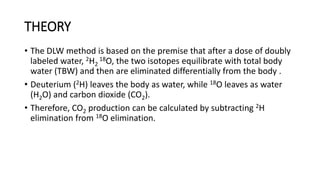
• (DLW) technique was developed as a method for measurement of
free-living energy expenditure in animals (Lifson and McClintock,
1966). The method has since been validated in many animal species
(for summary see Roberts, 1989; Schoeller, 1988).
• 2H2
18O,technique to calculate total production of carbondioxide(CO₂)
&from this measurement of mean respiratory quotient and total
energy expenditure was originally developed in small animals
THEORY
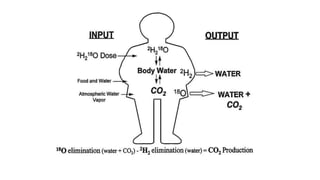
• The DLW method is based on the premise that after a dose of doubly
labeled water, 2H2
18O, the two isotopes equilibrate with total body
water (TBW) and then are eliminated differentially from the body .
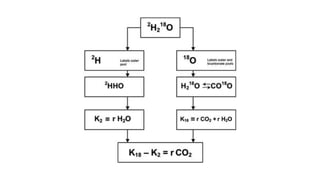
• Deuterium (2H) leaves the body as water, while 18O leaves as water
(H2O) and carbon dioxide (CO2).
• Therefore, CO2 production can be calculated by subtracting 2H
elimination from 18O elimination.
Doubly Labeled Water Protocol
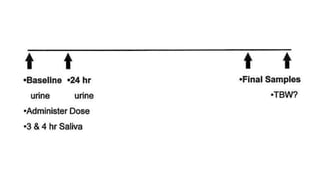
• The study begins with the collection of baseline urine and/or saliva
samples, followed by oral administration of the 2H2
18O dose.
• Saliva samples are obtained 2 to 4 hours after the dose for calculation
of dilution spaces (Schoeller et al., 1980).
• Urine samples then are collected at the end of the period for
measurement of final isotopic enrichment.
• The length of time a DLW study can be carried out depends on the
turnover of the two isotopes, which is dependent on H2O and CO2
output.
• For studies in typical adults, the optimal metabolic period is 4 to 21
days (Schoeller, 1988).
CALCULATION
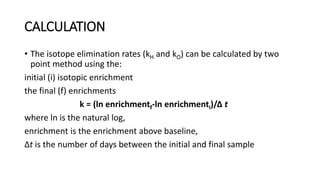
• The isotope elimination rates (kH and kO) can be calculated by two
point method using the:
initial (i) isotopic enrichment
the final (f) enrichments
k = (ln enrichmentf-ln enrichmenti)/Δ t
where ln is the natural log,
enrichment is the enrichment above baseline,
Δt is the number of days between the initial and final sample
CALCULATION
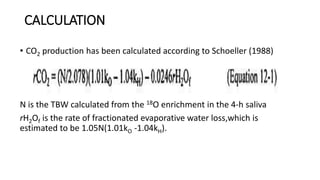
• CO2 production has been calculated according to Schoeller (1988)
N is the TBW calculated from the 18O enrichment in the 4-h saliva
rH2Of is the rate of fractionated evaporative water loss,which is
estimated to be 1.05N(1.01kO -1.04kH).
CALCULATION BY WEIR'S FORMULA
• The rate of CO2 production (rCO2) is calculated as the difference
between the elimination rates of 2H and 18O, using the following
formula [31]:
rCO2 (mol/day) = 0.4554 × TBW (mol) × (1.007 ko − 1.041 kh)
• where ko and kh (day-1) are the elimination rates of 2H and 18O,
respectively.
• The TEE is calculated by using the modified version of Weir's formula
based on rCO2 and food quotient (FQ) [31]:
TEE (kcal/day) = 22.4 × (3.9 × [rCO2/FQ] + 1.1 × rCO2)
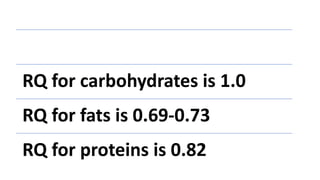
RQ for carbohydrates is 1.0
RQ for fats is 0.69-0.73
RQ for proteins is 0.82
DOSAGE OF DLW
• The dose of DLW is based on the body size of subject in order to
match the body water enrichments to the isotope-ratio mass
spectrometry precision.
• In most DLW studies, investigators have assumed TBW as 60% of
body weight. The 99 atom % deuterium 2H2 and 10 atom % 18O, are
the most commonly used for enrichments of the labeled water
available on the market.
• The International Atomic Energy Agency (IAEA) recommends doses of
0.12 g·kg−1 body water of 99 atom % deuterium labeled water and
1.80 g·kg−1 body water of 10 atom % 18O, When the more highly
enriched 18O, water is used, the dose should be reduced [25].
ADVANTAGES
• The DLW method uses stable isotopes of oxygen (18O) and hydrogen
(2H) for the measurement of TEE.
• The DLW method is widely recognized as the gold standard for the
measurement of TEE.
• DLW method presents the advantage of its noninvasive nature and
possibility for the subjects to continue their normal activities during
the measurement period.
LIMITATIONS
• The method is its high cost due to the high price of DLW, the
expensive equipment and expertise required for analysis.
• DLW technique is that it provides the overall measure of averaged
daily TEE over the measurement period, but it does not provide any
specific details on physical activity.
REFERENCES:
• www.ncbi.nlm.nih.gov/books/NBK233774/
• https://doi.org/10.7762/cnr.2017.6.2.68
• Scholler et al 1983
Doubly labelled water

Doubly labelled water

  • 1.
    DOUBLY LABELLED WATERTECHNIQUE By E.SRILALITHA MSC SPORTS NUTRITION ROLL NO-10
  • 2.
    INTRODUCTION • (DLW) techniquewas developed as a method for measurement of free-living energy expenditure in animals (Lifson and McClintock, 1966). The method has since been validated in many animal species (for summary see Roberts, 1989; Schoeller, 1988). • 2H2 18O,technique to calculate total production of carbondioxide(CO₂) &from this measurement of mean respiratory quotient and total energy expenditure was originally developed in small animals
  • 3.
    THEORY • The DLWmethod is based on the premise that after a dose of doubly labeled water, 2H2 18O, the two isotopes equilibrate with total body water (TBW) and then are eliminated differentially from the body . • Deuterium (2H) leaves the body as water, while 18O leaves as water (H2O) and carbon dioxide (CO2). • Therefore, CO2 production can be calculated by subtracting 2H elimination from 18O elimination.
  • 6.
    Doubly Labeled WaterProtocol • The study begins with the collection of baseline urine and/or saliva samples, followed by oral administration of the 2H2 18O dose. • Saliva samples are obtained 2 to 4 hours after the dose for calculation of dilution spaces (Schoeller et al., 1980). • Urine samples then are collected at the end of the period for measurement of final isotopic enrichment. • The length of time a DLW study can be carried out depends on the turnover of the two isotopes, which is dependent on H2O and CO2 output. • For studies in typical adults, the optimal metabolic period is 4 to 21 days (Schoeller, 1988).
  • 8.
    CALCULATION • The isotopeelimination rates (kH and kO) can be calculated by two point method using the: initial (i) isotopic enrichment the final (f) enrichments k = (ln enrichmentf-ln enrichmenti)/Δ t where ln is the natural log, enrichment is the enrichment above baseline, Δt is the number of days between the initial and final sample
  • 9.
    CALCULATION • CO2 productionhas been calculated according to Schoeller (1988) N is the TBW calculated from the 18O enrichment in the 4-h saliva rH2Of is the rate of fractionated evaporative water loss,which is estimated to be 1.05N(1.01kO -1.04kH).
  • 10.
    CALCULATION BY WEIR'SFORMULA • The rate of CO2 production (rCO2) is calculated as the difference between the elimination rates of 2H and 18O, using the following formula [31]: rCO2 (mol/day) = 0.4554 × TBW (mol) × (1.007 ko − 1.041 kh) • where ko and kh (day-1) are the elimination rates of 2H and 18O, respectively. • The TEE is calculated by using the modified version of Weir's formula based on rCO2 and food quotient (FQ) [31]: TEE (kcal/day) = 22.4 × (3.9 × [rCO2/FQ] + 1.1 × rCO2)
  • 11.
    RQ for carbohydratesis 1.0 RQ for fats is 0.69-0.73 RQ for proteins is 0.82
  • 12.
    DOSAGE OF DLW •The dose of DLW is based on the body size of subject in order to match the body water enrichments to the isotope-ratio mass spectrometry precision. • In most DLW studies, investigators have assumed TBW as 60% of body weight. The 99 atom % deuterium 2H2 and 10 atom % 18O, are the most commonly used for enrichments of the labeled water available on the market. • The International Atomic Energy Agency (IAEA) recommends doses of 0.12 g·kg−1 body water of 99 atom % deuterium labeled water and 1.80 g·kg−1 body water of 10 atom % 18O, When the more highly enriched 18O, water is used, the dose should be reduced [25].
  • 13.
    ADVANTAGES • The DLWmethod uses stable isotopes of oxygen (18O) and hydrogen (2H) for the measurement of TEE. • The DLW method is widely recognized as the gold standard for the measurement of TEE. • DLW method presents the advantage of its noninvasive nature and possibility for the subjects to continue their normal activities during the measurement period.
  • 14.
    LIMITATIONS • The methodis its high cost due to the high price of DLW, the expensive equipment and expertise required for analysis. • DLW technique is that it provides the overall measure of averaged daily TEE over the measurement period, but it does not provide any specific details on physical activity.
  • 15.