SCHOOL OF ENGINEERING AND TECHNOLOGY
Department of Food Technology
Jain University, Jain Global Campus, Jakkasandra Post,
Kanakapura Main road, Ramanagara District,
Karnataka-562112
Poly Unsaturated Fatty Acid
(PUFA)
Presented
by
Sreeparna Pal
1
2
3
PUFA
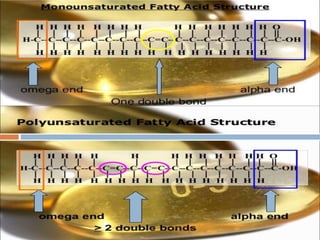
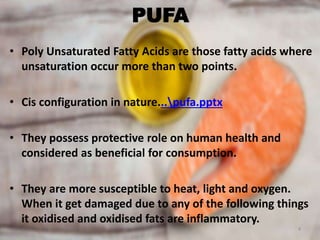
• Poly Unsaturated Fatty Acids are those fatty acids where
unsaturation occur more than two points.
• Cis configuration in nature...pufa.pptx
• They possess protective role on human health and
considered as beneficial for consumption.
• They are more susceptible to heat, light and oxygen.
When it get damaged due to any of the following things
it oxidised and oxidised fats are inflammatory.
4
Sources
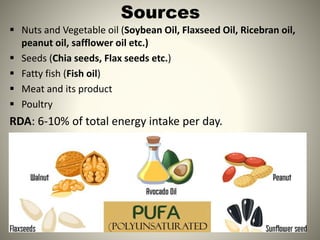
 Nuts and Vegetable oil (Soybean Oil, Flaxseed Oil, Ricebran oil,
peanut oil, safflower oil etc.)
 Seeds (Chia seeds, Flax seeds etc.)
 Fatty fish (Fish oil)
 Meat and its product
 Poultry
RDA: 6-10% of total energy intake per day.
5
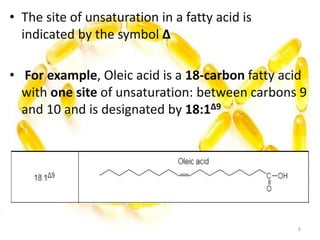
• The site of unsaturation in a fatty acid is
indicated by the symbol Δ
• For example, Oleic acid is a 18-carbon fatty acid
with one site of unsaturation: between carbons 9
and 10 and is designated by 18:1Δ9
6
Classification
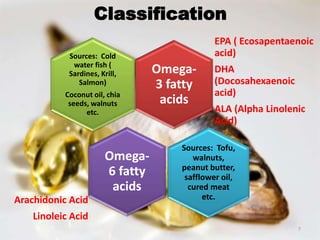
Omega-
3 fatty
acids
EPA ( Ecosapentaenoic
acid)
DHA
(Docosahexaenoic
acid)
ALA (Alpha Linolenic
Acid)
Sources: Cold
water fish (
Sardines, Krill,
Salmon)
Coconut oil, chia
seeds, walnuts
etc.
Omega-
6 fatty
acids
Arachidonic Acid
Linoleic Acid
Sources: Tofu,
walnuts,
peanut butter,
safflower oil,
cured meat
etc.
7
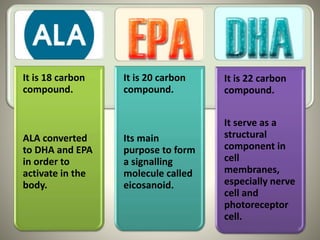
It is 18 carbon
compound.
ALA converted
to DHA and EPA
in order to
activate in the
body.
It is 20 carbon
compound.
Its main
purpose to form
a signalling
molecule called
eicosanoid.
It is 22 carbon
compound.
It serve as a
structural
component in
cell
membranes,
especially nerve
cell and
photoreceptor
cell.
8
9
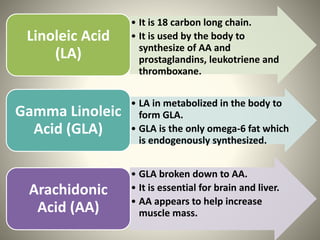
• It is 18 carbon long chain.
• It is used by the body to
synthesize of AA and
prostaglandins, leukotriene and
thromboxane.
Linoleic Acid
(LA)
• LA in metabolized in the body to
form GLA.
• GLA is the only omega-6 fat which
is endogenously synthesized.
Gamma Linoleic
Acid (GLA)
• GLA broken down to AA.
• It is essential for brain and liver.
• AA appears to help increase
muscle mass.
Arachidonic
Acid (AA)
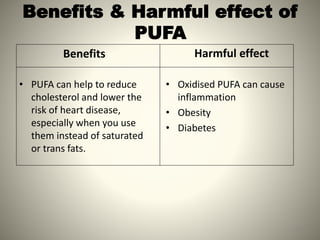
Benefits & Harmful effect of
PUFA
Benefits
• PUFA can help to reduce
cholesterol and lower the
risk of heart disease,
especially when you use
them instead of saturated
or trans fats.
Harmful effect
• Oxidised PUFA can cause
inflammation
• Obesity
• Diabetes
10
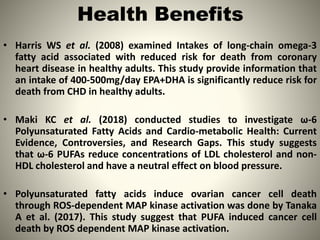
Health Benefits
• Harris WS et al. (2008) examined Intakes of long-chain omega-3
fatty acid associated with reduced risk for death from coronary
heart disease in healthy adults. This study provide information that
an intake of 400-500mg/day EPA+DHA is significantly reduce risk for
death from CHD in healthy adults.
• Maki KC et al. (2018) conducted studies to investigate ω-6
Polyunsaturated Fatty Acids and Cardio-metabolic Health: Current
Evidence, Controversies, and Research Gaps. This study suggests
that ω-6 PUFAs reduce concentrations of LDL cholesterol and non-
HDL cholesterol and have a neutral effect on blood pressure.
• Polyunsaturated fatty acids induce ovarian cancer cell death
through ROS-dependent MAP kinase activation was done by Tanaka
A et al. (2017). This study suggest that PUFA induced cancer cell
death by ROS dependent MAP kinase activation. 11
Reference
• Harris WS, Kris-Etherton PM, Harris KA (2008). Intakes of long-chain
omega-3 fatty acid associated with reduced risk for death from
coronary heart disease in healthy adults. Curr Atheroscler Rep. 2008
Dec;10(6):503-9.
• Maki KC1, Eren F2, Cassens ME2, Dicklin MR1, Davidson MH (2018).
ω-6 Polyunsaturated Fatty Acids and Cardiometabolic Health:
Current Evidence, Controversies, and Research Gaps. Adv Nutr. 2018
Sep 4. doi: 10.1093/advances/nmy038.
• Tanaka A, Yamamoto A, Murota K, Tsujiuchi T, Iwamori M,
Fukushima N (2017). Polyunsaturated fatty acids induce ovarian
cancer cell death through ROS-dependent MAP kinase activation.
Biochem Biophys Res Commun. 2017 Nov 4;493(1):468-473. doi:
10.1016/j.bbrc.2017.08.168. Epub 2017 Sep 4.
12
THANK
YOU
13

Poly Unsaturated Fatty Acid (PUFA)

  • 1.
    SCHOOL OF ENGINEERINGAND TECHNOLOGY Department of Food Technology Jain University, Jain Global Campus, Jakkasandra Post, Kanakapura Main road, Ramanagara District, Karnataka-562112 Poly Unsaturated Fatty Acid (PUFA) Presented by Sreeparna Pal 1
  • 2.
  • 3.
  • 4.
    PUFA • Poly UnsaturatedFatty Acids are those fatty acids where unsaturation occur more than two points. • Cis configuration in nature...pufa.pptx • They possess protective role on human health and considered as beneficial for consumption. • They are more susceptible to heat, light and oxygen. When it get damaged due to any of the following things it oxidised and oxidised fats are inflammatory. 4
  • 5.
    Sources  Nuts andVegetable oil (Soybean Oil, Flaxseed Oil, Ricebran oil, peanut oil, safflower oil etc.)  Seeds (Chia seeds, Flax seeds etc.)  Fatty fish (Fish oil)  Meat and its product  Poultry RDA: 6-10% of total energy intake per day. 5
  • 6.
    • The siteof unsaturation in a fatty acid is indicated by the symbol Δ • For example, Oleic acid is a 18-carbon fatty acid with one site of unsaturation: between carbons 9 and 10 and is designated by 18:1Δ9 6
  • 7.
    Classification Omega- 3 fatty acids EPA (Ecosapentaenoic acid) DHA (Docosahexaenoic acid) ALA (Alpha Linolenic Acid) Sources: Cold water fish ( Sardines, Krill, Salmon) Coconut oil, chia seeds, walnuts etc. Omega- 6 fatty acids Arachidonic Acid Linoleic Acid Sources: Tofu, walnuts, peanut butter, safflower oil, cured meat etc. 7
  • 8.
    It is 18carbon compound. ALA converted to DHA and EPA in order to activate in the body. It is 20 carbon compound. Its main purpose to form a signalling molecule called eicosanoid. It is 22 carbon compound. It serve as a structural component in cell membranes, especially nerve cell and photoreceptor cell. 8
  • 9.
    9 • It is18 carbon long chain. • It is used by the body to synthesize of AA and prostaglandins, leukotriene and thromboxane. Linoleic Acid (LA) • LA in metabolized in the body to form GLA. • GLA is the only omega-6 fat which is endogenously synthesized. Gamma Linoleic Acid (GLA) • GLA broken down to AA. • It is essential for brain and liver. • AA appears to help increase muscle mass. Arachidonic Acid (AA)
  • 10.
    Benefits & Harmfuleffect of PUFA Benefits • PUFA can help to reduce cholesterol and lower the risk of heart disease, especially when you use them instead of saturated or trans fats. Harmful effect • Oxidised PUFA can cause inflammation • Obesity • Diabetes 10
  • 11.
    Health Benefits • HarrisWS et al. (2008) examined Intakes of long-chain omega-3 fatty acid associated with reduced risk for death from coronary heart disease in healthy adults. This study provide information that an intake of 400-500mg/day EPA+DHA is significantly reduce risk for death from CHD in healthy adults. • Maki KC et al. (2018) conducted studies to investigate ω-6 Polyunsaturated Fatty Acids and Cardio-metabolic Health: Current Evidence, Controversies, and Research Gaps. This study suggests that ω-6 PUFAs reduce concentrations of LDL cholesterol and non- HDL cholesterol and have a neutral effect on blood pressure. • Polyunsaturated fatty acids induce ovarian cancer cell death through ROS-dependent MAP kinase activation was done by Tanaka A et al. (2017). This study suggest that PUFA induced cancer cell death by ROS dependent MAP kinase activation. 11
  • 12.
    Reference • Harris WS,Kris-Etherton PM, Harris KA (2008). Intakes of long-chain omega-3 fatty acid associated with reduced risk for death from coronary heart disease in healthy adults. Curr Atheroscler Rep. 2008 Dec;10(6):503-9. • Maki KC1, Eren F2, Cassens ME2, Dicklin MR1, Davidson MH (2018). ω-6 Polyunsaturated Fatty Acids and Cardiometabolic Health: Current Evidence, Controversies, and Research Gaps. Adv Nutr. 2018 Sep 4. doi: 10.1093/advances/nmy038. • Tanaka A, Yamamoto A, Murota K, Tsujiuchi T, Iwamori M, Fukushima N (2017). Polyunsaturated fatty acids induce ovarian cancer cell death through ROS-dependent MAP kinase activation. Biochem Biophys Res Commun. 2017 Nov 4;493(1):468-473. doi: 10.1016/j.bbrc.2017.08.168. Epub 2017 Sep 4. 12
  • 13.