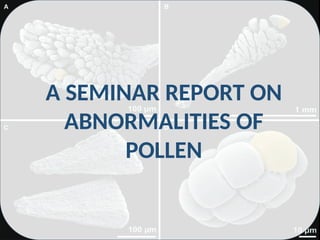
A SEMINAR REPORT ON
ABNORMALITIES OF
POLLEN
Abnormal features of pollen
grain
Most of the pollen grain in the plant kingdom show normal
.
condition How ever there are many species in which pollen
grains remain in a group or as compound pollen grain or
may take different association and form for convenience of
.
pollination These compound pollen are also called as the
.
pollen aggregates Some major pollen grain abnormalities
:
are listed below -
• Pollinia
• Pseudomonads
• Massulae
• Polyads
POLLINI
A
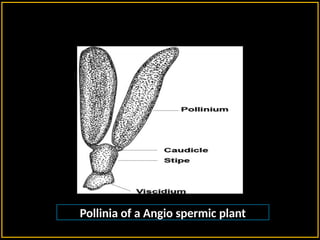
 Pollinia are coherent mass of pollen grain often
found in Asclepiadaceae, orchidaceae and
Apocynaceae etc.
 They are the product of only one another but
are transferred as a singe unit during
pollination .
 This abnormality reduces the pollen wastage as
this unit or pollinia contain all the pollen grain
or microspore which reduces the wastage of
pollen after the dehiscence of anther for
pollination.
 Pollinia remain single as in apocyanaceae or
may join in 2 or more to a translator arms
structure for pollination and this double unit
pollinia other wisely called as pollinarium .
 This pollinia contains a sticky disc of tissue
which help them to attach to the insect body
and this way they help the plant for easy
pollination .
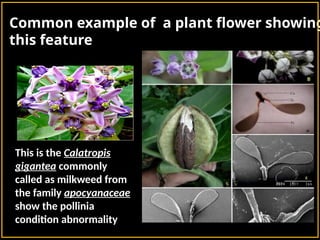
Pollinia of a Angio spermic plant
Common example of a plant flower showing
this feature
This is the Calatropis
gigantea commonly
called as milkweed from
the family apocyanaceae
show the pollinia
condition abnormality
PSEUDOMONADS
 A typical feature of some members of
cyperaceae family .
 It is a type of pollen in which all the four
microspores of the tetrad are enclosed
within the wall of a single pollen grain
this is because during the tetrad
condition due to some reason 3 out of 4
pollen grains get disintegrated or
aborted and only one remain functional
.
 At first it seems to be a loss for the
plant pollination and fertilization .
 As this decreases the pollen number
but this is beneficial to that single
functional pollen as it get all sufficient
nutrition after the disintegration of the
3 pollen grains .
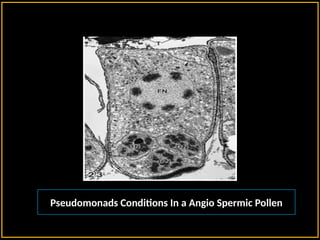
 Pseudomonad are also called as the
Pseudomonads Conditions In a Angio Spermic Pollen
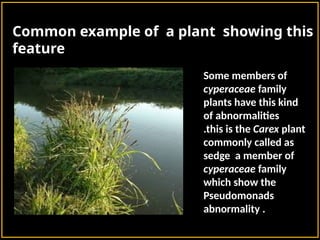
Common example of a plant showing this
feature
Some members of
cyperaceae family
plants have this kind
of abnormalities
.this is the Carex plant
commonly called as
sedge a member of
cyperaceae family
which show the
Pseudomonads
abnormality .
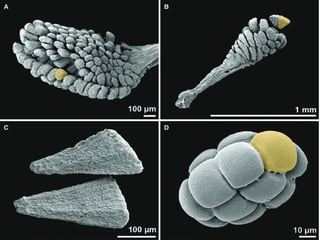
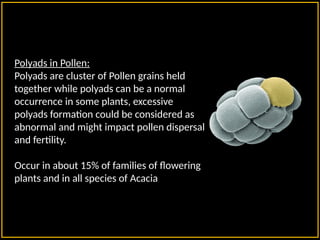
Polyads in Pollen:
Polyads are cluster of Pollen grains held
together while polyads can be a normal
occurrence in some plants, excessive
polyads formation could be considered as
abnormal and might impact pollen dispersal
and fertility.
Occur in about 15% of families of flowering
plants and in all species of Acacia
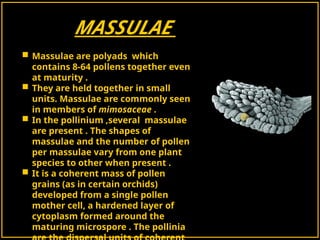
 Massulae are polyads which
contains 8-64 pollens together even
at maturity .
 They are held together in small
units. Massulae are commonly seen
in members of mimosaceae .
 In the pollinium ,several massulae
are present . The shapes of
massulae and the number of pollen
per massulae vary from one plant
species to other when present .
 It is a coherent mass of pollen
grains (as in certain orchids)
developed from a single pollen
mother cell, a hardened layer of
cytoplasm formed around the
maturing microspore . The pollinia
MASSULAE
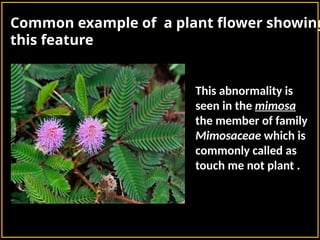
Common example of a plant flower showing
this feature
This abnormality is
seen in the mimosa
the member of family
Mimosaceae which is
commonly called as
touch me not plant .
Thank You