Extrapolation of in vitro data to
preclinical and preclinical to
Humans
Presented by- Sushavan Roy
AUID-ACP22PHCL002
M.Pharm 1st Sem
Department of Pharmacology
Acharya & B.M Reddy College Of Pharmacy, Bangalore.
1
Contents
In vivo studies
In Vitro Studies
What is Extrapolation?
Pre-Clinical Trials
Methods of extrapolation of data
Extrapolation of in vitro data to pre-clinical and pre-clinical to
humans
Estimation of MRSD
Estimating the MRSD method
Process of evaluation of data
Categories evaluated in first-in-human trials
2
• In vivo Studies
In vivo is the Latin word that means within the living body
Biological entities are tested on whole living organisms or cells, usually animals
including humans and plants
Animal testing and clinical trials are major elements of in vivo research.
In vivo is preferred over in vitro because it’s better suited for observing the
overall effects of experiments on a living subject in drug discovery.
• Example- verification of the efficacy of test drug in the animal body.
• In vitro Studies
In a laboratory environment using test tubes, Petri dishes, etc.
• Example- pathogenesis of disease
3
What is extrapolation?
• Extrapolation can be defined as estimating or arrived at conclusion
based on known facts or conclusions.
• In preclinical studies we use mathematical process extrapolation to
estimate the conclusion of preclinical drug testing data to human
drugs. This makes us understand how a drug dose & data can be
correlated or estimated to get the same effect in higher mammals.
4
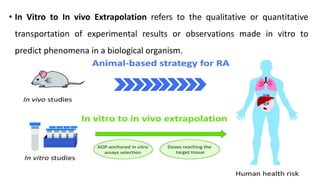
• In Vitro to In vivo Extrapolation refers to the qualitative or quantitative
transportation of experimental results or observations made in vitro to
predict phenomena in a biological organism.
5
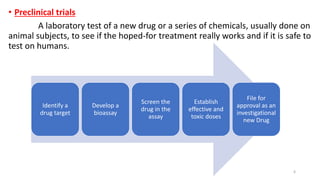
• Preclinical trials
A laboratory test of a new drug or a series of chemicals, usually done on
animal subjects, to see if the hoped-for treatment really works and if it is safe to
test on humans.
Identify a
drug target
Develop a
bioassay
Screen the
drug in the
assay
Establish
effective and
toxic doses
File for
approval as an
investigational
new Drug
6
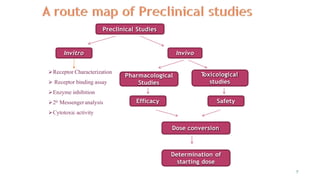
Preclinical Studies
Invitro Invivo
Pharmacological
Studies
T
oxicological
studies
Safety
Efficacy
Dose conversion
Determination of
starting dose
Receptor Characterization
 Receptor binding assay
Enzyme inhibition
20 Messengeranalysis
Cytotoxic activity
7
Methods of extrapolation of data
1. Linear extrapolation/simple scaling/isometric scaling method.
The dose that was established for one species is applied across all
species.
Advantage-
• Simple
• Dosage & weight are directly proportional.
Drawbacks –
• This method tends to overdose large animals and underdose small
animals, which may be very clinically significant.
• Typically, this method is only effective with drugs that have large
margins of safety and wide therapeutic ranges.
8
2. Allometric Scaling.
• Allometry, in its broadest sense, describes how the characteristics of
living creatures change with size. The term originally referred to the
scaling relationship between the size of a body part and the size of the
body as a whole, as both grow during development.
• It is the study, of size and its consequences, based on the principle that major
physiologic processes are related to body weight raised to an allometric
exponent.
9
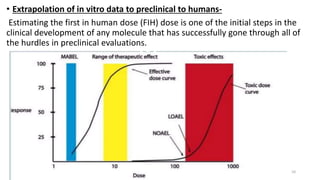
• Extrapolation of in vitro data to preclinical to humans-
Estimating the first in human dose (FIH) dose is one of the initial steps in the
clinical development of any molecule that has successfully gone through all of
the hurdles in preclinical evaluations.
10
• MABEL( minimum anticipated biological effect level)- it is the anticipated dose
level leading to minimal biological effect level in humans. In general, MABEL can
be used to determine a starting dose when conventional toxicology testing may
not be sufficient to predict serious adverse reactions in clinical trials.
• NOAEL(No-observed-Adverse–Effect level)- The no observed adverse effect
level is defined as the highest dose where the effects observed in the treated
group do not imply an adverse effect on the subject.
• LOAEL(lowest observed adverse effect level) – it is defined as the lowest dose
where the effects observed in the treated group imply an adverse effect on the
subject.
11
• Estimation for the MRSD (maximum recommended starting dose)
Aim of MRSD
 Avoid toxicity at an initial dose
Dose needs to be high enough to allow reasonably rapid attainment of phase 1
trial objectives.
Not applicable to
Endogenous hormones and proteins
Vaccines
Limitations
Does not address dose escalation or maximum allowable doses in clinical trials
12
•Estimating the MRSD method
NOAEL METHOD
MABEL METHOD
Similar drug Comparison Method
Pharmacokinetic Guided Approach
PK/PD Modelling Guided Approach
13
NOAEL Method
The NOAEL method is based on selecting a dose with minimal risk of toxicity,
rather than selecting one with minimal pharmacologic activity in humans.
This approach works well with new molecules that act on establishing
targets and/or have a pharmacology that is more or less understood.
5 Steps using animal toxicology data
• Determine NOAEL %
• Convert NOAEL to Human Equivalent Dose(HED)
• Apply Safety factor
• Consider Pharmacologically Active Dose
14
Step 1- No observed adverse Effect Level
Determination
• The NOAEL is a generally accepted benchmark for safety when
derived from appropriate studies.
• The available animal toxicology data is reviewed and evaluated so
that a NOAEL can be determined for each study.
• While reviewing the animal toxicology data, the adverse effects that
are statistically significant and adverse effects that may be clinically
significant should be considered in the determination of the NOAEL
15
Types of findings in nonclinical toxicology studies
that can be used to determined the NOAEL
Over toxicity(e.g. Clinical signs, macro & microscopic lesions)
Surrogate markers of toxicity( e.g., serum liver enzymes levels) &
Exaggerated pharmacodynamic effects.
16
Step 2: Human Equivalent Dose Calculation
• Correcting for body surface area increase clinical trial safety by resulting in a
more conservative starting dose estimate.
• Hence, it was concluded that the approach of converting NOAEL doses to a HED
based on body surface area correction factors should be maintained for selecting
starting doses for initial studies in adult healthy volunteers.
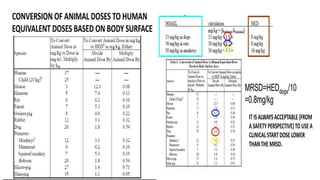
CONVERSION FACTORS
• These are recommended as the standard values to be used for interspecies dose
conversion for NOAELs.
17
• Since surface area varies with surface area correction factors, the
conversion factors are therefore dependent on the weight of the
animals in the studies.
• These factors may also be applied when comparing margins for
other toxicity endpoints(e.g., reproductivity toxicity &
carcinogenicity) when data for comparison,(i.e., AUCs) are
unavailable or are otherwise inappropriate for comparisons.
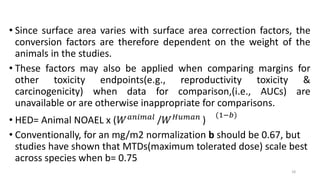
• HED= Animal NOAEL x (𝑊𝑎𝑛𝑖𝑚𝑎𝑙
/𝑊𝐻𝑢𝑚𝑎𝑛
)
(1−𝑏)
• Conventionally, for an mg/m2 normalization b should be 0.67, but
studies have shown that MTDs(maximum tolerated dose) scale best
across species when b= 0.75
18
19
Step 3: Most appropriate species selection
• HED should be chosen from the most appropriate species.
• Most sensitive species (i.e., the species in which the lowest HED can be
identified)
• Factors that could influence the choice of the most appropriate species:
1. Difference in the absorption, distribution, metabolism, and
excretion(ADME) of the therapeutic between the species.
When determining the MRSD for the first dose of a new therapeutic in
humans, the ADME parameters will not be known. Comparative metabolism
data, however, might be available based on in vitro studies.
These data are particularly relevant when there are marked differences in
both the in vivo metabolite profiles and HEDs in animals.
20
2. Class experience that may indicate a particular animal model is more
predictive of human toxicity.
• Class Experience implies that previous studies have demonstrated that a
particular animal model is more appropriate for the assessment of safety for a
particular class of therapeutics.
• Selection of the most appropriate species for certain biological products
involves consideration of various factors unique to these products.
E.g.- in the nonclinical safety assessment of the phosphorothioate antisense
drug, the monkey is considered the most appropriate species because monkeys
experience the same dose-limiting toxicity as humans whereas rodents do not.
21
3. Limited biological cross-species pharmacologic reactivity of the
therapeutic.
This is especially important for biological therapeutics as many are human
proteins that bind to human or non-human primate targets.
Step 4: Application of safety factor
A safety factor is applied in order to provide a margin of safety for
the protection of human subjects receiving the initial clinical dose.
22
Step 5: Consideration of the pharmacologically
active Dose (PAD)
• Selection of a PAD depends upon many factors and differs markedly
among pharmacological drug classes and clinical indications.
• Once the MRSD has been determined, comparing it to the PAD
derived from appropriate pharmacodynamic models may be valuable.
• If the PAD is from an in vivo study, a HED can be derived from a PAD
estimate by using a body surface area conversion factor (BSA-CF). This
HED value should be compared directly to the MRSD.
• If this pharmacologic HED is lower than the MRSD, it may be
appropriate to decrease the clinical starting dose for scientific
reasons.
23
MABEL Method
• The MABEL is the anticipated dose level leading to a minimal biological
effect level in human
• It is used to determine a starting dose when conventional toxicology testing
may not be sufficient to predict serious adverse reactions in clinical trials.
• It has no single method for calculation
• Use all available data
• Binding endpoints- Binding affinity, receptor occupancy
• Functional endpoints- Cytotoxicity, cytokine release, intracellular signaling.
24
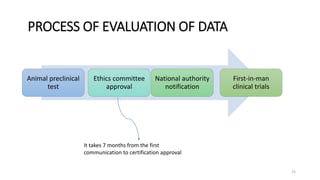
PROCESS OF EVALUATION OF DATA
Animal preclinical
test
Ethics committee
approval
National authority
notification
First-in-man
clinical trials
It takes 7 months from the first
communication to certification approval
25
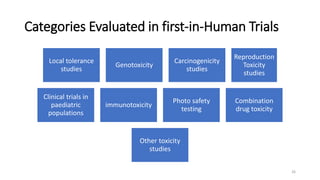
Categories Evaluated in first-in-Human Trials
Local tolerance
studies
Genotoxicity
Carcinogenicity
studies
Reproduction
Toxicity
studies
Clinical trials in
paediatric
populations
immunotoxicity
Photo safety
testing
Combination
drug toxicity
Other toxicity
studies
26
References
• https://www.slideshare.net/Prakharvarshney27/extrapolation-of-in-
vitro-data-to-preclinical
• https:/ARSHIKHANAM4/extrapolation-of-in-vitro-data-to-preclinical
• https://link.springer.com/chapter/10.1007/978-3-540-49529-1_1
• https://en.wikipedia.org/wiki/In_vitro_to_in_vivo_extrapolation
27
28
Thank you

Extrapolation.pptx

  • 1.
    Extrapolation of invitro data to preclinical and preclinical to Humans Presented by- Sushavan Roy AUID-ACP22PHCL002 M.Pharm 1st Sem Department of Pharmacology Acharya & B.M Reddy College Of Pharmacy, Bangalore. 1
  • 2.
    Contents In vivo studies InVitro Studies What is Extrapolation? Pre-Clinical Trials Methods of extrapolation of data Extrapolation of in vitro data to pre-clinical and pre-clinical to humans Estimation of MRSD Estimating the MRSD method Process of evaluation of data Categories evaluated in first-in-human trials 2
  • 3.
    • In vivoStudies In vivo is the Latin word that means within the living body Biological entities are tested on whole living organisms or cells, usually animals including humans and plants Animal testing and clinical trials are major elements of in vivo research. In vivo is preferred over in vitro because it’s better suited for observing the overall effects of experiments on a living subject in drug discovery. • Example- verification of the efficacy of test drug in the animal body. • In vitro Studies In a laboratory environment using test tubes, Petri dishes, etc. • Example- pathogenesis of disease 3
  • 4.
    What is extrapolation? •Extrapolation can be defined as estimating or arrived at conclusion based on known facts or conclusions. • In preclinical studies we use mathematical process extrapolation to estimate the conclusion of preclinical drug testing data to human drugs. This makes us understand how a drug dose & data can be correlated or estimated to get the same effect in higher mammals. 4
  • 5.
    • In Vitroto In vivo Extrapolation refers to the qualitative or quantitative transportation of experimental results or observations made in vitro to predict phenomena in a biological organism. 5
  • 6.
    • Preclinical trials Alaboratory test of a new drug or a series of chemicals, usually done on animal subjects, to see if the hoped-for treatment really works and if it is safe to test on humans. Identify a drug target Develop a bioassay Screen the drug in the assay Establish effective and toxic doses File for approval as an investigational new Drug 6
  • 7.
    Preclinical Studies Invitro Invivo Pharmacological Studies T oxicological studies Safety Efficacy Doseconversion Determination of starting dose Receptor Characterization  Receptor binding assay Enzyme inhibition 20 Messengeranalysis Cytotoxic activity 7
  • 8.
    Methods of extrapolationof data 1. Linear extrapolation/simple scaling/isometric scaling method. The dose that was established for one species is applied across all species. Advantage- • Simple • Dosage & weight are directly proportional. Drawbacks – • This method tends to overdose large animals and underdose small animals, which may be very clinically significant. • Typically, this method is only effective with drugs that have large margins of safety and wide therapeutic ranges. 8
  • 9.
    2. Allometric Scaling. •Allometry, in its broadest sense, describes how the characteristics of living creatures change with size. The term originally referred to the scaling relationship between the size of a body part and the size of the body as a whole, as both grow during development. • It is the study, of size and its consequences, based on the principle that major physiologic processes are related to body weight raised to an allometric exponent. 9
  • 10.
    • Extrapolation ofin vitro data to preclinical to humans- Estimating the first in human dose (FIH) dose is one of the initial steps in the clinical development of any molecule that has successfully gone through all of the hurdles in preclinical evaluations. 10
  • 11.
    • MABEL( minimumanticipated biological effect level)- it is the anticipated dose level leading to minimal biological effect level in humans. In general, MABEL can be used to determine a starting dose when conventional toxicology testing may not be sufficient to predict serious adverse reactions in clinical trials. • NOAEL(No-observed-Adverse–Effect level)- The no observed adverse effect level is defined as the highest dose where the effects observed in the treated group do not imply an adverse effect on the subject. • LOAEL(lowest observed adverse effect level) – it is defined as the lowest dose where the effects observed in the treated group imply an adverse effect on the subject. 11
  • 12.
    • Estimation forthe MRSD (maximum recommended starting dose) Aim of MRSD  Avoid toxicity at an initial dose Dose needs to be high enough to allow reasonably rapid attainment of phase 1 trial objectives. Not applicable to Endogenous hormones and proteins Vaccines Limitations Does not address dose escalation or maximum allowable doses in clinical trials 12
  • 13.
    •Estimating the MRSDmethod NOAEL METHOD MABEL METHOD Similar drug Comparison Method Pharmacokinetic Guided Approach PK/PD Modelling Guided Approach 13
  • 14.
    NOAEL Method The NOAELmethod is based on selecting a dose with minimal risk of toxicity, rather than selecting one with minimal pharmacologic activity in humans. This approach works well with new molecules that act on establishing targets and/or have a pharmacology that is more or less understood. 5 Steps using animal toxicology data • Determine NOAEL % • Convert NOAEL to Human Equivalent Dose(HED) • Apply Safety factor • Consider Pharmacologically Active Dose 14
  • 15.
    Step 1- Noobserved adverse Effect Level Determination • The NOAEL is a generally accepted benchmark for safety when derived from appropriate studies. • The available animal toxicology data is reviewed and evaluated so that a NOAEL can be determined for each study. • While reviewing the animal toxicology data, the adverse effects that are statistically significant and adverse effects that may be clinically significant should be considered in the determination of the NOAEL 15
  • 16.
    Types of findingsin nonclinical toxicology studies that can be used to determined the NOAEL Over toxicity(e.g. Clinical signs, macro & microscopic lesions) Surrogate markers of toxicity( e.g., serum liver enzymes levels) & Exaggerated pharmacodynamic effects. 16
  • 17.
    Step 2: HumanEquivalent Dose Calculation • Correcting for body surface area increase clinical trial safety by resulting in a more conservative starting dose estimate. • Hence, it was concluded that the approach of converting NOAEL doses to a HED based on body surface area correction factors should be maintained for selecting starting doses for initial studies in adult healthy volunteers. CONVERSION FACTORS • These are recommended as the standard values to be used for interspecies dose conversion for NOAELs. 17
  • 18.
    • Since surfacearea varies with surface area correction factors, the conversion factors are therefore dependent on the weight of the animals in the studies. • These factors may also be applied when comparing margins for other toxicity endpoints(e.g., reproductivity toxicity & carcinogenicity) when data for comparison,(i.e., AUCs) are unavailable or are otherwise inappropriate for comparisons. • HED= Animal NOAEL x (𝑊𝑎𝑛𝑖𝑚𝑎𝑙 /𝑊𝐻𝑢𝑚𝑎𝑛 ) (1−𝑏) • Conventionally, for an mg/m2 normalization b should be 0.67, but studies have shown that MTDs(maximum tolerated dose) scale best across species when b= 0.75 18
  • 19.
  • 20.
    Step 3: Mostappropriate species selection • HED should be chosen from the most appropriate species. • Most sensitive species (i.e., the species in which the lowest HED can be identified) • Factors that could influence the choice of the most appropriate species: 1. Difference in the absorption, distribution, metabolism, and excretion(ADME) of the therapeutic between the species. When determining the MRSD for the first dose of a new therapeutic in humans, the ADME parameters will not be known. Comparative metabolism data, however, might be available based on in vitro studies. These data are particularly relevant when there are marked differences in both the in vivo metabolite profiles and HEDs in animals. 20
  • 21.
    2. Class experiencethat may indicate a particular animal model is more predictive of human toxicity. • Class Experience implies that previous studies have demonstrated that a particular animal model is more appropriate for the assessment of safety for a particular class of therapeutics. • Selection of the most appropriate species for certain biological products involves consideration of various factors unique to these products. E.g.- in the nonclinical safety assessment of the phosphorothioate antisense drug, the monkey is considered the most appropriate species because monkeys experience the same dose-limiting toxicity as humans whereas rodents do not. 21
  • 22.
    3. Limited biologicalcross-species pharmacologic reactivity of the therapeutic. This is especially important for biological therapeutics as many are human proteins that bind to human or non-human primate targets. Step 4: Application of safety factor A safety factor is applied in order to provide a margin of safety for the protection of human subjects receiving the initial clinical dose. 22
  • 23.
    Step 5: Considerationof the pharmacologically active Dose (PAD) • Selection of a PAD depends upon many factors and differs markedly among pharmacological drug classes and clinical indications. • Once the MRSD has been determined, comparing it to the PAD derived from appropriate pharmacodynamic models may be valuable. • If the PAD is from an in vivo study, a HED can be derived from a PAD estimate by using a body surface area conversion factor (BSA-CF). This HED value should be compared directly to the MRSD. • If this pharmacologic HED is lower than the MRSD, it may be appropriate to decrease the clinical starting dose for scientific reasons. 23
  • 24.
    MABEL Method • TheMABEL is the anticipated dose level leading to a minimal biological effect level in human • It is used to determine a starting dose when conventional toxicology testing may not be sufficient to predict serious adverse reactions in clinical trials. • It has no single method for calculation • Use all available data • Binding endpoints- Binding affinity, receptor occupancy • Functional endpoints- Cytotoxicity, cytokine release, intracellular signaling. 24
  • 25.
    PROCESS OF EVALUATIONOF DATA Animal preclinical test Ethics committee approval National authority notification First-in-man clinical trials It takes 7 months from the first communication to certification approval 25
  • 26.
    Categories Evaluated infirst-in-Human Trials Local tolerance studies Genotoxicity Carcinogenicity studies Reproduction Toxicity studies Clinical trials in paediatric populations immunotoxicity Photo safety testing Combination drug toxicity Other toxicity studies 26
  • 27.
    References • https://www.slideshare.net/Prakharvarshney27/extrapolation-of-in- vitro-data-to-preclinical • https:/ARSHIKHANAM4/extrapolation-of-in-vitro-data-to-preclinical •https://link.springer.com/chapter/10.1007/978-3-540-49529-1_1 • https://en.wikipedia.org/wiki/In_vitro_to_in_vivo_extrapolation 27
  • 28.