Dopamine receptor
Dopamine receptors are a class of G protein-coupled receptors that are prominent in the vertebrate
central nervous system (CNS). Dopamine receptors are implicated in many neurological processes,
including motivation, pleasure, cognition, memory, learning, and fine motor control, as well as
modulation of neuroendocrine signaling.
Abnormal dopamine receptor signaling and dopaminergic nerve function is implicated in several
neuropsychiatric disorders. Thus, dopamine receptors are common neurologic drug targets.
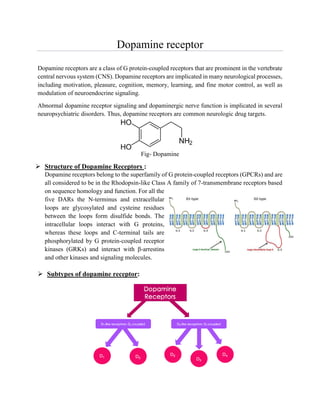
Fig- Dopamine
 Structure of Dopamine Receptors :
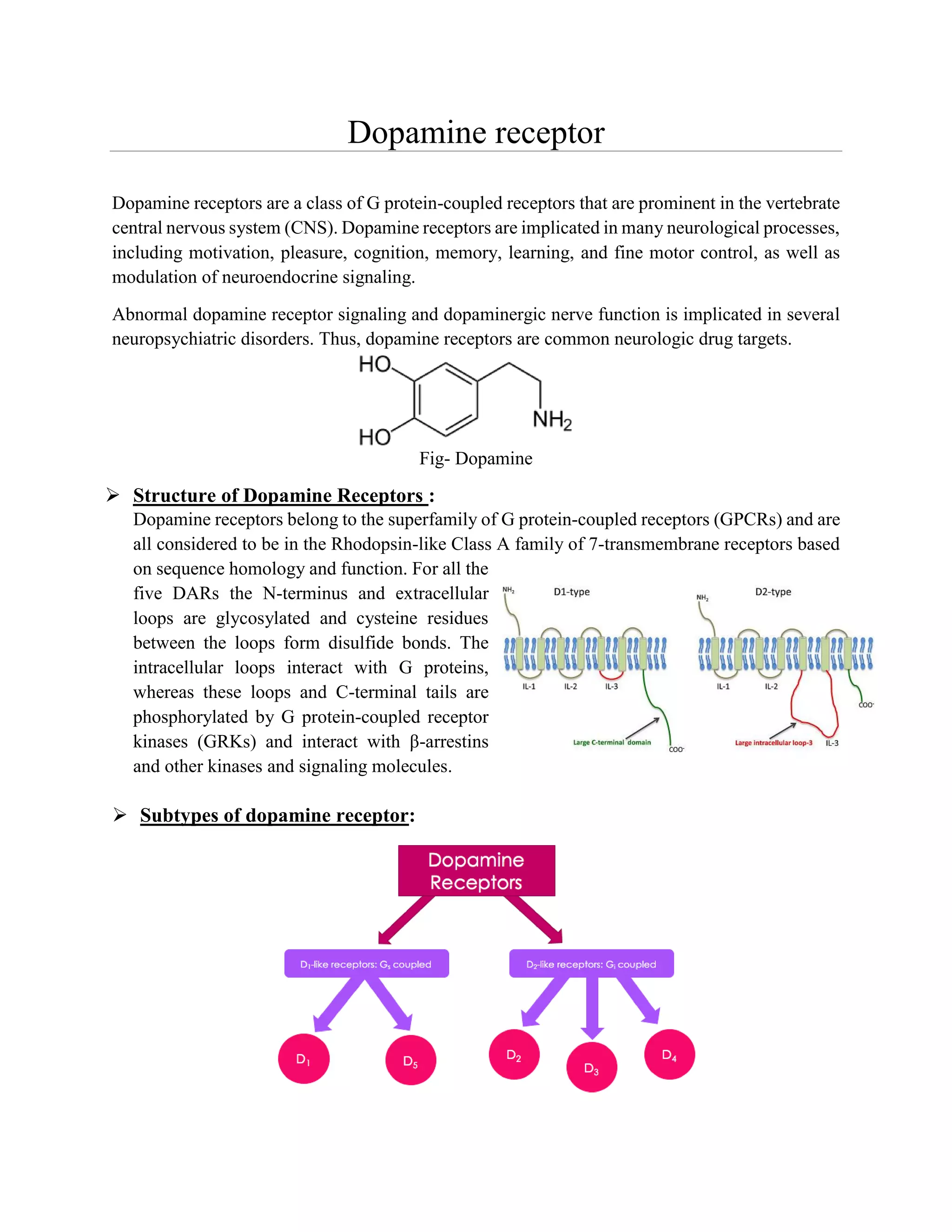
Dopamine receptors belong to the superfamily of G protein-coupled receptors (GPCRs) and are
all considered to be in the Rhodopsin-like Class A family of 7-transmembrane receptors based
on sequence homology and function. For all the
five DARs the N-terminus and extracellular
loops are glycosylated and cysteine residues
between the loops form disulfide bonds. The
intracellular loops interact with G proteins,
whereas these loops and C-terminal tails are
phosphorylated by G protein-coupled receptor
kinases (GRKs) and interact with β-arrestins
and other kinases and signaling molecules.
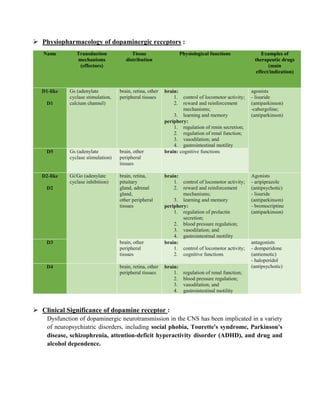
 Subtypes of dopamine receptor:
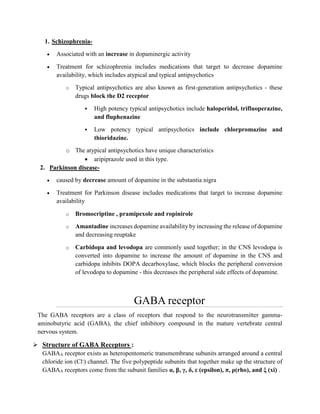
 Physiopharmacology of dopaminergic receptors :
Name Transduction
mechanisms
(effectors)
Tissue
distribution
Physiological functions Examples of
therapeutic drugs
(main
effect/indication)
D1-like
D1
Gs (adenylate
cyclase stimulation,
calcium channel)
brain, retina, other
peripheral tissues
brain:
1. control of locomotor activity;
2. reward and reinforcement
mechanisms;
3. learning and memory
periphery:
1. regulation of renin secretion;
2. regulation of renal function;
3. vasodilation; and
4. gastrointestinal motility
agonists
- lisuride
(antiparkinson)
-cabergoline;
(antiparkinson)
D5 Gs (adenylate
cyclase stimulation)
brain, other
peripheral
tissues
brain: cognitive functions
D2-like
D2
Gi/Go (adenylate
cyclase inhibition)
brain, retina,
pituitary
gland, adrenal
gland,
other peripheral
tissues
brain:
1. control of locomotor activity;
2. reward and reinforcement
mechanisms;
3. learning and memory
periphery:
1. regulation of prolactin
secretion;
2. blood pressure regulation;
3. vasodilation; and
4. gastrointestinal motility
Agonists
- aripiprazole
(antipsychotic)
- lisuride
(antiparkinson)
- bromocriptine
(antiparkinson)
D3 brain, other
peripheral
tissues
brain:
1. control of locomotor activity;
2. cognitive functions
antagonists
- domperidone
(antiemetic)
- haloperidol
(antipsychotic)D4 brain, retina, other
peripheral tissues
brain:
1. regulation of renal function;
2. blood pressure regulation;
3. vasodilation; and
4. gastrointestinal motility
 Clinical Significance of dopamine receptor :
Dysfunction of dopaminergic neurotransmission in the CNS has been implicated in a variety
of neuropsychiatric disorders, including social phobia, Tourette's syndrome, Parkinson's
disease, schizophrenia, attention-deficit hyperactivity disorder (ADHD), and drug and
alcohol dependence.
1. Schizophrenia-
 Associated with an increase in dopaminergic activity
 Treatment for schizophrenia includes medications that target to decrease dopamine
availability, which includes atypical and typical antipsychotics
o Typical antipsychotics are also known as first-generation antipsychotics - these
drugs block the D2 receptor
 High potency typical antipsychotics include haloperidol, trifluoperazine,
and fluphenazine
 Low potency typical antipsychotics include chlorpromazine and
thioridazine.
o The atypical antipsychotics have unique characteristics
 aripiprazole used in this type.
2. Parkinson disease-
 caused by decrease amount of dopamine in the substantia nigra
 Treatment for Parkinson disease includes medications that target to increase dopamine
availability
o Bromocriptine , pramipexole and ropinirole
o Amantadine increases dopamine availability by increasing the release of dopamine
and decreasing reuptake
o Carbidopa and levodopa are commonly used together; in the CNS levodopa is
converted into dopamine to increase the amount of dopamine in the CNS and
carbidopa inhibits DOPA decarboxylase, which blocks the peripheral conversion
of levodopa to dopamine - this decreases the peripheral side effects of dopamine.
GABA receptor
The GABA receptors are a class of receptors that respond to the neurotransmitter gamma-
aminobutyric acid (GABA), the chief inhibitory compound in the mature vertebrate central
nervous system.
 Structure of GABA Receptors :
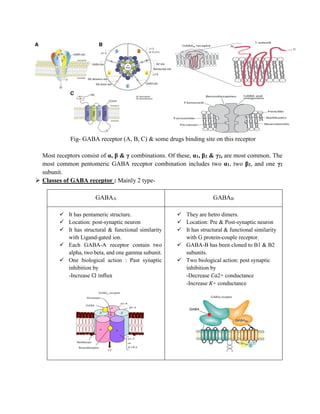
GABAA receptor exists as heteropentomeric transmembrane subunits arranged around a central
chloride ion (Cl-) channel. The five polypeptide subunits that together make up the structure of
GABAA receptors come from the subunit families α, β, γ, δ, ε (epsilon), π, ρ(rho), and ξ (xi) .
Fig- GABA receptor (A, B, C) & some drugs binding site on this receptor
Most receptors consist of α, β & γ combinations. Of these, α1, β2 & γ2, are most common. The
most common pentomeric GABA receptor combination includes two α1, two β2, and one γ2
subunit.
 Classes of GABA receptor : Mainly 2 type-
GABAA GABAB
 It has pentameric structure.
 Location: post-synaptic neuron
 It has structural & functional similarity
with Ligand-gated ion.
 Each GABA-A receptor contain two
alpha, two beta, and one gamma subunit.
 One biological action : Past synaptic
inhibition by
-Increase Cl- influx
 They are hetro dimers.
 Location: Pre & Post-synaptic neuron
 It has structural & functional similarity
with G protein-couple receptor.
 GABA-B has been cloned to B1 & B2
subunits.
 Two biological action: post synaptic
inhibition by
-Decrease 𝐶𝑎2+ conductance
-Increase 𝐾+ conductance
GABAB receptor
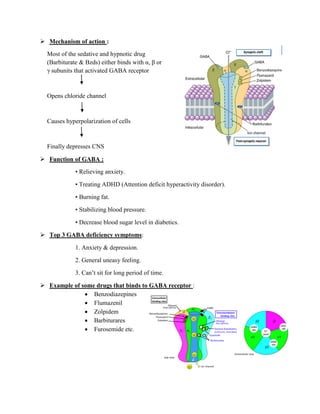
 Mechanism of action :
Most of the sedative and hypnotic drug
(Barbiturate & Bzds) either binds with α, β or
γ subunits that activated GABA receptor
Opens chloride channel
Causes hyperpolarization of cells
Finally depresses CNS
 Function of GABA :
• Relieving anxiety.
• Treating ADHD (Attention deficit hyperactivity disorder).
• Burning fat.
• Stabilizing blood pressure.
• Decrease blood sugar level in diabetics.
 Top 3 GABA deficiency symptoms:
1. Anxiety & depression.
2. General uneasy feeling.
3. Can’t sit for long period of time.
 Example of some drugs that binds to GABA receptor :
 Benzodiazepines
 Flumazenil
 Zolpidem
 Barbiturares
 Furosemide etc.

Dopamine & GABA receptor in a nutshell

  • 1.
    Dopamine receptor Dopamine receptorsare a class of G protein-coupled receptors that are prominent in the vertebrate central nervous system (CNS). Dopamine receptors are implicated in many neurological processes, including motivation, pleasure, cognition, memory, learning, and fine motor control, as well as modulation of neuroendocrine signaling. Abnormal dopamine receptor signaling and dopaminergic nerve function is implicated in several neuropsychiatric disorders. Thus, dopamine receptors are common neurologic drug targets. Fig- Dopamine  Structure of Dopamine Receptors : Dopamine receptors belong to the superfamily of G protein-coupled receptors (GPCRs) and are all considered to be in the Rhodopsin-like Class A family of 7-transmembrane receptors based on sequence homology and function. For all the five DARs the N-terminus and extracellular loops are glycosylated and cysteine residues between the loops form disulfide bonds. The intracellular loops interact with G proteins, whereas these loops and C-terminal tails are phosphorylated by G protein-coupled receptor kinases (GRKs) and interact with β-arrestins and other kinases and signaling molecules.  Subtypes of dopamine receptor:
  • 2.
     Physiopharmacology ofdopaminergic receptors : Name Transduction mechanisms (effectors) Tissue distribution Physiological functions Examples of therapeutic drugs (main effect/indication) D1-like D1 Gs (adenylate cyclase stimulation, calcium channel) brain, retina, other peripheral tissues brain: 1. control of locomotor activity; 2. reward and reinforcement mechanisms; 3. learning and memory periphery: 1. regulation of renin secretion; 2. regulation of renal function; 3. vasodilation; and 4. gastrointestinal motility agonists - lisuride (antiparkinson) -cabergoline; (antiparkinson) D5 Gs (adenylate cyclase stimulation) brain, other peripheral tissues brain: cognitive functions D2-like D2 Gi/Go (adenylate cyclase inhibition) brain, retina, pituitary gland, adrenal gland, other peripheral tissues brain: 1. control of locomotor activity; 2. reward and reinforcement mechanisms; 3. learning and memory periphery: 1. regulation of prolactin secretion; 2. blood pressure regulation; 3. vasodilation; and 4. gastrointestinal motility Agonists - aripiprazole (antipsychotic) - lisuride (antiparkinson) - bromocriptine (antiparkinson) D3 brain, other peripheral tissues brain: 1. control of locomotor activity; 2. cognitive functions antagonists - domperidone (antiemetic) - haloperidol (antipsychotic)D4 brain, retina, other peripheral tissues brain: 1. regulation of renal function; 2. blood pressure regulation; 3. vasodilation; and 4. gastrointestinal motility  Clinical Significance of dopamine receptor : Dysfunction of dopaminergic neurotransmission in the CNS has been implicated in a variety of neuropsychiatric disorders, including social phobia, Tourette's syndrome, Parkinson's disease, schizophrenia, attention-deficit hyperactivity disorder (ADHD), and drug and alcohol dependence.
  • 3.
    1. Schizophrenia-  Associatedwith an increase in dopaminergic activity  Treatment for schizophrenia includes medications that target to decrease dopamine availability, which includes atypical and typical antipsychotics o Typical antipsychotics are also known as first-generation antipsychotics - these drugs block the D2 receptor  High potency typical antipsychotics include haloperidol, trifluoperazine, and fluphenazine  Low potency typical antipsychotics include chlorpromazine and thioridazine. o The atypical antipsychotics have unique characteristics  aripiprazole used in this type. 2. Parkinson disease-  caused by decrease amount of dopamine in the substantia nigra  Treatment for Parkinson disease includes medications that target to increase dopamine availability o Bromocriptine , pramipexole and ropinirole o Amantadine increases dopamine availability by increasing the release of dopamine and decreasing reuptake o Carbidopa and levodopa are commonly used together; in the CNS levodopa is converted into dopamine to increase the amount of dopamine in the CNS and carbidopa inhibits DOPA decarboxylase, which blocks the peripheral conversion of levodopa to dopamine - this decreases the peripheral side effects of dopamine. GABA receptor The GABA receptors are a class of receptors that respond to the neurotransmitter gamma- aminobutyric acid (GABA), the chief inhibitory compound in the mature vertebrate central nervous system.  Structure of GABA Receptors : GABAA receptor exists as heteropentomeric transmembrane subunits arranged around a central chloride ion (Cl-) channel. The five polypeptide subunits that together make up the structure of GABAA receptors come from the subunit families α, β, γ, δ, ε (epsilon), π, ρ(rho), and ξ (xi) .
  • 4.
    Fig- GABA receptor(A, B, C) & some drugs binding site on this receptor Most receptors consist of α, β & γ combinations. Of these, α1, β2 & γ2, are most common. The most common pentomeric GABA receptor combination includes two α1, two β2, and one γ2 subunit.  Classes of GABA receptor : Mainly 2 type- GABAA GABAB  It has pentameric structure.  Location: post-synaptic neuron  It has structural & functional similarity with Ligand-gated ion.  Each GABA-A receptor contain two alpha, two beta, and one gamma subunit.  One biological action : Past synaptic inhibition by -Increase Cl- influx  They are hetro dimers.  Location: Pre & Post-synaptic neuron  It has structural & functional similarity with G protein-couple receptor.  GABA-B has been cloned to B1 & B2 subunits.  Two biological action: post synaptic inhibition by -Decrease 𝐶𝑎2+ conductance -Increase 𝐾+ conductance GABAB receptor
  • 5.
     Mechanism ofaction : Most of the sedative and hypnotic drug (Barbiturate & Bzds) either binds with α, β or γ subunits that activated GABA receptor Opens chloride channel Causes hyperpolarization of cells Finally depresses CNS  Function of GABA : • Relieving anxiety. • Treating ADHD (Attention deficit hyperactivity disorder). • Burning fat. • Stabilizing blood pressure. • Decrease blood sugar level in diabetics.  Top 3 GABA deficiency symptoms: 1. Anxiety & depression. 2. General uneasy feeling. 3. Can’t sit for long period of time.  Example of some drugs that binds to GABA receptor :  Benzodiazepines  Flumazenil  Zolpidem  Barbiturares  Furosemide etc.