Design of Experiments (DOE):  A “New” Approach to Reaction Optimization Dr. Steven Weissman Merck & Co.  Feb 4, 2008/UPR
Outline Background: Big changes for Pharma  Basic Principles of  Design of Experiments Merck Case Studies Take Home message/Questions
Big Changes for Big Pharma Costs/Risks of drug development are rising low hanging fruit has been picked small molecules no longer in vogue protein-based and vaccines = more opportunities ‘ Vioxx hangover’- more trials/more patients = $$
Big Changes for Big Pharma Costs/Risks of drug development are rising Globalization of marketplace US market sales is matured; slow growth Emerging markets sales = high growth potential Strategic portions of drug development outsourced to India/China (low-cost providers)
Big Changes for Big Pharma Costs/Risks of drug development are rising Globalization of marketplace Uncertain pipelines ‘Batting average’ is unchanged despite huge investments  Is bureaucracy killing drug discovery? Are smaller companies becoming better at this?
Big Changes for Big Pharma Costs/Risks of drug development are rising Globalization of marketplace Uncertain pipelines Revenues/profits are being squeezed patent expirations – Fosamax ($3 B) tougher regulatory environment payers demand value-added lower cost structures: aggressively pursued downsizing plant closings-namely here in PR
Big Changes for Big Pharma Costs/Risks of drug development are rising Globalization of marketplace Uncertain pipelines Revenues/profits are being squeezed
New Approaches Needed What can we do as chemists to change the way we do our jobs ? Can we work smarter/faster ? How ??
New Approaches Needed What can we do as chemists to change the way we do our jobs ? Can we work smarter/faster ? How ??  Automation/Technology
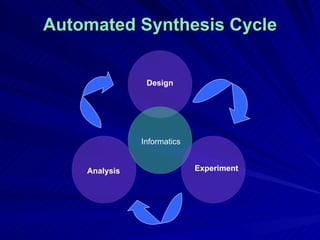
Automated Synthesis Cycle Design Experiment Analysis Informatics
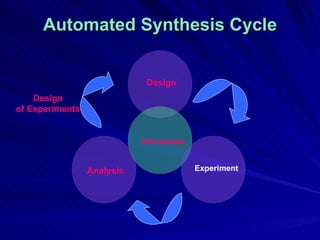
Automated Synthesis Cycle Design Experiment Analysis Informatics Design of Experiments
Current Approach to Optimization Change One Factor at a time (OFAT) Rarely leads to optimal conditions Leads to different conclusions depending on starting point Requires many expts/little information Cannot separate “noise” from true variability
Current Approach to Optimization Change One Factor at a time (OFAT) Rarely leads to optimal conditions Leads to different conclusions depending on starting point Requires many expts/little information Cannot separate “noise” from true variability Ignores interactions of variables
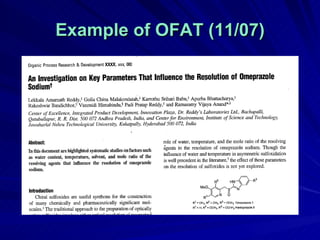
Example of OFAT (11/07)
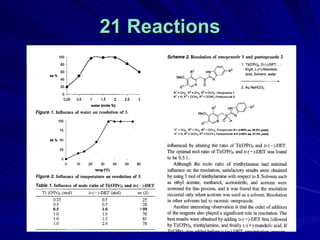
21 Reactions
DOE vs OFAT OFAT: 3 factors needed 21 reactions No information on interactions of effects DOE: 3 or 4 factors- 11 or 17 reactions Better quality information Learn about interactions of effects Fewer reactions
Notable Quote “ If you test one factor at a time, there’s a low probability that you are going to hit the right one before everybody gets sick of it and quits” Forbes magazine article on DOE in 1996
What is DOE ? Selected set of expts in which all relevant factors are varied  simultaneously ‘ Continuous’ factors are ideal (time, temp, equiv)-the ‘ How much’ Analysis reveals which factors influence the outcome and identifies optimal conditions Systematic, organized approach to problem solving Mathematical model of the design space
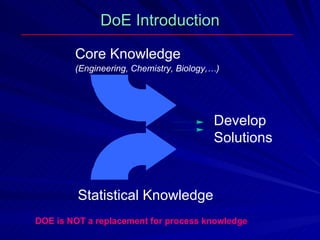
DoE Introduction Core Knowledge (Engineering, Chemistry, Biology,…) Statistical Knowledge Develop Solutions DOE is NOT a replacement for process knowledge
Questions to be Answered by DoE How do we get the best synthetic yield ? How much catalyst/ligand do I need ? Can we minimize formation of an impurity? Which experimental factors are (un) important? How robust is my process ?
DOE: Considerations Can’t replace full screening of catalyst or solvent (HTS)- ‘ discreet ’ variables Best suited for  continuous  variables time, temp, stoichiometry Not helpful for non-reproducible rxns Best suited for ‘low maintenance’ rxns Temp = 20 to 150  o C All reactants added at once
DOE: Experimental Objectives Screening Which factors are most influential ?  What are their appropriate values/ranges ? Optimization Extract  information regarding how factors combine to influence response Identify optimized reaction conditions
DOE: Misconceptions   Requires in-depth statistics knowledge User-friendly DOE software does this for you MODDE  (Umetrics)/ Design Expert  (Stat-ease)
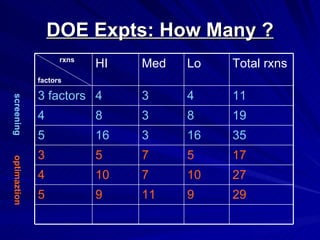
DOE: Misconceptions   DoE requires in-depth statistics knowledge Experimental design software does this for you DoE requires a lot of experiments and time Perhaps. but will always get better quality information Typically 11-27 reactions per design Automation/technology helps reduce the effort needed
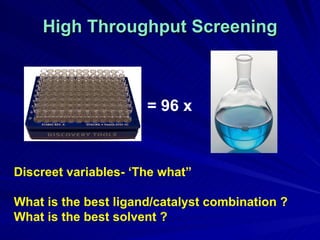
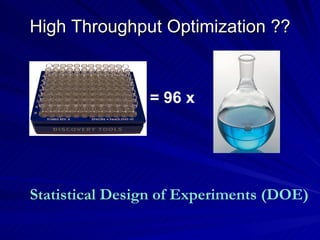
High Throughput Screening = 96 x Discreet variables- ‘The what” What is the best ligand/catalyst combination ? What is the best solvent ?
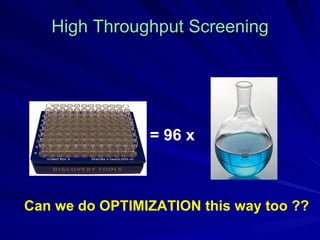
High Throughput Screening = 96 x Can we do OPTIMIZATION this way too ??
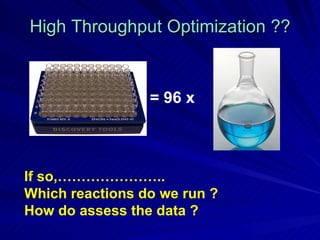
High Throughput Optimization ?? = 96 x If so,………………….. Which reactions do we run ? How do assess the data ?
High Throughput Optimization ?? = 96 x Statistical Design of Experiments (DOE)
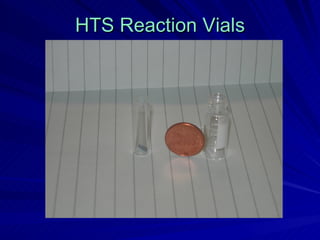
HTS Reaction Vials
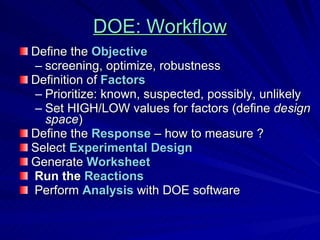
DOE: Workflow Define the  Objective  screening, optimize, robustness Definition of  Factors  Prioritize: known, suspected, possibly, unlikely Set HIGH/LOW values for factors (define  design space ) Define the  Response  – how to measure ? Select  Experimental Design   Generate  Worksheet Run the  Reactions Perform  Analysis  with DOE software
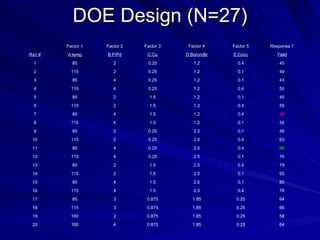
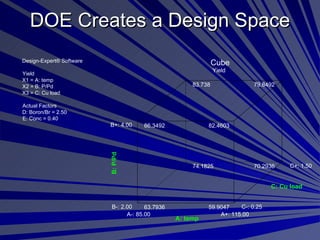
DOE Design (N=27) 64 0.25 1.85 0.875 4 100 20 58 0.25 1.85 0.875 2 100 19 66 0.25 1.85 0.875 3 115 18 64 0.25 1.85 0.875 3 85 17 76 0.4 2.5 1.5 4 115 16 80 0.1 2.5 1.5 4 85 15 65 0.1 2.5 1.5 2 115 14 79 0.4 2.5 1.5 2 85 13 76 0.1 2.5 0.25 4 115 12 88 0.4 2.5 0.25 4 85 11 63 0.4 2.5 0.25 2 115 10 48 0.1 2.5 0.25 2 85 9 54 0.1 1.2 1.5 4 115 8 39 0.4 1.2 1.5 4 85 7 55 0.4 1.2 1.5 2 115 6 45 0.1 1.2 1.5 2 85 5 55 0.4 1.2 0.25 4 115 4 43 0.1 1.2 0.25 4 85 3 49 0.1 1.2 0.25 2 115 2 45 0.4 1.2 0.25 2 85 1 Yield E:Conc D:Boron/Br C:Cu B:P/Pd A:temp Rxn # Response 1 Factor 5 Factor 4 Factor 3 Factor 2 Factor 1
DOE Creates a Design Space Design-Expert® Software Yield X1 = A: temp X2 = B: P/Pd X3 = C: Cu load Actual Factors D: Boron/Br = 2.50 E: Conc = 0.40 Cube Yield A: temp B: P/Pd C: Cu load A-: 85.00 A+: 115.00 B-: 2.00 B+: 4.00 C-: 0.25 C+: 1.50 63.7936 74.1825 86.3492 83.738 59.9047 70.2936 82.4603 79.8492
DOE Expts: How Many ? screening  optimaztion 29 9 11 9 5 27 10 7 10 4 17 5 7 5 3 35 16 3 16 5  19 8 3 8 4 11 4 3 4 3 factors Total rxns Lo Med  HI rxns factors
DOE Case Studies
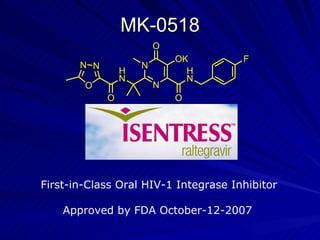
MK-0518 First-in-Class Oral HIV-1 Integrase Inhibitor Approved by FDA October-12-2007
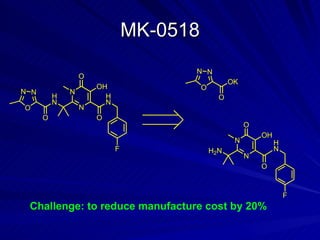
MK-0518
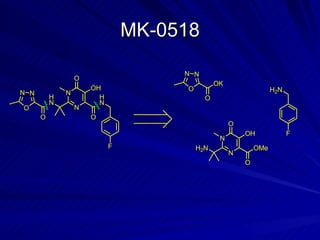
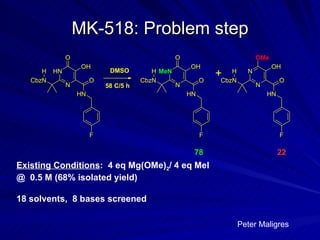
MK-0518 Challenge: to reduce manufacture cost by 20%
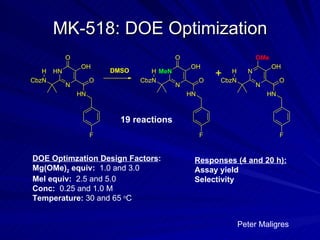
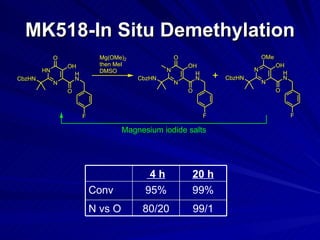
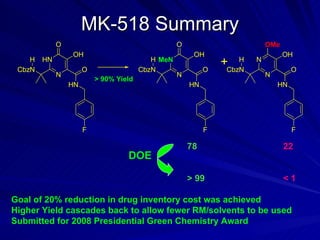
MK-518: Problem step Peter Maligres Existing Conditions :  4 eq Mg(OMe) 2 / 4 eq MeI  @  0.5 M (68% isolated yield) 18 solvents,  8 bases screened 78   22
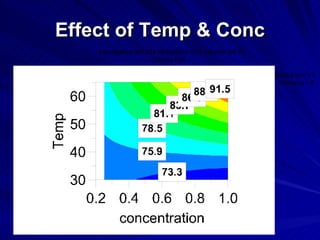
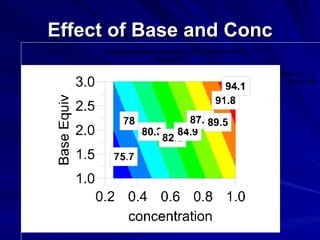
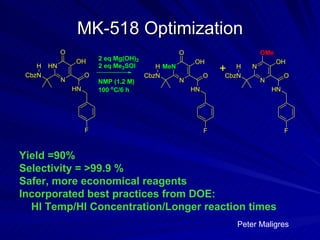
MK-518: DOE Optimization Peter Maligres DOE Optimzation Design Factors :  Mg(OMe) 2  equiv:  1.0 and 3.0 MeI equiv:  2.5 and 5.0 Conc:  0.25 and 1.0 M Temperature:  30 and 65  o C 19 reactions Responses (4 and 20 h): Assay yield Selectivity
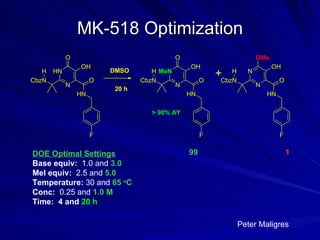
MK-518 Optimization Peter Maligres DOE Optimal Settings Base equiv:  1.0   and  3.0  MeI equiv:  2.5 and  5.0 Temperature:  30 and  65  o C Conc:  0.25 and  1.0 M Time:  4 and  20 h 99   1
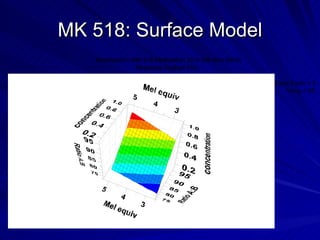
MK 518: Surface Model
Effect of Temp & Conc
Effect of Base and Conc
MK518-In Situ Demethylation 99/1 80/20 N vs O 99% 95% Conv 20 h 4 h
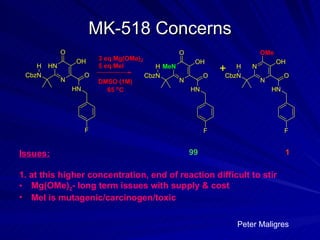
MK-518 Concerns Peter Maligres Issues:   1. at this higher concentration, end of reaction difficult to stir Mg(OMe) 2 - long term issues with supply & cost MeI is mutagenic/carcinogen/toxic 99   1
MK-518 Optimization Peter Maligres Yield =90% Selectivity = >99.9 % Safer, more economical reagents Incorporated best practices from DOE: HI Temp/HI Concentration/Longer reaction times
MK-518 Summary 78 22 > 99 < 1 DOE Goal of 20% reduction in drug inventory cost was achieved Higher Yield cascades back to allow fewer RM/solvents to be used Submitted for 2008 Presidential Green Chemistry Award
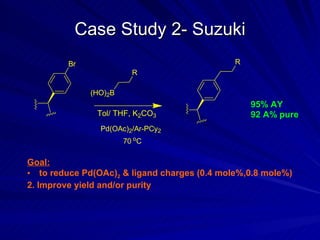
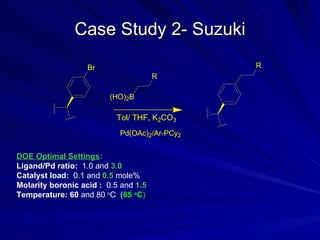
Case Study 2- Suzuki Goal:   to reduce Pd(OAc) 2  & ligand charges (0.4 mole%,0.8 mole%) 2. Improve yield and/or purity
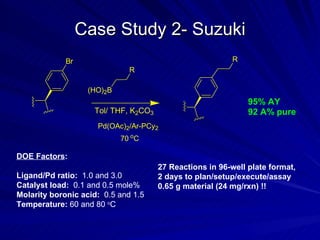
Case Study 2- Suzuki DOE Factors : Ligand/Pd ratio:  1.0 and 3.0 Catalyst load:  0.1 and   0.5 mole% Molarity boronic acid:  0.5 and 1.5 Temperature:  60 and 80  o C 27 Reactions in 96-well plate format,  2 days to plan/setup/execute/assay 0.65 g material (24 mg/rxn) !!
Case Study 2- Suzuki DOE Optimal Settings : Ligand/Pd ratio:  1.0 and  3.0 Catalyst load:  0.1 and   0.5  mole% Molarity boronic acid :  0.5 and  1.5 Temperature: 60  and 80  o C  ( 65  o C )
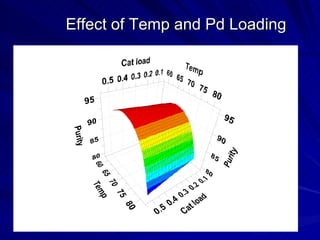
Effect of Temp and Pd Loading Lig/ catalyst ratio fixed at 3:1; Triol M fixed at 1.5 M Overall LCAP
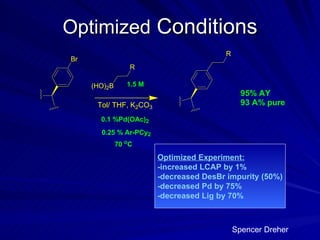
Optimized  Conditions Optimized Experiment: -increased LCAP by 1% -decreased DesBr impurity (50%) -decreased Pd by 75% -decreased Lig by 70% Spencer Dreher
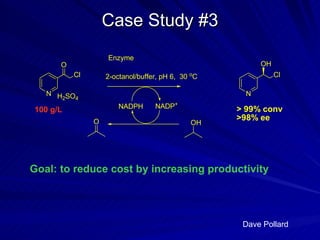
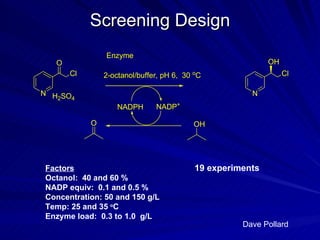
Case Study #3 Dave Pollard Goal: to reduce cost by increasing productivity 100 g/L
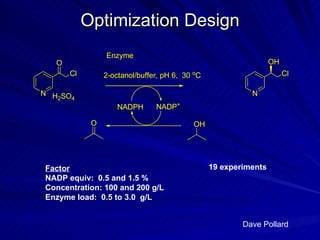
Screening Design Dave Pollard Factors Octanol:  40 and 60 % NADP equiv:  0.1 and 0.5 % Concentration: 50 and 150 g/L Temp: 25 and 35  o C Enzyme load:  0.3 to 1.0  g/L 19 experiments
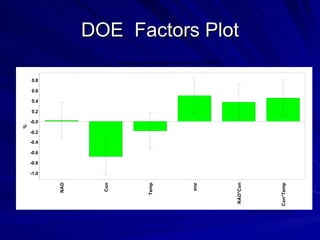
DOE  Factors Plot
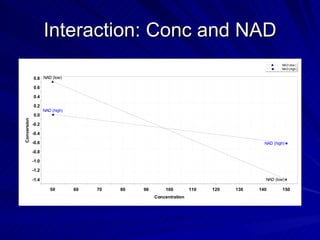
Interaction: Conc and NAD
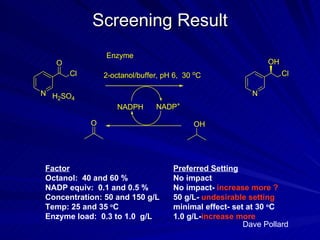
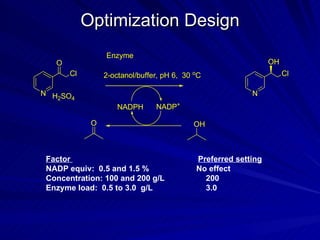
Screening Result Dave Pollard Factor Preferred Setting Octanol:  40 and 60 % No impact NADP equiv:  0.1 and 0.5 % No impact-  increase more ?   Concentration: 50 and 150 g/L 50 g/L-  undesirable setting Temp: 25 and 35  o C minimal effect- set at 30  o C Enzyme load:  0.3 to 1.0  g/L 1.0 g/L- increase more
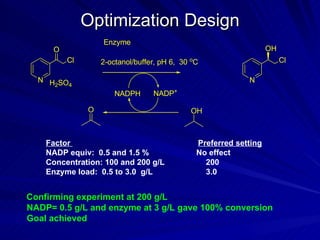
Optimization Design Dave Pollard Factor NADP equiv:  0.5 and 1.5 %   Concentration: 100 and 200 g/L Enzyme load:  0.5 to 3.0  g/L 19 experiments
Optimization Design Factor  Preferred setting NADP equiv:  0.5 and 1.5 %   No effect   Concentration: 100 and 200 g/L 200 Enzyme load:  0.5 to 3.0  g/L 3.0
Optimization Design Factor  Preferred setting NADP equiv:  0.5 and 1.5 %   No effect   Concentration: 100 and 200 g/L 200 Enzyme load:  0.5 to 3.0  g/L 3.0 Confirming experiment at 200 g/L NADP= 0.5 g/L and enzyme at 3 g/L gave 100% conversion Goal achieved
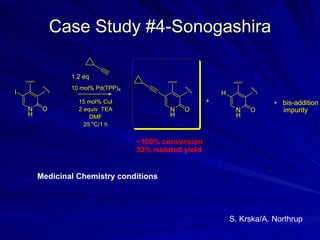
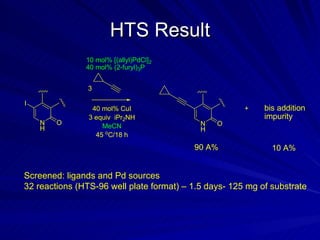
Case Study #4-Sonogashira S. Krska/A. Northrup Medicinal Chemistry conditions
HTS Result Screened: ligands and Pd sources 32 reactions (HTS-96 well plate format) – 1.5 days- 125 mg of substrate
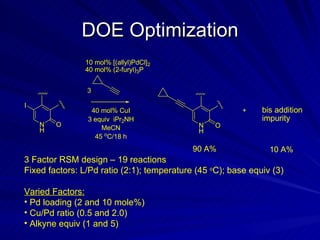
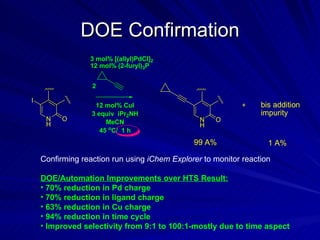
DOE Optimization 3 Factor RSM design – 19 reactions Fixed factors: L/Pd ratio (2:1); temperature (45  o C); base equiv (3) Varied Factors: Pd loading (2 and 10 mole%) Cu/Pd ratio (0.5 and 2.0) Alkyne equiv (1 and 5)
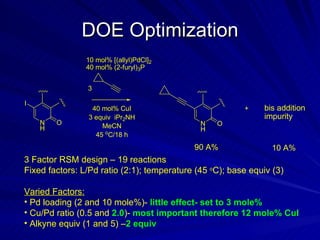
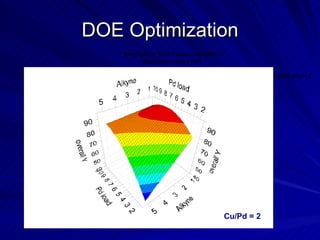
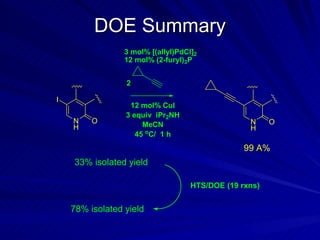
DOE Optimization 3 Factor RSM design – 19 reactions Fixed factors: L/Pd ratio (2:1); temperature (45  o C); base equiv (3) Varied Factors: Pd loading (2 and 10 mole%)-  little effect- set to 3 mole% Cu/Pd ratio (0.5 and  2.0 )-  most important   therefore 12 mole% CuI Alkyne equiv (1 and 5) – 2 equiv
DOE Optimization Cu/Pd = 2
DOE Confirmation Confirming reaction run using  iChem Explorer  to monitor reaction DOE/Automation Improvements over HTS Result: 70% reduction in Pd charge 70% reduction in ligand charge 63% reduction in Cu charge 94% reduction in time cycle Improved selectivity from 9:1 to 100:1-mostly due to time aspect
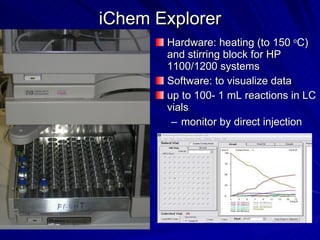
iChem Explorer Hardware: heating (to 150  o C) and stirring block for HP 1100/1200 systems Software: to visualize data up to 100- 1 mL reactions in LC vials monitor by direct injection
DOE Summary
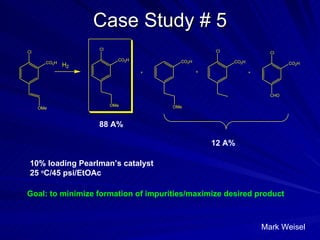
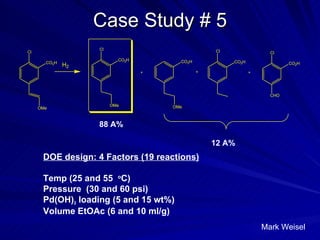
Case Study # 5 Mark Weisel 10% loading Pearlman’s catalyst 25  o C/45 psi/EtOAc 88 A% Goal: to minimize formation of impurities/maximize desired product 12 A%
Case Study # 5 Mark Weisel 88 A% 12 A% DOE design: 4 Factors (19 reactions) Temp (25 and 55  o C) Pressure  (30 and 60 psi) Pd(OH) 2  loading (5 and 15 wt%) Volume EtOAc (6 and 10 ml/g)
Factors
Effect of Pd and Temp
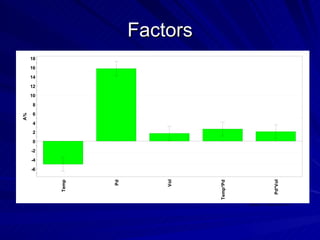
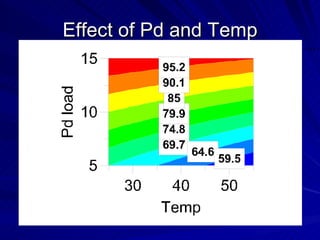
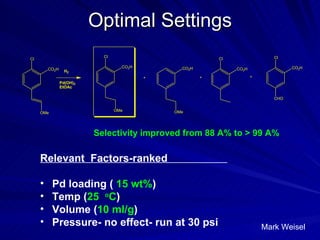
Optimal Settings Mark Weisel Relevant  Factors-ranked  Pd loading (  15 wt% ) Temp ( 25  o C ) Volume ( 10 ml/g ) Pressure- no effect- run at 30 psi Selectivity improved from 88 A% to > 99 A%
DOE Benefits Increase your process knowledge Discover the effects of changing factors Understand the effects of interactions Learn what is and what is NOT important Save time, materials, and  money
Take Home Message DOE is a powerful tool for optimization of reactions Automated tools minimize the effort of running multiple rxns HTS & DOE in 96-well format represents leading-edge science Academics embracing HTS approach Professor D. MacMillan ( Princeton)
Acknowledgments Peter Maligres Danny Gauvreau Spenser Dreher Dave Pollard Shane Krska Mark Weisel Dave Tellers
QUESTIONS ?

DOE Applications in Process Chemistry Presentation

  • 1.
    Design of Experiments(DOE): A “New” Approach to Reaction Optimization Dr. Steven Weissman Merck & Co. Feb 4, 2008/UPR
  • 2.
    Outline Background: Bigchanges for Pharma Basic Principles of Design of Experiments Merck Case Studies Take Home message/Questions
  • 3.
    Big Changes forBig Pharma Costs/Risks of drug development are rising low hanging fruit has been picked small molecules no longer in vogue protein-based and vaccines = more opportunities ‘ Vioxx hangover’- more trials/more patients = $$
  • 4.
    Big Changes forBig Pharma Costs/Risks of drug development are rising Globalization of marketplace US market sales is matured; slow growth Emerging markets sales = high growth potential Strategic portions of drug development outsourced to India/China (low-cost providers)
  • 5.
    Big Changes forBig Pharma Costs/Risks of drug development are rising Globalization of marketplace Uncertain pipelines ‘Batting average’ is unchanged despite huge investments Is bureaucracy killing drug discovery? Are smaller companies becoming better at this?
  • 6.
    Big Changes forBig Pharma Costs/Risks of drug development are rising Globalization of marketplace Uncertain pipelines Revenues/profits are being squeezed patent expirations – Fosamax ($3 B) tougher regulatory environment payers demand value-added lower cost structures: aggressively pursued downsizing plant closings-namely here in PR
  • 7.
    Big Changes forBig Pharma Costs/Risks of drug development are rising Globalization of marketplace Uncertain pipelines Revenues/profits are being squeezed
  • 8.
    New Approaches NeededWhat can we do as chemists to change the way we do our jobs ? Can we work smarter/faster ? How ??
  • 9.
    New Approaches NeededWhat can we do as chemists to change the way we do our jobs ? Can we work smarter/faster ? How ?? Automation/Technology
  • 10.
    Automated Synthesis CycleDesign Experiment Analysis Informatics
  • 11.
    Automated Synthesis CycleDesign Experiment Analysis Informatics Design of Experiments
  • 12.
    Current Approach toOptimization Change One Factor at a time (OFAT) Rarely leads to optimal conditions Leads to different conclusions depending on starting point Requires many expts/little information Cannot separate “noise” from true variability
  • 13.
    Current Approach toOptimization Change One Factor at a time (OFAT) Rarely leads to optimal conditions Leads to different conclusions depending on starting point Requires many expts/little information Cannot separate “noise” from true variability Ignores interactions of variables
  • 14.
  • 15.
  • 16.
    DOE vs OFATOFAT: 3 factors needed 21 reactions No information on interactions of effects DOE: 3 or 4 factors- 11 or 17 reactions Better quality information Learn about interactions of effects Fewer reactions
  • 17.
    Notable Quote “If you test one factor at a time, there’s a low probability that you are going to hit the right one before everybody gets sick of it and quits” Forbes magazine article on DOE in 1996
  • 18.
    What is DOE? Selected set of expts in which all relevant factors are varied simultaneously ‘ Continuous’ factors are ideal (time, temp, equiv)-the ‘ How much’ Analysis reveals which factors influence the outcome and identifies optimal conditions Systematic, organized approach to problem solving Mathematical model of the design space
  • 19.
    DoE Introduction CoreKnowledge (Engineering, Chemistry, Biology,…) Statistical Knowledge Develop Solutions DOE is NOT a replacement for process knowledge
  • 20.
    Questions to beAnswered by DoE How do we get the best synthetic yield ? How much catalyst/ligand do I need ? Can we minimize formation of an impurity? Which experimental factors are (un) important? How robust is my process ?
  • 21.
    DOE: Considerations Can’treplace full screening of catalyst or solvent (HTS)- ‘ discreet ’ variables Best suited for continuous variables time, temp, stoichiometry Not helpful for non-reproducible rxns Best suited for ‘low maintenance’ rxns Temp = 20 to 150 o C All reactants added at once
  • 22.
    DOE: Experimental ObjectivesScreening Which factors are most influential ? What are their appropriate values/ranges ? Optimization Extract information regarding how factors combine to influence response Identify optimized reaction conditions
  • 23.
    DOE: Misconceptions Requires in-depth statistics knowledge User-friendly DOE software does this for you MODDE (Umetrics)/ Design Expert (Stat-ease)
  • 24.
    DOE: Misconceptions DoE requires in-depth statistics knowledge Experimental design software does this for you DoE requires a lot of experiments and time Perhaps. but will always get better quality information Typically 11-27 reactions per design Automation/technology helps reduce the effort needed
  • 25.
    High Throughput Screening= 96 x Discreet variables- ‘The what” What is the best ligand/catalyst combination ? What is the best solvent ?
  • 26.
    High Throughput Screening= 96 x Can we do OPTIMIZATION this way too ??
  • 27.
    High Throughput Optimization?? = 96 x If so,………………….. Which reactions do we run ? How do assess the data ?
  • 28.
    High Throughput Optimization?? = 96 x Statistical Design of Experiments (DOE)
  • 29.
  • 30.
    DOE: Workflow Definethe Objective screening, optimize, robustness Definition of Factors Prioritize: known, suspected, possibly, unlikely Set HIGH/LOW values for factors (define design space ) Define the Response – how to measure ? Select Experimental Design Generate Worksheet Run the Reactions Perform Analysis with DOE software
  • 31.
    DOE Design (N=27)64 0.25 1.85 0.875 4 100 20 58 0.25 1.85 0.875 2 100 19 66 0.25 1.85 0.875 3 115 18 64 0.25 1.85 0.875 3 85 17 76 0.4 2.5 1.5 4 115 16 80 0.1 2.5 1.5 4 85 15 65 0.1 2.5 1.5 2 115 14 79 0.4 2.5 1.5 2 85 13 76 0.1 2.5 0.25 4 115 12 88 0.4 2.5 0.25 4 85 11 63 0.4 2.5 0.25 2 115 10 48 0.1 2.5 0.25 2 85 9 54 0.1 1.2 1.5 4 115 8 39 0.4 1.2 1.5 4 85 7 55 0.4 1.2 1.5 2 115 6 45 0.1 1.2 1.5 2 85 5 55 0.4 1.2 0.25 4 115 4 43 0.1 1.2 0.25 4 85 3 49 0.1 1.2 0.25 2 115 2 45 0.4 1.2 0.25 2 85 1 Yield E:Conc D:Boron/Br C:Cu B:P/Pd A:temp Rxn # Response 1 Factor 5 Factor 4 Factor 3 Factor 2 Factor 1
  • 32.
    DOE Creates aDesign Space Design-Expert® Software Yield X1 = A: temp X2 = B: P/Pd X3 = C: Cu load Actual Factors D: Boron/Br = 2.50 E: Conc = 0.40 Cube Yield A: temp B: P/Pd C: Cu load A-: 85.00 A+: 115.00 B-: 2.00 B+: 4.00 C-: 0.25 C+: 1.50 63.7936 74.1825 86.3492 83.738 59.9047 70.2936 82.4603 79.8492
  • 33.
    DOE Expts: HowMany ? screening optimaztion 29 9 11 9 5 27 10 7 10 4 17 5 7 5 3 35 16 3 16 5 19 8 3 8 4 11 4 3 4 3 factors Total rxns Lo Med HI rxns factors
  • 34.
  • 35.
    MK-0518 First-in-Class OralHIV-1 Integrase Inhibitor Approved by FDA October-12-2007
  • 36.
  • 37.
    MK-0518 Challenge: toreduce manufacture cost by 20%
  • 38.
    MK-518: Problem stepPeter Maligres Existing Conditions : 4 eq Mg(OMe) 2 / 4 eq MeI @ 0.5 M (68% isolated yield) 18 solvents, 8 bases screened 78 22
  • 39.
    MK-518: DOE OptimizationPeter Maligres DOE Optimzation Design Factors : Mg(OMe) 2 equiv: 1.0 and 3.0 MeI equiv: 2.5 and 5.0 Conc: 0.25 and 1.0 M Temperature: 30 and 65 o C 19 reactions Responses (4 and 20 h): Assay yield Selectivity
  • 40.
    MK-518 Optimization PeterMaligres DOE Optimal Settings Base equiv: 1.0 and 3.0 MeI equiv: 2.5 and 5.0 Temperature: 30 and 65 o C Conc: 0.25 and 1.0 M Time: 4 and 20 h 99 1
  • 41.
  • 42.
  • 43.
  • 44.
    MK518-In Situ Demethylation99/1 80/20 N vs O 99% 95% Conv 20 h 4 h
  • 45.
    MK-518 Concerns PeterMaligres Issues: 1. at this higher concentration, end of reaction difficult to stir Mg(OMe) 2 - long term issues with supply & cost MeI is mutagenic/carcinogen/toxic 99 1
  • 46.
    MK-518 Optimization PeterMaligres Yield =90% Selectivity = >99.9 % Safer, more economical reagents Incorporated best practices from DOE: HI Temp/HI Concentration/Longer reaction times
  • 47.
    MK-518 Summary 7822 > 99 < 1 DOE Goal of 20% reduction in drug inventory cost was achieved Higher Yield cascades back to allow fewer RM/solvents to be used Submitted for 2008 Presidential Green Chemistry Award
  • 48.
    Case Study 2-Suzuki Goal: to reduce Pd(OAc) 2 & ligand charges (0.4 mole%,0.8 mole%) 2. Improve yield and/or purity
  • 49.
    Case Study 2-Suzuki DOE Factors : Ligand/Pd ratio: 1.0 and 3.0 Catalyst load: 0.1 and 0.5 mole% Molarity boronic acid: 0.5 and 1.5 Temperature: 60 and 80 o C 27 Reactions in 96-well plate format, 2 days to plan/setup/execute/assay 0.65 g material (24 mg/rxn) !!
  • 50.
    Case Study 2-Suzuki DOE Optimal Settings : Ligand/Pd ratio: 1.0 and 3.0 Catalyst load: 0.1 and 0.5 mole% Molarity boronic acid : 0.5 and 1.5 Temperature: 60 and 80 o C ( 65 o C )
  • 51.
    Effect of Tempand Pd Loading Lig/ catalyst ratio fixed at 3:1; Triol M fixed at 1.5 M Overall LCAP
  • 52.
    Optimized ConditionsOptimized Experiment: -increased LCAP by 1% -decreased DesBr impurity (50%) -decreased Pd by 75% -decreased Lig by 70% Spencer Dreher
  • 53.
    Case Study #3Dave Pollard Goal: to reduce cost by increasing productivity 100 g/L
  • 54.
    Screening Design DavePollard Factors Octanol: 40 and 60 % NADP equiv: 0.1 and 0.5 % Concentration: 50 and 150 g/L Temp: 25 and 35 o C Enzyme load: 0.3 to 1.0 g/L 19 experiments
  • 55.
  • 56.
  • 57.
    Screening Result DavePollard Factor Preferred Setting Octanol: 40 and 60 % No impact NADP equiv: 0.1 and 0.5 % No impact- increase more ? Concentration: 50 and 150 g/L 50 g/L- undesirable setting Temp: 25 and 35 o C minimal effect- set at 30 o C Enzyme load: 0.3 to 1.0 g/L 1.0 g/L- increase more
  • 58.
    Optimization Design DavePollard Factor NADP equiv: 0.5 and 1.5 % Concentration: 100 and 200 g/L Enzyme load: 0.5 to 3.0 g/L 19 experiments
  • 59.
    Optimization Design Factor Preferred setting NADP equiv: 0.5 and 1.5 % No effect Concentration: 100 and 200 g/L 200 Enzyme load: 0.5 to 3.0 g/L 3.0
  • 60.
    Optimization Design Factor Preferred setting NADP equiv: 0.5 and 1.5 % No effect Concentration: 100 and 200 g/L 200 Enzyme load: 0.5 to 3.0 g/L 3.0 Confirming experiment at 200 g/L NADP= 0.5 g/L and enzyme at 3 g/L gave 100% conversion Goal achieved
  • 61.
    Case Study #4-SonogashiraS. Krska/A. Northrup Medicinal Chemistry conditions
  • 62.
    HTS Result Screened:ligands and Pd sources 32 reactions (HTS-96 well plate format) – 1.5 days- 125 mg of substrate
  • 63.
    DOE Optimization 3Factor RSM design – 19 reactions Fixed factors: L/Pd ratio (2:1); temperature (45 o C); base equiv (3) Varied Factors: Pd loading (2 and 10 mole%) Cu/Pd ratio (0.5 and 2.0) Alkyne equiv (1 and 5)
  • 64.
    DOE Optimization 3Factor RSM design – 19 reactions Fixed factors: L/Pd ratio (2:1); temperature (45 o C); base equiv (3) Varied Factors: Pd loading (2 and 10 mole%)- little effect- set to 3 mole% Cu/Pd ratio (0.5 and 2.0 )- most important therefore 12 mole% CuI Alkyne equiv (1 and 5) – 2 equiv
  • 65.
  • 66.
    DOE Confirmation Confirmingreaction run using iChem Explorer to monitor reaction DOE/Automation Improvements over HTS Result: 70% reduction in Pd charge 70% reduction in ligand charge 63% reduction in Cu charge 94% reduction in time cycle Improved selectivity from 9:1 to 100:1-mostly due to time aspect
  • 67.
    iChem Explorer Hardware:heating (to 150 o C) and stirring block for HP 1100/1200 systems Software: to visualize data up to 100- 1 mL reactions in LC vials monitor by direct injection
  • 68.
  • 69.
    Case Study #5 Mark Weisel 10% loading Pearlman’s catalyst 25 o C/45 psi/EtOAc 88 A% Goal: to minimize formation of impurities/maximize desired product 12 A%
  • 70.
    Case Study #5 Mark Weisel 88 A% 12 A% DOE design: 4 Factors (19 reactions) Temp (25 and 55 o C) Pressure (30 and 60 psi) Pd(OH) 2 loading (5 and 15 wt%) Volume EtOAc (6 and 10 ml/g)
  • 71.
  • 72.
    Effect of Pdand Temp
  • 73.
    Optimal Settings MarkWeisel Relevant Factors-ranked Pd loading ( 15 wt% ) Temp ( 25 o C ) Volume ( 10 ml/g ) Pressure- no effect- run at 30 psi Selectivity improved from 88 A% to > 99 A%
  • 74.
    DOE Benefits Increaseyour process knowledge Discover the effects of changing factors Understand the effects of interactions Learn what is and what is NOT important Save time, materials, and money
  • 75.
    Take Home MessageDOE is a powerful tool for optimization of reactions Automated tools minimize the effort of running multiple rxns HTS & DOE in 96-well format represents leading-edge science Academics embracing HTS approach Professor D. MacMillan ( Princeton)
  • 76.
    Acknowledgments Peter MaligresDanny Gauvreau Spenser Dreher Dave Pollard Shane Krska Mark Weisel Dave Tellers
  • 77.

Editor's Notes

  • #4 mature categories: anti-hypertensives/anti-biotics/cholesterol unmet needs: cancer/alzheimers/obesity mature therapies = anti-hypertensive, antibiotics……. protein-based drugs and vaccines have greater opportunities
  • #5 Develop infrastructure in those countries
  • #7 Fosamax-coming off patent this week. Feb 6 Insurers/benefits managers/consumers
  • #8 Fosamax-coming off patent this week. Feb 6
  • #10 Automation: not necessarily always a robot.- can be any tool that speeds up a workflow or allows a chemist to perform more value added tasks.
  • #14 interaction = dependance of one factor on the setting of another
  • #20 Statistical methods are tools used to make sense out of numbers. This slide illustrates the combination of statistical methods with your core knowledge. Statistical methods (specifically, designed experiments in today’s course) are a catalyst to science, NOT a substitute for it.
  • #25 lead in to next slide: How to run the rxns ????
  • #26 Existing experience using HTS
  • #27 Here is the question we are now asking ourselves at Merck…..
  • #36 Isentress generically known as Raltegravir. 1 st commercial HIV integrase inhibitor. Over 3 dozen people from process res
  • #37 Retro: oxadiazole/aza-lactone (oxo-pyrimidine)/fluoro-benzylamine
  • #39 10 step process
  • #47 trimethyl sulfoxonium iodide
  • #52 Note that the low setting for Pd still gave good results !! and thus was chosen
  • #56 Octanol =NO EFFECT ( not included)
  • #70 enol ether reduction last one: oxidative cleavage
  • #71 enol ether reduction last one: oxidative cleavage