DOCUMENTING DISCIPLINE
Christina M. Jepson
April 25, 2013
Holiday Inn Salt Lake City Airport West
parsonsbehle.com
LORMAN EDUCATION SEMINAR
2
 Why is it important to carefully and
accurately document discipline of
employees?
3
 Employees can bring claims or lawsuits
because of discipline and terminations
 Discipline and terminations create risks
under the discrimination laws and other
employment laws
4
Assessing Risk
5
Specific Risks
 Employees may bring claims/lawsuits
– Protected class members under Title VII, ADEA, ADA
– Those who participate in protected proceedings
– EEOC and UALD charge filers
– Investigation participants
– Those who oppose allegedly discriminatory conduct
– Other complainants
– Investigation witnesses
– Those who exercise their rights
– Example: an employee who requests ADA accommodation
6
Who is High Risk?
Any employee who
(1) Is in a protected class;
(2) Is in circumstances that suggest that he or she
may file a claim; and
(3) Is subject to discipline
7
Managing the High-Risk Situation
 Properly document all actions taken
toward and interactions with the high-risk
employee
 Guard against careless communications
 Consult with counsel early about high-risk
situations to get guidance
8
Documentation Techniques
9
The documentation that is created can
show:
 That you did everything you were supposed to
do in furtherance of the employee‟s rights:
– ADA accommodation process
– Investigated and corrected promptly any claims of
discrimination or retaliation
 That your discipline and/or termination of the
employee were for legitimate business reasons
and not discriminatory:
– Employee was a bad performer
10
Documentation Throughout Employment
 Agreements with employees
 Acknowledgements by employees
 Employee requests for accommodation
 Employer responses to accommodation
requests
 Complaints and investigations
 Employee performance issues
 Employee misconduct
 Discipline and termination decisions
11
Documentation Throughout Employment
 Improved communication
 Uniformity in business decisions
 Lawsuit defense aides:
– Faded memories
– Credibility battles
– Binding admissions
12
Documentation in High-Risk Settings
 All interactions with the employee
 All crucial steps taken by the employer
 All buy-ins/acknowledgements by the
employee
13
Documenting Misconduct
 What is misconduct?
 What is proper discipline?
 Does consistency matter?
 What is proper documentation?
14
Documenting Misconduct
Susan Supervisor observed an incident. Her proper signed
write-up might look like this:
“On 9/15/13, I, Susan Supervisor, saw a puddle of water on
the floor in the west service hall. I told Jacob Janitor of the
puddle, where it was, and to please clean it up immediately.
He said, „I‟m busy right now. I‟ll get to that when I get around
to it. If you need it sooner than then, you can $@&% well do it
yourself.‟ I verbally warned him that his response was
unacceptable, that his behavior would be noted in his file, and
that further disciplinary action might be taken. Jose Assistant
witnessed this exchange, and I asked him to write up a
statement.”
15
Documenting Misconduct
Compare that with:
“There was something on the floor in the hall. I
told Jerry Jacob to take care of it. He mouthed
off and blew me off.”
16
Documenting Misconduct
Ollie Jones told Susan Supervisor that he heard
Jacob Janitor was pushing and shoving others in
the hallway. Susan‟s proper signed write-up might
look like this:
“9/15/13: 2:15 p.m.: Ollie Jones came in and told
me he overheard from Wally Witness that Jacob
Janitor was pushing and shoving others in the
hallway.”
17
Documenting Misconduct
Compare that with:
“Ollie Overhearer told me Jerry Janitor was
goofing off.”
18
Documenting Misconduct
Susan‟s proper signed write-up (cont.):
“9/15/13, 2:20 p.m.: I called Wally Witness to my
office and asked about what he knew. He said
he saw Jacob Janitor push and shove Andy
Annoyance and Prickly Pete in the west service
hallway. Jacob was yelling and Andy and Pete
about spilled water. Andy fell down but got right
back up and did not appear to be hurt. I asked
Wally to write up a statement.”
19
Documenting Misconduct
Compare that with:
“Wally Witness told me Jacob Janitor pushed
and shoved a couple other guys in the hallway.
Jacob was yelling about something. One of the
guys fell.”
20
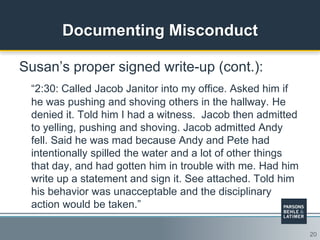
Documenting Misconduct
Susan‟s proper signed write-up (cont.):
“2:30: Called Jacob Janitor into my office. Asked him if
he was pushing and shoving others in the hallway. He
denied it. Told him I had a witness. Jacob then admitted
to yelling, pushing and shoving. Jacob admitted Andy
fell. Said he was mad because Andy and Pete had
intentionally spilled the water and a lot of other things
that day, and had gotten him in trouble with me. Had him
write up a statement and sign it. See attached. Told him
his behavior was unacceptable and the disciplinary
action would be taken.”
21
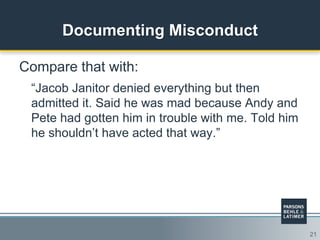
Documenting Misconduct
Compare that with:
“Jacob Janitor denied everything but then
admitted it. Said he was mad because Andy and
Pete had gotten him in trouble with me. Told him
he shouldn‟t have acted that way.”
22
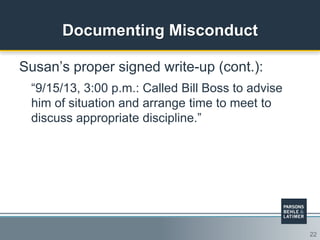
Documenting Misconduct
Susan‟s proper signed write-up (cont.):
“9/15/13, 3:00 p.m.: Called Bill Boss to advise
him of situation and arrange time to meet to
discuss appropriate discipline.”
23
Documenting Misconduct
Compare that with:
“Called Bill Boss.”
24
Misconduct Documentation
 How does the misconduct documentation
help the employer avoid liability?
– Encourages adequate investigation
– Permits review
– Promotes uniformity
– Provides contemporaneous evidence of facts
for use in lawsuits
25
Improvement Plans
 Can performance be improved?
– Usually
– Do the job requirements and the skill set
match?
– Where skills are lacking, can training fix it?
26
Improvement Plans
 What are the keys to improvement?
– Clear communication of expectations
– Clear feedback on meeting expectations
– Playing to the employee‟s strengths
– Getting the employee to buy into the goals
– Getting the employee involved in creating the
solution
27
Improvement Plans
 What if the plan doesn‟t work?
– Evaluate the communication dynamic
– Re-evaluate the job requirements and the skill
set
– Revise the plan, revise the job, change
supervision, or change the employee
28
Improvement Plans
 What does proper documentation look like?
– Objective goals
– Detailed plan to meet goals
• Employee‟s part
• Supervisor‟s needed contribution
– Ways to measure improvement
– Timeframe for improvement
– Employee or joint creation
29
Improvement Plans
 What does proper documentation look
like?
– Contains employee acknowledgements:
• Of the performance problem
• Of the employee‟s agreement to the plan
• Of the employee‟s knowledge that his failure to
perform may result in additional disciplinary action
– If acknowledgement is refused – document
that
30
Improvement Plans
 What does proper documentation look
like?
– Contains disclaimer:
• Plan is not a contract
• Employer does not have to facilitate improvement
• Employee remains at-will and subject to
termination at any time
31
Improvement Plans
 How does the improvement plan
documentation help the employer avoid
liability?
– Undermines employee‟s later claim in lawsuit that his
performance was not the reason for his termination
– Caveat: short-cutting improvement timeframes can
permit argument that protected class status caused
the short-cut and that had the full time been given, he
would have performed
32
Documentation
 Is the form of the documentation magical?
 Where should you keep it?
33
Handling the Termination
34
Termination Documents
 Termination Procedures
 Termination Decision
 Termination Communication
 Separation Agreements
35
Termination Procedures Documentation
 You may have some policies impacting your ability to
discipline or terminate. Check before you start creating
documentation. If you aren‟t, have good and well-
documented reasons for the departure. Examples of
existing documents that may impact your termination
process include:
– Employment contract provisions
– Progressive discipline policies
– Grievance and decision review policies
– HR/Legal oversight approval policies
36
Termination Decision Documentation
 Written before the termination decision is communicated
to the employee
 Explains the reason for the decision
 Provides enough history to understand and evaluate the
decision from a legitimate business reason perspective
 References and has attached backup documentation for
the decision
 In complicated or risky situations, should be written only
after discussions with counsel and at request of counsel
or in a communication to counsel to permit non-
discoverable revisions
37
Termination Communication
Documentation
 Clearly communicates to the employee that he
or she has been terminated, effective when, and
– May include the reasons
– Should never include false reasons
– Should never include only some reasons when other
reasons are also present
– In complicated or risky situations, should be written
only after discussions with counsel and at request of
counsel or in a communication to counsel to permit
non-discoverable revisions
38
Common Mistakes
39
Common Mistakes in Disciplining
 Creating arguments that “employment at-will”
was changed
 Vague communications of the expectations and
consequences going forward
 Inconsistent discipline for similar infractions
across the company
 Inappropriately light discipline
 Bringing unrelated or irrelevant issues into the
documentation
40
Common Mistakes in Terminating
 Terminating without having exhausted the ADA reasonable
accommodation process
 Termination for retaliatory reasons (known to the decision
maker but not to HR)
 Overlooking procedural requirements
 Bringing unrelated or irrelevant issues into the documentation
 Sugar-coating or leaving out some reasons for termination
 Getting HR or counsel involved too late – after a bad decision
has been made or bad documentation has been created
41
Avoiding Lawsuits
42
Separation Agreements
 What are they?
 Why have them?
 What consideration must the employer
give in exchange for a release?
 What can be released?
43
Avoiding Lawsuits
 Avoid discrimination and retaliation
 Create an atmosphere of fairness
 Manage employee expectations - avoid
surprises
 Use severance payments to buy releases
of claims
44
Releases of Claims
 Don‟t pay severance without obtaining a release
 Make sure your release is well drafted, complies with the
law, and protects you to the fullest extent possible
 Understand the requirements for releasing age
discrimination claims. Know what Age Discrimination
releases (employees 40 y.o. +):
– Must use plain language
– Must give consideration beyond anything employee is
already entitled to
– Must advise employee to consult an attorney
45
Releases of Claims
 Don‟t pay severance without obtaining a release
 Make sure your release is well drafted, complies
with the law, and protects you to the fullest
extent possible
 Understand and comply with the requirements
for releasing age discrimination claims
 Get legal advice as soon as you know a group
termination (reduction in force) is on the horizon
46
Age Discrimination Releases
 Age Discrimination releases (40 y.o. +):
– Must use plain language
– Must give consideration beyond anything
employee is already entitled to
– Must advise employee to consult an attorney
47
Age Discrimination Releases
 If the termination is of one person:
– Must give him/her 21 days to consider the
release, and 7 days to revoke the agreement
– The 7 day period cannot be shortened, even
by agreement
48
Age Discrimination Releases
 If the termination is of a group of people:
– Must give the employees 45 days to consider
the release, and 7 days to revoke their
agreement
– The 7 day period cannot be shortened, even
by agreement
– Must include a disclosure containing specific
additional information about how the firing
decision was made and who was impacted
49
Age Discrimination Releases
 Group termination releases must provide:
– Decisional unit information (who was
considered for termination)
– Eligibility factors (parameters for selecting
employees for the termination)
– Identification information (ages/titles of those
terminated and not terminated)
50
 Christina M. Jepson
direct: 801.536.6820
email: cjepson@parsonsbehle.com
Thank You

Documenting_Discipline

  • 1.
    DOCUMENTING DISCIPLINE Christina M.Jepson April 25, 2013 Holiday Inn Salt Lake City Airport West parsonsbehle.com LORMAN EDUCATION SEMINAR
  • 2.
    2  Why isit important to carefully and accurately document discipline of employees?
  • 3.
    3  Employees canbring claims or lawsuits because of discipline and terminations  Discipline and terminations create risks under the discrimination laws and other employment laws
  • 4.
  • 5.
    5 Specific Risks  Employeesmay bring claims/lawsuits – Protected class members under Title VII, ADEA, ADA – Those who participate in protected proceedings – EEOC and UALD charge filers – Investigation participants – Those who oppose allegedly discriminatory conduct – Other complainants – Investigation witnesses – Those who exercise their rights – Example: an employee who requests ADA accommodation
  • 6.
    6 Who is HighRisk? Any employee who (1) Is in a protected class; (2) Is in circumstances that suggest that he or she may file a claim; and (3) Is subject to discipline
  • 7.
    7 Managing the High-RiskSituation  Properly document all actions taken toward and interactions with the high-risk employee  Guard against careless communications  Consult with counsel early about high-risk situations to get guidance
  • 8.
  • 9.
    9 The documentation thatis created can show:  That you did everything you were supposed to do in furtherance of the employee‟s rights: – ADA accommodation process – Investigated and corrected promptly any claims of discrimination or retaliation  That your discipline and/or termination of the employee were for legitimate business reasons and not discriminatory: – Employee was a bad performer
  • 10.
    10 Documentation Throughout Employment Agreements with employees  Acknowledgements by employees  Employee requests for accommodation  Employer responses to accommodation requests  Complaints and investigations  Employee performance issues  Employee misconduct  Discipline and termination decisions
  • 11.
    11 Documentation Throughout Employment Improved communication  Uniformity in business decisions  Lawsuit defense aides: – Faded memories – Credibility battles – Binding admissions
  • 12.
    12 Documentation in High-RiskSettings  All interactions with the employee  All crucial steps taken by the employer  All buy-ins/acknowledgements by the employee
  • 13.
    13 Documenting Misconduct  Whatis misconduct?  What is proper discipline?  Does consistency matter?  What is proper documentation?
  • 14.
    14 Documenting Misconduct Susan Supervisorobserved an incident. Her proper signed write-up might look like this: “On 9/15/13, I, Susan Supervisor, saw a puddle of water on the floor in the west service hall. I told Jacob Janitor of the puddle, where it was, and to please clean it up immediately. He said, „I‟m busy right now. I‟ll get to that when I get around to it. If you need it sooner than then, you can $@&% well do it yourself.‟ I verbally warned him that his response was unacceptable, that his behavior would be noted in his file, and that further disciplinary action might be taken. Jose Assistant witnessed this exchange, and I asked him to write up a statement.”
  • 15.
    15 Documenting Misconduct Compare thatwith: “There was something on the floor in the hall. I told Jerry Jacob to take care of it. He mouthed off and blew me off.”
  • 16.
    16 Documenting Misconduct Ollie Jonestold Susan Supervisor that he heard Jacob Janitor was pushing and shoving others in the hallway. Susan‟s proper signed write-up might look like this: “9/15/13: 2:15 p.m.: Ollie Jones came in and told me he overheard from Wally Witness that Jacob Janitor was pushing and shoving others in the hallway.”
  • 17.
    17 Documenting Misconduct Compare thatwith: “Ollie Overhearer told me Jerry Janitor was goofing off.”
  • 18.
    18 Documenting Misconduct Susan‟s propersigned write-up (cont.): “9/15/13, 2:20 p.m.: I called Wally Witness to my office and asked about what he knew. He said he saw Jacob Janitor push and shove Andy Annoyance and Prickly Pete in the west service hallway. Jacob was yelling and Andy and Pete about spilled water. Andy fell down but got right back up and did not appear to be hurt. I asked Wally to write up a statement.”
  • 19.
    19 Documenting Misconduct Compare thatwith: “Wally Witness told me Jacob Janitor pushed and shoved a couple other guys in the hallway. Jacob was yelling about something. One of the guys fell.”
  • 20.
    20 Documenting Misconduct Susan‟s propersigned write-up (cont.): “2:30: Called Jacob Janitor into my office. Asked him if he was pushing and shoving others in the hallway. He denied it. Told him I had a witness. Jacob then admitted to yelling, pushing and shoving. Jacob admitted Andy fell. Said he was mad because Andy and Pete had intentionally spilled the water and a lot of other things that day, and had gotten him in trouble with me. Had him write up a statement and sign it. See attached. Told him his behavior was unacceptable and the disciplinary action would be taken.”
  • 21.
    21 Documenting Misconduct Compare thatwith: “Jacob Janitor denied everything but then admitted it. Said he was mad because Andy and Pete had gotten him in trouble with me. Told him he shouldn‟t have acted that way.”
  • 22.
    22 Documenting Misconduct Susan‟s propersigned write-up (cont.): “9/15/13, 3:00 p.m.: Called Bill Boss to advise him of situation and arrange time to meet to discuss appropriate discipline.”
  • 23.
    23 Documenting Misconduct Compare thatwith: “Called Bill Boss.”
  • 24.
    24 Misconduct Documentation  Howdoes the misconduct documentation help the employer avoid liability? – Encourages adequate investigation – Permits review – Promotes uniformity – Provides contemporaneous evidence of facts for use in lawsuits
  • 25.
    25 Improvement Plans  Canperformance be improved? – Usually – Do the job requirements and the skill set match? – Where skills are lacking, can training fix it?
  • 26.
    26 Improvement Plans  Whatare the keys to improvement? – Clear communication of expectations – Clear feedback on meeting expectations – Playing to the employee‟s strengths – Getting the employee to buy into the goals – Getting the employee involved in creating the solution
  • 27.
    27 Improvement Plans  Whatif the plan doesn‟t work? – Evaluate the communication dynamic – Re-evaluate the job requirements and the skill set – Revise the plan, revise the job, change supervision, or change the employee
  • 28.
    28 Improvement Plans  Whatdoes proper documentation look like? – Objective goals – Detailed plan to meet goals • Employee‟s part • Supervisor‟s needed contribution – Ways to measure improvement – Timeframe for improvement – Employee or joint creation
  • 29.
    29 Improvement Plans  Whatdoes proper documentation look like? – Contains employee acknowledgements: • Of the performance problem • Of the employee‟s agreement to the plan • Of the employee‟s knowledge that his failure to perform may result in additional disciplinary action – If acknowledgement is refused – document that
  • 30.
    30 Improvement Plans  Whatdoes proper documentation look like? – Contains disclaimer: • Plan is not a contract • Employer does not have to facilitate improvement • Employee remains at-will and subject to termination at any time
  • 31.
    31 Improvement Plans  Howdoes the improvement plan documentation help the employer avoid liability? – Undermines employee‟s later claim in lawsuit that his performance was not the reason for his termination – Caveat: short-cutting improvement timeframes can permit argument that protected class status caused the short-cut and that had the full time been given, he would have performed
  • 32.
    32 Documentation  Is theform of the documentation magical?  Where should you keep it?
  • 33.
  • 34.
    34 Termination Documents  TerminationProcedures  Termination Decision  Termination Communication  Separation Agreements
  • 35.
    35 Termination Procedures Documentation You may have some policies impacting your ability to discipline or terminate. Check before you start creating documentation. If you aren‟t, have good and well- documented reasons for the departure. Examples of existing documents that may impact your termination process include: – Employment contract provisions – Progressive discipline policies – Grievance and decision review policies – HR/Legal oversight approval policies
  • 36.
    36 Termination Decision Documentation Written before the termination decision is communicated to the employee  Explains the reason for the decision  Provides enough history to understand and evaluate the decision from a legitimate business reason perspective  References and has attached backup documentation for the decision  In complicated or risky situations, should be written only after discussions with counsel and at request of counsel or in a communication to counsel to permit non- discoverable revisions
  • 37.
    37 Termination Communication Documentation  Clearlycommunicates to the employee that he or she has been terminated, effective when, and – May include the reasons – Should never include false reasons – Should never include only some reasons when other reasons are also present – In complicated or risky situations, should be written only after discussions with counsel and at request of counsel or in a communication to counsel to permit non-discoverable revisions
  • 38.
  • 39.
    39 Common Mistakes inDisciplining  Creating arguments that “employment at-will” was changed  Vague communications of the expectations and consequences going forward  Inconsistent discipline for similar infractions across the company  Inappropriately light discipline  Bringing unrelated or irrelevant issues into the documentation
  • 40.
    40 Common Mistakes inTerminating  Terminating without having exhausted the ADA reasonable accommodation process  Termination for retaliatory reasons (known to the decision maker but not to HR)  Overlooking procedural requirements  Bringing unrelated or irrelevant issues into the documentation  Sugar-coating or leaving out some reasons for termination  Getting HR or counsel involved too late – after a bad decision has been made or bad documentation has been created
  • 41.
  • 42.
    42 Separation Agreements  Whatare they?  Why have them?  What consideration must the employer give in exchange for a release?  What can be released?
  • 43.
    43 Avoiding Lawsuits  Avoiddiscrimination and retaliation  Create an atmosphere of fairness  Manage employee expectations - avoid surprises  Use severance payments to buy releases of claims
  • 44.
    44 Releases of Claims Don‟t pay severance without obtaining a release  Make sure your release is well drafted, complies with the law, and protects you to the fullest extent possible  Understand the requirements for releasing age discrimination claims. Know what Age Discrimination releases (employees 40 y.o. +): – Must use plain language – Must give consideration beyond anything employee is already entitled to – Must advise employee to consult an attorney
  • 45.
    45 Releases of Claims Don‟t pay severance without obtaining a release  Make sure your release is well drafted, complies with the law, and protects you to the fullest extent possible  Understand and comply with the requirements for releasing age discrimination claims  Get legal advice as soon as you know a group termination (reduction in force) is on the horizon
  • 46.
    46 Age Discrimination Releases Age Discrimination releases (40 y.o. +): – Must use plain language – Must give consideration beyond anything employee is already entitled to – Must advise employee to consult an attorney
  • 47.
    47 Age Discrimination Releases If the termination is of one person: – Must give him/her 21 days to consider the release, and 7 days to revoke the agreement – The 7 day period cannot be shortened, even by agreement
  • 48.
    48 Age Discrimination Releases If the termination is of a group of people: – Must give the employees 45 days to consider the release, and 7 days to revoke their agreement – The 7 day period cannot be shortened, even by agreement – Must include a disclosure containing specific additional information about how the firing decision was made and who was impacted
  • 49.
    49 Age Discrimination Releases Group termination releases must provide: – Decisional unit information (who was considered for termination) – Eligibility factors (parameters for selecting employees for the termination) – Identification information (ages/titles of those terminated and not terminated)
  • 50.
    50  Christina M.Jepson direct: 801.536.6820 email: cjepson@parsonsbehle.com Thank You