parsonsbehle.com
May 14, 2024 | The Grand America Hotel – Salt Lake City
Documents are an Employer’s Best
Friend: How to Properly Document
Employee Interactions with HR
Liz M. Mellem and Leah Trahan
2
This presentation is based on available information as of May 14,
2024, but everyone must understand that the information provided is
not a substitute for legal advice. This presentation is not intended and
will not serve as a substitute for legal counsel on these issues.
Legal Disclaimer
Documentation Basics
4
Communication and Documentation
 Two pillars of good employee performance management and risk
management
 Communication = oral and written
o Conveys information regarding job duties, expectations, performance
feedback, corrective actions, etc.
o Frequent and early communication and intervention will help avoid
employment claims and protect an employer when claims are brought
 Documentation can be a form of communication AND evidence of
communication
5
“Golden Rule” of Documentation
IF IT IS NOT IN WRITING,
IT DIDN’T HAPPEN!
6
How will documentation help limit risk?
 In a case that goes to a jury trial, we never want to rely on
testimony alone because the jury gets to pick who to believe
o Spoiler Alert: They tend to believe the employee more often than the
employer!
 Documents help to establish intent and show:
o Decisions were performance or business based
o Decisions were not motivated by discriminatory, retaliatory, or other unlawful
intent
7
 Show that you did everything you were supposed to do in
furtherance of the employee’s rights, such as:
o ADA accommodation process
o Investigated and corrected promptly any claims of discrimination or
retaliation
Other reasons for documenting?
8
Who Else Cares About Documentation?
 Documentation also really matters to the agencies that enforce anti-
discrimination and anti-retaliation employment laws:
o State Agencies (e.g. UALD)
o EEOC
o DOL
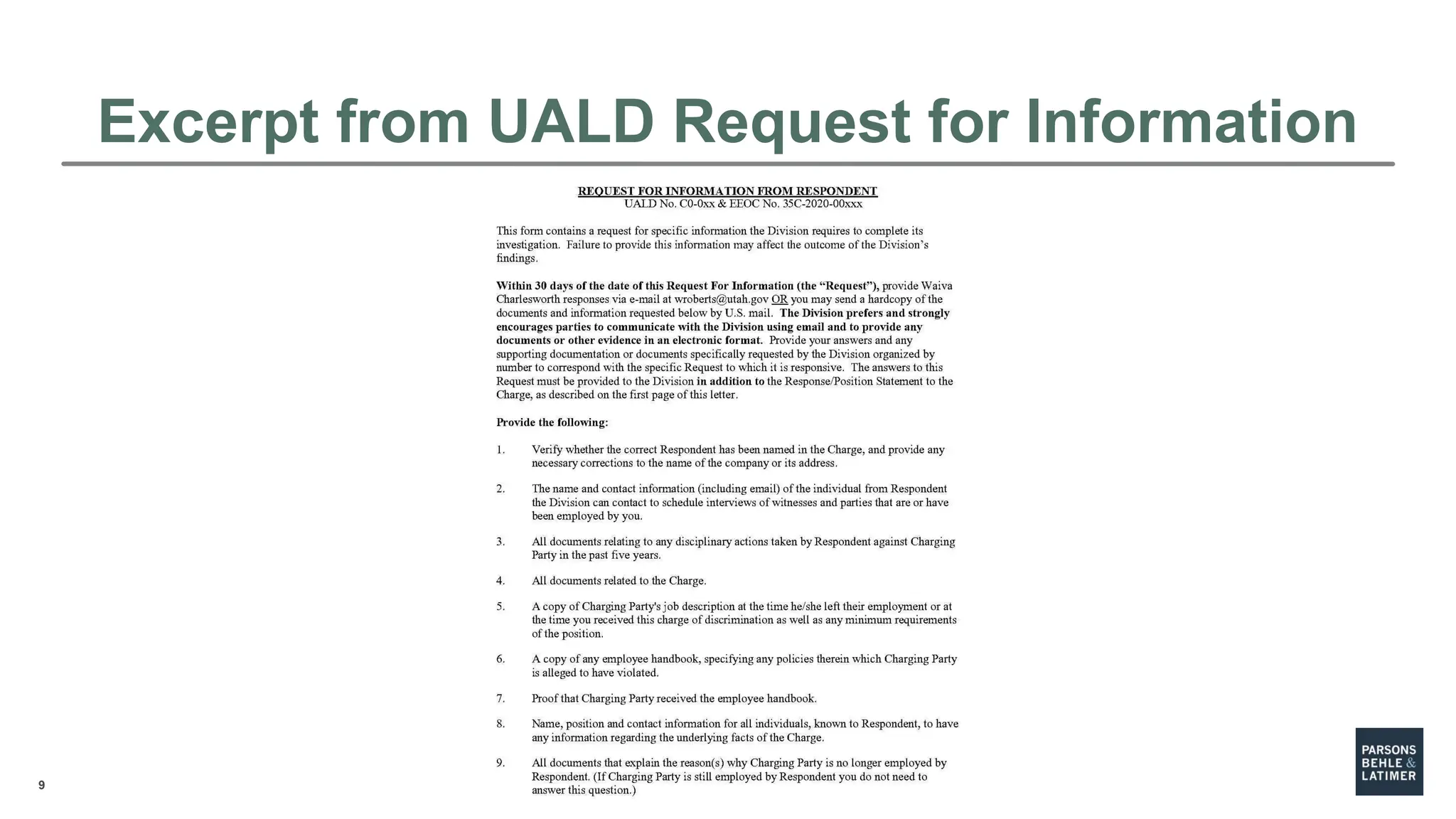
 Service of a Charge or Complaint is always accompanied by a
Request for Information
9
Excerpt from UALD Request for Information
10
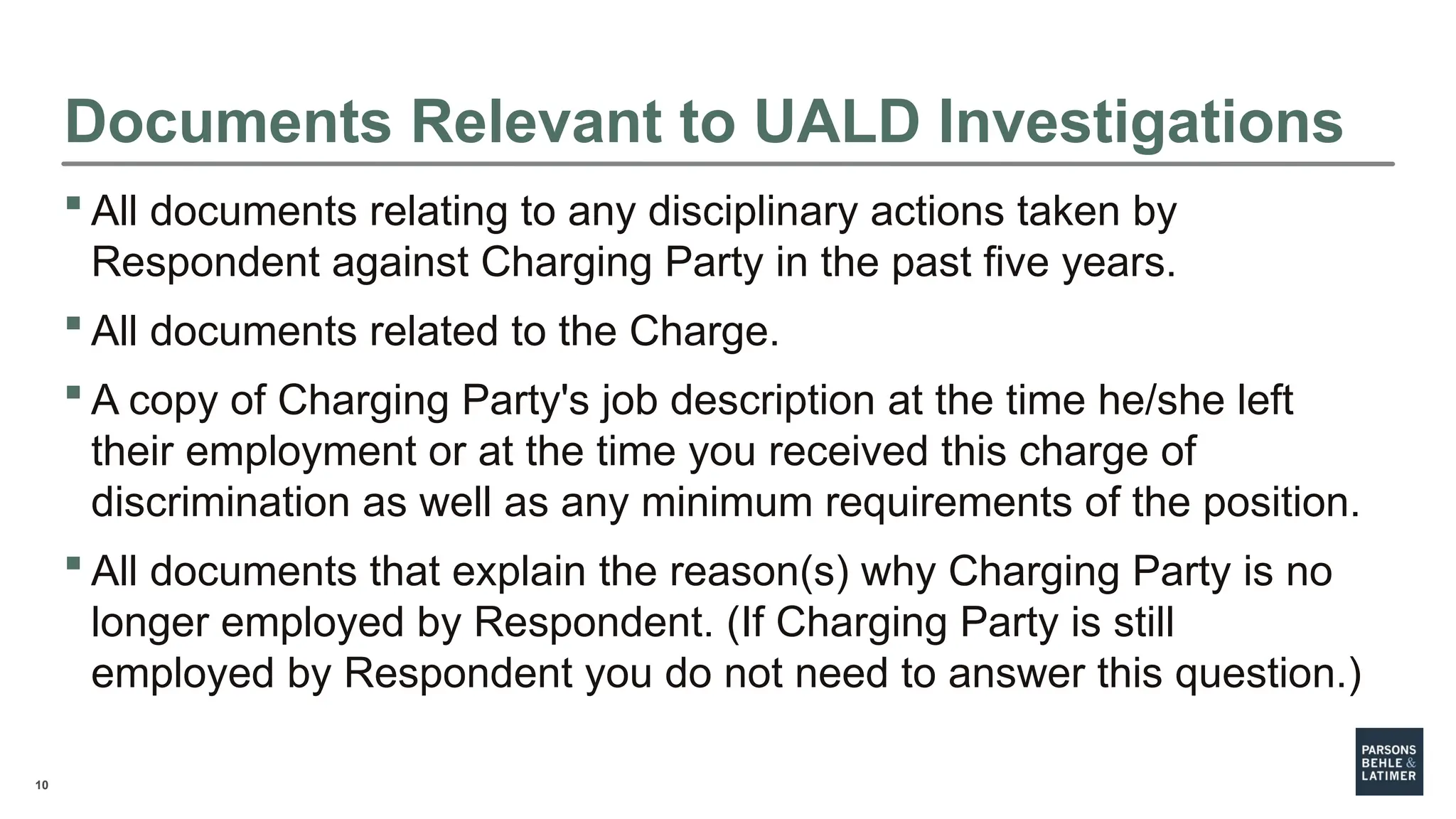
Documents Relevant to UALD Investigations
 All documents relating to any disciplinary actions taken by
Respondent against Charging Party in the past five years.
 All documents related to the Charge.
 A copy of Charging Party's job description at the time he/she left
their employment or at the time you received this charge of
discrimination as well as any minimum requirements of the position.
 All documents that explain the reason(s) why Charging Party is no
longer employed by Respondent. (If Charging Party is still
employed by Respondent you do not need to answer this question.)
Why is documentation important?
12
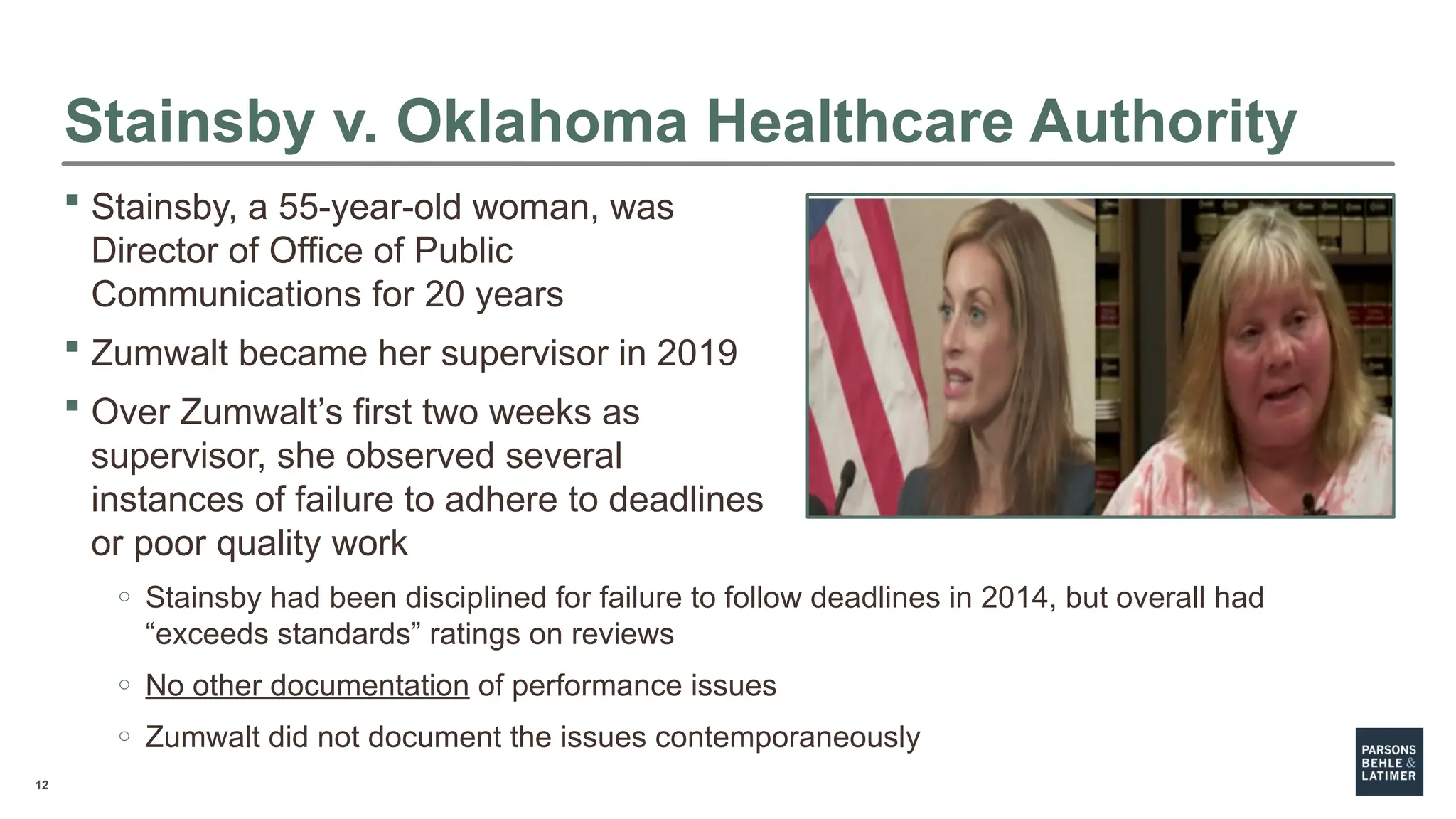
Stainsby v. Oklahoma Healthcare Authority
 Stainsby, a 55-year-old woman, was
Director of Office of Public
Communications for 20 years
 Zumwalt became her supervisor in 2019
 Over Zumwalt’s first two weeks as
supervisor, she observed several
instances of failure to adhere to deadlines
or poor quality work
o Stainsby had been disciplined for failure to follow deadlines in 2014, but overall had
“exceeds standards” ratings on reviews
o No other documentation of performance issues
o Zumwalt did not document the issues contemporaneously
13
Stainsby, continued
 Zumwalt terminated Stainsby and Stainsby sued, claiming age discrimination
 The district court allowed the case to go to the jury
o Oklahoma Healthcare Authority had shown legitimate business reasons for terminating
Stainsby
o But lack of contemporaneous documentation left whether reason was pretextual
disputed
o Jury would have to decide whose account to credit
 As public entity, Oklahoma Healthcare Authority decided to settle instead of
spending money on litigating the issue.
Stainsby v. Oklahoma ex rel. Oklahoma Health Care Auth., No. CIV-21-1073-D,
2023 WL 1825099, at *7 (W.D. Okla. Feb. 8, 2023)
14
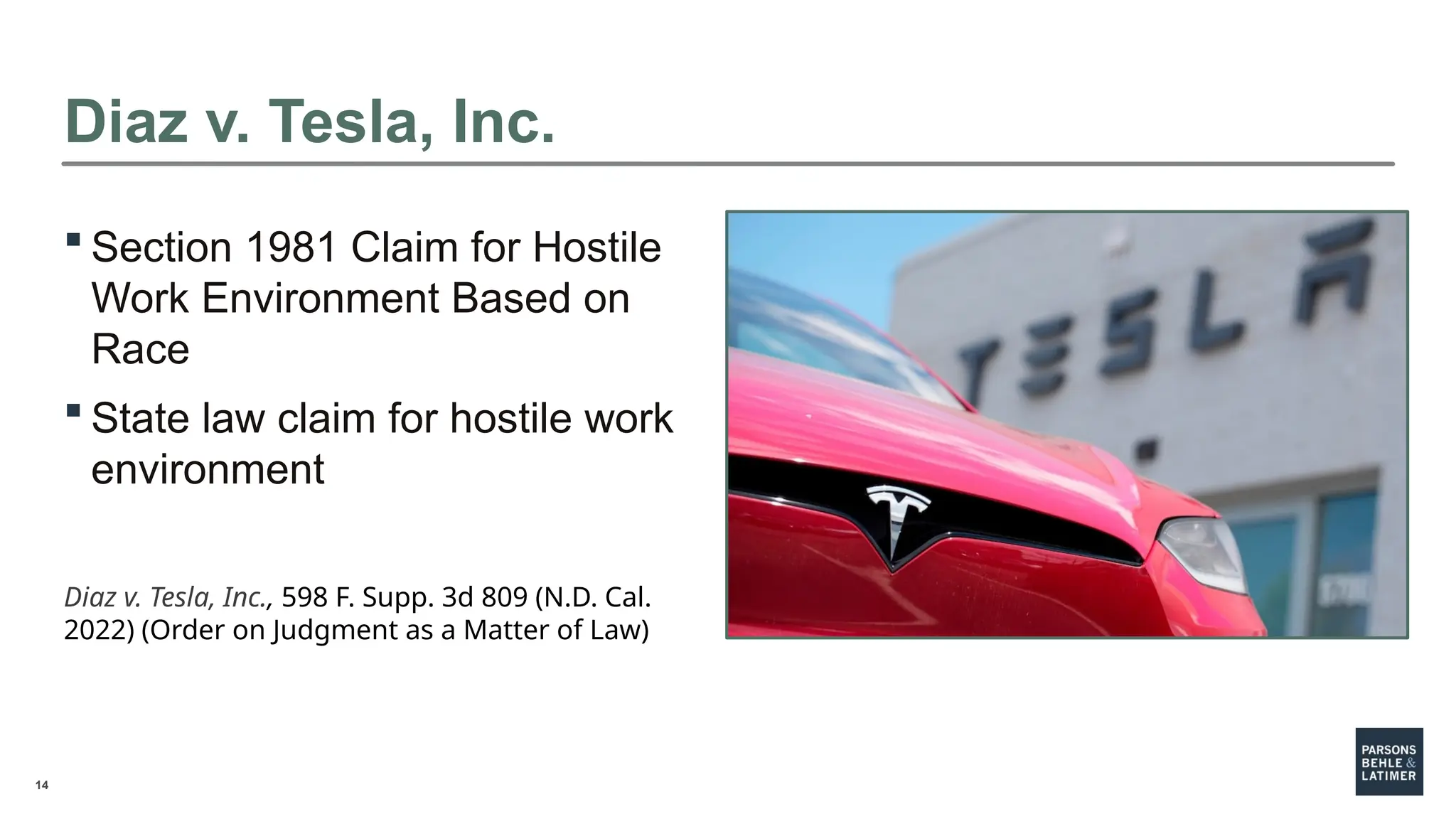
Diaz v. Tesla, Inc.
 Section 1981 Claim for Hostile
Work Environment Based on
Race
 State law claim for hostile work
environment
Diaz v. Tesla, Inc., 598 F. Supp. 3d 809 (N.D. Cal.
2022) (Order on Judgment as a Matter of Law)
15
Diaz’s Allegations
 Diaz was a forklift driver at a Tesla factory
 He alleged n-word “thrown around the factory” a lot
o 8-10 employees calling names, including supervisors
 Only a few specific reports of allegations documented
 Diaz reported verbal altercation with co-worker who used racist
slurs:
o No documentation of investigation
o “Muddled” testimony regarding the incident
o No written discipline in evidence
16
Diaz Incident with Supervisor (Martinez)
o Diaz also alleged supervisor called him n-word and physically threatened
him.
o Diaz reported altercation by e-mail, but did not specify the n-word was used;
although he claimed he had verbally told company that supervisor called
him n-word regularly
o Martinez also reported altercation, claiming Diaz was not “professional”
o Company determined no “formal investigation” needed
• Apparently did not take notes of discussions with Diaz and Martinez
• Did not review video footage of incident
• Did not interview witnesses
• Issued both Diaz and Martinez verbal warnings
17
Additional Incident Involving Martinez
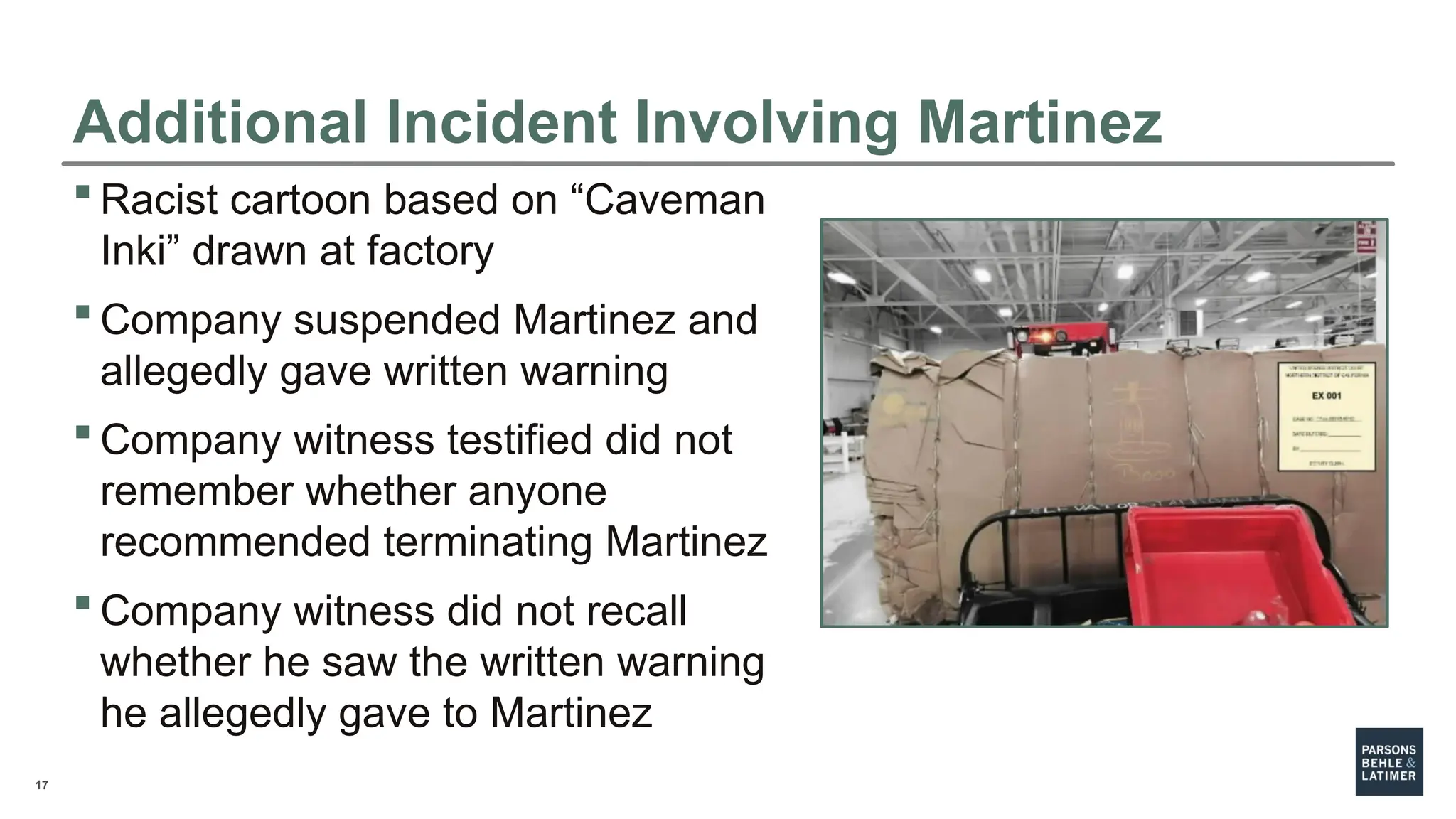
 Racist cartoon based on “Caveman
Inki” drawn at factory
 Company suspended Martinez and
allegedly gave written warning
 Company witness testified did not
remember whether anyone
recommended terminating Martinez
 Company witness did not recall
whether he saw the written warning
he allegedly gave to Martinez
18
Verdict and Takeaways
 Jury awarded:
o $6.9 million compensatory damages; $130 million punitive damages (though
later reduced)
 Incidents were reported to different individuals; more thorough
documentation could have helped illustrate a pattern of behavior
and resulted in escalating action, if necessary
 If Diaz was inflating the number or severity of incidents (as Tesla
argued), more complete documentation could have been more
compelling to make that case to the jury.
o Spotty documentation and witnesses with memory gaps call into question
Tesla’s credibility to claim nothing else occurred.
19
Diaz Takeaways, continued
 Ultimately, Tesla was unable to convince judge or jury it had taken
reasonable remedial action in response to complaints of
harassment.
 Better documentation could have supported Tesla’s defense by
acting as memory-aid for some of the gaps in testimony and better
illustrating Tesla’s decision-making process and action.
Documenting throughout
employment
21
Best Practices
 Outline the lifecycle of an employee and identify all communication
possibilities:
o Hiring
o Training
o Day-to-day Feedback/Daily Meetings
o Biannual Reviews
o Write Ups/Performance Improvement Plans
o Termination of employment relationship
22
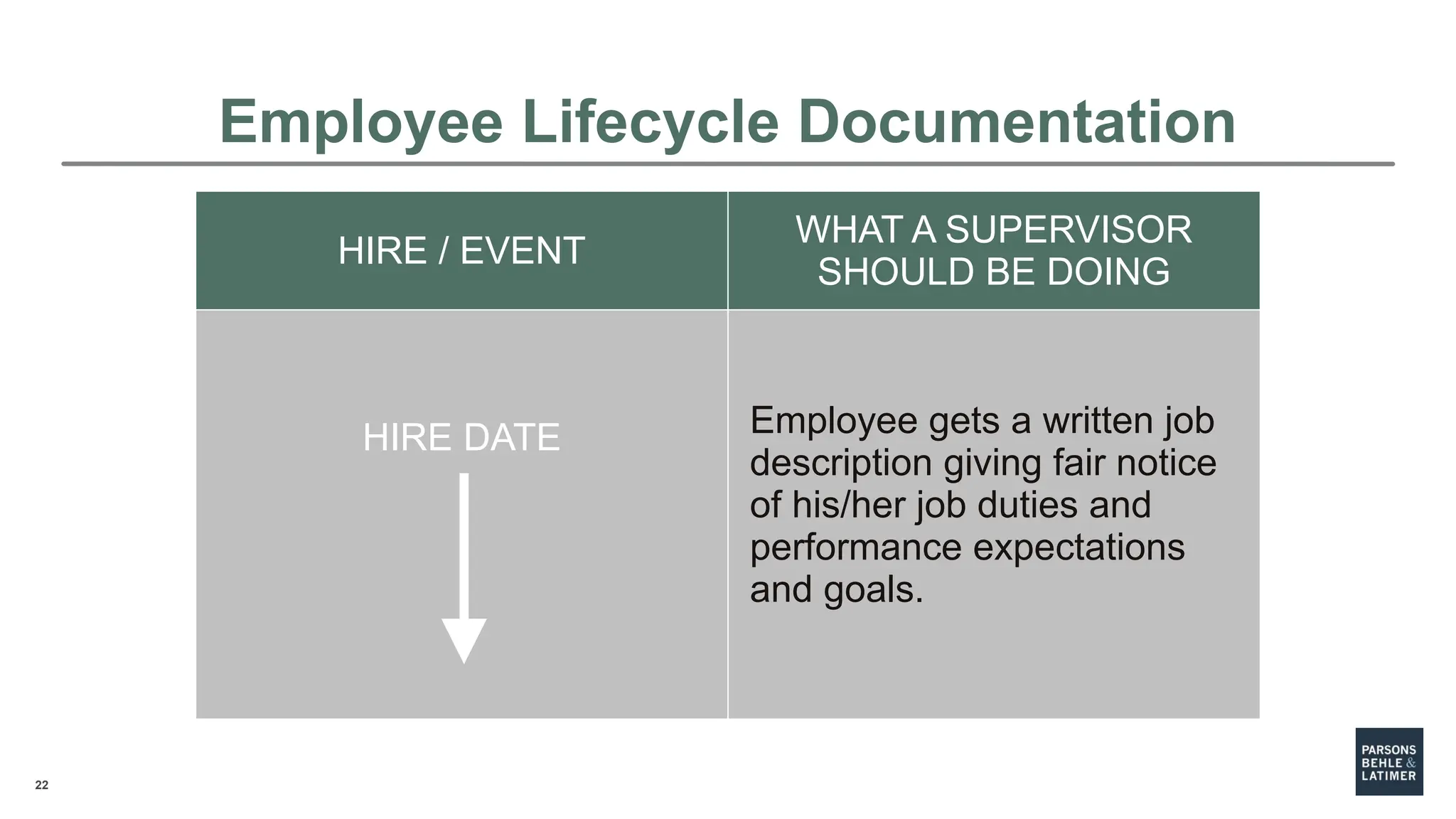
HIRE / EVENT
WHAT A SUPERVISOR
SHOULD BE DOING
HIRE DATE Employee gets a written job
description giving fair notice
of his/her job duties and
performance expectations
and goals.
Employee Lifecycle Documentation
23
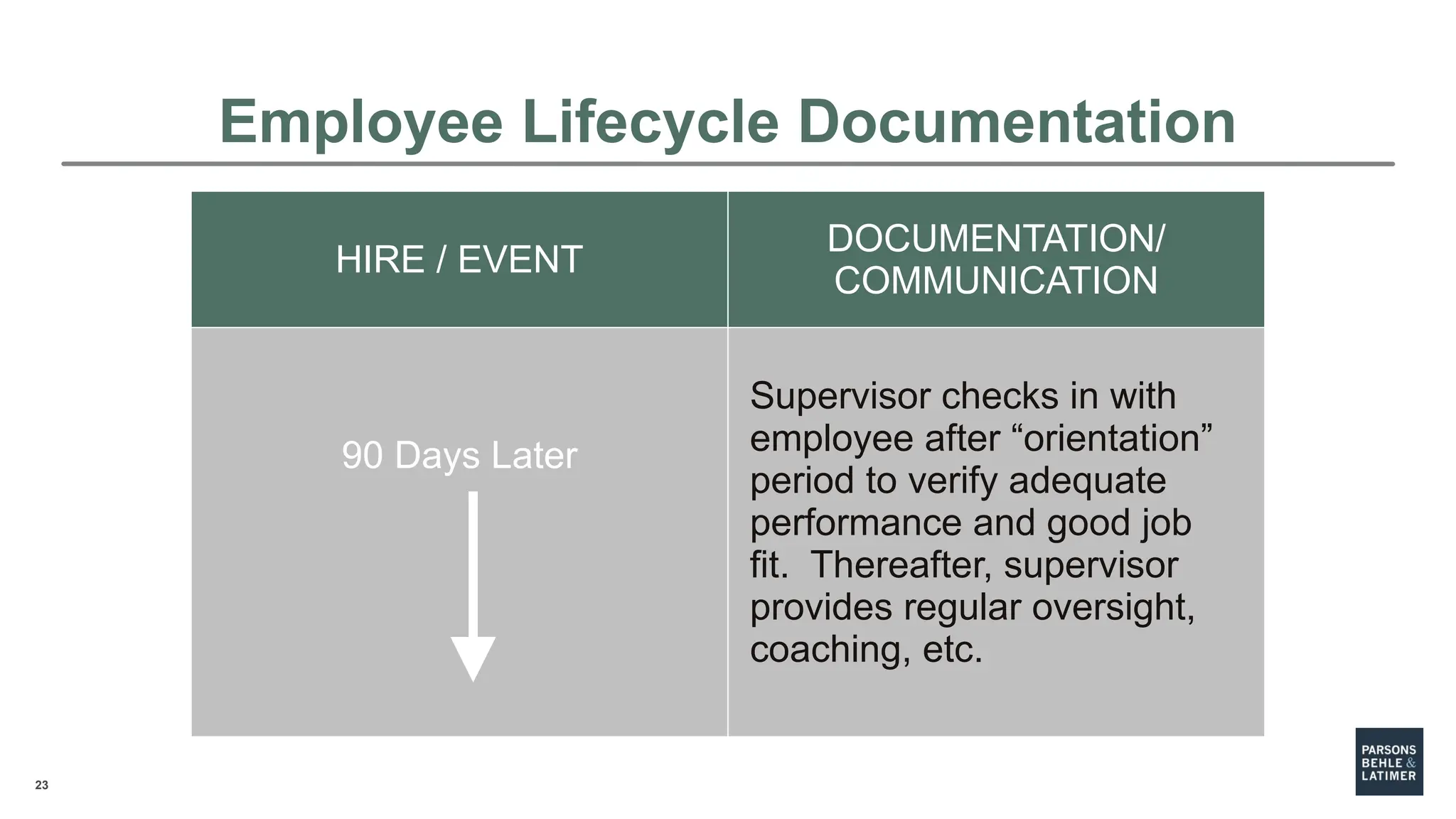
HIRE / EVENT
DOCUMENTATION/
COMMUNICATION
90 Days Later
Supervisor checks in with
employee after “orientation”
period to verify adequate
performance and good job
fit. Thereafter, supervisor
provides regular oversight,
coaching, etc.
Employee Lifecycle Documentation
24
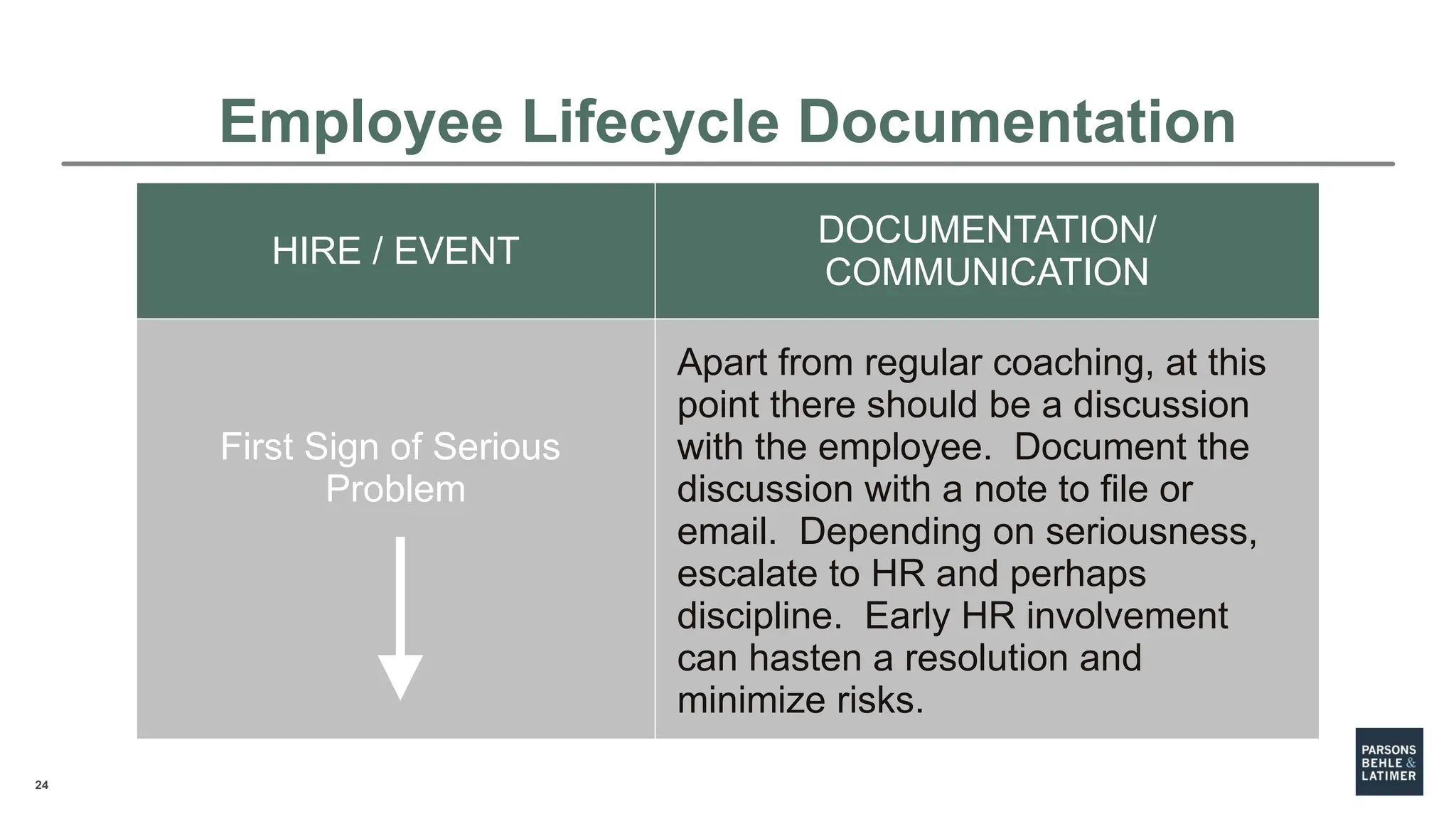
HIRE / EVENT
DOCUMENTATION/
COMMUNICATION
First Sign of Serious
Problem
Apart from regular coaching, at this
point there should be a discussion
with the employee. Document the
discussion with a note to file or
email. Depending on seriousness,
escalate to HR and perhaps
discipline. Early HR involvement
can hasten a resolution and
minimize risks.
Employee Lifecycle Documentation
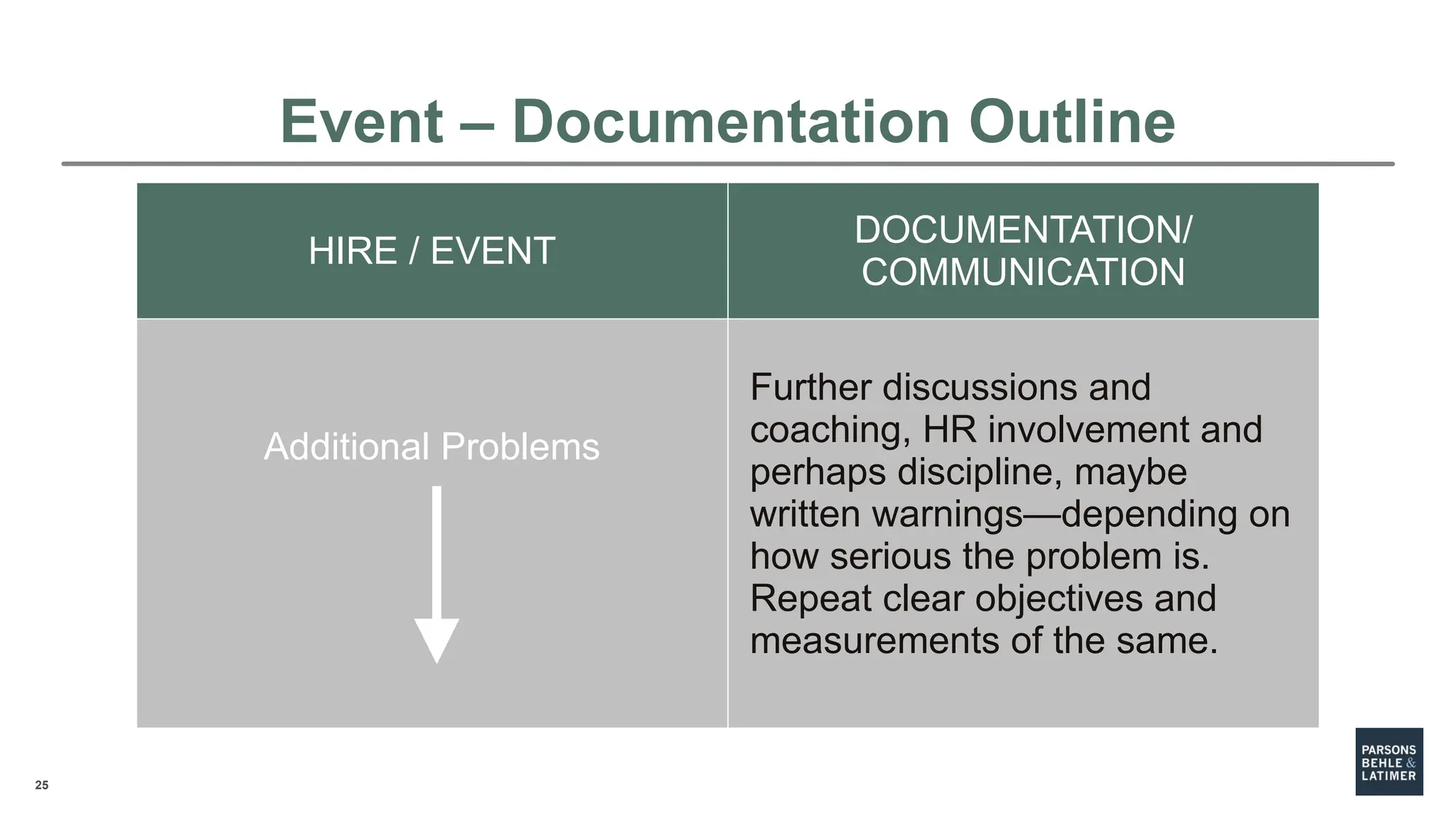
25
HIRE / EVENT
DOCUMENTATION/
COMMUNICATION
Additional Problems
Further discussions and
coaching, HR involvement and
perhaps discipline, maybe
written warnings—depending on
how serious the problem is.
Repeat clear objectives and
measurements of the same.
Event – Documentation Outline
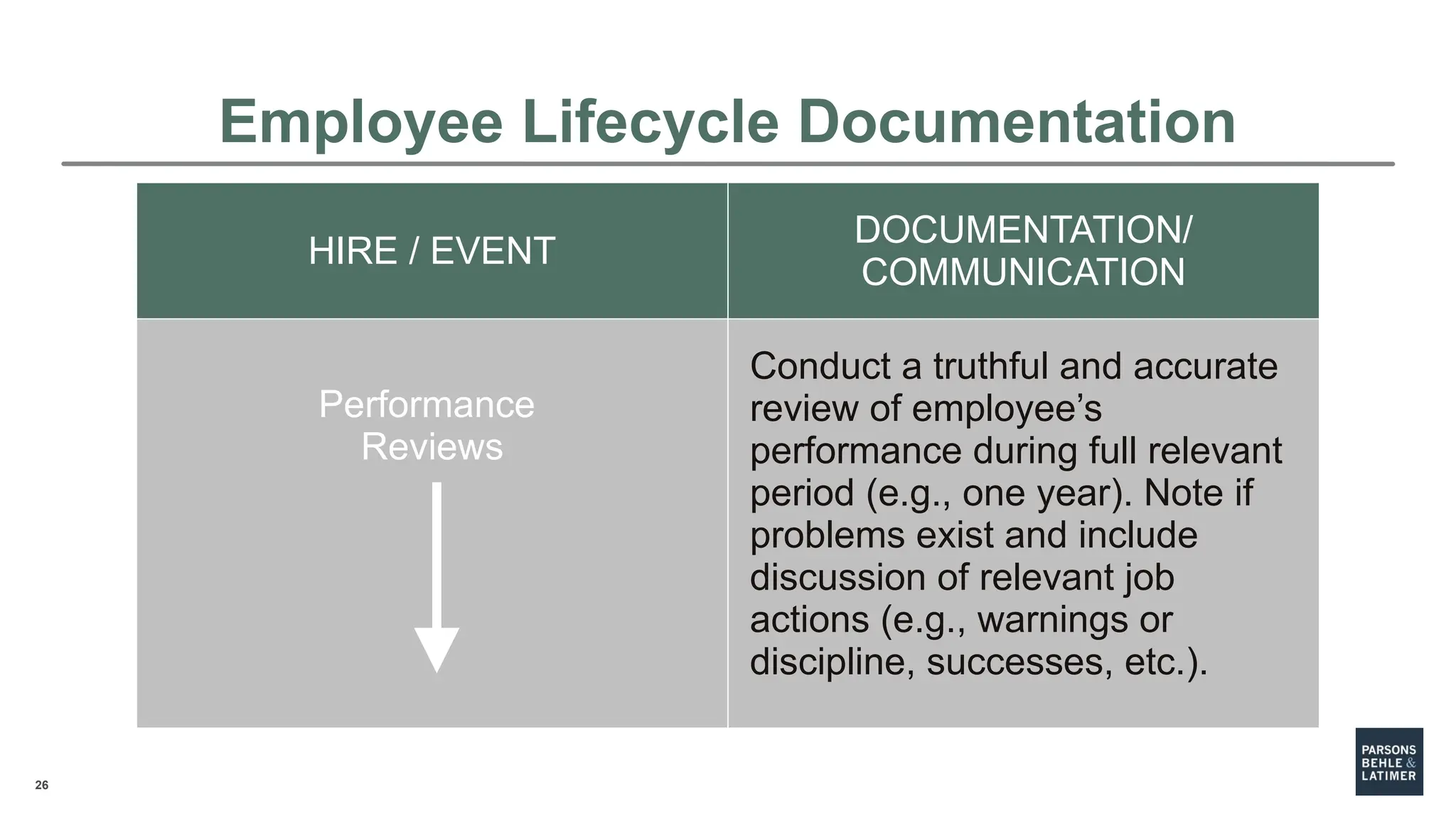
26
HIRE / EVENT
DOCUMENTATION/
COMMUNICATION
Performance
Reviews
Conduct a truthful and accurate
review of employee’s
performance during full relevant
period (e.g., one year). Note if
problems exist and include
discussion of relevant job
actions (e.g., warnings or
discipline, successes, etc.).
Employee Lifecycle Documentation
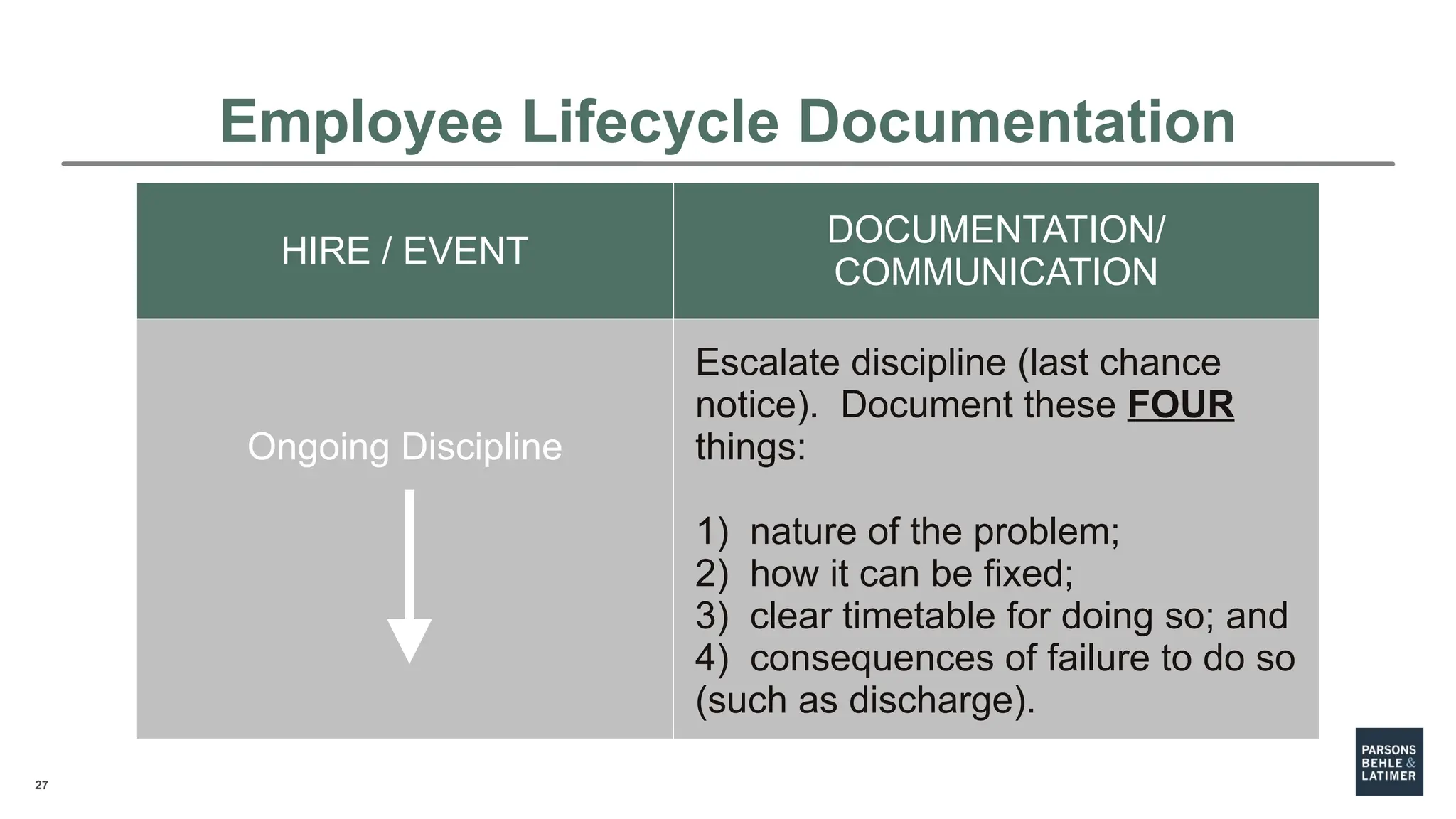
27
HIRE / EVENT
DOCUMENTATION/
COMMUNICATION
Ongoing Discipline
Escalate discipline (last chance
notice). Document these FOUR
things:
1) nature of the problem;
2) how it can be fixed;
3) clear timetable for doing so; and
4) consequences of failure to do so
(such as discharge).
Employee Lifecycle Documentation
28
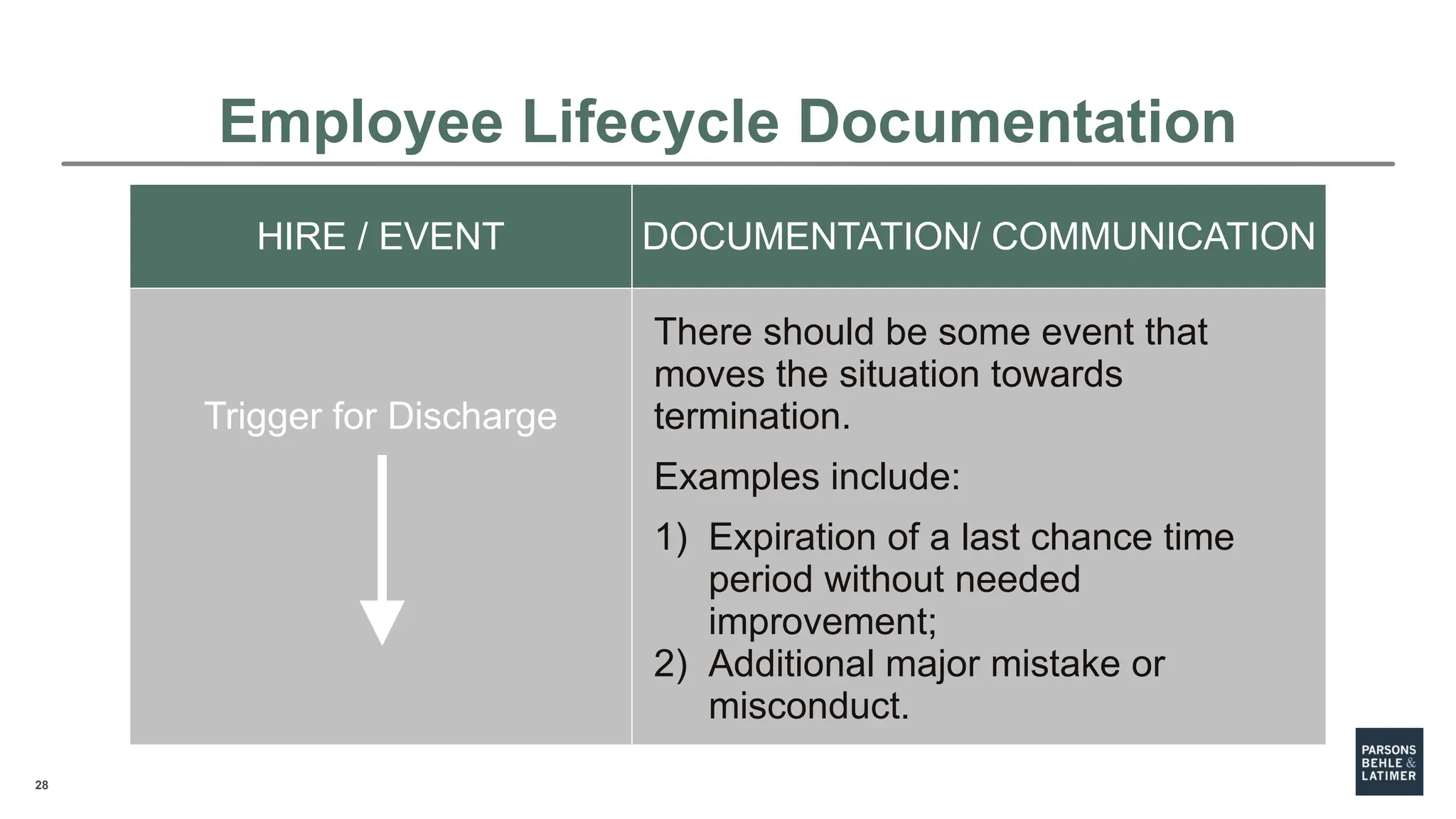
HIRE / EVENT DOCUMENTATION/ COMMUNICATION
Trigger for Discharge
There should be some event that
moves the situation towards
termination.
Examples include:
1) Expiration of a last chance time
period without needed
improvement;
2) Additional major mistake or
misconduct.
Employee Lifecycle Documentation
29
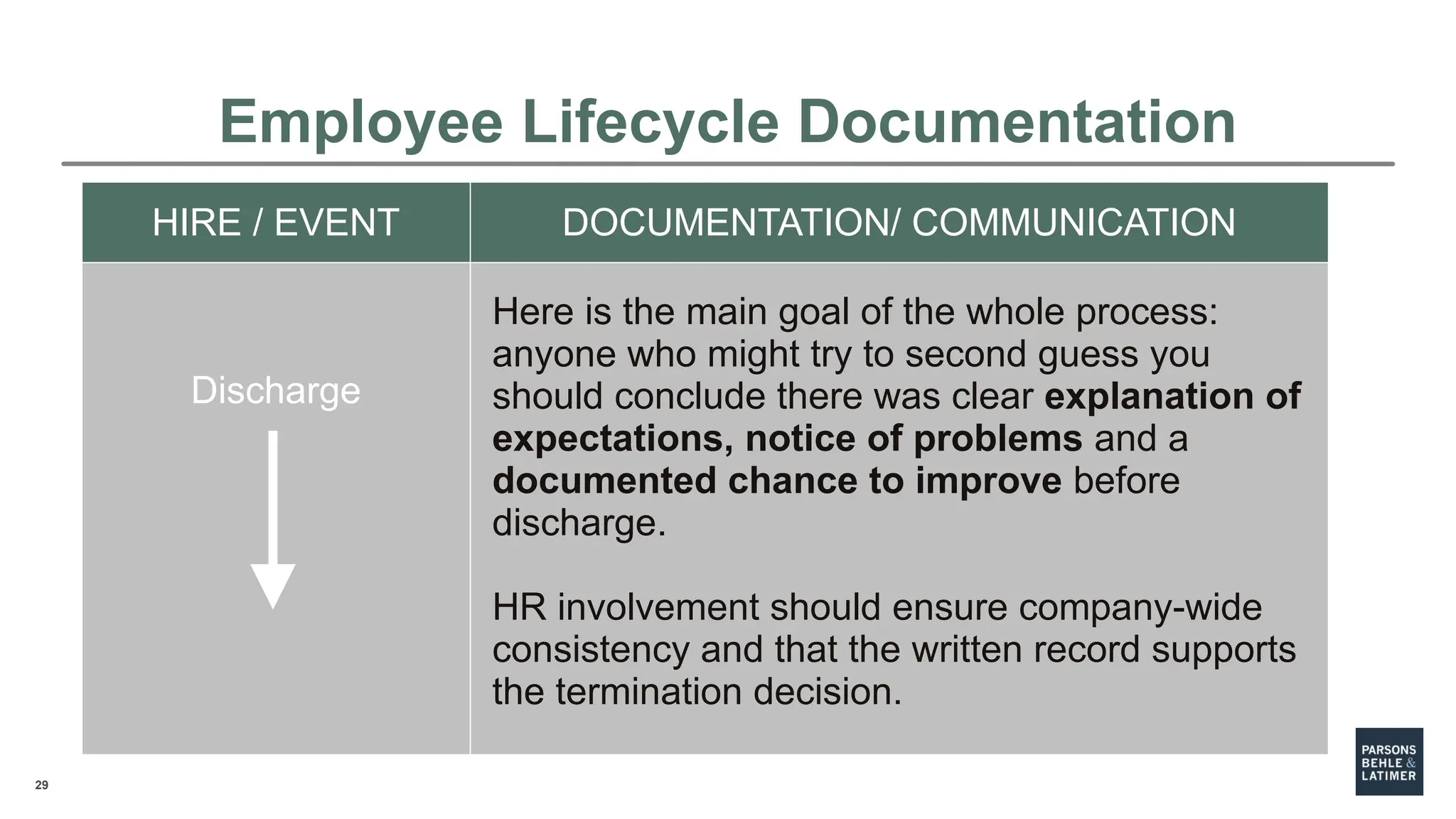
HIRE / EVENT DOCUMENTATION/ COMMUNICATION
Discharge
Here is the main goal of the whole process:
anyone who might try to second guess you
should conclude there was clear explanation of
expectations, notice of problems and a
documented chance to improve before
discharge.
HR involvement should ensure company-wide
consistency and that the written record supports
the termination decision.
Employee Lifecycle Documentation
30
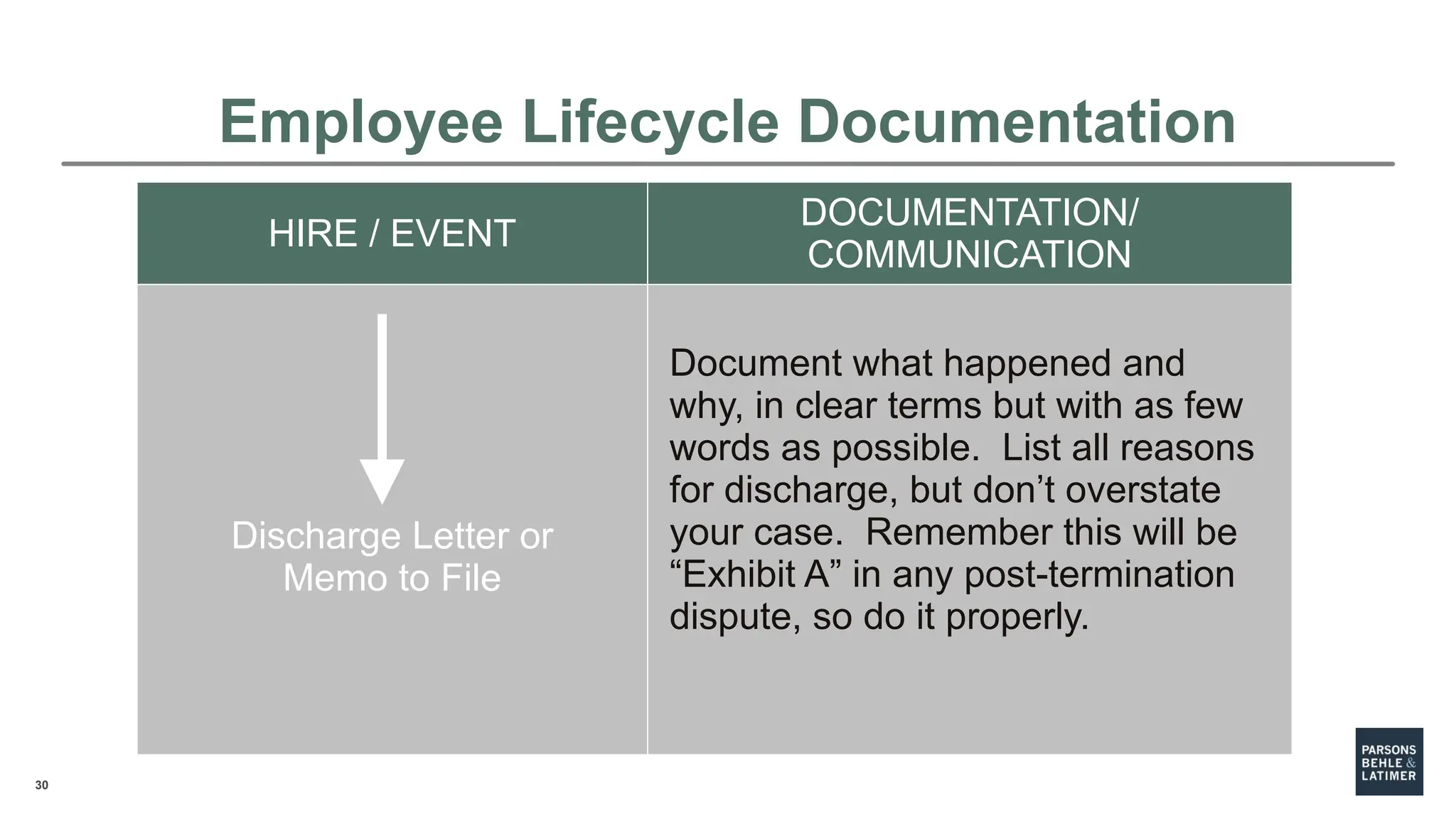
HIRE / EVENT
DOCUMENTATION/
COMMUNICATION
Discharge Letter or
Memo to File
Document what happened and
why, in clear terms but with as few
words as possible. List all reasons
for discharge, but don’t overstate
your case. Remember this will be
“Exhibit A” in any post-termination
dispute, so do it properly.
Employee Lifecycle Documentation
Documenting Misconduct
32
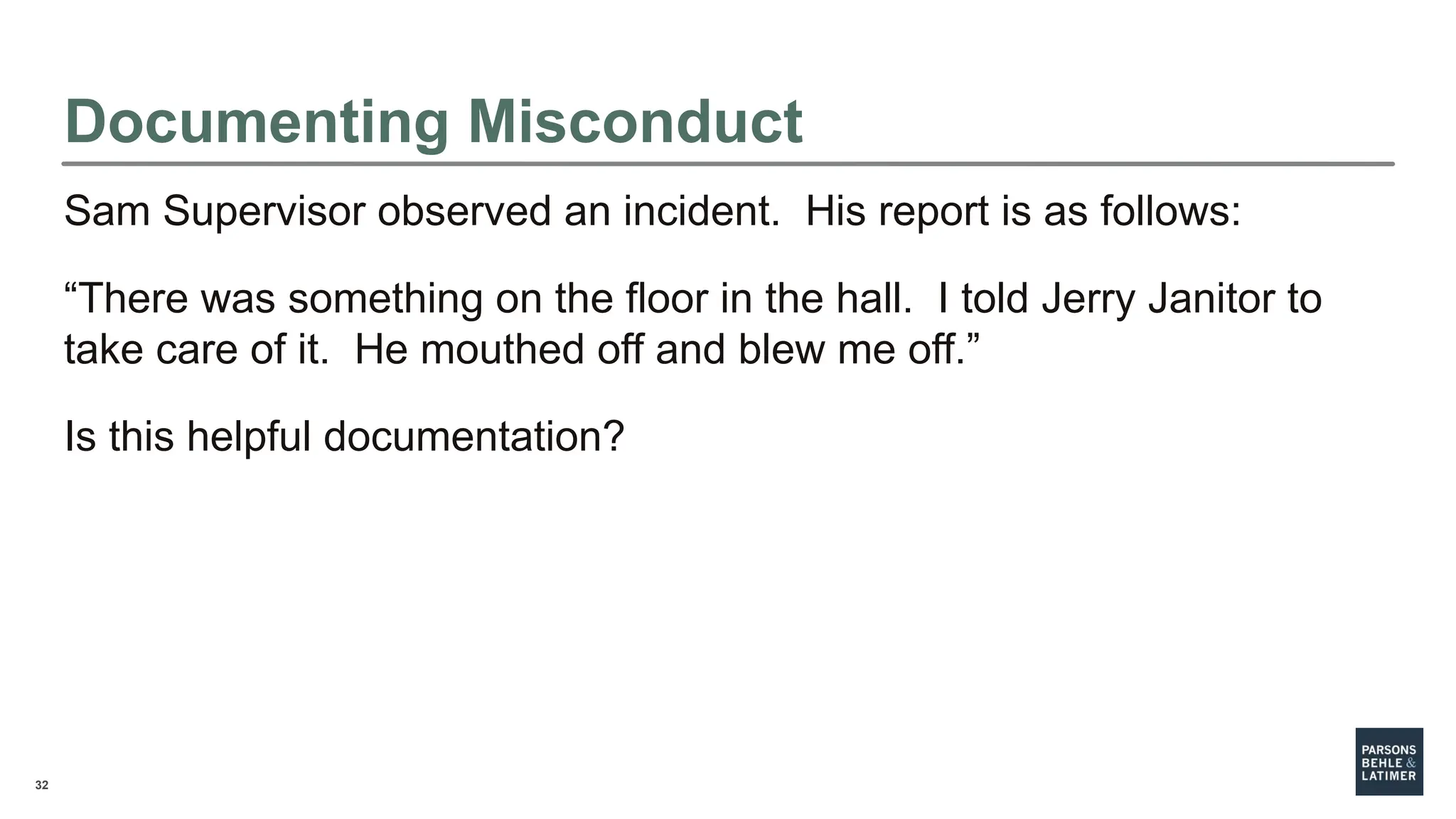
Sam Supervisor observed an incident. His report is as follows:
“There was something on the floor in the hall. I told Jerry Janitor to
take care of it. He mouthed off and blew me off.”
Is this helpful documentation?
Documenting Misconduct
33
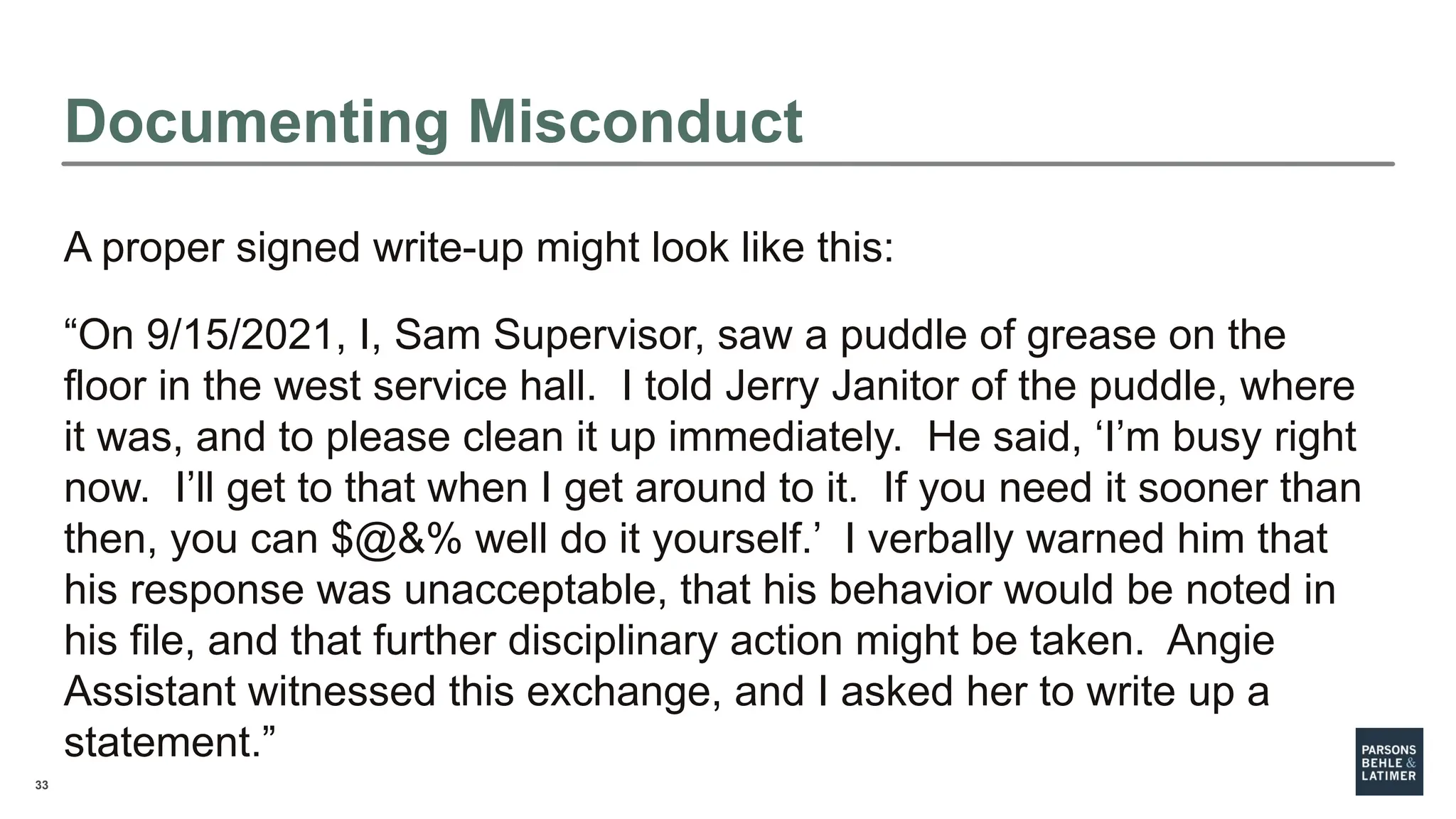
A proper signed write-up might look like this:
“On 9/15/2021, I, Sam Supervisor, saw a puddle of grease on the
floor in the west service hall. I told Jerry Janitor of the puddle, where
it was, and to please clean it up immediately. He said, ‘I’m busy right
now. I’ll get to that when I get around to it. If you need it sooner than
then, you can $@&% well do it yourself.’ I verbally warned him that
his response was unacceptable, that his behavior would be noted in
his file, and that further disciplinary action might be taken. Angie
Assistant witnessed this exchange, and I asked her to write up a
statement.”
Documenting Misconduct
34
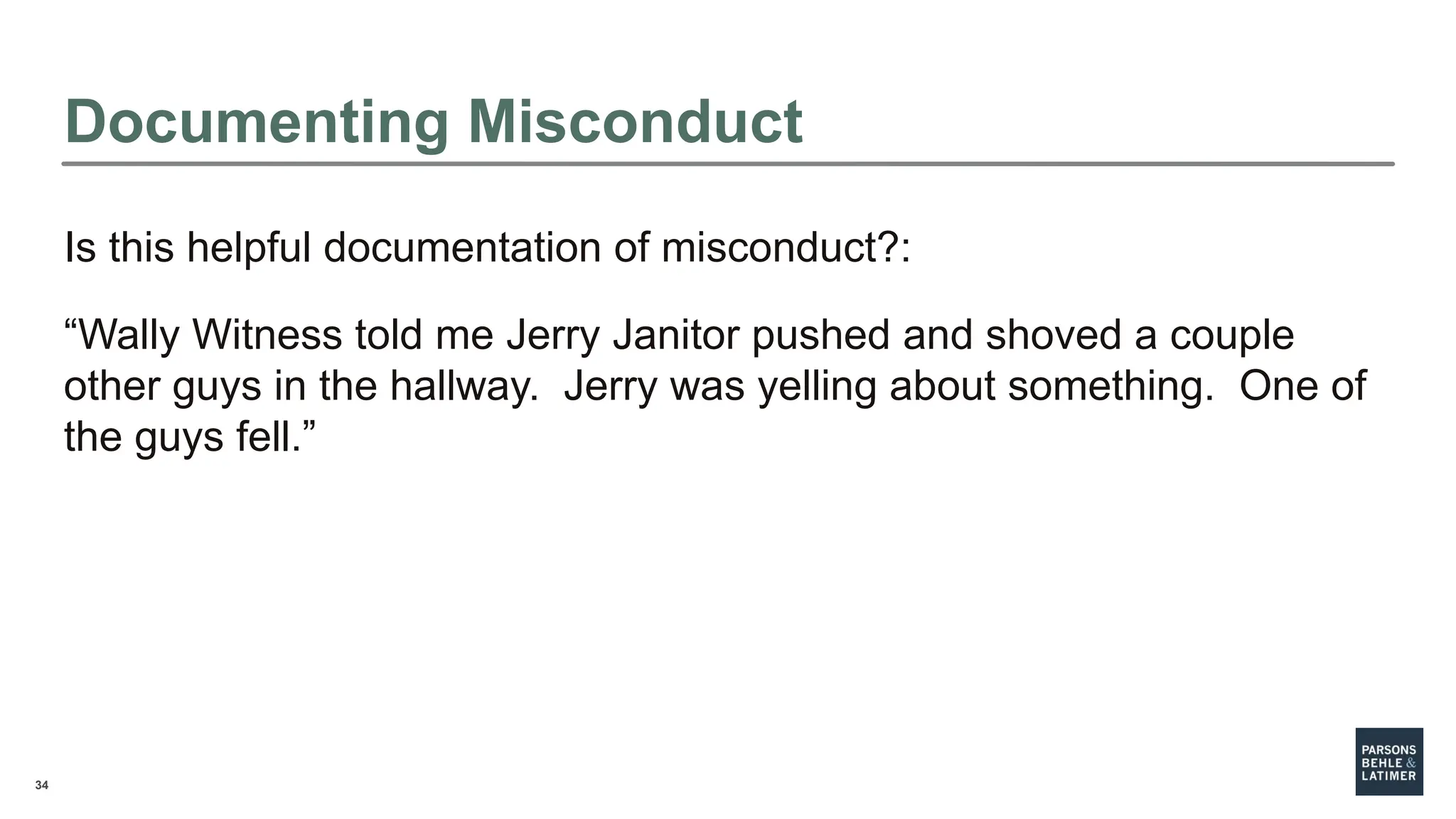
Is this helpful documentation of misconduct?:
“Wally Witness told me Jerry Janitor pushed and shoved a couple
other guys in the hallway. Jerry was yelling about something. One of
the guys fell.”
Documenting Misconduct
35
Documenting Misconduct
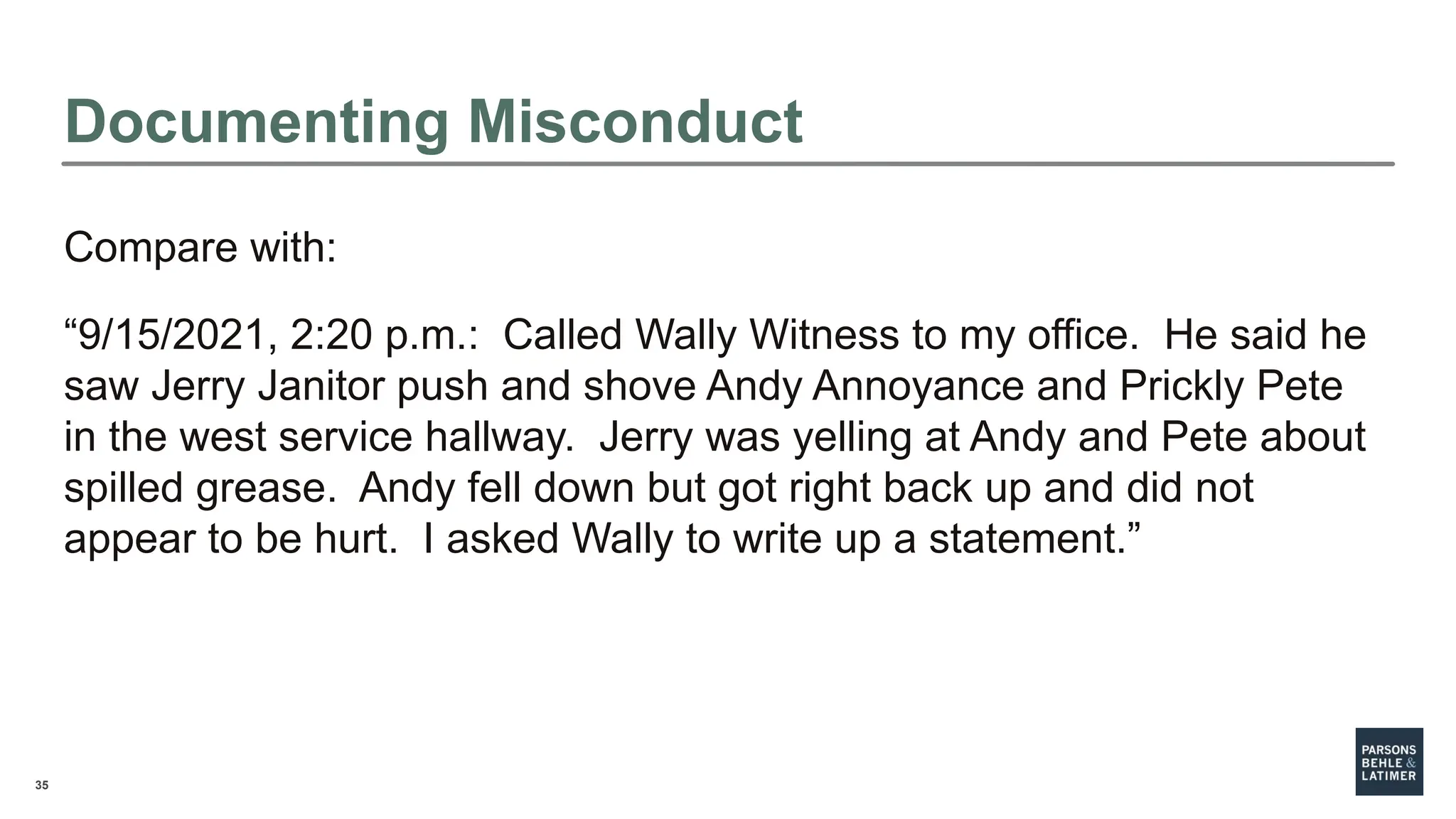
Compare with:
“9/15/2021, 2:20 p.m.: Called Wally Witness to my office. He said he
saw Jerry Janitor push and shove Andy Annoyance and Prickly Pete
in the west service hallway. Jerry was yelling at Andy and Pete about
spilled grease. Andy fell down but got right back up and did not
appear to be hurt. I asked Wally to write up a statement.”
36
 Vague communication of the expectations and consequences going
forward
 Inconsistent discipline for similar infractions across the company
 Inappropriately light discipline or giving too many chances to
improve
 Bringing unrelated or irrelevant issues into the documentation
Common Mistakes in Disciplining
37
 How does the misconduct documentation help the employer avoid
liability?
o Encourages adequate investigation
o Permits review
o Promotes uniformity
o Provides contemporaneous evidence of facts for use in lawsuits
Documenting Misconduct
38
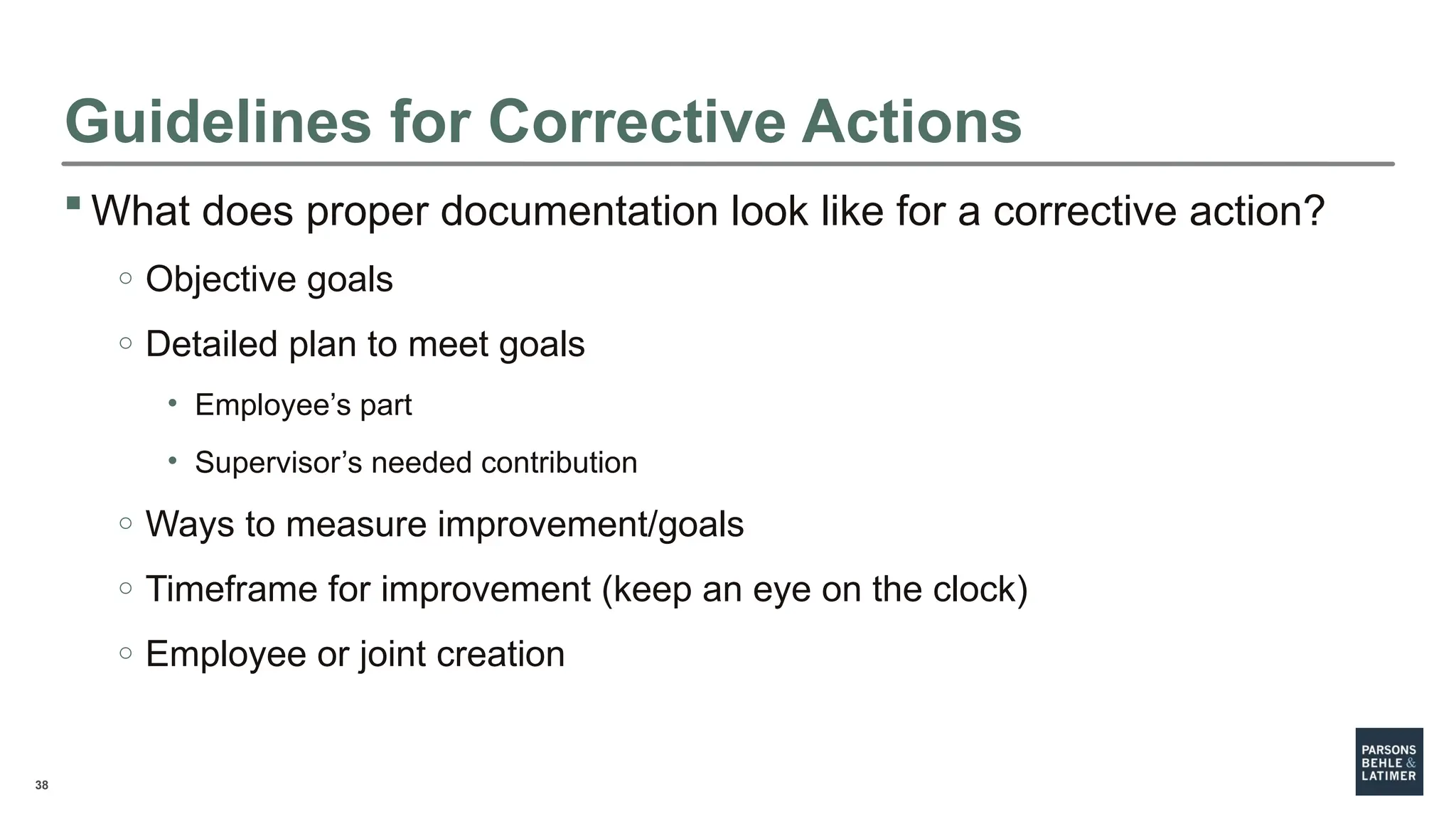
 What does proper documentation look like for a corrective action?
o Objective goals
o Detailed plan to meet goals
• Employee’s part
• Supervisor’s needed contribution
o Ways to measure improvement/goals
o Timeframe for improvement (keep an eye on the clock)
o Employee or joint creation
Guidelines for Corrective Actions
39
 What does proper documentation for a corrective action look like
(cont.)?
o Contains employee acknowledgements:
• Of the performance problem
• Of the employee’s agreement to the plan
• Of the employee’s knowledge that failure to perform may result in additional disciplinary
action
o If acknowledgment is refused – document it
Guidelines for Corrective Actions
40
 What does proper documentation look like for a corrective action
(cont.)?
o Contains disclaimer:
• Plan is not a contract
• Employer does not have to facilitate improvement
Guidelines for Corrective Actions
Documenting Performance
42
AVOIDING LEGAL TROUBLE
Performance Evaluations, Reviews, and Appraisals
o Should address: C.A.P.
o CONDUCT
o ATTENDANCE
o PERFORMANCE
 Be Courageously Honest
 But Not About Non C.A.P. Issues!
43
BAD Excerpts from Federal Employee Evals
 “Since my last report, this employee has reached rock-bottom and has started to dig.”
 “I would not allow this employee to breed.”
 “Works well when under constant supervision and cornered like a rat in a trap.”
 “When she opens her mouth, it seems that it is only to change feet.”
 “This young lady has delusions of adequacy.”
 “He sets low personal standards and then consistently fails to achieve them.”
 “This employee should go far, and the sooner he starts, the better.”
 “He would argue with a signpost.”
 “He brings a lot of joy whenever he leaves the room.”
 “If you give him a penny for his thoughts, you’d get change.”
44
Be Smart About Documentation
Terms used in a female employee’s evaluation:
o “macho”
o “overcompensated for being a woman”
o “needs a course in charm school”
o “matured from a masculine manager to an appealing lady
partner candidate”
o “should walk, talk and dress more femininely, wear makeup, get
her hair styled and wear jewelry”
Price Waterhouse v. Hopkins, 490 U.S. 228 (1989) (gender stereotyping)
45
Characteristics of Bad Evaluation Ratings
Central Tendency – supervisor avoids rating employees either
very high or very low. Reviews are clustered in the middle of the
rating scale for all employees.
Leniency – supervisor gives high ratings to all employees.
Strictness – supervisor gives low ratings to all employees.
Similar-to-Me – supervisor gives high ratings only to employees
who share similar thinking, personality, background.
46
Characteristics of Good Evaluation Ratings
 Addresses C.A.P. (Conduct, Attendance, Performance)
 Provides same or similar review/ratings to same or similar Conduct,
Attendance, Performance
 Connected to Job Duties and Description
 Looks at entire performance period; notes trends
 Supports employment decisions
o Ask: Should this person be promoted? Should this person be on a PIP?
 Avoids stereotypes and personal attacks
Documenting Termination
48
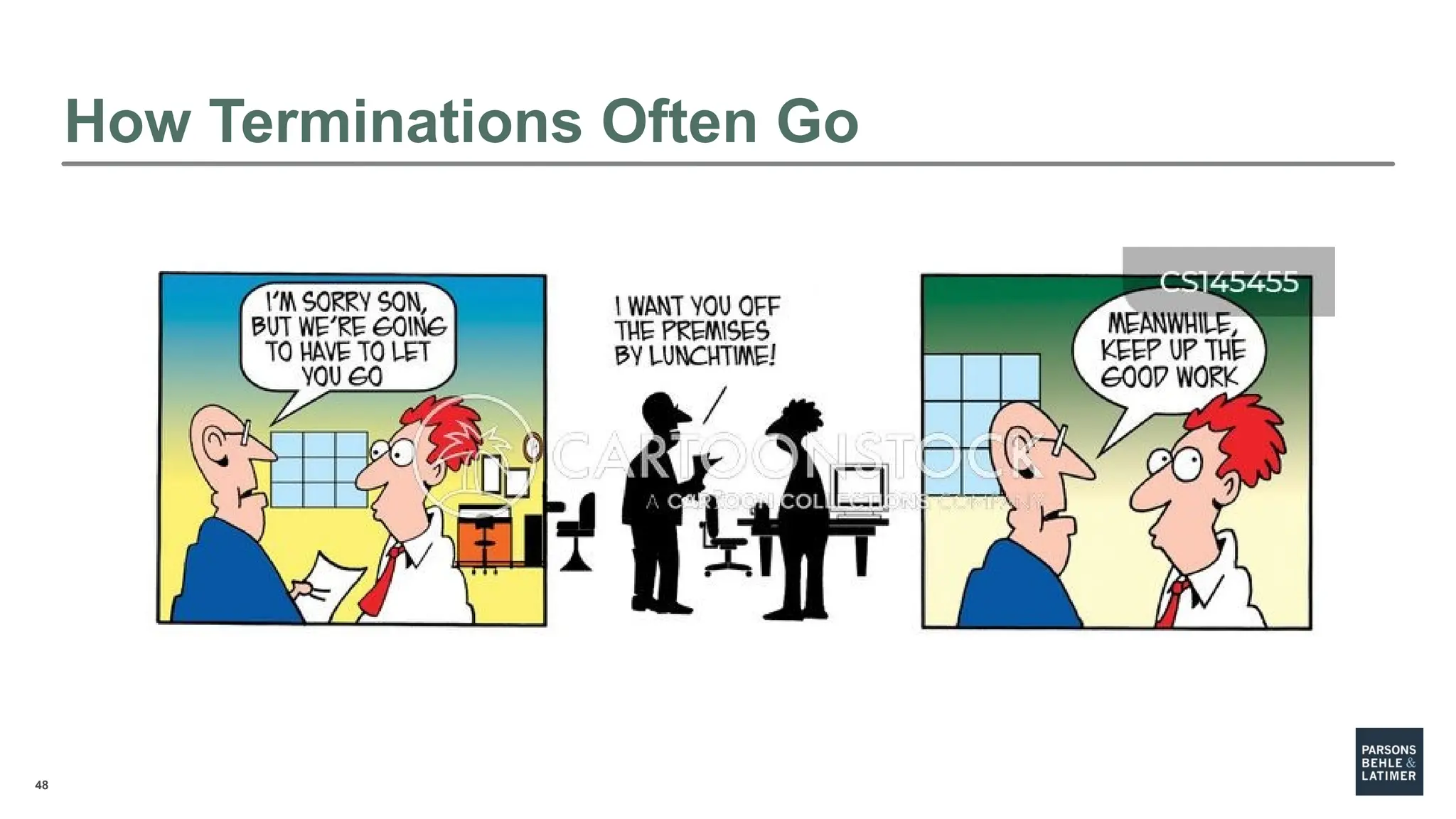
How Terminations Often Go
49
 NO DOCUMENTATION
 Not giving a complete, written reason for the termination to employee
 Not giving employee a copy of the Termination Appeal Process
 Terminating without having exhausted the ADA reasonable accommodation process
 Termination for retaliatory reasons (known to the decision maker, but not to HR)
 Overlooking procedural requirements
 Bringing unrelated or irrelevant issues into the documentation
 Sugar-coating or leaving out some reasons for termination – if it is not noted in a
contemporaneous document, it did not happen
 Getting HR or counsel involved too late – after a bad decision has been made or bad
documentation has been created
Common Mistakes in Termination
Thank You
You can scan the QR code or visit
parsonsbehle.com/emp-seminar
to download a PDF handbook of
today’s seminar.
51
Thank You
 Liz M. Mellem
amellem@parsonsbehle.com
406.317.7240
 Leah Trahan
ltrahan@parsonsbehle.com
406.317.7244
Documents are an Employer's Best Friend: How to Properly Document Employee Interactions with HR

  • 1.
    parsonsbehle.com May 14, 2024| The Grand America Hotel – Salt Lake City Documents are an Employer’s Best Friend: How to Properly Document Employee Interactions with HR Liz M. Mellem and Leah Trahan
  • 2.
    2 This presentation isbased on available information as of May 14, 2024, but everyone must understand that the information provided is not a substitute for legal advice. This presentation is not intended and will not serve as a substitute for legal counsel on these issues. Legal Disclaimer
  • 3.
  • 4.
    4 Communication and Documentation Two pillars of good employee performance management and risk management  Communication = oral and written o Conveys information regarding job duties, expectations, performance feedback, corrective actions, etc. o Frequent and early communication and intervention will help avoid employment claims and protect an employer when claims are brought  Documentation can be a form of communication AND evidence of communication
  • 5.
    5 “Golden Rule” ofDocumentation IF IT IS NOT IN WRITING, IT DIDN’T HAPPEN!
  • 6.
    6 How will documentationhelp limit risk?  In a case that goes to a jury trial, we never want to rely on testimony alone because the jury gets to pick who to believe o Spoiler Alert: They tend to believe the employee more often than the employer!  Documents help to establish intent and show: o Decisions were performance or business based o Decisions were not motivated by discriminatory, retaliatory, or other unlawful intent
  • 7.
    7  Show thatyou did everything you were supposed to do in furtherance of the employee’s rights, such as: o ADA accommodation process o Investigated and corrected promptly any claims of discrimination or retaliation Other reasons for documenting?
  • 8.
    8 Who Else CaresAbout Documentation?  Documentation also really matters to the agencies that enforce anti- discrimination and anti-retaliation employment laws: o State Agencies (e.g. UALD) o EEOC o DOL  Service of a Charge or Complaint is always accompanied by a Request for Information
  • 9.
    9 Excerpt from UALDRequest for Information
  • 10.
    10 Documents Relevant toUALD Investigations  All documents relating to any disciplinary actions taken by Respondent against Charging Party in the past five years.  All documents related to the Charge.  A copy of Charging Party's job description at the time he/she left their employment or at the time you received this charge of discrimination as well as any minimum requirements of the position.  All documents that explain the reason(s) why Charging Party is no longer employed by Respondent. (If Charging Party is still employed by Respondent you do not need to answer this question.)
  • 11.
  • 12.
    12 Stainsby v. OklahomaHealthcare Authority  Stainsby, a 55-year-old woman, was Director of Office of Public Communications for 20 years  Zumwalt became her supervisor in 2019  Over Zumwalt’s first two weeks as supervisor, she observed several instances of failure to adhere to deadlines or poor quality work o Stainsby had been disciplined for failure to follow deadlines in 2014, but overall had “exceeds standards” ratings on reviews o No other documentation of performance issues o Zumwalt did not document the issues contemporaneously
  • 13.
    13 Stainsby, continued  Zumwaltterminated Stainsby and Stainsby sued, claiming age discrimination  The district court allowed the case to go to the jury o Oklahoma Healthcare Authority had shown legitimate business reasons for terminating Stainsby o But lack of contemporaneous documentation left whether reason was pretextual disputed o Jury would have to decide whose account to credit  As public entity, Oklahoma Healthcare Authority decided to settle instead of spending money on litigating the issue. Stainsby v. Oklahoma ex rel. Oklahoma Health Care Auth., No. CIV-21-1073-D, 2023 WL 1825099, at *7 (W.D. Okla. Feb. 8, 2023)
  • 14.
    14 Diaz v. Tesla,Inc.  Section 1981 Claim for Hostile Work Environment Based on Race  State law claim for hostile work environment Diaz v. Tesla, Inc., 598 F. Supp. 3d 809 (N.D. Cal. 2022) (Order on Judgment as a Matter of Law)
  • 15.
    15 Diaz’s Allegations  Diazwas a forklift driver at a Tesla factory  He alleged n-word “thrown around the factory” a lot o 8-10 employees calling names, including supervisors  Only a few specific reports of allegations documented  Diaz reported verbal altercation with co-worker who used racist slurs: o No documentation of investigation o “Muddled” testimony regarding the incident o No written discipline in evidence
  • 16.
    16 Diaz Incident withSupervisor (Martinez) o Diaz also alleged supervisor called him n-word and physically threatened him. o Diaz reported altercation by e-mail, but did not specify the n-word was used; although he claimed he had verbally told company that supervisor called him n-word regularly o Martinez also reported altercation, claiming Diaz was not “professional” o Company determined no “formal investigation” needed • Apparently did not take notes of discussions with Diaz and Martinez • Did not review video footage of incident • Did not interview witnesses • Issued both Diaz and Martinez verbal warnings
  • 17.
    17 Additional Incident InvolvingMartinez  Racist cartoon based on “Caveman Inki” drawn at factory  Company suspended Martinez and allegedly gave written warning  Company witness testified did not remember whether anyone recommended terminating Martinez  Company witness did not recall whether he saw the written warning he allegedly gave to Martinez
  • 18.
    18 Verdict and Takeaways Jury awarded: o $6.9 million compensatory damages; $130 million punitive damages (though later reduced)  Incidents were reported to different individuals; more thorough documentation could have helped illustrate a pattern of behavior and resulted in escalating action, if necessary  If Diaz was inflating the number or severity of incidents (as Tesla argued), more complete documentation could have been more compelling to make that case to the jury. o Spotty documentation and witnesses with memory gaps call into question Tesla’s credibility to claim nothing else occurred.
  • 19.
    19 Diaz Takeaways, continued Ultimately, Tesla was unable to convince judge or jury it had taken reasonable remedial action in response to complaints of harassment.  Better documentation could have supported Tesla’s defense by acting as memory-aid for some of the gaps in testimony and better illustrating Tesla’s decision-making process and action.
  • 20.
  • 21.
    21 Best Practices  Outlinethe lifecycle of an employee and identify all communication possibilities: o Hiring o Training o Day-to-day Feedback/Daily Meetings o Biannual Reviews o Write Ups/Performance Improvement Plans o Termination of employment relationship
  • 22.
    22 HIRE / EVENT WHATA SUPERVISOR SHOULD BE DOING HIRE DATE Employee gets a written job description giving fair notice of his/her job duties and performance expectations and goals. Employee Lifecycle Documentation
  • 23.
    23 HIRE / EVENT DOCUMENTATION/ COMMUNICATION 90Days Later Supervisor checks in with employee after “orientation” period to verify adequate performance and good job fit. Thereafter, supervisor provides regular oversight, coaching, etc. Employee Lifecycle Documentation
  • 24.
    24 HIRE / EVENT DOCUMENTATION/ COMMUNICATION FirstSign of Serious Problem Apart from regular coaching, at this point there should be a discussion with the employee. Document the discussion with a note to file or email. Depending on seriousness, escalate to HR and perhaps discipline. Early HR involvement can hasten a resolution and minimize risks. Employee Lifecycle Documentation
  • 25.
    25 HIRE / EVENT DOCUMENTATION/ COMMUNICATION AdditionalProblems Further discussions and coaching, HR involvement and perhaps discipline, maybe written warnings—depending on how serious the problem is. Repeat clear objectives and measurements of the same. Event – Documentation Outline
  • 26.
    26 HIRE / EVENT DOCUMENTATION/ COMMUNICATION Performance Reviews Conducta truthful and accurate review of employee’s performance during full relevant period (e.g., one year). Note if problems exist and include discussion of relevant job actions (e.g., warnings or discipline, successes, etc.). Employee Lifecycle Documentation
  • 27.
    27 HIRE / EVENT DOCUMENTATION/ COMMUNICATION OngoingDiscipline Escalate discipline (last chance notice). Document these FOUR things: 1) nature of the problem; 2) how it can be fixed; 3) clear timetable for doing so; and 4) consequences of failure to do so (such as discharge). Employee Lifecycle Documentation
  • 28.
    28 HIRE / EVENTDOCUMENTATION/ COMMUNICATION Trigger for Discharge There should be some event that moves the situation towards termination. Examples include: 1) Expiration of a last chance time period without needed improvement; 2) Additional major mistake or misconduct. Employee Lifecycle Documentation
  • 29.
    29 HIRE / EVENTDOCUMENTATION/ COMMUNICATION Discharge Here is the main goal of the whole process: anyone who might try to second guess you should conclude there was clear explanation of expectations, notice of problems and a documented chance to improve before discharge. HR involvement should ensure company-wide consistency and that the written record supports the termination decision. Employee Lifecycle Documentation
  • 30.
    30 HIRE / EVENT DOCUMENTATION/ COMMUNICATION DischargeLetter or Memo to File Document what happened and why, in clear terms but with as few words as possible. List all reasons for discharge, but don’t overstate your case. Remember this will be “Exhibit A” in any post-termination dispute, so do it properly. Employee Lifecycle Documentation
  • 31.
  • 32.
    32 Sam Supervisor observedan incident. His report is as follows: “There was something on the floor in the hall. I told Jerry Janitor to take care of it. He mouthed off and blew me off.” Is this helpful documentation? Documenting Misconduct
  • 33.
    33 A proper signedwrite-up might look like this: “On 9/15/2021, I, Sam Supervisor, saw a puddle of grease on the floor in the west service hall. I told Jerry Janitor of the puddle, where it was, and to please clean it up immediately. He said, ‘I’m busy right now. I’ll get to that when I get around to it. If you need it sooner than then, you can $@&% well do it yourself.’ I verbally warned him that his response was unacceptable, that his behavior would be noted in his file, and that further disciplinary action might be taken. Angie Assistant witnessed this exchange, and I asked her to write up a statement.” Documenting Misconduct
  • 34.
    34 Is this helpfuldocumentation of misconduct?: “Wally Witness told me Jerry Janitor pushed and shoved a couple other guys in the hallway. Jerry was yelling about something. One of the guys fell.” Documenting Misconduct
  • 35.
    35 Documenting Misconduct Compare with: “9/15/2021,2:20 p.m.: Called Wally Witness to my office. He said he saw Jerry Janitor push and shove Andy Annoyance and Prickly Pete in the west service hallway. Jerry was yelling at Andy and Pete about spilled grease. Andy fell down but got right back up and did not appear to be hurt. I asked Wally to write up a statement.”
  • 36.
    36  Vague communicationof the expectations and consequences going forward  Inconsistent discipline for similar infractions across the company  Inappropriately light discipline or giving too many chances to improve  Bringing unrelated or irrelevant issues into the documentation Common Mistakes in Disciplining
  • 37.
    37  How doesthe misconduct documentation help the employer avoid liability? o Encourages adequate investigation o Permits review o Promotes uniformity o Provides contemporaneous evidence of facts for use in lawsuits Documenting Misconduct
  • 38.
    38  What doesproper documentation look like for a corrective action? o Objective goals o Detailed plan to meet goals • Employee’s part • Supervisor’s needed contribution o Ways to measure improvement/goals o Timeframe for improvement (keep an eye on the clock) o Employee or joint creation Guidelines for Corrective Actions
  • 39.
    39  What doesproper documentation for a corrective action look like (cont.)? o Contains employee acknowledgements: • Of the performance problem • Of the employee’s agreement to the plan • Of the employee’s knowledge that failure to perform may result in additional disciplinary action o If acknowledgment is refused – document it Guidelines for Corrective Actions
  • 40.
    40  What doesproper documentation look like for a corrective action (cont.)? o Contains disclaimer: • Plan is not a contract • Employer does not have to facilitate improvement Guidelines for Corrective Actions
  • 41.
  • 42.
    42 AVOIDING LEGAL TROUBLE PerformanceEvaluations, Reviews, and Appraisals o Should address: C.A.P. o CONDUCT o ATTENDANCE o PERFORMANCE  Be Courageously Honest  But Not About Non C.A.P. Issues!
  • 43.
    43 BAD Excerpts fromFederal Employee Evals  “Since my last report, this employee has reached rock-bottom and has started to dig.”  “I would not allow this employee to breed.”  “Works well when under constant supervision and cornered like a rat in a trap.”  “When she opens her mouth, it seems that it is only to change feet.”  “This young lady has delusions of adequacy.”  “He sets low personal standards and then consistently fails to achieve them.”  “This employee should go far, and the sooner he starts, the better.”  “He would argue with a signpost.”  “He brings a lot of joy whenever he leaves the room.”  “If you give him a penny for his thoughts, you’d get change.”
  • 44.
    44 Be Smart AboutDocumentation Terms used in a female employee’s evaluation: o “macho” o “overcompensated for being a woman” o “needs a course in charm school” o “matured from a masculine manager to an appealing lady partner candidate” o “should walk, talk and dress more femininely, wear makeup, get her hair styled and wear jewelry” Price Waterhouse v. Hopkins, 490 U.S. 228 (1989) (gender stereotyping)
  • 45.
    45 Characteristics of BadEvaluation Ratings Central Tendency – supervisor avoids rating employees either very high or very low. Reviews are clustered in the middle of the rating scale for all employees. Leniency – supervisor gives high ratings to all employees. Strictness – supervisor gives low ratings to all employees. Similar-to-Me – supervisor gives high ratings only to employees who share similar thinking, personality, background.
  • 46.
    46 Characteristics of GoodEvaluation Ratings  Addresses C.A.P. (Conduct, Attendance, Performance)  Provides same or similar review/ratings to same or similar Conduct, Attendance, Performance  Connected to Job Duties and Description  Looks at entire performance period; notes trends  Supports employment decisions o Ask: Should this person be promoted? Should this person be on a PIP?  Avoids stereotypes and personal attacks
  • 47.
  • 48.
  • 49.
    49  NO DOCUMENTATION Not giving a complete, written reason for the termination to employee  Not giving employee a copy of the Termination Appeal Process  Terminating without having exhausted the ADA reasonable accommodation process  Termination for retaliatory reasons (known to the decision maker, but not to HR)  Overlooking procedural requirements  Bringing unrelated or irrelevant issues into the documentation  Sugar-coating or leaving out some reasons for termination – if it is not noted in a contemporaneous document, it did not happen  Getting HR or counsel involved too late – after a bad decision has been made or bad documentation has been created Common Mistakes in Termination
  • 50.
    Thank You You canscan the QR code or visit parsonsbehle.com/emp-seminar to download a PDF handbook of today’s seminar.
  • 51.
    51 Thank You  LizM. Mellem amellem@parsonsbehle.com 406.317.7240  Leah Trahan ltrahan@parsonsbehle.com 406.317.7244