Handbook Updates: 2024 Policy Pointers and Pitfalls
1.
parsonsbehle.com
May 14, 2024| The Grand America Hotel – Salt Lake City
Handbook Updates:
2024 Policy Pointers and Pitfalls
Mark D. Tolman & Karen M. Clemes
2.
2
This presentation isbased on available information as of May 14,
2024, but everyone must understand that the information provided is
not a substitute for legal advice. This presentation is not intended and
will not serve as legal advice on these issues.
Legal Disclaimer
4
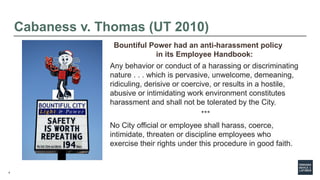
Cabaness v. Thomas(UT 2010)
Bountiful Power had an anti-harassment policy
in its Employee Handbook:
Any behavior or conduct of a harassing or discriminating
nature . . . which is pervasive, unwelcome, demeaning,
ridiculing, derisive or coercive, or results in a hostile,
abusive or intimidating work environment constitutes
harassment and shall not be tolerated by the City.
***
No City official or employee shall harass, coerce,
intimidate, threaten or discipline employees who
exercise their rights under this procedure in good faith.
5.
5
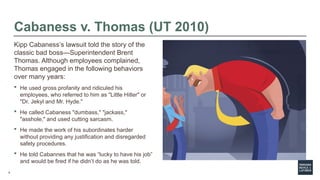
Cabaness v. Thomas(UT 2010)
Kipp Cabaness’s lawsuit told the story of the
classic bad boss—Superintendent Brent
Thomas. Although employees complained,
Thomas engaged in the following behaviors
over many years:
He used gross profanity and ridiculed his
employees, who referred to him as "Little Hitler" or
"Dr. Jekyl and Mr. Hyde."
He called Cabaness "dumbass," "jackass,"
"asshole," and used cutting sarcasm.
He made the work of his subordinates harder
without providing any justification and disregarded
safety procedures.
He told Cabannes that he was “lucky to have his job”
and would be fired if he didn’t do as he was told.
6.
6
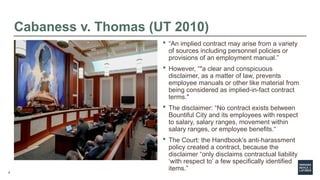
Cabaness v. Thomas(UT 2010)
“An implied contract may arise from a variety
of sources including personnel policies or
provisions of an employment manual.”
However, “"a clear and conspicuous
disclaimer, as a matter of law, prevents
employee manuals or other like material from
being considered as implied-in-fact contract
terms."
The disclaimer: “No contract exists between
Bountiful City and its employees with respect
to salary, salary ranges, movement within
salary ranges, or employee benefits.“
The Court: the Handbook’s anti-harassment
policy created a contract, because the
disclaimer “only disclaims contractual liability
‘with respect to’ a few specifically identified
items.”
7.
7
Policy Example
It’s sosimple. In addition to your at-will disclaimer, add a
contract disclaimer like this:
Neither this Handbook, nor the maintenance of other policies
or procedures shall be construed as constituting a promise
from or contract of any kind with the Company, either
express or implied, regarding any of the matters addressed
in any such handbooks or policies.
9
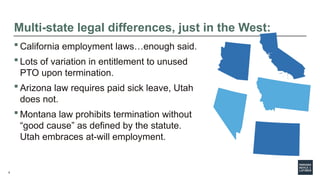
California employmentlaws…enough said.
Lots of variation in entitlement to unused
PTO upon termination.
Arizona law requires paid sick leave, Utah
does not.
Montana law prohibits termination without
“good cause” as defined by the statute.
Utah embraces at-will employment.
Multi-state legal differences, just in the West:
10.
10
Policy Takeaways forMulti-state Employers
Balance goals for consistency v. against state-specific compliance.
The lowest common denominator approach (apply the laws of the
state with the most employee-friendly requirements).
State-specific policies, e.g., an addenda for each state that identifies
policy differences.
Disclaimer approach, e.g., “To the fullest extent allowed by the law in
the state where you reside,…” Or other disclaimers that make clear
that when the law in the employee’s state varies from the policy, we
will follow the law.
12
Increase of theFLSA salary threshold.
On April 23, 2024, the DOL published its final rule
raising the salary threshold for the executive,
administrative, professional exemptions.
https://www.dol.gov/agencies/whd/overtime/rulemaking
Recall that to qualify for an exemption to the FLSA overtime requirements under the
executive, administrative, or professional tests, employers must meet a minimum salary
basis test of $684 per week ($35,568 per year).
A relaxed job duties test applies to “highly compensated employees” who earn $107,432
per year.
13.
13
Rolling increases in2024, 2025, and beyond.
July 1, 2024: the salary threshold increases to $844 per week ($43,888 per year)
for EAP exemptions; and $132,964 per year for highly compensated exemption.
January 1, 2025: salary threshold increases to $1,128 per week ($58,656 per
year) for EAP exemptions; and $151,164 per year for highly compensated
exemption.
July 1, 2027, and every three years: threshold for EAP exemption will be
reevaluated to align with 35th
percentile of weekly earnings of full-time salaried
workers based on lowest-wage census data; and 85th
percentile for highly
compensated exemption.
14.
14
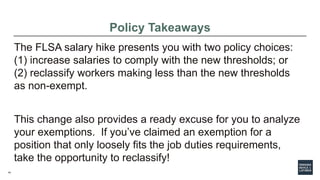
Policy Takeaways
The FLSAsalary hike presents you with two policy choices:
(1) increase salaries to comply with the new thresholds; or
(2) reclassify workers making less than the new thresholds
as non-exempt.
This change also provides a ready excuse for you to analyze
your exemptions. If you’ve claimed an exemption for a
position that only loosely fits the job duties requirements,
take the opportunity to reclassify!
17
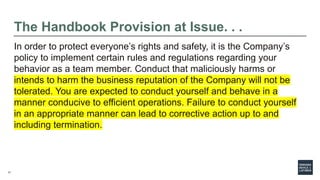
The Handbook Provisionat Issue. . .
In order to protect everyone’s rights and safety, it is the Company’s
policy to implement certain rules and regulations regarding your
behavior as a team member. Conduct that maliciously harms or
intends to harm the business reputation of the Company will not be
tolerated. You are expected to conduct yourself and behave in a
manner conducive to efficient operations. Failure to conduct yourself
in an appropriate manner can lead to corrective action up to and
including termination.
18.
18
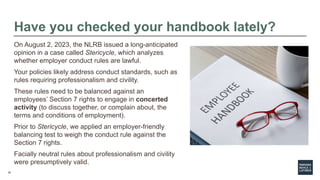
Have you checkedyour handbook lately?
On August 2, 2023, the NLRB issued a long-anticipated
opinion in a case called Stericycle, which analyzes
whether employer conduct rules are lawful.
Your policies likely address conduct standards, such as
rules requiring professionalism and civility.
These rules need to be balanced against an
employees’ Section 7 rights to engage in concerted
activity (to discuss together, or complain about, the
terms and conditions of employment).
Prior to Stericycle, we applied an employer-friendly
balancing test to weigh the conduct rule against the
Section 7 rights.
Facially neutral rules about professionalism and civility
were presumptively valid.
19.
19
The Pendulum SwingsBack in Favor of Employees
Stericycle reversed that precent, adopting a
new case-by-base balancing approach to
determine if a conduct rule has “a reasonable
tendency to chill employees from exercising
their Section 7 rights.”
The Board will read conduct rules from the
perspective of a “reasonable employee.”
If a “reasonable employee” could interpret the
rule in a way that limits Section 7 rights, the
rule will be presumptively invalid.
The employer’s intent in making the rule is
irrelevant.
20.
20
Conduct Policy Takeaways
Avoidsweeping conduct and professionalism policies that broadly, and without
context, require employees to avoid harming the employer’s reputation or
interests, to treat coworkers “respectfully and professionally,” or to refrain from
“disparaging” the employer or coworkers.
Instead, craft narrowly tailored policies that prohibit employees from disclosing
confidential information, defaming the employer or coworkers (i.e., knowingly
lying), breaching their duties of loyalty not to engage in competitive activities
while employed, or violating EEO policies against discrimination, harassment,
and retaliation.
Provide express Section 7 context for your conduct policies, e.g., that your
policies shall not be read to preclude (non-supervisory) employees from
speaking with other employees about the terms and conditions of their
employment.
21.
21
Another Handbook Provisionto Consider . . .
Investigation Confidentiality Policies
All complaints will be promptly investigated. All parties
involved in the investigation will keep complaints and the
terms of their resolution confidential to the fullest extent
practicable.
22.
22
Confidentiality Instructions ChangedToo
For internal investigations, many
employers instruct all witnesses to
maintain the confidentiality of the
investigation—during and after the
investigation.
For supervisors, there’s no change.
Recall that supervisors don’t have
Section 7 rights. Feel free to tell
them to keep it secret.
But what about non-supervisors?
22
23.
23
Confidentiality Instructions toNon-Supervisors
In 2019, the NLRB ruled that employer rules requiring employee
confidentiality during open investigations are lawful. But you needed
to apply “individualized scrutiny” in each case to maintain
confidentiality post-investigation, e.g., to protect the integrity of the
investigation, or to protect the complainant against mistreatment or
retaliation.
In Stericycle, the NLRB overruled their 2019 decision with respect
to confidentiality instructions during the pendency of the
investigation. Now, you need a specific reason—during and after
the investigation—to maintain confidentiality with non-supervisors.
23
24.
24
Investigation Confidentiality PolicyExample
Instead of: All parties involved in an investigation will keep
complaints and the terms of their resolution confidential.
Consider: All supervisors involved in an investigation will keep
complaints and the terms of their resolution confidential. The
Company may require that non-supervisors maintain confidentiality
during an investigation when confidentiality is needed, e.g., to protect
the integrity of the investigation, or to protect complainants or
witnesses against tampering or mistreatment.
26
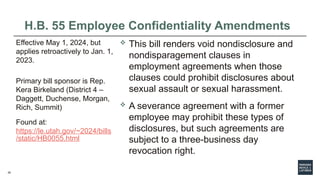
H.B. 55 EmployeeConfidentiality Amendments
This bill renders void nondisclosure and
nondisparagement clauses in
employment agreements when those
clauses could prohibit disclosures about
sexual assault or sexual harassment.
A severance agreement with a former
employee may prohibit these types of
disclosures, but such agreements are
subject to a three-business day
revocation right.
Effective May 1, 2024, but
applies retroactively to Jan. 1,
2023.
Primary bill sponsor is Rep.
Kera Birkeland (District 4 –
Daggett, Duchense, Morgan,
Rich, Summit)
Found at:
https://le.utah.gov/~2024/bills
/static/HB0055.html
27.
27
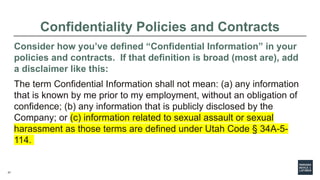
Confidentiality Policies andContracts
Consider how you’ve defined “Confidential Information” in your
policies and contracts. If that definition is broad (most are), add
a disclaimer like this:
The term Confidential Information shall not mean: (a) any information
that is known by me prior to my employment, without an obligation of
confidence; (b) any information that is publicly disclosed by the
Company; or (c) information related to sexual assault or sexual
harassment as those terms are defined under Utah Code § 34A-5-
114.
29
PUMP Act
The PUMPAct amends the Fair Labor Standards Act, with
an effective date of December 29, 2022.
This law requires employers provide new birthmothers with
reasonable breaktime to express breastmilk for the
employee’s nursing child for one year after childbirth.
Employers also must provide a private place (other than a
bathroom) to express breastmilk.
30.
30
Basic Lactation PolicyExample (from SHRM.org)
As part of our family-friendly policies and benefits, the Company supports
breastfeeding employees by accommodating an employee who needs to express
breast milk during the workday.
For up to one year after the child's birth, any employee who is breastfeeding will
be provided reasonable break times to express breast milk. The Company has
designated the room located [insert location] for this purpose.
Employees must reserve the room by contacting [insert name and phone
number].
For non-exempt (hourly) employees, breaks of more than 20 minutes in length
will be unpaid, and recorded on timesheets where appropriate.
32
PREGNANT WORKERS FAIRNESSACT
On December 22, 2022,
Congress passed the
Pregnant Workers Fairness Act
(PWFA)
On April 15, 2024, the EEOC
issued its final regulations on
PWFA enforcement.
33.
33
PREGNANT WORKERS FAIRNESSACT
PWFA requires that employers with at least 15 employees must
provide reasonable accommodations for pregnant applicants and
employees that are needed for pregnancy, childbirth and related
medical conditions.
PWFA became effective June 27, 2023.
On Aril 15, 2024, the EEOC issued its final regulations about its
enforcement of the PWFA—a mere 408 pages long!
https://www.eeoc.gov/newsroom/eeoc-issues-final-regulation-pregna
nt-workers-fairness-act
34.
34
PWFA Final Regulations
Thefinal regs make clear that the EEOC takes a broad view of the
meaning of pregnancy, childbirth, or related medical conditions.
Among other things, the non-exhaustive definition includes
pregnancy, lactation, use of birth control, infertility, menstruation,
endometriosis, postpartum depression, miscarriages, and abortions.
Unlike the ADA, the PWFA provides an express timeline for
accommodation: essential job functions must be modified or
eliminated on temporary basis, “generally 40 weeks” (absent showing
of undue hardship).
35.
35
PWFA Final Regulations
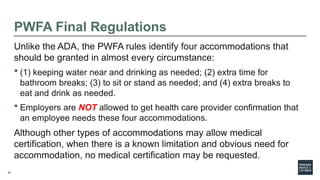
Unlikethe ADA, the PWFA rules identify four accommodations that
should be granted in almost every circumstance:
(1) keeping water near and drinking as needed; (2) extra time for
bathroom breaks; (3) to sit or stand as needed; and (4) extra breaks to
eat and drink as needed.
Employers are NOT allowed to get health care provider confirmation that
an employee needs these four accommodations.
Although other types of accommodations may allow medical
certification, when there is a known limitation and obvious need for
accommodation, no medical certification may be requested.
36.
36
Basic PWFA PolicyExample
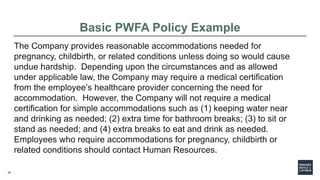
The Company provides reasonable accommodations needed for
pregnancy, childbirth, or related conditions unless doing so would cause
undue hardship. Depending upon the circumstances and as allowed
under applicable law, the Company may require a medical certification
from the employee’s healthcare provider concerning the need for
accommodation. However, the Company will not require a medical
certification for simple accommodations such as (1) keeping water near
and drinking as needed; (2) extra time for bathroom breaks; (3) to sit or
stand as needed; and (4) extra breaks to eat and drink as needed.
Employees who require accommodations for pregnancy, childbirth or
related conditions should contact Human Resources.
38
NEW EEOC EnforcementGuidance on Harassment
On April 29, 2024, the EEOC
published its final “Enforcement
Guidance on Harassment in the
Workplace.”
Found here:
https://www.eeoc.gov/laws/guidance/e
nforcement-guidance-harassment-wor
kplace
Why now? EEOC says between
2016-2022, more than a third of all
EEOC charges included harassment
allegations.
39.
39
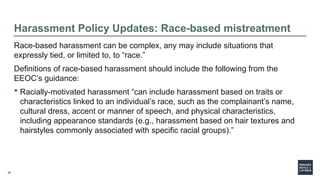
Harassment Policy Updates:Race-based mistreatment
Race-based harassment can be complex, any may include situations that
expressly tied, or limited to, to “race.”
Definitions of race-based harassment should include the following from the
EEOC’s guidance:
Racially-motivated harassment “can include harassment based on traits or
characteristics linked to an individual’s race, such as the complainant’s name,
cultural dress, accent or manner of speech, and physical characteristics,
including appearance standards (e.g., harassment based on hair textures and
hairstyles commonly associated with specific racial groups).”
40.
40
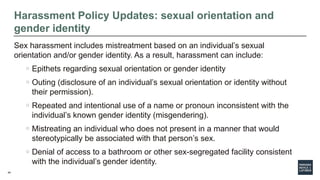
Harassment Policy Updates:sexual orientation and
gender identity
Sex harassment includes mistreatment based on an individual’s sexual
orientation and/or gender identity. As a result, harassment can include:
o Epithets regarding sexual orientation or gender identity
o Outing (disclosure of an individual’s sexual orientation or identity without
their permission).
o Repeated and intentional use of a name or pronoun inconsistent with the
individual’s known gender identity (misgendering).
o Mistreating an individual who does not present in a manner that would
stereotypically be associated with that person’s sex.
o Denial of access to a bathroom or other sex-segregated facility consistent
with the individual’s gender identity.
41.
41
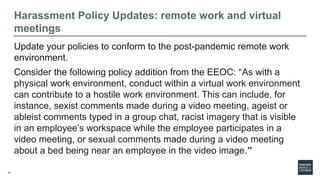
Harassment Policy Updates:remote work and virtual
meetings
Update your policies to conform to the post-pandemic remote work
environment.
Consider the following policy addition from the EEOC: “As with a
physical work environment, conduct within a virtual work environment
can contribute to a hostile work environment. This can include, for
instance, sexist comments made during a video meeting, ageist or
ableist comments typed in a group chat, racist imagery that is visible
in an employee’s workspace while the employee participates in a
video meeting, or sexual comments made during a video meeting
about a bed being near an employee in the video image.”
42.
42
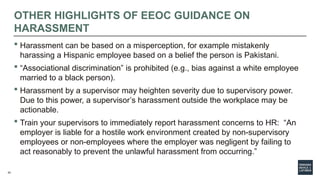
OTHER HIGHLIGHTS OFEEOC GUIDANCE ON
HARASSMENT
Harassment can be based on a misperception, for example mistakenly
harassing a Hispanic employee based on a belief the person is Pakistani.
“Associational discrimination” is prohibited (e.g., bias against a white employee
married to a black person).
Harassment by a supervisor may heighten severity due to supervisory power.
Due to this power, a supervisor’s harassment outside the workplace may be
actionable.
Train your supervisors to immediately report harassment concerns to HR: “An
employer is liable for a hostile work environment created by non-supervisory
employees or non-employees where the employer was negligent by failing to
act reasonably to prevent the unlawful harassment from occurring.”
44
H.B. 396 WorkplaceDiscrimination Amendments
This bill expands religious liberty protections:
Prohibits an employer from compelling an
employee to engage in “religiously
objectionable expression,” i.e.,
expression that offends a sincerely held
religious belief.
Unless accommodating the employee would
impose undue burden by interfering with (1)
the employer’s core mission or ability to
conduct business in an effective manner or
(2) the employer’s ability to provide training
and safety instructions.”
Effective May 1, 2024.
Primary bill sponsor is
Rep. Brady Brammer
(District 54 – Utah)
Found at:
https://le.utah.gov/~20
24/bills/static/HB0396.
html
45.
45
Addressing conflicts betweenH.B. 396
and Federal Law
What about an employee who refuses to use a transgender
coworker’s pronouns and preferred name?
EEOC: “Although accidental misuse of a transgender employee’s
name and pronouns does not violate Title VII, intentionally and
repeatedly using the wrong name and pronouns to refer to a
transgender employee could contribute to an unlawful hostile work
environment.”
Consider relying on the exception that granting a request to
deadname a transgender employee or to refuse to use that
employee’s preferred pronouns interferes with an employer’s “ability
to conduct business in an effective manner” because lawsuits are
expensive!
46.
46
HB 396 PolicyAddition
Consider this addition to your religious accommodation policy:
“The Company also will provide reasonable accommodations, absent
undue hardship, to excuse employees from engaging in religiously
objectionable expression, i.e., an expression that offends your
sincerely held religious beliefs. If you believe that the Company has
asked you to express something that offends your religious beliefs,
you may seek an accommodation from Human Resources. The
Company will endeavor to provide such accommodations, unless
doing so would cause an undue hardship, such as by interfering with
a core mission, our ability to conduct business in an effective manner,
or our ability to provide training and safety instructions.”
48
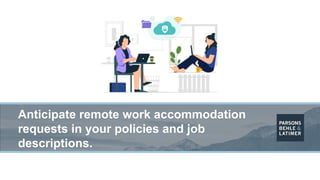
What if youdon’t want to allow remote work?
For employees who simply prefer remote work,
you may compel them to return onsite, citing your
policies.
But if an employee cannot work onsite for health
reasons—physical (e.g., immunocompromised
conditions) or mental (e.g., anxiety or depression)
—the employee may be eligible for a remote work
accommodation under the ADA (among other
things).
You’ve got to provide remote work when needed
for a disability, unless onsite work is essential or
remote work would impose an undue hardship.
49.
49
If you believeonsite work is essential, don’t wait for an employee to
request remote work as an accommodation to document why.
Document these issues now!
Review your remote work policy. If you are going to bring folks back to
onsite work, or you’ve done so already and want to keep it that way,
document how telework was a challenge. Also document why onsite
work is essential. Don’t just say it’s essential—explain it.
Review your job descriptions. Is there something there about onsite
work? If not, add it.
Document how onsite work is essential now, not
for the first time in response to ADA request.
51
Students for FairAdmissions v. Harvard/UNC
In Students for Fair Admissions v. Harvard/UNC, the
Supreme Court struck down race-based college
admissions programs that considered minority status as
a “plus factor” for enrollment.
The Court relied on Title VI of the Civil Rights Act of
1964, which forbids organizations that receive federal
funding from denying benefits on the grounds of race.
But it is Title VII, not Title VI, that governs employment
discrimination.
And under Title VII, it’s already understood that
employers may not consider race or other protected
classes as a “plus factor.”
52.
52
Drafting compliant DEIpolicies
Affirmational statements about diversity, equity, and inclusion are fine (for now).
However, policies should make clear the initiatives that will, and will not, be
undertaken to achieve affirmational goals about DEI. For example, emphasize that
your DEI program is about:
Training.
Efforts to help employees feel included.
Expansion of job posting outreach to increase applicant pool diversity.
Make clear that protected classes will never be considered in hiring decisions and
that the company always will hire and promote based on merit.
Finally, expect continued scrutiny of DEI policies and practices. Consider
rebranding your DEI initiatives to avoid the spotlight.
53.
53
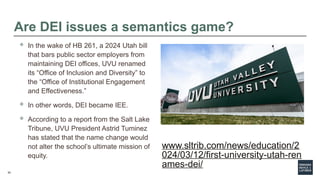
Are DEI issuesa semantics game?
In the wake of HB 261, a 2024 Utah bill
that bars public sector employers from
maintaining DEI offices, UVU renamed
its “Office of Inclusion and Diversity” to
the “Office of Institutional Engagement
and Effectiveness.”
In other words, DEI became IEE.
According to a report from the Salt Lake
Tribune, UVU President Astrid Tuminez
has stated that the name change would
not alter the school’s ultimate mission of
equity.
www.sltrib.com/news/education/2
024/03/12/first-university-utah-ren
ames-dei/
54.
Thank You
To downloada PDF handbook of today’s seminar,
including presentations and materials, please visit
parsonsbehle.com/employment-law-seminar
55.
55
Thank You
MarkD. Tolman
mtolman@parsonsbehle.com
801.536.6932
Karen M. Clemes
VP & Associate General Counsel for HealthEquity, Inc.
kclemes@healthequity.com
Editor's Notes
#22 Mark – be sure to define who a supervisor is under the NLRB decision.


![30
Basic Lactation Policy Example (from SHRM.org)
As part of our family-friendly policies and benefits, the Company supports
breastfeeding employees by accommodating an employee who needs to express
breast milk during the workday.
For up to one year after the child's birth, any employee who is breastfeeding will
be provided reasonable break times to express breast milk. The Company has
designated the room located [insert location] for this purpose.
Employees must reserve the room by contacting [insert name and phone
number].
For non-exempt (hourly) employees, breaks of more than 20 minutes in length
will be unpaid, and recorded on timesheets where appropriate.](https://image.slidesharecdn.com/2024handbookupdatesforemploymentlawseminar4871-3268-2682v-250327205044-3a972112/85/Handbook-Updates-2024-Policy-Pointers-and-Pitfalls-30-320.jpg)