
parsonsbehle.com
October 5, 2022 | Boise Centre East
Employee Discipline and Termination:
Avoiding Problems with Effective
Communication and Documentation
Liz M. Mellem
406.317.7240
amellem@parsonsbehle.com
2
This presentation is based on available information as of Oct. 5, 2022,
but everyone must understand that the information provided is not a
substitute for legal advice. This presentation is not intended and will
not serve as a substitute for legal counsel on these issues.
Legal Disclaimer
3
At Will Employment Doctrine
 In Idaho, the default for all employees is that they are employed “at-
will.” This means that either the employer or the at-will employee
may terminate the employment relationship at any time, with or
without advance notice, and for any reason or no reason at all.
 Although the at-will employment doctrine is alive and well in Idaho,
employers who rely on it do so at their peril.
 There are many federal and state exceptions to at-will employment!
4
Exceptions to At-Will Employment
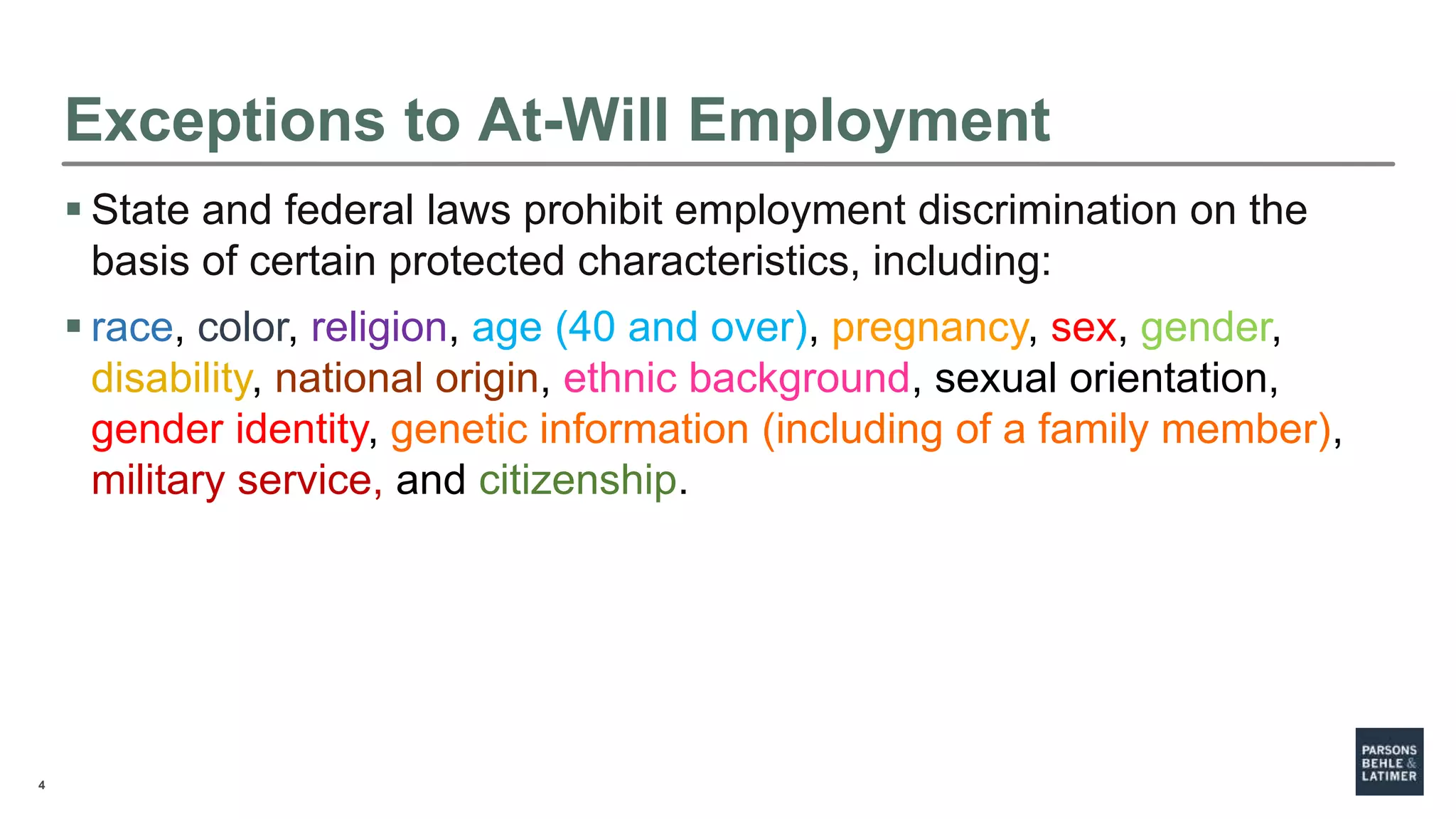
 State and federal laws prohibit employment discrimination on the
basis of certain protected characteristics, including:
 race, color, religion, age (40 and over), pregnancy, sex, gender,
disability, national origin, ethnic background, sexual orientation,
gender identity, genetic information (including of a family member),
military service, and citizenship.
5
Exceptions to At-Will Employment
 Be mindful of timing issues to avoid a retaliation claim.
 Courts will infer a retaliatory intent when an employer takes adverse
employment action soon after (e.g., within about 3 months) an
engages in protected activity (e.g., complaining about discrimination
or harassment).
 In such cases, the burden will shift to the employer to rebut the
retaliatory presumption with evidence of its legitimate, non-
retaliatory intent.
6
Exceptions to At-Will Employment
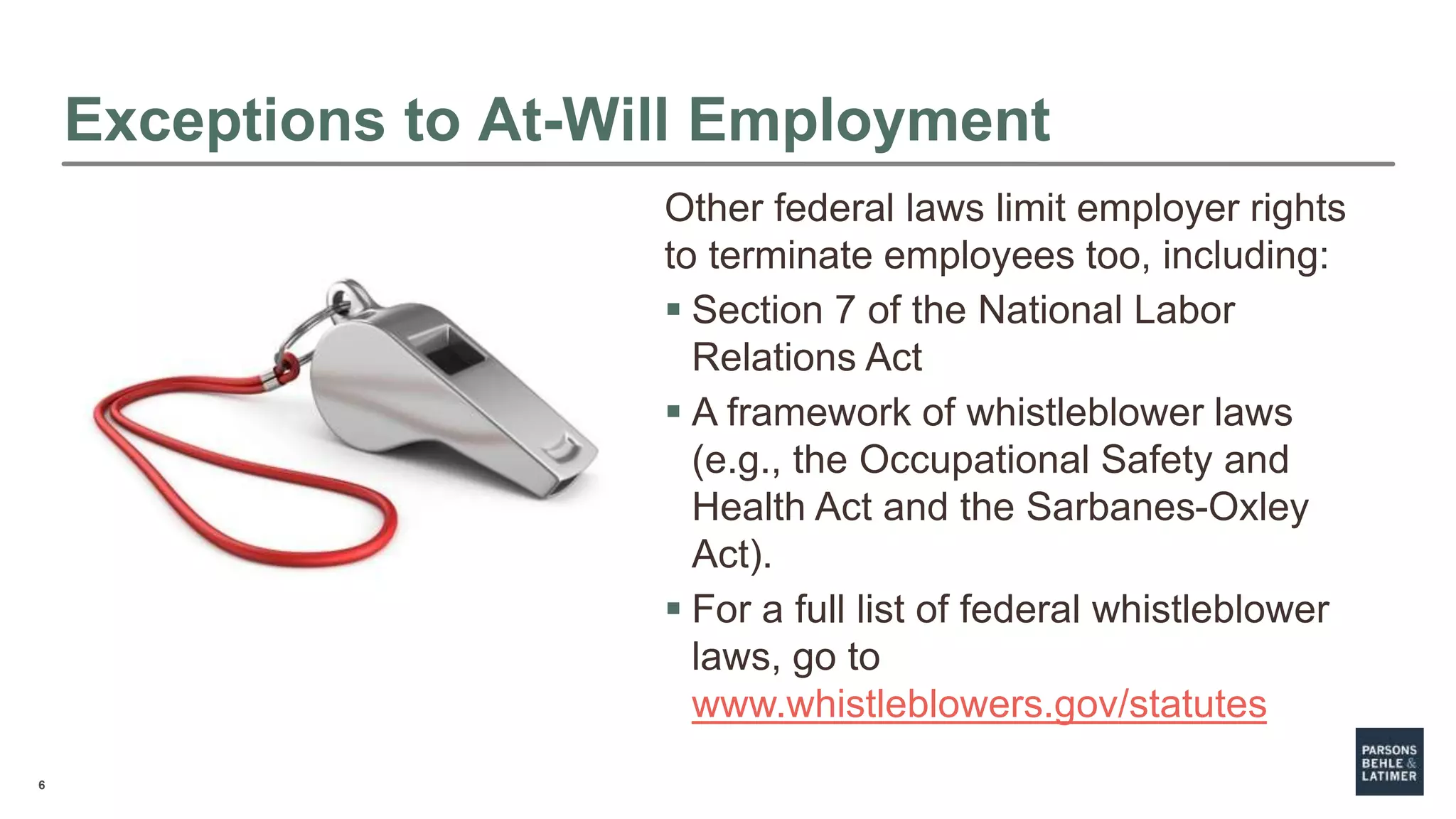
Other federal laws limit employer rights
to terminate employees too, including:
 Section 7 of the National Labor
Relations Act
 A framework of whistleblower laws
(e.g., the Occupational Safety and
Health Act and the Sarbanes-Oxley
Act).
 For a full list of federal whistleblower
laws, go to
www.whistleblowers.gov/statutes
7
Exceptions to At-Will Employment
 Idaho has an exception to the at-will employment doctrine:
“termination in violation of public policy” that occurs when an
employer terminates an employee in a way that violates an
important public policy (found in state statutes).
 Common fact patterns:
o Employee alleges they were fired in retaliation for reporting a workplace
injury or filing a workers compensation claim.
o Employee alleges they were fired in retaliation for reporting a suspected
violation of law to their employer or to the authorities.
8
Communication and Documentation
 Two pillars of good employee performance management and risk
management
 Communication = oral and written
o Conveys information regarding job duties, expectations, performance
feedback, corrective actions, etc.
o Frequent and early communication and intervention will help avoid
employment claims and protect an employer when claims are brought
 Documentation can be a form of communication AND evidence of
communication
9
How will documentation help limit risk?
 In a case that goes to a jury trial, we never want to rely on
testimony alone because the jury gets to pick who to believe
o Spoiler Alert: They tend to believe the employee more often than the
employer!
 Documents help to establish intent and show:
o Decisions were performance or business based
o Decisions were not motivated by discriminatory, retaliatory, or other unlawful
intent
10
Who Else Cares About Documentation?
 Documentation also really matters to the agencies that enforce anti-
discrimination and anti-retaliation employment laws:
o State Agencies (UALD; Montana Human Rights Bureau; Idaho Human
Rights Commission)
o EEOC
o DOL
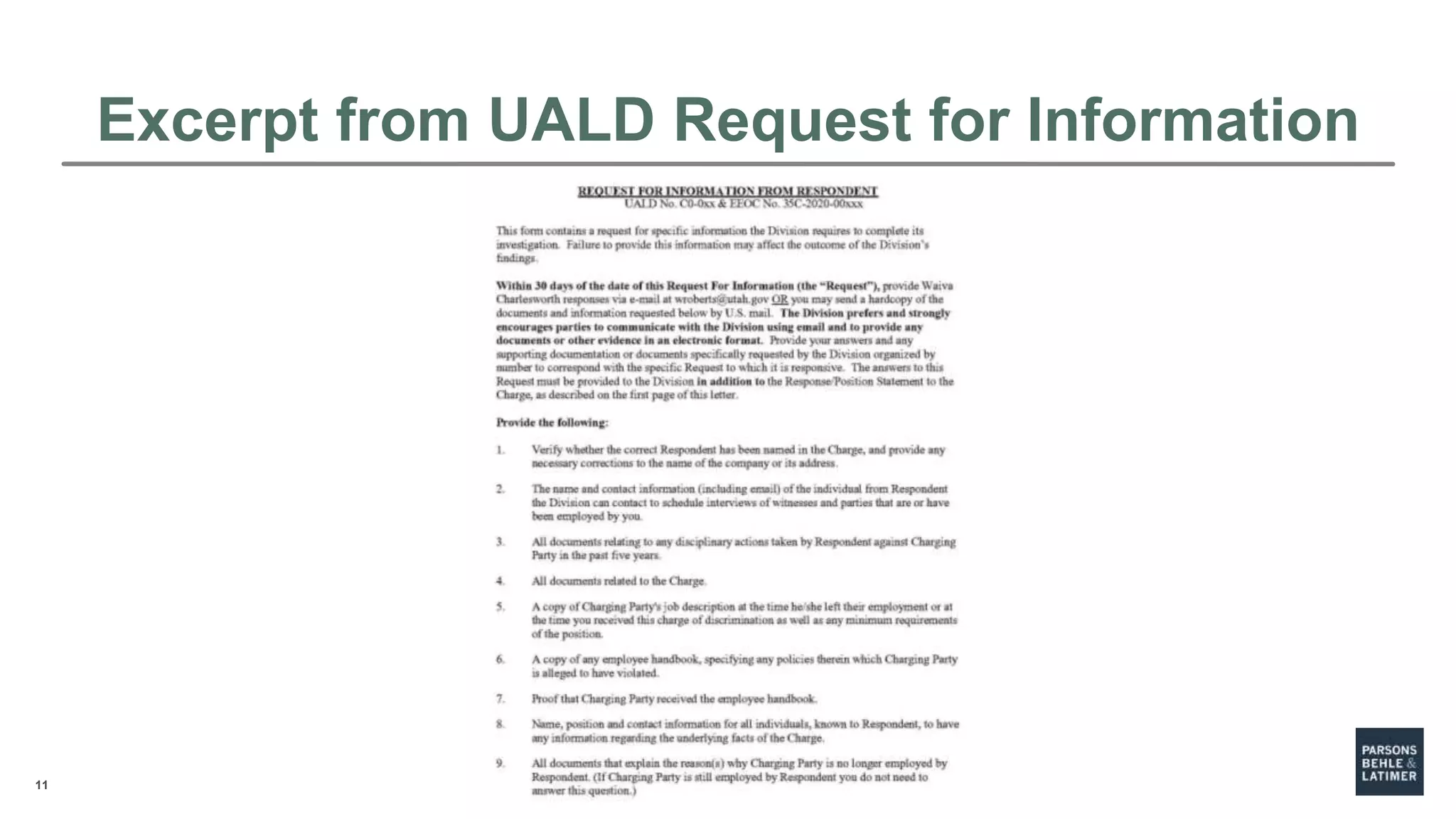
 Service of a Charge or Complaint is always accompanied by a
Request for Information
11
Excerpt from UALD Request for Information
12
Documents Requested in Every UALD Charge
 All documents relating to any disciplinary actions taken by
Respondent against Charging Party in the past five years.
* All documents related to the Charge.
* A copy of Charging Party's job description at the time he/she left
their employment or at the time you received this charge of
discrimination as well as any minimum requirements of the position.
* All documents that explain the reason(s) why Charging Party is no
longer employed by Respondent. (If Charging Party is still employed
by Respondent you do not need to answer this question.)
13
Good Documentation Is Critical at 3 points:
Performance Evaluations and Appraisals
Discipline
Termination
14
“Golden Rule” of Documentation
IF IT IS NOT IN WRITING,
IT DIDN’T HAPPEN!
15
“Golden Rule” of Documentation
What happens when you
have not documented?
16
AVOIDING LEGAL TROUBLE
Performance Evaluations, Reviews, and Appraisals
o Should address: C.A.P.
o CONDUCT
o ATTENDANCE
o PERFORMANCE
 Be courageously Honest
 But Not About Non C.A.P. Issues!
17
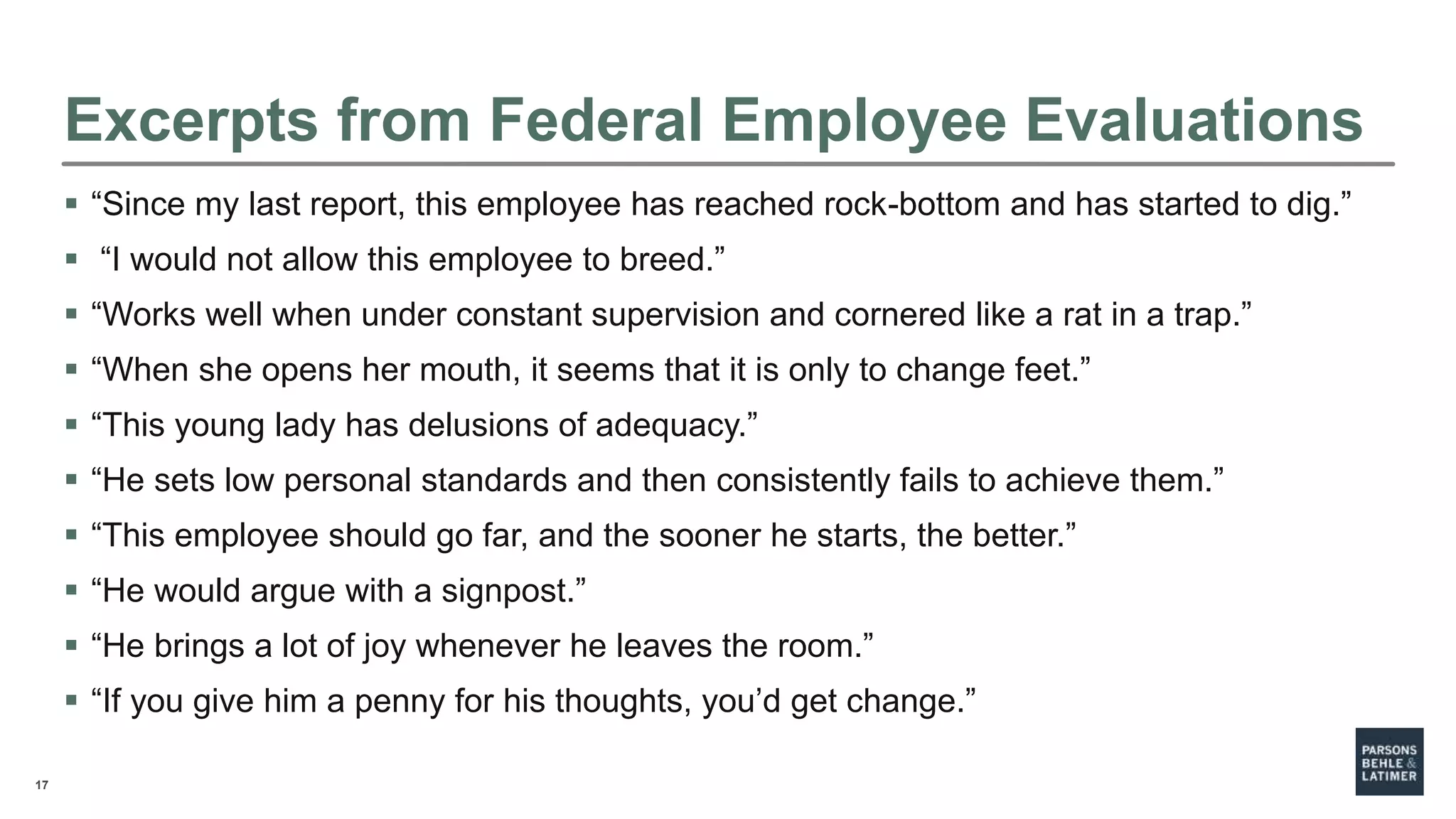
Excerpts from Federal Employee Evaluations
 “Since my last report, this employee has reached rock-bottom and has started to dig.”
 “I would not allow this employee to breed.”
 “Works well when under constant supervision and cornered like a rat in a trap.”
 “When she opens her mouth, it seems that it is only to change feet.”
 “This young lady has delusions of adequacy.”
 “He sets low personal standards and then consistently fails to achieve them.”
 “This employee should go far, and the sooner he starts, the better.”
 “He would argue with a signpost.”
 “He brings a lot of joy whenever he leaves the room.”
 “If you give him a penny for his thoughts, you’d get change.”
18
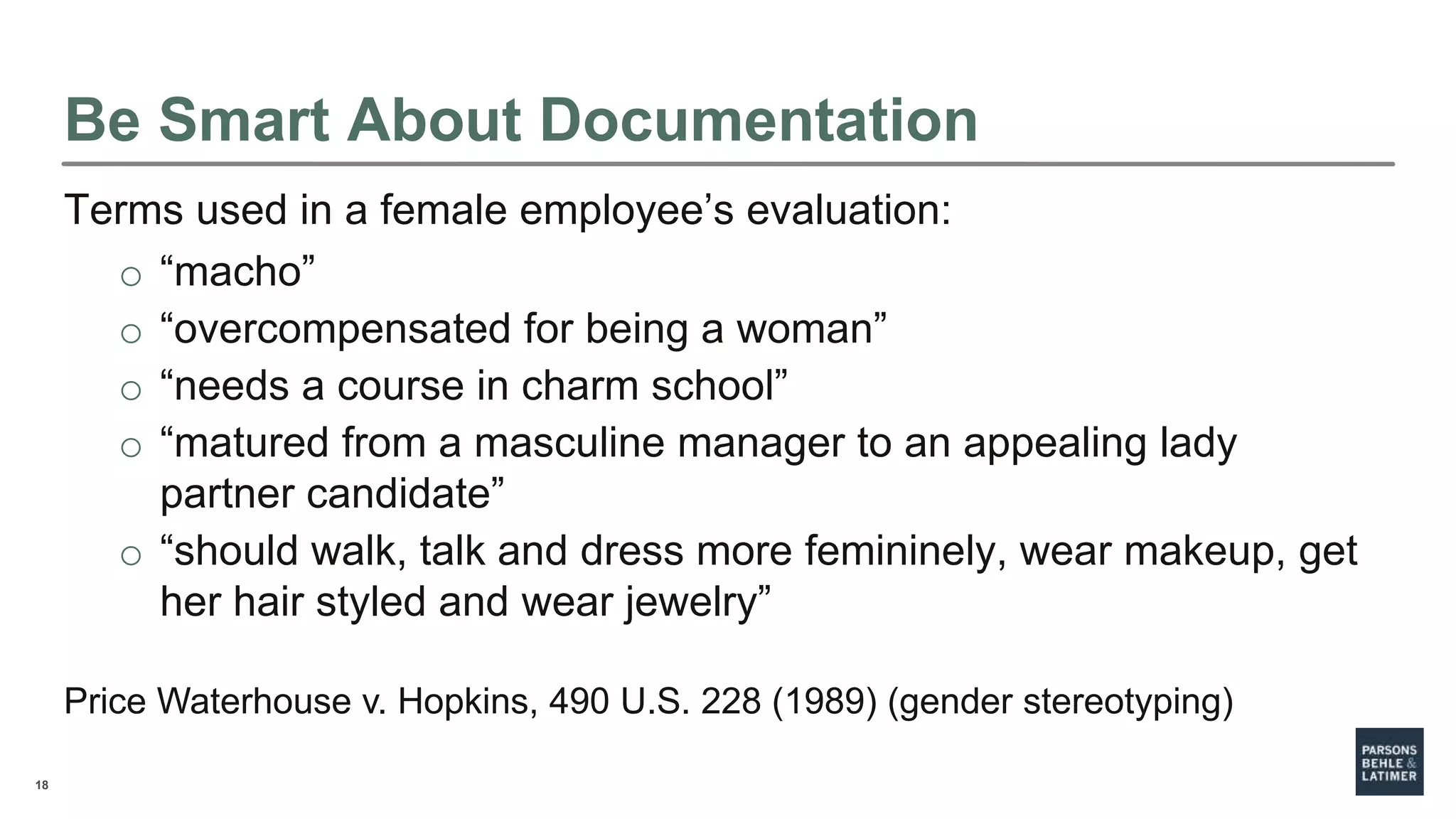
Be Smart About Documentation
Terms used in a female employee’s evaluation:
o “macho”
o “overcompensated for being a woman”
o “needs a course in charm school”
o “matured from a masculine manager to an appealing lady
partner candidate”
o “should walk, talk and dress more femininely, wear makeup, get
her hair styled and wear jewelry”
Price Waterhouse v. Hopkins, 490 U.S. 228 (1989) (gender stereotyping)
19
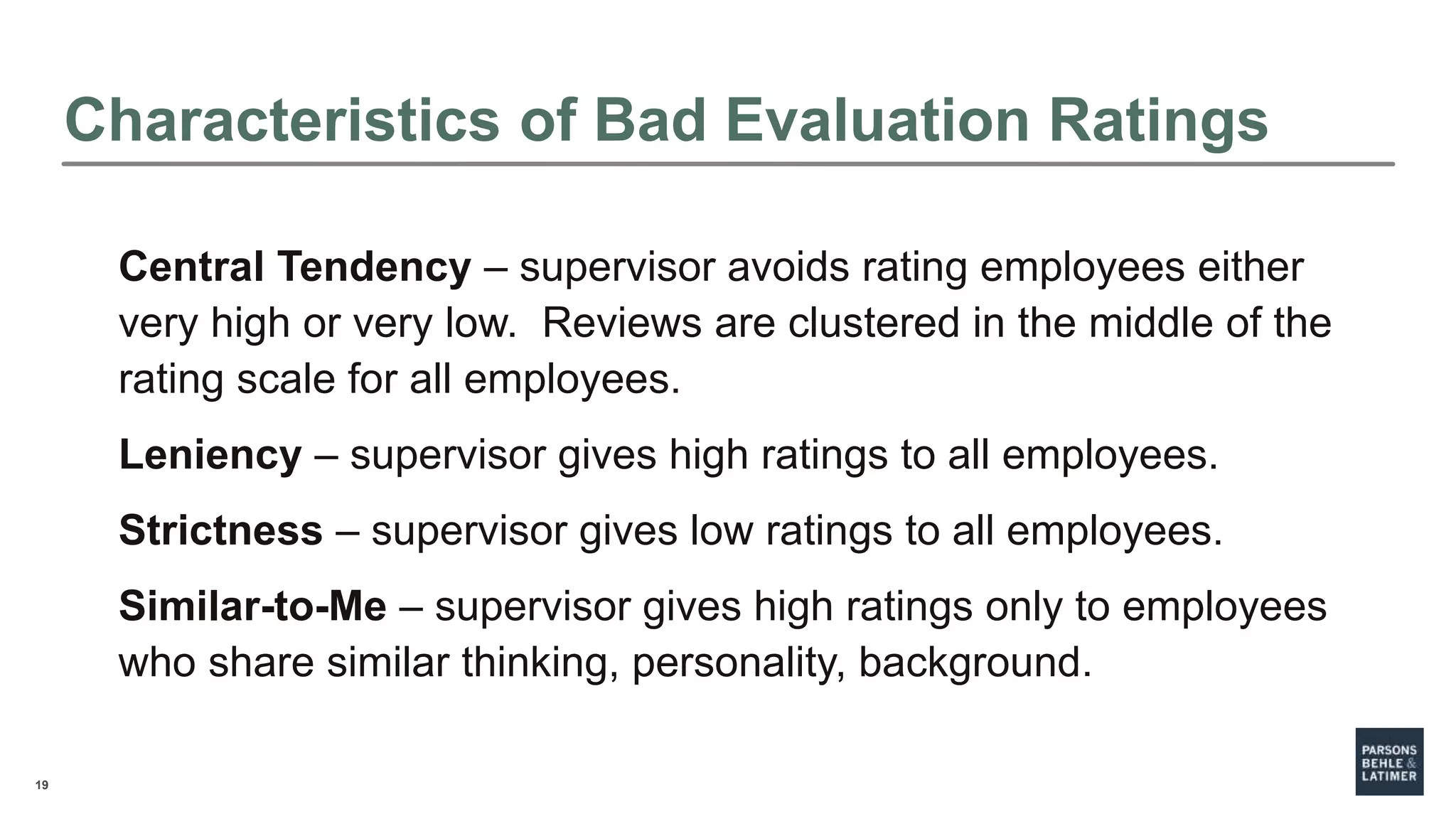
Characteristics of Bad Evaluation Ratings
Central Tendency – supervisor avoids rating employees either
very high or very low. Reviews are clustered in the middle of the
rating scale for all employees.
Leniency – supervisor gives high ratings to all employees.
Strictness – supervisor gives low ratings to all employees.
Similar-to-Me – supervisor gives high ratings only to employees
who share similar thinking, personality, background.
20
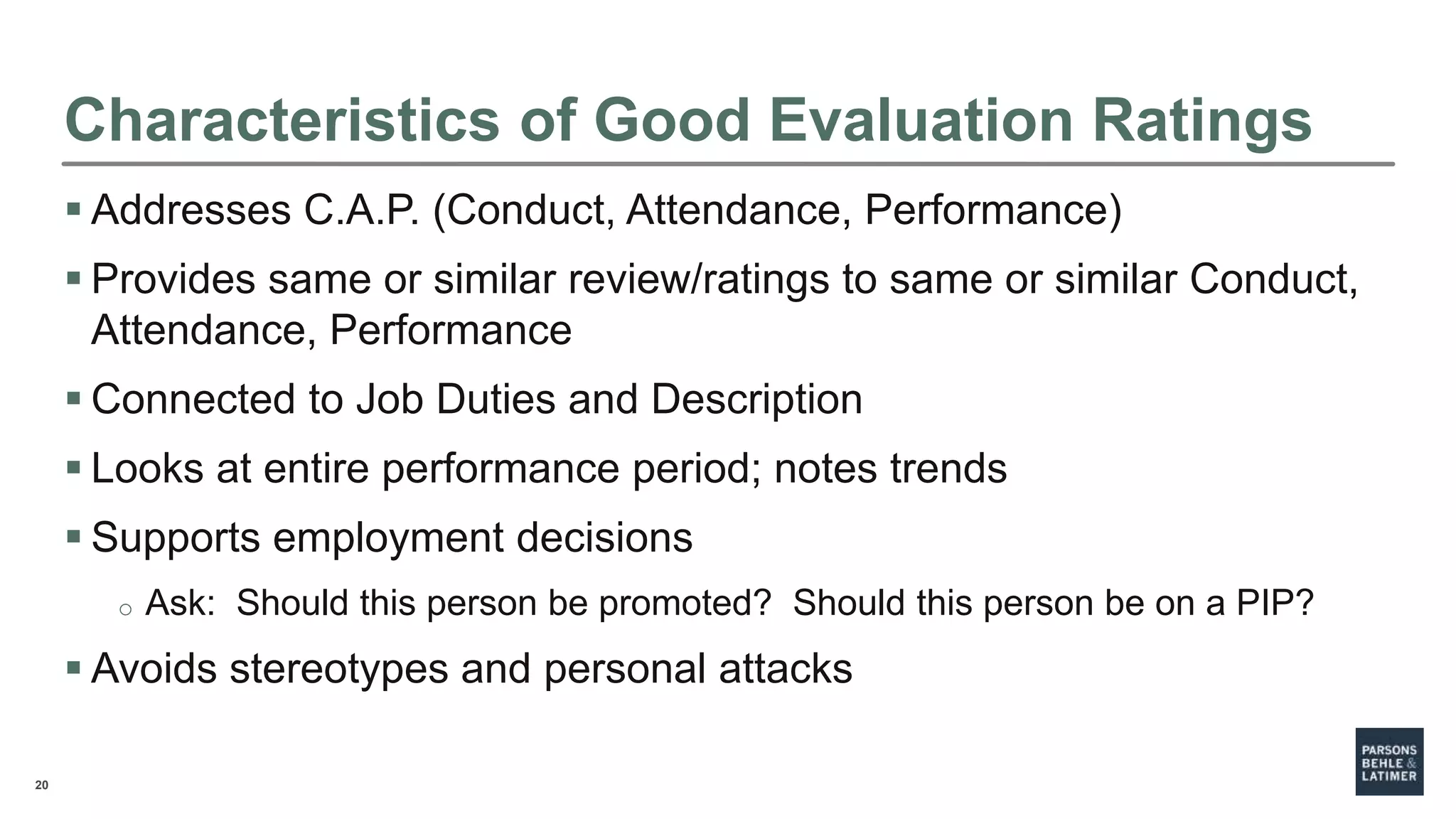
Characteristics of Good Evaluation Ratings
 Addresses C.A.P. (Conduct, Attendance, Performance)
 Provides same or similar review/ratings to same or similar Conduct,
Attendance, Performance
 Connected to Job Duties and Description
 Looks at entire performance period; notes trends
 Supports employment decisions
o Ask: Should this person be promoted? Should this person be on a PIP?
 Avoids stereotypes and personal attacks
21
AVOIDING LEGAL TROUBLE
Discipline and Termination: How Good
Communication and Documentation with All
Employees Can Help You
22
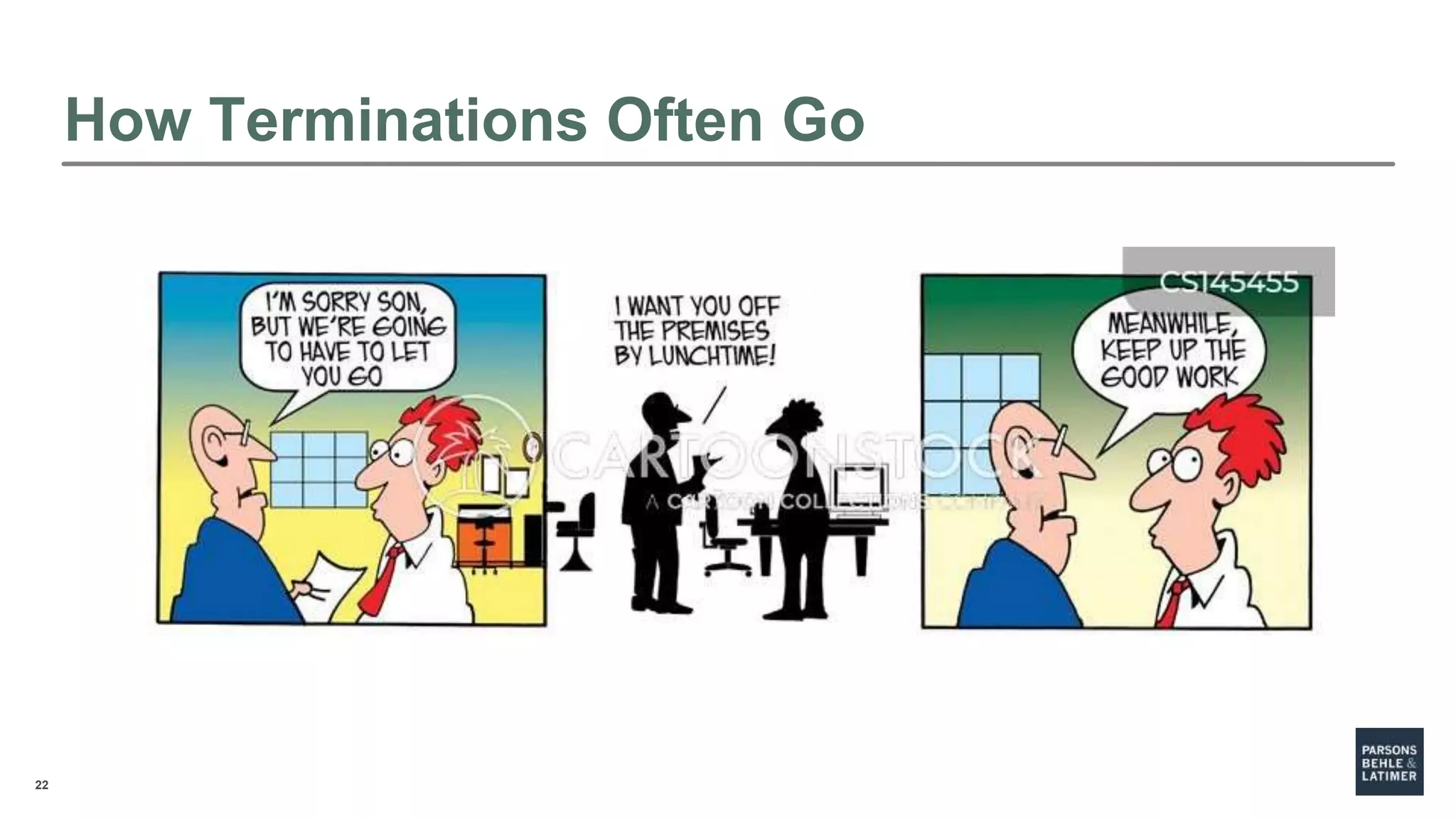
How Terminations Often Go
23
Best Practices
 Outline the lifecycle of an employee and identify all communication
possibilities:
o Hiring
o Training
o Day-to-day Feedback/Daily Meetings
o Biannual Reviews
o Write Ups/Performance Improvement Plans
 Outline the ideal way to communicate performance expectations
and document C.A.P. along the way
24
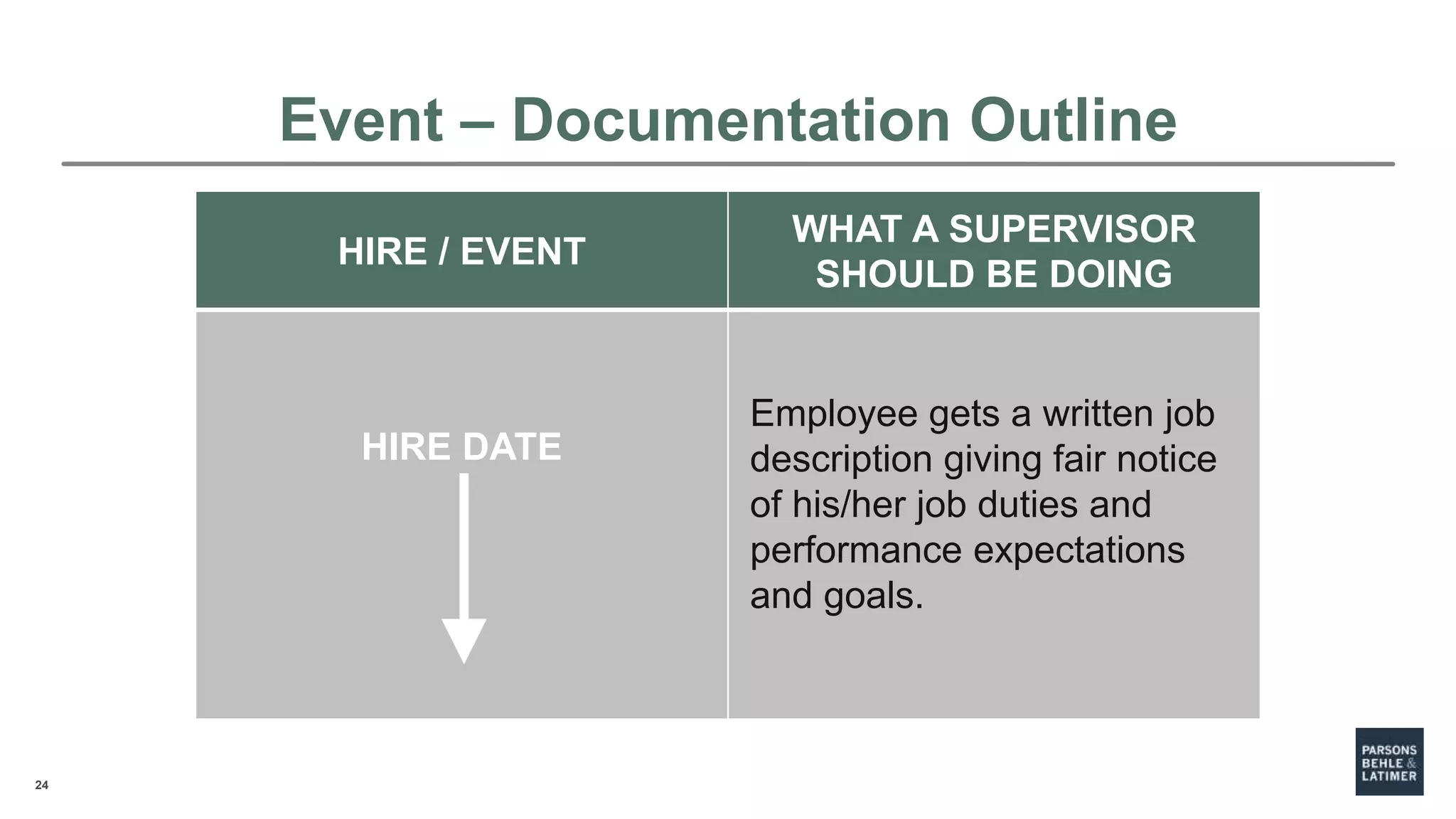
HIRE / EVENT
WHAT A SUPERVISOR
SHOULD BE DOING
HIRE DATE
Employee gets a written job
description giving fair notice
of his/her job duties and
performance expectations
and goals.
Event – Documentation Outline
25
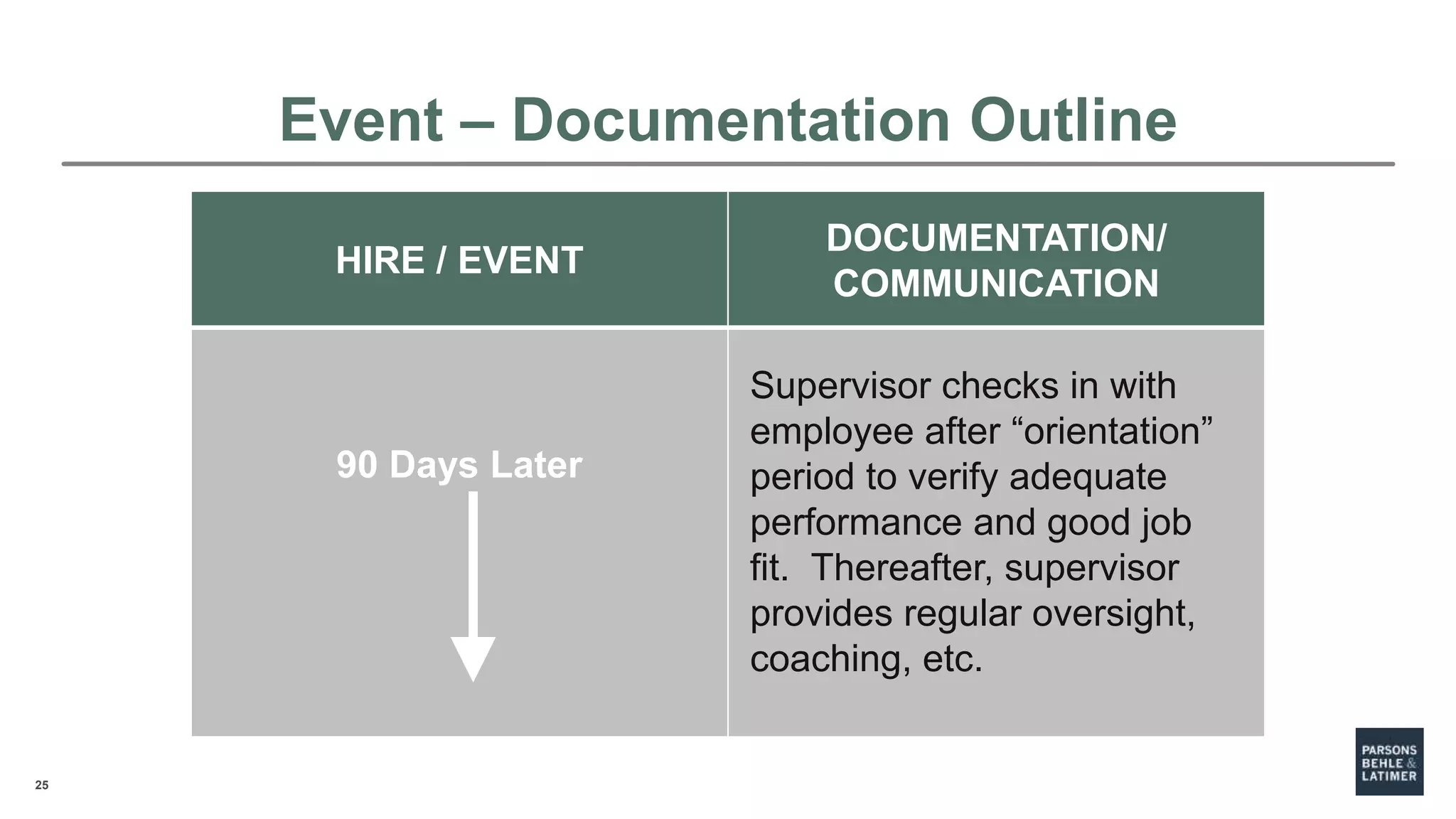
HIRE / EVENT
DOCUMENTATION/
COMMUNICATION
90 Days Later
Supervisor checks in with
employee after “orientation”
period to verify adequate
performance and good job
fit. Thereafter, supervisor
provides regular oversight,
coaching, etc.
Event – Documentation Outline
26
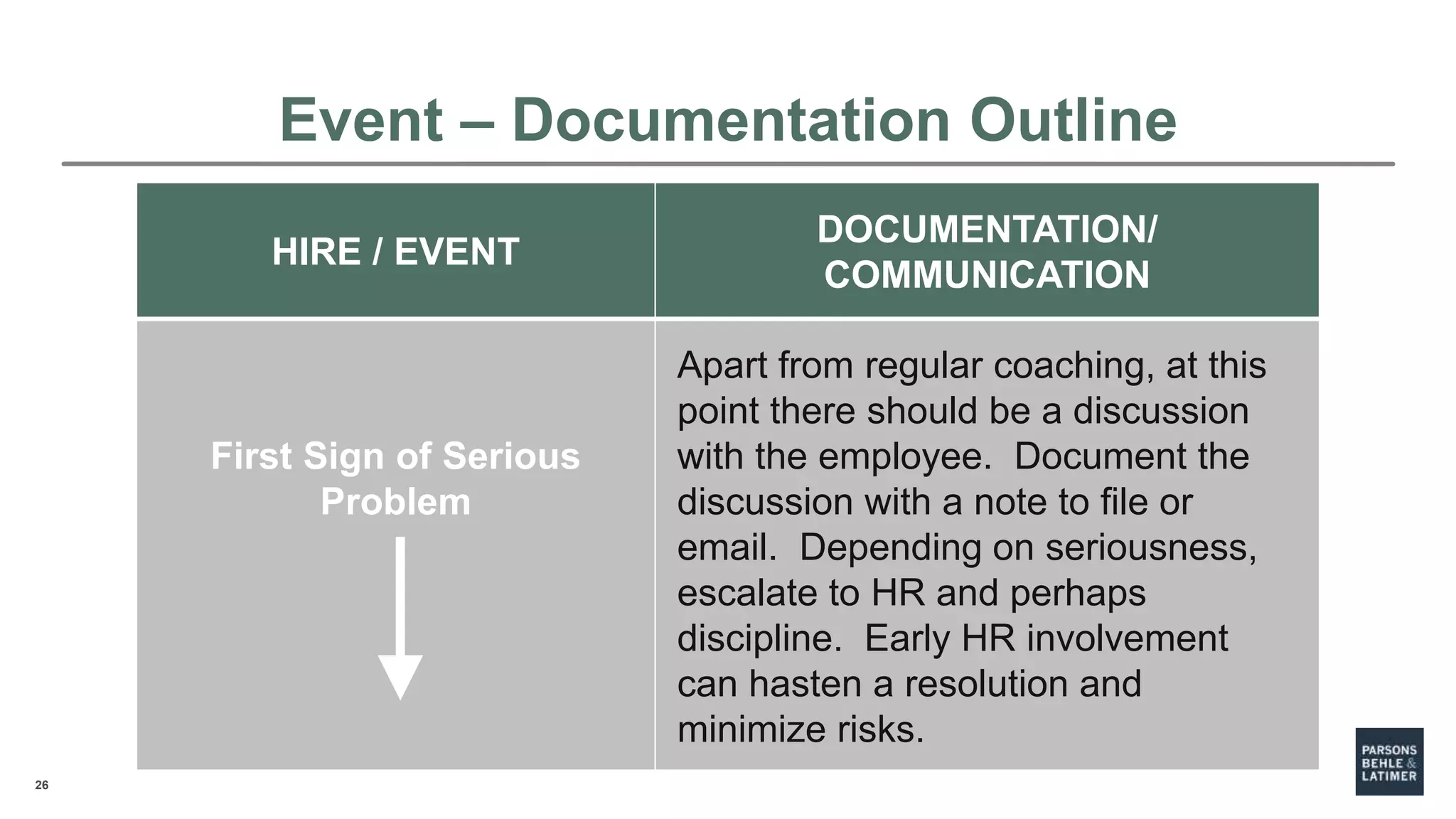
HIRE / EVENT
DOCUMENTATION/
COMMUNICATION
First Sign of Serious
Problem
Apart from regular coaching, at this
point there should be a discussion
with the employee. Document the
discussion with a note to file or
email. Depending on seriousness,
escalate to HR and perhaps
discipline. Early HR involvement
can hasten a resolution and
minimize risks.
Event – Documentation Outline
27
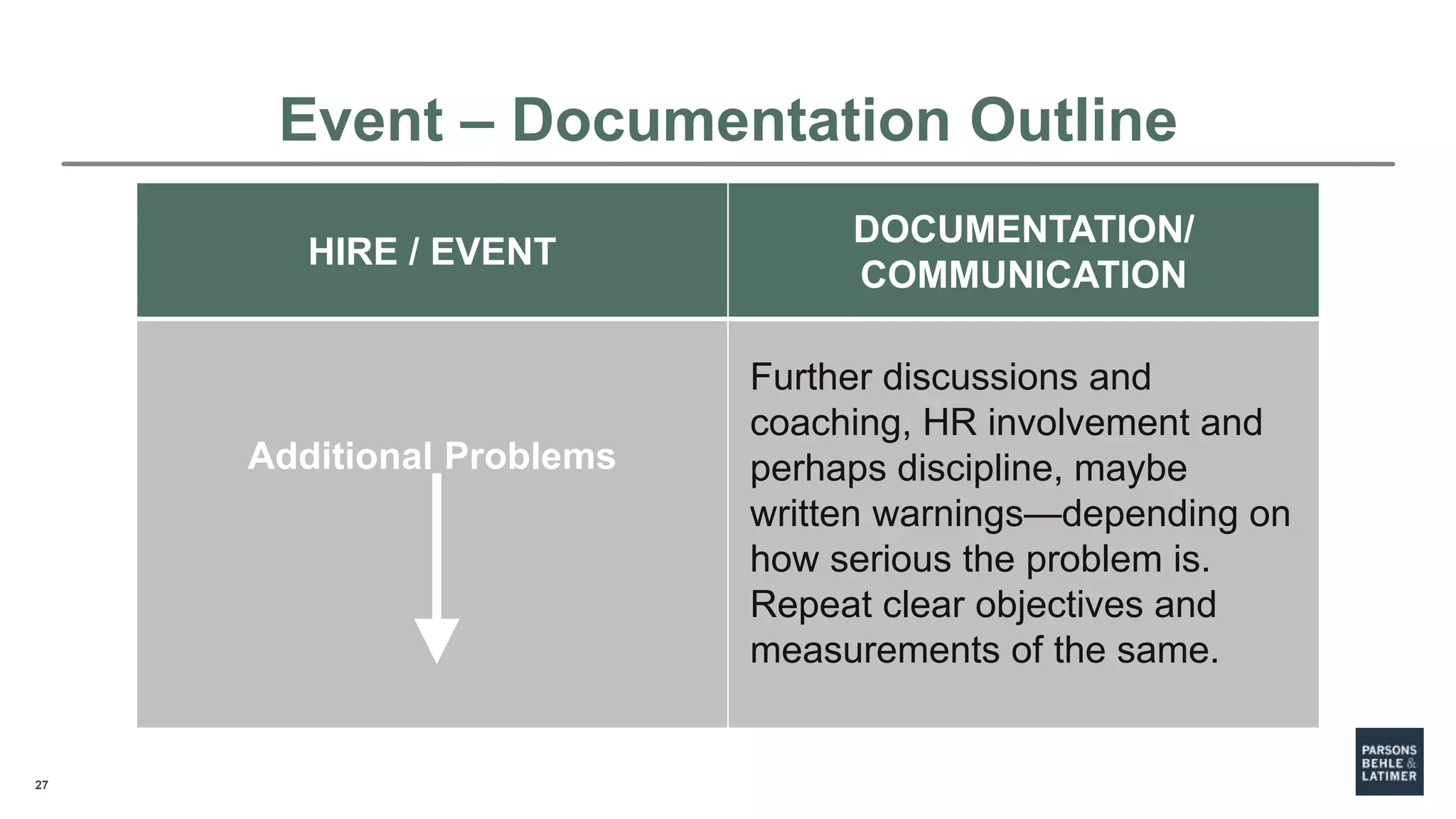
HIRE / EVENT
DOCUMENTATION/
COMMUNICATION
Additional Problems
Further discussions and
coaching, HR involvement and
perhaps discipline, maybe
written warnings—depending on
how serious the problem is.
Repeat clear objectives and
measurements of the same.
Event – Documentation Outline
28
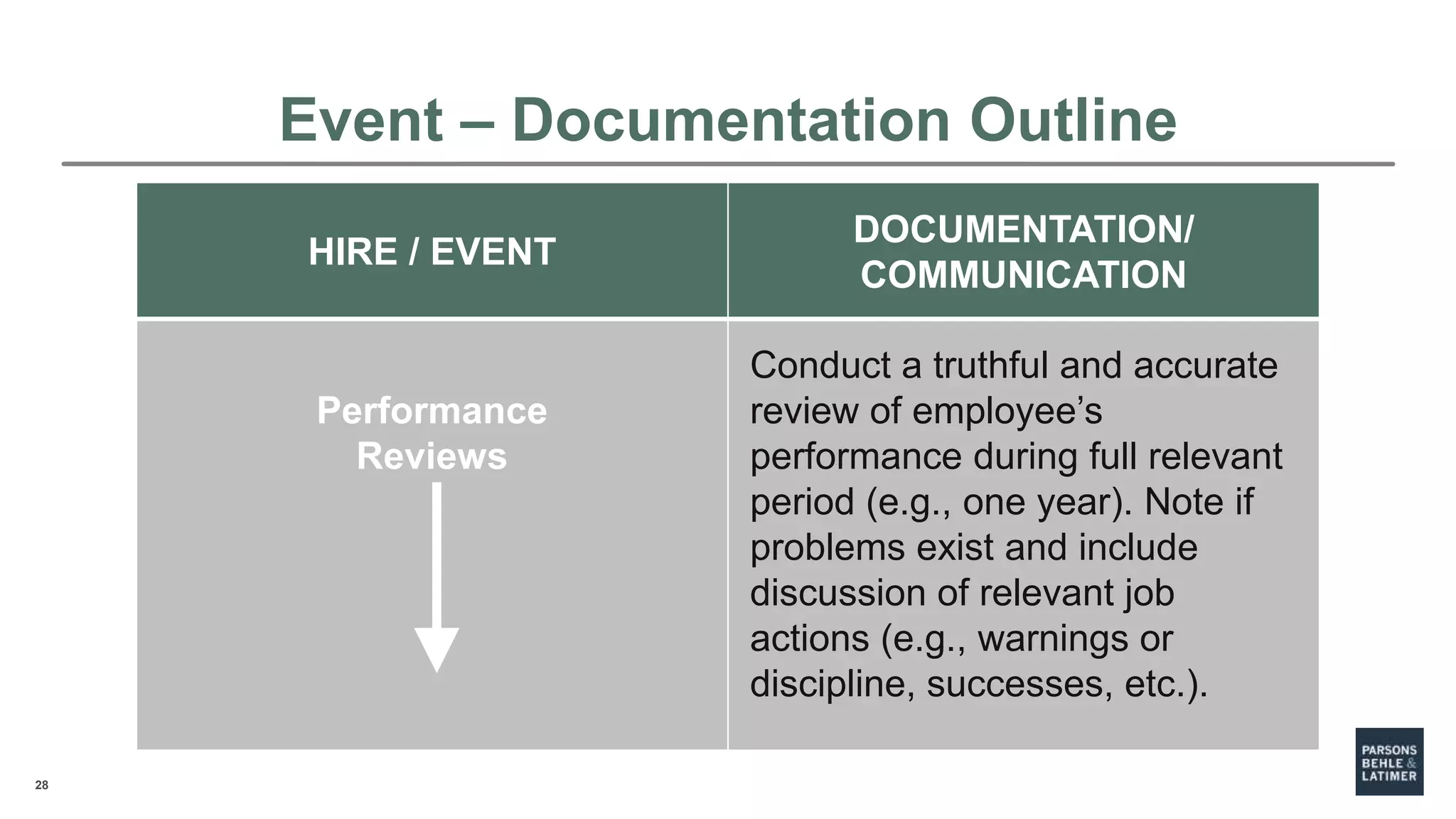
HIRE / EVENT
DOCUMENTATION/
COMMUNICATION
Performance
Reviews
Conduct a truthful and accurate
review of employee’s
performance during full relevant
period (e.g., one year). Note if
problems exist and include
discussion of relevant job
actions (e.g., warnings or
discipline, successes, etc.).
Event – Documentation Outline
29
HIRE / EVENT
DOCUMENTATION/
COMMUNICATION
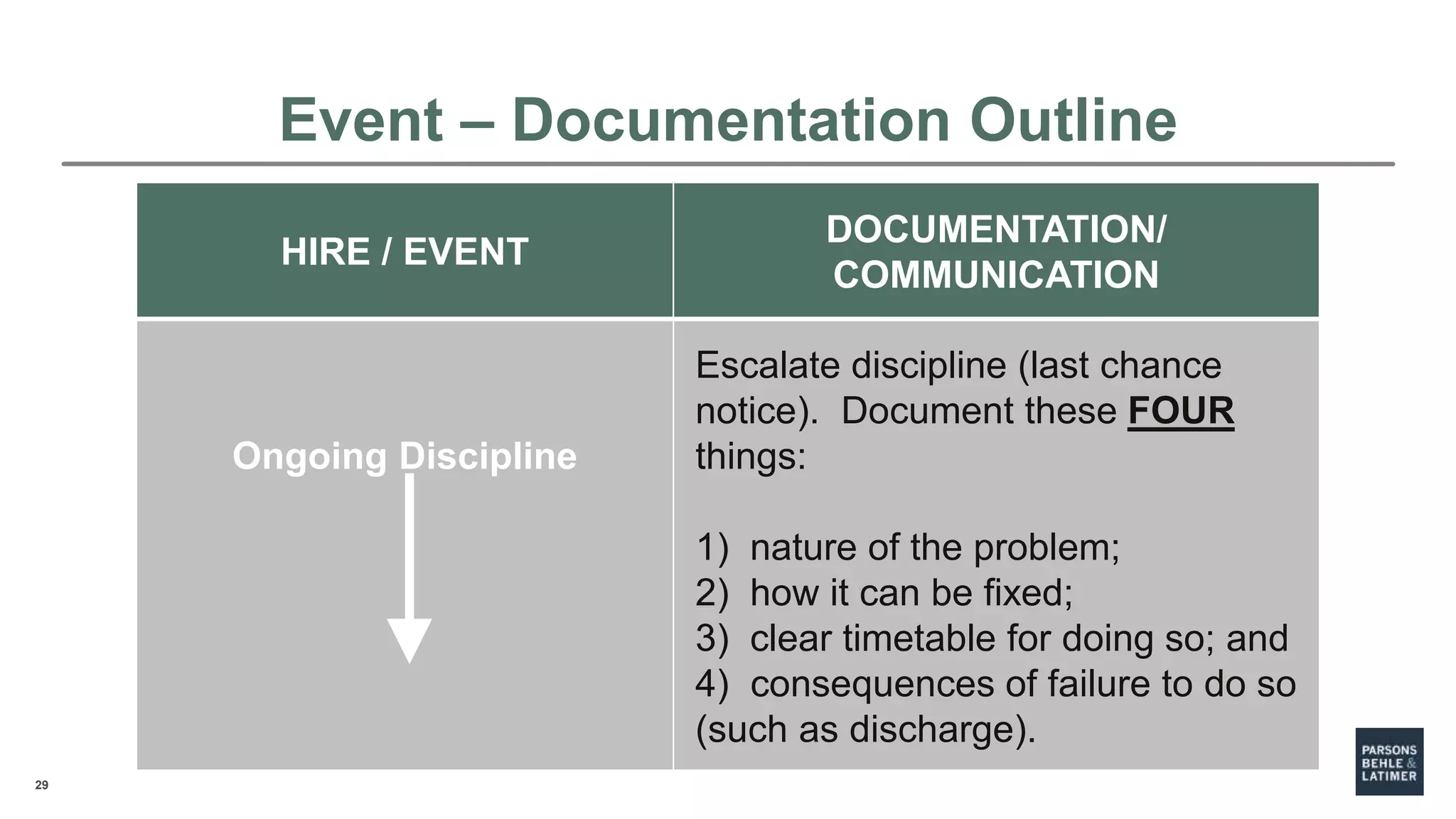
Ongoing Discipline
Escalate discipline (last chance
notice). Document these FOUR
things:
1) nature of the problem;
2) how it can be fixed;
3) clear timetable for doing so; and
4) consequences of failure to do so
(such as discharge).
Event – Documentation Outline
30
HIRE / EVENT
DOCUMENTATION/
COMMUNICATION
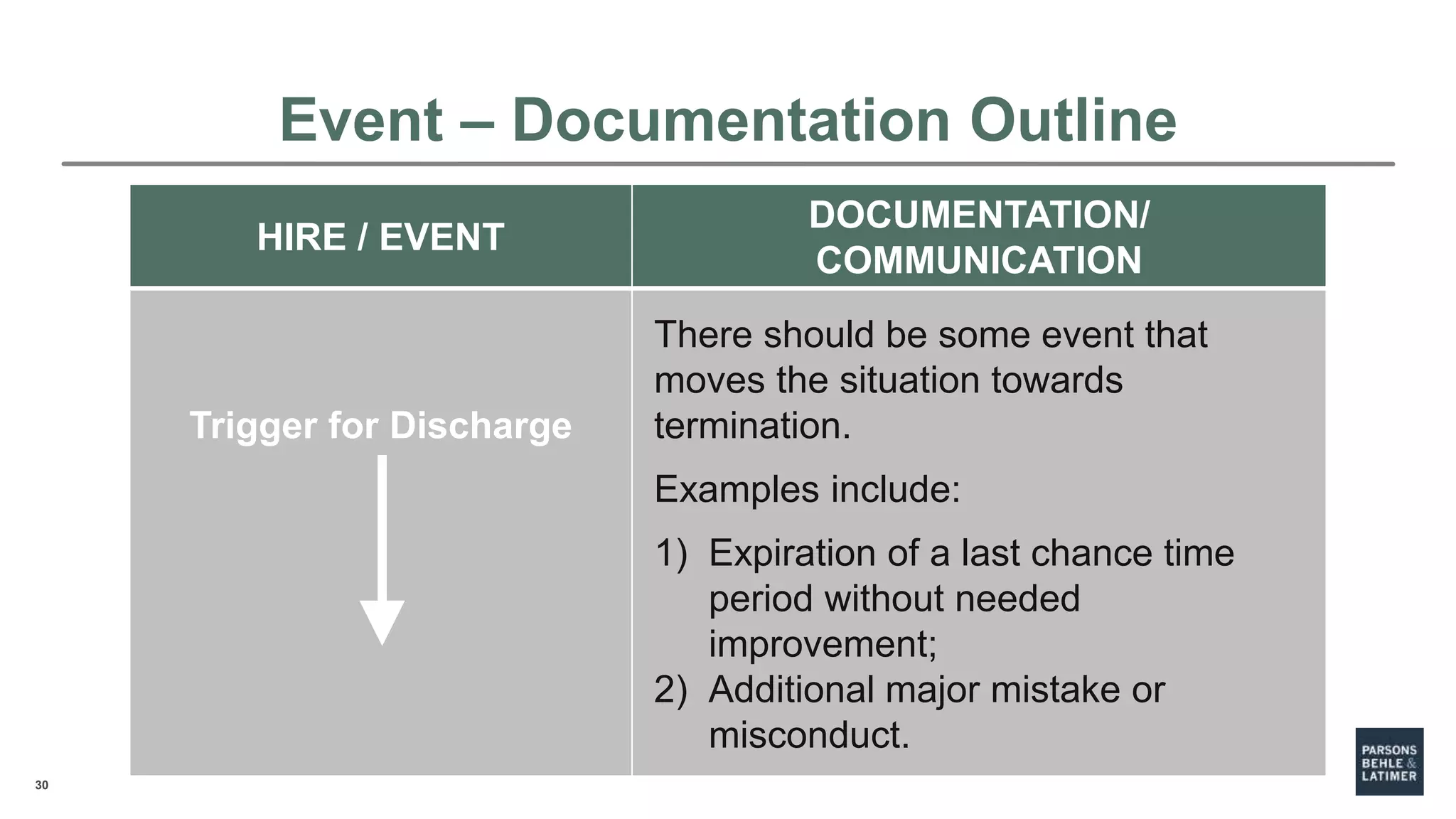
Trigger for Discharge
There should be some event that
moves the situation towards
termination.
Examples include:
1) Expiration of a last chance time
period without needed
improvement;
2) Additional major mistake or
misconduct.
Event – Documentation Outline
31
HIRE / EVENT DOCUMENTATION/ COMMUNICATION
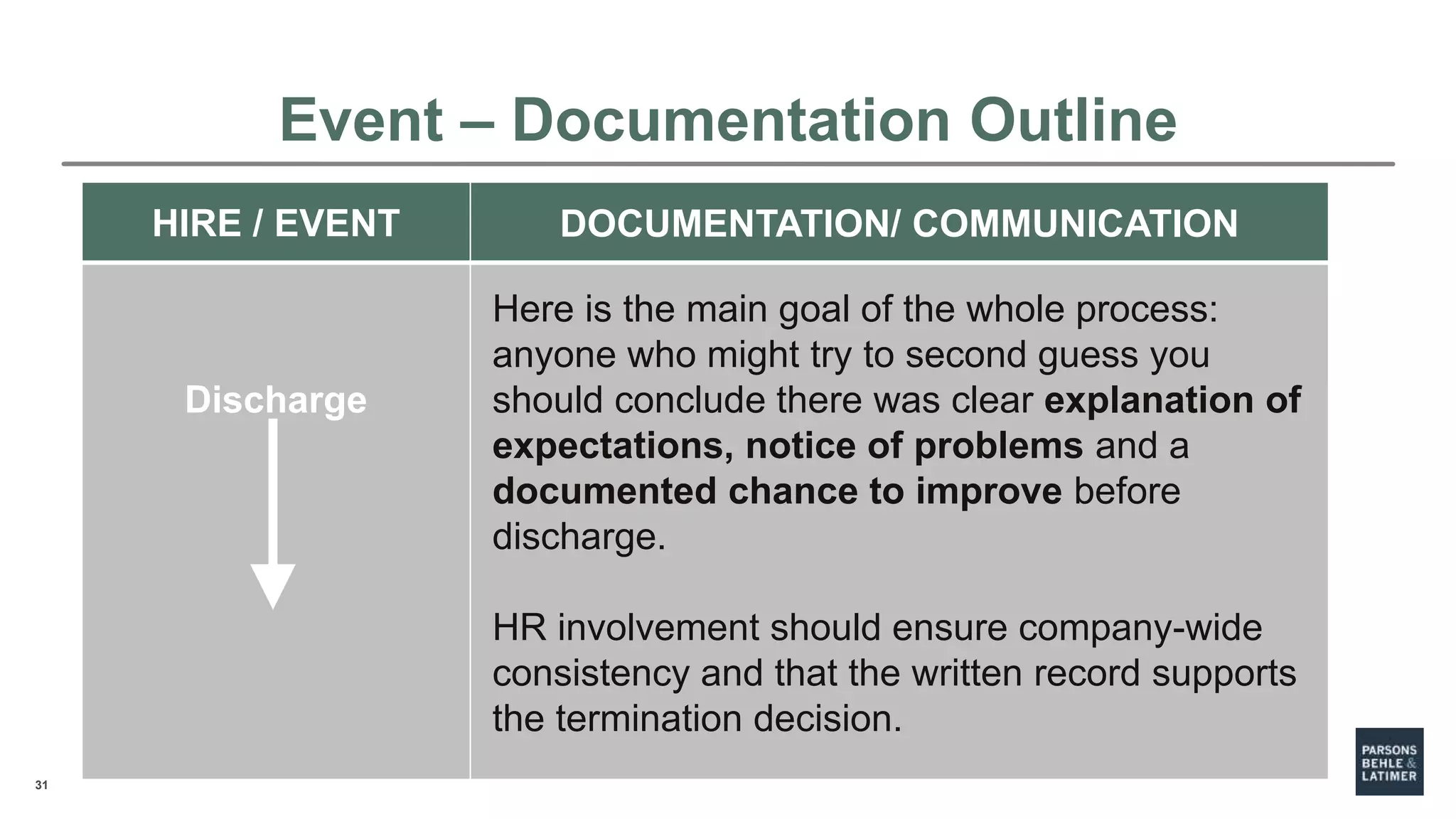
Discharge
Here is the main goal of the whole process:
anyone who might try to second guess you
should conclude there was clear explanation of
expectations, notice of problems and a
documented chance to improve before
discharge.
HR involvement should ensure company-wide
consistency and that the written record supports
the termination decision.
Event – Documentation Outline
32
HIRE / EVENT
DOCUMENTATION/
COMMUNICATION
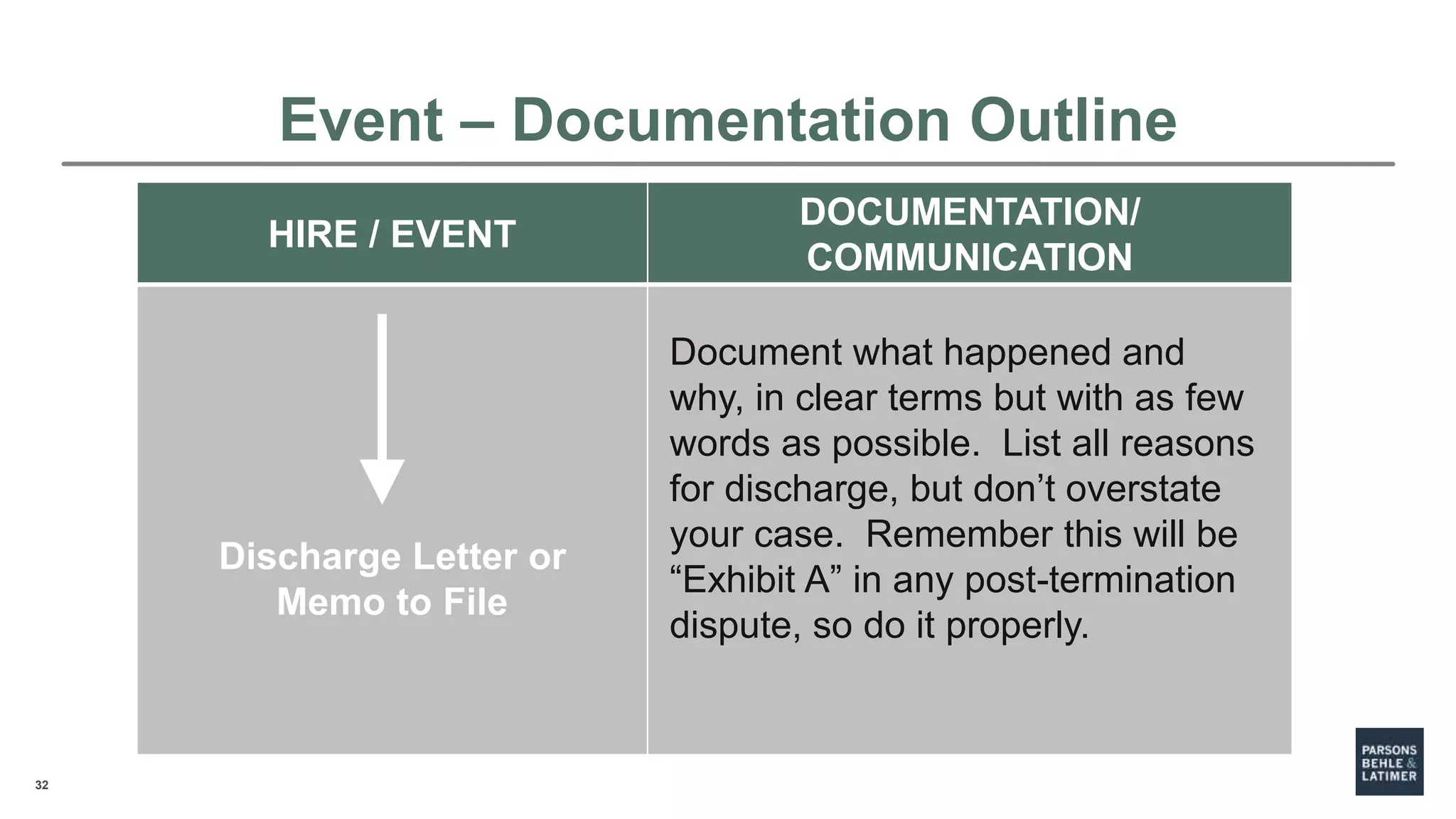
Discharge Letter or
Memo to File
Document what happened and
why, in clear terms but with as few
words as possible. List all reasons
for discharge, but don’t overstate
your case. Remember this will be
“Exhibit A” in any post-termination
dispute, so do it properly.
Event – Documentation Outline
Thank You
To download a PDF handbook of today’s seminar,
including presentations and materials, please visit
parsonsbehle.com/emp-seminar
34
For more information, contact:
Liz M. Mellem
406.317.7240
amellem@parsonsbehle.com

Employee Discipline and Termination: Avoiding Problems with Effective Communication and Documentation

  • 1.
    parsonsbehle.com October 5, 2022| Boise Centre East Employee Discipline and Termination: Avoiding Problems with Effective Communication and Documentation Liz M. Mellem 406.317.7240 amellem@parsonsbehle.com
  • 2.
    2 This presentation isbased on available information as of Oct. 5, 2022, but everyone must understand that the information provided is not a substitute for legal advice. This presentation is not intended and will not serve as a substitute for legal counsel on these issues. Legal Disclaimer
  • 3.
    3 At Will EmploymentDoctrine  In Idaho, the default for all employees is that they are employed “at- will.” This means that either the employer or the at-will employee may terminate the employment relationship at any time, with or without advance notice, and for any reason or no reason at all.  Although the at-will employment doctrine is alive and well in Idaho, employers who rely on it do so at their peril.  There are many federal and state exceptions to at-will employment!
  • 4.
    4 Exceptions to At-WillEmployment  State and federal laws prohibit employment discrimination on the basis of certain protected characteristics, including:  race, color, religion, age (40 and over), pregnancy, sex, gender, disability, national origin, ethnic background, sexual orientation, gender identity, genetic information (including of a family member), military service, and citizenship.
  • 5.
    5 Exceptions to At-WillEmployment  Be mindful of timing issues to avoid a retaliation claim.  Courts will infer a retaliatory intent when an employer takes adverse employment action soon after (e.g., within about 3 months) an engages in protected activity (e.g., complaining about discrimination or harassment).  In such cases, the burden will shift to the employer to rebut the retaliatory presumption with evidence of its legitimate, non- retaliatory intent.
  • 6.
    6 Exceptions to At-WillEmployment Other federal laws limit employer rights to terminate employees too, including:  Section 7 of the National Labor Relations Act  A framework of whistleblower laws (e.g., the Occupational Safety and Health Act and the Sarbanes-Oxley Act).  For a full list of federal whistleblower laws, go to www.whistleblowers.gov/statutes
  • 7.
    7 Exceptions to At-WillEmployment  Idaho has an exception to the at-will employment doctrine: “termination in violation of public policy” that occurs when an employer terminates an employee in a way that violates an important public policy (found in state statutes).  Common fact patterns: o Employee alleges they were fired in retaliation for reporting a workplace injury or filing a workers compensation claim. o Employee alleges they were fired in retaliation for reporting a suspected violation of law to their employer or to the authorities.
  • 8.
    8 Communication and Documentation Two pillars of good employee performance management and risk management  Communication = oral and written o Conveys information regarding job duties, expectations, performance feedback, corrective actions, etc. o Frequent and early communication and intervention will help avoid employment claims and protect an employer when claims are brought  Documentation can be a form of communication AND evidence of communication
  • 9.
    9 How will documentationhelp limit risk?  In a case that goes to a jury trial, we never want to rely on testimony alone because the jury gets to pick who to believe o Spoiler Alert: They tend to believe the employee more often than the employer!  Documents help to establish intent and show: o Decisions were performance or business based o Decisions were not motivated by discriminatory, retaliatory, or other unlawful intent
  • 10.
    10 Who Else CaresAbout Documentation?  Documentation also really matters to the agencies that enforce anti- discrimination and anti-retaliation employment laws: o State Agencies (UALD; Montana Human Rights Bureau; Idaho Human Rights Commission) o EEOC o DOL  Service of a Charge or Complaint is always accompanied by a Request for Information
  • 11.
    11 Excerpt from UALDRequest for Information
  • 12.
    12 Documents Requested inEvery UALD Charge  All documents relating to any disciplinary actions taken by Respondent against Charging Party in the past five years. * All documents related to the Charge. * A copy of Charging Party's job description at the time he/she left their employment or at the time you received this charge of discrimination as well as any minimum requirements of the position. * All documents that explain the reason(s) why Charging Party is no longer employed by Respondent. (If Charging Party is still employed by Respondent you do not need to answer this question.)
  • 13.
    13 Good Documentation IsCritical at 3 points: Performance Evaluations and Appraisals Discipline Termination
  • 14.
    14 “Golden Rule” ofDocumentation IF IT IS NOT IN WRITING, IT DIDN’T HAPPEN!
  • 15.
    15 “Golden Rule” ofDocumentation What happens when you have not documented?
  • 16.
    16 AVOIDING LEGAL TROUBLE PerformanceEvaluations, Reviews, and Appraisals o Should address: C.A.P. o CONDUCT o ATTENDANCE o PERFORMANCE  Be courageously Honest  But Not About Non C.A.P. Issues!
  • 17.
    17 Excerpts from FederalEmployee Evaluations  “Since my last report, this employee has reached rock-bottom and has started to dig.”  “I would not allow this employee to breed.”  “Works well when under constant supervision and cornered like a rat in a trap.”  “When she opens her mouth, it seems that it is only to change feet.”  “This young lady has delusions of adequacy.”  “He sets low personal standards and then consistently fails to achieve them.”  “This employee should go far, and the sooner he starts, the better.”  “He would argue with a signpost.”  “He brings a lot of joy whenever he leaves the room.”  “If you give him a penny for his thoughts, you’d get change.”
  • 18.
    18 Be Smart AboutDocumentation Terms used in a female employee’s evaluation: o “macho” o “overcompensated for being a woman” o “needs a course in charm school” o “matured from a masculine manager to an appealing lady partner candidate” o “should walk, talk and dress more femininely, wear makeup, get her hair styled and wear jewelry” Price Waterhouse v. Hopkins, 490 U.S. 228 (1989) (gender stereotyping)
  • 19.
    19 Characteristics of BadEvaluation Ratings Central Tendency – supervisor avoids rating employees either very high or very low. Reviews are clustered in the middle of the rating scale for all employees. Leniency – supervisor gives high ratings to all employees. Strictness – supervisor gives low ratings to all employees. Similar-to-Me – supervisor gives high ratings only to employees who share similar thinking, personality, background.
  • 20.
    20 Characteristics of GoodEvaluation Ratings  Addresses C.A.P. (Conduct, Attendance, Performance)  Provides same or similar review/ratings to same or similar Conduct, Attendance, Performance  Connected to Job Duties and Description  Looks at entire performance period; notes trends  Supports employment decisions o Ask: Should this person be promoted? Should this person be on a PIP?  Avoids stereotypes and personal attacks
  • 21.
    21 AVOIDING LEGAL TROUBLE Disciplineand Termination: How Good Communication and Documentation with All Employees Can Help You
  • 22.
  • 23.
    23 Best Practices  Outlinethe lifecycle of an employee and identify all communication possibilities: o Hiring o Training o Day-to-day Feedback/Daily Meetings o Biannual Reviews o Write Ups/Performance Improvement Plans  Outline the ideal way to communicate performance expectations and document C.A.P. along the way
  • 24.
    24 HIRE / EVENT WHATA SUPERVISOR SHOULD BE DOING HIRE DATE Employee gets a written job description giving fair notice of his/her job duties and performance expectations and goals. Event – Documentation Outline
  • 25.
    25 HIRE / EVENT DOCUMENTATION/ COMMUNICATION 90Days Later Supervisor checks in with employee after “orientation” period to verify adequate performance and good job fit. Thereafter, supervisor provides regular oversight, coaching, etc. Event – Documentation Outline
  • 26.
    26 HIRE / EVENT DOCUMENTATION/ COMMUNICATION FirstSign of Serious Problem Apart from regular coaching, at this point there should be a discussion with the employee. Document the discussion with a note to file or email. Depending on seriousness, escalate to HR and perhaps discipline. Early HR involvement can hasten a resolution and minimize risks. Event – Documentation Outline
  • 27.
    27 HIRE / EVENT DOCUMENTATION/ COMMUNICATION AdditionalProblems Further discussions and coaching, HR involvement and perhaps discipline, maybe written warnings—depending on how serious the problem is. Repeat clear objectives and measurements of the same. Event – Documentation Outline
  • 28.
    28 HIRE / EVENT DOCUMENTATION/ COMMUNICATION Performance Reviews Conducta truthful and accurate review of employee’s performance during full relevant period (e.g., one year). Note if problems exist and include discussion of relevant job actions (e.g., warnings or discipline, successes, etc.). Event – Documentation Outline
  • 29.
    29 HIRE / EVENT DOCUMENTATION/ COMMUNICATION OngoingDiscipline Escalate discipline (last chance notice). Document these FOUR things: 1) nature of the problem; 2) how it can be fixed; 3) clear timetable for doing so; and 4) consequences of failure to do so (such as discharge). Event – Documentation Outline
  • 30.
    30 HIRE / EVENT DOCUMENTATION/ COMMUNICATION Triggerfor Discharge There should be some event that moves the situation towards termination. Examples include: 1) Expiration of a last chance time period without needed improvement; 2) Additional major mistake or misconduct. Event – Documentation Outline
  • 31.
    31 HIRE / EVENTDOCUMENTATION/ COMMUNICATION Discharge Here is the main goal of the whole process: anyone who might try to second guess you should conclude there was clear explanation of expectations, notice of problems and a documented chance to improve before discharge. HR involvement should ensure company-wide consistency and that the written record supports the termination decision. Event – Documentation Outline
  • 32.
    32 HIRE / EVENT DOCUMENTATION/ COMMUNICATION DischargeLetter or Memo to File Document what happened and why, in clear terms but with as few words as possible. List all reasons for discharge, but don’t overstate your case. Remember this will be “Exhibit A” in any post-termination dispute, so do it properly. Event – Documentation Outline
  • 33.
    Thank You To downloada PDF handbook of today’s seminar, including presentations and materials, please visit parsonsbehle.com/emp-seminar
  • 34.
    34 For more information,contact: Liz M. Mellem 406.317.7240 amellem@parsonsbehle.com