What's Not to Like About Social Media in Workplace?
1.
parsonsbehle.com
October 23, 2024| Boise Centre East
What’s Not to Like About Social Media in
the Workplace?
Sean A. Monson
smonson@parsonsbehle.com
Michael Judd
mjudd@parsonsbehle.com
2.
Digital Handbook ofToday’s Seminar
You can scan the following QR code
or visit parsonsbehle.com/idaho-
seminar to download a PDF
handbook of today’s seminar.
2
3.
This presentation isbased on available information as of Oct. 23,
2024, but everyone must understand that the information provided is
not a substitute for legal advice. This presentation is not intended and
will not serve as a substitute for legal counsel on these issues.
Legal Disclaimer
3
4.
Note: Digging intoreal-life cases helps us polish our skills as HR
specialists. But the details of some of those cases—like the details of
many of the disputes you all encounter every day—can be distasteful and
even upsetting.
Our apologies, in advance, for a little rudeness to come.
A note about content
. . .even coworkers.
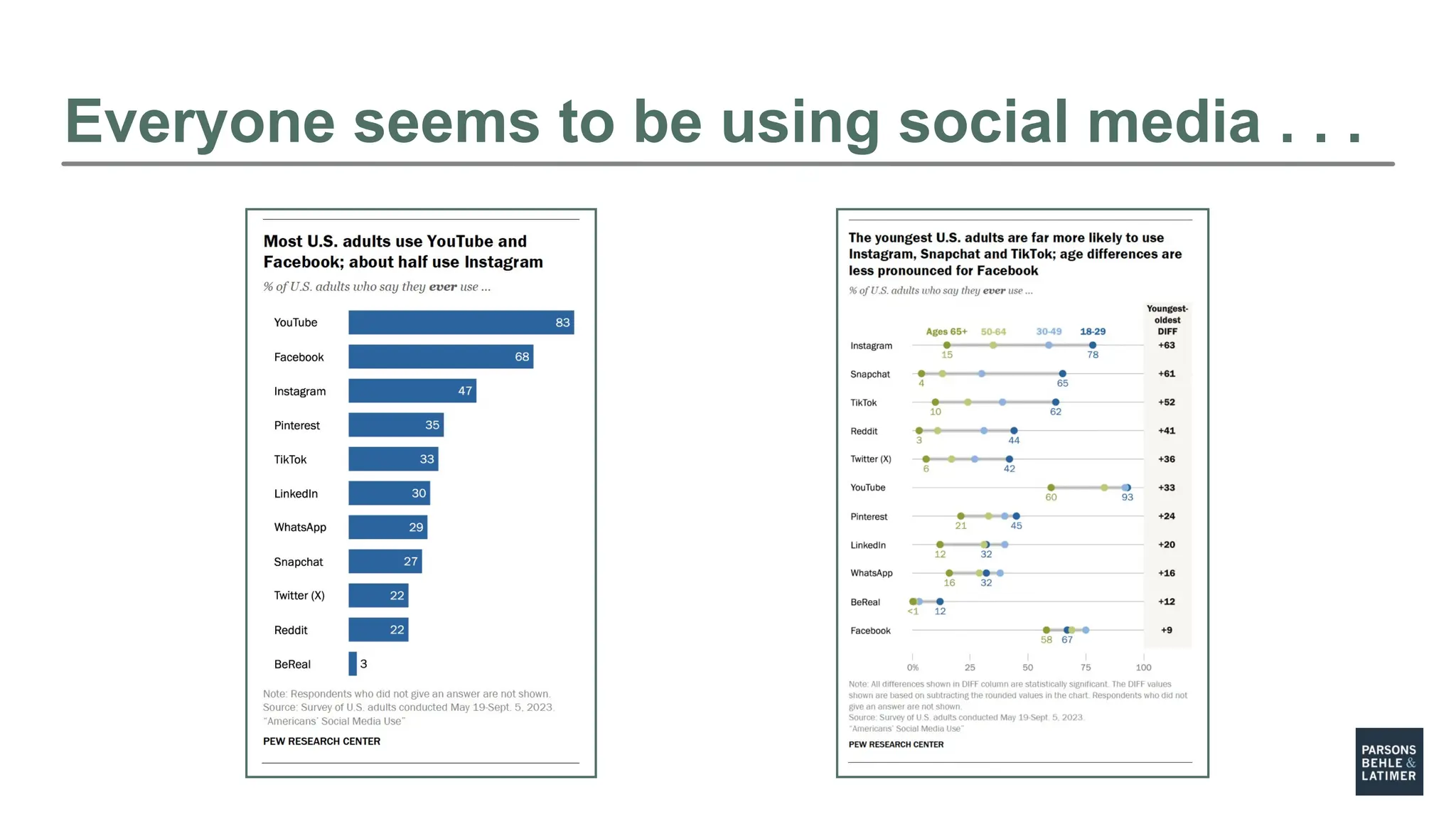
The Journal of Social Media in Society recently published an
article titled “Where and Why Coworkers Connect on Social
Media.” Highlights from the abstract include:
“[P]articipants were mainly connected to coworkers using
Facebook (89.7%), LinkedIn (77.6%), and Instagram (69.5%).”
“[N]o difference was found in employees’ motivation to connect
via social media whether they are working in-person, remotely, or
in a hybrid format.”
“[P]articipants had two main motivations for using personal social
media accounts to connect with coworkers: a) sharing and
obtaining personal information, and b) communicating about work
and nonwork issues.”
7.
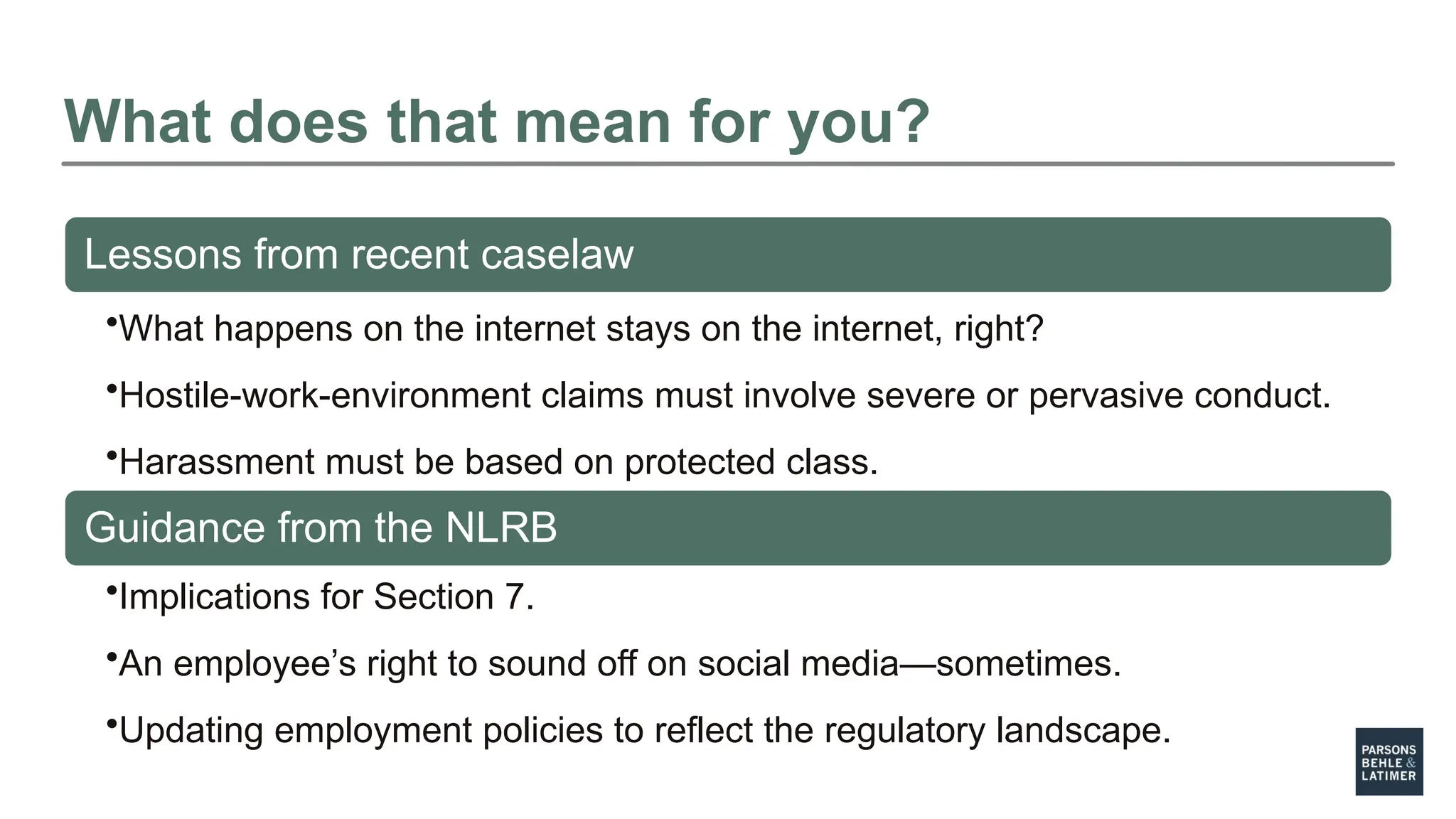
What does thatmean for you?
Lessons from recent caselaw
•What happens on the internet stays on the internet, right?
•Hostile-work-environment claims must involve severe or pervasive conduct.
•Harassment must be based on protected class.
Guidance from the NLRB
•Implications for Section 7.
•An employee’s right to sound off on social media—sometimes.
•Updating employment policies to reflect the regulatory landscape.
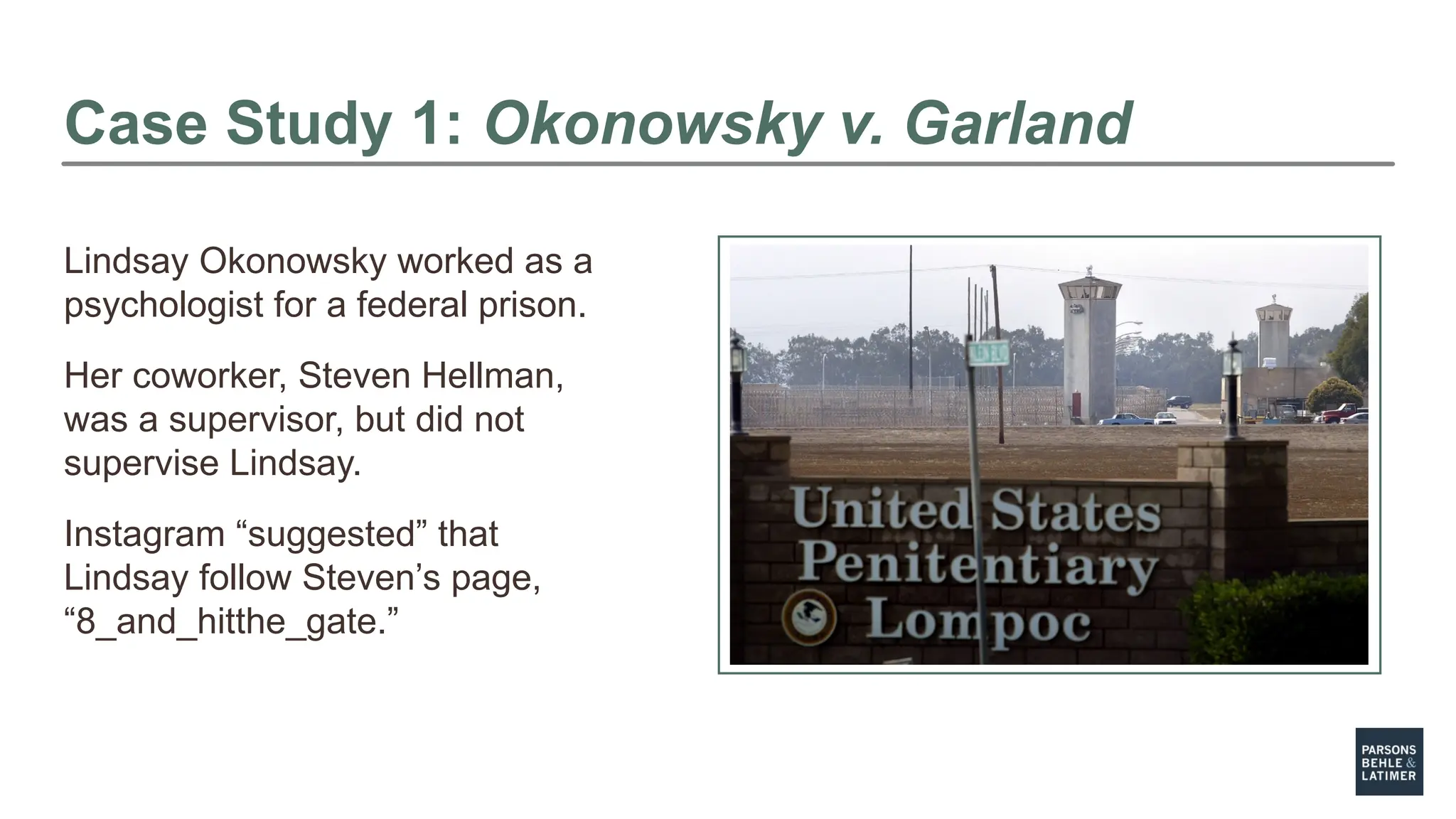
Case Study 1:Okonowsky v. Garland
Lindsay Okonowsky worked as a
psychologist for a federal prison.
Her coworker, Steven Hellman,
was a supervisor, but did not
supervise Lindsay.
Instagram “suggested” that
Lindsay follow Steven’s page,
“8_and_hitthe_gate.”
10.
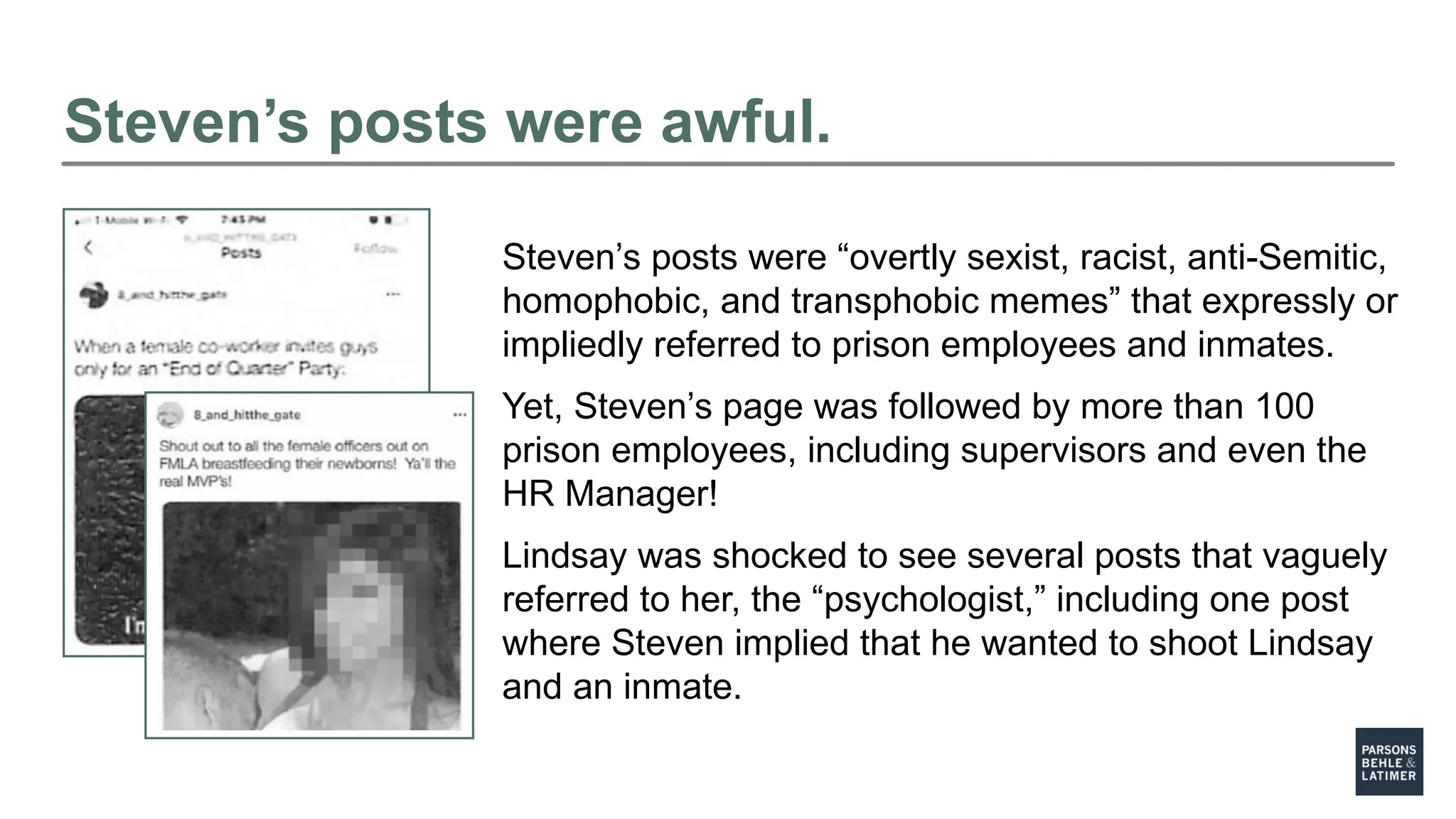
Steven’s posts wereawful.
Steven’s posts were “overtly sexist, racist, anti-Semitic,
homophobic, and transphobic memes” that expressly or
impliedly referred to prison employees and inmates.
Yet, Steven’s page was followed by more than 100
prison employees, including supervisors and even the
HR Manager!
Lindsay was shocked to see several posts that vaguely
referred to her, the “psychologist,” including one post
where Steven implied that he wanted to shoot Lindsay
and an inmate.
11.
Quiz Time: Round1
Lindsay complained to the prison’s Active Safety Manager and, eventually, HR.
12.
Lindsay’s complaints aredismissed.
The prison’s Acting Safety Manager
dismissed Lindsay’s concerns, telling
her:
“Sorry, not sorry.”
Making matters worse, the HR Manager dismissed Lindsay’s concerns too,
concluding that her complaint did not involve the workplace.
13.
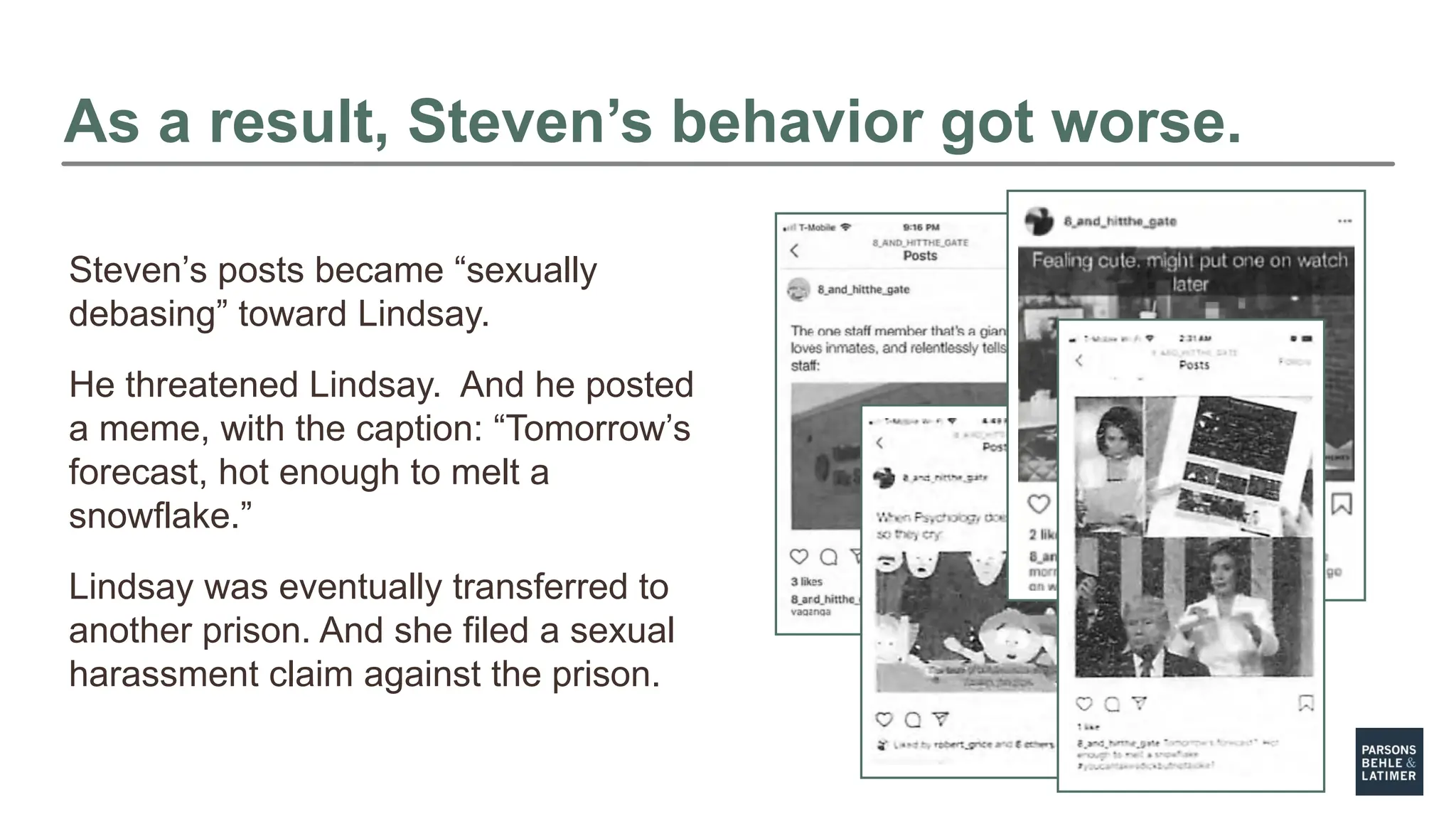
As a result,Steven’s behavior got worse.
Steven’s posts became “sexually
debasing” toward Lindsay.
He threatened Lindsay. And he posted
a meme, with the caption: “Tomorrow’s
forecast, hot enough to melt a
snowflake.”
Lindsay was eventually transferred to
another prison. And she filed a sexual
harassment claim against the prison.
14.
The Ninth Circuitdropped the gavel.
The Court held that “even if
discriminatory or intimidating conduct
occurs wholly offsite, it remains
relevant to the extent it affects the
employee’s working environment.”
15.
The Ninth Circuitwasn’t done.
“Social Media posts are permanently and infinitely viewable and re-viewable by
any person with access to the page or site on which the posts appear. No matter
where [Steven] was or what he was doing when he made his posts, [coworkers]
who followed the page were free to, and did, view, ‘like,’ comment, share,
screenshot, print, and otherwise engage with or perceive his abusive posts from
anywhere. The Instagram page also served as a record of which co-workers
subscribed to the page and commented on posts, showed their comments and
their ‘likes,’ and could be seen at any time or at any place—including from the
workplace.”
16.
Takeaways
Just because conductoccurs offsite does
not mean it cannot be the basis for a
harassment claim.
Employee social-media pages allow
coworkers to interact with content at any
time, from anywhere.
If conduct affects an employee’s working
environment, there may be trouble.
This Photo by Unknown Author is licensed under CC BY-NC
17.
Case Study 2:A (slightly) more nuanced
picture of online harassment and the
modern workplace.
18.
Case Study 2:Chinery v. Am. Airlines
Melissa Chinery worked as a flight attendant for
American Airlines.
She ran for presidency of the local union chapter, on a
platform disagreeing with the existing union contract, but
lost the election.
After her election loss, she
said other flight attendants
began harassing her online.
19.
Wingnuts . .. the Facebook group
“Chinery claims that a large group of American flight
attendants, and four specific flight attendants, harassed her
during and after the election campaign through posts they
made to several Facebook groups, including a group called
Wingnuts.
Wingnuts’s membership is composed primarily of American
flight attendants based out of Philadelphia who use the
page to communicate about work-related issues such as
scheduling, layovers, and flight operations. American did
not create the Wingnuts Facebook group and does not
monitor it.”
20.
The Harassing Posts
FirstPoster: Posted a photograph of a
broken record, which Melissa believes was
harassing, and about her, because she had
previously complained to HR about the poster.
Melissa’s claims of harassment were based on posts by four different men in
the “Wingnuts” Facebook group.
Second Poster: Made no gender-based comments about Melissa, but Melissa
viewed the poster as part of a bullying effort that occurred during her union-
leadership campaign.
21.
The Harassing Posts
ThirdPoster: During the union election, a third
poster posted on Wingnuts:
“This is war. [The incumbent union leaders]
are my friends. If you f**k with my friends you
f*** with me and I don't like being f***ked with :
(.”
Melissa believed this statement was gender-related
because she did not believe he would have said that
if she were a male candidate.
22.
Fourth Poster: Thefinal poster was more prolific—and demeaning.
He made several posts that contained sexualized, belittling puns.
He made several references to that Melissa believed were veiled digs at her
(including posting a picture of a “bedazzled vagina”).
He made disparaging references to the appearances of union opponents
“Have any of them LOOKED in a mirror? Tuck your shirt in fat ass ...
Fix your hair ... How bout [sic] a tie? A little lipstick? Maybe a smile
and a HELLO when a passenger steps aboard.”
He engaged in name-calling, including calling those opposed to the union
contract “cavalier harpies” and “shrews of misinformation.”
The Harassing Posts
23.
Quiz Time: Round2
Melissa reported these posts to HR, invoking a company social-media policy.
24.
What did AmericanAirlines do?
American Airlines determined that Melissa’s
claims were meritless.
Melissa complained that the investigator
failed to adequately address her concerns
and that American could have enforced its
social-media policy against the flight
attendants at issue but chose not to.
25.
The court dismissesharassment claims.
Melissa raised disparate treatment, hostile work
environment, and retaliation claims.
American moved for summary judgment, and the
district court granted that motion in full.
With respect to her hostile work environment claim,
the Court concluded that no reasonable trier of fact
could find that the Facebook posts were “so
objectively severe or pervasive that [they] would
unreasonably interfere with an employee's work
performance.”
26.
The Third Circuitaffirms.
“It is clear that the alleged instances of harassment were not so objectively
severe or pervasive to give rise to a cause of action . . . the offending behavior
must be sufficiently severe or pervasive to alter the conditions of the victim’s
employment and create an abusive working environment . . . A court must
analyze the alleged harassment by looking at all the circumstances . . . Looking
at all of the complained of behavior objectively, even that which does not appear
connected to gender and instead appears to be related to Chinery's stance on
union issues, the behavior does not amount to severe or pervasive sexual
harassment.”
27.
The Third Circuitaffirms.
“[I]nsults in the workplace do not constitute discrimination merely because the
words used have sexual content or connotations . . . . [T]he posts, if directed at
Chinery, appear juvenile and unprofessional, particularly when referring to a
colleague . . . [but] Title VII is not a general civility code.”
28.
Takeaways
Online harassment—like anyother harassment—must be severe or pervasive to
constitute a hostile work environment.
Of course, even if this conduct does not violate the law, it may well violate your
internal policies and be grounds for discipline.
Case Study 3:Koslosky v. Am. Airlines
Colleen Koslosky worked as a customer-service
agent for American Airlines at the Philadelphia
International Airport.
In 2017, she made a series of racially insensitive
posts on Facebook, and those posts went viral.
31.
The posts inquestion
“If I were Black in America, I think I’d get down on my knees every day and
thank my lucky stars that my ancestors were brought over here as slaves,
because when you look at the amazing rights, privileges, and benefits that
come along with U.S. citizenship, and then compare that to the relentless
poverty, violence, and suffering in Africa, it’s like winning the Super Lotto a
hundred times over. But I guess I’m old-fashioned that way, believing as I do in
the importance of gratitude, humility, and respect.”
“We are losing Blue Eyed People. Too many are reproducing with Brown Eyed
People. It is true. Blue Eyed People ... UNITE!”
32.
The posts wentviral. Complaints rolled in.
An American employee in Ft. Lauderdale reported that customers and
employees as far away as Seattle were discussing Colleen’s posts.
Employees both in Philadelphia and elsewhere complained to the company
through various channels, including to the company’s CEO. American
passengers also complained.
However, for a company as large as American, Colleen was not (of course) the
only employee posting inflammatory things online.
33.
Quiz Time: Round3
American’s HR team faced a challenge. Did Colleen’s inflammatory posts create
special concerns that would justify sterner treatment?
34.
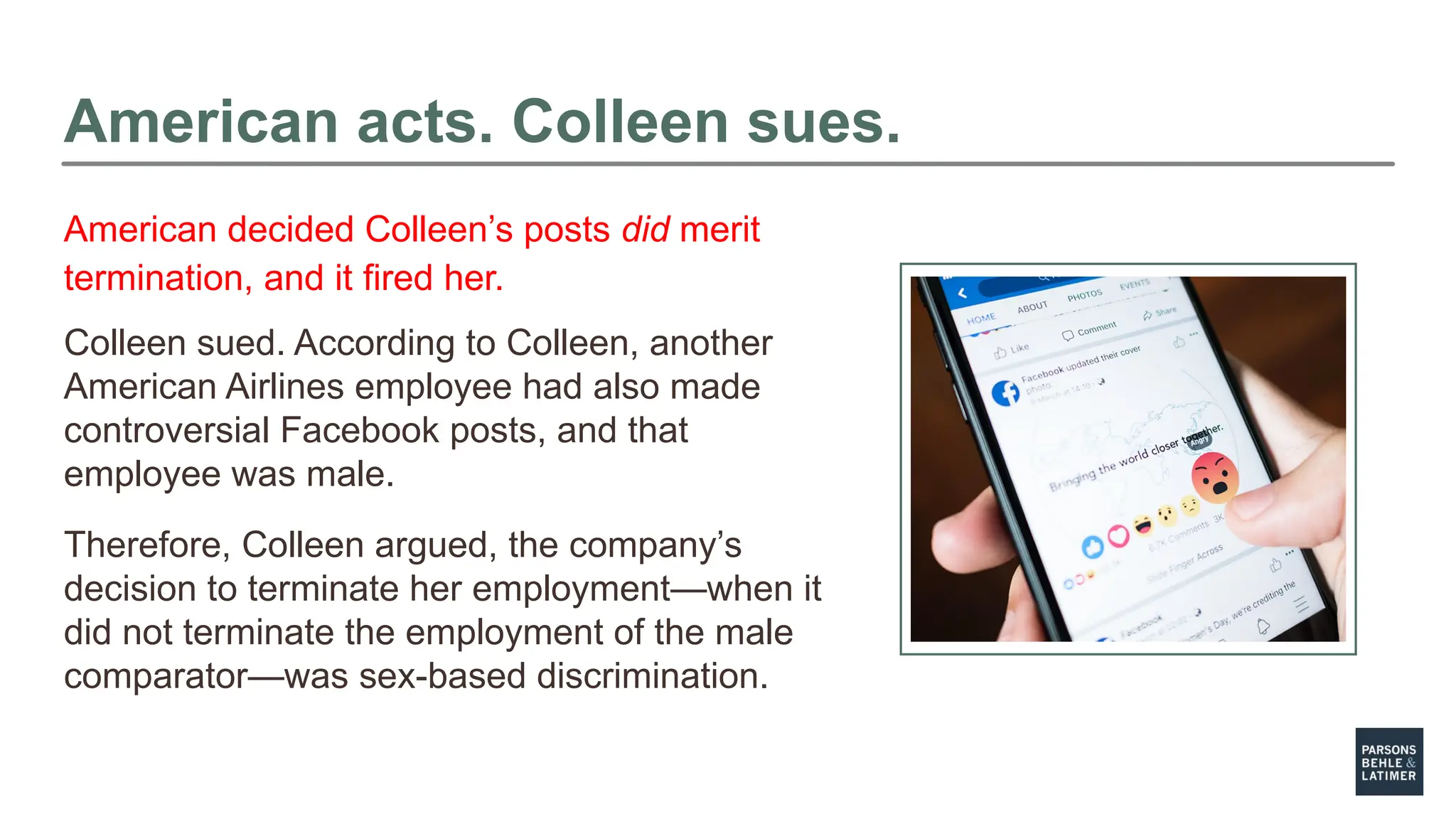
American acts. Colleensues.
Colleen sued. According to Colleen, another
American Airlines employee had also made
controversial Facebook posts, and that
employee was male.
Therefore, Colleen argued, the company’s
decision to terminate her employment—when it
did not terminate the employment of the male
comparator—was sex-based discrimination.
American decided Colleen’s posts did merit
termination, and it fired her.
35.
But the courtlooked closely at those posts.
The “comparator” employee had posted sharp political commentary.
As the court pointed out, the other employee “posted inflammatory social media
comments to Facebook, but his comments tended to be critical of President
Trump and his supporters. These comments included ‘[g]et rid of ignorant
rednecks,’ and ‘Trump supporter [equals] Nazi sympathizer [equals] stay away
from me.’”
Political Affiliation ≠ Protected Class
36.
Moreover . .. no one raised complaints.
“Although Mr. Doersam had a Facebook account that identified himself as an
American employee, no one complained to the company about his comments.
American never disciplined Doersam for violating its policies. . . Ms. Koslosky
offers no evidence that anyone ever reported Mr. Doersam's posts to American.
Therefore, American could not have treated the two differently because, without
knowing about his posts, it had no basis to take any action against Mr.
Doersam.”
37.
Colleen’s posts weredifferent.
“Colleen Koslosky learned first-hand the danger of social media posts while
working for American Airlines in 2017. Over a short period of time, she made
several posts on her Facebook account containing inflammatory and racially
insensitive sentiments that went viral. The posts created a firestorm.
American’s employees complained, as did some of its customers. So
American fired her. In this lawsuit, she claims that American’s decision to
terminate her employment was discriminatory . . . because it was a pretext for
some discriminatory intent . . . She does not have the evidence to support her
claims, though. Instead, the evidence points to one conclusion: American
fired her for her posts on social media.”
38.
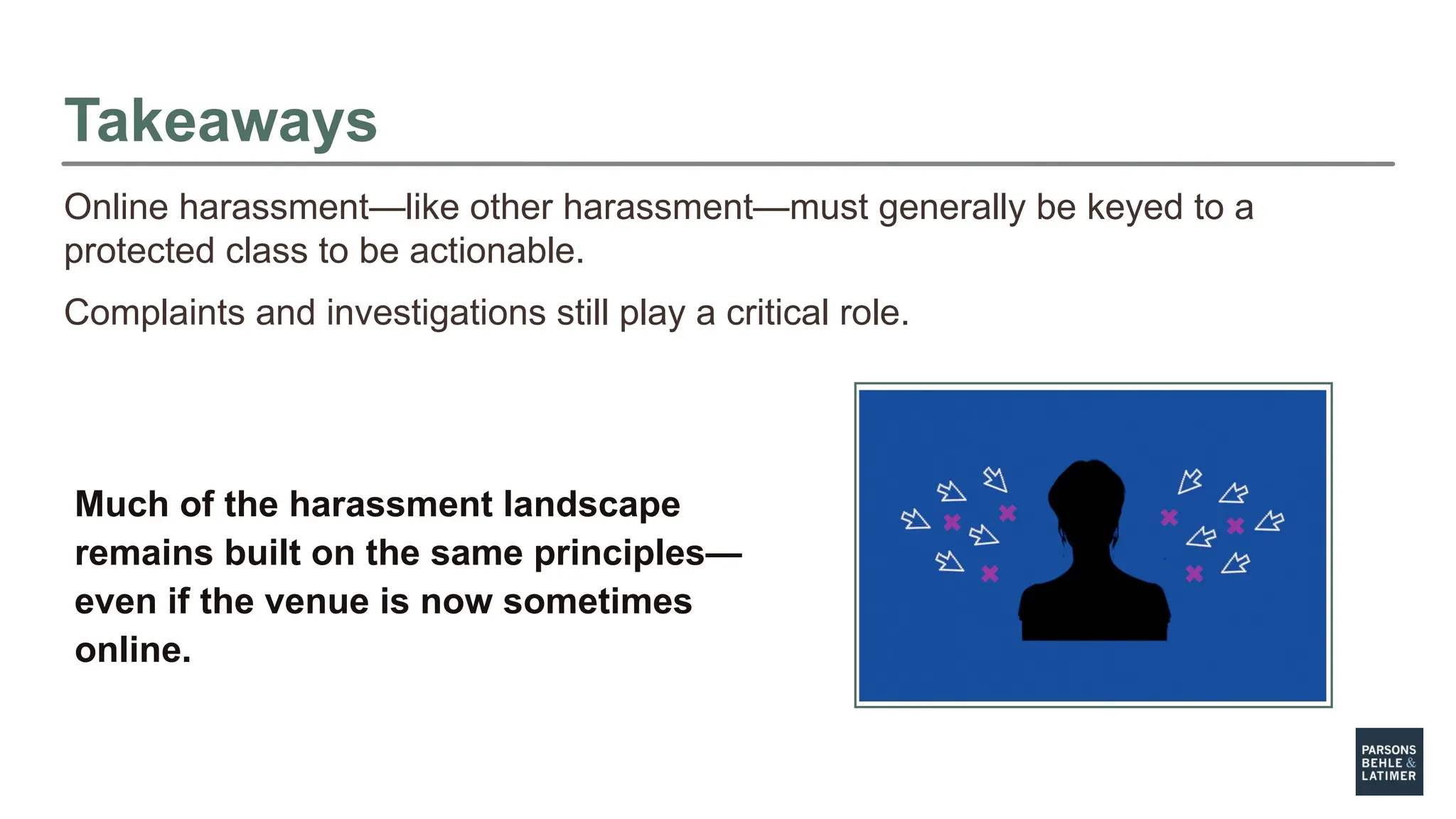
Takeaways
Online harassment—like otherharassment—must generally be keyed to a
protected class to be actionable.
Complaints and investigations still play a critical role.
Much of the harassment landscape
remains built on the same principles—
even if the venue is now sometimes
online.
But Idaho isnot one of them.
Still, what should employers
consider when employee social-
media use becomes an issue?
42.
“We don’t havea workplace union, so
the NLRB doesn’t care what goes on
here . . . right? Right?!”
43.
Consider one morehypothetical . . .
HR becomes aware of an employee complaining about the company on
Facebook. Upset with conditions at the office, he targets his manager specifically,
calling him a “nasty mother f***er,” then adds, “f*** his mother and his entire
f***ing family.”
44.
Quiz Time: Round4
How should HR respond to that social media post?
45.
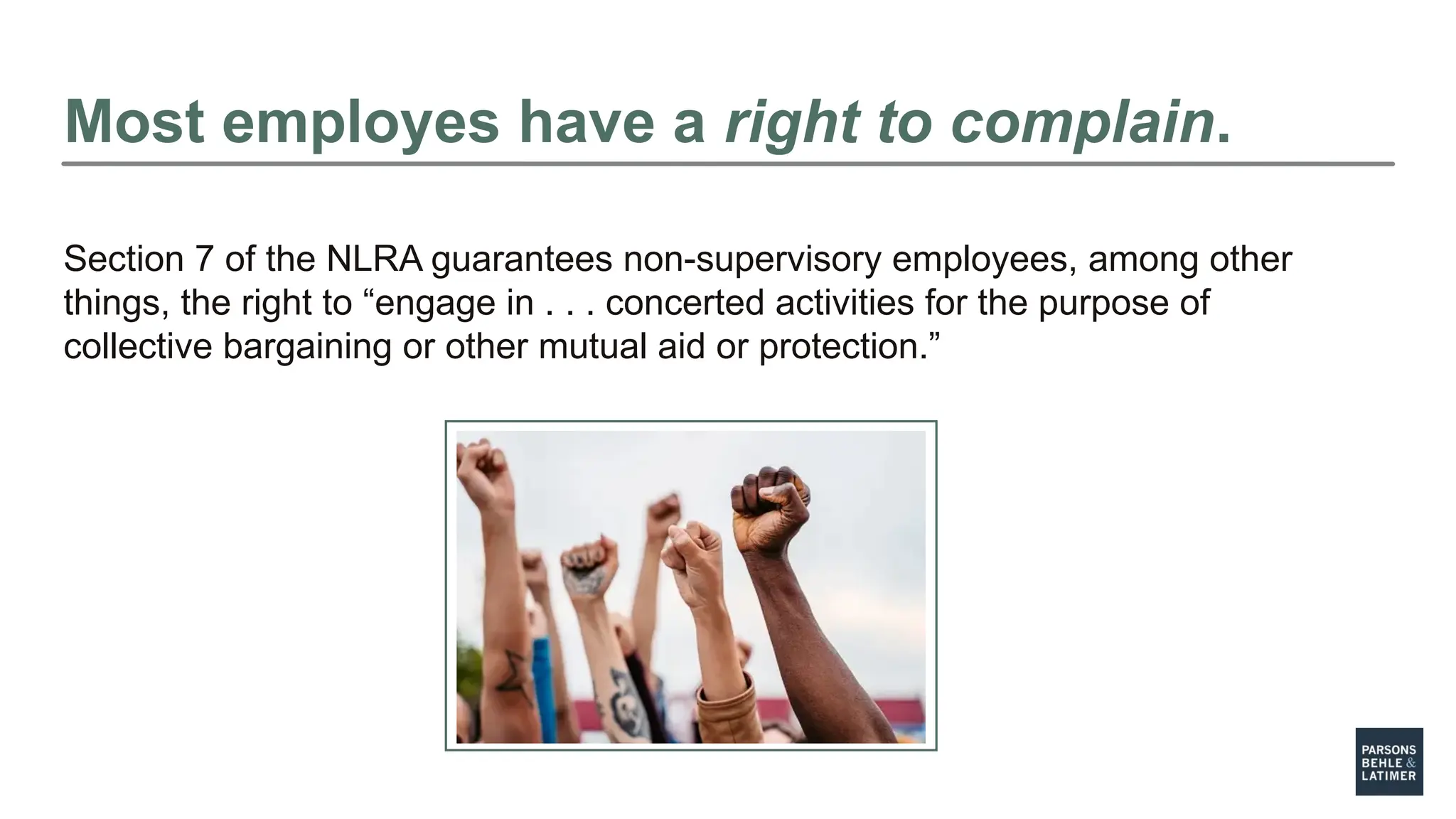
Most employes havea right to complain.
Section 7 of the NLRA guarantees non-supervisory employees, among other
things, the right to “engage in . . . concerted activities for the purpose of
collective bargaining or other mutual aid or protection.”
46.
“Employees shall havethe right to self-organization, to
form, join, or assist labor organizations, to bargain
collectively through representatives of their own
choosing, and to engage in other concerted activities
for the purpose of collective bargaining or other
mutual aid or protection, and shall also have the right
to refrain from any or all such activities.” (NLRA, Section
7.)
Key phrase = acting in concert
The NLRB’s view on complaining.
47.
Definition time: what’s“concerted activity,”
anyway?
Is the activity concerted?
Generally…
o Two or more non-manager employees
o Acting together
o To improve wages or working conditions.
But the action of a single employee may be considered concerted if…
o The employee involves co-workers before acting, or
o Acts on behalf of others
48.
Does the actionseek to benefit other employees?
Will the improvements sought benefit more than just the employee
taking action (protected)?
Or is the action more along the lines of a personal gripe (not protected)?
Is the action carried out in a way that causes it to lose protection?
Reckless or malicious behavior—e.g, sabotaging equipment, threatening
violence, spreading lies about a product, or revealing trade secrets—may
cause concerted activity to lose its protection.
Definition time: what’s “concerted activity,”
anyway?
49.
Give me somemore examples.
Recall our opening hypothetical: an employee posts on Facebook, in connection
with complaints about working conditions, that his manager is a “nasty mother
f***er” and “f*** his mother and his entire f***ing family.”
An employee, without involving any coworkers, blurts out during an all-hands
meeting to discuss COVID-19 protocols, “We shouldn’t be working!” (The
employee also voiced concerns about the employer’s lack of proper
precautions.)
An employee states that workers did not “give a f***” about a cross-training
program and telling his manager to “shove it up his f***in’ ass!”
50.
Takeaways
What can anemployer do when (non-supervisory) employees speak ill of
the workplace, the company, or their coworkers or managers?
Mere griping, without involvement or solicitation of co-workers, is not protected
by the NLRA.
But when two or more employees are talking about work—even in a negative
way and even when the rest of the world can see it on social media—tread
lightly.
51.
The key answers,the answer key.
The NLRB tells us the key to regulating social media conduct: CONTEXT.
Your communications with employees should avoid sweeping bans on social
media conduct.
Refer your employees to your conduct-based policies – e.g., your anti-
harassment policy.
Always make clear that communications with coworkers about their working
conditions are allowed.
52.
Thank You!
To downloada PDF handbook of
today’s seminar, scan the QR code or
visit parsonsbehle.com/idaho-seminar
53.
For more information,contact:
Sean A. Monson
smonson@parsonsbehle.com
801.536.6714
Michael Judd
mjudd@parsonsbehle.com
801.536.6648
53
![. . . even coworkers.
The Journal of Social Media in Society recently published an
article titled “Where and Why Coworkers Connect on Social
Media.” Highlights from the abstract include:
“[P]articipants were mainly connected to coworkers using
Facebook (89.7%), LinkedIn (77.6%), and Instagram (69.5%).”
“[N]o difference was found in employees’ motivation to connect
via social media whether they are working in-person, remotely, or
in a hybrid format.”
“[P]articipants had two main motivations for using personal social
media accounts to connect with coworkers: a) sharing and
obtaining personal information, and b) communicating about work
and nonwork issues.”](https://image.slidesharecdn.com/2024boiseemploymentlawseminar-socialmediainworkplace-monsonjudd-250515210557-9fca812f/75/What-s-Not-to-Like-About-Social-Media-in-Workplace-6-2048.jpg)


![The Ninth Circuit wasn’t done.
“Social Media posts are permanently and infinitely viewable and re-viewable by
any person with access to the page or site on which the posts appear. No matter
where [Steven] was or what he was doing when he made his posts, [coworkers]
who followed the page were free to, and did, view, ‘like,’ comment, share,
screenshot, print, and otherwise engage with or perceive his abusive posts from
anywhere. The Instagram page also served as a record of which co-workers
subscribed to the page and commented on posts, showed their comments and
their ‘likes,’ and could be seen at any time or at any place—including from the
workplace.”](https://image.slidesharecdn.com/2024boiseemploymentlawseminar-socialmediainworkplace-monsonjudd-250515210557-9fca812f/75/What-s-Not-to-Like-About-Social-Media-in-Workplace-15-2048.jpg)



![The Harassing Posts
Third Poster: During the union election, a third
poster posted on Wingnuts:
“This is war. [The incumbent union leaders]
are my friends. If you f**k with my friends you
f*** with me and I don't like being f***ked with :
(.”
Melissa believed this statement was gender-related
because she did not believe he would have said that
if she were a male candidate.](https://image.slidesharecdn.com/2024boiseemploymentlawseminar-socialmediainworkplace-monsonjudd-250515210557-9fca812f/75/What-s-Not-to-Like-About-Social-Media-in-Workplace-21-2048.jpg)
![Fourth Poster: The final poster was more prolific—and demeaning.
He made several posts that contained sexualized, belittling puns.
He made several references to that Melissa believed were veiled digs at her
(including posting a picture of a “bedazzled vagina”).
He made disparaging references to the appearances of union opponents
“Have any of them LOOKED in a mirror? Tuck your shirt in fat ass ...
Fix your hair ... How bout [sic] a tie? A little lipstick? Maybe a smile
and a HELLO when a passenger steps aboard.”
He engaged in name-calling, including calling those opposed to the union
contract “cavalier harpies” and “shrews of misinformation.”
The Harassing Posts](https://image.slidesharecdn.com/2024boiseemploymentlawseminar-socialmediainworkplace-monsonjudd-250515210557-9fca812f/75/What-s-Not-to-Like-About-Social-Media-in-Workplace-22-2048.jpg)


![The court dismisses harassment claims.
Melissa raised disparate treatment, hostile work
environment, and retaliation claims.
American moved for summary judgment, and the
district court granted that motion in full.
With respect to her hostile work environment claim,
the Court concluded that no reasonable trier of fact
could find that the Facebook posts were “so
objectively severe or pervasive that [they] would
unreasonably interfere with an employee's work
performance.”](https://image.slidesharecdn.com/2024boiseemploymentlawseminar-socialmediainworkplace-monsonjudd-250515210557-9fca812f/75/What-s-Not-to-Like-About-Social-Media-in-Workplace-25-2048.jpg)
![The Third Circuit affirms.
“[I]nsults in the workplace do not constitute discrimination merely because the
words used have sexual content or connotations . . . . [T]he posts, if directed at
Chinery, appear juvenile and unprofessional, particularly when referring to a
colleague . . . [but] Title VII is not a general civility code.”](https://image.slidesharecdn.com/2024boiseemploymentlawseminar-socialmediainworkplace-monsonjudd-250515210557-9fca812f/75/What-s-Not-to-Like-About-Social-Media-in-Workplace-27-2048.jpg)


![But the court looked closely at those posts.
The “comparator” employee had posted sharp political commentary.
As the court pointed out, the other employee “posted inflammatory social media
comments to Facebook, but his comments tended to be critical of President
Trump and his supporters. These comments included ‘[g]et rid of ignorant
rednecks,’ and ‘Trump supporter [equals] Nazi sympathizer [equals] stay away
from me.’”
Political Affiliation ≠ Protected Class](https://image.slidesharecdn.com/2024boiseemploymentlawseminar-socialmediainworkplace-monsonjudd-250515210557-9fca812f/75/What-s-Not-to-Like-About-Social-Media-in-Workplace-35-2048.jpg)








![[Webinar] Harassment Prevention Training](https://cdn.slidesharecdn.com/ss_thumbnails/harassmentpreventioninsightbeyondpay-160229194220-thumbnail.jpg?width=640&height=640&fit=bounds)


