Drugs and Alcohol in the Workplace - Employment Seminar
1.
parsonsbehle.com
October 23, 2024| Boise Centre East
Drugs and Alcohol in the Workplace
Susan Baird Motschiedler
smotschiedler@parsonsbehle.com
Kristyn Escalante
kescalante@parsonsbehle.com
2.
Digital Handbook ofToday’s Seminar
You can scan the following QR code
or visit parsonsbehle.com/idaho-
seminar to download a PDF
handbook of today’s seminar.
2
3.
This presentation isbased on available information as of Oct. 23,
2024, but everyone must understand that the information provided is
not a substitute for legal advice. This presentation is not intended and
will not serve as a substitute for legal counsel on these issues.
Legal Disclaimer
3
4.
Informal Audience Survey
Do you have a drug testing policy?
o Written
o Signed by Employee
Do you not have a drug testing policy?
o Do you test anyway?
Do you not test for marijuana?
o Industrial work force?
Have you had an increase in the past 5 years of drug or alcohol use
impacting the workplace?
Which causes more problems in the workplace: marijuana, alcohol,
or other
4
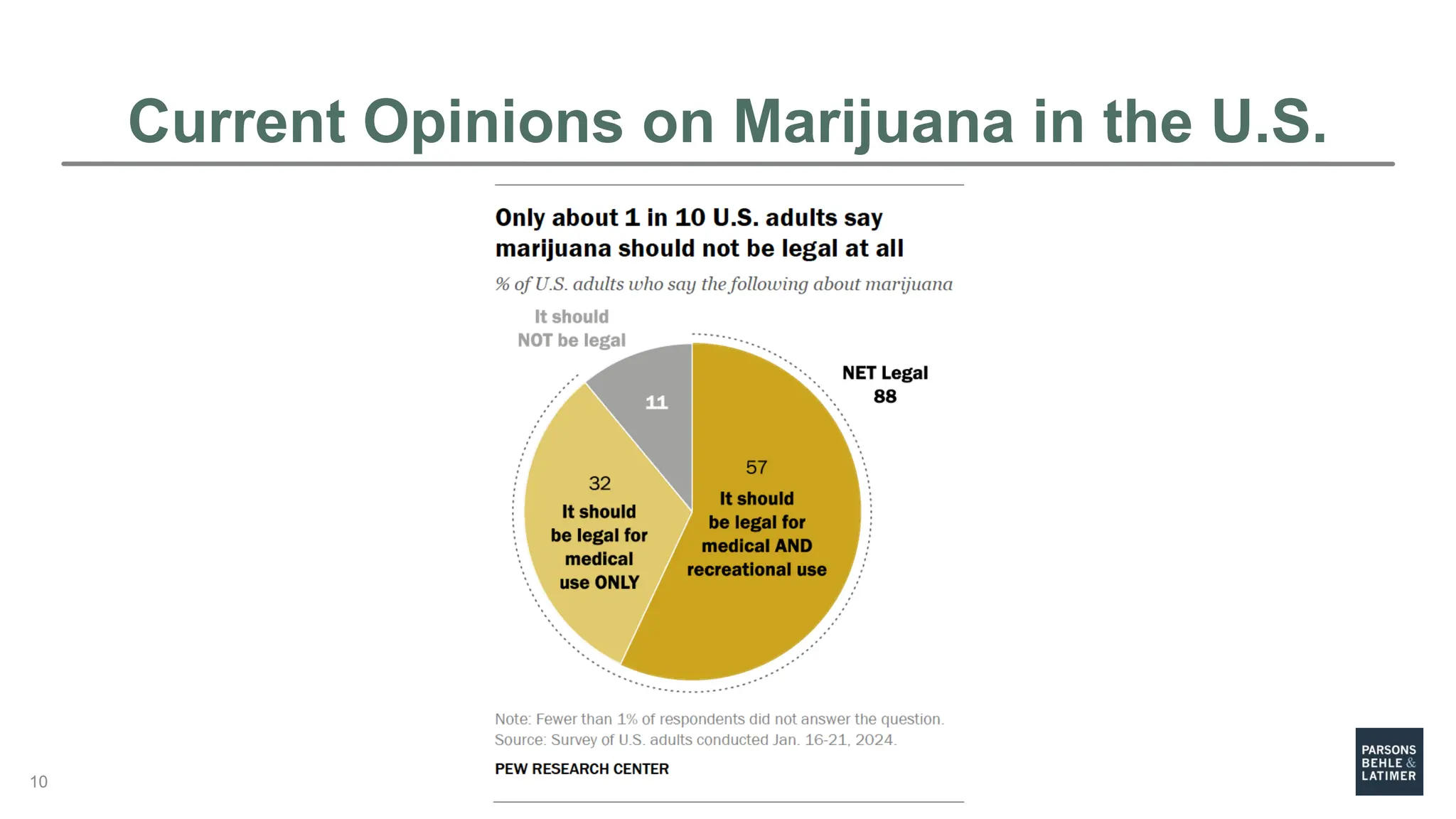
Current Opinions onMarijuana in the U.S.
50.3% of U.S. adults say they have used
marijuana at least once, ever
84.1% of U.S. adults say they have
consumed alcohol at least once, ever
23.0% of adults have used marijuana in the
past year
15.9% of adults have used marijuana in the
past month
Of adults who drink alcohol:
o 69% had a drink within the last week
o 32% had a drink within the last 24 hours
11
12.
Trends in Marijuanaand the Workplace
NYC ban on employer preemployment drug testing, April 2019.
Only Half of CO Employers Will Fire for a Single Pot Test, Denver
Post, March 2019.
Quest Diagnostics Study, May 15, 2024:
o Over the past five years, marijuana positivity has increased by 45.2% (3.1%
in 2019 versus 4.5% in 2023).
o In the past nine years, post-accident marijuana positivity increased 114.3%.
o Marijuana positivity increased in industries associated with office work but
has decreased in the federally mandated, safety sensitive workspace.
12
13.
Trends in CourtCases and Marijuana and the Workplace
Judicial interpretation trending more favorably to employees
o Before 2017 (outside of workers’ compensation and unemployment),
employers won each case brought based on alleged violation of right to use
medical marijuana.
• Washburn v. Columbia Forest Products, Inc., (Or. 2006)
• Ross v. RagingWire Telecomms., Inc. (Cal. 2008)
• Johnson v. Columbia Falls Aluminum Co., LLC (Mont. 2009)
• Emerald Steel Fabricators, Inc. v. Bureau of Labor & Industries (Or. 2010)
• Roe v. Teletech Customer Care Mgmt. LLC (Wash. 2011)
• Casias v. Wal-Mart Stores, Inc. (6th Cir. 2012) (construing Mich. law)
• Savage v. Maine Pretrial Services, Inc. (Me. 2013)
• Coats v. Dish Network, LLC, 350 P.3d 849 (Colo. 2015)
13
14.
Trends in CourtCases and Marijuana and the Workplace
After 2017, employers have lost almost every such case.
o Callaghan v. Darlington Fabrics Corp. (R.I. Superior Ct. 2017)
The judge started the opinion with the Beatles song quote “I get high with a little help from
my friends.
o Barbuto v. Advantage Sales & Marketing, LLC (Mass 2017)
o Noffsinger v. SSC Niantic Operating Co., LLC (D. Conn. 2017)
o Chance v. Kraft Heinz Food’s Co. (Del. Superior Ct. 2018)
o Wild v Carriage Funeral Holdings, Inc. (N.J. App. Div. 2019)
But see Cotto v. Ardagh Glass Packaging, (D.N.J. 2018)
14
15.
Trends in CourtCases and Marijuana in the Workplace
Several recent federal cases interpreting ADA favor employers:
o Skoric v. Marble Valley Reg’l Transit Dist. (D. Vt. Feb. 14, 2024)
• ADA does not protect medical marijuana usage in the workplace.
o See also Snow v. Autozoners, LLC (D. Utah Sept. 5, 2023).
Because medical marijuana remains illegal under federal law, an ADA
discrimination claim is not available for individuals who claim that they
suffered discrimination based on their use of medical marijuana.
15
Must Employers AccommodateMedical Marijuana?
Under Federal Law, Marijuana remains illegal.
Under Idaho Law, Marijuana remains illegal.
Nearly all neighboring states have some level of legality:
o Washington, Oregon, Montana, and Nevada: medicinal and recreational;
o Utah: medicinal;
o Wyoming: illegal.
17
18.
How isMarijuana different from Alcohol?
Problem with testing for Marijuana/THC:
o Does not test for impairment
o THC stays in the system for a long time after use
• Long term users can test positive for up to 30 days after last use
• One-time users can test positive for up to 3 days after use
o So: the user can test positive but not be impaired
• Same with cocaine, amphetamines, prescription drugs, but has a much longer half life
in the body
• Testing sensitivity varies wildly
Drug-Testing Considerations for Current and
Prospective Employees
18
19.
May notalways differentiate between THC and CBD
Tests are getting more practical:
o Portable (testing “in the field”)
o Detect level of THC and can determine impairment levels, similar to a
breathalyzer or BAC test
o Some states are identifying THC thresholds: 5ng/mL
Not necessarily widely available
Some are marketed as medical devices for medical marijuana users
Drug-Testing Considerations for Current and
Prospective Employees
19
20.
Legal andPractical Considerations:
o Federally Regulated Employees:
• DOT- mandated testing
• Federal Contractors and Grant Recipients
o Workplace Safety: Federal or State MSHA and OSHA
o Other Workplace Enforcement Concerns
• Public Policy
• Policing Outside-of-Work Activities
o At-will vs. For-Cause (employment agreements) vs. Just Cause (Collective
Bargaining Agreements)
Drug-Testing Considerations for Current and
Prospective Employees
20
21.
Workers’ Compensation
Unemployment Benefits
Issues with types of drug testing:
o Pre-employment v. post-hire
o Random
o Suspicion of Impairment
o Post Accident
Market Forces
Company Culture
Drug-Testing Considerations for Current and
Prospective Employees
21
22.
Drug Free WorkplaceAct (federal contractors/grant recipients)
Develop and publish a written policy that prohibits manufacture, use,
distributions in the workplace; ensure that employees read and consent to it as
condition to employment.
Establish a drug-free awareness program to educate employees of the dangers
of drug abuse.
Require notifications from employees within 5 days of a criminal drug conviction.
Notify the federal contracting agency within 10 days of any covered violation.
Does not require drug tests and does not prohibit drug use OUTSIDE of the
workplace.
Drug-Testing Considerations for Current and
Prospective Employees
22
23.
Department of Transportation:
The Omnibus Transportation Employee Testing Act requires DOT Agencies to
implement drug & alcohol testing of safety-sensitive transportation employees.
DOT-regulated drug testing is not changed by state laws permitting medical
marijuana.
Medical Review Officers will still treat as positive test.
Drug-Testing Considerations for Current and
Prospective Employees
23
24.
Drug-Testing Considerations forCurrent and
Prospective Employees
OSHA General Duty Clause
Employers can still expect employees to work to the required standards.
o Marijuana laws do not diminish need for a safe, productive workplace.
But off-duty use is not a violation of the OSHA general duty clause.
Post-incident drug testing policies must be consistent or will be considered
retaliatory.
OSHA allows Injury Illness Prevention Programs to address Medical Marijuana
P. Gillespie’s Article: State Medical Marijuana Legalization and OSHA Anti-Retaliation Rules: Post
Accident Drug Testing Consideration for Employers (SciTech Lawyer, Vol 13 No. 3, 2017).
24
25.
Disciplining and TerminatingMedical Marijuana
Users: Current Legal Perspectives
Some states specifically protect legal medical marijuana users under the
state’s disability act—but not under Federal law
Don’t have to allow possession on the job
Don’t have to allow influence or impairment on the job
Safety sensitive positions or tasks, such as heaving machine operators,
driving, handling medicine or regulated chemicals, or working in high or
confined spaces
Where may constitute negligence, professional negligence, or
professional misconduct.
25
26.
Disciplining and TerminatingMedical Marijuana
Users: Current Legal Perspectives
Legal Considerations:
Federal Law Enforcement has decreased enforcement.
Many states have signaled they will not enforce federal laws and have
none/have modified/do not enforce possession and use.
U.S. public sentiment towards marijuana usage has changed.
26
27.
Disciplining and TerminatingMedical Marijuana
Users: Current Legal Perspectives
Practical Considerations:
There is a worker shortage.
Some good workers use medical marijuana.
Consider business needs/culture – drivers, operators, safety, image.
Are you a multi-state employer in a state that has different laws?
Consider testing and disciplining for other drugs, but not marijuana.
Rely on fitness for duty and objective criteria to measure impairment on the job.
27
28.
Recognizing Impairment onthe Job
Reasonable Suspicion:
o A belief based on specific and articulable facts and/or inferences from those
facts regarding a specific individual that would lead a reasonable person to
suspect that the individual is impaired
• More than a hunch, a feeling, or other unparticularized suspicion
o Based on observations
o Contemporaneous to the work period
o Based on senses: what supervisor sees, hears, smells
o Objective and documented criteria
o Capable of being expressed as signs of possible drug/alcohol use
28
29.
Recognizing Impairment onthe Job
Marijuana and Other Drugs:
Personality Changes
o Personality changes are the most difficult to specify/articulate
o Be alert to changes in the employee’s usual personality traits or expression
o Personality changes due to drug use often are sudden and dramatic
Speech Patterns
o Stimulants create rapid, pressured speech patterns
o Narcotics produce slow, thick, slurred speech
o Hallucinogens may produce nonsense, fantasy speech
29
30.
Recognizing Impairment onthe Job
Marijuana and Other Drugs:
Social Interaction Changes:
o Changes in social interaction are not specific to drug use
o Varies from person to person
o Be alert to changes in the employee’s usual patters of interacting
Psychomotor Changes:
o Marijuana delays reaction times, impairs eye-hand coordination and creates
unsteadiness
o Sedatives or narcotics slow down motor function and may cause a person
to stagger, move very slowly, be unsteady when walking
30
31.
Recognizing Impairment onthe Job
Physical signs of drug use
• Changes in physical appearance
• Worsening personal hygiene
• Impaired reaction times
• Slurred speech
• Impaired awareness
• Sudden incapacity
• Restricted mobility
• Distorted hearing or vision
31
32.
Recognizing Impairment onthe Job
Psychological signs of drug use
• Lack of memory
• Limited judgment
• Unusual irritability or aggression
• Tendency to become confused
• Sudden mood changes
32
33.
Recognizing Impairment onthe Job
Behavioral signs of drug uses:
• Poor job performance (bad time-keeping, errors, lowered ability to
successfully carry out everyday tasks)
• Greater levels of absence through short-term sickness
• Worsening relationships with management, colleagues or customers
• Dishonesty and theft
• Atypical or erratic behavior
• Reduced levels of perception and coordination
• Big fluctuations in energy or concentration
• Lack of reasoning
33
34.
To benefitfrom the Idaho Employer Alcohol and Drug-Free
Workplace Act, employers must have written policy on drugs and/or
alcohol testing (I.C. § 72-1705).
Must identify what type of testing you will do:
o Baseline, preemployment, post-accident, random, return to duty, follow-up,
reasonable suspicion.
Must state that a violation of drug testing policy may result in
termination due to misconduct
Must give written notice of positive test result
Must allow a retest requested within 7 days
Creating Drug and Alcohol Policies That Leave No
Room for Interpretation
34
35.
Consider reasonablesuspicion/post accident testing instead of
mandatory or random.
Make clear the policy for usage among on-call employees.
o Does the type of position matter?
• IT after hours help vs. EMT or ER MD
Consider reasonable suspicion instead of mandatory.
o Train how to recognize impairment
Use/possession at work grounds for termination.
Creating Drug and Alcohol Policies That Leave No
Room for Interpretation
35
36.
Keep drugand alcohol policy updated.
o Be specific; e.g., clarify federal and state law, not just “legally prescribed.”
o Address prescription medication that may affect ability to work.
o Define impairment based on observable characteristics.
o Consequences for refusal to submit to testing.
Know handbook and policies.
o Apply uniformly.
o Publicize your policy and train supervisors.
o Sign receipt of the policy.
Consider accommodation process.
Creating Drug and Alcohol Policies That Leave No
Room for Interpretation
36
37.
Thank You
To downloada PDF handbook of
today’s seminar, scan the QR code or
visit parsonsbehle.com/idaho-seminar
38.
For more information,contact:
Susan Baird Motschiedler
smotschiedler@parsonsbehle.com
801.536.6923
Kristyn Escalante
kescalante@parsonsbehle.com
208.562.4857
38
#6 Big year:
MM statutes enacted by Connecticut and Massachusetts
AND
Recreational Marijuana statutes enacted by Colorado and Washington.
#7 2014 – Medical Marijuana statutes enacted by Minnesota and New York.
AND
Here come the CBD laws:
Alabama
Florida
Iowa
Kentucky
Mississippi
Missouri
North Carolina
South Carolina
Tennessee
And finally, Utah
#8 And, in 2019, Illinois joins the recreational use states.
This exercise was good for my national geography.
So, who is left without significant legalization of some form of marijuana?: Idaho, South Dakota, Nebraska, and Kansas.