RECENT DEVELOPMENTS IN
EMPLOYEE BACKGROUND CHECKS
Christina M. Jepson
Tuesday, May 6, 2014
The Little America Hotel
26th ANNUAL EMPLOYMENT LAW SEMINAR
parsonsbehle.com
2
Introduction
 The Obama administration, the
EEOC, and the Federal Trade
Commission (FTC) have identified criminal
background checks as an area of priority
 EEOC Issued Guidance in April 2012
which shook the business world
 Lots of litigation about that guidance
 EEOC and FTC just issued new guidance
3
Background Checks – Concerns
 The basis for the EEOC‟s new guidance in
April of 2012 was that national data shows
criminal record exclusions have disparate
impact on race/national origin
– Hispanics and African Americans more likely to
be arrested and convicted for drug offenses
despite similar rate of drug use as Whites
4
New Guidance
 4/25/2012
 EEOC issued Enforcement Guidance on use
of Arrest and Conviction Records in
employment decisions under Title VII
 Concerns with disparate treatment and
disparate impact – uniform policies may still
have a disparate impact
 Does not have force of statute or even
regulation – but it holds weight
5
Title VII Discrimination
 Being a person with a criminal record is not a
protected class
 Use of criminal convictions/arrest records
may violate Title VII
– Direct discrimination – inconsistent treatment
(stereotyping)
– Disparate impact on race and national origin
 EEOC states that even “consistent” or
“neutral” treatment of convictions can have
disparate impact on these groups
6
Direct Discrimination
 Example from EEOC
– Jon (white) and Robert (African American)
have similar education, skills, & work history.
– Both pled guilty to comparable drug charges
in high school and have had no problems
since
– Employer hires Jon noting his “youthful
mistake” but does not hire Robert because
company doesn‟t hire “drug dealer types”
7
Disparate Impact
 Disparate impact when
– Neutral criminal record screening policy has
affect of disproportionately screening out a
protected group, and
– Employer fails to demonstrate that policy or
practice is job related and consistent with
business necessity
8
Problems with Records
 EEOC Guidance claims that a “significant
number of state and federal criminal
record databases include incomplete
criminal records”
 “Criminal records may be inaccurate”
– Expunged records, misspellings, clerical
errors, intentionally inaccurate information
9
Problems with Records
 Many employers “buy” criminal record data
from companies who provide these
services
– Subject to Fair Credit Reporting Act
– Vary widely in how they collect information
and how often they update information
– Inaccurate information
10
 Criminal convictions may be relevant if
– Job related – specific and tailored (tight nexus)
– Direct threat to public safety or property
– Business necessity – individualized assessment
 Fact of an arrest does not establish criminal
conduct
– May consider conduct underlying arrest if conduct
makes individual unfit for position
Crimes/Arrests May Be Relevant
11
Business Necessity Defense
 In a lawsuit, plaintiff would have to show
disparate impact – applies to
hiring, retention, promotion, etc.
 If policy has a disparate impact, an
employer will have to explain how the
policy is “job related and consistent with
business necessity”
 Business necessity defense
12
Three Defenses
 Three circumstances
– Employer validates the policy under the
Uniform Guidelines on Employee Selection
Procedures (used in federal programs)
– The policy includes a “targeted screen” or
– The policy complies with federal laws and
regulations
13
Targeted Screen
 Second defense – targeted screen
– Identify essential job requirements and actual
circumstances of performance
– Identify specific offenses that may
demonstrate unfitness for that job
– Identify duration for exclusion for that job
based upon all evidence
– Provide an opportunity for an individual
assessment for people excluded by screen
14
Targeted Screen
 Time
– Permanent exclusions from all employment
based on any offense will never fly
– “Time when a former criminal is no longer
more likely to recidivate than the average
person” – experts in lawsuits
– Studies about risk of recidivism over time
– Discussion at page 15
15
Targeted Screen
 Job
– Essential functions
– Circumstances of performance
– Level of supervision
– Level of oversight
– Interaction with co-workers or vulnerable
individuals
– Environment (private home, public)
16
Individual Assessments
 Is the EEOC requiring an individualized
assessment?
– “Although Title VII does not require individualized
assessment in all circumstances, the use of a screen
that does not include individualized assessment is
more likely to violate Title VII.” Page 4
– An employer may be able to justify a targeted screen
(with no individualized assessment) if the screen is
“narrowly tailored to identify criminal conduct with a
demonstrably tight nexus to the position in question.”
– However, still recommended
17
Individualized Assessments
 Individualized assessment
– Notice to individual that he has been
screened out because of criminal conviction
(more from FTC)
– Opportunity to demonstrate he should not be
excluded due to particular circumstances
– Consideration as to whether additional
information warrants an exception because it
shows not job related and consistent with
business necessity
18
Best Practices
 Targeted screen “best practices”
– Eliminate blanket policies
– Train decision makers (maybe centralize)
– Develop a narrowly tailored screening policy
– Record the policy‟s justification
– Keep records of consultations and research
considered in preparing the policy
– Keep records of decision (maybe applicants)
– Limit inquiries to relevant criminal conduct
– Keep info confidential – only use as intended
19
Federal Laws
 Third defense
– Compliance with federal laws and regulations
(if you stay strictly within parameters) is a
defense to a charge of discrimination under
Title VII
– Airports, law
enforcement, banks, licenses, transportation, f
inancial, import/export, security clearances
 Pages 4, 20-21
20
State Laws
 However, Guidance specifically states that
Title VII preempts inconsistent state/local
laws regarding background checks
 “State and local laws or regulations are
preempted by Title VII if they „purport to
require or permit the doing of any act
which would be an unlawful employment
practice under Title VII.” 42 USC 2000e-7
21
Rock and Hard Place
 Tension with desire to avoid lawsuits –
negligent hiring lawsuits
– You get sued because you did not do a
criminal background check or
– You get sued because you hired someone
anyway
 Some state laws require background
checks – may be inconsistent
22
Applications
 “Commission recommends that employers not ask about
convictions on job applications and that, if and when they
make such inquiries, the inquiries be limited to
convictions for which exclusion would be job related for
the position in question and consistent with business
necessity.”
 Some states require employers to wait until after the
selection process to ask about convictions – ten states
and about 50 cities/counties have “ban the box” laws
 More likely to objectively assess applicant and conviction
23
Applications
 Best to follow EEOC‟s recommendation
 If you decide to ask, include a disclaimer
that a conviction will not necessarily
preclude the applicant from employment
24
Real World
 El v. Southeastern Pennsylvania
Transportation Authority (3rd Cir. 2007)
– Employer had a policy of excluding everyone
ever convicted of a violent crime from job of
paratransit driver
– 55-year old African American trainee was
terminated when employer learned of 2nd
degree murder conviction 40 years earlier
25
Real World
– Gang fight when he was 15 years old and
only violent crime
– Although the court upheld the decision to
terminate him, it expressed “reservations”
about a policy excluding all violent crimes no
matter how long ago “in the abstract”
(meaning without individual assessment)
– Stated outcome might be different if plaintiff
had hired an expert on recidivism
26
Reaction to Guidance
 Some push back
 Business community has complained that
Guidance goes too far in restricting
employers
 EEOC has not fared well in litigation
 But EEOC has recently stated it will
continue to pursue
27
Reaction to Guidance
 9 State Attorney Generals (including Utah) wrote
letter to EEOC protesting its position
– For some positions like police officer, any criminal
conviction should disqualify
– Adding discretion to process creates more opportunity for
discrimination than bright line rule
– Accused EEOC of trying to create a backdoor new
protected class – convicted criminals EEOC
– Many states have positions that require no criminal
background – took exception with federal preemption
 Texas sued the EEOC to stop enforcement –
pending
28
Reaction to Guidance
 Several courts have found against EEOC
 EEOC v. Freeman (D. Md. 2013)
– National convention and corporate event
service
– EEOC sued Freeman for using criminal
background checks
– Claimed there was a disparate impact
– EEOC expert used database that was wrong
– Cherry picked examples, not random
29
Reaction to Guidance
 EEOC v. Freeman
– Court found expert report filed by EEOC an
“egregious example of scientific dishonesty” filled with
a “mind-boggling number of errors”
– EEOC then tried to use national data
– Court rejected – did not reflect applicant pool
– Court noted employer needed background checks –
company had very tailored program
– Complete victory for employer, but only after four
years of litigation and discovery disputes
30
Reaction to Guidance
 EEOC v. Peoplemark (6th Cir. 2013)
– EEOC alleged company had a practice of not
hiring individuals with criminal records which
had a disparate impact on African Americans
– EEOC claimed company had a blanket no-
hire policy
– Court found this was not true
31
Reaction to Guidance
 EEOC v. Peoplemark
– Company had hired people with criminal
records
– EEOC case fell apart when it could not
designate a statistical expert
– EEOC folded and dismissed case
– Court said – Hobson‟s choice
32
Reaction to Guidance
 EEOC v. Peoplemark
– Company brought motion for sanctions
against EEOC
– Court found that EEOC knew its theory was
wrong and proceeded anyway
 Granted $750,000 in fees against EEOC
– $220,000 in attorneys‟ fees
– $526,000 in expert fees!
33
Reaction to Guidance
 EEOC also lost cases against BMW
manufacturing plant and Kaplan Higher
Education
 Courts are not tolerating EEOC‟s “shoot
first, aim later” tactics
34
Reaction to Guidance
 EEOC v. Kaplan, 2014 WL 1378197 (6th
Cir. April 9, 2014)
– Affirming summary judgment for employer on
alleged disparate impact in background
checks because EEOC‟s expert testimony
was based on “homemade methodology”
– Wall Street Journal called the decision the
“Opinion of the Year”
35
Reaction to Guidance
 Texas legislature passed law September
1, 2013 limiting liability of employers who
hire applicants with a criminal record
 Will other states follow?
 Employers need to do their best to follow
guidance but use common sense in using
background checks
36
Reaction to Guidance
 In January 2014, DOJ accused background
checking firm of taking shortcuts in 40% of
checks performed for US government
– Edward Snowden and Aaron Alexis (who shot
12 people in Washington Navy Yard) both
passed checks
– According to FTC, 21% of all credit reporting
agency reports contain inaccuracies
37
 After taking some hits in court, in March 2014
the EEOC and FTC issued new guidance
– Jointly published
• “Background Checks: What Employers Need to Know?
• “Background Checks: What Job Applicants and
Employees Should Know”
– Much shorter
– Does not replace earlier guidance
– Note use of “background” instead of “criminal
convictions”
EEOC/FTC Guidance
38
 EEOC‟s focus is complying with
antidiscrimination laws
 FTC‟s focus is complying with Fair Credit
Reporting Act (FCRA)
 The two intersect
 FCRA kicks in when employer runs a
background check through a company in the
business of compiling background
information
EEOC/FTC Guidance
39
 EEOC‟s primary message
– Employers may ask questions about an
applicant‟s/employee‟s background or require a
background check including
criminal, education, financial, or social media
– Limitation – Regardless of how you get the
information, employers must comply with anti-
discrimination laws and avoid discrimination
based on race, color, national
origin, sex, religion, disability, genetic
information, and age (over 40)
EEOC/FTC Guidance
40
– But must treat all applicants/employees equally
when deciding whether to gather background
information
• For example, can‟t target a particular race or other
protected class
• “Special care when basing employment decisions on
background problems that may be more common
among people of a certain class”
• Policy should accurately predict who will be a
responsible, reliable, or safe employee
– However, you may target a job classification if it
makes sense, i.e. truck drivers
EEOC/FTC Guidance
41
– Background checks
• Guidance acknowledges use of background information in
employment
– Hiring
– Retention (firing)
– Promotion
– Reassignment
• Types of information you find out (intentionally or not)
– Work history
– Education
– Criminal record
– Financial History
– Medical history (very limited)
– Genetic information (extremely limited)
EEOC/FTC Guidance
42
 Genetic information
– Except in “rare circumstances,” do not get
genetic information (including family medical
history)
– If it becomes know to you, don‟t use it in
making employment decisions
– Information sheet in your handbook
EEOC/FTC Guidance
43
 Medical information
– Do not ask any medical questions before a
conditional job offer has been made
– If employee has started, don‟t ask medical questions
unless you have objective evidence that employee is
unable to do the job or poses a safety risk
– Information sheet in your handbook
– Be prepared to make exception for problems that
were caused by a disability – allow person to
demonstrate ability
EEOC/FTC Guidance
44
 FCRA (also check states laws) Step One
– Must inform the applicant/employee in writing that you are
obtaining background information, about the potential to
use such information, and obtain written permission
– This should be a stand-alone document – not hidden in
employment application
– You can include other minor information (like description of
consumer report) if it does not confuse or distract from
notice
– Reardon v. Closetmaid Corp., 2011 WL 152804 (W.D.
Penn.) (certifying class action of applicants and employees
who were given FCRA authorization forms that were not
stand-alone documents)
EEOC/FTC Guidance
45
 FCRA Step One (Getting Report)
– Must get the applicant‟s/employee‟s
permission to do a background check
– This can be part of the document used to
notify the person you are getting a report.
– If you want continuing authorization
throughout employment, you must say so
CLEARLY AND CONSPICUOUSLY
EEOC/FTC Guidance
46
 FCRA Step One (Getting report)
– If you are obtaining an “investigative report”
you must also inform the applicant/employee
of his or her right to a description of the nature
and scope of the investigation
– An “investigative report” is when you use a
company to prepare a report based on
personal interviews concerning a person‟s
character, general reputation, personal
characteristics, and lifestyle
EEOC/FTC Guidance
47
 FCRA Step One (Getting Report)
– Must certify to company who is providing
report that
• You notified person and got their permission
• Complied with FCRA requirements
• You will not discriminate or misuse the information
in violation of the law
EEOC/FTC Guidance
48
 FCRA Step Two (Before Adverse Action)
– If you intend to take adverse action based on
information obtained via a company
• Must provide applicant/employee a copy of the
report you relied on
• Must provide applicant/employee “A Summary of
Your Rights Under the Fair Credit Reporting Act”
– Should get from company who provided report or
www.ftc.gov/bcp/edu/pubs/consumer/credit/cre35.pdf
• Notice is meant to give person an opportunity to
review, explain, or challenge information
EEOC/FTC Guidance
49
 FCRA Step Three (After Adverse Action)
– After you take adverse action
• Must inform person they were rejected because of
information in the report
• You may do so orally, in writing, or electronically
• Best practice is do in writing of some sort
– Beverly v. Wal-Mart Stores, 2008 WL 149032 (E.D.
Va.) (denying employer‟s motion for summary
judgment where its third party background checker
rejected an applicant on employer‟s behalf without
giving applicant sufficient time to contest erroneous
criminal history on which rejection was based)
EEOC/FTC Guidance
50
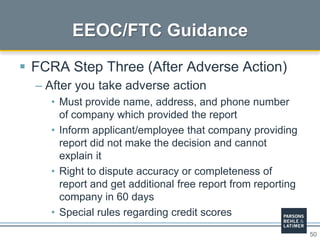
 FCRA Step Three (After Adverse Action)
– After you take adverse action
• Must provide name, address, and phone number
of company which provided the report
• Inform applicant/employee that company providing
report did not make the decision and cannot
explain it
• Right to dispute accuracy or completeness of
report and get additional free report from reporting
company in 60 days
• Special rules regarding credit scores
EEOC/FTC Guidance
51
 Keeping records
– EEOC requires personnel/employment records you make
or keep be preserved for 1 year after record was made or
decision was made (whichever is later)
• Includes application and other hiring documents, even if
applicant was not hired
– EEOC requires records maintained 2 years for educational
institutions and state/local government
– DOL extends to 2 years for federal contractors that have at
least 150 employees and a government contract of at least
$150,000
– If applicant/employee files charge of discrimination,
must maintain records until case concluded
EEOC/FTC Guidance
52
 Keeping records
– Must keep records if litigation is threatened or likely
– Area of great risk
– Litigation hold letters
 Disposing of records
– Secure disposal required
• Burning
• Pulverizing
• Shredding
• Disposing of electronic records so they cannot be
reconstructed
EEOC/FTC Guidance
53
 What is a credit reporting agency
– Companies in the business of collecting information to sell
to employers and other companies
• If it assembles and evaluates consumer report information for
the purpose of providing those reports to third parties
• Character, reputation, or personal characteristics
• Employment, housing, credit, etc.
– Doesn‟t matter if you are called a credit reporting agency
– Includes Apps that collect criminal background information
for fee
– Includes internet sites that collect information for fee
EEOC/FTC Guidance
54
 Review your background check procedures
 Confirm that the same questions are being
asked of all applicant/employees (or at least
categories make sense)
 Make sure you are complying with FCRA
notice requirements
 Memo to file regarding decision
What Now?
55
Thank You
 Christina M. Jepson
direct: 801.536.6820
email: cjepson@parsonsbehle.com

Recent Developments in Employee Background Checks

  • 1.
    RECENT DEVELOPMENTS IN EMPLOYEEBACKGROUND CHECKS Christina M. Jepson Tuesday, May 6, 2014 The Little America Hotel 26th ANNUAL EMPLOYMENT LAW SEMINAR parsonsbehle.com
  • 2.
    2 Introduction  The Obamaadministration, the EEOC, and the Federal Trade Commission (FTC) have identified criminal background checks as an area of priority  EEOC Issued Guidance in April 2012 which shook the business world  Lots of litigation about that guidance  EEOC and FTC just issued new guidance
  • 3.
    3 Background Checks –Concerns  The basis for the EEOC‟s new guidance in April of 2012 was that national data shows criminal record exclusions have disparate impact on race/national origin – Hispanics and African Americans more likely to be arrested and convicted for drug offenses despite similar rate of drug use as Whites
  • 4.
    4 New Guidance  4/25/2012 EEOC issued Enforcement Guidance on use of Arrest and Conviction Records in employment decisions under Title VII  Concerns with disparate treatment and disparate impact – uniform policies may still have a disparate impact  Does not have force of statute or even regulation – but it holds weight
  • 5.
    5 Title VII Discrimination Being a person with a criminal record is not a protected class  Use of criminal convictions/arrest records may violate Title VII – Direct discrimination – inconsistent treatment (stereotyping) – Disparate impact on race and national origin  EEOC states that even “consistent” or “neutral” treatment of convictions can have disparate impact on these groups
  • 6.
    6 Direct Discrimination  Examplefrom EEOC – Jon (white) and Robert (African American) have similar education, skills, & work history. – Both pled guilty to comparable drug charges in high school and have had no problems since – Employer hires Jon noting his “youthful mistake” but does not hire Robert because company doesn‟t hire “drug dealer types”
  • 7.
    7 Disparate Impact  Disparateimpact when – Neutral criminal record screening policy has affect of disproportionately screening out a protected group, and – Employer fails to demonstrate that policy or practice is job related and consistent with business necessity
  • 8.
    8 Problems with Records EEOC Guidance claims that a “significant number of state and federal criminal record databases include incomplete criminal records”  “Criminal records may be inaccurate” – Expunged records, misspellings, clerical errors, intentionally inaccurate information
  • 9.
    9 Problems with Records Many employers “buy” criminal record data from companies who provide these services – Subject to Fair Credit Reporting Act – Vary widely in how they collect information and how often they update information – Inaccurate information
  • 10.
    10  Criminal convictionsmay be relevant if – Job related – specific and tailored (tight nexus) – Direct threat to public safety or property – Business necessity – individualized assessment  Fact of an arrest does not establish criminal conduct – May consider conduct underlying arrest if conduct makes individual unfit for position Crimes/Arrests May Be Relevant
  • 11.
    11 Business Necessity Defense In a lawsuit, plaintiff would have to show disparate impact – applies to hiring, retention, promotion, etc.  If policy has a disparate impact, an employer will have to explain how the policy is “job related and consistent with business necessity”  Business necessity defense
  • 12.
    12 Three Defenses  Threecircumstances – Employer validates the policy under the Uniform Guidelines on Employee Selection Procedures (used in federal programs) – The policy includes a “targeted screen” or – The policy complies with federal laws and regulations
  • 13.
    13 Targeted Screen  Seconddefense – targeted screen – Identify essential job requirements and actual circumstances of performance – Identify specific offenses that may demonstrate unfitness for that job – Identify duration for exclusion for that job based upon all evidence – Provide an opportunity for an individual assessment for people excluded by screen
  • 14.
    14 Targeted Screen  Time –Permanent exclusions from all employment based on any offense will never fly – “Time when a former criminal is no longer more likely to recidivate than the average person” – experts in lawsuits – Studies about risk of recidivism over time – Discussion at page 15
  • 15.
    15 Targeted Screen  Job –Essential functions – Circumstances of performance – Level of supervision – Level of oversight – Interaction with co-workers or vulnerable individuals – Environment (private home, public)
  • 16.
    16 Individual Assessments  Isthe EEOC requiring an individualized assessment? – “Although Title VII does not require individualized assessment in all circumstances, the use of a screen that does not include individualized assessment is more likely to violate Title VII.” Page 4 – An employer may be able to justify a targeted screen (with no individualized assessment) if the screen is “narrowly tailored to identify criminal conduct with a demonstrably tight nexus to the position in question.” – However, still recommended
  • 17.
    17 Individualized Assessments  Individualizedassessment – Notice to individual that he has been screened out because of criminal conviction (more from FTC) – Opportunity to demonstrate he should not be excluded due to particular circumstances – Consideration as to whether additional information warrants an exception because it shows not job related and consistent with business necessity
  • 18.
    18 Best Practices  Targetedscreen “best practices” – Eliminate blanket policies – Train decision makers (maybe centralize) – Develop a narrowly tailored screening policy – Record the policy‟s justification – Keep records of consultations and research considered in preparing the policy – Keep records of decision (maybe applicants) – Limit inquiries to relevant criminal conduct – Keep info confidential – only use as intended
  • 19.
    19 Federal Laws  Thirddefense – Compliance with federal laws and regulations (if you stay strictly within parameters) is a defense to a charge of discrimination under Title VII – Airports, law enforcement, banks, licenses, transportation, f inancial, import/export, security clearances  Pages 4, 20-21
  • 20.
    20 State Laws  However,Guidance specifically states that Title VII preempts inconsistent state/local laws regarding background checks  “State and local laws or regulations are preempted by Title VII if they „purport to require or permit the doing of any act which would be an unlawful employment practice under Title VII.” 42 USC 2000e-7
  • 21.
    21 Rock and HardPlace  Tension with desire to avoid lawsuits – negligent hiring lawsuits – You get sued because you did not do a criminal background check or – You get sued because you hired someone anyway  Some state laws require background checks – may be inconsistent
  • 22.
    22 Applications  “Commission recommendsthat employers not ask about convictions on job applications and that, if and when they make such inquiries, the inquiries be limited to convictions for which exclusion would be job related for the position in question and consistent with business necessity.”  Some states require employers to wait until after the selection process to ask about convictions – ten states and about 50 cities/counties have “ban the box” laws  More likely to objectively assess applicant and conviction
  • 23.
    23 Applications  Best tofollow EEOC‟s recommendation  If you decide to ask, include a disclaimer that a conviction will not necessarily preclude the applicant from employment
  • 24.
    24 Real World  Elv. Southeastern Pennsylvania Transportation Authority (3rd Cir. 2007) – Employer had a policy of excluding everyone ever convicted of a violent crime from job of paratransit driver – 55-year old African American trainee was terminated when employer learned of 2nd degree murder conviction 40 years earlier
  • 25.
    25 Real World – Gangfight when he was 15 years old and only violent crime – Although the court upheld the decision to terminate him, it expressed “reservations” about a policy excluding all violent crimes no matter how long ago “in the abstract” (meaning without individual assessment) – Stated outcome might be different if plaintiff had hired an expert on recidivism
  • 26.
    26 Reaction to Guidance Some push back  Business community has complained that Guidance goes too far in restricting employers  EEOC has not fared well in litigation  But EEOC has recently stated it will continue to pursue
  • 27.
    27 Reaction to Guidance 9 State Attorney Generals (including Utah) wrote letter to EEOC protesting its position – For some positions like police officer, any criminal conviction should disqualify – Adding discretion to process creates more opportunity for discrimination than bright line rule – Accused EEOC of trying to create a backdoor new protected class – convicted criminals EEOC – Many states have positions that require no criminal background – took exception with federal preemption  Texas sued the EEOC to stop enforcement – pending
  • 28.
    28 Reaction to Guidance Several courts have found against EEOC  EEOC v. Freeman (D. Md. 2013) – National convention and corporate event service – EEOC sued Freeman for using criminal background checks – Claimed there was a disparate impact – EEOC expert used database that was wrong – Cherry picked examples, not random
  • 29.
    29 Reaction to Guidance EEOC v. Freeman – Court found expert report filed by EEOC an “egregious example of scientific dishonesty” filled with a “mind-boggling number of errors” – EEOC then tried to use national data – Court rejected – did not reflect applicant pool – Court noted employer needed background checks – company had very tailored program – Complete victory for employer, but only after four years of litigation and discovery disputes
  • 30.
    30 Reaction to Guidance EEOC v. Peoplemark (6th Cir. 2013) – EEOC alleged company had a practice of not hiring individuals with criminal records which had a disparate impact on African Americans – EEOC claimed company had a blanket no- hire policy – Court found this was not true
  • 31.
    31 Reaction to Guidance EEOC v. Peoplemark – Company had hired people with criminal records – EEOC case fell apart when it could not designate a statistical expert – EEOC folded and dismissed case – Court said – Hobson‟s choice
  • 32.
    32 Reaction to Guidance EEOC v. Peoplemark – Company brought motion for sanctions against EEOC – Court found that EEOC knew its theory was wrong and proceeded anyway  Granted $750,000 in fees against EEOC – $220,000 in attorneys‟ fees – $526,000 in expert fees!
  • 33.
    33 Reaction to Guidance EEOC also lost cases against BMW manufacturing plant and Kaplan Higher Education  Courts are not tolerating EEOC‟s “shoot first, aim later” tactics
  • 34.
    34 Reaction to Guidance EEOC v. Kaplan, 2014 WL 1378197 (6th Cir. April 9, 2014) – Affirming summary judgment for employer on alleged disparate impact in background checks because EEOC‟s expert testimony was based on “homemade methodology” – Wall Street Journal called the decision the “Opinion of the Year”
  • 35.
    35 Reaction to Guidance Texas legislature passed law September 1, 2013 limiting liability of employers who hire applicants with a criminal record  Will other states follow?  Employers need to do their best to follow guidance but use common sense in using background checks
  • 36.
    36 Reaction to Guidance In January 2014, DOJ accused background checking firm of taking shortcuts in 40% of checks performed for US government – Edward Snowden and Aaron Alexis (who shot 12 people in Washington Navy Yard) both passed checks – According to FTC, 21% of all credit reporting agency reports contain inaccuracies
  • 37.
    37  After takingsome hits in court, in March 2014 the EEOC and FTC issued new guidance – Jointly published • “Background Checks: What Employers Need to Know? • “Background Checks: What Job Applicants and Employees Should Know” – Much shorter – Does not replace earlier guidance – Note use of “background” instead of “criminal convictions” EEOC/FTC Guidance
  • 38.
    38  EEOC‟s focusis complying with antidiscrimination laws  FTC‟s focus is complying with Fair Credit Reporting Act (FCRA)  The two intersect  FCRA kicks in when employer runs a background check through a company in the business of compiling background information EEOC/FTC Guidance
  • 39.
    39  EEOC‟s primarymessage – Employers may ask questions about an applicant‟s/employee‟s background or require a background check including criminal, education, financial, or social media – Limitation – Regardless of how you get the information, employers must comply with anti- discrimination laws and avoid discrimination based on race, color, national origin, sex, religion, disability, genetic information, and age (over 40) EEOC/FTC Guidance
  • 40.
    40 – But musttreat all applicants/employees equally when deciding whether to gather background information • For example, can‟t target a particular race or other protected class • “Special care when basing employment decisions on background problems that may be more common among people of a certain class” • Policy should accurately predict who will be a responsible, reliable, or safe employee – However, you may target a job classification if it makes sense, i.e. truck drivers EEOC/FTC Guidance
  • 41.
    41 – Background checks •Guidance acknowledges use of background information in employment – Hiring – Retention (firing) – Promotion – Reassignment • Types of information you find out (intentionally or not) – Work history – Education – Criminal record – Financial History – Medical history (very limited) – Genetic information (extremely limited) EEOC/FTC Guidance
  • 42.
    42  Genetic information –Except in “rare circumstances,” do not get genetic information (including family medical history) – If it becomes know to you, don‟t use it in making employment decisions – Information sheet in your handbook EEOC/FTC Guidance
  • 43.
    43  Medical information –Do not ask any medical questions before a conditional job offer has been made – If employee has started, don‟t ask medical questions unless you have objective evidence that employee is unable to do the job or poses a safety risk – Information sheet in your handbook – Be prepared to make exception for problems that were caused by a disability – allow person to demonstrate ability EEOC/FTC Guidance
  • 44.
    44  FCRA (alsocheck states laws) Step One – Must inform the applicant/employee in writing that you are obtaining background information, about the potential to use such information, and obtain written permission – This should be a stand-alone document – not hidden in employment application – You can include other minor information (like description of consumer report) if it does not confuse or distract from notice – Reardon v. Closetmaid Corp., 2011 WL 152804 (W.D. Penn.) (certifying class action of applicants and employees who were given FCRA authorization forms that were not stand-alone documents) EEOC/FTC Guidance
  • 45.
    45  FCRA StepOne (Getting Report) – Must get the applicant‟s/employee‟s permission to do a background check – This can be part of the document used to notify the person you are getting a report. – If you want continuing authorization throughout employment, you must say so CLEARLY AND CONSPICUOUSLY EEOC/FTC Guidance
  • 46.
    46  FCRA StepOne (Getting report) – If you are obtaining an “investigative report” you must also inform the applicant/employee of his or her right to a description of the nature and scope of the investigation – An “investigative report” is when you use a company to prepare a report based on personal interviews concerning a person‟s character, general reputation, personal characteristics, and lifestyle EEOC/FTC Guidance
  • 47.
    47  FCRA StepOne (Getting Report) – Must certify to company who is providing report that • You notified person and got their permission • Complied with FCRA requirements • You will not discriminate or misuse the information in violation of the law EEOC/FTC Guidance
  • 48.
    48  FCRA StepTwo (Before Adverse Action) – If you intend to take adverse action based on information obtained via a company • Must provide applicant/employee a copy of the report you relied on • Must provide applicant/employee “A Summary of Your Rights Under the Fair Credit Reporting Act” – Should get from company who provided report or www.ftc.gov/bcp/edu/pubs/consumer/credit/cre35.pdf • Notice is meant to give person an opportunity to review, explain, or challenge information EEOC/FTC Guidance
  • 49.
    49  FCRA StepThree (After Adverse Action) – After you take adverse action • Must inform person they were rejected because of information in the report • You may do so orally, in writing, or electronically • Best practice is do in writing of some sort – Beverly v. Wal-Mart Stores, 2008 WL 149032 (E.D. Va.) (denying employer‟s motion for summary judgment where its third party background checker rejected an applicant on employer‟s behalf without giving applicant sufficient time to contest erroneous criminal history on which rejection was based) EEOC/FTC Guidance
  • 50.
    50  FCRA StepThree (After Adverse Action) – After you take adverse action • Must provide name, address, and phone number of company which provided the report • Inform applicant/employee that company providing report did not make the decision and cannot explain it • Right to dispute accuracy or completeness of report and get additional free report from reporting company in 60 days • Special rules regarding credit scores EEOC/FTC Guidance
  • 51.
    51  Keeping records –EEOC requires personnel/employment records you make or keep be preserved for 1 year after record was made or decision was made (whichever is later) • Includes application and other hiring documents, even if applicant was not hired – EEOC requires records maintained 2 years for educational institutions and state/local government – DOL extends to 2 years for federal contractors that have at least 150 employees and a government contract of at least $150,000 – If applicant/employee files charge of discrimination, must maintain records until case concluded EEOC/FTC Guidance
  • 52.
    52  Keeping records –Must keep records if litigation is threatened or likely – Area of great risk – Litigation hold letters  Disposing of records – Secure disposal required • Burning • Pulverizing • Shredding • Disposing of electronic records so they cannot be reconstructed EEOC/FTC Guidance
  • 53.
    53  What isa credit reporting agency – Companies in the business of collecting information to sell to employers and other companies • If it assembles and evaluates consumer report information for the purpose of providing those reports to third parties • Character, reputation, or personal characteristics • Employment, housing, credit, etc. – Doesn‟t matter if you are called a credit reporting agency – Includes Apps that collect criminal background information for fee – Includes internet sites that collect information for fee EEOC/FTC Guidance
  • 54.
    54  Review yourbackground check procedures  Confirm that the same questions are being asked of all applicant/employees (or at least categories make sense)  Make sure you are complying with FCRA notice requirements  Memo to file regarding decision What Now?
  • 55.
    55 Thank You  ChristinaM. Jepson direct: 801.536.6820 email: cjepson@parsonsbehle.com