DRUG DEVELOPMENT CMC logistics
STAGES OF DRUG DEVELOPMENT Research & Development (p-chem, ADME-Tox) Pre-IND/IND ( Phases 1, 2, 3 Clinical Studies)  Pre-NDA/NDA (Marketing Approval) post NDA (mfg supplements)  SUPAC ( the Scale-Up and Post Approval Changes)
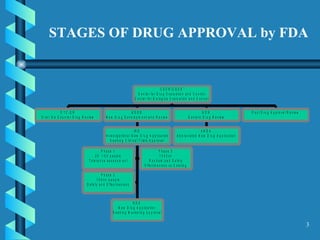
STAGES OF DRUG APPROVAL by FDA
IND/NDA APPLICATION CONTENT Medical Data Chemical Data (CMC) Pharmacology and Drug Distribution  (21 CFR 312.23(a)(8)(I))   Toxicology Data ( 21 CFR 312.23(a)(8)(ii)(a) )  Clinical Data
IND/NDA CMC INFORMATION CONTENT AND FORMAT Completeness of CMC information needed may vary at the various stages of drug development. The information format preferred is divided in two major headings .  I: DRUG SUBSTANCE  (active pharmaceutical ingredient(API)/ bulk drug/bulk materials) II: DRUG PRODUCT  (formulated bulk drug/product/drug)
I. DRUG SUBSTANCE: CHARACTERIZATION AND PROOF OF STRUCTURE  Supporting evidence to elucidate and characterize the chemical structure should be provided. In general, the following information including spectra should be submitted:
I. DRUG SUBSTANCE: (cont) CHARACTERIZATION AND PROOF OF STRUCTURE (cont)  Physical/Chemical Characterization: Water Solubility Dissociation Constant Octanol/Water Partition Coefficient Vapor Pressure Sorbtion/desorbtion properties
I. DRUG SUBSTANCE: (cont) CHARACTERIZATION AND PROOF OF STRUCTURE (cont)  Elemental analysis, IR, NMR, UV, MS, optical activity, X-ray diffraction, single crystal data if available c)  For proteins: amino acid sequence, peptide map, and secondary and tertiary structure if known
2.  MANUFACTURER  A list of all companies associated with manufacturing and controls of the drug substance, contract laboratories for QC and release and contractor for stability studies must be submitted   I. DRUG SUBSTANCE: (cont)
I. DRUG SUBSTANCE: (cont)  3.  SYNTHESIS/METHOD OF MANUFACTURE  Starting Materials  b)  Reagents, Solvents and Auxiliary Materials
I. DRUG SUBSTANCE: (cont)  4.  FLOW CHART  a)  Description of the synthetic or manufacturing  process (e.g. fermentation, extraction/purification)  should be provided. A general  step-by-step  description  of the synthesis or manufacturing  process should be provided, including the final  recrystallization of the drug substance.
I. DRUG SUBSTANCE: (cont)  4.  FLOW CHART (cont) b)  The flow chart containing the following information  should be submitted:  chemical structures, including stereo configuration if applicable  intermediates (either in-situ or isolated) and significant side products  solvents, catalysts and reagents  fermenters, columns and other equipment/ reagent used for biotech or natural products
I. DRUG SUBSTANCE: (cont)  Reprocessing Is not a deviation from cGMP if conducted properly!   Any time reprocessing occurs, there should be a written record of the investigation that includes conclusions and follow-up. Production and Process Controls:   Time limitations on production should be established, documented and considered Control of possible microbiological contamination required even for non-sterile products Reprocessing should be approved by QC Records and Reports: Production (Batch)Record Review
I. DRUG SUBSTANCE: (cont)  5.  IN-PROCESS CONTROLS  Controls at selected stages in the synthesis or manufacturing process to assure reaction completion and purity or proper cell growth should be described.  For isolated intermediates that require control, the acceptance criteria and analytical methods should be described.
I. DRUG SUBSTANCE: (cont)  6.  REFERENCE STANDARD  Preparation/Qualification The synthesis/purification of the reference standard and/or a working standard used to support the IND should be described if it differs from that of the drug substance.  The analytical tests and results for the working standard against the regulatory acceptance criteria should be provided.
DRUG SUBSTANCE: (cont)  7.  REGULATORY SPECIFICATIONS &  ANALYTICAL METHODS  a)  The regulatory test performed should be indicated (e.g.,description, identity, assay etc.)  b)  A brief description of the analytical methods should be submitted  c)  Acceptance limits should be stated  d)  Purity/Impurity Profile- Impurities should be identified and qualified
I. DRUG SUBSTANCE: (cont)   8.  MICROBIOLOGY  Microbial limits should be considered if appropriate
I. DRUG SUBSTANCE: (cont)  9.  BATCH RESULTS:  A summary table of the test results  Analytical data (e.g., chromatograms)  Certificate of Analysis (COA)  for relevant lots of the drug substance should be provided
I. DRUG SUBSTANCE: (cont)   10.  CONTAINER/CLOSURE SYSTEM:  A detailed description of the container/closure system used to transport and/or inventory the bulk materials should be described.  It is important that this container/closure system be simulated in the drug substance stability studies.
DRUG SUBSTANCE: (cont) 11.  STABILITY STUDIES:  a)  Stress/accelerated studies:  Studies should be included to demonstrate the inherent stability of the drug substance and potential degradation products and the capability of the analytical methods to detect the degradation product known as the  “stability indicating method.”  These studies may include studies at various pH, temperature, relative humidity, presence of oxygen and/or light.
DRUG SUBSTANCE: (cont) 11.  STABILITY STUDIES:  b)  Stability studies and protocol:  Protocols should include study design, list of tests, sampling time points for each test and the expected duration of the stability program. The study should include short and long term storage conditions. Methodology should be described in detail.
DRUG SUBSTANCE: (cont) 11.  STABILITY STUDIES:  c)  Stability data/commitment  Tabulated data should include the lot-batch numbers (s), manufacturing site(s) and the date of manufacture. FDA recommends that each table of data contain data from only one storage condition. Individual data points for each test should be reported.
DRUG SUBSTANCE: (cont) 11.  STABILITY STUDIES:  d)  Analysis of results (statistics)   A short conclusion based on discussion for each of the parameters being investigated in the stability program be provided. The discussion should demonstrate that appropriate controls and storage conditions are in place to ensure the quality of the product used in the clinical trials. A statistical analysis may be provided.
II: DRUG PRODUCT: COMPONENT/COMPOSITION  Quantitative composition per unit of use should be provided ( e.g., mg/tablet). The components should be identified by the established names and compendial status, if they exist.  The batch formula should be provided.
II: DRUG PRODUCT: (cont) SPECIFICATIONS &  METHODS FOR COMPONENTS  a)  Active Ingredients - Analytical methods and acceptance criteria should be submitted  b)  Inactive ingredients - Compendial or non-compendial. For compendial ingredients, analystical methods and acceptance criteria recognized in official compendia should be referenced.
II: DRUG PRODUCT: (cont) 2.  SPECIFICATIONS &  METHODS FOR COMPONENTS  b)  Inactive ingredients (cont).  For non-compendial ingredients, analytical methods and acceptance criteria should be submitted. A description of the manufacture and control of these compounds should be submitted or appropriate reference provided (e.g., DMF, approved NDA’s and ANDA’s).
II: DRUG PRODUCT: (cont) 3.  MANUFACTURERS:  Same as drug substance requirement
II: DRUG PRODUCT: (cont) 4.  METHOD OF MANUFACTURING & PACKAGING  a)  Production Operation  b)  Packaging/Labeling Process  c)  In-process Controls  d)  Reprocessing Procedures and Controls
II: DRUG PRODUCT: (cont) 5.  REGULATORY SPECIFICATIONS & METHODS  Tests  Methods  Acceptance Criteria ( limits)  Degradants Profile  Microbiology  Batch Results (consistency)
II: DRUG PRODUCT: (cont) 6.  CONTAINER/CLOSURE:  A general description of the system, Drug Master File authorization, name of suppliers/ manufacturers should be submitted.  Additional information may be needed for novel delivery systems (MDI, disposal injection devices etc..)
II: DRUG PRODUCT: (cont) 7.  STABILITY:  a)  Stress/Accelerated Studies  b)  Stability Studies and Protocol  c)  Stability Data/Commitment  Analysis of Results (Same as discussed for the drug substance)
II: DRUG PRODUCT: (cont)  8.  LABELING:  For Phase 1, 2 and 3 INDs: a mock-up or printed representation of the proposed labeling and labels that will be provided to investigators to be used on the drug container should be submitted. Investigational labels must carry the standard Caution Statement per 21 CFR 312.6(a).
DRUG SUBSTANCE &  DRUG PRODUCT   9.  ENVIRONMENTAL ASSESSMENT:  IND:   A claim for categorical exclusion may be submitted under 21 CFR 25.24  NDA or ANDA:   EA may be waived for most NDAs and ANDAs when the approval will not increase the use of the drug or concentration of the drug expected to enter the aquatic environment is less than 1 ppb.
ICH Quality Activities Q1: Stability Testing  Q2: Validation and Analytical Procedures  Q3: Impurity Testing  Q4: Pharmacopoeial Harmonization  Q5: Quality of Biotechnological Products  Q6: Specifications for New Drug Substances and Products  see http://www.ich.org

CMC Logistics

  • 1.
  • 2.
    STAGES OF DRUGDEVELOPMENT Research & Development (p-chem, ADME-Tox) Pre-IND/IND ( Phases 1, 2, 3 Clinical Studies) Pre-NDA/NDA (Marketing Approval) post NDA (mfg supplements) SUPAC ( the Scale-Up and Post Approval Changes)
  • 3.
    STAGES OF DRUGAPPROVAL by FDA
  • 4.
    IND/NDA APPLICATION CONTENTMedical Data Chemical Data (CMC) Pharmacology and Drug Distribution (21 CFR 312.23(a)(8)(I)) Toxicology Data ( 21 CFR 312.23(a)(8)(ii)(a) ) Clinical Data
  • 5.
    IND/NDA CMC INFORMATIONCONTENT AND FORMAT Completeness of CMC information needed may vary at the various stages of drug development. The information format preferred is divided in two major headings . I: DRUG SUBSTANCE (active pharmaceutical ingredient(API)/ bulk drug/bulk materials) II: DRUG PRODUCT (formulated bulk drug/product/drug)
  • 6.
    I. DRUG SUBSTANCE:CHARACTERIZATION AND PROOF OF STRUCTURE Supporting evidence to elucidate and characterize the chemical structure should be provided. In general, the following information including spectra should be submitted:
  • 7.
    I. DRUG SUBSTANCE:(cont) CHARACTERIZATION AND PROOF OF STRUCTURE (cont) Physical/Chemical Characterization: Water Solubility Dissociation Constant Octanol/Water Partition Coefficient Vapor Pressure Sorbtion/desorbtion properties
  • 8.
    I. DRUG SUBSTANCE:(cont) CHARACTERIZATION AND PROOF OF STRUCTURE (cont) Elemental analysis, IR, NMR, UV, MS, optical activity, X-ray diffraction, single crystal data if available c) For proteins: amino acid sequence, peptide map, and secondary and tertiary structure if known
  • 9.
    2. MANUFACTURER A list of all companies associated with manufacturing and controls of the drug substance, contract laboratories for QC and release and contractor for stability studies must be submitted I. DRUG SUBSTANCE: (cont)
  • 10.
    I. DRUG SUBSTANCE:(cont) 3. SYNTHESIS/METHOD OF MANUFACTURE Starting Materials b) Reagents, Solvents and Auxiliary Materials
  • 11.
    I. DRUG SUBSTANCE:(cont) 4. FLOW CHART a) Description of the synthetic or manufacturing process (e.g. fermentation, extraction/purification) should be provided. A general step-by-step description of the synthesis or manufacturing process should be provided, including the final recrystallization of the drug substance.
  • 12.
    I. DRUG SUBSTANCE:(cont) 4. FLOW CHART (cont) b) The flow chart containing the following information should be submitted: chemical structures, including stereo configuration if applicable intermediates (either in-situ or isolated) and significant side products solvents, catalysts and reagents fermenters, columns and other equipment/ reagent used for biotech or natural products
  • 13.
    I. DRUG SUBSTANCE:(cont) Reprocessing Is not a deviation from cGMP if conducted properly! Any time reprocessing occurs, there should be a written record of the investigation that includes conclusions and follow-up. Production and Process Controls: Time limitations on production should be established, documented and considered Control of possible microbiological contamination required even for non-sterile products Reprocessing should be approved by QC Records and Reports: Production (Batch)Record Review
  • 14.
    I. DRUG SUBSTANCE:(cont) 5. IN-PROCESS CONTROLS Controls at selected stages in the synthesis or manufacturing process to assure reaction completion and purity or proper cell growth should be described. For isolated intermediates that require control, the acceptance criteria and analytical methods should be described.
  • 15.
    I. DRUG SUBSTANCE:(cont) 6. REFERENCE STANDARD Preparation/Qualification The synthesis/purification of the reference standard and/or a working standard used to support the IND should be described if it differs from that of the drug substance. The analytical tests and results for the working standard against the regulatory acceptance criteria should be provided.
  • 16.
    DRUG SUBSTANCE: (cont) 7. REGULATORY SPECIFICATIONS & ANALYTICAL METHODS a) The regulatory test performed should be indicated (e.g.,description, identity, assay etc.) b) A brief description of the analytical methods should be submitted c) Acceptance limits should be stated d) Purity/Impurity Profile- Impurities should be identified and qualified
  • 17.
    I. DRUG SUBSTANCE:(cont) 8. MICROBIOLOGY Microbial limits should be considered if appropriate
  • 18.
    I. DRUG SUBSTANCE:(cont) 9. BATCH RESULTS: A summary table of the test results Analytical data (e.g., chromatograms) Certificate of Analysis (COA) for relevant lots of the drug substance should be provided
  • 19.
    I. DRUG SUBSTANCE:(cont) 10. CONTAINER/CLOSURE SYSTEM: A detailed description of the container/closure system used to transport and/or inventory the bulk materials should be described. It is important that this container/closure system be simulated in the drug substance stability studies.
  • 20.
    DRUG SUBSTANCE: (cont)11. STABILITY STUDIES: a) Stress/accelerated studies: Studies should be included to demonstrate the inherent stability of the drug substance and potential degradation products and the capability of the analytical methods to detect the degradation product known as the “stability indicating method.” These studies may include studies at various pH, temperature, relative humidity, presence of oxygen and/or light.
  • 21.
    DRUG SUBSTANCE: (cont)11. STABILITY STUDIES: b) Stability studies and protocol: Protocols should include study design, list of tests, sampling time points for each test and the expected duration of the stability program. The study should include short and long term storage conditions. Methodology should be described in detail.
  • 22.
    DRUG SUBSTANCE: (cont)11. STABILITY STUDIES: c) Stability data/commitment Tabulated data should include the lot-batch numbers (s), manufacturing site(s) and the date of manufacture. FDA recommends that each table of data contain data from only one storage condition. Individual data points for each test should be reported.
  • 23.
    DRUG SUBSTANCE: (cont)11. STABILITY STUDIES: d) Analysis of results (statistics) A short conclusion based on discussion for each of the parameters being investigated in the stability program be provided. The discussion should demonstrate that appropriate controls and storage conditions are in place to ensure the quality of the product used in the clinical trials. A statistical analysis may be provided.
  • 24.
    II: DRUG PRODUCT:COMPONENT/COMPOSITION Quantitative composition per unit of use should be provided ( e.g., mg/tablet). The components should be identified by the established names and compendial status, if they exist. The batch formula should be provided.
  • 25.
    II: DRUG PRODUCT:(cont) SPECIFICATIONS & METHODS FOR COMPONENTS a) Active Ingredients - Analytical methods and acceptance criteria should be submitted b) Inactive ingredients - Compendial or non-compendial. For compendial ingredients, analystical methods and acceptance criteria recognized in official compendia should be referenced.
  • 26.
    II: DRUG PRODUCT:(cont) 2. SPECIFICATIONS & METHODS FOR COMPONENTS b) Inactive ingredients (cont). For non-compendial ingredients, analytical methods and acceptance criteria should be submitted. A description of the manufacture and control of these compounds should be submitted or appropriate reference provided (e.g., DMF, approved NDA’s and ANDA’s).
  • 27.
    II: DRUG PRODUCT:(cont) 3. MANUFACTURERS: Same as drug substance requirement
  • 28.
    II: DRUG PRODUCT:(cont) 4. METHOD OF MANUFACTURING & PACKAGING a) Production Operation b) Packaging/Labeling Process c) In-process Controls d) Reprocessing Procedures and Controls
  • 29.
    II: DRUG PRODUCT:(cont) 5. REGULATORY SPECIFICATIONS & METHODS Tests Methods Acceptance Criteria ( limits) Degradants Profile Microbiology Batch Results (consistency)
  • 30.
    II: DRUG PRODUCT:(cont) 6. CONTAINER/CLOSURE: A general description of the system, Drug Master File authorization, name of suppliers/ manufacturers should be submitted. Additional information may be needed for novel delivery systems (MDI, disposal injection devices etc..)
  • 31.
    II: DRUG PRODUCT:(cont) 7. STABILITY: a) Stress/Accelerated Studies b) Stability Studies and Protocol c) Stability Data/Commitment Analysis of Results (Same as discussed for the drug substance)
  • 32.
    II: DRUG PRODUCT:(cont) 8. LABELING: For Phase 1, 2 and 3 INDs: a mock-up or printed representation of the proposed labeling and labels that will be provided to investigators to be used on the drug container should be submitted. Investigational labels must carry the standard Caution Statement per 21 CFR 312.6(a).
  • 33.
    DRUG SUBSTANCE & DRUG PRODUCT 9. ENVIRONMENTAL ASSESSMENT: IND: A claim for categorical exclusion may be submitted under 21 CFR 25.24 NDA or ANDA: EA may be waived for most NDAs and ANDAs when the approval will not increase the use of the drug or concentration of the drug expected to enter the aquatic environment is less than 1 ppb.
  • 34.
    ICH Quality ActivitiesQ1: Stability Testing Q2: Validation and Analytical Procedures Q3: Impurity Testing Q4: Pharmacopoeial Harmonization Q5: Quality of Biotechnological Products Q6: Specifications for New Drug Substances and Products see http://www.ich.org