Documentary Genre Analysis
Introduction
Documentaries are non-fiction motion pictures
intended to present and portray a particular
real life subject.
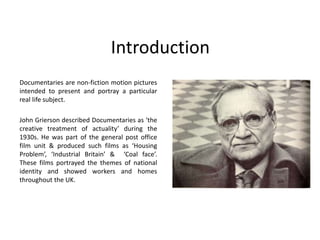
John Grierson described Documentaries as ‘the
creative treatment of actuality’ during the
1930s. He was part of the general post office
film unit & produced such films as ‘Housing
Problem’, ‘Industrial Britain’ & ‘Coal face’.
These films portrayed the themes of national
identity and showed workers and homes
throughout the UK.
Outline of features
Documentary features include:
Interviews
Dramatization
Observation
Archive
Footage
Exposition
Dramatization is often used where archive footage
is unavailable, to recreate events that are
important to the subject matter of the
documentary. For example, crime documentaries
often include recreations of the crime itself.
Observation is where the events are shown from a
fly on the wall perspective, and the people
involved won’t be conscious of the fact they are
being recorded.
Interviews are where people related to or with
knowledge of the subject matter are recorded
speaking to an interviewer or presenter, offering
their opinion or knowledge on the events
involved. Interviews are often made with a tripod
camera set-up, and with inter-cut b-roll footage.
In order to increase the viewers
understanding of events, archive footage
of TV Shows, music videos, CCTV, news
reels or historic interviews is used, to
show the reaction to the events shown
in the documentary at the time they
originally took place. This is rarely
produced specifically for the
documentary.
Exposition is the angle at which a producer
approaches the documentary. Documentaries can
either be neutral or biased to a certain cause or
belief.
Outline of types of documentary
Types of documentary include:
Docudrama
Fly on the wall
Self Reflexive
Fully Narrated
Mixed
Mixed documentaries are documentaries that
have been created with a variety of techniques,
and often include narration, fly on the wall
observation, archive footage, interviews and
dramatization.
Docudramas are documentaries that mostly
consist of dramatized recreated footage. They
occasionally feature archive footage or interviews
alongside the dramatization.
Self reflexive documentaries are documentaries in
which the subjects acknowledge their presence in
front of the camera. Self-reflexive documentaries
sometimes include presenters & not just
narrators.
Fully narrated documentaries focus on the ‘voice
of god’ technique, and often feature archive
footage or specially filmed footage but with little
diegetic sound & a full voice-over.
Fly on the wall documentaries are filmed without
the subjects being conscious of the fact they are
being filmed. They allow the viewers to see the
events from the perspective of a ‘fly on the wall’

A2 Media - Documentary Genre Analysis

  • 1.
  • 2.
    Introduction Documentaries are non-fictionmotion pictures intended to present and portray a particular real life subject. John Grierson described Documentaries as ‘the creative treatment of actuality’ during the 1930s. He was part of the general post office film unit & produced such films as ‘Housing Problem’, ‘Industrial Britain’ & ‘Coal face’. These films portrayed the themes of national identity and showed workers and homes throughout the UK.
  • 3.
    Outline of features Documentaryfeatures include: Interviews Dramatization Observation Archive Footage Exposition Dramatization is often used where archive footage is unavailable, to recreate events that are important to the subject matter of the documentary. For example, crime documentaries often include recreations of the crime itself. Observation is where the events are shown from a fly on the wall perspective, and the people involved won’t be conscious of the fact they are being recorded. Interviews are where people related to or with knowledge of the subject matter are recorded speaking to an interviewer or presenter, offering their opinion or knowledge on the events involved. Interviews are often made with a tripod camera set-up, and with inter-cut b-roll footage. In order to increase the viewers understanding of events, archive footage of TV Shows, music videos, CCTV, news reels or historic interviews is used, to show the reaction to the events shown in the documentary at the time they originally took place. This is rarely produced specifically for the documentary. Exposition is the angle at which a producer approaches the documentary. Documentaries can either be neutral or biased to a certain cause or belief.
  • 4.
    Outline of typesof documentary Types of documentary include: Docudrama Fly on the wall Self Reflexive Fully Narrated Mixed Mixed documentaries are documentaries that have been created with a variety of techniques, and often include narration, fly on the wall observation, archive footage, interviews and dramatization. Docudramas are documentaries that mostly consist of dramatized recreated footage. They occasionally feature archive footage or interviews alongside the dramatization. Self reflexive documentaries are documentaries in which the subjects acknowledge their presence in front of the camera. Self-reflexive documentaries sometimes include presenters & not just narrators. Fully narrated documentaries focus on the ‘voice of god’ technique, and often feature archive footage or specially filmed footage but with little diegetic sound & a full voice-over. Fly on the wall documentaries are filmed without the subjects being conscious of the fact they are being filmed. They allow the viewers to see the events from the perspective of a ‘fly on the wall’