Chapter 4 Doctor-
Patient
Relationship
Good physician treats the disease;
the great physician treats the
patient who has the disease ~
William Osler (Canadian
Physician, 1849-1919)
The Patient-Doctor
Relationship
 Class exercise:
 Tell me about your most memorable positive experience
with a physician (when you were a patient)
The Patient-Doctor
Relationship
 Class exercise:
 Tell me your most negative experience
The Patient-Doctor
Relationship
 What does being a doctor mean to you?
The Doctor-Patient relationship
Is the core of the practice of medicine
The patient expects a good relationship
as much as a cure
Doctor -patient relationship itself
becomes part of the therapeutic process
Introduction
• These two people have just met, but within
seconds one has begun to tell the other intimate
personal details about his health.
• What is more, it is likely that, in a few minutes,
he will be prepared to remove some of his
clothes and submit to a physical examination.
• The interaction is shaped by their differing
social roles and their different needs.
Parsons’ “Ideal Patient”
Permitted to:
Give up some activities and
responsibilities, Regarded as being
in need of care
In Return :
Must want to get better quickly, Seek
help from and cooperate with a
doctor
Parsons’ “ Ideal Doctor”
 Apply a high degree of skill and knowledge
 Act for the good of the patient
 Remain objective and emotionally detached
What do patients want from
a physician?
 Patients want to be able to trust the competence
and efficacy of their caregivers.
 Patients want to be able to negotiate the health
care system effectively and to be treated with
dignity and respect.
 Patients want to understand how their sickness or
treatment will affect their lives, and they often fear
that their doctors are not telling them everything
they want to know.
 Patients want to discuss the effect their
illness will have on their family, friends, and
finances.
 Patients worry about the future.
 Patients worry about and want to learn how
to care for themselves away from the clinical
setting.
Why is Doctor-Patient Communication
Unique?
Trust
Within minutes of meeting, patients are
often required to remove their cloth for
a physical examination and are placed
in a vulnerable situation
Respect
 Introduce yourself (Patient, Family, caregiver)
 Explain your role and goal for the interaction
 If appropriate shake hands
 Always address the patient as: Mr., Mrs., Ms,
etc.
Empathy
 To understand a person’s experience
 Different than sympathy
 Requires
Active listening
Interest in patient’s experience
Objectivity
 Removing your own beliefs and values
 Avoid judgmental attitudes
Drug Abuse, Ageism
Education
Socioeconomic status
Language/Cultural differences
Person’s autonomy and value
What constitutes a person’s autonomy?
Three aspects of autonomy
1. Freedom of thought
2. Freedom of will
3. Freedom of action
UNDERSTANDING PATIENT VALUES
AND AUTONOMY
 The term value itself is generally defined as the beliefs or
principles of a person or group that are used to guide
decisions and way of life
 Collectively, values give weight and worth to ideas and
actions.
 A person’s values strongly influence how one feels about
many issues, including choice of occupation, the utility of
preserving life, and expenditure of resources on various
items.
 Health-related values specifically describe a person’s
values relating to the medical sphere,
 Health-related values include the extent to which a
person values life versus lifestyle, personal health
versus preservation of family assets, and unpleasant
physical symptoms versus potential health benefits
 Patient autonomy concerns the patient’s right to
involvement in the discussion and decision-making
process during consultation
 It can further be described as the patient’s ability to
make medical care decisions without being influenced
too strongly by care providers or others.
 Respect for patient autonomy is an important tenet of
ethical medical conduct and reflects a balance of the
physician’s practice style with the patient’s inclinations
 A common challenge to patient autonomy arises when
the patient’s expressed preferences contradict what the
physician perceives as being in the patient’s best
interest, such as when the patient refuses necessary
treatment or expresses desires drastically different from
those of family and friends
 Patient autonomy falls on a wide spectrum, ranging from
very high, where patients make all decisions, to very low,
where they have minimal decision-making involvement.
 Patient autonomy is often associated with the idea of
“locus of control,” which emerged from Julian Rotter’s
Social Learning Theory, where personality is described as
the product of individual and environment.
 Locus of control describes the extent to which one feels in
control of one’s environment and has been explicitly
extended to health care through such tools as the
Multidimensional Health Locus of Control Scales (MHLC).
Conflicting Values
 Paternalism:
 The doctor should act in a way that protects or
advances the patient’s best interests, even if it
is against the patient’s will.
 Patient autonomy:
 The doctor should help the patient to make
real choice, and provide intervention under the
constraints of (a) informed consent and (b)
confidentiality.
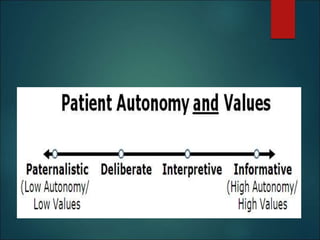
 In clinical practice, however, it has become evident that
many patients are not well represented by this single-axis
approach
 e.g. the patient with high autonomy but low formation of
health-related values.
 Consequently, the first step in the formation of the new
model is to allow autonomy and health care-related values
to vary independently of one another.
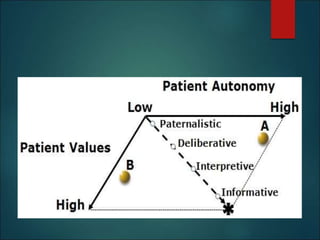
 This can be represented by plotting values and autonomy
on separate, perpendicular axes as illustrated below
A, the patient with high levels of autonomy and relatively unformed
health care-related values, e.g. a financial analyst
B, the patient from a very traditional culture where health care-
related values are clear but personal autonomy is low
An example of a situation in which values and autonomy are
uncoupled could be a stock analyst or high-ranking business
executive recently diagnosed with a rare disorder
From years of experience with executive responsibilities, this
patient has a high decision-making capacity and deeply involved
with all decisions and actions taken. However, this patient may
have no familiarity with the nature of illness or with health care as a
whole
 In previous models, the impact of patient medical knowledge
was not formally incorporated.
 The flow of medical information was assumed to move only
from physician to patient, but with information becoming
increasingly available to patients, such an assumption is no
longer reasonable.
 Patient familiarity with technical material has begun to
significantly influence the dynamic of patient–physician
interactions.
 As such, we complete our model of patient–physician
interaction with the addition of patient medical knowledge as a
third and final axis
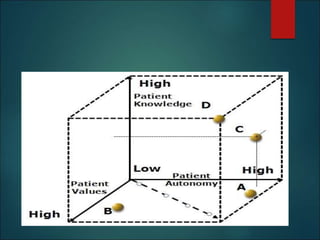
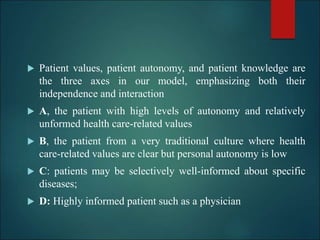
 Patient values, patient autonomy, and patient knowledge are
the three axes in our model, emphasizing both their
independence and interaction
 A, the patient with high levels of autonomy and relatively
unformed health care-related values
 B, the patient from a very traditional culture where health
care-related values are clear but personal autonomy is low
 C: patients may be selectively well-informed about specific
diseases;
 D: Highly informed patient such as a physician
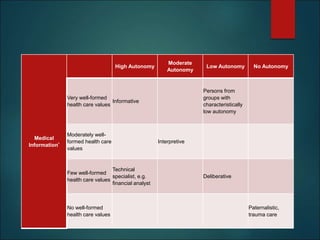
Medical
Information*
High Autonomy
Moderate
Autonomy
Low Autonomy No Autonomy
Very well-formed
health care values
Informative
Persons from
groups with
characteristically
low autonomy
Moderately well-
formed health care
values
Interpretive
Few well-formed
health care values
Technical
specialist, e.g.
financial analyst
Deliberative
No well-formed
health care values
Paternalistic,
trauma care
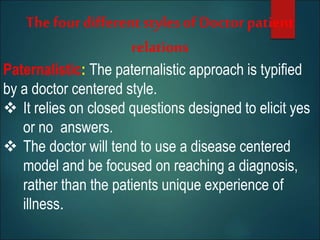
The four different stylesof Doctor patient
relations
Paternalistic: The paternalistic approach is typified
by a doctor centered style.
 It relies on closed questions designed to elicit yes
or no answers.
 The doctor will tend to use a disease centered
model and be focused on reaching a diagnosis,
rather than the patients unique experience of
illness.
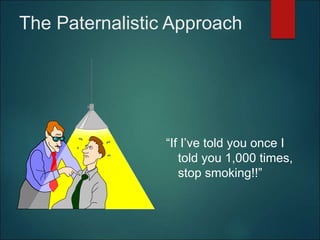
The Paternalistic Approach
“If I’ve told you once I
told you 1,000 times,
stop smoking!!”
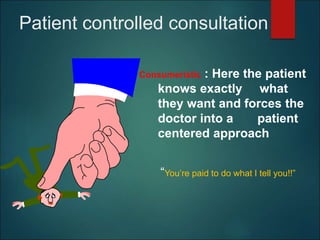
Patient controlled consultation
Consumeristic : Here the patient
knows exactly what
they want and forces the
doctor into a patient
centered approach
“You’re paid to do what I tell you!!”
Default :
This is where the patient centered style fails.
The doctor is trying to resign control but the patient is
unwilling to accept it, the result is an impasse/dead
Mutuality
The doctor uses open questions to encourage the
patient to talk about his complaint.
This approach relies on taking time to listen and trying
to understand the patients point of view
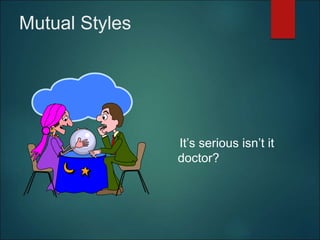
Mutual Styles
It’s serious isn’t it
doctor?
Evaluating Ethical models at
a glance
Paternalistic model
Informative model
Interpretive model
Deliberative model
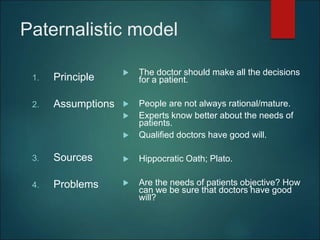
Paternalistic model
1. Principle
2. Assumptions
3. Sources
4. Problems
 The doctor should make all the decisions
for a patient.
 People are not always rational/mature.
 Experts know better about the needs of
patients.
 Qualified doctors have good will.
 Hippocratic Oath; Plato.
 Are the needs of patients objective? How
can we be sure that doctors have good
will?
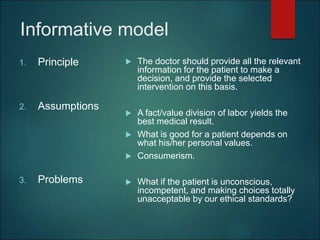
Informative model
1. Principle
2. Assumptions
3. Problems
 The doctor should provide all the relevant
information for the patient to make a
decision, and provide the selected
intervention on this basis.
 A fact/value division of labor yields the
best medical result.
 What is good for a patient depends on
what his/her personal values.
 Consumerism.
 What if the patient is unconscious,
incompetent, and making choices totally
unacceptable by our ethical standards?
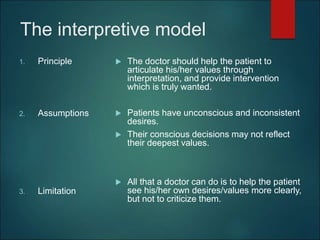
The interpretive model
1. Principle
2. Assumptions
3. Limitation
 The doctor should help the patient to
articulate his/her values through
interpretation, and provide intervention
which is truly wanted.
 Patients have unconscious and inconsistent
desires.
 Their conscious decisions may not reflect
their deepest values.
 All that a doctor can do is to help the patient
see his/her own desires/values more clearly,
but not to criticize them.
The deliberative model
1. Principle
2. Assumptions
3. Source
4. Problems
 The doctor should help the patient to deliberate well
through dialogue and discussion, and so develop
values which are objective and truly worthy.
 The objectivity of values.
 The patient’s good life consists not in the satisfaction
of desires, but maturity and rationality.
 Aristotelian ethics
 Is the model different from the paternalistic model?
What is the difference between dialogue and
persuasion?
Factors which influence
Dr-Patient Communication
 Patient-related factors
 Dr-related factors
 The interview setting
Patient-related factors
 Physical symptoms
 Psychological factors
 Previous experience
 Current experience
Dr-related factors
 Training in communication skills
 Self-confidence in ability to communicate
 Personality
 Physical factors
 Psychological factors
The interview setting
 Privacy
 Comfortable surroundings
 An appropriate seating arrangement
Discussion
 Give an example which indicates the
tension between doctors and patients
in Addis Ababa.
 Which ethical model of doctor-patient
relationship can give help resolving
this tension? And how?
 Does your favorite model suggest that
we give more rights to patients? Or
less?
What makes communication effective?
 Communication between two people is most likely to be
successful when two conditions are present:
 One person is not more powerful than the other
 Both people have the same objective
 The doctor is likely to be in a more powerful position than
the patient; having professional knowledge social status,
and gate-keepers such as receptionists and secretaries.
 The patient is the supplicant, may have waited a long time
for the appointment, may feel humiliated by embarrassing
confessions or undress and may be heavily out-numbered
eg. during a ward round
Continued--
 The patient will be concerned mainly with their own
symptoms; and their perspective will be coloured by
the material, cultural and inter-personal context
 The doctor will be concerned with their whole work
load i.e. the present patient plus all the other patients
waiting to be seen; and their perspective will be
coloured by their professional training and
socialisation.
 In consequence, successful communication during a
consultation can be difficult to achieve. Doctors
need to understand these problems, because
successful communication can influence their
clinical effectiveness
Clinical Effectiveness
The following can affect the doctor's clinical
effectiveness.
A. Information exchange:
 Accuracy and completeness of the diagnosis
 Physiological response to therapy, e.g. recovery
after surgery
 Practicality of the treatment regime
B. Patient Satisfaction
 Effectiveness of therapy, e.g. placebo effect
 Compliance with medical advice e.g. 30% of
prescribed drugs are either not taken or taken
incorrectly;
Continued---
C. Balance of power
 Historically power has shifted between doctor and
patient; as medicine becomes more specialised, shift
of power towards doctor.
 However medical paternalism clashes with patient
autonomy, therefore the power shifts back towards
patient. The balance of power between doctor and
patient depends up on: Patient’s clinical status :
 unconscious, acutely ill
 managing a chronic disease
 healthy patient requesting assistance
Continued----
D. Setting of the consultation
 number of staff present
 whether patient undressed or in bed
 patient alone
 Depends on whether the person is GP, Hospital, surgeon etc
 symbols of authority- white coat, stethoscope etc
Continued---
E. Social distance between doctor and patient
 Doctors are members of social class and the majority
of consultations are with working class patients.
 Inverse Care Law: the lower class you are, the less
time you get with GP
F. Private consultations
 fee-paying patients often feel more confident; and
doctors may be more concerned to remain of service
to these patients.
Continued---
G. Negotiation
 Doctors have tended to prefer guidance-cooperation,
paternalistic style doctor-centred
 Patients prefer mutual participation
 Both doctors and patients have strategies for shifting
the balance of power in the direction they desire.
 The doctor can indicate lack of time and emphasise
greater knowledge.
 The patient may display emotion e.g. sob or cry; and
make unfavourable comparisons with other doctors
Suggestions for further
reading
1. Parker, Michael & Dickenson, Donna (2010),
The Cambridge Medical Ethics Workbook:
Case Studies, Commentaries, and Activities,
Cambridge; New York: Cambridge University
Press, Chapter 9.
2. Emanuel, Ezekiel J., & Emanuel, Linda L.
(1992), “Four Models of the Physician-Patient
Relationship”, Journal of the American
Medical Association, vol.267, no.16, pp.2221-
2226.

Doctor-Patient_Relationship.ppt

  • 1.
  • 2.
    Good physician treatsthe disease; the great physician treats the patient who has the disease ~ William Osler (Canadian Physician, 1849-1919)
  • 3.
    The Patient-Doctor Relationship  Classexercise:  Tell me about your most memorable positive experience with a physician (when you were a patient)
  • 4.
    The Patient-Doctor Relationship  Classexercise:  Tell me your most negative experience
  • 5.
    The Patient-Doctor Relationship  Whatdoes being a doctor mean to you?
  • 6.
    The Doctor-Patient relationship Isthe core of the practice of medicine The patient expects a good relationship as much as a cure Doctor -patient relationship itself becomes part of the therapeutic process
  • 7.
    Introduction • These twopeople have just met, but within seconds one has begun to tell the other intimate personal details about his health. • What is more, it is likely that, in a few minutes, he will be prepared to remove some of his clothes and submit to a physical examination. • The interaction is shaped by their differing social roles and their different needs.
  • 8.
    Parsons’ “Ideal Patient” Permittedto: Give up some activities and responsibilities, Regarded as being in need of care In Return : Must want to get better quickly, Seek help from and cooperate with a doctor
  • 9.
    Parsons’ “ IdealDoctor”  Apply a high degree of skill and knowledge  Act for the good of the patient  Remain objective and emotionally detached
  • 10.
    What do patientswant from a physician?  Patients want to be able to trust the competence and efficacy of their caregivers.  Patients want to be able to negotiate the health care system effectively and to be treated with dignity and respect.  Patients want to understand how their sickness or treatment will affect their lives, and they often fear that their doctors are not telling them everything they want to know.
  • 11.
     Patients wantto discuss the effect their illness will have on their family, friends, and finances.  Patients worry about the future.  Patients worry about and want to learn how to care for themselves away from the clinical setting.
  • 12.
    Why is Doctor-PatientCommunication Unique? Trust Within minutes of meeting, patients are often required to remove their cloth for a physical examination and are placed in a vulnerable situation
  • 13.
    Respect  Introduce yourself(Patient, Family, caregiver)  Explain your role and goal for the interaction  If appropriate shake hands  Always address the patient as: Mr., Mrs., Ms, etc.
  • 14.
    Empathy  To understanda person’s experience  Different than sympathy  Requires Active listening Interest in patient’s experience
  • 15.
    Objectivity  Removing yourown beliefs and values  Avoid judgmental attitudes Drug Abuse, Ageism Education Socioeconomic status Language/Cultural differences
  • 16.
    Person’s autonomy andvalue What constitutes a person’s autonomy? Three aspects of autonomy 1. Freedom of thought 2. Freedom of will 3. Freedom of action
  • 17.
    UNDERSTANDING PATIENT VALUES ANDAUTONOMY  The term value itself is generally defined as the beliefs or principles of a person or group that are used to guide decisions and way of life  Collectively, values give weight and worth to ideas and actions.  A person’s values strongly influence how one feels about many issues, including choice of occupation, the utility of preserving life, and expenditure of resources on various items.  Health-related values specifically describe a person’s values relating to the medical sphere,
  • 18.
     Health-related valuesinclude the extent to which a person values life versus lifestyle, personal health versus preservation of family assets, and unpleasant physical symptoms versus potential health benefits  Patient autonomy concerns the patient’s right to involvement in the discussion and decision-making process during consultation  It can further be described as the patient’s ability to make medical care decisions without being influenced too strongly by care providers or others.
  • 19.
     Respect forpatient autonomy is an important tenet of ethical medical conduct and reflects a balance of the physician’s practice style with the patient’s inclinations  A common challenge to patient autonomy arises when the patient’s expressed preferences contradict what the physician perceives as being in the patient’s best interest, such as when the patient refuses necessary treatment or expresses desires drastically different from those of family and friends
  • 20.
     Patient autonomyfalls on a wide spectrum, ranging from very high, where patients make all decisions, to very low, where they have minimal decision-making involvement.  Patient autonomy is often associated with the idea of “locus of control,” which emerged from Julian Rotter’s Social Learning Theory, where personality is described as the product of individual and environment.  Locus of control describes the extent to which one feels in control of one’s environment and has been explicitly extended to health care through such tools as the Multidimensional Health Locus of Control Scales (MHLC).
  • 22.
    Conflicting Values  Paternalism: The doctor should act in a way that protects or advances the patient’s best interests, even if it is against the patient’s will.  Patient autonomy:  The doctor should help the patient to make real choice, and provide intervention under the constraints of (a) informed consent and (b) confidentiality.
  • 23.
     In clinicalpractice, however, it has become evident that many patients are not well represented by this single-axis approach  e.g. the patient with high autonomy but low formation of health-related values.  Consequently, the first step in the formation of the new model is to allow autonomy and health care-related values to vary independently of one another.  This can be represented by plotting values and autonomy on separate, perpendicular axes as illustrated below
  • 25.
    A, the patientwith high levels of autonomy and relatively unformed health care-related values, e.g. a financial analyst B, the patient from a very traditional culture where health care- related values are clear but personal autonomy is low An example of a situation in which values and autonomy are uncoupled could be a stock analyst or high-ranking business executive recently diagnosed with a rare disorder From years of experience with executive responsibilities, this patient has a high decision-making capacity and deeply involved with all decisions and actions taken. However, this patient may have no familiarity with the nature of illness or with health care as a whole
  • 26.
     In previousmodels, the impact of patient medical knowledge was not formally incorporated.  The flow of medical information was assumed to move only from physician to patient, but with information becoming increasingly available to patients, such an assumption is no longer reasonable.  Patient familiarity with technical material has begun to significantly influence the dynamic of patient–physician interactions.  As such, we complete our model of patient–physician interaction with the addition of patient medical knowledge as a third and final axis
  • 28.
     Patient values,patient autonomy, and patient knowledge are the three axes in our model, emphasizing both their independence and interaction  A, the patient with high levels of autonomy and relatively unformed health care-related values  B, the patient from a very traditional culture where health care-related values are clear but personal autonomy is low  C: patients may be selectively well-informed about specific diseases;  D: Highly informed patient such as a physician
  • 29.
    Medical Information* High Autonomy Moderate Autonomy Low AutonomyNo Autonomy Very well-formed health care values Informative Persons from groups with characteristically low autonomy Moderately well- formed health care values Interpretive Few well-formed health care values Technical specialist, e.g. financial analyst Deliberative No well-formed health care values Paternalistic, trauma care
  • 30.
    The four differentstylesof Doctor patient relations Paternalistic: The paternalistic approach is typified by a doctor centered style.  It relies on closed questions designed to elicit yes or no answers.  The doctor will tend to use a disease centered model and be focused on reaching a diagnosis, rather than the patients unique experience of illness.
  • 31.
    The Paternalistic Approach “IfI’ve told you once I told you 1,000 times, stop smoking!!”
  • 32.
    Patient controlled consultation Consumeristic: Here the patient knows exactly what they want and forces the doctor into a patient centered approach “You’re paid to do what I tell you!!”
  • 33.
    Default : This iswhere the patient centered style fails. The doctor is trying to resign control but the patient is unwilling to accept it, the result is an impasse/dead Mutuality The doctor uses open questions to encourage the patient to talk about his complaint. This approach relies on taking time to listen and trying to understand the patients point of view
  • 34.
    Mutual Styles It’s seriousisn’t it doctor?
  • 35.
    Evaluating Ethical modelsat a glance Paternalistic model Informative model Interpretive model Deliberative model
  • 36.
    Paternalistic model 1. Principle 2.Assumptions 3. Sources 4. Problems  The doctor should make all the decisions for a patient.  People are not always rational/mature.  Experts know better about the needs of patients.  Qualified doctors have good will.  Hippocratic Oath; Plato.  Are the needs of patients objective? How can we be sure that doctors have good will?
  • 37.
    Informative model 1. Principle 2.Assumptions 3. Problems  The doctor should provide all the relevant information for the patient to make a decision, and provide the selected intervention on this basis.  A fact/value division of labor yields the best medical result.  What is good for a patient depends on what his/her personal values.  Consumerism.  What if the patient is unconscious, incompetent, and making choices totally unacceptable by our ethical standards?
  • 38.
    The interpretive model 1.Principle 2. Assumptions 3. Limitation  The doctor should help the patient to articulate his/her values through interpretation, and provide intervention which is truly wanted.  Patients have unconscious and inconsistent desires.  Their conscious decisions may not reflect their deepest values.  All that a doctor can do is to help the patient see his/her own desires/values more clearly, but not to criticize them.
  • 39.
    The deliberative model 1.Principle 2. Assumptions 3. Source 4. Problems  The doctor should help the patient to deliberate well through dialogue and discussion, and so develop values which are objective and truly worthy.  The objectivity of values.  The patient’s good life consists not in the satisfaction of desires, but maturity and rationality.  Aristotelian ethics  Is the model different from the paternalistic model? What is the difference between dialogue and persuasion?
  • 40.
    Factors which influence Dr-PatientCommunication  Patient-related factors  Dr-related factors  The interview setting
  • 41.
    Patient-related factors  Physicalsymptoms  Psychological factors  Previous experience  Current experience
  • 42.
    Dr-related factors  Trainingin communication skills  Self-confidence in ability to communicate  Personality  Physical factors  Psychological factors
  • 43.
    The interview setting Privacy  Comfortable surroundings  An appropriate seating arrangement
  • 44.
    Discussion  Give anexample which indicates the tension between doctors and patients in Addis Ababa.  Which ethical model of doctor-patient relationship can give help resolving this tension? And how?  Does your favorite model suggest that we give more rights to patients? Or less?
  • 45.
    What makes communicationeffective?  Communication between two people is most likely to be successful when two conditions are present:  One person is not more powerful than the other  Both people have the same objective  The doctor is likely to be in a more powerful position than the patient; having professional knowledge social status, and gate-keepers such as receptionists and secretaries.  The patient is the supplicant, may have waited a long time for the appointment, may feel humiliated by embarrassing confessions or undress and may be heavily out-numbered eg. during a ward round
  • 46.
    Continued--  The patientwill be concerned mainly with their own symptoms; and their perspective will be coloured by the material, cultural and inter-personal context  The doctor will be concerned with their whole work load i.e. the present patient plus all the other patients waiting to be seen; and their perspective will be coloured by their professional training and socialisation.  In consequence, successful communication during a consultation can be difficult to achieve. Doctors need to understand these problems, because successful communication can influence their clinical effectiveness
  • 47.
    Clinical Effectiveness The followingcan affect the doctor's clinical effectiveness. A. Information exchange:  Accuracy and completeness of the diagnosis  Physiological response to therapy, e.g. recovery after surgery  Practicality of the treatment regime B. Patient Satisfaction  Effectiveness of therapy, e.g. placebo effect  Compliance with medical advice e.g. 30% of prescribed drugs are either not taken or taken incorrectly;
  • 48.
    Continued--- C. Balance ofpower  Historically power has shifted between doctor and patient; as medicine becomes more specialised, shift of power towards doctor.  However medical paternalism clashes with patient autonomy, therefore the power shifts back towards patient. The balance of power between doctor and patient depends up on: Patient’s clinical status :  unconscious, acutely ill  managing a chronic disease  healthy patient requesting assistance
  • 49.
    Continued---- D. Setting ofthe consultation  number of staff present  whether patient undressed or in bed  patient alone  Depends on whether the person is GP, Hospital, surgeon etc  symbols of authority- white coat, stethoscope etc
  • 50.
    Continued--- E. Social distancebetween doctor and patient  Doctors are members of social class and the majority of consultations are with working class patients.  Inverse Care Law: the lower class you are, the less time you get with GP F. Private consultations  fee-paying patients often feel more confident; and doctors may be more concerned to remain of service to these patients.
  • 51.
    Continued--- G. Negotiation  Doctorshave tended to prefer guidance-cooperation, paternalistic style doctor-centred  Patients prefer mutual participation  Both doctors and patients have strategies for shifting the balance of power in the direction they desire.  The doctor can indicate lack of time and emphasise greater knowledge.  The patient may display emotion e.g. sob or cry; and make unfavourable comparisons with other doctors
  • 52.
    Suggestions for further reading 1.Parker, Michael & Dickenson, Donna (2010), The Cambridge Medical Ethics Workbook: Case Studies, Commentaries, and Activities, Cambridge; New York: Cambridge University Press, Chapter 9. 2. Emanuel, Ezekiel J., & Emanuel, Linda L. (1992), “Four Models of the Physician-Patient Relationship”, Journal of the American Medical Association, vol.267, no.16, pp.2221- 2226.