Physician-Patient Relationship
AB.RAJAR.
ASSISTANT PROFESSOR.
COMMUNITY HEALTH SCIENCES.
Physician-Patient Relationship
Learning Objectives.
• Introduction.
• Why does it matter?
• Types of relationships.
• What is the ideal patient-physician relationships ?
• Ethical Models of Physician-Patient Relationship.
• Relationship of the 21st century
• Conclusion.
Physician-Patient Relationship
INTRODUCTION
• Doctor-Patient relationships
express the values of medical
profession.
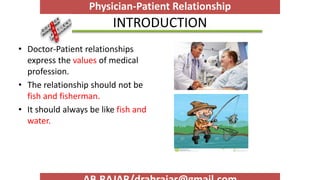
• The relationship should not be
fish and fisherman.
• It should always be like fish and
water.
Physician-Patient Relationship
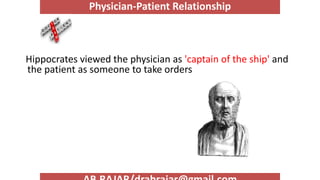
Hippocrates viewed the physician as 'captain of the ship' and
the patient as someone to take orders
Physician-Patient Relationship
Why Does It Matter
• The patient-physician relationship is fundamental for
providing and receiving,
– Excellent care
– To the healing process
– To improved outcomes
• Therefore, it is important to understand what
elements comprise the relationship and identify
those that make it "good."
AB.RAJAR/drabrajar@gmail.com
Physician-Patient Relationship
Why Does It Matter
• Because of the rapidly changing environment
that characterizes health care today,
• We need to understand what physicians and
patients must do to protect and nurture the
relationship.
AB.RAJAR/drabrajar@gmail.com
Physician-Patient Relationship
The Patient
• Patients are individual human beings with problems that all to
often transcend their physical complaints.
• The patient are not „cases” or „admissions” or „diseases”
AB.RAJAR/drabrajar@gmail.com
Physician-Patient Relationship
Parsons’ model
• The nature of relationships determines
the success of the
treatment/intervention.
• PARSON was one of the earliest
sociologist to examine the patient
doctor relationship.
• He regarded illness as a form of social
deviance (impairs normal role
performance, affects smooth
functioning of the society).
• The amount of illness is controlled by
socially prescribed roles for doctors
and patients.
AB.RAJAR/drabrajar@gmail.com
Physician-Patient Relationship
Parsons’ model
• Parson saw the doctor and patient as fulfilling
necessary functions in a well balanced and
maintained social structure
• Sickness is considered to be necessary,
providing a brief exemption for patient from
social responsibilities
AB.RAJAR/drabrajar@gmail.com
Physician-Patient Relationship
Parsons’ “Ideal Patient”
Permitted to:
 Give up-
• some activities.
• responsibilities
 Regarded as being in need of care
In Return :
 Must want to get better quickly
 Seek help from and cooperate with a doctor
AB.RAJAR/drabrajar@gmail.com
Physician-Patient Relationship
Parsons’ “ Ideal Doctor”
 Apply a high degree of-
 skill and
 knowledge
 Acts for the good of the patient
 Remain objective and
emotionally detached
 Respect the position of privilege
AB.RAJAR/drabrajar@gmail.com
Physician-Patient Relationship
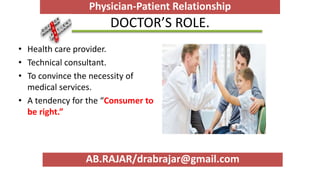
DOCTOR’S ROLE.
• Health care provider.
• Technical consultant.
• To convince the necessity of
medical services.
• A tendency for the “Consumer to
be right.”
Physician-Patient Relationship
AB.RAJAR/drabrajar@gmail.com
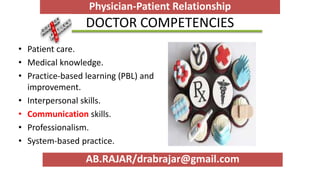
DOCTOR COMPETENCIES
• Patient care.
• Medical knowledge.
• Practice-based learning (PBL) and
improvement.
• Interpersonal skills.
• Communication skills.
• Professionalism.
• System-based practice.
Physician-Patient Relationship
AB.RAJAR/drabrajar@gmail.com
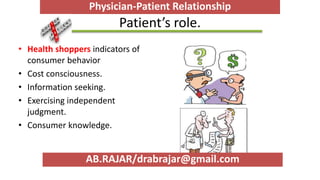
Patient’s role.
• Health shoppers indicators of
consumer behavior
• Cost consciousness.
• Information seeking.
• Exercising independent
judgment.
• Consumer knowledge.
Physician-Patient Relationship
AB.RAJAR/drabrajar@gmail.com
CONFLICT OF INTEREST
• Interests of patient Vs society.
• Interests of patient Vs other patients.
• Problems of confidentiality.
Physician-Patient Relationship
AB.RAJAR/drabrajar@gmail.com
The Physician Charter.
Principle includes:
– Patient welfare.
– Patient autonomy.
Commencements Includes:
– Honesty with Patients.
– Patient confidentiality.
– Maintaining appropriate
relationships with patients.
AB.RAJAR/drabrajar@gmail.com
Physician-Patient Relationship
PATIENTS BELIEFS & EXPECTATIONS
• Influenced by:
1. Previous experience.
2. Literature.
3. The media.
4. Family and friends.
5. Cultural influences.
6. Social significance.
These beliefs influence in outcome.
AB.RAJAR/drabrajar@gmail.com
Physician-Patient Relationship
TYPES OF RELATIONSHIPS
1) Paternalism (Doctor centered, Disease Model).
2) Mutuality (Patient centered, Illness model).
3) Consumerism (Typical in private practice)
4) Default.
5) Conflict.
Physician-Patient Relationship
AB.RAJAR/drabrajar@gmail.com
1.Paternalism
• Traditional form of doctor-patient relationship
• Doctor takes on role of parent
• Doctor is the expert and patient expected to cooperate
• Tightly controlled interviewing style aimed at reaching an
organic diagnosis
• Passive patient and a dominant doctor
• Focus is on care, rather than autonomy
AB.RAJAR/drabrajar@gmail.com
Physician-Patient Relationship
PATERNALISM
• Making of decisions by professionals on behalf of patients.
• Dirty word-OUT-AUTONOMY- is IN.
– Liberty,diginity,individuality,independence,accepting responsibility, self assertion,
knowledge of one’s own interests,privacy,voluntarieness,freedom from
deception.
Physician-Patient Relationship
AB.RAJAR/drabrajar@gmail.com
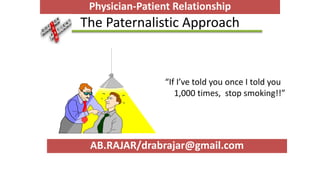
The Paternalistic Approach
“If I’ve told you once I told you
1,000 times, stop smoking!!”
AB.RAJAR/drabrajar@gmail.com
Physician-Patient Relationship
Advantages
• The supportive nature of paternalism appears to be
important when patients are very sick at their most
vulnerable
• Relief from the burden of worry is curative in itself, and the
trust and confident implied by this model allows doctor to
perform “medical magic”
AB.RAJAR/drabrajar@gmail.com
Physician-Patient Relationship
2.Mutuality
• The optimal doctor-patient relationship model
• This model views neither the patient nor the physician as
standing aside
• Each of participants brings strengths and resources to the
relationship
• Based on the communication between doctors and patients
AB.RAJAR/drabrajar@gmail.com
Physician-Patient Relationship
2.Mutuality Cont...
• Patients need to define their problems in an open and full manner
• The patient has right to seek care elsewhere when demands are not satisfactorily
met.
• Physicians need to work with the patient to articulate the problem and refine the
request
• The physician’s right to withdraw services formally from a patient if he or she feels it
is impossible to satisfy the patient’s demand
AB.RAJAR/drabrajar@gmail.com
Physician-Patient Relationship
Advantages
• Patients can fully understand what problem they are coping
with through physicians’ help.
• Physicians can entirely know patient’s value.
• Decisions can easily be made from a mutual and collaborative
relationship
AB.RAJAR/drabrajar@gmail.com
Physician-Patient Relationship
Disadvantages
• Physicians do not know what certain degree should they
reach in communication
• Is the patient capable of making the important
therapeutic .
AB.RAJAR/drabrajar@gmail.com
Physician-Patient Relationship
3.Consumerism
• We can simplify the complicated relationship with “buyer and seller”
relationship, is it good or bad? What is your opinion?
• The patient can challenge to unilateral decision making by physicians in
reaching diagnosis and working out treatment plans
• Reversing the very basic nature of the power relationship.
AB.RAJAR/drabrajar@gmail.com
Physician-Patient Relationship
4.Default
• When patient and physician expectation are at odds, or when
the need for change in the relationship cannot be negotiated,
the relationship may come to a dysfunction standstill.
AB.RAJAR/drabrajar@gmail.com
Physician-Patient Relationship
Patient Centred consultation style
• Dr is less authoritarian , encourages patients to express their own
feelings and concerns , empathic , listen more than talk .
• Dr use open end questioning , show interest in psycho-social aspect of
patient’s illness .
AB.RAJAR/drabrajar@gmail.com
Physician-Patient Relationship
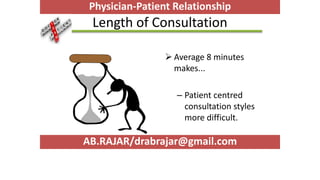
Length of Consultation
 Average 8 minutes
makes...
– Patient centred
consultation styles
more difficult.
AB.RAJAR/drabrajar@gmail.com
Physician-Patient Relationship
Consultation style.
It’s serious, isn’t it doctor ?
• Sustained physician patient
partnerships with bonds of trust
and knowledge of patients were
correlate of three outcomes of
care…
– Adherence.
– Satisfaction.
– Improved health status.
Physician-Patient Relationship
Types of Dr-Pt relationship
 Doctor controlled
 Patient controlled
AB.RAJAR/drabrajar@gmail.com
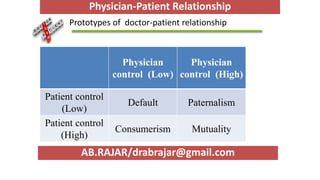
Physician-Patient Relationship
Prototypes of doctor-patient relationship
Physician
control (Low)
Physician
control (High)
Patient control
(Low)
Default Paternalism
Patient control
(High)
Consumerism Mutuality
AB.RAJAR/drabrajar@gmail.com
Physician-Patient Relationship
Patient controlled consultation
“You’re paid to do what I tell
you!!”
AB.RAJAR/drabrajar@gmail.com
Physician-Patient Relationship
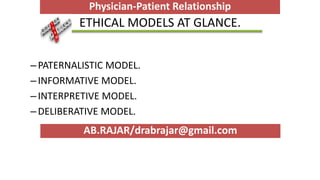
ETHICAL MODELS AT GLANCE.
–PATERNALISTIC MODEL.
–INFORMATIVE MODEL.
–INTERPRETIVE MODEL.
–DELIBERATIVE MODEL.
AB.RAJAR/drabrajar@gmail.com
Physician-Patient Relationship
PETERNALISTIC MODEL
• Principle.
– The doctor should make all the decisions for the patient.
• Assumptions.
– People are not always rational/mature.
– Experts knows better about the needs of patients.
– Qualified doctors have good will.
• Sources:
– Hippocratic oath.
• Problems:
– Are the needs of patients objective?
– How can we be sure that doctors have good will?
AB.RAJAR/drabrajar@gmail.com
Physician-Patient Relationship
INFORMATIVE MODEL
• Principle.
– The doctor should provide all the relevant information for the
patient to make a decision, and provide the selected
intervention on this basis.
• Assumptions.
– A fact/value division of labor yields the best medical results.
– What is good for a patient depends on what his/her personal
values.
– Consumerism.
• Problems.
– What if patient is unconcious,incompetent and making choices
totally unacceptable by our ethical standards?
AB.RAJAR/drabrajar@gmail.com
Physician-Patient Relationship
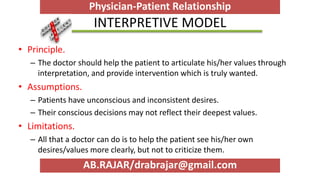
INTERPRETIVE MODEL
• Principle.
– The doctor should help the patient to articulate his/her values through
interpretation, and provide intervention which is truly wanted.
• Assumptions.
– Patients have unconscious and inconsistent desires.
– Their conscious decisions may not reflect their deepest values.
• Limitations.
– All that a doctor can do is to help the patient see his/her own
desires/values more clearly, but not to criticize them.
AB.RAJAR/drabrajar@gmail.com
Physician-Patient Relationship
DELIBERATIVE MODEL
• Principle.
– The doctor should help the patient to deliberate well through dialog and
discussion, and ,
– So develop values which are objective and truly worthy.
• Assumptions.
– The objectivity of values.
– The patient’s good life consist not in the satisfaction of desires, but
maturity and rationality.
• Problems.
– Is the model different from the paternalistic model?
– What is the difference b/w dialog and persuasions?
AB.RAJAR/drabrajar@gmail.com
Physician-Patient Relationship
The Patient
"nothing about me without me."
AB.RAJAR/drabrajar@gmail.com
Physician-Patient Relationship
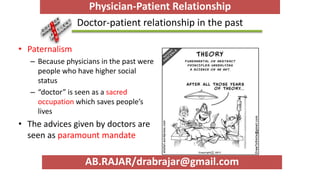
Doctor-patient relationship in the past
• Paternalism
– Because physicians in the past were
people who have higher social
status
– “doctor” is seen as a sacred
occupation which saves people’s
lives
• The advices given by doctors are
seen as paramount mandate
AB.RAJAR/drabrajar@gmail.com
Physician-Patient Relationship
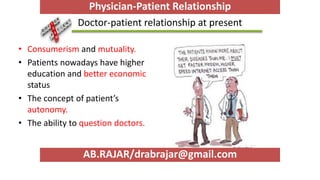
Doctor-patient relationship at present
• Consumerism and mutuality.
• Patients nowadays have higher
education and better economic
status
• The concept of patient’s
autonomy.
• The ability to question doctors.
AB.RAJAR/drabrajar@gmail.com
Physician-Patient Relationship
Principal elements that are essential to the relationship
1) Communication.
2) Office Experience.
3) Hospital Experience.
4) Education.
5) Integration.
6) Decision-Making.
7) Outcome.
AB.RAJAR/drabrajar@gmail.com
Physician-Patient Relationship
Communication and Treatment
• Advice reassurance and support
from the doctor can have a
significant effect on recovery.
• The placebo effect
AB.RAJAR/drabrajar@gmail.com
Physician-Patient Relationship
Communication with pt includes
 An integrated approach to information gathering.
 Seeking to identify physical psychological and social factors
 Will likely to produce a better outcome of health care.
Physician-Patient Relationship
AB.RAJAR/drabrajar@gmail.com
Elements of Communication
• Seven Essential Elements in Physician-Patient Communication
– Build the doctor-patient relationship
– Open the discussion
– Gather information
– Understand the patient’s perspective
– Share information
– Reach agreement on problems and plans
– Provide closure
AB.RAJAR/drabrajar@gmail.com
Physician-Patient Relationship
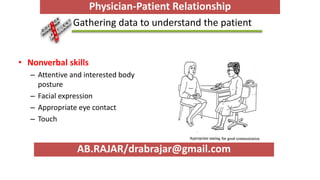
Gathering data to understand the patient
• Nonverbal skills
– Attentive and interested body
posture
– Facial expression
– Appropriate eye contact
– Touch
AB.RAJAR/drabrajar@gmail.com
Physician-Patient Relationship
AB.RAJAR/drabrajar@gmail.com
Physician-Patient Relationship
Who are “difficult” patients?
What characteristics make a patient “difficult”?
– Mental health disorders
– Multiple symptoms
– Chronic pain
– Functional impairment
– Unmet expectations
– Lower satisfaction with care
– High users of health care services
Dr. Tom O’Dowd coined the term “heartsink patient”
BMJ, 1988
AB.RAJAR/drabrajar@gmail.com
Physician-Patient Relationship
Conclusion
• Relationship between patients and doctors are often
unstated, and they are dynamic.
• As conditions change, the kind of relationship that
works best for a patient may change.
• Doctors and patients should choose a “relationship
fit”.
• effectiveness of the patient-physician relationship
directly relates to health outcomes.
AB.RAJAR/drabrajar@gmail.com
Physician-Patient Relationship
AB.RAJAR/drabrajar@gmail.com
Physician-Patient Relationship

Physician Patient Relationship

  • 1.
    Physician-Patient Relationship AB.RAJAR. ASSISTANT PROFESSOR. COMMUNITYHEALTH SCIENCES. Physician-Patient Relationship
  • 2.
    Learning Objectives. • Introduction. •Why does it matter? • Types of relationships. • What is the ideal patient-physician relationships ? • Ethical Models of Physician-Patient Relationship. • Relationship of the 21st century • Conclusion. Physician-Patient Relationship
  • 3.
    INTRODUCTION • Doctor-Patient relationships expressthe values of medical profession. • The relationship should not be fish and fisherman. • It should always be like fish and water. Physician-Patient Relationship
  • 4.
    Hippocrates viewed thephysician as 'captain of the ship' and the patient as someone to take orders Physician-Patient Relationship
  • 5.
    Why Does ItMatter • The patient-physician relationship is fundamental for providing and receiving, – Excellent care – To the healing process – To improved outcomes • Therefore, it is important to understand what elements comprise the relationship and identify those that make it "good." AB.RAJAR/drabrajar@gmail.com Physician-Patient Relationship
  • 6.
    Why Does ItMatter • Because of the rapidly changing environment that characterizes health care today, • We need to understand what physicians and patients must do to protect and nurture the relationship. AB.RAJAR/drabrajar@gmail.com Physician-Patient Relationship
  • 7.
    The Patient • Patientsare individual human beings with problems that all to often transcend their physical complaints. • The patient are not „cases” or „admissions” or „diseases” AB.RAJAR/drabrajar@gmail.com Physician-Patient Relationship
  • 8.
    Parsons’ model • Thenature of relationships determines the success of the treatment/intervention. • PARSON was one of the earliest sociologist to examine the patient doctor relationship. • He regarded illness as a form of social deviance (impairs normal role performance, affects smooth functioning of the society). • The amount of illness is controlled by socially prescribed roles for doctors and patients. AB.RAJAR/drabrajar@gmail.com Physician-Patient Relationship
  • 9.
    Parsons’ model • Parsonsaw the doctor and patient as fulfilling necessary functions in a well balanced and maintained social structure • Sickness is considered to be necessary, providing a brief exemption for patient from social responsibilities AB.RAJAR/drabrajar@gmail.com Physician-Patient Relationship
  • 10.
    Parsons’ “Ideal Patient” Permittedto:  Give up- • some activities. • responsibilities  Regarded as being in need of care In Return :  Must want to get better quickly  Seek help from and cooperate with a doctor AB.RAJAR/drabrajar@gmail.com Physician-Patient Relationship
  • 11.
    Parsons’ “ IdealDoctor”  Apply a high degree of-  skill and  knowledge  Acts for the good of the patient  Remain objective and emotionally detached  Respect the position of privilege AB.RAJAR/drabrajar@gmail.com Physician-Patient Relationship
  • 12.
    DOCTOR’S ROLE. • Healthcare provider. • Technical consultant. • To convince the necessity of medical services. • A tendency for the “Consumer to be right.” Physician-Patient Relationship AB.RAJAR/drabrajar@gmail.com
  • 13.
    DOCTOR COMPETENCIES • Patientcare. • Medical knowledge. • Practice-based learning (PBL) and improvement. • Interpersonal skills. • Communication skills. • Professionalism. • System-based practice. Physician-Patient Relationship AB.RAJAR/drabrajar@gmail.com
  • 14.
    Patient’s role. • Healthshoppers indicators of consumer behavior • Cost consciousness. • Information seeking. • Exercising independent judgment. • Consumer knowledge. Physician-Patient Relationship AB.RAJAR/drabrajar@gmail.com
  • 15.
    CONFLICT OF INTEREST •Interests of patient Vs society. • Interests of patient Vs other patients. • Problems of confidentiality. Physician-Patient Relationship AB.RAJAR/drabrajar@gmail.com
  • 16.
    The Physician Charter. Principleincludes: – Patient welfare. – Patient autonomy. Commencements Includes: – Honesty with Patients. – Patient confidentiality. – Maintaining appropriate relationships with patients. AB.RAJAR/drabrajar@gmail.com Physician-Patient Relationship
  • 17.
    PATIENTS BELIEFS &EXPECTATIONS • Influenced by: 1. Previous experience. 2. Literature. 3. The media. 4. Family and friends. 5. Cultural influences. 6. Social significance. These beliefs influence in outcome. AB.RAJAR/drabrajar@gmail.com Physician-Patient Relationship
  • 18.
    TYPES OF RELATIONSHIPS 1)Paternalism (Doctor centered, Disease Model). 2) Mutuality (Patient centered, Illness model). 3) Consumerism (Typical in private practice) 4) Default. 5) Conflict. Physician-Patient Relationship AB.RAJAR/drabrajar@gmail.com
  • 19.
    1.Paternalism • Traditional formof doctor-patient relationship • Doctor takes on role of parent • Doctor is the expert and patient expected to cooperate • Tightly controlled interviewing style aimed at reaching an organic diagnosis • Passive patient and a dominant doctor • Focus is on care, rather than autonomy AB.RAJAR/drabrajar@gmail.com Physician-Patient Relationship
  • 20.
    PATERNALISM • Making ofdecisions by professionals on behalf of patients. • Dirty word-OUT-AUTONOMY- is IN. – Liberty,diginity,individuality,independence,accepting responsibility, self assertion, knowledge of one’s own interests,privacy,voluntarieness,freedom from deception. Physician-Patient Relationship AB.RAJAR/drabrajar@gmail.com
  • 21.
    The Paternalistic Approach “IfI’ve told you once I told you 1,000 times, stop smoking!!” AB.RAJAR/drabrajar@gmail.com Physician-Patient Relationship
  • 22.
    Advantages • The supportivenature of paternalism appears to be important when patients are very sick at their most vulnerable • Relief from the burden of worry is curative in itself, and the trust and confident implied by this model allows doctor to perform “medical magic” AB.RAJAR/drabrajar@gmail.com Physician-Patient Relationship
  • 23.
    2.Mutuality • The optimaldoctor-patient relationship model • This model views neither the patient nor the physician as standing aside • Each of participants brings strengths and resources to the relationship • Based on the communication between doctors and patients AB.RAJAR/drabrajar@gmail.com Physician-Patient Relationship
  • 24.
    2.Mutuality Cont... • Patientsneed to define their problems in an open and full manner • The patient has right to seek care elsewhere when demands are not satisfactorily met. • Physicians need to work with the patient to articulate the problem and refine the request • The physician’s right to withdraw services formally from a patient if he or she feels it is impossible to satisfy the patient’s demand AB.RAJAR/drabrajar@gmail.com Physician-Patient Relationship
  • 25.
    Advantages • Patients canfully understand what problem they are coping with through physicians’ help. • Physicians can entirely know patient’s value. • Decisions can easily be made from a mutual and collaborative relationship AB.RAJAR/drabrajar@gmail.com Physician-Patient Relationship
  • 26.
    Disadvantages • Physicians donot know what certain degree should they reach in communication • Is the patient capable of making the important therapeutic . AB.RAJAR/drabrajar@gmail.com Physician-Patient Relationship
  • 27.
    3.Consumerism • We cansimplify the complicated relationship with “buyer and seller” relationship, is it good or bad? What is your opinion? • The patient can challenge to unilateral decision making by physicians in reaching diagnosis and working out treatment plans • Reversing the very basic nature of the power relationship. AB.RAJAR/drabrajar@gmail.com Physician-Patient Relationship
  • 28.
    4.Default • When patientand physician expectation are at odds, or when the need for change in the relationship cannot be negotiated, the relationship may come to a dysfunction standstill. AB.RAJAR/drabrajar@gmail.com Physician-Patient Relationship
  • 29.
    Patient Centred consultationstyle • Dr is less authoritarian , encourages patients to express their own feelings and concerns , empathic , listen more than talk . • Dr use open end questioning , show interest in psycho-social aspect of patient’s illness . AB.RAJAR/drabrajar@gmail.com Physician-Patient Relationship
  • 30.
    Length of Consultation Average 8 minutes makes... – Patient centred consultation styles more difficult. AB.RAJAR/drabrajar@gmail.com Physician-Patient Relationship
  • 31.
    Consultation style. It’s serious,isn’t it doctor ? • Sustained physician patient partnerships with bonds of trust and knowledge of patients were correlate of three outcomes of care… – Adherence. – Satisfaction. – Improved health status. Physician-Patient Relationship
  • 32.
    Types of Dr-Ptrelationship  Doctor controlled  Patient controlled AB.RAJAR/drabrajar@gmail.com Physician-Patient Relationship
  • 33.
    Prototypes of doctor-patientrelationship Physician control (Low) Physician control (High) Patient control (Low) Default Paternalism Patient control (High) Consumerism Mutuality AB.RAJAR/drabrajar@gmail.com Physician-Patient Relationship
  • 34.
    Patient controlled consultation “You’repaid to do what I tell you!!” AB.RAJAR/drabrajar@gmail.com Physician-Patient Relationship
  • 35.
    ETHICAL MODELS ATGLANCE. –PATERNALISTIC MODEL. –INFORMATIVE MODEL. –INTERPRETIVE MODEL. –DELIBERATIVE MODEL. AB.RAJAR/drabrajar@gmail.com Physician-Patient Relationship
  • 36.
    PETERNALISTIC MODEL • Principle. –The doctor should make all the decisions for the patient. • Assumptions. – People are not always rational/mature. – Experts knows better about the needs of patients. – Qualified doctors have good will. • Sources: – Hippocratic oath. • Problems: – Are the needs of patients objective? – How can we be sure that doctors have good will? AB.RAJAR/drabrajar@gmail.com Physician-Patient Relationship
  • 37.
    INFORMATIVE MODEL • Principle. –The doctor should provide all the relevant information for the patient to make a decision, and provide the selected intervention on this basis. • Assumptions. – A fact/value division of labor yields the best medical results. – What is good for a patient depends on what his/her personal values. – Consumerism. • Problems. – What if patient is unconcious,incompetent and making choices totally unacceptable by our ethical standards? AB.RAJAR/drabrajar@gmail.com Physician-Patient Relationship
  • 38.
    INTERPRETIVE MODEL • Principle. –The doctor should help the patient to articulate his/her values through interpretation, and provide intervention which is truly wanted. • Assumptions. – Patients have unconscious and inconsistent desires. – Their conscious decisions may not reflect their deepest values. • Limitations. – All that a doctor can do is to help the patient see his/her own desires/values more clearly, but not to criticize them. AB.RAJAR/drabrajar@gmail.com Physician-Patient Relationship
  • 39.
    DELIBERATIVE MODEL • Principle. –The doctor should help the patient to deliberate well through dialog and discussion, and , – So develop values which are objective and truly worthy. • Assumptions. – The objectivity of values. – The patient’s good life consist not in the satisfaction of desires, but maturity and rationality. • Problems. – Is the model different from the paternalistic model? – What is the difference b/w dialog and persuasions? AB.RAJAR/drabrajar@gmail.com Physician-Patient Relationship
  • 40.
    The Patient "nothing aboutme without me." AB.RAJAR/drabrajar@gmail.com Physician-Patient Relationship
  • 41.
    Doctor-patient relationship inthe past • Paternalism – Because physicians in the past were people who have higher social status – “doctor” is seen as a sacred occupation which saves people’s lives • The advices given by doctors are seen as paramount mandate AB.RAJAR/drabrajar@gmail.com Physician-Patient Relationship
  • 42.
    Doctor-patient relationship atpresent • Consumerism and mutuality. • Patients nowadays have higher education and better economic status • The concept of patient’s autonomy. • The ability to question doctors. AB.RAJAR/drabrajar@gmail.com Physician-Patient Relationship
  • 43.
    Principal elements thatare essential to the relationship 1) Communication. 2) Office Experience. 3) Hospital Experience. 4) Education. 5) Integration. 6) Decision-Making. 7) Outcome. AB.RAJAR/drabrajar@gmail.com Physician-Patient Relationship
  • 44.
    Communication and Treatment •Advice reassurance and support from the doctor can have a significant effect on recovery. • The placebo effect AB.RAJAR/drabrajar@gmail.com Physician-Patient Relationship
  • 45.
    Communication with ptincludes  An integrated approach to information gathering.  Seeking to identify physical psychological and social factors  Will likely to produce a better outcome of health care. Physician-Patient Relationship AB.RAJAR/drabrajar@gmail.com
  • 46.
    Elements of Communication •Seven Essential Elements in Physician-Patient Communication – Build the doctor-patient relationship – Open the discussion – Gather information – Understand the patient’s perspective – Share information – Reach agreement on problems and plans – Provide closure AB.RAJAR/drabrajar@gmail.com Physician-Patient Relationship
  • 47.
    Gathering data tounderstand the patient • Nonverbal skills – Attentive and interested body posture – Facial expression – Appropriate eye contact – Touch AB.RAJAR/drabrajar@gmail.com Physician-Patient Relationship
  • 48.
  • 49.
    Who are “difficult”patients? What characteristics make a patient “difficult”? – Mental health disorders – Multiple symptoms – Chronic pain – Functional impairment – Unmet expectations – Lower satisfaction with care – High users of health care services Dr. Tom O’Dowd coined the term “heartsink patient” BMJ, 1988 AB.RAJAR/drabrajar@gmail.com Physician-Patient Relationship
  • 50.
    Conclusion • Relationship betweenpatients and doctors are often unstated, and they are dynamic. • As conditions change, the kind of relationship that works best for a patient may change. • Doctors and patients should choose a “relationship fit”. • effectiveness of the patient-physician relationship directly relates to health outcomes. AB.RAJAR/drabrajar@gmail.com Physician-Patient Relationship
  • 51.