Mark Sullivan, MD, PhD
Psychiatry and Behavioral Sciences
Anesthesiology and Pain Medicine
Bioethics and Humanities
 We spend $2.7T, 18% GDP, $8000/Am/year.
$525B on Medicare and $400B on Medicaid
This is 7x the education budget.
 Despite accelerating spending, the US is declining
in health status relative to peer countries
 Chronic illness care accounts for 84% of costs
 Health behavior accounts for 40% of deaths
 >90% of risk for CV disease and stroke worldwide
 Who defines and discerns health?
 The patient
 Who produces health?
 The patient
 Thesis: the patient is the primary perceiver
and producer of health
 defined as the capacity for meaningful action
 Patient health= patient autonomy, patient agency
 48 year old divorced female with R knee pain
 Some pain in both knees for about 5 years,
much worse after twisting stepping off curb
last month with mild effusion
 Orthopedics consult diagnosed meniscal tear
based on MRI scan, likely degenerative
recommended arthroscopic meniscal repair
 Clarice refused surgery, sister had bad result
 Clarice returns to you, her PMD, asking what
to do about her knee pain. No more swelling.
 She is 5’8”, 220lb., BMI 34 and has a history of
twisting injury to her knee while playing
volleyball in high school
 Your dx: osteoarthritis/ degen. meniscal tear
 Your tx recommendation: exercise, wt. loss
 Clarice refuses: “I’ve tried that before.”
 Autonomy: self-directed action (decisions)
 Agency: doing, making, changing (patiency)
 Capability: freedom to achieve valuable
functionings, which make it possible “to do
and to be” what one wishes (Sen)
 Health capability= ability to pursue health (Ruger)
 Hospitalized patients generally severely ill
with very little capacity for activity
 All aspects of agency compromised by illness,
except for moral agency: ill patient is still a
person who can make choices
 Therefore, respect this patient as a person by
respecting his/her autonomy, operationalized
as capacity for treatment choice
 Since Hippocrates, healers have pledged to reduce
sickness and improve the welfare of patients
(beneficence)
 “… beneficence provides the primary goal and
rationale of medicine and health care whereas
respect for autonomy sets moral limits on the
professionals’ actions in pursuit of this goal.”
— Beauchamp and Childress, Principles of
Biomedical Ethics
 Duty to respect autonomy is based on belief
that patient’s moral agency is not essentially
compromised by illness
 Provision is made for patients who lack decisional
capacity, e.g., due to delirium
 But actually all aspects of patient agency are
compromised by serious illness
 Walking, talking, thinking, working, relating
 Hospitalized patients function cognitively at level
of 10 year old (Cassell, Ann Int Med, 2001)
 “In short, autonomy in the medical context is an
aspiration of the curing process-a goal, not a starting
position.”-- AlfredTauber
 “the function of medicine is the preservation of
autonomy.” --Eric Cassell
 principle of respect for persons yields not one, but
“…at least two moral duties.The first is to respect the self-
determination or autonomy of others. The second, often-
neglected duty is to help restore that autonomy or help
establish it when it is absent.” –Edmund Pellegrino
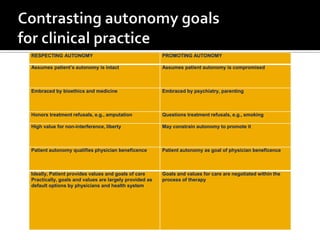
RESPECTING AUTONOMY PROMOTING AUTONOMY
Assumes patient’s autonomy is intact Assumes patient autonomy is compromised
Embraced by bioethics and medicine Embraced by psychiatry, parenting
Honors treatment refusals, e.g., amputation Questions treatment refusals, e.g., smoking
High value for non-interference, liberty May constrain autonomy to promote it
Patient autonomy qualifies physician beneficence Patient autonomy as goal of physician beneficence
Ideally, Patient provides values and goals of care
Practically, goals and values are largely provided as
default options by physicians and health system
Goals and values for care are negotiated within the
process of therapy
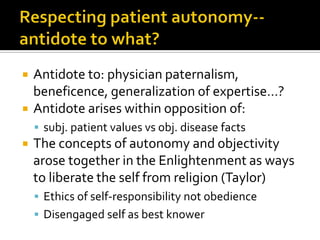
 Antidote to: physician paternalism,
beneficence, generalization of expertise…?
 Antidote arises within opposition of:
 subj. patient values vs obj. disease facts
 The concepts of autonomy and objectivity
arose together in the Enlightenment as ways
to liberate the self from religion (Taylor)
 Ethics of self-responsibility not obedience
 Disengaged self as best knower
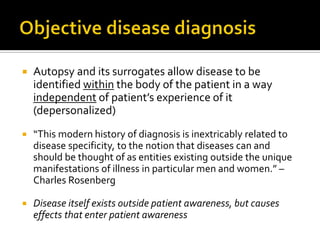
 Autopsy and its surrogates allow disease to be
identified within the body of the patient in a way
independent of patient’s experience of it
(depersonalized)
 “This modern history of diagnosis is inextricably related to
disease specificity, to the notion that diseases can and
should be thought of as entities existing outside the unique
manifestations of illness in particular men and women.” –
Charles Rosenberg
 Disease itself exists outside patient awareness, but causes
effects that enter patient awareness
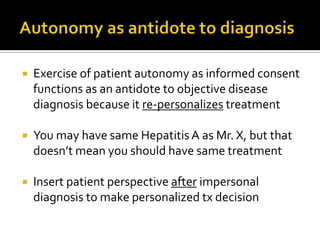
 Exercise of patient autonomy as informed consent
functions as an antidote to objective disease
diagnosis because it re-personalizes treatment
 You may have same Hepatitis A as Mr. X, but that
doesn’t mean you should have same treatment
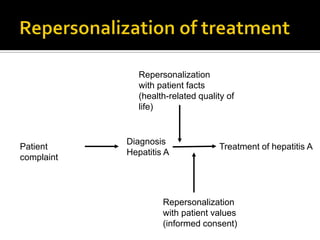
 Insert patient perspective after impersonal
diagnosis to make personalized tx decision
Patient
complaint
Diagnosis
Hepatitis A
Treatment of hepatitis A
Repersonalization
with patient values
(informed consent)
Repersonalization
with patient facts
(health-related quality of
life)
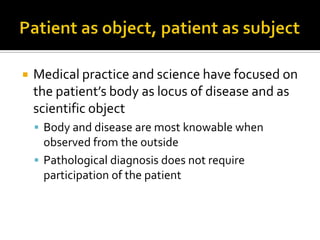
 Medical practice and science have focused on
the patient’s body as locus of disease and as
scientific object
 Body and disease are most knowable when
observed from the outside
 Pathological diagnosis does not require
participation of the patient
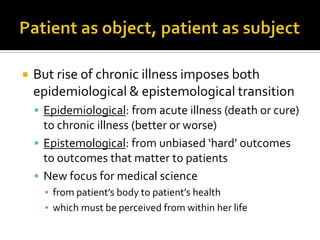
 But rise of chronic illness imposes both
epidemiological & epistemological transition
 Epidemiological: from acute illness (death or cure)
to chronic illness (better or worse)
 Epistemological: from unbiased ‘hard’ outcomes
to outcomes that matter to patients
 New focus for medical science
▪ from patient’s body to patient’s health
▪ which must be perceived from within her life
 Patient as chooser of health care
 Patient as perceiver of health
 Patient as health actor
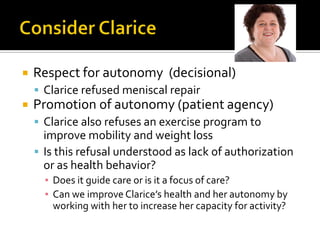
 Respect for autonomy (decisional)
 Clarice refused meniscal repair
 Promotion of autonomy (patient agency)
 Clarice also refuses an exercise program to
improve mobility and weight loss
 Is this refusal understood as lack of authorization
or as health behavior?
▪ Does it guide care or is it a focus of care?
▪ Can we improve Clarice’s health and her autonomy by
working with her to increase her capacity for activity?
 Then: compliance, adherence
 Provide information to obedient patient
 Now: self-management of chronic illness
 Provides skills in responsive system (CCM, PCMH)
 Management toward medical goals: BP, LDL, A1c
 Future: patient empowerment
 Subordinates clinical goals to patient’s vital goals
 Focus on maintenance of healthy action
 Emphasize intrinsic rather than extrinsic motivation
 Self-management is not just behavior-- but
intentional action: confidence/self-efficacy
 Bandura: patients “are agents of experience rather
than simply undergoers of experience.”
 “Among the mechanisms of personal agency, none is
more central or pervasive than people’s beliefs in their
capability to exercise some measure of control over
their own functioning and over environmental
events.” (Bandura 1997).
 New focus on agency and self-efficacy allowed
advance from predicting to changing health behavior
 Beneath confidence to personal importance
of behavior change using motivational
interviewing (MI)
 elicit rather than instill motivation for change
 By highlighting contrast between aspiration and
performance
 MI is patient-centered, but “sneaky” because
practitioner denies he has his own behavior
change goal
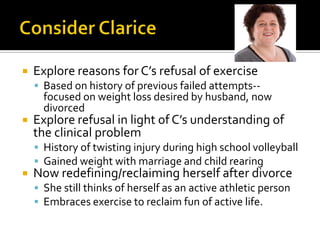
 Explore reasons for C’s refusal of exercise
 Based on history of previous failed attempts--
focused on weight loss desired by husband, now
divorced
 Explore refusal in light of C’s understanding of
the clinical problem
 History of twisting injury during high school volleyball
 Gained weight with marriage and child rearing
 Now redefining/reclaiming herself after divorce
 She still thinks of herself as an active athletic person
 Embraces exercise to reclaim fun of active life.
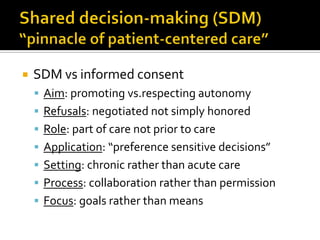
 SDM vs informed consent
 Aim: promoting vs.respecting autonomy
 Refusals: negotiated not simply honored
 Role: part of care not prior to care
 Application: “preference sensitive decisions”
 Setting: chronic rather than acute care
 Process: collaboration rather than permission
 Focus: goals rather than means
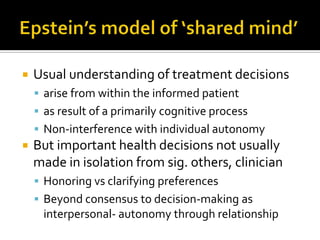
 Usual understanding of treatment decisions
 arise from within the informed patient
 as result of a primarily cognitive process
 Non-interference with individual autonomy
 But important health decisions not usually
made in isolation from sig. others, clinician
 Honoring vs clarifying preferences
 Beyond consensus to decision-making as
interpersonal- autonomy through relationship
 Maintenance of new health behaviors
requires that patients internalize both skills
and values for change
 Internalization promoted by support of:
 Autonomy: act intentionally c/w values
 Competence: confidence plus agency
 Relatedness: inclination to seek close relat.
 Effective for tobacco cessation, physical activity, weight loss,
diabetes management, dental health, medication adherence
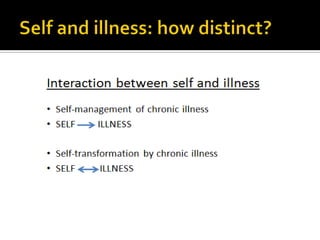
 Self-mgmt. of disease separate from self
 Mgmt. dictated by nature of disease
 Manage diabetes as professional would
 Little attention to threats to patient’s identity
 Consider self-management of depression
 Dictated by and focused on disease and person
 Disease goals and personal goals relevant
 Not just adherence, but agency and autonomy
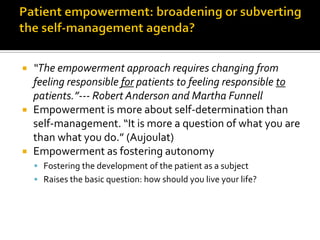
 “The empowerment approach requires changing from
feeling responsible for patients to feeling responsible to
patients.”--- Robert Anderson and Martha Funnell
 Empowerment is more about self-determination than
self-management. “It is more a question of what you are
than what you do.” (Aujoulat)
 Empowerment as fostering autonomy
 Fostering the development of the patient as a subject
 Raises the basic question: how should you live your life?
 Raising obedient or responsible children
 Who provides the direction?
 Clinical issue: do care goals arise from
diagnosis or from the patient?
 Informed consent begins with diagnosis-derived
goals
 SDM begins with patient choosing goals of care,
not in authorizing means of care
 Does empowerment lead to health defined in
traditional disease-oriented terms: A1c, LDL
 Or is empowerment a part of health itself?
 Is it part of process or an outcome of care?
 Consider empowerment as a means to foster
patient autonomy, understood broadly as
patient agency or capability
 Extrinsic: healthy action produces health-
diet, exercise, medication adherence
 Unavoidable in chronic illness care
 Intrinsic: meaningful action is a component of
health- acting is being healthy
 Can mitigate and retard progress of pathology
 WHO ICF Domains:
▪ organ impairments, activity restrictions, participation
limitations
▪ Not linear but circular relationship
 Health is not a state of body or of mind
 Not objective absence of death and disease
 Nor subjective state of well-being
 But the capacity for meaningful action
 Patient agency is both a means to health and a
component of health itself
 Amartya Sen: impossible to understand the well-
being of persons without understanding their
agency -- both a means to well-being and an
intrinsically valuable component of it.
 Respecting autonomy
 Honoring refusal of meniscal repair
 Promoting autonomy
 Working with refusal of exercise/weight loss
 Not simply information to promote compliance
 SDM to formulate consensus plan for adherence
 Develop confidence/self-efficacy to succeed
 Elicit personal goals and importance to help
internalize motivation for maintenance
 Patients’ capacity for action (beyond
decisional autonomy) has not been
incorporated into clinical practice or theory
 The patient is the primary agent of both
health and health care.
 Patient agency is the means and the end of
health care.
 Understanding and incorporating this
capacity represents our best chance to
achieve the triple aim of health reform
 In order to meet the
challenge of chronic
illness, we must promote
patient participation in the
production of health.
 Patients are the primary
producers and perceivers
of health.
 Available from Oxford or
Amazon
 markdsullivan.org