Docker for Fun and Profit 
Carl Quinn 
Java Posse, Riot Games 
http://github.com/cquinn/devoxx14 
#DV14 #Docker4Fun @cquinn
Schedule 
➡About Docker 
➡Getting Docker 
➡Booting to Docker 
➡The Docker Daemon 
➡Images and Containers 
➡Images, Layer by Layer 
➡Simple Dockerized 
Service 
➡Containers and Networks 
➡Containers and Volumes 
➡Linking Containers 
Together 
➡Using cAdvisor 
➡Basic Docker Clusters 
➡Fleet 
➡More: Mesos, Kubernetes 
#DV14 #Docker4Fun @cquinn
About Docker 
What It Is 
#DV14 #Docker4Fun @cquinn
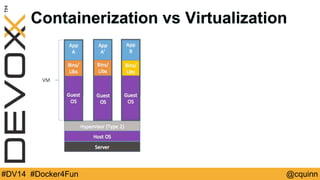
Containerization vs Virtualization 
#DV14 #Docker4Fun @cquinn
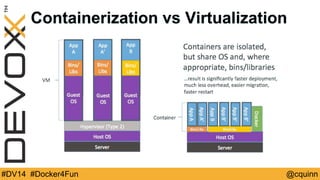
Containerization vs Virtualization 
#DV14 #Docker4Fun @cquinn
About Docker 
Origins 
#DV14 #Docker4Fun @cquinn
Origins 
• Google circa 2007 
• Linux cgroups (control groups) (resource limits) 
• Linux namespaces (resource isolation) 
• Docker circa 2013 
• Layered virtual filesystem 
• One stop shop encapsulating many Linux kernel features 
#DV14 #Docker4Fun @cquinn
About Docker 
Why It Is So Good 
#DV14 #Docker4Fun @cquinn
Sounds cool, but what’s the big deal? 
#DV14 #Docker4Fun @cquinn
Universal Deployable Artifact 
• Complete: Everything the app needs is in the artifact. 
• Small: The artifact is small enough to be easily managed. 
• Immutable: The contents of the artifact can’t change. 
• Universal: The artifact can run on any Linux host. 
• Deployable: The artifact can actually be run directly, without 
being unpacked or installed. 
#DV14 #Docker4Fun @cquinn
Image Sharing 
• Universal Images are Easy to Share 
• https://hub.docker.com/ 
#DV14 #Docker4Fun @cquinn
Getting Docker 
#DV14 #Docker4Fun @cquinn
Home base 
• https://docker.com/ 
• Current version: 1.3.1 
• Requires 64-bit Linux 
#DV14 #Docker4Fun @cquinn
Docker Environment on Linux 
• Ubuntu Trusty (14.4) 
• CentOS 7 
• CoreOS https://coreos.com/ 472.0.1 
• Other Linux: RedHat, Fedora, Debian, Gentoo, etc 
• Cloud: AWS, Rackspace, GCE, etc 
#DV14 #Docker4Fun @cquinn
Docker Environment on Mac 
• boot2docker 
• and/or: brew install docker 
• Installs virtual box with a tiny Linux that runs Docker 
• Docker cmdline client runs on Mac 
#DV14 #Docker4Fun @cquinn
Docker Environment on Windows 
• boot2docker 
• Installs virtual box with a tiny Linux that runs the Docker daemon 
• May have to shell into the VM to work 
• (I have no direct experience) 
#DV14 #Docker4Fun @cquinn
Booting to Docker 
Mac Version 
#DV14 #Docker4Fun @cquinn
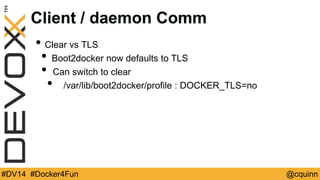
Client / daemon Comm 
• Clear vs TLS 
• Boot2docker now defaults to TLS 
• Can switch to clear 
• /var/lib/boot2docker/profile : DOCKER_TLS=no 
#DV14 #Docker4Fun @cquinn
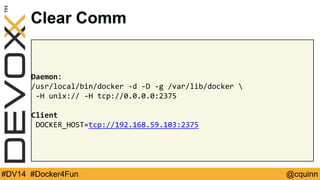
Clear Comm 
Daemon: 
/usr/local/bin/docker -d -D -g /var/lib/docker  
-H unix:// -H tcp://0.0.0.0:2375 
Client 
DOCKER_HOST=tcp://192.168.59.103:2375 
#DV14 #Docker4Fun @cquinn
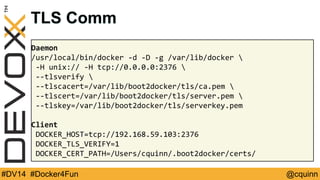
TLS Comm 
Daemon 
/usr/local/bin/docker -d -D -g /var/lib/docker  
-H unix:// -H tcp://0.0.0.0:2376  
--tlsverify  
--tlscacert=/var/lib/boot2docker/tls/ca.pem  
--tlscert=/var/lib/boot2docker/tls/server.pem  
--tlskey=/var/lib/boot2docker/tls/serverkey.pem 
Client 
DOCKER_HOST=tcp://192.168.59.103:2376 
DOCKER_TLS_VERIFY=1 
DOCKER_CERT_PATH=/Users/cquinn/.boot2docker/certs/ 
#DV14 #Docker4Fun @cquinn
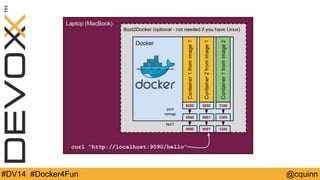
Boot2docker VM 
• vboxnet2 is mapped to nested Linux VM 
• My case: tcp://192.168.59.103 
#DV14 #Docker4Fun @cquinn
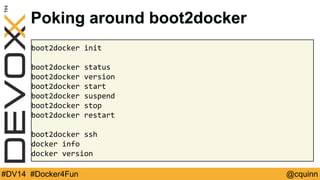
Poking around boot2docker 
boot2docker init 
boot2docker status 
boot2docker version 
boot2docker start 
boot2docker suspend 
boot2docker stop 
boot2docker restart 
boot2docker ssh 
docker info 
docker version 
#DV14 #Docker4Fun @cquinn
The Docker Daemon 
#DV14 #Docker4Fun @cquinn
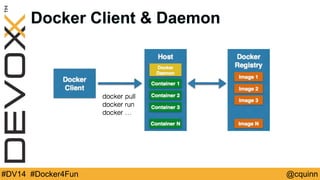
Docker Client & Daemon 
#DV14 #Docker4Fun @cquinn
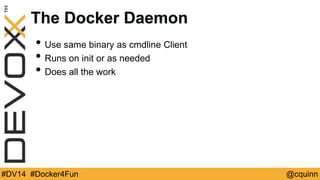
The Docker Daemon 
• Use same binary as cmdline Client 
• Runs on init or as needed 
• Does all the work 
#DV14 #Docker4Fun @cquinn
The Docker Daemon 
• Uses libcontainer to talk to Linux kernel 
• Starts process group for container 
• Creates namespaces for process group 
• Creates cgroups for resource quotas 
• Controls network access, port mapping 
• Controls volume mounting 
#DV14 #Docker4Fun @cquinn
Docker Daemon REST API 
• Docker daemon exposes an HTTP JSON over REST API 
• See: https://docs.docker.com/reference/api/docker_remote_api/ 
• Version 1.15 
• Normally this is over a local unix socket, but can go over tcp as 
well. 
#DV14 #Docker4Fun @cquinn
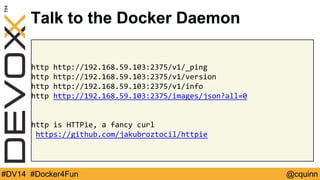
Talk to the Docker Daemon 
http http://192.168.59.103:2375/v1/_ping 
http http://192.168.59.103:2375/v1/version 
http http://192.168.59.103:2375/v1/info 
http http://192.168.59.103:2375/images/json?all=0 
http is HTTPie, a fancy curl 
https://github.com/jakubroztocil/httpie 
#DV14 #Docker4Fun @cquinn
Images and Containers 
#DV14 #Docker4Fun @cquinn
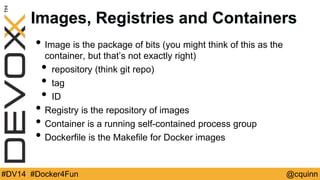
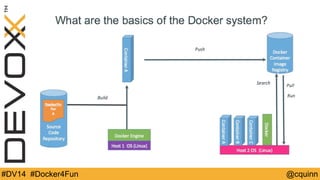
Images, Registries and Containers 
• Image is the package of bits (you might think of this as the 
container, but that’s not exactly right) 
• repository (think git repo) 
• tag 
• ID 
• Registry is the repository of images 
• Container is a running self-contained process group 
• Dockerfile is the Makefile for Docker images 
#DV14 #Docker4Fun @cquinn
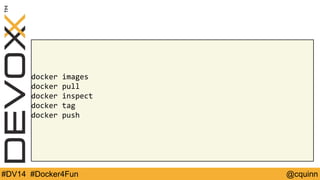
docker images 
docker pull 
docker inspect 
docker tag 
docker push 
#DV14 #Docker4Fun @cquinn
Images, Layer by Layer 
#DV14 #Docker4Fun @cquinn
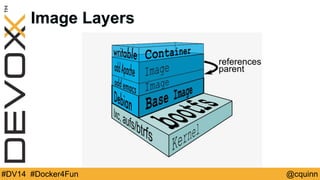
Image Layers 
#DV14 #Docker4Fun @cquinn
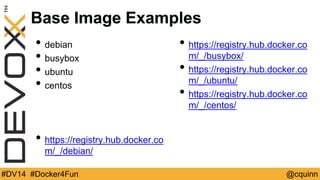
Base Image Examples 
• debian 
• busybox 
• ubuntu 
• centos 
• https://registry.hub.docker.co 
m/_/debian/ 
• https://registry.hub.docker.co 
m/_/busybox/ 
• https://registry.hub.docker.co 
m/_/ubuntu/ 
• https://registry.hub.docker.co 
m/_/centos/ 
#DV14 #Docker4Fun @cquinn
docker history 
#DV14 #Docker4Fun @cquinn
Simple Dockerized Service 
Example: ticktock 
#DV14 #Docker4Fun @cquinn
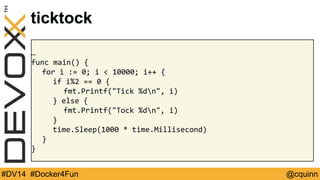
ticktock 
• Very simple Go app that just writes to stdout 
#DV14 #Docker4Fun @cquinn
ticktock 
… 
func main() { 
for i := 0; i < 10000; i++ { 
if i%2 == 0 { 
fmt.Printf("Tick %dn", i) 
} else { 
fmt.Printf("Tock %dn", i) 
} 
time.Sleep(1000 * time.Millisecond) 
} 
} 
#DV14 #Docker4Fun @cquinn
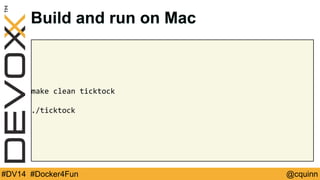
Build and run on Mac 
make clean ticktock 
./ticktock 
#DV14 #Docker4Fun @cquinn
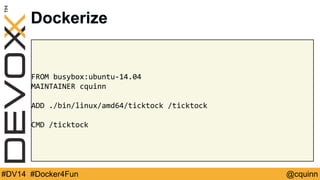
Dockerize 
FROM busybox:ubuntu-14.04 
MAINTAINER cquinn 
ADD ./bin/linux/amd64/ticktock /ticktock 
CMD /ticktock 
#DV14 #Docker4Fun @cquinn
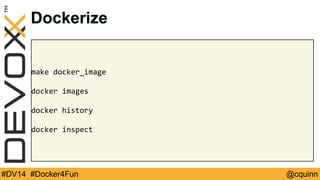
Dockerize 
make docker_image 
docker images 
docker history 
docker inspect 
#DV14 #Docker4Fun @cquinn
Demo 
#DV14 #Docker4Fun @cquinn
Containers and Networks 
Example: webhellogo 
#DV14 #Docker4Fun @cquinn
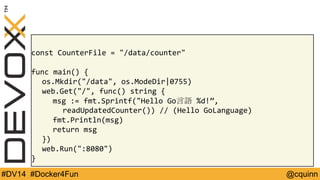
const CounterFile = "/data/counter" 
func main() { 
os.Mkdir("/data", os.ModeDir|0755) 
web.Get("/", func() string { 
msg := fmt.Sprintf("Hello Go言語%d!”, 
readUpdatedCounter()) // (Hello GoLanguage) 
fmt.Println(msg) 
return msg 
}) 
web.Run(":8080") 
} 
#DV14 #Docker4Fun @cquinn
func readUpdatedCounter() int { 
store, _ := ioutil.ReadFile(CounterFile) 
var i = 0 
fmt.Sscanf(string(store), "%d", &i) 
i++ 
store = []byte(fmt.Sprintf("%d", i)) 
ioutil.WriteFile(CounterFile, store, 0755) 
return i 
} 
#DV14 #Docker4Fun @cquinn
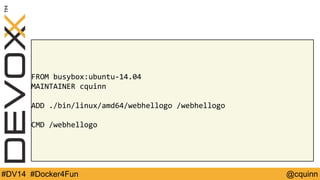
FROM busybox:ubuntu-14.04 
MAINTAINER cquinn 
ADD ./bin/linux/amd64/webhellogo /webhellogo 
CMD /webhellogo 
#DV14 #Docker4Fun @cquinn
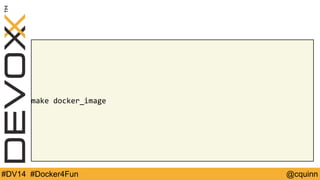
make docker_image 
#DV14 #Docker4Fun @cquinn
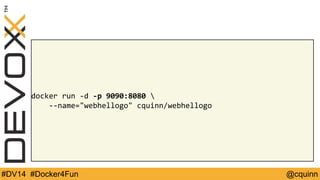
docker run -d -p 9090:8080  
--name="webhellogo" cquinn/webhellogo 
#DV14 #Docker4Fun @cquinn
Demo 
#DV14 #Docker4Fun @cquinn
Containers and Volumes 
Example: webhellogo 
#DV14 #Docker4Fun @cquinn
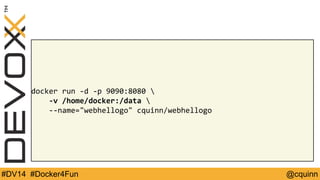
docker run -d -p 9090:8080  
-v /home/docker:/data  
--name="webhellogo" cquinn/webhellogo 
#DV14 #Docker4Fun @cquinn
Demo 
#DV14 #Docker4Fun @cquinn
Linking Containers Together 
Example: figgy 
#DV14 #Docker4Fun @cquinn
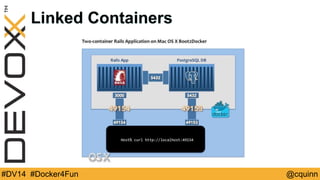
Linked Containers 
#DV14 #Docker4Fun @cquinn
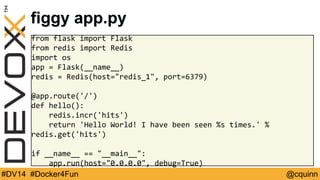
figgy app.py 
from flask import Flask 
from redis import Redis 
import os 
app = Flask(__name__) 
redis = Redis(host="redis_1", port=6379) 
@app.route('/') 
def hello(): 
redis.incr('hits') 
return 'Hello World! I have been seen %s times.' % 
redis.get('hits') 
if __name__ == "__main__": 
app.run(host="0.0.0.0", debug=True) 
#DV14 #Docker4Fun @cquinn
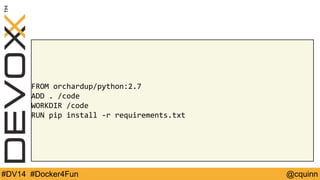
FROM orchardup/python:2.7 
ADD . /code 
WORKDIR /code 
RUN pip install -r requirements.txt 
#DV14 #Docker4Fun @cquinn
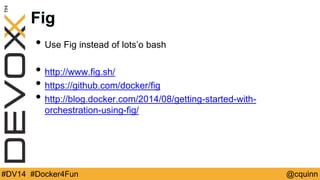
Fig 
• Use Fig instead of lots’o bash 
• http://www.fig.sh/ 
• https://github.com/docker/fig 
• http://blog.docker.com/2014/08/getting-started-with-orchestration- 
using-fig/ 
#DV14 #Docker4Fun @cquinn
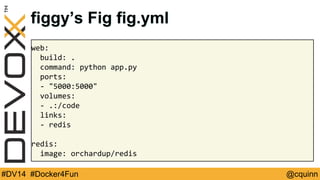
figgy’s Fig fig.yml 
web: 
build: . 
command: python app.py 
ports: 
- "5000:5000" 
volumes: 
- .:/code 
links: 
- redis 
redis: 
image: orchardup/redis 
#DV14 #Docker4Fun @cquinn
Demo 
#DV14 #Docker4Fun @cquinn
Using cAdvisor 
Example: cadvisor 
#DV14 #Docker4Fun @cquinn
cAdvisor 
• https://github.com/google/cadvisor 
#DV14 #Docker4Fun @cquinn
Demo 
#DV14 #Docker4Fun @cquinn
Extra Credit 
• Can also hookup InfluxDB + Grafana 
• http://influxdb.com/ 
• http://grafana.org/ 
• Or use Heapster across a cluster 
• https://github.com/GoogleCloudPlatform/heapster 
#DV14 #Docker4Fun @cquinn
Clusters of Dockers 
#DV14 #Docker4Fun @cquinn
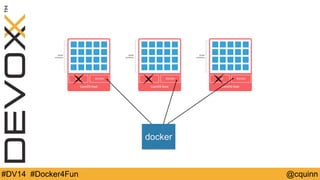
Clustering with Docker 
• Dockers are black boxes 
• Config goes into args & env. 
• Functional I/O is on network ports. 
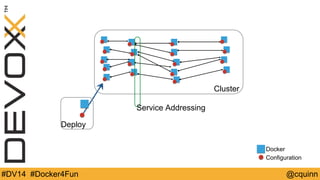
• System needs to Solve 
• configuration delivery 
• dynamic service addressing 
#DV14 #Docker4Fun @cquinn
Deploy 
Service Addressing 
Cluster 
Docker 
Configuration 
#DV14 #Docker4Fun @cquinn
Basic Docker Clusters 
Example: cluster 
#DV14 #Docker4Fun @cquinn
docker 
#DV14 #Docker4Fun @cquinn
docker cloud-init 
coreos: 
units: 
- name: docker-tcp.socket 
command: start 
content: | 
[Unit] 
Description=Docker Socket for the API 
[Socket] 
ListenStream=2375 
Service=docker.service 
BindIPv6Only=both 
[Install] 
WantedBy=sockets.target 
#DV14 #Docker4Fun @cquinn
docker cloud-init (cont) 
- name: enable-docker-tcp.service 
command: start 
content: | 
[Unit] 
Description=Enable the Docker Socket for the API 
[Service] 
Type=oneshot 
ExecStart=/usr/bin/systemctl enable docker-tcp.socket 
#DV14 #Docker4Fun @cquinn
Demo 
#DV14 #Docker4Fun @cquinn
Fleet 
Example: fleet 
#DV14 #Docker4Fun @cquinn
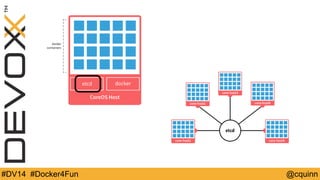
fleet 
• https://coreos.com/using-coreos/clustering/ 
• https://coreos.com/docs/launching-containers/ 
launching/launching-containers-fleet/ 
#DV14 #Docker4Fun @cquinn
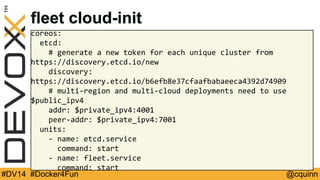
fleet cloud-init 
coreos: 
etcd: 
# generate a new token for each unique cluster from 
https://discovery.etcd.io/new 
discovery: 
https://discovery.etcd.io/b6efb8e37cfaafbabaeeca4392d74909 
# multi-region and multi-cloud deployments need to use 
$public_ipv4 
addr: $private_ipv4:4001 
peer-addr: $private_ipv4:7001 
units: 
- name: etcd.service 
command: start 
- name: fleet.service 
command: start 
#DV14 #Docker4Fun @cquinn
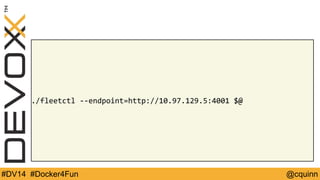
./fleetctl --endpoint=http://10.97.129.5:4001 $@ 
#DV14 #Docker4Fun @cquinn
myapp.service 
[Unit] 
Description=MyApp 
After=docker.service 
Requires=docker.service 
[Service] 
TimeoutStartSec=0 
ExecStartPre=-/usr/bin/docker kill busybox1 
ExecStartPre=-/usr/bin/docker rm busybox1 
ExecStartPre=/usr/bin/docker pull busybox 
ExecStart=/usr/bin/docker run --name busybox1 busybox /bin/sh -c 
"while true; do echo Hello World; sleep 1; done" 
ExecStop=/usr/bin/docker stop busybox1 
#DV14 #Docker4Fun @cquinn
Demo 
#DV14 #Docker4Fun @cquinn
More: Mesos, Kubernetes 
#DV14 #Docker4Fun @cquinn
Mesos 
• http://mesos.apache.org/ 
• https://mesosphere.com/learn/ 
#DV14 #Docker4Fun @cquinn
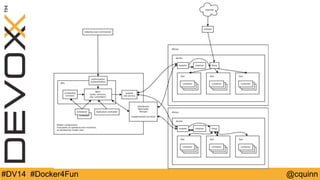
Kubernetes 
• Googles next generation “lmctfy” for Docker 
• https://github.com/GoogleCloudPlatform/kubernetes 
• Available on GCE 
#DV14 #Docker4Fun @cquinn
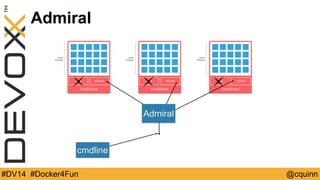
Admiral 
• Our Simple Cluster Manager 
#DV14 #Docker4Fun @cquinn
Admiral 
Admiral 
cmdline 
#DV14 #Docker4Fun @cquinn
Links & Credits 
• Images from 
• http://www.slideshare.net/dotCloud/docker-intro-november 
• https://coreos.com/ 
#DV14 #Docker4Fun @cquinn
Docker is the latest hotness in the deployment automation space, and opens a whole 
new world of opportunities in how we bundle, deploy and manage our running apps. 
Learn what Docker is all about and how to get started working with it. 
During this university, you will learn how to get Docker installed and get started using it 
to build and run your own containers. We'll take Docker apart and see how it works 
under the hood. Then we'll zoom out and experiment with Fleet and Mesos – 
interesting technologies built upon Docker for deploying containers to clusters of 
machines. All the while, we'll talk about how this new technology is poised to radically 
change how we think about deployment.

Docker for Fun and Profit, Devoxx 2014

  • 1.
    Docker for Funand Profit Carl Quinn Java Posse, Riot Games http://github.com/cquinn/devoxx14 #DV14 #Docker4Fun @cquinn
  • 2.
    Schedule ➡About Docker ➡Getting Docker ➡Booting to Docker ➡The Docker Daemon ➡Images and Containers ➡Images, Layer by Layer ➡Simple Dockerized Service ➡Containers and Networks ➡Containers and Volumes ➡Linking Containers Together ➡Using cAdvisor ➡Basic Docker Clusters ➡Fleet ➡More: Mesos, Kubernetes #DV14 #Docker4Fun @cquinn
  • 3.
    About Docker WhatIt Is #DV14 #Docker4Fun @cquinn
  • 4.
  • 5.
  • 6.
  • 7.
  • 8.
  • 9.
  • 10.
  • 11.
  • 12.
    Containerization vs Virtualization #DV14 #Docker4Fun @cquinn
  • 13.
    Containerization vs Virtualization #DV14 #Docker4Fun @cquinn
  • 14.
  • 15.
    About Docker Origins #DV14 #Docker4Fun @cquinn
  • 16.
    Origins • Googlecirca 2007 • Linux cgroups (control groups) (resource limits) • Linux namespaces (resource isolation) • Docker circa 2013 • Layered virtual filesystem • One stop shop encapsulating many Linux kernel features #DV14 #Docker4Fun @cquinn
  • 17.
    About Docker WhyIt Is So Good #DV14 #Docker4Fun @cquinn
  • 18.
    Sounds cool, butwhat’s the big deal? #DV14 #Docker4Fun @cquinn
  • 19.
  • 20.
    Universal Deployable Artifact • Complete: Everything the app needs is in the artifact. • Small: The artifact is small enough to be easily managed. • Immutable: The contents of the artifact can’t change. • Universal: The artifact can run on any Linux host. • Deployable: The artifact can actually be run directly, without being unpacked or installed. #DV14 #Docker4Fun @cquinn
  • 21.
    Image Sharing •Universal Images are Easy to Share • https://hub.docker.com/ #DV14 #Docker4Fun @cquinn
  • 22.
    Getting Docker #DV14#Docker4Fun @cquinn
  • 23.
    Home base •https://docker.com/ • Current version: 1.3.1 • Requires 64-bit Linux #DV14 #Docker4Fun @cquinn
  • 24.
    Docker Environment onLinux • Ubuntu Trusty (14.4) • CentOS 7 • CoreOS https://coreos.com/ 472.0.1 • Other Linux: RedHat, Fedora, Debian, Gentoo, etc • Cloud: AWS, Rackspace, GCE, etc #DV14 #Docker4Fun @cquinn
  • 25.
    Docker Environment onMac • boot2docker • and/or: brew install docker • Installs virtual box with a tiny Linux that runs Docker • Docker cmdline client runs on Mac #DV14 #Docker4Fun @cquinn
  • 26.
    Docker Environment onWindows • boot2docker • Installs virtual box with a tiny Linux that runs the Docker daemon • May have to shell into the VM to work • (I have no direct experience) #DV14 #Docker4Fun @cquinn
  • 27.
    Booting to Docker Mac Version #DV14 #Docker4Fun @cquinn
  • 28.
  • 29.
    Client / daemonComm • Clear vs TLS • Boot2docker now defaults to TLS • Can switch to clear • /var/lib/boot2docker/profile : DOCKER_TLS=no #DV14 #Docker4Fun @cquinn
  • 30.
    Clear Comm Daemon: /usr/local/bin/docker -d -D -g /var/lib/docker -H unix:// -H tcp://0.0.0.0:2375 Client DOCKER_HOST=tcp://192.168.59.103:2375 #DV14 #Docker4Fun @cquinn
  • 31.
    TLS Comm Daemon /usr/local/bin/docker -d -D -g /var/lib/docker -H unix:// -H tcp://0.0.0.0:2376 --tlsverify --tlscacert=/var/lib/boot2docker/tls/ca.pem --tlscert=/var/lib/boot2docker/tls/server.pem --tlskey=/var/lib/boot2docker/tls/serverkey.pem Client DOCKER_HOST=tcp://192.168.59.103:2376 DOCKER_TLS_VERIFY=1 DOCKER_CERT_PATH=/Users/cquinn/.boot2docker/certs/ #DV14 #Docker4Fun @cquinn
  • 32.
    Boot2docker VM •vboxnet2 is mapped to nested Linux VM • My case: tcp://192.168.59.103 #DV14 #Docker4Fun @cquinn
  • 33.
    Poking around boot2docker boot2docker init boot2docker status boot2docker version boot2docker start boot2docker suspend boot2docker stop boot2docker restart boot2docker ssh docker info docker version #DV14 #Docker4Fun @cquinn
  • 34.
    The Docker Daemon #DV14 #Docker4Fun @cquinn
  • 35.
    Docker Client &Daemon #DV14 #Docker4Fun @cquinn
  • 36.
    The Docker Daemon • Use same binary as cmdline Client • Runs on init or as needed • Does all the work #DV14 #Docker4Fun @cquinn
  • 37.
    The Docker Daemon • Uses libcontainer to talk to Linux kernel • Starts process group for container • Creates namespaces for process group • Creates cgroups for resource quotas • Controls network access, port mapping • Controls volume mounting #DV14 #Docker4Fun @cquinn
  • 38.
  • 39.
    Docker Daemon RESTAPI • Docker daemon exposes an HTTP JSON over REST API • See: https://docs.docker.com/reference/api/docker_remote_api/ • Version 1.15 • Normally this is over a local unix socket, but can go over tcp as well. #DV14 #Docker4Fun @cquinn
  • 40.
    Talk to theDocker Daemon http http://192.168.59.103:2375/v1/_ping http http://192.168.59.103:2375/v1/version http http://192.168.59.103:2375/v1/info http http://192.168.59.103:2375/images/json?all=0 http is HTTPie, a fancy curl https://github.com/jakubroztocil/httpie #DV14 #Docker4Fun @cquinn
  • 41.
    Images and Containers #DV14 #Docker4Fun @cquinn
  • 42.
    Images, Registries andContainers • Image is the package of bits (you might think of this as the container, but that’s not exactly right) • repository (think git repo) • tag • ID • Registry is the repository of images • Container is a running self-contained process group • Dockerfile is the Makefile for Docker images #DV14 #Docker4Fun @cquinn
  • 43.
  • 44.
    docker images dockerpull docker inspect docker tag docker push #DV14 #Docker4Fun @cquinn
  • 45.
    Images, Layer byLayer #DV14 #Docker4Fun @cquinn
  • 46.
    Image Layers #DV14#Docker4Fun @cquinn
  • 47.
    Base Image Examples • debian • busybox • ubuntu • centos • https://registry.hub.docker.co m/_/debian/ • https://registry.hub.docker.co m/_/busybox/ • https://registry.hub.docker.co m/_/ubuntu/ • https://registry.hub.docker.co m/_/centos/ #DV14 #Docker4Fun @cquinn
  • 48.
    docker history #DV14#Docker4Fun @cquinn
  • 49.
    Simple Dockerized Service Example: ticktock #DV14 #Docker4Fun @cquinn
  • 50.
    ticktock • Verysimple Go app that just writes to stdout #DV14 #Docker4Fun @cquinn
  • 51.
    ticktock … funcmain() { for i := 0; i < 10000; i++ { if i%2 == 0 { fmt.Printf("Tick %dn", i) } else { fmt.Printf("Tock %dn", i) } time.Sleep(1000 * time.Millisecond) } } #DV14 #Docker4Fun @cquinn
  • 52.
    Build and runon Mac make clean ticktock ./ticktock #DV14 #Docker4Fun @cquinn
  • 53.
    Dockerize FROM busybox:ubuntu-14.04 MAINTAINER cquinn ADD ./bin/linux/amd64/ticktock /ticktock CMD /ticktock #DV14 #Docker4Fun @cquinn
  • 54.
    Dockerize make docker_image docker images docker history docker inspect #DV14 #Docker4Fun @cquinn
  • 55.
  • 56.
    Containers and Networks Example: webhellogo #DV14 #Docker4Fun @cquinn
  • 57.
    const CounterFile ="/data/counter" func main() { os.Mkdir("/data", os.ModeDir|0755) web.Get("/", func() string { msg := fmt.Sprintf("Hello Go言語%d!”, readUpdatedCounter()) // (Hello GoLanguage) fmt.Println(msg) return msg }) web.Run(":8080") } #DV14 #Docker4Fun @cquinn
  • 58.
    func readUpdatedCounter() int{ store, _ := ioutil.ReadFile(CounterFile) var i = 0 fmt.Sscanf(string(store), "%d", &i) i++ store = []byte(fmt.Sprintf("%d", i)) ioutil.WriteFile(CounterFile, store, 0755) return i } #DV14 #Docker4Fun @cquinn
  • 59.
    FROM busybox:ubuntu-14.04 MAINTAINERcquinn ADD ./bin/linux/amd64/webhellogo /webhellogo CMD /webhellogo #DV14 #Docker4Fun @cquinn
  • 60.
    make docker_image #DV14#Docker4Fun @cquinn
  • 61.
    docker run -d-p 9090:8080 --name="webhellogo" cquinn/webhellogo #DV14 #Docker4Fun @cquinn
  • 62.
  • 63.
    Containers and Volumes Example: webhellogo #DV14 #Docker4Fun @cquinn
  • 64.
    docker run -d-p 9090:8080 -v /home/docker:/data --name="webhellogo" cquinn/webhellogo #DV14 #Docker4Fun @cquinn
  • 65.
  • 66.
    Linking Containers Together Example: figgy #DV14 #Docker4Fun @cquinn
  • 67.
    Linked Containers #DV14#Docker4Fun @cquinn
  • 68.
    figgy app.py fromflask import Flask from redis import Redis import os app = Flask(__name__) redis = Redis(host="redis_1", port=6379) @app.route('/') def hello(): redis.incr('hits') return 'Hello World! I have been seen %s times.' % redis.get('hits') if __name__ == "__main__": app.run(host="0.0.0.0", debug=True) #DV14 #Docker4Fun @cquinn
  • 69.
    FROM orchardup/python:2.7 ADD. /code WORKDIR /code RUN pip install -r requirements.txt #DV14 #Docker4Fun @cquinn
  • 70.
    Fig • UseFig instead of lots’o bash • http://www.fig.sh/ • https://github.com/docker/fig • http://blog.docker.com/2014/08/getting-started-with-orchestration- using-fig/ #DV14 #Docker4Fun @cquinn
  • 71.
    figgy’s Fig fig.yml web: build: . command: python app.py ports: - "5000:5000" volumes: - .:/code links: - redis redis: image: orchardup/redis #DV14 #Docker4Fun @cquinn
  • 72.
  • 73.
    Using cAdvisor Example:cadvisor #DV14 #Docker4Fun @cquinn
  • 74.
  • 75.
  • 76.
    Extra Credit •Can also hookup InfluxDB + Grafana • http://influxdb.com/ • http://grafana.org/ • Or use Heapster across a cluster • https://github.com/GoogleCloudPlatform/heapster #DV14 #Docker4Fun @cquinn
  • 77.
    Clusters of Dockers #DV14 #Docker4Fun @cquinn
  • 78.
    Clustering with Docker • Dockers are black boxes • Config goes into args & env. • Functional I/O is on network ports. • System needs to Solve • configuration delivery • dynamic service addressing #DV14 #Docker4Fun @cquinn
  • 79.
    Deploy Service Addressing Cluster Docker Configuration #DV14 #Docker4Fun @cquinn
  • 80.
    Basic Docker Clusters Example: cluster #DV14 #Docker4Fun @cquinn
  • 81.
  • 82.
    docker cloud-init coreos: units: - name: docker-tcp.socket command: start content: | [Unit] Description=Docker Socket for the API [Socket] ListenStream=2375 Service=docker.service BindIPv6Only=both [Install] WantedBy=sockets.target #DV14 #Docker4Fun @cquinn
  • 83.
    docker cloud-init (cont) - name: enable-docker-tcp.service command: start content: | [Unit] Description=Enable the Docker Socket for the API [Service] Type=oneshot ExecStart=/usr/bin/systemctl enable docker-tcp.socket #DV14 #Docker4Fun @cquinn
  • 84.
  • 85.
    Fleet Example: fleet #DV14 #Docker4Fun @cquinn
  • 86.
    fleet • https://coreos.com/using-coreos/clustering/ • https://coreos.com/docs/launching-containers/ launching/launching-containers-fleet/ #DV14 #Docker4Fun @cquinn
  • 87.
  • 88.
    fleet cloud-init coreos: etcd: # generate a new token for each unique cluster from https://discovery.etcd.io/new discovery: https://discovery.etcd.io/b6efb8e37cfaafbabaeeca4392d74909 # multi-region and multi-cloud deployments need to use $public_ipv4 addr: $private_ipv4:4001 peer-addr: $private_ipv4:7001 units: - name: etcd.service command: start - name: fleet.service command: start #DV14 #Docker4Fun @cquinn
  • 89.
  • 90.
    myapp.service [Unit] Description=MyApp After=docker.service Requires=docker.service [Service] TimeoutStartSec=0 ExecStartPre=-/usr/bin/docker kill busybox1 ExecStartPre=-/usr/bin/docker rm busybox1 ExecStartPre=/usr/bin/docker pull busybox ExecStart=/usr/bin/docker run --name busybox1 busybox /bin/sh -c "while true; do echo Hello World; sleep 1; done" ExecStop=/usr/bin/docker stop busybox1 #DV14 #Docker4Fun @cquinn
  • 91.
  • 92.
    More: Mesos, Kubernetes #DV14 #Docker4Fun @cquinn
  • 93.
    Mesos • http://mesos.apache.org/ • https://mesosphere.com/learn/ #DV14 #Docker4Fun @cquinn
  • 94.
  • 95.
    Kubernetes • Googlesnext generation “lmctfy” for Docker • https://github.com/GoogleCloudPlatform/kubernetes • Available on GCE #DV14 #Docker4Fun @cquinn
  • 96.
  • 97.
  • 98.
    Admiral • OurSimple Cluster Manager #DV14 #Docker4Fun @cquinn
  • 99.
    Admiral Admiral cmdline #DV14 #Docker4Fun @cquinn
  • 100.
    Links & Credits • Images from • http://www.slideshare.net/dotCloud/docker-intro-november • https://coreos.com/ #DV14 #Docker4Fun @cquinn
  • 101.
    Docker is thelatest hotness in the deployment automation space, and opens a whole new world of opportunities in how we bundle, deploy and manage our running apps. Learn what Docker is all about and how to get started working with it. During this university, you will learn how to get Docker installed and get started using it to build and run your own containers. We'll take Docker apart and see how it works under the hood. Then we'll zoom out and experiment with Fleet and Mesos – interesting technologies built upon Docker for deploying containers to clusters of machines. All the while, we'll talk about how this new technology is poised to radically change how we think about deployment.

Editor's Notes

  • #4 Self-contained complete app, or mini-machine ready to run. Docker is an open platform for developers and sysadmins to build, ship, and run distributed applications. Encapsulation like a VM image Lean and mean like a tar ball
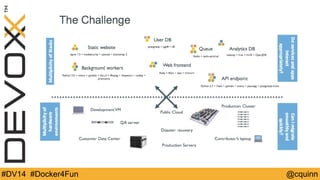
  • #6 There are many different kinds of apps and tools and libraries for writing apps, and these come in many flavors and different needs for deployment. What system libraries they need, what language runtimes, etc. And often these libraries can have conflicting versions and other interactions that can be extremely difficult to deal with. At the same time, there are different machine and infrastructure types. Development machines, VMs, internal datacenter or partner / customer datacenter, not to mention all the kinds of public, private and hybrid clouds.
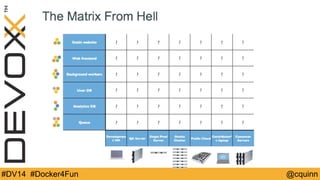
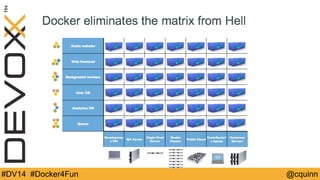
  • #7 If you lay out the software variables on one axis, and the hardware ones on the other, you get a huge nasty matrix. And, there’s a lot of work to do every time you add one thing to either axis. And there isn’t always a clear separation of responsibility for what the app developers and the devops folks are responsible for.
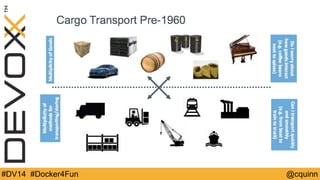
  • #8 Back in the day, the cargo industry had the same situation. Every kind of cargo was packed differently and had unique handling requirements. And each leg of the journey for the cargo had its own unique characteristics and cargo equipment.
  • #9 They too had a huge matrix problem. Moving goods from one place to another required knowing the exact route that the goods would take, and a negotiation with every provider on the way.
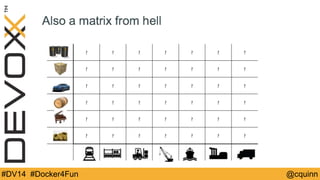
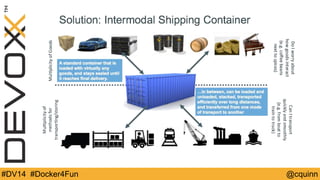
  • #10 That was eventually solved by the introduction of the intermodal shipping container. Really very simple: it was just a big metal box that could be loaded up with anything. The sizes were standardized, as well as was the way they stacked and how they were picked up by cranes. Someone shipping goods from point a to point b now didn’t have to know what modes of transportation were used, and in fact they could change based on needs and prices.
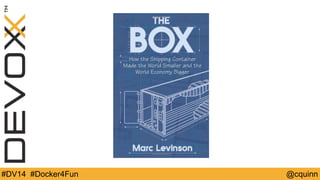
  • #11 Side note: the shipping container was not a big-bang invention, and not a committee-developed standard. It was an ad-hoc adaption of a de-facto standard mostly introduced and push by one iconoclast entrepreneur, Malcom McLean, who wanted to offer an end-to-end shipping solution. Book: http://www.amazon.com/The-Box-Shipping-Container-Smaller/dp/0691136408
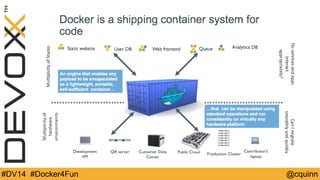
  • #12 Now in the software world we have the same solution. A container that can hold all kinds of our software cargo, and that can be deployed on any kind of hardware.
  • #13 And now the matrix looks a whole lot easier. Instead of an N*M problem, it is just N+M.
  • #15 Virtualization Sits on top of a machine abstraction of some kind Usually have an entire OS in an image Since the machine is big, often multiple apps are still deployed to each
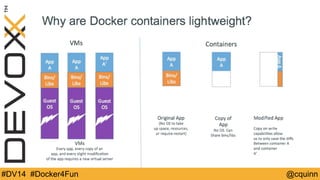
  • #16 Containerization Sits on top of a Linux host OS and shares the kernel. Very fast. This host can be very minimal. Container has its own copy of all the libs and other files that the deployed app will need.
  • #17 As apps are built and rebuilt, many shared components can be packaged separately and only the actual app bits updated incrementally.
  • #19 Docker doesn’t invent any single major thing, but it does package some existing tech in a very easy to use bundle that sets a de-facto standard. Just like the real shipping container.
  • #21 Certainly this sounds cool, but what’s the big deal? We already have tools that can deal with (most of) this deployment already. And a lot of this tech is not new.
  • #22 Developers can package complete artifacts for their apps. Deployment systems now have a standard artifact to deploy.
  • #30 How many in the audience develop on Mac? Windows? Linux?
  • #31 Here’s a picture of what this boot2docker inception looks like [TODO: redo this picture to show Docker client]
  • #44 http://enthusiasm.cozy.org/archives/2014/07/docker-4-accessing-a-remote-docker-daemon-using-socatssh
  • #47 [redo this drawing]
  • #50 Images are actually built in layers. Like ogres. Or parfaits. Best practices in keeping these layers clean and small: base image install updates install common packages install app Also, not the difference between the Host OS that is hosting Docker, and the Base OS that is the base image in the container.
  • #53 This example is in cquinn/ticktock
  • #59 Run the ticktock image. Show ‘docker help run’, some interesting flags: Use -it to run it in foreground. ctrl-c to get out. Use -d to have it daemonize. Kill it later with ‘docker kill’ Use ‘docker ps’ to see it running. Use ‘docker logs -f’ to watch it go. Use ‘docker pause’, show logs, then ‘docker unpause' Use ‘docker stop’ to stop it, ‘docker ps -a’ to see it stopped, then ‘docker rm’ to delete it.
  • #66 Show ‘docker help run’, some interesting flags: Use -p or -P to map ports. Use ‘docker ps’ to see port mapping, 9090->8080 Curl port to see webhellogo output. Use browser to see webhellogo page.
  • #69 Pause and unpause, or stop and start container: Counter continues. Stop and rm the container: Now notice that the counter state lived in the container and is lost. Mount some storage: Use -v to mount a host volume to save state Stop, rm, start container Use browser to see webhellogo page, counters still going!
  • #71 Lets build something like this, but with Python and Redis.
  • #76 Use fig to build and run figgy: fig up Uses 'docker run —link' Talk about how the port mapping works
  • #82 Docker containers are nice immutable deployable artifacts, and just need a few things plugged into them when deployed. These are the configuration, and a system for dynamic service discovery.
  • #88 Fire up CoreOS cluster in AWS with the above clout-init as user data Use local docker cli to talk to multiple CoreOS hosts using -H in dall.sh Use dall.sh to list images, ps containers, etc. Start a container on the multiple hosts. Use dall.sh to see the containers running.
  • #95 Unit part tells systemd about how this service unit fits in. Service part tells systemd how to start and stop the service.
  • #96 Show cluster machines: ./fc.sh list-machines Show cluster units: ./fc.sh list-unit-files Show cluster unit states: ./fc.sh list-units fleetctl service control pairs: submit / destroy load / unload start / stop
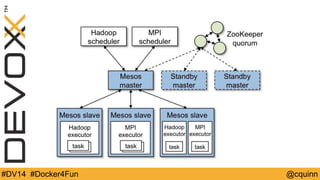
  • #99 Mesos has a master / slave architecture. Single master, but with standbys for HA. Zookeeper is used for leader election, but also exposed to frameworks. Schedulers can be added to the master. Executors can be added to the slaves. Bundled together, Schedulers and Executors are Frameworks. Docker support is just one kind of executor