An Introduction
A pecha-kucha inspired presentation
by Nissan Dookeran
1of 401
2of 402
Static website
Web frontend
User DB
Queue Analytics DB
Background workers
API endpoint
nginx 1.5 + modsecurity + openssl + bootstrap 2
postgresql + pgv8 + v8
hadoop + hive + thrift + OpenJDK
Ruby + Rails + sass + Unicorn
Redis + redis-sentinel
Python 3.0 + celery + pyredis + libcurl + ffmpeg + libopencv + nodejs +
phantomjs
Python 2.7 + Flask + pyredis + celery + psycopg + postgresql-client
Development VM
QA server
Public Cloud
Disaster recovery
Contributor’s laptop
Production Servers
The Challenge
Multiplicityof
Stacks
Multiplicityof
hardware
environments
Production Cluster
Customer Data Center
Doservicesand
appsinteract
appropriately?
CanImigrate
smoothlyand
quickly?
of 403
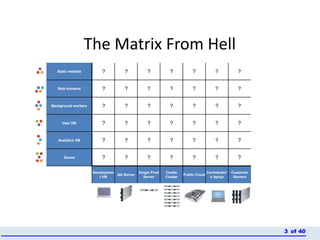
The Matrix From Hell
Static website
Web frontend
Background workers
User DB
Analytics DB
Queue
Developmen
t VM
QA Server
Single Prod
Server
Onsite
Cluster
Public Cloud
Contributor’
s laptop
Customer
Servers
? ? ? ? ? ? ?
? ? ? ? ? ? ?
? ? ? ? ? ? ?
? ? ? ? ? ? ?
? ? ? ? ? ? ?
? ? ? ? ? ? ?
of 404
Static website Web frontendUser DB Queue Analytics DB
Development
VM
QA server Public Cloud Contributor’s
laptop
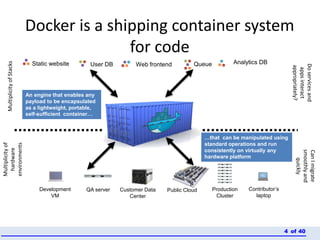
Docker is a shipping container system
for code
MultiplicityofStacks
Multiplicityof
hardware
environments
Production
Cluster
Customer Data
Center
Doservicesand
appsinteract
appropriately?
CanImigrate
smoothlyand
quickly
…that can be manipulated using
standard operations and run
consistently on virtually any
hardware platform
An engine that enables any
payload to be encapsulated
as a lightweight, portable,
self-sufficient container…
of 405
Static website
Web frontend
Background workers
User DB
Analytics DB
Queue
Developmen
t VM
QA Server
Single Prod
Server
Onsite
Cluster
Public Cloud
Contributor’
s laptop
Customer
Servers
Docker eliminates the matrix from
Hell
Of 406
Why it works—separation of concerns
• Dan the Developer
– Worries about what’s “inside”
the container
• His code
• His Libraries
• His Package Manager
• His Apps
• His Data
– All Linux servers look the same
• Oscar the Ops Guy
• Worries about what’s “outside”
the container
• Logging
• Remote access
• Monitoring
• Network config
• All containers start, stop, copy,
attach, migrate, etc. the same
way
Of 407
App
A
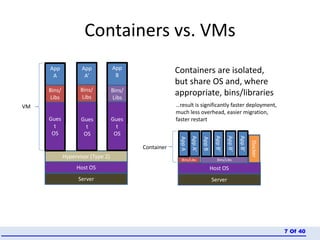
Containers vs. VMs
Hypervisor (Type 2)
Host OS
Server
Gues
t
OS
Bins/
Libs
App
A’
Gues
t
OS
Bins/
Libs
App
B
Gues
t
OS
Bins/
Libs
AppA’
Docker
Host OS
Server
Bins/Libs
AppA
Bins/Libs
AppB
AppB’
AppB’
AppB’
VM
Container
Containers are isolated,
but share OS and, where
appropriate, bins/libraries
Gues
t
OS
Gues
t
OS
…result is significantly faster deployment,
much less overhead, easier migration,
faster restart
Of 408
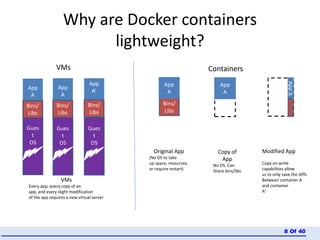
Why are Docker containers
lightweight?
Bins/
Libs
App
A
Original App
(No OS to take
up space, resources,
or require restart)
AppΔ
Bins
/
App
A
Bins/
Libs
App
A’
Gues
t
OS
Bins/
Libs
Modified App
Copy on write
capabilities allow
us to only save the diffs
Between container A
and container
A’
VMs
Every app, every copy of an
app, and every slight modification
of the app requires a new virtual server
App
A
Gues
t
OS
Bins/
Libs
Copy of
App
No OS. Can
Share bins/libs
App
A
Gues
t
OS
Gues
t
OS
VMs Containers
Of 409
What are the basics of the Docker
system?
Source
Code
Repositor
y
Dockerfil
e
For
A
Docker Engine
Docker
Container
Image
Registry
Build
Docker
Host 2 OS (Linux)
ContainerA
Container
B
Container
C
ContainerA
Push
Search
Pull
Run
Host 1 OS (Linux)
Of 4010
Changes and Updates
Docker Engine
Docker
Container
Image
Registry
Docker Engine
Push
Update
Bins/
Libs
App
A
AppΔ
Bins
/
Base
Container
Image
Host is now running A’’
Container
Mod A’’
AppΔ
Bins
/
Bins/
Libs
App
A
Bins
/
Bins/
Libs
App
A’’
Host running A wants to upgrade to A’’.
Requests update. Gets only diffs
Container
Mod A’
Of 4011
Ecosystem Support
• Operating systems
– Virtually any distribution with a 2.6.32+ kernel
– Red Hat/Docker collaboration to make work across RHEL 6.4+, Fedora, and other members of the family (2.6.32 +)
– CoreOS—Small core OS purpose built with Docker
• OpenStack
– Docker integration into NOVA (& compatibility with Glance, Horizon, etc.) accepted for Havana release
• Private PaaS
– OpenShift
– Solum (Rackspace, OpenStack)
– Other TBA
• Public PaaS
– Deis, Voxoz, Cocaine (Yandex), Baidu PaaS
• Public IaaS
– Native support in Rackspace, Digital Ocean,+++
– AMI (or equivalent) available for AWS & other
• DevOps Tools
– Integrations with Chef, Puppet, Jenkins, Travis, Salt, Ansible +++
• Orchestration tools
– Mesos, Heat, ++
– Shipyard & others purpose built for Docker
• Applications
– 1000’s of Dockerized applications available at index.docker.io
Of 4012
Of 4013
Getting Started
• Verify you have Oracle VirtualBox 4.3.x
• Install Docker
(https://docs.docker.com/installation/)
• UPDATE: Use https://www.docker.com/docker-
toolbox
– Installs Docker Client, Docker Machine, Docker
Compose, Docker Kitematic, VirtualBox
– NOTE: for OS X, you can use brew: brew install
docker-machine
– Windows: need to have HVT (Hyper-V)
• Understand the architecture
• Smoke test
Of 4014
Of 4015
Smoke Test Environment: (1)
Of 4016
Run the following commands from shell:
docker info
Output:
Containers: 0
Images: 0
Storage Driver: aufs
Root Dir: /mnt/sda1/var/lib/docker/aufs
Backing Filesystem: tmpfs
Dirs: 0
Dirperm1 Supported: true
Execution Driver: native-0.2
Logging Driver: json-file
Kernel Version: 4.1.10-boot2docker
Operating System: Boot2Docker 1.8.3 (TCL 6.4); master : af8b089 - Mon Oct 12 18:56:54 UTC 2015
CPUs: 1
Total Memory: 1.956 GiB
Name: default
ID: 54V7:OQNP:A4GT:D2T5:USDN:QLUG:PDOC:4I7I:I3O4:XW62:RCUP:24A7
Debug mode (server): true
File Descriptors: 10
Goroutines: 16
System Time: 2015-10-15T23:34:17.354643925Z
EventsListeners: 0
Init SHA1:
Init Path: /usr/local/bin/docker
Docker Root Dir: /mnt/sda1/var/lib/docker
Labels:
provider=virtualbox
Smoke Test Environment (2)
Of 4017
Run the following commands from shell:
docker ps
Output:
CONTAINER ID IMAGE COMMAND
CREATED STATUS PORTS
NAMES
Pull a Docker image
Of 4018
Pull Centos7 from DockerHub (http://docker.io)
docker pull centos:7
output:
ceposta@postamac(~) $ docker pull centos:7
7: Pulling from library/centos
fa5be2806d4c: Pull complete
0cd86ce0a197: Pull complete
e9407f1d4b65: Pull complete
c9853740aa05: Pull complete
e9fa5d3a0d0e: Pull complete
Digest:
sha256:def5c79bc29849815dec7dddc8f75530a9115c94d5b17e0e6807f92990
2fab62
Status: Downloaded newer image for centos:7
Of 4019
Of 4020
List Docker images
Of 4021
List locally, installed images
docker images
output:
ceposta@postamac(~) $ docker images
REPOSITORY TAG IMAGE ID CREATED VIRTUAL SIZE
centos 7 e9fa5d3a0d0e 2 days ago 172.3 MB
Show all images, including intermediate
docker images -a
output:
ceposta@postamac(~) $ docker images -a
REPOSITORY TAG IMAGE ID CREATED VIRTUAL SIZE
centos 7 e9fa5d3a0d0e 2 days ago 172.3 MB
<none> <none> c9853740aa05 2 days ago 172.3 MB
<none> <none> e9407f1d4b65 2 days ago 172.3 MB
<none> <none> 0cd86ce0a197 2 days ago 172.3 MB
<none> <none> fa5be2806d4c 5 weeks ago 0 B
Run a Docker container
Of 4022
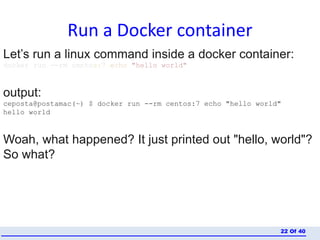
Let’s run a linux command inside a docker container:
docker run --rm centos:7 echo "hello world"
output:
ceposta@postamac(~) $ docker run --rm centos:7 echo "hello world"
hello world
Woah, what happened? It just printed out "hello, world"?
So what?
Run a Docker container
Of 4023
Let’s run a shell inside a docker container:
docker run -it --rm centos:7 bash
output:
[root@d7dfcc490cbe /]# _
Cool! We have a bash shell, and a minimal distro of
Centos 7! Did you see how fast that booted up? Typing
ls -l /etc/*-release from the new bash prompt
shows us we indeed have a Centos 7 distro:
[root@c2c2b8a65afe /]# ls -l /etc/*-release
-rw-r--r-- 1 root root 38 Mar 31 2015 /etc/centos-release
-rw-r--r-- 1 root root 393 Mar 31 2015 /etc/os-release
lrwxrwxrwx 1 root root 14 Aug 14 21:00 /etc/redhat-release -> centos-
release
lrwxrwxrwx 1 root root 14 Aug 14 21:00 /etc/system-release -> centos-
release
Run a Docker container
Of 4024
Run some other commands from within the
container:
hostname -f
cat /etc/hosts
ps aux
yum -y install vim
ip a
A real linux distro right? Did you notice that
ps aux didn’t show too many processes?
Run a Docker container
Of 4025
Let’s do some destructive stuff:
rm -fr /usr/sbin
Wuh? you deleted all of the sacred system tools!?
Let’s delete some user tools too
rm -fr /usr/bin
output:
[root@c2c2b8a65afe /]# ls
bash: /usr/bin/ls: No such file or directory
Whoops… cannot ls or do anything useful anymore.
What have we done!?
Run a Docker container
Of 4026
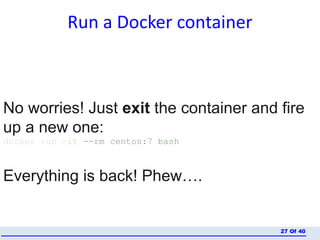
No worries! Just exit the container and fire
up a new one:
docker run -it --rm centos:7 bash
Everything is back! Phew….
Run a Docker container
Of 4027
No worries! Just exit the container and fire
up a new one:
docker run -it --rm centos:7 bash
Everything is back! Phew….
Run Apache Tomcat in a Docker
container
Of 4028
Now let’s run a JVM based application like Apache Tomcat:
docker run --rm -p 8888:8080 tomcat:8.0
Since the Tomcat 8.0 docker image doesn’t exist, Docker will try to automatically pull it
from the registry. Give it a moment, and you should see tomcat start successfully:
16-Oct-2015 18:30:51.541 INFO [localhost-startStop-1]
org.apache.catalina.startup.HostConfig.deployDirectory Deployment of web application directory
/usr/local/tomcat/webapps/manager has finished in 28 ms
16-Oct-2015 18:30:51.542 INFO [localhost-startStop-1]
org.apache.catalina.startup.HostConfig.deployDirectory Deploying web application directory
/usr/local/tomcat/webapps/examples
16-Oct-2015 18:30:52.108 INFO [localhost-startStop-1]
org.apache.catalina.startup.HostConfig.deployDirectory Deployment of web application directory
/usr/local/tomcat/webapps/examples has finished in 566 ms
16-Oct-2015 18:30:52.117 INFO [localhost-startStop-1]
org.apache.catalina.startup.HostConfig.deployDirectory Deploying web application directory
/usr/local/tomcat/webapps/ROOT
16-Oct-2015 18:30:52.161 INFO [localhost-startStop-1]
org.apache.catalina.startup.HostConfig.deployDirectory Deployment of web application directory
/usr/local/tomcat/webapps/ROOT has finished in 45 ms
16-Oct-2015 18:30:52.176 INFO [main] org.apache.coyote.AbstractProtocol.start Starting ProtocolHandler
["http-nio-8080"]
16-Oct-2015 18:30:52.206 INFO [main] org.apache.coyote.AbstractProtocol.start Starting ProtocolHandler
["ajp-nio-8009"]
16-Oct-2015 18:30:52.208 INFO [main] org.apache.catalina.startup.Catalina.start Server startup in 1589 ms
Run Apache Tomcat in a Docker
container
Of 4029
Let’s explore that command for a quick sec:
docker run --rm -p 8888:8080 tomcat:8.0
•--rm tells us that we want to remove the
container (delete) when it’s done running
•-p 8888:8080 tells us we want to map the
container’s port 8080 to the host port of 8888
So if we try to connect to http://localhost:8888
we should be able to reach our tomcat server!
Run Apache Tomcat in a Docker
container
Of 4030
Well, not quite. Why not?
Problem:
Our Docker Host has been mapped properly, but we cannot reach it
from our host (Windows/MacOSX) because the VM does not expose
those ports.
Solution:
Map ports for tomcat
How: Enable port forwarding between the VM Host (windows/Mac) and
the VM Guest (Docker host):
Run Apache Tomcat in a Docker
container
Of 4031
Run Apache Tomcat in a Docker
container
Of 4032
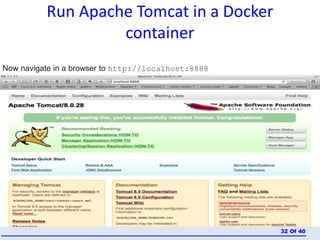
Now navigate in a browser to http://localhost:8888
Run Apache Tomcat in a Docker
container
Of 4033
We have a running container that has tomcat in it! WooHoo! Let’s explore the
tomcat container really quick. Fire up a new shell window (separate than the
running tomcat docker container from previous)
docker ps
output:
ceposta@postamac(~) $ docker ps
CONTAINER ID IMAGE COMMAND CREATED STATUS
PORTS NAMES
c2c059a3baab tomcat:8.0 "catalina.sh run" 36 minutes ago Up 36 minutes
0.0.0.0:8888->8080/tcp dreamy_kowalevski
Let’s log into the container to explore:
docker exec -it <container_id> bash
We should now be at the bash prompt for the tomcat container. Feel free to
explore around a bit.
Run Apache Tomcat in a Docker
container
Of 4034
Now exit out of the tomcat container
exit
And switch back to the other window where we ran tomcat. Let’s
CTR+C that window and exit the docker container.
We should have no containers running:
docker ps
Nor should we have any stopped containers:
docker ps -a
This is because we used the --rm command when we started the
tomcat container, so it will automatically remove the container.
Run Apache Tomcat in a Docker
container
Of 4035
Here are some other useful docker run flags:
•--name give your container a unique name
•-d run your container in daemon mode (in the background)
•--dns give your container a different nameserver from the host
•-it interactive with tty (wouldn’t use this with -d)
•-e pass in environment variables to the container
•--expose expose ports from the docker container
•-P expose all published ports on the container
•-p map a specific port from the container to the host
host:container
Also commands like --link and --volume (a little more advanced).
Run Apache Tomcat in a Docker
container
Of 4036
Let’s use some of those previous run command-line flags and start tomcat in
the background:
docker run -d --name="tomcat8" -p 8888:8080 tomcat:8.0
Note, we also gave this container a name, so we can refer to it by name instead
of container id:
docker logs tomcat8
output:
examples
16-Oct-2015 19:19:20.441 INFO [localhost-startStop-1]
org.apache.catalina.startup.HostConfig.deployDirectory Deployment of web application directory
/usr/local/tomcat/webapps/examples has finished in 526 ms
16-Oct-2015 19:19:20.447 INFO [localhost-startStop-1]
org.apache.catalina.startup.HostConfig.deployDirectory Deploying web application directory
/usr/local/tomcat/webapps/ROOT
16-Oct-2015 19:19:20.507 INFO [localhost-startStop-1]
org.apache.catalina.startup.HostConfig.deployDirectory Deployment of web application directory
/usr/local/tomcat/webapps/ROOT has finished in 60 ms
16-Oct-2015 19:19:20.515 INFO [main] org.apache.coyote.AbstractProtocol.start Starting
ProtocolHandler ["http-nio-8080"]
16-Oct-2015 19:19:20.527 INFO [main] org.apache.coyote.AbstractProtocol.start Starting
ProtocolHandler ["ajp-nio-8009"]
16-Oct-2015 19:19:20.547 INFO [main] org.apache.catalina.startup.Catalina.start Server startup in
1497 ms
Run Apache Tomcat in a Docker
container
Of 4037
Feel free to play around with the container a little bit
more. When finished, stop the container:
docker stop tomcat8
If you run docker ps you shouldn’t see the container
running any more. However, docker run -a will show
all containers even the stopped ones. We can remove a
container with:
docker rm tomcat8
Then neither docker ps nor docker ps -a should
show the container.
Next steps
Of 4038
• Register for a DockerHub account - https://hub.docker.com
• Read up on Dockerfile syntax to create your own Docker images and best practices
• http://docs.docker.com/engine/reference/builder/
• https://docs.docker.com/engine/articles/dockerfile_best-practices/
• Feel free to check out some of my Dockerfiles on DockerHub
• https://hub.docker.com/u/nissan/
• Feel free to also check out some of the Dockerfiles I am working on in GitHub
• https://github.com/nissan?tab=repositories
References/Further Readings
• Red Hat Workshops – Intro to Docker and
Kubernetes (next steps walkthru on
Docker/Tomcat setup)
• Slideshare – Introduction to Docker
Of 4039
Of 4040

Introduction to Docker

  • 1.
    An Introduction A pecha-kuchainspired presentation by Nissan Dookeran 1of 401
  • 2.
    2of 402 Static website Webfrontend User DB Queue Analytics DB Background workers API endpoint nginx 1.5 + modsecurity + openssl + bootstrap 2 postgresql + pgv8 + v8 hadoop + hive + thrift + OpenJDK Ruby + Rails + sass + Unicorn Redis + redis-sentinel Python 3.0 + celery + pyredis + libcurl + ffmpeg + libopencv + nodejs + phantomjs Python 2.7 + Flask + pyredis + celery + psycopg + postgresql-client Development VM QA server Public Cloud Disaster recovery Contributor’s laptop Production Servers The Challenge Multiplicityof Stacks Multiplicityof hardware environments Production Cluster Customer Data Center Doservicesand appsinteract appropriately? CanImigrate smoothlyand quickly?
  • 3.
    of 403 The MatrixFrom Hell Static website Web frontend Background workers User DB Analytics DB Queue Developmen t VM QA Server Single Prod Server Onsite Cluster Public Cloud Contributor’ s laptop Customer Servers ? ? ? ? ? ? ? ? ? ? ? ? ? ? ? ? ? ? ? ? ? ? ? ? ? ? ? ? ? ? ? ? ? ? ? ? ? ? ? ? ? ?
  • 4.
    of 404 Static websiteWeb frontendUser DB Queue Analytics DB Development VM QA server Public Cloud Contributor’s laptop Docker is a shipping container system for code MultiplicityofStacks Multiplicityof hardware environments Production Cluster Customer Data Center Doservicesand appsinteract appropriately? CanImigrate smoothlyand quickly …that can be manipulated using standard operations and run consistently on virtually any hardware platform An engine that enables any payload to be encapsulated as a lightweight, portable, self-sufficient container…
  • 5.
    of 405 Static website Webfrontend Background workers User DB Analytics DB Queue Developmen t VM QA Server Single Prod Server Onsite Cluster Public Cloud Contributor’ s laptop Customer Servers Docker eliminates the matrix from Hell
  • 6.
    Of 406 Why itworks—separation of concerns • Dan the Developer – Worries about what’s “inside” the container • His code • His Libraries • His Package Manager • His Apps • His Data – All Linux servers look the same • Oscar the Ops Guy • Worries about what’s “outside” the container • Logging • Remote access • Monitoring • Network config • All containers start, stop, copy, attach, migrate, etc. the same way
  • 7.
    Of 407 App A Containers vs.VMs Hypervisor (Type 2) Host OS Server Gues t OS Bins/ Libs App A’ Gues t OS Bins/ Libs App B Gues t OS Bins/ Libs AppA’ Docker Host OS Server Bins/Libs AppA Bins/Libs AppB AppB’ AppB’ AppB’ VM Container Containers are isolated, but share OS and, where appropriate, bins/libraries Gues t OS Gues t OS …result is significantly faster deployment, much less overhead, easier migration, faster restart
  • 8.
    Of 408 Why areDocker containers lightweight? Bins/ Libs App A Original App (No OS to take up space, resources, or require restart) AppΔ Bins / App A Bins/ Libs App A’ Gues t OS Bins/ Libs Modified App Copy on write capabilities allow us to only save the diffs Between container A and container A’ VMs Every app, every copy of an app, and every slight modification of the app requires a new virtual server App A Gues t OS Bins/ Libs Copy of App No OS. Can Share bins/libs App A Gues t OS Gues t OS VMs Containers
  • 9.
    Of 409 What arethe basics of the Docker system? Source Code Repositor y Dockerfil e For A Docker Engine Docker Container Image Registry Build Docker Host 2 OS (Linux) ContainerA Container B Container C ContainerA Push Search Pull Run Host 1 OS (Linux)
  • 10.
    Of 4010 Changes andUpdates Docker Engine Docker Container Image Registry Docker Engine Push Update Bins/ Libs App A AppΔ Bins / Base Container Image Host is now running A’’ Container Mod A’’ AppΔ Bins / Bins/ Libs App A Bins / Bins/ Libs App A’’ Host running A wants to upgrade to A’’. Requests update. Gets only diffs Container Mod A’
  • 11.
    Of 4011 Ecosystem Support •Operating systems – Virtually any distribution with a 2.6.32+ kernel – Red Hat/Docker collaboration to make work across RHEL 6.4+, Fedora, and other members of the family (2.6.32 +) – CoreOS—Small core OS purpose built with Docker • OpenStack – Docker integration into NOVA (& compatibility with Glance, Horizon, etc.) accepted for Havana release • Private PaaS – OpenShift – Solum (Rackspace, OpenStack) – Other TBA • Public PaaS – Deis, Voxoz, Cocaine (Yandex), Baidu PaaS • Public IaaS – Native support in Rackspace, Digital Ocean,+++ – AMI (or equivalent) available for AWS & other • DevOps Tools – Integrations with Chef, Puppet, Jenkins, Travis, Salt, Ansible +++ • Orchestration tools – Mesos, Heat, ++ – Shipyard & others purpose built for Docker • Applications – 1000’s of Dockerized applications available at index.docker.io
  • 12.
  • 13.
  • 14.
    Getting Started • Verifyyou have Oracle VirtualBox 4.3.x • Install Docker (https://docs.docker.com/installation/) • UPDATE: Use https://www.docker.com/docker- toolbox – Installs Docker Client, Docker Machine, Docker Compose, Docker Kitematic, VirtualBox – NOTE: for OS X, you can use brew: brew install docker-machine – Windows: need to have HVT (Hyper-V) • Understand the architecture • Smoke test Of 4014
  • 15.
  • 16.
    Smoke Test Environment:(1) Of 4016 Run the following commands from shell: docker info Output: Containers: 0 Images: 0 Storage Driver: aufs Root Dir: /mnt/sda1/var/lib/docker/aufs Backing Filesystem: tmpfs Dirs: 0 Dirperm1 Supported: true Execution Driver: native-0.2 Logging Driver: json-file Kernel Version: 4.1.10-boot2docker Operating System: Boot2Docker 1.8.3 (TCL 6.4); master : af8b089 - Mon Oct 12 18:56:54 UTC 2015 CPUs: 1 Total Memory: 1.956 GiB Name: default ID: 54V7:OQNP:A4GT:D2T5:USDN:QLUG:PDOC:4I7I:I3O4:XW62:RCUP:24A7 Debug mode (server): true File Descriptors: 10 Goroutines: 16 System Time: 2015-10-15T23:34:17.354643925Z EventsListeners: 0 Init SHA1: Init Path: /usr/local/bin/docker Docker Root Dir: /mnt/sda1/var/lib/docker Labels: provider=virtualbox
  • 17.
    Smoke Test Environment(2) Of 4017 Run the following commands from shell: docker ps Output: CONTAINER ID IMAGE COMMAND CREATED STATUS PORTS NAMES
  • 18.
    Pull a Dockerimage Of 4018 Pull Centos7 from DockerHub (http://docker.io) docker pull centos:7 output: ceposta@postamac(~) $ docker pull centos:7 7: Pulling from library/centos fa5be2806d4c: Pull complete 0cd86ce0a197: Pull complete e9407f1d4b65: Pull complete c9853740aa05: Pull complete e9fa5d3a0d0e: Pull complete Digest: sha256:def5c79bc29849815dec7dddc8f75530a9115c94d5b17e0e6807f92990 2fab62 Status: Downloaded newer image for centos:7
  • 19.
  • 20.
  • 21.
    List Docker images Of4021 List locally, installed images docker images output: ceposta@postamac(~) $ docker images REPOSITORY TAG IMAGE ID CREATED VIRTUAL SIZE centos 7 e9fa5d3a0d0e 2 days ago 172.3 MB Show all images, including intermediate docker images -a output: ceposta@postamac(~) $ docker images -a REPOSITORY TAG IMAGE ID CREATED VIRTUAL SIZE centos 7 e9fa5d3a0d0e 2 days ago 172.3 MB <none> <none> c9853740aa05 2 days ago 172.3 MB <none> <none> e9407f1d4b65 2 days ago 172.3 MB <none> <none> 0cd86ce0a197 2 days ago 172.3 MB <none> <none> fa5be2806d4c 5 weeks ago 0 B
  • 22.
    Run a Dockercontainer Of 4022 Let’s run a linux command inside a docker container: docker run --rm centos:7 echo "hello world" output: ceposta@postamac(~) $ docker run --rm centos:7 echo "hello world" hello world Woah, what happened? It just printed out "hello, world"? So what?
  • 23.
    Run a Dockercontainer Of 4023 Let’s run a shell inside a docker container: docker run -it --rm centos:7 bash output: [root@d7dfcc490cbe /]# _ Cool! We have a bash shell, and a minimal distro of Centos 7! Did you see how fast that booted up? Typing ls -l /etc/*-release from the new bash prompt shows us we indeed have a Centos 7 distro: [root@c2c2b8a65afe /]# ls -l /etc/*-release -rw-r--r-- 1 root root 38 Mar 31 2015 /etc/centos-release -rw-r--r-- 1 root root 393 Mar 31 2015 /etc/os-release lrwxrwxrwx 1 root root 14 Aug 14 21:00 /etc/redhat-release -> centos- release lrwxrwxrwx 1 root root 14 Aug 14 21:00 /etc/system-release -> centos- release
  • 24.
    Run a Dockercontainer Of 4024 Run some other commands from within the container: hostname -f cat /etc/hosts ps aux yum -y install vim ip a A real linux distro right? Did you notice that ps aux didn’t show too many processes?
  • 25.
    Run a Dockercontainer Of 4025 Let’s do some destructive stuff: rm -fr /usr/sbin Wuh? you deleted all of the sacred system tools!? Let’s delete some user tools too rm -fr /usr/bin output: [root@c2c2b8a65afe /]# ls bash: /usr/bin/ls: No such file or directory Whoops… cannot ls or do anything useful anymore. What have we done!?
  • 26.
    Run a Dockercontainer Of 4026 No worries! Just exit the container and fire up a new one: docker run -it --rm centos:7 bash Everything is back! Phew….
  • 27.
    Run a Dockercontainer Of 4027 No worries! Just exit the container and fire up a new one: docker run -it --rm centos:7 bash Everything is back! Phew….
  • 28.
    Run Apache Tomcatin a Docker container Of 4028 Now let’s run a JVM based application like Apache Tomcat: docker run --rm -p 8888:8080 tomcat:8.0 Since the Tomcat 8.0 docker image doesn’t exist, Docker will try to automatically pull it from the registry. Give it a moment, and you should see tomcat start successfully: 16-Oct-2015 18:30:51.541 INFO [localhost-startStop-1] org.apache.catalina.startup.HostConfig.deployDirectory Deployment of web application directory /usr/local/tomcat/webapps/manager has finished in 28 ms 16-Oct-2015 18:30:51.542 INFO [localhost-startStop-1] org.apache.catalina.startup.HostConfig.deployDirectory Deploying web application directory /usr/local/tomcat/webapps/examples 16-Oct-2015 18:30:52.108 INFO [localhost-startStop-1] org.apache.catalina.startup.HostConfig.deployDirectory Deployment of web application directory /usr/local/tomcat/webapps/examples has finished in 566 ms 16-Oct-2015 18:30:52.117 INFO [localhost-startStop-1] org.apache.catalina.startup.HostConfig.deployDirectory Deploying web application directory /usr/local/tomcat/webapps/ROOT 16-Oct-2015 18:30:52.161 INFO [localhost-startStop-1] org.apache.catalina.startup.HostConfig.deployDirectory Deployment of web application directory /usr/local/tomcat/webapps/ROOT has finished in 45 ms 16-Oct-2015 18:30:52.176 INFO [main] org.apache.coyote.AbstractProtocol.start Starting ProtocolHandler ["http-nio-8080"] 16-Oct-2015 18:30:52.206 INFO [main] org.apache.coyote.AbstractProtocol.start Starting ProtocolHandler ["ajp-nio-8009"] 16-Oct-2015 18:30:52.208 INFO [main] org.apache.catalina.startup.Catalina.start Server startup in 1589 ms
  • 29.
    Run Apache Tomcatin a Docker container Of 4029 Let’s explore that command for a quick sec: docker run --rm -p 8888:8080 tomcat:8.0 •--rm tells us that we want to remove the container (delete) when it’s done running •-p 8888:8080 tells us we want to map the container’s port 8080 to the host port of 8888 So if we try to connect to http://localhost:8888 we should be able to reach our tomcat server!
  • 30.
    Run Apache Tomcatin a Docker container Of 4030 Well, not quite. Why not? Problem: Our Docker Host has been mapped properly, but we cannot reach it from our host (Windows/MacOSX) because the VM does not expose those ports. Solution: Map ports for tomcat How: Enable port forwarding between the VM Host (windows/Mac) and the VM Guest (Docker host):
  • 31.
    Run Apache Tomcatin a Docker container Of 4031
  • 32.
    Run Apache Tomcatin a Docker container Of 4032 Now navigate in a browser to http://localhost:8888
  • 33.
    Run Apache Tomcatin a Docker container Of 4033 We have a running container that has tomcat in it! WooHoo! Let’s explore the tomcat container really quick. Fire up a new shell window (separate than the running tomcat docker container from previous) docker ps output: ceposta@postamac(~) $ docker ps CONTAINER ID IMAGE COMMAND CREATED STATUS PORTS NAMES c2c059a3baab tomcat:8.0 "catalina.sh run" 36 minutes ago Up 36 minutes 0.0.0.0:8888->8080/tcp dreamy_kowalevski Let’s log into the container to explore: docker exec -it <container_id> bash We should now be at the bash prompt for the tomcat container. Feel free to explore around a bit.
  • 34.
    Run Apache Tomcatin a Docker container Of 4034 Now exit out of the tomcat container exit And switch back to the other window where we ran tomcat. Let’s CTR+C that window and exit the docker container. We should have no containers running: docker ps Nor should we have any stopped containers: docker ps -a This is because we used the --rm command when we started the tomcat container, so it will automatically remove the container.
  • 35.
    Run Apache Tomcatin a Docker container Of 4035 Here are some other useful docker run flags: •--name give your container a unique name •-d run your container in daemon mode (in the background) •--dns give your container a different nameserver from the host •-it interactive with tty (wouldn’t use this with -d) •-e pass in environment variables to the container •--expose expose ports from the docker container •-P expose all published ports on the container •-p map a specific port from the container to the host host:container Also commands like --link and --volume (a little more advanced).
  • 36.
    Run Apache Tomcatin a Docker container Of 4036 Let’s use some of those previous run command-line flags and start tomcat in the background: docker run -d --name="tomcat8" -p 8888:8080 tomcat:8.0 Note, we also gave this container a name, so we can refer to it by name instead of container id: docker logs tomcat8 output: examples 16-Oct-2015 19:19:20.441 INFO [localhost-startStop-1] org.apache.catalina.startup.HostConfig.deployDirectory Deployment of web application directory /usr/local/tomcat/webapps/examples has finished in 526 ms 16-Oct-2015 19:19:20.447 INFO [localhost-startStop-1] org.apache.catalina.startup.HostConfig.deployDirectory Deploying web application directory /usr/local/tomcat/webapps/ROOT 16-Oct-2015 19:19:20.507 INFO [localhost-startStop-1] org.apache.catalina.startup.HostConfig.deployDirectory Deployment of web application directory /usr/local/tomcat/webapps/ROOT has finished in 60 ms 16-Oct-2015 19:19:20.515 INFO [main] org.apache.coyote.AbstractProtocol.start Starting ProtocolHandler ["http-nio-8080"] 16-Oct-2015 19:19:20.527 INFO [main] org.apache.coyote.AbstractProtocol.start Starting ProtocolHandler ["ajp-nio-8009"] 16-Oct-2015 19:19:20.547 INFO [main] org.apache.catalina.startup.Catalina.start Server startup in 1497 ms
  • 37.
    Run Apache Tomcatin a Docker container Of 4037 Feel free to play around with the container a little bit more. When finished, stop the container: docker stop tomcat8 If you run docker ps you shouldn’t see the container running any more. However, docker run -a will show all containers even the stopped ones. We can remove a container with: docker rm tomcat8 Then neither docker ps nor docker ps -a should show the container.
  • 38.
    Next steps Of 4038 •Register for a DockerHub account - https://hub.docker.com • Read up on Dockerfile syntax to create your own Docker images and best practices • http://docs.docker.com/engine/reference/builder/ • https://docs.docker.com/engine/articles/dockerfile_best-practices/ • Feel free to check out some of my Dockerfiles on DockerHub • https://hub.docker.com/u/nissan/ • Feel free to also check out some of the Dockerfiles I am working on in GitHub • https://github.com/nissan?tab=repositories
  • 39.
    References/Further Readings • RedHat Workshops – Intro to Docker and Kubernetes (next steps walkthru on Docker/Tomcat setup) • Slideshare – Introduction to Docker Of 4039
  • 40.

Editor's Notes

  • #2 What is Pecha-Kucha? 20 slides 20 seconds each (6:40 presentation) Hands-off!
  • #3 What is Pecha-Kucha? 20 slides 20 seconds each (6:40 presentation) Hands-off!