DNA DIGITAL STORAGE
Name:- Khalid Majeed Mir
Roll no. :- 321/14
Department:- IT
Semester:- 7th sem
12/4/2017 1
Guide:-Jasleen Mam
CONTENTS
 INTRODUCTION
 WHAT IS DNA
 DO WE NEED ANOTHER STORAGE TECHNOLOGY
 STRUCTURE OF DNA
 CODES FOR ENCODING
 HOW DNAAS STORAGE TECHNOLOGY
 PROCESS
 WHY DNA
 APPLICATIONS
 DEVELOPMENTS
 OUR FUTURE
 CONCLUSIONS
 REFRENCES
INTRODUCTION
 Refers to the scheme to store digital data in the base sequence of DNA
 Uses artificial DNA made using commercially available oligonucleotide synthesis
WHAT IS DNA?
 Deoxyribonucleic acid
 Molecule that carries the genetic instructions
 Essential for all known forms of life
 Consist of two biopolymer strands coiled around each other to form a double
helix
 Nature’s storage device, replicating and propagating genetic code over thousands
of generations
DNA under an electron microscope
DO WE NEED ANOTHER STORAGE
TECHNOLOGY?
 Rapid growth of data generated
 Information to be stored for long periods
 Prone to damage from external factors
 Rise in e-waste
 Requires more energy
E-waste disposal site
STRUCTURE OF DNA
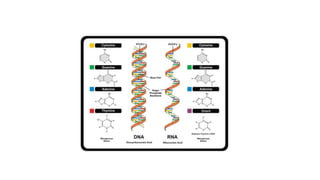
 DNA consists of Adenine(A), Guanine(G), Cytosine(C) and
Thymine(T)
 Paired into nucleotide base pairs A-T and G-C
 Backbone of the DNA strand is made from alternating
phosphate and sugar residues
 Single nucleotide can represent 2 bits of information
CODES FOR ENCODING
 The Huffman Code
 Perfect Genetic Code
HOW DNA AS STORAGE
TECHNOLOGY?
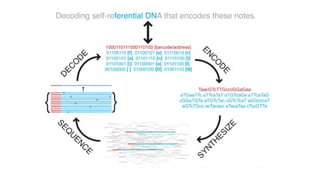
 Source data in form of binary bits (0 and 1) was converted to a tertiary bit code (0, 1
and 2) to decrease chances of encoding errors
 Following the conversion, the digital data is encoded into the nucleobases of DNA
 By altering the positions of nucleobases A,T,G and C, the tertiary code can be
mapped onto the nucleobases codes, thus making a repetitive blocks of nucleobases
that encode data
 The encoded DNA then can be sequenced and read back to tertiary and then to
binary data using technologies similar to those used to map the human genome
PROCESS
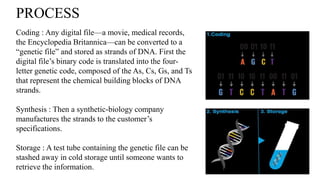
Coding : Any digital file—a movie, medical records,
the Encyclopedia Britannica—can be converted to a
“genetic file” and stored as strands of DNA. First the
digital file’s binary code is translated into the four-
letter genetic code, composed of the As, Cs, Gs, and Ts
that represent the chemical building blocks of DNA
strands.
Synthesis : Then a synthetic-biology company
manufactures the strands to the customer’s
specifications.
Storage : A test tube containing the genetic file can be
stashed away in cold storage until someone wants to
retrieve the information.
WHY DNA?
 A mere milligram of the molecule could encode the complete text of
every book in the Library of Congress
 Very high data density
 More compact than current magnetic tape or hard drive storage
Human genetic code
APPLICATIONS
 National security for information hiding
purposes and for data stenography
 Preserve safely the personal information of a person such as medical information and
family history in their own bodies
 Storage of archival documents
DEVELOPMENTS
 Microsoft is making huge investment in DNA data storage research. The
company reported that it had written 200 MB data, including War and
Peace and 99 other literary classics, into DNA
 Twist Bioscience of San Francisco used a machine to create the strings
letter by letter that can build up to 1.6 million strings at a time
 The field has scope for research in the coming years
OUR FUTURE!!
An artist’s impression of a DNA storage device
CONCLUSION
DNA-based storage has the potential to be the ultimate archival storage
solution: it is extremely dense and durable.While this is not practical yet due
to the current state of DNA synthesis and sequencing, both technologies are
improving at an exponential rate with advances in the biotechnology
industry.Given the impending limits of silicon technology, we believe that
hybrid silicon and biochemical systems are worth
serious consideration: time is ripe for computer architects to consider
incorporating biomolecules as an integral part of computer design. DNA-
based storage is one clear example of this direction.
REFERENCES
[1] http://www.nature.com/news/how-dna-could-store-all-the- world-s-data-1.20496
[2]https://homes.cs.washington.edu/~bornholt/papers/dnastorageasplos16.pdf
[3]//www.idc.com/downloads/where_is_storage_infographic_243338.pdf
[4]http://www.synthesis.cc/2014/02/time-for-new-cost-curves-2014.html
[5]http://www.datacenterknowledge.com/archives/2013/01/18/facebook-builds-newdata-
centers-for-cold-storage/
[6]http://www.extremetech.com/computing/159245-new-optical-laser-canincrease-dvd-
storage-up-to-one-petabyte
Questions?
THANK YOU !

DNA STORAGE

  • 1.
    DNA DIGITAL STORAGE Name:-Khalid Majeed Mir Roll no. :- 321/14 Department:- IT Semester:- 7th sem 12/4/2017 1 Guide:-Jasleen Mam
  • 2.
    CONTENTS  INTRODUCTION  WHATIS DNA  DO WE NEED ANOTHER STORAGE TECHNOLOGY  STRUCTURE OF DNA  CODES FOR ENCODING  HOW DNAAS STORAGE TECHNOLOGY  PROCESS  WHY DNA  APPLICATIONS  DEVELOPMENTS  OUR FUTURE  CONCLUSIONS  REFRENCES
  • 3.
    INTRODUCTION  Refers tothe scheme to store digital data in the base sequence of DNA  Uses artificial DNA made using commercially available oligonucleotide synthesis
  • 4.
    WHAT IS DNA? Deoxyribonucleic acid  Molecule that carries the genetic instructions  Essential for all known forms of life  Consist of two biopolymer strands coiled around each other to form a double helix  Nature’s storage device, replicating and propagating genetic code over thousands of generations
  • 5.
    DNA under anelectron microscope
  • 6.
    DO WE NEEDANOTHER STORAGE TECHNOLOGY?  Rapid growth of data generated  Information to be stored for long periods  Prone to damage from external factors  Rise in e-waste  Requires more energy E-waste disposal site
  • 7.
    STRUCTURE OF DNA DNA consists of Adenine(A), Guanine(G), Cytosine(C) and Thymine(T)  Paired into nucleotide base pairs A-T and G-C  Backbone of the DNA strand is made from alternating phosphate and sugar residues  Single nucleotide can represent 2 bits of information
  • 9.
    CODES FOR ENCODING The Huffman Code  Perfect Genetic Code
  • 10.
    HOW DNA ASSTORAGE TECHNOLOGY?  Source data in form of binary bits (0 and 1) was converted to a tertiary bit code (0, 1 and 2) to decrease chances of encoding errors  Following the conversion, the digital data is encoded into the nucleobases of DNA  By altering the positions of nucleobases A,T,G and C, the tertiary code can be mapped onto the nucleobases codes, thus making a repetitive blocks of nucleobases that encode data  The encoded DNA then can be sequenced and read back to tertiary and then to binary data using technologies similar to those used to map the human genome
  • 11.
    PROCESS Coding : Anydigital file—a movie, medical records, the Encyclopedia Britannica—can be converted to a “genetic file” and stored as strands of DNA. First the digital file’s binary code is translated into the four- letter genetic code, composed of the As, Cs, Gs, and Ts that represent the chemical building blocks of DNA strands. Synthesis : Then a synthetic-biology company manufactures the strands to the customer’s specifications. Storage : A test tube containing the genetic file can be stashed away in cold storage until someone wants to retrieve the information.
  • 13.
    WHY DNA?  Amere milligram of the molecule could encode the complete text of every book in the Library of Congress  Very high data density  More compact than current magnetic tape or hard drive storage
  • 14.
  • 15.
    APPLICATIONS  National securityfor information hiding purposes and for data stenography  Preserve safely the personal information of a person such as medical information and family history in their own bodies  Storage of archival documents
  • 16.
    DEVELOPMENTS  Microsoft ismaking huge investment in DNA data storage research. The company reported that it had written 200 MB data, including War and Peace and 99 other literary classics, into DNA  Twist Bioscience of San Francisco used a machine to create the strings letter by letter that can build up to 1.6 million strings at a time  The field has scope for research in the coming years
  • 17.
    OUR FUTURE!! An artist’simpression of a DNA storage device
  • 18.
    CONCLUSION DNA-based storage hasthe potential to be the ultimate archival storage solution: it is extremely dense and durable.While this is not practical yet due to the current state of DNA synthesis and sequencing, both technologies are improving at an exponential rate with advances in the biotechnology industry.Given the impending limits of silicon technology, we believe that hybrid silicon and biochemical systems are worth serious consideration: time is ripe for computer architects to consider incorporating biomolecules as an integral part of computer design. DNA- based storage is one clear example of this direction.
  • 19.
  • 20.
  • 21.