DATA STORAGE IN
DNA
Presented By-
Aditya Nag
BCA
Inspiria Knowledge Campus
CONTENTS
A brief introduction on data storage and DNA storage
INTRODUCTION
01
Includes a brief explanation about DNA and Digital Storage in
DNA .
WHAT IS DNA?
02
Includes Methods, Picture explanation, Codes for encrypting
data, Secret algorithm, Advantages, Disadvantages.
HOW IS DATASTORED IN
DNA?03
.
CONCLUSION04
INTRODUCTION
INTRODUCTION
1. The demand for data storage devices is increasing day by day as more and more
data is generated every day.
2. As the data increases, the current data storage technology would not be
enough to store data in future as data is growing every day.
3. New York Genome Center have come up with a new way to encode digital data in
DNA to create the highest density large scale data storage scheme ever invented.
4. capable of storing 215 petabytes (215 million gigabytes) in a single gram of
DNA(It means it could store every bit of datum ever recorded by humans in a
container about the size and weight of a couple of pickup trucks) and it could
potentially last for hundreds of thousands of years.
WHAT IS DNA?
WHAT IS DNA?
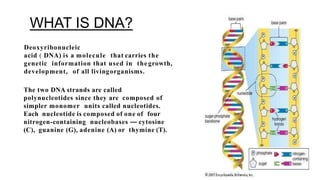
Deoxyribonucleic
acid ( DNA) is a molecule that carries the
genetic information that used in thegrowth,
development, of all livingorganisms.
The two DNA strands are called
polynucleotides since they are composed of
simpler monomer units called nucleotides.
Each nucleotide is composed of one of four
nitrogen-containing nucleobases — cytosine
(C), guanine (G), adenine (A) or thymine (T).
D I G I T A L
STORAGE IN DNA
• DNA digital data storage refers to any process to
store digital data in the base sequence of DNA.
• This technology uses artificial DNA made using
commercially available oligonucleotide synthesis
machines for storage and DNA sequencing
machines for retrieval.
• This type of storage system is more compact than
current magnetic tape or hard drive storage systems
due to the data density of the DNA.
• Currently it was reported that in 1gram of DNA 215
petabytes (215 million gigabytes) could be stored.
HOW IS DATA
STORED IN DNA?
DATA
STORED
IN DNA
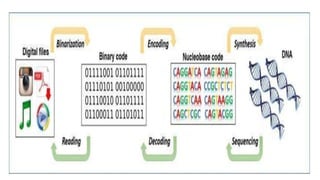
How is Data stored in DNA
further these ATGC
sequences are synthesized
into DNA molecules. And
to read this information
back from DNA,
sequencing of DNA
fragments is done by using
various algorithms
an algorithm called a DNA
Fountain which randomly
packaged the strings into
droplets,
In most of the techniques
the random access of the
data is possible.
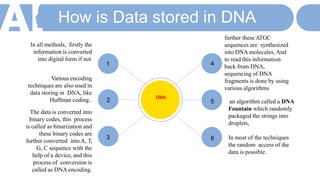
In all methods, firstly the
information is converted
into digital form if not.
. Various encoding
techniques are also used in
data storing in DNA, like
Huffman coding..
The data is converted into
binary codes, this process
is called as binarization and
these binary codes are
further converted into A, T,
G, C sequence with the
help of a device, and this
process of conversion is
called as DNA encoding.
DNA
1
2
3
4
5
6
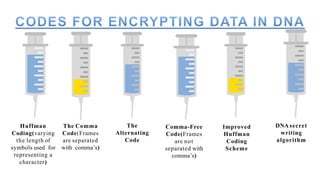
Huffman
Coding(varying
the length of
symbols used for
representing a
character)
The Comma
Code(Frames
are separated
with comma’s)
The
Alternating
Code
Comma-Free
Code(Frames
are not
separated with
comma’s)
Improved
Huffman
Coding
Scheme
DNA secret
writing
algorithm
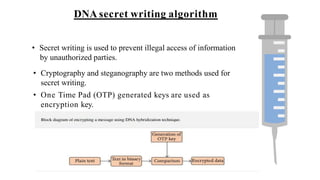
DNA secret writing algorithm
• Secret writing is used to prevent illegal access of information
by unauthorized parties.
• Cryptography and steganography are two methods used for
secret writing.
• One Time Pad (OTP) generated keys are used as
encryption key.
ADVANTAGES
• It is ultra compact
• It can last hundreds of thousands of
years if kept in a cool, dry place.
• As long as human societies are
reading and writing DNA, they will be
able to decode it.
• DNA won’t degrade over time like
cassette tapes and CDs, and it won’t
become obsolete.
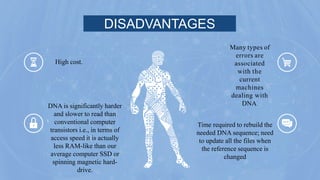
DISADVANTAGES
I
High cost.
Many types of
errors are
associated
with the
current
machines
dealing with
DNA.
.
DNA is significantly harder
and slower to read than
conventional computer
transistors i.e., in terms of
access speed it is actually
less RAM-like than our
average computer SSD or
spinning magnetic hard-
drive.
Time required to rebuild the
needed DNA sequence; need
to update all the files when
the reference sequence is
changed
CONCLUSION
As DNA can retain data
for millions of years, it is
possible to store data for
a long time.
Byusing DNA
multiplication, we can
create number of
copies of important data
and can be distributed
to servers
Thus, using DNA for
data storage, it is
possible to store huge
amount of data in very
less size.
Parallel reading of files
is also possible enabling
users to read multiple
files at the same time.
Thank You

Datastorage in DNA

  • 1.
    DATA STORAGE IN DNA PresentedBy- Aditya Nag BCA Inspiria Knowledge Campus
  • 2.
    CONTENTS A brief introductionon data storage and DNA storage INTRODUCTION 01 Includes a brief explanation about DNA and Digital Storage in DNA . WHAT IS DNA? 02 Includes Methods, Picture explanation, Codes for encrypting data, Secret algorithm, Advantages, Disadvantages. HOW IS DATASTORED IN DNA?03 . CONCLUSION04
  • 3.
  • 4.
    INTRODUCTION 1. The demandfor data storage devices is increasing day by day as more and more data is generated every day. 2. As the data increases, the current data storage technology would not be enough to store data in future as data is growing every day. 3. New York Genome Center have come up with a new way to encode digital data in DNA to create the highest density large scale data storage scheme ever invented. 4. capable of storing 215 petabytes (215 million gigabytes) in a single gram of DNA(It means it could store every bit of datum ever recorded by humans in a container about the size and weight of a couple of pickup trucks) and it could potentially last for hundreds of thousands of years.
  • 5.
  • 6.
    WHAT IS DNA? Deoxyribonucleic acid( DNA) is a molecule that carries the genetic information that used in thegrowth, development, of all livingorganisms. The two DNA strands are called polynucleotides since they are composed of simpler monomer units called nucleotides. Each nucleotide is composed of one of four nitrogen-containing nucleobases — cytosine (C), guanine (G), adenine (A) or thymine (T).
  • 7.
    D I GI T A L STORAGE IN DNA • DNA digital data storage refers to any process to store digital data in the base sequence of DNA. • This technology uses artificial DNA made using commercially available oligonucleotide synthesis machines for storage and DNA sequencing machines for retrieval. • This type of storage system is more compact than current magnetic tape or hard drive storage systems due to the data density of the DNA. • Currently it was reported that in 1gram of DNA 215 petabytes (215 million gigabytes) could be stored.
  • 8.
    HOW IS DATA STOREDIN DNA? DATA STORED IN DNA
  • 9.
    How is Datastored in DNA further these ATGC sequences are synthesized into DNA molecules. And to read this information back from DNA, sequencing of DNA fragments is done by using various algorithms an algorithm called a DNA Fountain which randomly packaged the strings into droplets, In most of the techniques the random access of the data is possible. In all methods, firstly the information is converted into digital form if not. . Various encoding techniques are also used in data storing in DNA, like Huffman coding.. The data is converted into binary codes, this process is called as binarization and these binary codes are further converted into A, T, G, C sequence with the help of a device, and this process of conversion is called as DNA encoding. DNA 1 2 3 4 5 6
  • 11.
    Huffman Coding(varying the length of symbolsused for representing a character) The Comma Code(Frames are separated with comma’s) The Alternating Code Comma-Free Code(Frames are not separated with comma’s) Improved Huffman Coding Scheme DNA secret writing algorithm
  • 12.
    DNA secret writingalgorithm • Secret writing is used to prevent illegal access of information by unauthorized parties. • Cryptography and steganography are two methods used for secret writing. • One Time Pad (OTP) generated keys are used as encryption key.
  • 13.
    ADVANTAGES • It isultra compact • It can last hundreds of thousands of years if kept in a cool, dry place. • As long as human societies are reading and writing DNA, they will be able to decode it. • DNA won’t degrade over time like cassette tapes and CDs, and it won’t become obsolete.
  • 14.
    DISADVANTAGES I High cost. Many typesof errors are associated with the current machines dealing with DNA. . DNA is significantly harder and slower to read than conventional computer transistors i.e., in terms of access speed it is actually less RAM-like than our average computer SSD or spinning magnetic hard- drive. Time required to rebuild the needed DNA sequence; need to update all the files when the reference sequence is changed
  • 15.
    CONCLUSION As DNA canretain data for millions of years, it is possible to store data for a long time. Byusing DNA multiplication, we can create number of copies of important data and can be distributed to servers Thus, using DNA for data storage, it is possible to store huge amount of data in very less size. Parallel reading of files is also possible enabling users to read multiple files at the same time.
  • 16.