SUMMARY
Current storage technology mainly consist of hard drives and flash drives made up of
aluminum and silicone materials. These storage devices have low capacity and are not enough
to store the entire data of digital universe.
DNA drives is a new technology which promises to solve the looming data storage crisis.
It brings a lot of advantages. However right now a lot of research is needed to make DNA
drives commercially viable in terms of cost and efficiency.
OUTLINE
• Digital Data Storage
• Problems with current
technology
• DNA Drive – Technology of
Future
• What is DNA
• Features of DNA drive
• How DNA Drive work
• Current Research Status
• Problems with DNA Drive
• Solutions & Conclusions
Digital Data Storage Problems DNAStorage FeaturesofDNA CurrentStatusHowitworks
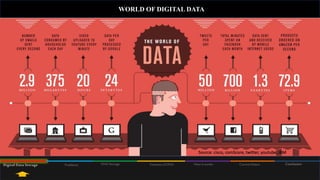
WORLD OF DIGITAL DATA
Conclusion
Source: cisco, comScore, twitter, youtube, IBM
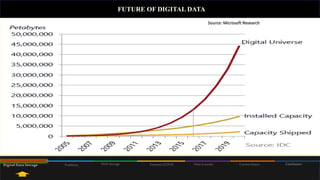
FUTURE OF DIGITAL DATA
Source: Microsoft Research
Digital Data Storage Problems DNAStorage FeaturesofDNA CurrentStatusHowitworks Conclusion
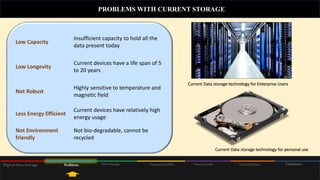
PROBLEMS WITH CURRENT STORAGE
Digital Data Storage Problems DNAStorage FeaturesofDNA CurrentStatusHowitworks
Current Data storage technology for personal use
Current Data storage technology for Enterprise Users
Low Capacity
Insufficient capacity to hold all the
data present today
Low Longevity
Current devices have a life span of 5
to 20 years
Not Robust
Highly sensitive to temperature and
magnetic field
Less Energy Efficient
Current devices have relatively high
energy usage
Not Environment
friendly
Not bio-degradable, cannot be
recycled
Conclusion
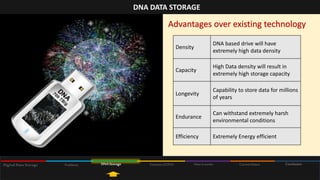
DNA DATA STORAGE
Digital Data Storage Problems DNAStorage FeaturesofDNA CurrentStatusHowitworks
Density
DNA based drive will have
extremely high data density
Capacity
High Data density will result in
extremely high storage capacity
Longevity
Capability to store data for millions
of years
Endurance
Can withstand extremely harsh
environmental conditions
Efficiency Extremely Energy efficient
Advantages over existing technology
Conclusion
WHAT IS DNA
DNA stands for Deoxyribonucleic acid.
It is a molecule which stores the genetic
information used for functioning and
development of all living organisms
DNA acts as the blueprint of life, changes to
DNA results in evolution
Digital Data Storage Problems DNAStorage FeaturesofDNA CurrentStatusHowitworks
DNA stored in fossils gives us information about extinct animals
Conclusion
DNA STORAGE CAPABILITY
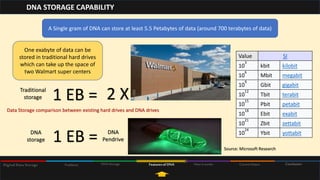
A Single gram of DNA can store at least 5.5 Petabytes of data (around 700 terabytes of data)
One exabyte of data can be
stored in traditional hard drives
which can take up the space of
two Walmart super centers
2 XTraditional
storage 1 EB =
DNA
storage 1 EB = DNA
Pendrive
Digital Data Storage Problems DNAStorage Featuresof DNA CurrentStatusHowitworks
Value SI
10
3
kbit kilobit
10
6
Mbit megabit
10
9
Gbit gigabit
10
12
Tbit terabit
10
15
Pbit petabit
10
18
Ebit exabit
10
21
Zbit zettabit
10
24
Ybit yottabit
Data Storage comparison between existing hard drives and DNA drives
Conclusion
Source: Microsoft Research
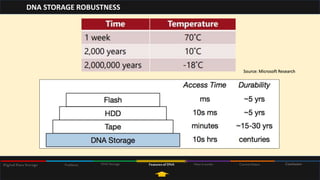
DNA STORAGE ROBUSTNESS
Digital Data Storage Problems DNAStorage Featuresof DNA CurrentStatusHowitworks Conclusion
Source: Microsoft Research
DNA STORAGE COMPARISION
Digital Data Storage Problems DNAStorage Featuresof DNA CurrentStatusHowitworks Conclusion
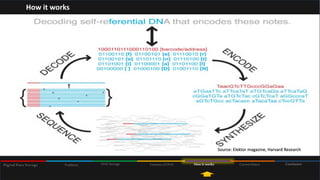
How it works
Digital Data Storage Problems DNAStorage FeaturesofDNA CurrentStatusHowitworks Conclusion
Source: Elektor magazine, Harvard Research
CURRENT STATUS – Microsoft Research with University of Washington
 In the year 2016, Microsoft and University of Washington, as a pilot project, stored and retrieved 200 MB of data (HD
Video, Multiple books, Articles, database) using DNA provided by twist bioscience
 In general in last 10 years, researchers have been able to store and retrieve data with increasing efficiency ( less
percentage of errors)
 Time of reading and writing data is currently very high compared to tradition storage devices.
24301 bytes 11901 bytes 5665 bytes
Digital Data Storage Problems DNAStorage FeaturesofDNA CurrentStatusHowitworks Conclusion
Actual picture files retrieved from a DNA drive. (Project by Microsoft)
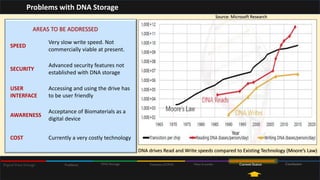
Problems with DNA Storage
AREAS TO BE ADDRESSED
Digital Data Storage Problems DNAStorage FeaturesofDNA CurrentStatusHowitworks Conclusion
SPEED
Very slow write speed. Not
commercially viable at present.
SECURITY
Advanced security features not
established with DNA storage
USER
INTERFACE
Accessing and using the drive has
to be user friendly
AWARENESS
Acceptance of Biomaterials as a
digital device
COST Currently a very costly technology
DNA drives Read and Write speeds compared to Existing Technology (Moore’s Law)
Source: Microsoft Research
CONCLUSION – What needs to be done
Digital Data Storage Problems DNAStorage FeaturesofDNA CurrentStatus ConclusionHowitworks
 Develop better ways of translating digital information into
biological information. Improve the write speed of DNA drive
 Research on DNA synthesis for cost effective and efficient DNA
creation.
 Develop security protocols for data storage in an organic medium
 Public training and awareness campaigns to initiate mass usage of
DNA storage technology
 Automation in production workflows to achieve lower cost
DNA digital storage is the most promising solution to the looming data storage crisis
Research Develop Training Automation
2020
DNA Read Cost
DNA write Cost
THANK YOU
References:
1) Microsoft Research ((https://homes.cs.washington.edu/~bornholt/papers/dnastorage-asplos16.pdf)
2) http://www.nature.com/news/how-dna-could-store-all-the-world-s-data-1.20496
3) www.ibm.com
4) Singularity Hub (https://singularityhub.com/2016/10/21/can-dna-hard-drives-solve-our-looming-data-storage-crisis/)
5) https://www.elektormagazine.com/news/all-data-humanity-creates-in-a-year-stored-on-4-grams-of-dna

DNA Storage

  • 2.
    SUMMARY Current storage technologymainly consist of hard drives and flash drives made up of aluminum and silicone materials. These storage devices have low capacity and are not enough to store the entire data of digital universe. DNA drives is a new technology which promises to solve the looming data storage crisis. It brings a lot of advantages. However right now a lot of research is needed to make DNA drives commercially viable in terms of cost and efficiency. OUTLINE • Digital Data Storage • Problems with current technology • DNA Drive – Technology of Future • What is DNA • Features of DNA drive • How DNA Drive work • Current Research Status • Problems with DNA Drive • Solutions & Conclusions
  • 3.
    Digital Data StorageProblems DNAStorage FeaturesofDNA CurrentStatusHowitworks WORLD OF DIGITAL DATA Conclusion Source: cisco, comScore, twitter, youtube, IBM
  • 4.
    FUTURE OF DIGITALDATA Source: Microsoft Research Digital Data Storage Problems DNAStorage FeaturesofDNA CurrentStatusHowitworks Conclusion
  • 5.
    PROBLEMS WITH CURRENTSTORAGE Digital Data Storage Problems DNAStorage FeaturesofDNA CurrentStatusHowitworks Current Data storage technology for personal use Current Data storage technology for Enterprise Users Low Capacity Insufficient capacity to hold all the data present today Low Longevity Current devices have a life span of 5 to 20 years Not Robust Highly sensitive to temperature and magnetic field Less Energy Efficient Current devices have relatively high energy usage Not Environment friendly Not bio-degradable, cannot be recycled Conclusion
  • 6.
    DNA DATA STORAGE DigitalData Storage Problems DNAStorage FeaturesofDNA CurrentStatusHowitworks Density DNA based drive will have extremely high data density Capacity High Data density will result in extremely high storage capacity Longevity Capability to store data for millions of years Endurance Can withstand extremely harsh environmental conditions Efficiency Extremely Energy efficient Advantages over existing technology Conclusion
  • 7.
    WHAT IS DNA DNAstands for Deoxyribonucleic acid. It is a molecule which stores the genetic information used for functioning and development of all living organisms DNA acts as the blueprint of life, changes to DNA results in evolution Digital Data Storage Problems DNAStorage FeaturesofDNA CurrentStatusHowitworks DNA stored in fossils gives us information about extinct animals Conclusion
  • 8.
    DNA STORAGE CAPABILITY ASingle gram of DNA can store at least 5.5 Petabytes of data (around 700 terabytes of data) One exabyte of data can be stored in traditional hard drives which can take up the space of two Walmart super centers 2 XTraditional storage 1 EB = DNA storage 1 EB = DNA Pendrive Digital Data Storage Problems DNAStorage Featuresof DNA CurrentStatusHowitworks Value SI 10 3 kbit kilobit 10 6 Mbit megabit 10 9 Gbit gigabit 10 12 Tbit terabit 10 15 Pbit petabit 10 18 Ebit exabit 10 21 Zbit zettabit 10 24 Ybit yottabit Data Storage comparison between existing hard drives and DNA drives Conclusion Source: Microsoft Research
  • 9.
    DNA STORAGE ROBUSTNESS DigitalData Storage Problems DNAStorage Featuresof DNA CurrentStatusHowitworks Conclusion Source: Microsoft Research
  • 10.
    DNA STORAGE COMPARISION DigitalData Storage Problems DNAStorage Featuresof DNA CurrentStatusHowitworks Conclusion
  • 11.
    How it works DigitalData Storage Problems DNAStorage FeaturesofDNA CurrentStatusHowitworks Conclusion Source: Elektor magazine, Harvard Research
  • 12.
    CURRENT STATUS –Microsoft Research with University of Washington  In the year 2016, Microsoft and University of Washington, as a pilot project, stored and retrieved 200 MB of data (HD Video, Multiple books, Articles, database) using DNA provided by twist bioscience  In general in last 10 years, researchers have been able to store and retrieve data with increasing efficiency ( less percentage of errors)  Time of reading and writing data is currently very high compared to tradition storage devices. 24301 bytes 11901 bytes 5665 bytes Digital Data Storage Problems DNAStorage FeaturesofDNA CurrentStatusHowitworks Conclusion Actual picture files retrieved from a DNA drive. (Project by Microsoft)
  • 13.
    Problems with DNAStorage AREAS TO BE ADDRESSED Digital Data Storage Problems DNAStorage FeaturesofDNA CurrentStatusHowitworks Conclusion SPEED Very slow write speed. Not commercially viable at present. SECURITY Advanced security features not established with DNA storage USER INTERFACE Accessing and using the drive has to be user friendly AWARENESS Acceptance of Biomaterials as a digital device COST Currently a very costly technology DNA drives Read and Write speeds compared to Existing Technology (Moore’s Law) Source: Microsoft Research
  • 14.
    CONCLUSION – Whatneeds to be done Digital Data Storage Problems DNAStorage FeaturesofDNA CurrentStatus ConclusionHowitworks  Develop better ways of translating digital information into biological information. Improve the write speed of DNA drive  Research on DNA synthesis for cost effective and efficient DNA creation.  Develop security protocols for data storage in an organic medium  Public training and awareness campaigns to initiate mass usage of DNA storage technology  Automation in production workflows to achieve lower cost DNA digital storage is the most promising solution to the looming data storage crisis Research Develop Training Automation 2020 DNA Read Cost DNA write Cost
  • 15.
    THANK YOU References: 1) MicrosoftResearch ((https://homes.cs.washington.edu/~bornholt/papers/dnastorage-asplos16.pdf) 2) http://www.nature.com/news/how-dna-could-store-all-the-world-s-data-1.20496 3) www.ibm.com 4) Singularity Hub (https://singularityhub.com/2016/10/21/can-dna-hard-drives-solve-our-looming-data-storage-crisis/) 5) https://www.elektormagazine.com/news/all-data-humanity-creates-in-a-year-stored-on-4-grams-of-dna