Chapter 10
Replication of DNA and
Chromosomes
Chapter Outline
Basic Features of DNA Replication In
Vivo
DNA Polymerases and DNA Synthesis
In Vitro
The Complex Replication Apparatus
Unique Aspects of Eukaryotic
Chromosome replication
Basic Features of DNA
Replication In Vivo
DNA replication occurs
semiconservatively, is initiated at
unique origins, and usually
proceeds bidirectionally from each
origin of replication.
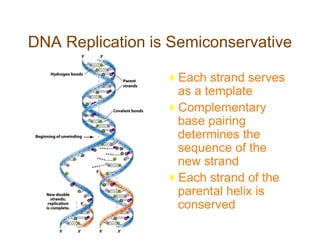
DNA Replication is Semiconservative
Each strand serves
as a template
Complementary
base pairing
determines the
sequence of the
new strand
Each strand of the
parental helix is
conserved
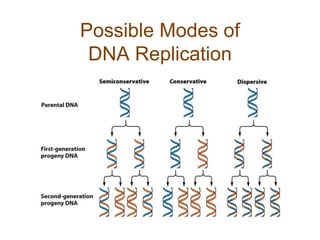
Possible Modes of
DNA Replication
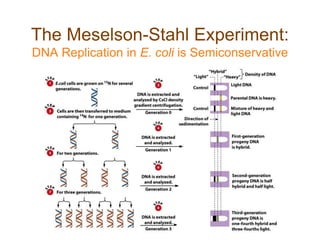
The Meselson-Stahl Experiment:
DNA Replication in E. coli is Semiconservative
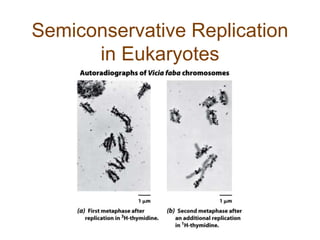
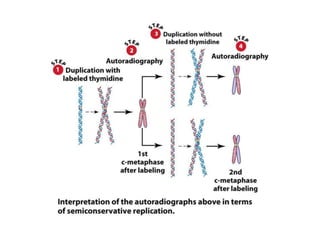
Semiconservative Replication
in Eukaryotes
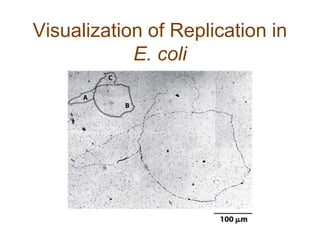
Visualization of Replication in
E. coli
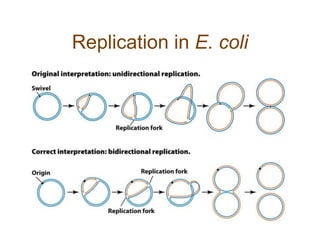
Replication in E. coli
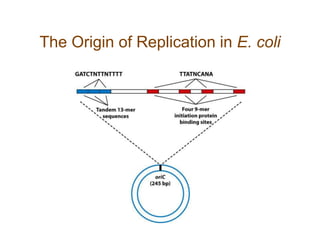
The Origin of Replication in E. coli
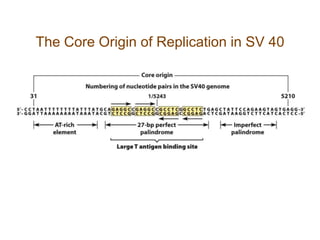
The Core Origin of Replication in SV 40
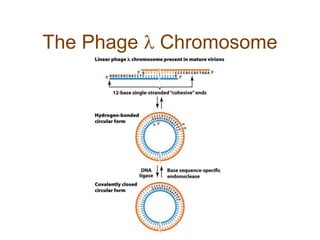
The Phage  Chromosome
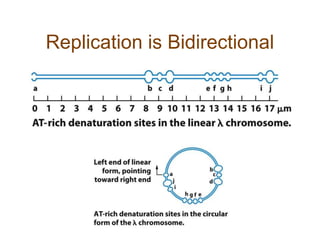
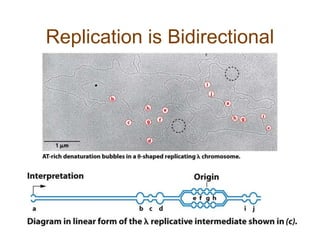
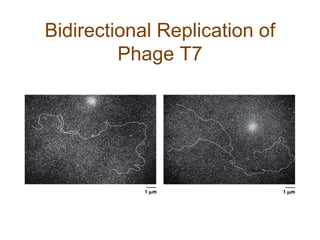
Replication is Bidirectional
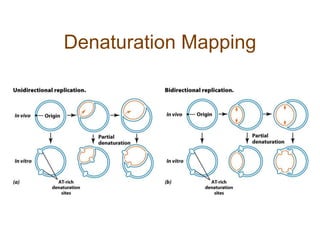
Denaturation Mapping
Bidirectional Replication of
Phage T7
Key Points
DNA replicates by a semiconservative mechanism:
as the two complementary strands of a parental
double helix unwind and separate, each serves as a
template for the synthesis of a new complementary
strand.
The hydrogen-bonding potentials of the bases in the
template strands specify complementary base
sequences in the nascent DNA strands.
Replication is initiated at unique origins and usually
proceeds bidirectionally from each origin.
DNA Polymerases and DNA
Synthesis In Vitro
Much of what we know about DNA
synthesis was deduced from in
vitro studies.
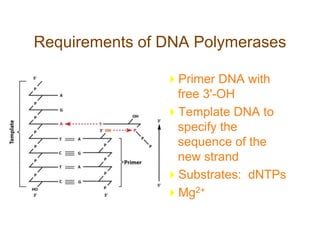
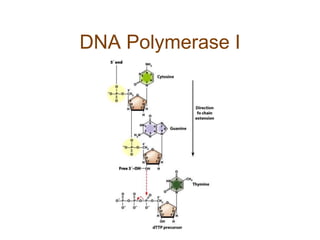
Requirements of DNA Polymerases
Primer DNA with
free 3'-OH
Template DNA to
specify the
sequence of the
new strand
Substrates: dNTPs
Mg2+
DNA Polymerase I
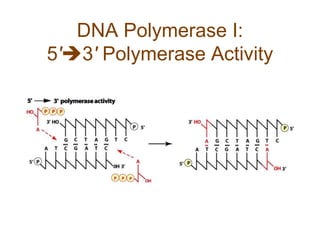
DNA Polymerase I:
5'3' Polymerase Activity
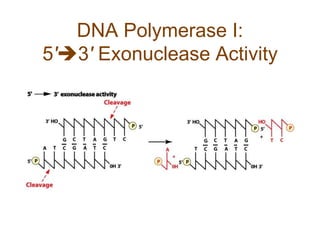
DNA Polymerase I:
5'3' Exonuclease Activity
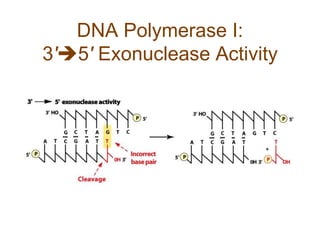
DNA Polymerase I:
3'5' Exonuclease Activity
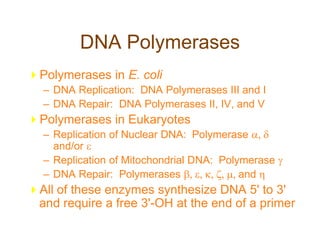
DNA Polymerases
Polymerases in E. coli
– DNA Replication: DNA Polymerases III and I
– DNA Repair: DNA Polymerases II, IV, and V
Polymerases in Eukaryotes
– Replication of Nuclear DNA: Polymerase 
and/or 
– Replication of Mitochondrial DNA: Polymerase 
– DNA Repair: Polymerases and
All of these enzymes synthesize DNA 5' to 3'
and require a free 3'-OH at the end of a primer
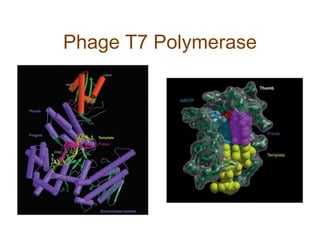
Phage T7 Polymerase
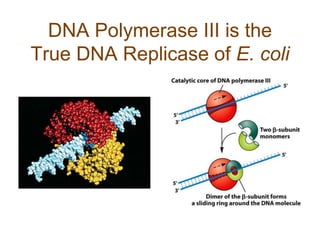
DNA Polymerase III is the
True DNA Replicase of E. coli
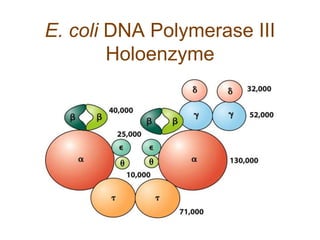
E. coli DNA Polymerase III
Holoenzyme
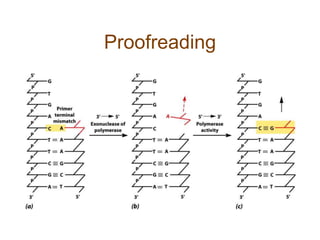
Proofreading
Key Points
DNA synthesis is catalyzed by enzymes called DNA
polymerases.
All DNA polymerases require a primer strand, which
is extended, and a template strand, which is copied.
All DNA polymerases have an absolute requirement
for a free 3'-OH on the primer strand, and all DNA
synthesis occurs in the 5' to 3' direction.
Key Points
The 3'5' exonuclease activities of DNA
polymerases proofread nascent strands as
they are synthesized, removing any
mispaired nucleotides at the 3' termini of
primer strands.
The Complex Replication
Apparatus
DNA replication is a complex
process, requiring the concerted
action of a large number of
proteins.
DNA Replication
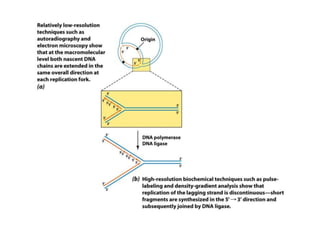
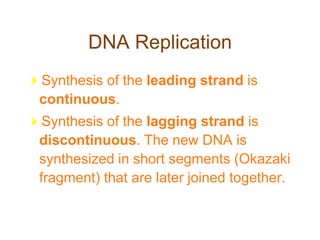
Synthesis of the leading strand is
continuous.
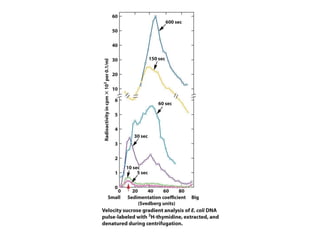
Synthesis of the lagging strand is
discontinuous. The new DNA is
synthesized in short segments (Okazaki
fragment) that are later joined together.
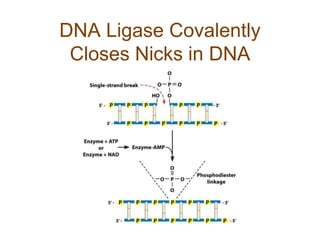
DNA Ligase Covalently
Closes Nicks in DNA
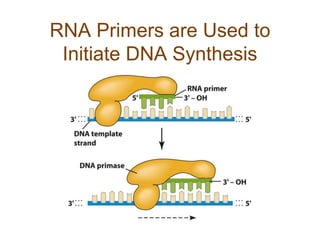
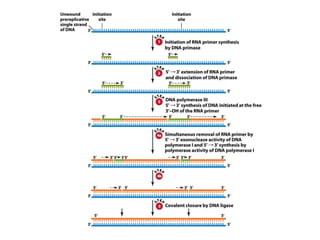
RNA Primers are Used to
Initiate DNA Synthesis
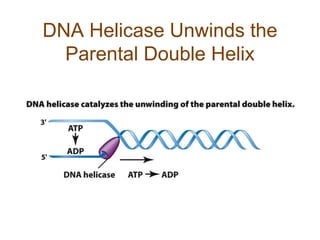
DNA Helicase Unwinds the
Parental Double Helix
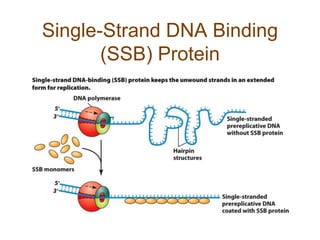
Single-Strand DNA Binding
(SSB) Protein
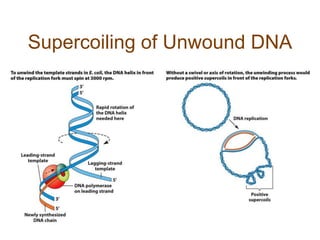
Supercoiling of Unwound DNA
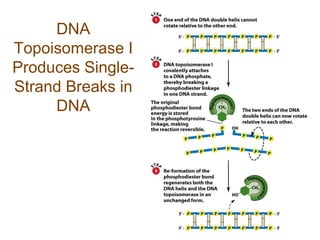
DNA
Topoisomerase I
Produces Single-
Strand Breaks in
DNA
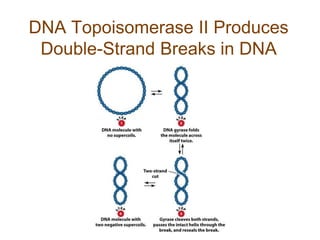
DNA Topoisomerase II Produces
Double-Strand Breaks in DNA
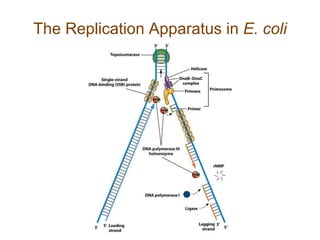
The Replication Apparatus in E. coli
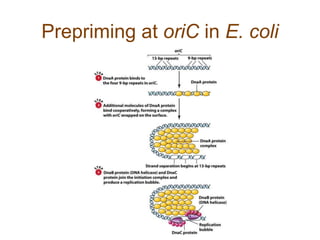
Prepriming at oriC in E. coli
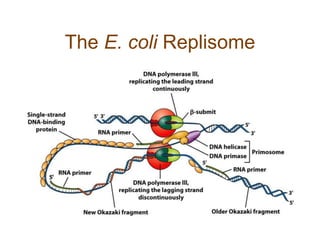
The E. coli Replisome
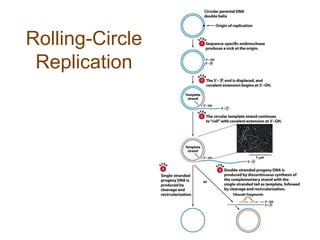
Rolling-Circle
Replication
Key Points
DNA replication is complex, requiring the
participation of a large number of proteins.
DNA synthesis is continuous on the progeny
strand that is being extended in the overall
5'3' direction, but is discontinuous on the
strand growing in the overall 3'5' direction.
Key Points
New DNA chains are initiated by short RNA
primers synthesized by DNA primase.
The enzymes and DNA-binding proteins
involved in replication assembled into a
replisome at each replication fork and act in
concert as the fork moves along the parental
DNA molecule.
Unique Aspects of Eukaryotic
Chromosome Replication
Although the main features of
DNA replication are the same in
all organisms, some processes
occur only in eukaryotes.
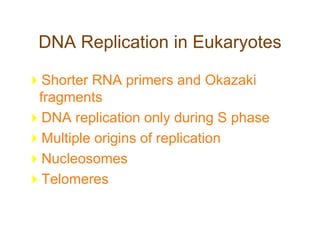
DNA Replication in Eukaryotes
Shorter RNA primers and Okazaki
fragments
DNA replication only during S phase
Multiple origins of replication
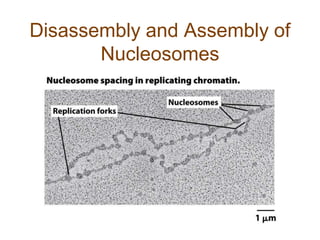
Nucleosomes
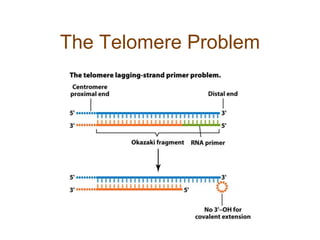
Telomeres
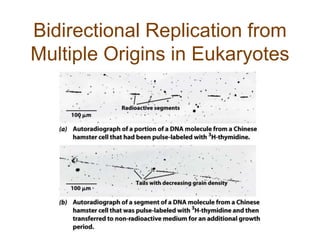
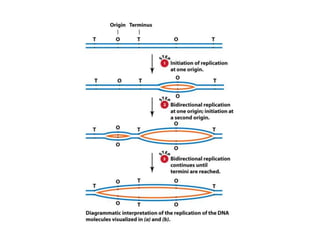
Bidirectional Replication from
Multiple Origins in Eukaryotes
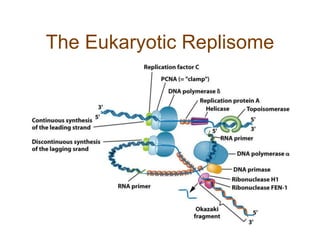
The Eukaryotic Replisome
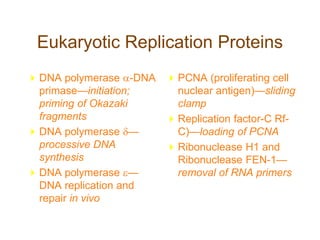
Eukaryotic Replication Proteins
DNA polymerase -DNA
primase—initiation;
priming of Okazaki
fragments
DNA polymerase —
processive DNA
synthesis
DNA polymerase —
DNA replication and
repair in vivo
PCNA (proliferating cell
nuclear antigen)—sliding
clamp
Replication factor-C Rf-
C)—loading of PCNA
Ribonuclease H1 and
Ribonuclease FEN-1—
removal of RNA primers
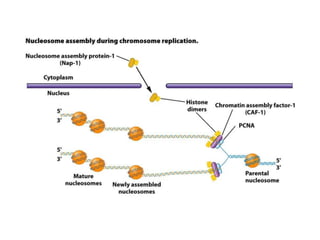
Disassembly and Assembly of
Nucleosomes
The Telomere Problem
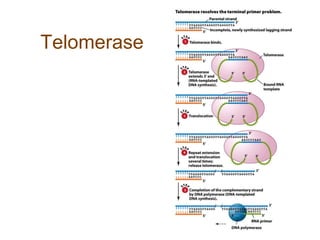
Telomerase
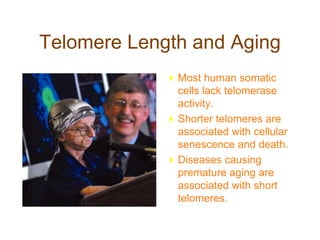
Telomere Length and Aging
Most human somatic
cells lack telomerase
activity.
Shorter telomeres are
associated with cellular
senescence and death.
Diseases causing
premature aging are
associated with short
telomeres.
Key Points
The large DNA molecules in eukaryotic chromosome
replicate bidirectionally from multiple origins.
Two or three DNA polymerases (and/or ) are
present at each replication fork in eukaryotes.
Telomeres, the unique sequences at the ends of
chromosomes, are added to chromosome by a
unique enzyme called telomerase.

DNA Replication-2 in prokaryotes and eukaryotes.ppt