DNA Repair MechanismsMaria Fernanda Sánchez RicoThird SemesterMedicine – UPB2010
Folding
Folding
IntroductionCells have the ability to detect and repair the damage that DNA might suffer.When DNA sequence is damaged and left uncorrected, the cells can accumulate mutations and function improperly. To prevent these kinds of failures, the cell has DNA repair mechanisms .
  Researchers identify DNA damage repair gene in Fanconi anemia pathwayNewswire The Rockefeller University(July 20, 2010)     
Researchers identify DNA damage repair gene in Fanconi anemia pathwayProtein associated with Fanconi Anemia (FA) might be involved in repairing inter-strand crosslinks in DNA.
When one of the proteins in the FA  pathway is damaged, the result is Fanconi Anemia, which can cause various forms of cancer.Researchers identify DNA damage repair gene in Fanconi anemia pathwayFAN1 has important properties to repair DNAEncodes a nucleaseHas a UBZ domain that binds ubiquinated proteins
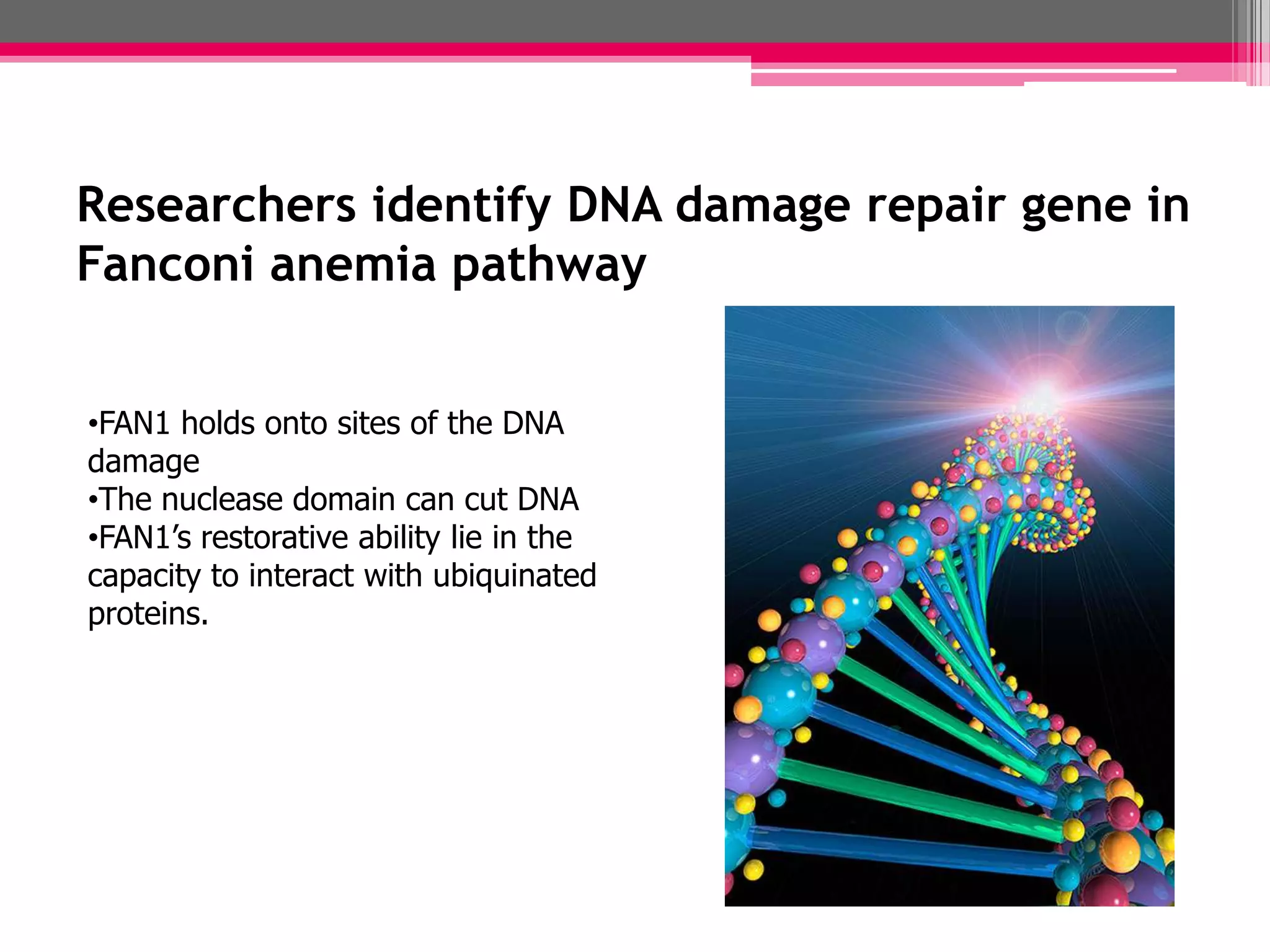
Researchers identify DNA damage repair gene in Fanconi anemia pathwayFAN1 holds onto sites of the DNA damage
The nuclease domain can cut DNA
FAN1’s restorative ability lie in the capacity to interact with ubiquinated proteins.Observation
Drug that Inhibits DNA-repair Enzyme Shrinks Some Breast and Ovarian TumorsNCI Cancer Bulletin(July 13, 2010)
Drug that Inhibits DNA-repair Enzyme Shrinks Some Breast and Ovarian TumorsThe drug Olaparib blocks a DNA repair enzyme called PARP
Two phase II clinical trials were made to prove that olaparib shrinks tumors in women with inherited BRCA1 or BRCA2 mutationsDrug that Inhibits DNA-repair Enzyme Shrinks Some Breast and Ovarian TumorsIn the first clinical trial 54 women with breast cancer and BRCA1 or BRCA2 mutations participated.27 women received 400mg of olaparib twice a day             tumors shrank in 11 women in this group.
27 women received 100mg of olaparib twice a day            tumors shrank in 6 women in this group.Drug that Inhibits DNA-repair Enzyme Shrinks Some Breast and Ovarian TumorsIn the second clinical trial 57 women with ovarian cancer and BRCA1 or BRCA2 mutations participated.33 women received 400mg of olaparib twice a day           tumors shrank in 6 women in this group.
24 received 100mg of olaparib twice a day         tumors shrank in 3 women in this group. Observation
Medical Utility
Medical UtilityThe study of DNA repair mechanisms is very promising to reduce the incidence of cancer. 
Medical UtilityResearchers identify DNA damage repair gene in Fanconi anemia pathwayThe discovery of FAN1 could probably hold the key to improve the lives of those who have Fanconi Anemia, avoiding the incidence of cancer in these patients.
FAN1 might also be related with multiple types of cancer. 
Medical UtilityDrug that Inhibits DNA-repair Enzyme Shrinks Some Breast and Ovarian TumorsOlaparib could become a way of treatment for cancer patients that have resistant tumors.

Dna Repair Mechanisms

  • 1.
    DNA Repair MechanismsMariaFernanda Sánchez RicoThird SemesterMedicine – UPB2010
  • 2.
  • 3.
  • 4.
    IntroductionCells have theability to detect and repair the damage that DNA might suffer.When DNA sequence is damaged and left uncorrected, the cells can accumulate mutations and function improperly. To prevent these kinds of failures, the cell has DNA repair mechanisms .
  • 5.
      Researchers identify DNAdamage repair gene in Fanconi anemia pathwayNewswire The Rockefeller University(July 20, 2010)     
  • 6.
    Researchers identify DNAdamage repair gene in Fanconi anemia pathwayProtein associated with Fanconi Anemia (FA) might be involved in repairing inter-strand crosslinks in DNA.
  • 7.
    When one ofthe proteins in the FA pathway is damaged, the result is Fanconi Anemia, which can cause various forms of cancer.Researchers identify DNA damage repair gene in Fanconi anemia pathwayFAN1 has important properties to repair DNAEncodes a nucleaseHas a UBZ domain that binds ubiquinated proteins
  • 8.
    Researchers identify DNAdamage repair gene in Fanconi anemia pathwayFAN1 holds onto sites of the DNA damage
  • 9.
  • 10.
    FAN1’s restorative abilitylie in the capacity to interact with ubiquinated proteins.Observation
  • 11.
    Drug that InhibitsDNA-repair Enzyme Shrinks Some Breast and Ovarian TumorsNCI Cancer Bulletin(July 13, 2010)
  • 12.
    Drug that InhibitsDNA-repair Enzyme Shrinks Some Breast and Ovarian TumorsThe drug Olaparib blocks a DNA repair enzyme called PARP
  • 13.
    Two phase IIclinical trials were made to prove that olaparib shrinks tumors in women with inherited BRCA1 or BRCA2 mutationsDrug that Inhibits DNA-repair Enzyme Shrinks Some Breast and Ovarian TumorsIn the first clinical trial 54 women with breast cancer and BRCA1 or BRCA2 mutations participated.27 women received 400mg of olaparib twice a day tumors shrank in 11 women in this group.
  • 14.
    27 women received100mg of olaparib twice a day tumors shrank in 6 women in this group.Drug that Inhibits DNA-repair Enzyme Shrinks Some Breast and Ovarian TumorsIn the second clinical trial 57 women with ovarian cancer and BRCA1 or BRCA2 mutations participated.33 women received 400mg of olaparib twice a day tumors shrank in 6 women in this group.
  • 15.
    24 received 100mgof olaparib twice a day tumors shrank in 3 women in this group. Observation
  • 16.
  • 17.
    Medical UtilityThe studyof DNA repair mechanisms is very promising to reduce the incidence of cancer. 
  • 18.
    Medical UtilityResearchers identifyDNA damage repair gene in Fanconi anemia pathwayThe discovery of FAN1 could probably hold the key to improve the lives of those who have Fanconi Anemia, avoiding the incidence of cancer in these patients.
  • 19.
    FAN1 might alsobe related with multiple types of cancer. 
  • 20.
    Medical UtilityDrug thatInhibits DNA-repair Enzyme Shrinks Some Breast and Ovarian TumorsOlaparib could become a way of treatment for cancer patients that have resistant tumors.
  • 21.
    This drug mayperhaps provide a longer life and stabilize the disease.BibliographyMARTINEZ SANCHEZ, L. Biología Molecular. Libro de case. Quinta edición. Medellín: UPB 2009.LODISH, Harvey. Molecular CellBiology. 5th Edition. W.H. Freeman, 2008.Researchersidentify DNA damagerepair gene in Fanconi anemia pathway. The Rockefeller UniversityNewswire [internet magazine] 2010 20 July [consult date July 22, 2010]. Availableon: http://newswire.rockefeller.edu/?page=engine&id=1084DrugthatInhibits DNA-repairEnzymeShrinksSomeBreast and OvarianTumors. NCI CancerBulletin [internet magazine] 2010 13 July [consult date July22, 2010]. Availableon: http://www.cancer.gov/ncicancerbulletin/071310/page3
  • 22.