SANT GADGEBABA AMRAVATI UNIVERSITY, AMRAVATI .
Anuradha College of pharmacy, Chikhli (Maharashtra)
(2018-2019)
Submitted by Under the guidance of
SEMINAR ON GENE THERAPY
Mr. Yogesh Pralhad Jadhao
B.Pharm VIth Semister
Prof. D.T.Panjawani Sir
(M.Pharm)
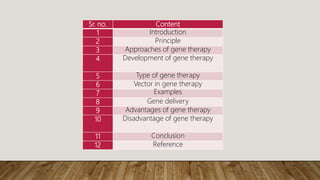
Sr. no. Content
1 Introduction
2 Principle
3 Approaches of gene therapy
4 Development of gene therapy
5 Type of gene therapy
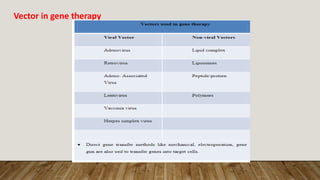
6 Vector in gene therapy
7 Examples
8 Gene delivery
9 Advantages of gene therapy
10 Disadvantage of gene therapy
11 Conclusion
12 Reference
Gene therapy
INTRODUCTION
 Gene therapy is a novel treatment method which utilize gene or short oligonucleotide sequence
therapeutic as molecule, instead of conventional drug components.
 This technique is widely used to treat those defective genes which contribute to disease
development.
 Gene therapy involved the introduction of one or more gene into an organism to treat hereditary
or acquired genetic defects.
 Gene therapy is basically to correct defective gene responsible for genetic disorder by one of the
following approaches.
o A normal gene could be inserted into a non-specific location within the genome to replace the non-
functional gene (most common).
o An abnormal gene could be repaired through selective reverse mutation.
o Regulation (degree to which a gene is turned on or off) of a particular gene could be alter.
Scope of this approach is broad
with potential in treatment 0f
disease caused by single gene
recessive disorder (like cystic
fibrosis, hemophilia, muscular
dystrophy, sickle cell anemia,
etc.). Acquired genetic disease
such as cancer and central viral
infection like AID’S as shown in
fig. 1
Principle of gene therapy
1. Addition of normal gene to replace the function of mutant gene.
2. Replacement of mutant gene sequence with normal gene sequence.
3. By construction of novel function.
Gene therapy is the process of inserting genes into cells to treat diseases
 The newly introduced gene will encoded protein and correct the deficiencies that occur in genetic diseases.
Thus gene therapy primarily involve genetic manipulation in animal or humans to correct a disease, and keep
the organism in good health. The initial experiments on gene therapy are carried out in animals, and then in
humans.
•In gene augmentation therapy, a DNA is inserted
into the genome to replace the missing gene
product. In case of gene inhibition therapy, the
antisense gene inhibit the expression of the
dominant gene.
An overview of gene therapy strategies is depicted in fig.2
Mutation in gene
↓
Change in codon sequence
↓
Alter transcription and translation
↓
Defective protein synthesis
↓
Disease
GENE
THERAPY
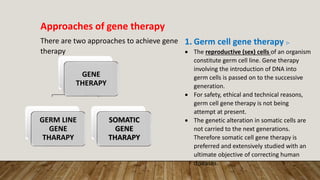
GERM LINE
GENE
THARAPY
SOMATIC
GENE
THARAPY
Approaches of gene therapy
There are two approaches to achieve gene
therapy
1. Germ cell gene therapy :-
 The reproductive (sex) cells of an organism
constitute germ cell line. Gene therapy
involving the introduction of DNA into
germ cells is passed on to the successive
generation.
 For safety, ethical and technical reasons,
germ cell gene therapy is not being
attempt at present.
 The genetic alteration in somatic cells are
not carried to the next generations.
Therefore somatic cell gene therapy is
preferred and extensively studied with an
ultimate objective of correcting human
diseases.
DEVELOPMENT OF GENE THEARPY:-
Development of gene therapy in humans for any specific disease involves the following steps. In fact this is a
general format for introducing any therapeutic agents for human use.
1. In vivo experiment and research on laboratory animals (pre-clinical trials )
2. Phase I trials with a small numbers (5-10) of human subject to test safety of the product.
3. Phase II trials with more human subjects to assess whether the product is helpful.
4. Phase III trials in large human samples for a final and comprehensive analysis of the safety and efficacy of
the product.
2. Somatic cell gene therapy :-
 The non-reproductive (non-sex) cells of an organism are referred to as somatic cells.
 These are the cells of an organism other than sperm or eggs cells, e.g., bone marrow cells, blood cells, skin cells,
intestinal cells.
 At present, all the research on gene therapy is directed to correct the genetic defect in somatic cells.
TYPE OF
GENE
THARAPY
EX-VIVO
GENE
THARAPY
IN-VIVO
GENE
THARAPY
Ex vivo gene therapy:- This involves the transfer of genes in
cultured cells (e.g., bone marrow cells ) which are then
reintroduced into the patient
In vivo gene therapy:- the direct delivery of genes into the
cells of a particular tissue is referred to as in vivo gene therapy
Types of gene therapy
Fig.3 ex-vivo and in-vivo gene therapy
Ex vivo gene therapy:-
The ex vivo gene therapy can be applied to only selected tissue (e.g., bone marrow ) whose cells
can be cultured in laboratory.
The technique of ex vivo gene therapy
involves the following steps
1. Isolate cells with genetic defect from a
patient.
2. Grow the cells in culture.
3. Introduced a therapeutic gene to correct the
gene defect.
4. Select the genetically corrected cells (stable
transformation) and grow.
5. Transplant the modified cells to the patient.
Fig.4 The procedure for EX vivo gene therapy
In vivo gene therapy:-
 The direct delivery of the therapeutic
gene (DNA) into target cells of a
particular tissue of a patient
constituent in vivo gene therapy many
tissue are the potential candidates for
this approaches.
 These include liver, muscles, skin,
spleen, lungs, brains, and blood cells.
Gene delivery are carried out by viral
or non-viral vector.
Fig.5 in vivo gene therapy
Vector in gene therapy
Selected list of genetic disease that are likely to be cured by using bone
marrow cells (potential candidates for gene therapy)
 Severe combined immunodeficiency disease (SCID).
 Sickle-cell anemia
 Thalassemia
 Gaucher’s disease
 Hunter disease
 Hurler syndrome
 Chronic granulomatous disease
 Infentile agranulocytosis
 Osteoporosis
 x-linked agammaglobulinemia
sever combined immunodeficiency(SCID)
1. this is rare inherited immune disorder associated with T-lymphocyets, and B-lymphocytes dysfunction.
2. About 50% of SCID patient have a defects in the gene ( located on chromosome 20 and Has 32,000 base pair)
that encodes for adenosine deaminase.
3. the deficiency of ADA, deoxyadnosine and its metabolites accumulates and destroy T-lymphocytes .
4. L-lymphocytes are essential for body immunity beside participating directly in the body defense they promtes
the function of T-lymphocytes to produce antibodies.
• Thus , the patient of SCID suffer from infectious disease and die at an young age . previously the children
suffering from SCID were treated with conjugated bovine ADA, or by bone marrow transformation.
Technique of therapy for ADA deficiency
The general scheme for Gene therapy adopted for introducing a defective Gene in the patient has been
depicted in fig.6 .
The same procedure with suitable modifications can also be applied for other Gene therapies.
Circulating lymphocytes are removed from a
patient suffering from ADA deficiency. These cells
are transfected with ADA gene by exposing to
billion of retrovirus carrying the said gene.
The genetically-modified lymphocytes are grown
in culture to confirm the expression of ADA Gene
and returned to the patient. These lymphocytes
are persist in the circulation and sysnthesize ADA.
Consequently, the ability of the patient to produce
antibodies is increased.
Fig.6
treatment of ADA deficient by somatic ex vivo gene therapy (SCID)
However, there is a limitation . The lymphocytes have a short Life span , hence the transfusions have to be
carried out frequently.
the success of in vivo gene therapy mostly depends on the following parameters
 The efficiency of the uptake of the remedial (therapeutic) gene by target cells.
 Intracellular degradation of the gene and its uptake by nucleus.
 The expression capability of then gene.
In vivo gene therapy with special reference to gene delivery systems (viral, non-viral) with suitable example is
described.
Gene delivery
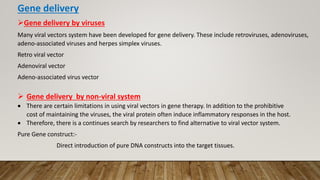
Gene delivery by viruses
Many viral vectors system have been developed for gene delivery. These include retroviruses, adenoviruses,
adeno-associated viruses and herpes simplex viruses.
Retro viral vector
Adenoviral vector
Adeno-associated virus vector
 Gene delivery by non-viral system
 There are certain limitations in using viral vectors in gene therapy. In addition to the prohibitive
cost of maintaining the viruses, the viral protein often induce inflammatory responses in the host.
 Therefore, there is a continues search by researchers to find alternative to viral vector system.
Pure Gene construct:-
Direct introduction of pure DNA constructs into the target tissues.
Advantage of gene therapy
 Gene therapy has the potential to eliminate and prevent hereditary disease such as cystic fibrosis and
is a possible cure for heart disease, AIDS, and cancer.
 These sceptics would almost certainly choose gene therapy, especially if it was the last hope for them
or one of their loved one as is the case for many gene therapy patients.
Disadvantages of gene therapy
 Short-lived nature of gene therapy.
 Immune response- gene injected with a virus may trigger as immune response against the virus.
Problem with viral vector (once inside the patient, the viral vector could recover its ability to cause
disease).
 Multigene disorder- the genetic material might not get into the right cell, or the right place in the
cell’s DNA.
Conclusion
 Introduced a new gene into the body to help fight disease.
 Inactivation or “knocking out”, a mutated gene that is functioning improperly.
 By using Gene therapy the genetic disorders can be corrected with the help of
suitable vector
Reference
1. Biotechnology by Dr. U. Satyanarayna (M. sc. Phd. F.L.C.) and Dr. U. Chakrapani
(M.B.B.S.M.S.) Page. no. 157 to 172.
2. Review Article Human Gene Therapy : A Brief Overview of the genetic revolution
Sanjukta Mishra February 2013 vol.61
3. MODULE 8-LECTURE 1 GENE THERAPY INTODUCTION AND METHOD, NTPL-Bio-
technology-genetic technique and application page no. 1-69
4. Review article development of gene therapy : potential in severe combined
immunodeficiency by Claudia A Montiel Equihua Adrian Thrasher H. Bobby
Gaspar.
Gene therapy

Gene therapy

  • 1.
    SANT GADGEBABA AMRAVATIUNIVERSITY, AMRAVATI . Anuradha College of pharmacy, Chikhli (Maharashtra) (2018-2019) Submitted by Under the guidance of SEMINAR ON GENE THERAPY Mr. Yogesh Pralhad Jadhao B.Pharm VIth Semister Prof. D.T.Panjawani Sir (M.Pharm)
  • 2.
    Sr. no. Content 1Introduction 2 Principle 3 Approaches of gene therapy 4 Development of gene therapy 5 Type of gene therapy 6 Vector in gene therapy 7 Examples 8 Gene delivery 9 Advantages of gene therapy 10 Disadvantage of gene therapy 11 Conclusion 12 Reference
  • 3.
    Gene therapy INTRODUCTION  Genetherapy is a novel treatment method which utilize gene or short oligonucleotide sequence therapeutic as molecule, instead of conventional drug components.  This technique is widely used to treat those defective genes which contribute to disease development.  Gene therapy involved the introduction of one or more gene into an organism to treat hereditary or acquired genetic defects.  Gene therapy is basically to correct defective gene responsible for genetic disorder by one of the following approaches. o A normal gene could be inserted into a non-specific location within the genome to replace the non- functional gene (most common). o An abnormal gene could be repaired through selective reverse mutation. o Regulation (degree to which a gene is turned on or off) of a particular gene could be alter.
  • 4.
    Scope of thisapproach is broad with potential in treatment 0f disease caused by single gene recessive disorder (like cystic fibrosis, hemophilia, muscular dystrophy, sickle cell anemia, etc.). Acquired genetic disease such as cancer and central viral infection like AID’S as shown in fig. 1 Principle of gene therapy 1. Addition of normal gene to replace the function of mutant gene. 2. Replacement of mutant gene sequence with normal gene sequence. 3. By construction of novel function.
  • 5.
    Gene therapy isthe process of inserting genes into cells to treat diseases  The newly introduced gene will encoded protein and correct the deficiencies that occur in genetic diseases. Thus gene therapy primarily involve genetic manipulation in animal or humans to correct a disease, and keep the organism in good health. The initial experiments on gene therapy are carried out in animals, and then in humans. •In gene augmentation therapy, a DNA is inserted into the genome to replace the missing gene product. In case of gene inhibition therapy, the antisense gene inhibit the expression of the dominant gene. An overview of gene therapy strategies is depicted in fig.2 Mutation in gene ↓ Change in codon sequence ↓ Alter transcription and translation ↓ Defective protein synthesis ↓ Disease
  • 6.
    GENE THERAPY GERM LINE GENE THARAPY SOMATIC GENE THARAPY Approaches ofgene therapy There are two approaches to achieve gene therapy 1. Germ cell gene therapy :-  The reproductive (sex) cells of an organism constitute germ cell line. Gene therapy involving the introduction of DNA into germ cells is passed on to the successive generation.  For safety, ethical and technical reasons, germ cell gene therapy is not being attempt at present.  The genetic alteration in somatic cells are not carried to the next generations. Therefore somatic cell gene therapy is preferred and extensively studied with an ultimate objective of correcting human diseases.
  • 7.
    DEVELOPMENT OF GENETHEARPY:- Development of gene therapy in humans for any specific disease involves the following steps. In fact this is a general format for introducing any therapeutic agents for human use. 1. In vivo experiment and research on laboratory animals (pre-clinical trials ) 2. Phase I trials with a small numbers (5-10) of human subject to test safety of the product. 3. Phase II trials with more human subjects to assess whether the product is helpful. 4. Phase III trials in large human samples for a final and comprehensive analysis of the safety and efficacy of the product. 2. Somatic cell gene therapy :-  The non-reproductive (non-sex) cells of an organism are referred to as somatic cells.  These are the cells of an organism other than sperm or eggs cells, e.g., bone marrow cells, blood cells, skin cells, intestinal cells.  At present, all the research on gene therapy is directed to correct the genetic defect in somatic cells.
  • 8.
    TYPE OF GENE THARAPY EX-VIVO GENE THARAPY IN-VIVO GENE THARAPY Ex vivogene therapy:- This involves the transfer of genes in cultured cells (e.g., bone marrow cells ) which are then reintroduced into the patient In vivo gene therapy:- the direct delivery of genes into the cells of a particular tissue is referred to as in vivo gene therapy Types of gene therapy Fig.3 ex-vivo and in-vivo gene therapy
  • 9.
    Ex vivo genetherapy:- The ex vivo gene therapy can be applied to only selected tissue (e.g., bone marrow ) whose cells can be cultured in laboratory. The technique of ex vivo gene therapy involves the following steps 1. Isolate cells with genetic defect from a patient. 2. Grow the cells in culture. 3. Introduced a therapeutic gene to correct the gene defect. 4. Select the genetically corrected cells (stable transformation) and grow. 5. Transplant the modified cells to the patient. Fig.4 The procedure for EX vivo gene therapy
  • 10.
    In vivo genetherapy:-  The direct delivery of the therapeutic gene (DNA) into target cells of a particular tissue of a patient constituent in vivo gene therapy many tissue are the potential candidates for this approaches.  These include liver, muscles, skin, spleen, lungs, brains, and blood cells. Gene delivery are carried out by viral or non-viral vector. Fig.5 in vivo gene therapy
  • 11.
  • 12.
    Selected list ofgenetic disease that are likely to be cured by using bone marrow cells (potential candidates for gene therapy)  Severe combined immunodeficiency disease (SCID).  Sickle-cell anemia  Thalassemia  Gaucher’s disease  Hunter disease  Hurler syndrome  Chronic granulomatous disease  Infentile agranulocytosis  Osteoporosis  x-linked agammaglobulinemia
  • 13.
    sever combined immunodeficiency(SCID) 1.this is rare inherited immune disorder associated with T-lymphocyets, and B-lymphocytes dysfunction. 2. About 50% of SCID patient have a defects in the gene ( located on chromosome 20 and Has 32,000 base pair) that encodes for adenosine deaminase. 3. the deficiency of ADA, deoxyadnosine and its metabolites accumulates and destroy T-lymphocytes . 4. L-lymphocytes are essential for body immunity beside participating directly in the body defense they promtes the function of T-lymphocytes to produce antibodies. • Thus , the patient of SCID suffer from infectious disease and die at an young age . previously the children suffering from SCID were treated with conjugated bovine ADA, or by bone marrow transformation. Technique of therapy for ADA deficiency The general scheme for Gene therapy adopted for introducing a defective Gene in the patient has been depicted in fig.6 . The same procedure with suitable modifications can also be applied for other Gene therapies.
  • 14.
    Circulating lymphocytes areremoved from a patient suffering from ADA deficiency. These cells are transfected with ADA gene by exposing to billion of retrovirus carrying the said gene. The genetically-modified lymphocytes are grown in culture to confirm the expression of ADA Gene and returned to the patient. These lymphocytes are persist in the circulation and sysnthesize ADA. Consequently, the ability of the patient to produce antibodies is increased. Fig.6 treatment of ADA deficient by somatic ex vivo gene therapy (SCID)
  • 15.
    However, there isa limitation . The lymphocytes have a short Life span , hence the transfusions have to be carried out frequently. the success of in vivo gene therapy mostly depends on the following parameters  The efficiency of the uptake of the remedial (therapeutic) gene by target cells.  Intracellular degradation of the gene and its uptake by nucleus.  The expression capability of then gene. In vivo gene therapy with special reference to gene delivery systems (viral, non-viral) with suitable example is described.
  • 16.
    Gene delivery Gene deliveryby viruses Many viral vectors system have been developed for gene delivery. These include retroviruses, adenoviruses, adeno-associated viruses and herpes simplex viruses. Retro viral vector Adenoviral vector Adeno-associated virus vector  Gene delivery by non-viral system  There are certain limitations in using viral vectors in gene therapy. In addition to the prohibitive cost of maintaining the viruses, the viral protein often induce inflammatory responses in the host.  Therefore, there is a continues search by researchers to find alternative to viral vector system. Pure Gene construct:- Direct introduction of pure DNA constructs into the target tissues.
  • 17.
    Advantage of genetherapy  Gene therapy has the potential to eliminate and prevent hereditary disease such as cystic fibrosis and is a possible cure for heart disease, AIDS, and cancer.  These sceptics would almost certainly choose gene therapy, especially if it was the last hope for them or one of their loved one as is the case for many gene therapy patients. Disadvantages of gene therapy  Short-lived nature of gene therapy.  Immune response- gene injected with a virus may trigger as immune response against the virus. Problem with viral vector (once inside the patient, the viral vector could recover its ability to cause disease).  Multigene disorder- the genetic material might not get into the right cell, or the right place in the cell’s DNA.
  • 18.
    Conclusion  Introduced anew gene into the body to help fight disease.  Inactivation or “knocking out”, a mutated gene that is functioning improperly.  By using Gene therapy the genetic disorders can be corrected with the help of suitable vector
  • 19.
    Reference 1. Biotechnology byDr. U. Satyanarayna (M. sc. Phd. F.L.C.) and Dr. U. Chakrapani (M.B.B.S.M.S.) Page. no. 157 to 172. 2. Review Article Human Gene Therapy : A Brief Overview of the genetic revolution Sanjukta Mishra February 2013 vol.61 3. MODULE 8-LECTURE 1 GENE THERAPY INTODUCTION AND METHOD, NTPL-Bio- technology-genetic technique and application page no. 1-69 4. Review article development of gene therapy : potential in severe combined immunodeficiency by Claudia A Montiel Equihua Adrian Thrasher H. Bobby Gaspar.