DMQL(Data Mining Query
Language)
Dr. G. Jasmine Beulah
Assistant Professor, Dept. Computer Science,
Kristu Jayanti College,Bengaluru.
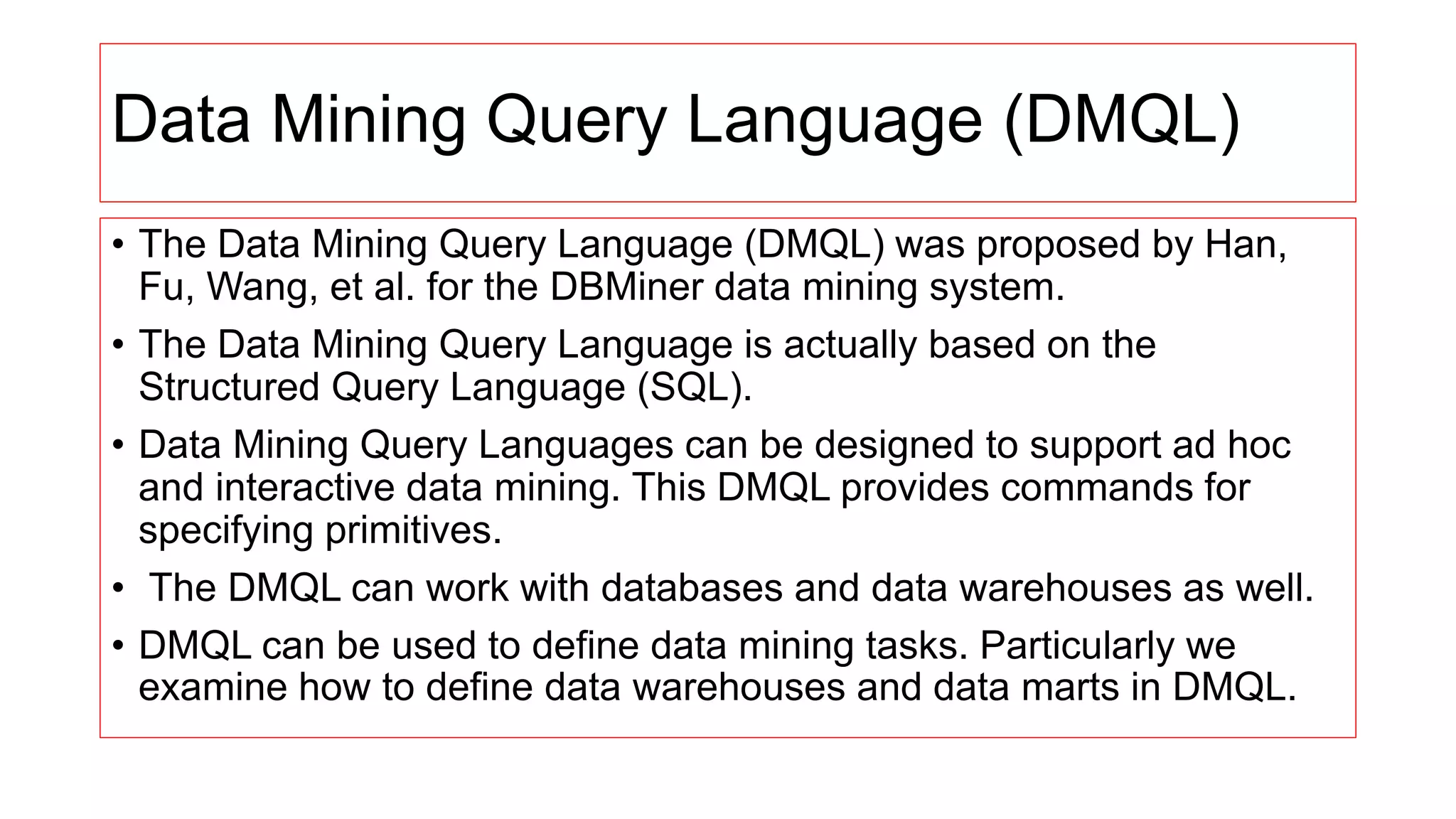
Data Mining Query Language (DMQL)
• The Data Mining Query Language (DMQL) was proposed by Han,
Fu, Wang, et al. for the DBMiner data mining system.
• The Data Mining Query Language is actually based on the
Structured Query Language (SQL).
• Data Mining Query Languages can be designed to support ad hoc
and interactive data mining. This DMQL provides commands for
specifying primitives.
• The DMQL can work with databases and data warehouses as well.
• DMQL can be used to define data mining tasks. Particularly we
examine how to define data warehouses and data marts in DMQL.
Syntax for Task-Relevant Data Specification
use database database_name
or
use data warehouse data_warehouse_name
in relevance to att_or_dim_list
from relation(s)/cube(s) [where condition]
order by order_list
group by grouping_list
Syntax for Specifying the Kind of Knowledge
• Syntax for Characterization, Discrimination, Association, Classification,
and Prediction.
Characterization
The syntax for characterization is −
mine characteristics [as pattern_name]
analyze {measure(s) }
The analyze clause, specifies aggregate measures, such as count, sum, or count%.
For example −
Description describing customer purchasing habits.
mine characteristics as customerPurchasing
analyze count%
Discrimination
mine comparison [as {pattern_name]}
For {target_class } where {t arget_condition }
{versus {contrast_class_i }
where {contrast_condition_i}}
analyze {measure(s) }
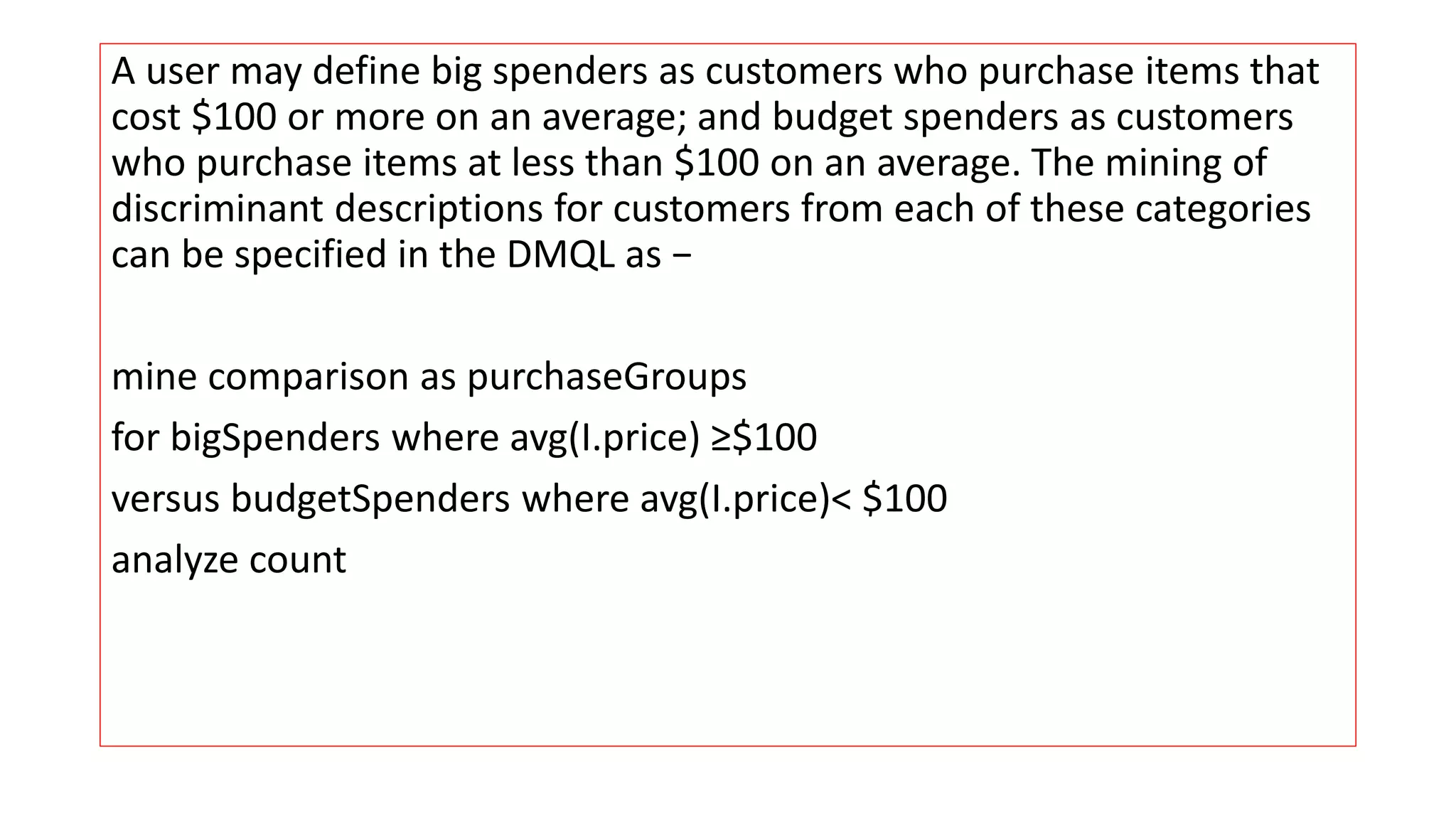
A user may define big spenders as customers who purchase items that
cost $100 or more on an average; and budget spenders as customers
who purchase items at less than $100 on an average. The mining of
discriminant descriptions for customers from each of these categories
can be specified in the DMQL as −
mine comparison as purchaseGroups
for bigSpenders where avg(I.price) ≥$100
versus budgetSpenders where avg(I.price)< $100
analyze count
Association
The syntax for Association is−
mine associations [ as {pattern_name} ]
{matching {metapattern} }
For Example −
mine associations as buyingHabits
matching P(X:customer,W) ^ Q(X,Y) ≥ buys(X,Z)
where X is key of customer relation; P and Q are predicate variables;
and W, Y, and Z are object variables.
Classification
The syntax for Classification is −
mine classification [as pattern_name]
analyze classifying_attribute_or_dimension
For example, to mine patterns, classifying customer credit rating where
the classes are determined by the attribute credit_rating, and mine
classification is determined as classifyCustomerCreditRating.
analyze credit_rating
Prediction
The syntax for prediction is −
mine prediction [as pattern_name]
analyze prediction_attribute_or_dimension
{set {attribute_or_dimension_i= value_i}}
Syntax for Concept Hierarchy Specification
To specify concept hierarchies, use the following syntax −
use hierarchy <hierarchy> for <attribute_or_dimension>
define hierarchy time_hierarchy on date as [date,month quarter,year]
-
set-grouping hierarchies
define hierarchy age_hierarchy for age on customer as
level1: {young, middle_aged, senior} < level0: all
level2: {20, ..., 39} < level1: young
level3: {40, ..., 59} < level1: middle_aged
level4: {60, ..., 89} < level1: senior
-operation-derived hierarchies
define hierarchy age_hierarchy for age on customer as
{age_category(1), ..., age_category(5)}
:= cluster(default, age, 5) < all(age)
-rule-based hierarchies
define hierarchy profit_margin_hierarchy on item as
level_1: low_profit_margin < level_0: all
if (price - cost)< $50
level_1: medium-profit_margin < level_0: all
if ((price - cost) > $50) and ((price - cost) ≤ $250))
level_1: high_profit_margin < level_0: all

DMQL(Data Mining Query Language).pptx

  • 1.
    DMQL(Data Mining Query Language) Dr.G. Jasmine Beulah Assistant Professor, Dept. Computer Science, Kristu Jayanti College,Bengaluru.
  • 2.
    Data Mining QueryLanguage (DMQL) • The Data Mining Query Language (DMQL) was proposed by Han, Fu, Wang, et al. for the DBMiner data mining system. • The Data Mining Query Language is actually based on the Structured Query Language (SQL). • Data Mining Query Languages can be designed to support ad hoc and interactive data mining. This DMQL provides commands for specifying primitives. • The DMQL can work with databases and data warehouses as well. • DMQL can be used to define data mining tasks. Particularly we examine how to define data warehouses and data marts in DMQL.
  • 3.
    Syntax for Task-RelevantData Specification use database database_name or use data warehouse data_warehouse_name in relevance to att_or_dim_list from relation(s)/cube(s) [where condition] order by order_list group by grouping_list
  • 4.
    Syntax for Specifyingthe Kind of Knowledge • Syntax for Characterization, Discrimination, Association, Classification, and Prediction. Characterization The syntax for characterization is − mine characteristics [as pattern_name] analyze {measure(s) } The analyze clause, specifies aggregate measures, such as count, sum, or count%. For example − Description describing customer purchasing habits. mine characteristics as customerPurchasing analyze count%
  • 5.
    Discrimination mine comparison [as{pattern_name]} For {target_class } where {t arget_condition } {versus {contrast_class_i } where {contrast_condition_i}} analyze {measure(s) }
  • 6.
    A user maydefine big spenders as customers who purchase items that cost $100 or more on an average; and budget spenders as customers who purchase items at less than $100 on an average. The mining of discriminant descriptions for customers from each of these categories can be specified in the DMQL as − mine comparison as purchaseGroups for bigSpenders where avg(I.price) ≥$100 versus budgetSpenders where avg(I.price)< $100 analyze count
  • 7.
    Association The syntax forAssociation is− mine associations [ as {pattern_name} ] {matching {metapattern} } For Example − mine associations as buyingHabits matching P(X:customer,W) ^ Q(X,Y) ≥ buys(X,Z) where X is key of customer relation; P and Q are predicate variables; and W, Y, and Z are object variables.
  • 8.
    Classification The syntax forClassification is − mine classification [as pattern_name] analyze classifying_attribute_or_dimension For example, to mine patterns, classifying customer credit rating where the classes are determined by the attribute credit_rating, and mine classification is determined as classifyCustomerCreditRating. analyze credit_rating
  • 9.
    Prediction The syntax forprediction is − mine prediction [as pattern_name] analyze prediction_attribute_or_dimension {set {attribute_or_dimension_i= value_i}}
  • 10.
    Syntax for ConceptHierarchy Specification To specify concept hierarchies, use the following syntax − use hierarchy <hierarchy> for <attribute_or_dimension>
  • 11.
    define hierarchy time_hierarchyon date as [date,month quarter,year] - set-grouping hierarchies define hierarchy age_hierarchy for age on customer as level1: {young, middle_aged, senior} < level0: all level2: {20, ..., 39} < level1: young level3: {40, ..., 59} < level1: middle_aged level4: {60, ..., 89} < level1: senior -operation-derived hierarchies define hierarchy age_hierarchy for age on customer as {age_category(1), ..., age_category(5)} := cluster(default, age, 5) < all(age)
  • 12.
    -rule-based hierarchies define hierarchyprofit_margin_hierarchy on item as level_1: low_profit_margin < level_0: all if (price - cost)< $50 level_1: medium-profit_margin < level_0: all if ((price - cost) > $50) and ((price - cost) ≤ $250)) level_1: high_profit_margin < level_0: all