DMA
Awards
Unplugge
d
Thursday 30 July 2015
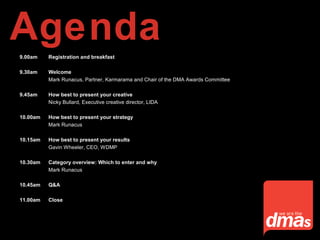
9.00am Registration and breakfast
9.30am Welcome
Mark Runacus, Partner, Karmarama and Chair of the DMA Awards Committee
9.45am How best to present your creative
Nicky Bullard, Executive creative director, LIDA
10.00am How best to present your strategy
Mark Runacus
10.15am How best to present your results
Gavin Wheeler, CEO, WDMP
10.30am Category overview: Which to enter and why
Mark Runacus
10.45am Q&A
11.00am Close
Agenda
Welcome
Mark Runacus
Partner, Karmarama and Chair of the
DMA Awards Committee
@DMA_UK #dmawards
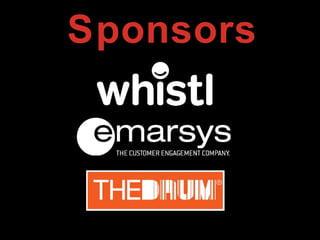
Sponsors
About this workshop
It’s interactive
The basics
11th
September
Early bird – Friday 7th
August
The basics
Sign-off
The basics
Work that ran until 31st
July 2015
The basics
Anonymity
The basics
Samples
About
Why enter?
• Winning a DMA has real value
For the company. For the agency. For an individual career.
• The DMAs are viewed by the marketing community
as one of the most respected awards schemes
• More robust, more business-driven
Thought
leadership• Category winners are well-publicised
• DMA provides winners with assets for promotion
• Winners become case histories in business and education
The marketing equivalent of winning a gold medal
• If you win – shout about it
Insight
• Developing the entry
“Like holding up a mirror to your marketing strategy”
• Identify areas for future improvement
Developing
people
• Developing the entry is a collaborative process
Winning recognises the whole team.
Identify and reward outstanding contributions from individuals
Attracting
talent• Ambitious young marketers use the DMA
Awards as part of their research process
when deciding who they want to work for
• A business that has entered – and won –
DMA awards has engendered a culture of
excellence
Is it worth
it?• Difficult to measure ROI, nevertheless
• Proven direct correlation between brand’s
awards success and business performance
• Effective organisations win DMA awards
DMAs
• Always been associated with
effectiveness
• Judged on strategy, creativity and
results
• Each year over 600 agency and
client awards entries
The best clients, agencies,
and businesses enter the
DMAs to prove they can
make a significant difference
to the bottom line.
Judging
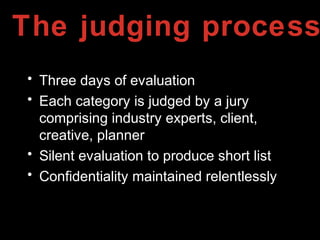
The judging process
• Three days of evaluation
• Each category is judged by a jury
comprising industry experts, client,
creative, planner
• Silent evaluation to produce short list
• Confidentiality maintained relentlessly
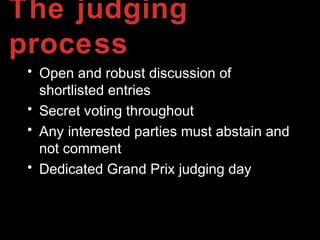
The judging
process
• Open and robust discussion of
shortlisted entries
• Secret voting throughout
• Any interested parties must abstain and
not comment
• Dedicated Grand Prix judging day
Get
involved
Get
involved• Enter some work
• Consider or recommend sponsorship
Tips
• Use the DMA help
– See contact details
• Make your submission interesting and enjoyable
– The judges have a lot to read!
– Tell a story with passion and conviction
Good
luck!
How best to
present your
creative
Nicky Bullard
Executive Creative Director, LIDA
@DMA_UK #dmawards
Creative
THE SWEET
SMELL
OF SUCCESS
CLIENT
EXCITEMENT
DO THE
AWARD FILM
BEFORE THE
AWARD FILM
GIVE IT A
NAME
WHAT’S YOUR
SOUNDBITE
THE
INTERROGATORS
&
THE INSTINCTIVE
YOU CAN
SMELL
IT A MILE OFF
GOOD LUCK
How best to
present your
strategy
Mark Runacus
@DMA_UK #dmawards
Strategy
Ten top tips for a
top notch entry
Objectives, meet
results
11
Assume no
knowledge
22
Avoid jargon
33
Share your
insights (and how
you got them)
44
Justify your
decisions
Customer
Creative
Channel
55
Tell a story
66
Make the whole
story flow
77
Write, re-write and
re-write again
(yep, you need to start now!)
88
Make your
summary sell
99
Misuse of
apostrophes and
other such
misdemeanors
1010
How best to
present your results
Gavin Wheeler
CEO, WDMP
@DMA_UK #dmawards
Results
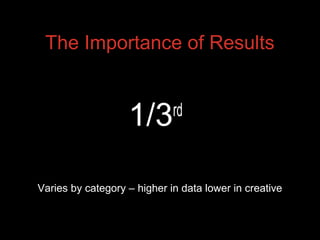
The Importance of Results
1/3rd
Varies by category – higher in data lower in creative
Often Hurried
Difficult to interpret
Different ways to show
results
Scoring
• An entry can be marked
down or ignored if the
results are not
presented correctly OR
not at all
Confidentiality
All judges have signed confidentiality
agreements
Remember YOUR clients
have signed-off the entry
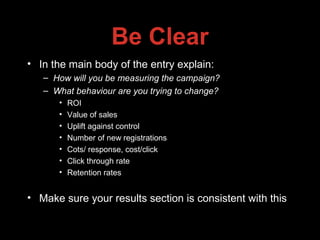
Be Clear
• In the main body of the entry explain:
– How will you be measuring the campaign?
– What behaviour are you trying to change?
• ROI
• Value of sales
• Uplift against control
• Number of new registrations
• Cots/ response, cost/click
• Click through rate
• Retention rates
• Make sure your results section is consistent with this
Don’t make us guess
• What is the definition of
success?
– Target was to reduce CPR
of £1.16, achieved £0.95
• Ideally we need to
benchmark against
previous activity
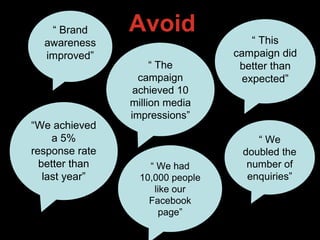
Avoid
“We achieved
a 5%
response rate
better than
last year”
“ This
campaign did
better than
expected”
“ We
doubled the
number of
enquiries”
“ Brand
awareness
improved”
“ The
campaign
achieved 10
million media
impressions”
“ We had
10,000 people
like our
Facebook
page”
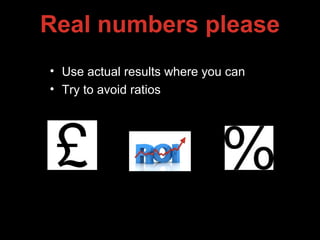
Real numbers please
• Use actual results where you can
• Try to avoid ratios
Categories
overview: Which to
enter and why
Mark Runacus
@DMA_UK #dmawards
Which
category
?
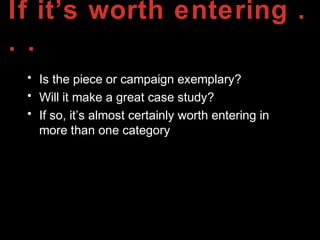
If it’s worth entering .
. .
• Is the piece or campaign exemplary?
• Will it make a great case study?
• If so, it’s almost certainly worth entering in
more than one category
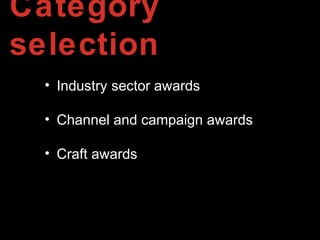
Category
selection
• Industry sector awards
• Channel and campaign awards
• Craft awards
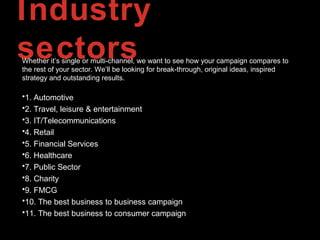
Industry
sectorsWhether it’s single or multi-channel, we want to see how your campaign compares to
the rest of your sector. We’ll be looking for break-through, original ideas, inspired
strategy and outstanding results.
•1. Automotive
•2. Travel, leisure & entertainment
•3. IT/Telecommunications
•4. Retail
•5. Financial Services
•6. Healthcare
•7. Public Sector
•8. Charity
•9. FMCG
•10. The best business to business campaign
•11. The best business to consumer campaign
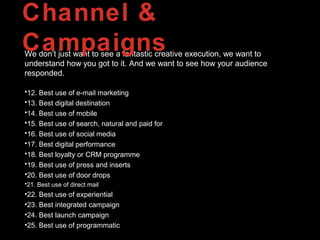
We don’t just want to see a fantastic creative execution, we want to
understand how you got to it. And we want to see how your audience
responded.
•12. Best use of e-mail marketing
•13. Best digital destination
•14. Best use of mobile
•15. Best use of search, natural and paid for
•16. Best use of social media
•17. Best digital performance
•18. Best loyalty or CRM programme
•19. Best use of press and inserts
•20. Best use of door drops
•21. Best use of direct mail
•22. Best use of experiential
•23. Best integrated campaign
•24. Best launch campaign
•25. Best use of programmatic
Channel &
Campaigns
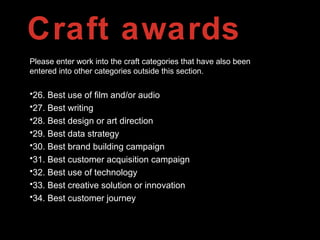
Craft awards
Please enter work into the craft categories that have also been
entered into other categories outside this section.
•26. Best use of film and/or audio
•27. Best writing
•28. Best design or art direction
•29. Best data strategy
•30. Best brand building campaign
•31. Best customer acquisition campaign
•32. Best use of technology
•33. Best creative solution or innovation
•34. Best customer journey
Questions?
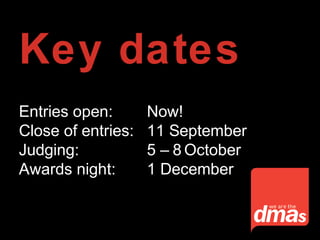
Key dates
Entries open: Now!
Close of entries: 11 September
Judging: 5 – 8 October
Awards night: 1 December
Thank your for attending
Please visit www.dmaawards.org.uk/
for more information
@DMA_UK #dmawards

DMA Awards unplugged - 30 July 2015

Editor's Notes

  • #6 This workshop is designed to be interactive. We don’t intend to stand/sit here and lecture you. Come with your questions prepared. Don’t be afraid to talk about your own entries. The more you ask, the more you’ll get out of it. Who’s started? Who doesn’t know where to start? Who’s entered before? Who’s entering for the first time? Who doesn’t know what to enter? Who’s won a DMA award before? Who’s staying for the surgery later?
  • #7 The closing date is Friday 11th September. If you’re quick, you can enter at a discounted rate – Friday 7th August. Late entries are permitted – at the DMAs discretion, with an additional charge.
  • #8 Get client or other relevant sign-off.
  • #9 To be eligible most of the categories demand that the work ran between 1st August 2014 and 31st July 2015. Some categories – like loyalty – allow work and results across a two-year period.
  • #10 Make sure you don’t do anything on the entry form, web urls or supporting materials including films etc that could identify the entering agency.
  • #11 If you’re submitting physical samples of work, direct mail, press ads etc, make sure you have plenty of copies to support each entry. You should provide three physical copies of each sample, that is because categories are judged simultaneously. Digital copies etc – upload with each entry. Maximum of 50MB.
  • #14 Obviously depends on that businesses’ priorities but entering and winning a DMA will help a brand: Reach senior decision makers with the added halo effect of being a thought leader, as the category winners are broadly publicised by the DMAs effective PR programme. It’s worth mentioning that if you’re lucky enough to win we’ll provide you with the assets you can use to amplify your success in your own relevant PR and sales channels. If you win – you’ve worked hard: shout about it. DMA Award Winners become marketing case histories, quoted by their peers and competitors, and are taught in schools and universities – it’s the marketing equivalent of winning an Olympic gold medal.
  • #15 The rigour of the DMAs entry process is like holding up a mirror to your marketing strategy, your creativity and your campaign’s overall performance. Many award entrants have told me that even though they have campaign dashboards, it was preparing an award entry that gave them an opportunity to objectively review their marketing activity and identify areas for future improvement.
  • #16 Entering an award will help a brand develop its marketing people. Creating an effective award entry should be collaborative process, and successful entries will of course provide recognition for the team. Nevertheless the awards entry process is also an opportunity to identify and then reward outstanding contributions from individuals within an organisation, and from a brand’s marketing partners, like their agencies. All of these boost morale, build strong, effective relationships, and contribute to personal development.
  • #17 Winning an award can also help a brand recruit the best marketing talent. Ambitious marketers use awards as part of their research process when evaluating the best brands to work for. Overall, a business that enters awards has probably engendered a culture of excellence.
  • #18 It’s difficult to measure ROI from entering an award, but there is a direct correlation between a brand’s success in awards, and its business performance. It’s clear that effective organisations win awards, and as part of a virtuous circle, the award entry process can bring numerous benefits to in turn drive the effectiveness of that organisation.
  • #26 We always remind DMA entrants of the basics, check carefully all the dates and entry criteria. We provide entrants with a wealth of assistance, online and offline. We run “How to win” events, when you’ll get to meet and talk to previous winners and quiz the judges on what they’re looking for. We also remind entrants to make the written submission interesting and enjoyable. The judges will be reviewing a lot of entries, so ensure yours tells a fascinating story with passion and conviction.
  • #41 I’m going to give you some pointers on dealing with the strategy element of paper submission, and this is an element that flows all the way through the paper, from summary to creative to results. It’s the statement which all elements will be judged by. And from a narrative point of view, it’s probably the most important part of your entry, Every one of these tips seems obvious in isolation, so apologies if it feels like a primary school lesson but you’d be amazed by how many entries fall foul of getting these basics right, not doing the campaign justice and not catching the judges eyes.
  • #42 The first point deals with one of the biggest mistakes we see, it’s imperative that when setting out the objectives of your work you think about how you’ll be able to prove that you’ve achieved them. It’s the check back that the judges will do when assessing the entry yet all too often it feels like objectives and results are written in isolation. You’re asked in the first section to outline the brief in 50 words or less. If you can, play back the objectives in the results section, showing how you have been successful, but make sure you emphasise the objectives you can most effectively prove success in
  • #43 All you judges are experts but they won’t necessarily know your clients business or sector as well as you do. Make sure that you explain your thinking fully from scratch, taking care not to short cut the thinking by leaving gaps.
  • #44 This extends further, try not to pack your entry full of jargon or buzzwords. They often appear to gloss over the real story and can also be a little cringe worthy. Give yourself the buzzword bingo test when reviewing your draft and remember that plain English is a much easier read
  • #45 Any campaign which is based on insight is going to be more effective. Make sure the judges know the insights that are driving your strategy and where they come from. These will be interrogated so don’t assume that simply adding the phrase ‘consumer research told us’ will be sufficient. Think about the broader consumer, market and business context. Because we do this stuff everyday we often forget how much effort goes into planning and executing a campaign, spell it out.
  • #46 Make sure you able to give to give strong rationale as to why you did the things you did to meet the objectives. Why was it the best way to target your customers, why was the creative strategy or proposition the most compelling and how did you get to the channel mix you proposed.
  • #47 These next two points are closely linked. You need to make the entry as easy to read and understand as possible. And it’s the strategy that holds it all together allowing you to tell a story in the natural structure – start, middle and end
  • #48 But you mustn’t let the structure of the form to break the flow, you need to be able to keep the story flowing between the sections, allowing them to feel like a continuation rather than a gear change. We often see entries where it feels like the sections of the form have been written by different people. Make one person responsible for crafting end to end.

  • #49 8 Don’t under-estimate how much a well written entry makes in the success on awards night. You’ll be lucky to hit that on the first draft or the night before the final submission deadline, review it, share it with people who don’t know the detail and write it again. Yes, it takes a long time, but you have time if you start now.
  • #50 Now we’re almost at the end, which is an important point to make when it comes to writing your summary, too many people write these first, just because that’s where it sits on the entry form. Make sure your summary highlights what I’m going to discover in the full entry, make me intrigued to read the detail and don’t just cut and paste. It’s human nature that judges will find it difficult not to have already made up their minds on whether it’s going to be a good entry after reading the summary. Make sure yours sells the story they’re about to read.
  • #51 So I’ll finish up on what’s potentially the most patronising point of all, but please do take care to proof read the entry well. Of course you’ll not miss out on the Grand prix because of a mix up in you their’s but judges will get tripped up on simple errors, again it’s human nature and if they getting caught up in typo’s they’re not concentrating fully on your brilliant campaign.