













































An insight into marketing automation & other collaborative marketing applications
Navigating B2B Marketing
Thursday 4 February 2016
Wifi: DMA Guest
@DMA_UK @theidm #dma #idm
Welcome
David Reed, Editor & Chief of IDM Journal
@DataGuv
Wifi: DMA Guest
@DMA_UK @theidm #dma #idm
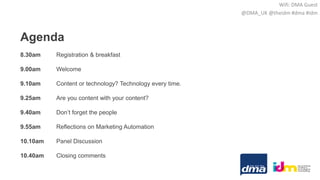
Agenda
8.30am Registration & breakfast
9.00am Welcome
9.10am Content or technology? Technology every time.
9.25am Are you content with your content?
9.40am Don’t forget the people
9.55am Reflections on Marketing Automation
10.10am Panel Discussion
10.40am Closing comments
Wifi: DMA Guest
@DMA_UK @theidm #dma #idm
Content or technology? Technology
every time.
Adam Sharp, Managing Director, CleverTouch Marketing
@CleverTouch @CTMadam
Wifi: DMA Guest
@DMA_UK @theidm #dma #idm
Are you content with your content?
Joe Edwards, Digital & Social Director, Marketing Options
International
@MOIglobal @brandjoe
Wifi: DMA Guest
@DMA_UK @theidm #dma #idm
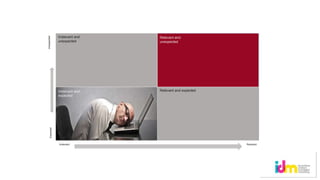
Relevant and
unexpected
Irrelevant and
expected
Irrelevant and
unexpected
Relevant and expected
Irrelevant Relevant
Expected
Unexpected
Don’t forget the people
Claire Wood, Director, Deloitte
@DeloitteUK @ClaireEMWood
Wifi: DMA Guest
@DMA_UK @theidm #dma #idm
Don’t forget the people
Lesson No 1 – Why?
Lesson No 2 – What’s in it for us?
Lesson No 3 – What’s in and what’s out
Lesson No 4 – Be realistic about your timescales
Lesson No 5 – All change
Lesson No 6 – Engagement is key
The four ‘Ps’
Walk a mile in their shoes
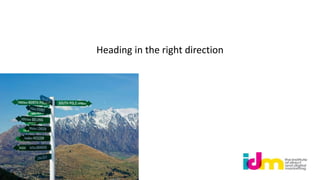
Heading in the right direction
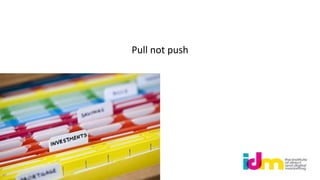
Pull not push
Planning is key
Support your marketers
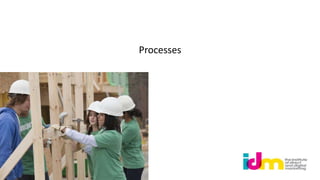
Processes
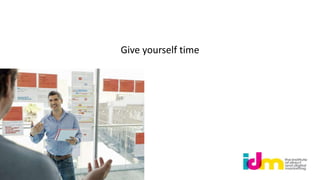
Give yourself time
Planning
Preparation
Preparation
Don’t forget the people
Reflections on Marketing Automation
Shane Redding, Owner, Think Direct
@ShaneRddng
Wifi: DMA Guest
@DMA_UK @theidm #dma #idm
Reflections on Marketing Automation
@ShaneRddng
4
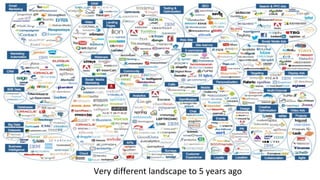
Very different landscape to 5 years ago
Fallen in love with the image?
7
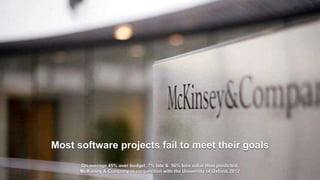
Most software projects fail to meet their goals
On average 45% over budget, 7% late & 56% less value than predicted.
McKinsey & Company in conjunction with the University of Oxford, 2012
Why?
Andrew Buckley
VP MasterCard
Collaboration
11
4 Common Internal factors
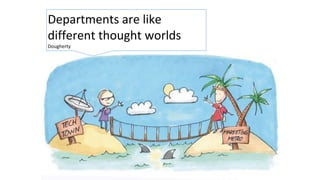
8Departments are like
different thought worlds
Dougherty
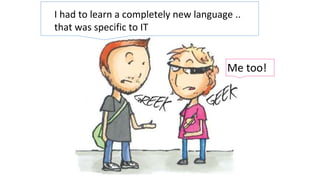
9I had to learn a completely new language ..
that was specific to IT
Me too!
10
Only when you get
to the “big unveil”
.. you realise,
You’ve misunderstood
Post Implementation
Andrea Collins
Head of Marketing,
UKI
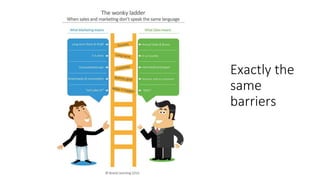
Marketing and Sales
Exactly the
same
barriers
Skill sets
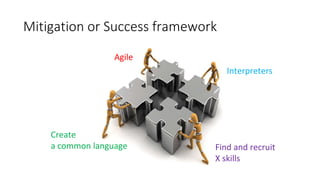
Mitigation or Success framework
Agile
Interpreters
Create
a common language Find and recruit
X skills
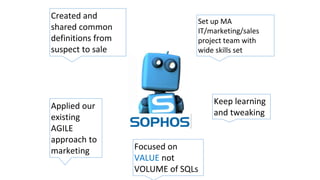
Set up MA
IT/marketing/sales
project team with
wide skills set
Created and
shared common
definitions from
suspect to sale
Focused on
VALUE not
VOLUME of SQLs
Applied our
existing
AGILE
approach to
marketing
Keep learning
and tweaking
Be Honest:
• Culture
• Capacity
• Change
What do you see?
Panel Discussion
Adam Sharp, Managing Director, CleverTouch Marketing
@CleverTouch @CTMadam
Joe Edwards, Digital & Social Director, Marketing Options International
@MOIglobal @brandjoe
Claire Wood, Director, Brand & Marketing, Deloitte
@DeloitteUK @ClaireEMWood
Shane Redding, Owner, Think Direct
@ShaneRddng
Wifi: DMA Guest
@DMA_UK @theidm #dma #idm
Closing Comments
David Reed, Editor & Chief of IDM Journal
@DataGuv
Wifi: DMA Guest
@DMA_UK @theidm #dma #idm

Navigating B2B marketing

Editor's Notes

  • #24 Put brandjoe on here
  • #25 Put brandjoe on here
  • #26 5 years working with the idm when content marketing became a course Only 35% have documented content strategy Only 21% are successfully tracking you ROI
  • #27 Joe Pulizzi 2015 Markters will start to become disillusioned with their content marketing investments. Some will pull the plug. Others will cut back sharply, asking their CMOs tougher questions about the real value of all these Infographics and documentary films and ‘owned media’ plays (the questions they probably should have been asking from the start). In truth, it isn’t the content marketing that’s bad, it’s the lack of strategy, the poor execution or both.
  • #28 We are in a content heavy world 2.5 qunitioon bytes of data a day globally 10million blue rays Which when stacked up would be as tall as 4 effiel towers stacked on top of each other Organic reach is restricticed by native platforms Ad blockers How can you make a huge impact to your business through the content you create.
  • #31  You produce, publish and promote the market share of content for your industry, so your audience really cannot hit a web page or social network without seeing you.   The problem with the this is you’ll need more budget and resource than you can shake a stick at and risk the chance of boring people (a bit like death by PowerPoint but with content), and in all honesty your chances of making a huge impact in the market place are pretty slim especially if you are creating "same as usual" content.
  • #32 Or   You create something so mind bendingly disruptive your audience can’t help but sit up, take note and tell others about it.   The issue with this is you’ll need to start thinking differently and quite possibly it’s going to look exactly the opposite as business as usual. This is about being brave, we all talk about innovation and digital disruption in our respective industries (I’ve even heard it come from the water board). As examples Eloqua were market makers of Automation, Radian6 for social listening. It’s these disruptive solutions that have shaken industries and created new market-places and while we talk about this a lot in the context of the market-place we rarely see it from a marketing and messaging perspective. 
  • #35 12 searchs 2 are brand while the others are genric Zero moment of truth is defining that intention to do something with your brand If you’re not there, you wont be anywhere
  • #36 The first step is not a crazy brain storming session where we dream up “Viral” (hate that word too) video campaigns. Is actually look at what business as usual looks like … what are you and your competition doing, now what might be the complete opposite of that?   Some examples of business as normal maybe: we are optimising for maximum efficiency, we post 3-5 five times a day across our social channels, and our resources are focused on gated content and events to nurture our audience. We create 30 blog posts per month, we target our Key Decision Makers, and we are recycling our content to get the most from it. We are educating our client base so they see the value in us.
  • #37 To address some of these business as usual statements: Rather than optimise for incremental improvement, A/B at extremes and see what works best. Rather than post 3-5 times a day make your twitter handle private and just post once a week, make it so engaging and exclusive that people are hanging on for your very next tweet. Set your content free, let people have it, they will contact you when they are ready. Forget blogs, why not use your budget on vlogs, video is becoming more important after all. The Key decision maker does not exist, at best they rubber stamp the contract and are heavily influenced by their peers, so target the peers. Never recycle a piece of content again, everything you produce should be original or it’s not worth talking about. Entertain rather than educate your audience so they build positive points of reference about your brand. Or you could just do what everyone else is doing…..
  • #47 Thank you for the introduction and for asking me to speak. It’s been some time since we started our marketing automation journey however the impact of implementing marketing automation on people – our marketers, our stakeholders in the business and our clients – only becomes more important as time goes on, not less.
  • #48 First for a quick recap… so first lesson learnt Be very clear why you are implementing a marketing automation system. For me those are: To enable your clients to pull content from you To enable them to get your content in the format that works for them To enable them to get it when they want it
  • #49 Lesson No 2 MA isn’t for everyone. So why are you doing it? New lead generation? Deeper client relationships? For me the reasons are clear: Efficiency and timeliness of response Creating that personalised experience The ability to tailor the user journey based on client behaviour and demand
  • #50 Lesson No 3 If any of you have worked on technology implementation projects before you will know that often the biggest challenge is curtailing scope creep. Be very clear what is in scope for your marketing automation project and what is not. Make your IT function your new best friend. Presenting a united front to your organisation will be vital to the success of the project.
  • #51 Lesson No 4 – be realistic about your timescales This is not a quick fix. You need to understand the technology challenges that need to be overcome. You need to think through the impact that implementing marketing automation will have on your organisation And you need to prepare for the change in behaviour and processes that it will bring about
  • #52 Lesson No 5 – this isn’t just about adding a new technology tool. Automating a bad process doesn’t magically make your marketing better. As I alluded to in the previous slide; do not under-estimate the change that marketing automation will bring to the way you plan a campaign; the timing of a campaign and the user journey scenarios and supporting materials that will be required.
  • #53 Lesson No 6 – keep engaging with your stakeholders. They need to be aligned to your vision. They need to understand that marketing automation is a shift in thinking, not just a change in technology and that their behaviour may have to change too. Most of all you need in your corner supporting you with the rest of the business and working with you to make sure marketing automation works for your clients or customers
  • #54 So now I would just like to take the next few slides to build on my original lessons learnt and go into some of them in a little more detail… They are People Processes Preparation Planning
  • #55 At the heart of your reasons for implementing marketing automation must be the end user experience. There will be an impact on your clients or customers and you need to plan and prepare for that. It’s taken us several months just to agree on the number of emails any one client can receive in a day because the question of volume is that important to us and to them.
  • #56 One of our biggest challenges believe it or not has been nomenclature in the preference centre. Trying to agree the taxonomy for that has been challenging for an organisation that tends to like everything to be structured in the way we are internally which of course makes life easy for us but is meaningless to the outside world.
  • #57 People are creatures of habit and in our case, as partners, they all technically ‘own the business’ so helping them to understand why we are now going in a different direction is vital. Helping our internal stakeholders to get to grips with a fundamental change from automatic ‘declined’ to automatic ‘approved’ in our CRM system has been interesting to say the least.
  • #58 Try telling a partner that because marketing automation gives the clients greater control that may mean they opt out of receiving some things from us and that is a good thing. Do not underestimate the amount of help some of your stakeholders will need to think this through from the customer perspective. This is no longer just about what we want to push; it is about what the client wants receive.
  • #59 This is the one I really under-estimated – the impact this will have on our marketers. I sat in a training session shortly before Christmas and had one of those real light-bulb moments when I realised the impact that this will have on our marketing teams. Our entire approach to annual and campaign planning needs to change
  • #60 Engagement is of course the key. We started running training workshops before Christmas and our system isn’t due to go live until the Spring. But we need people to be behaving differently now as they develop their first campaigns to use marketing automation.
  • #61 So our processes need to change to work with marketing automation not against it. Things like… Who is going to sign off on the campaigns? Who determines what, if any support can be provided from our central MA team? What planning process will we need? How do we control volume of activity? (A big challenge for us!)
  • #62 Through our pilot campaigns we have an insight into the increased length of time and effort it takes to properly plan for all the different user journeys and touchpoints that marketing automation will enable for your clients or customers. So, for the first time ever, our annual planning process will ask our people to plan for time spent on a project as well as money.
  • #63 That will be a major challenge for our people and we are not going to get it right first time. But we need to try. However we are hoping that it will have the knock on effect of helping us to control volume of activities. We go to market in support of 37 different dimensions of our business on a daily basis so as you can imagine volume control is tricky!
  • #64 The big light bulb moment for me was understanding the upfront preparation that each campaign will take. The need to have all the materials prepared to support all the potential user journeys and possible touchpoints upfront just frankly had not crossed my mind. It will force us to think differently and it may well require greater input from our stakeholders to get the messaging and content prepared.
  • #65 And of course it will also take more time. So our marketers will need to give themselves far greater lead time than they are historically used to doing in order to be properly prepared. So in conclusion…
  • #66 Marketing automation done well will feel like a personalised experience for your clients or customers but don’t under-estimate the planning and preparation it will take to get you there. In my original journal article I concluded with the somewhat ironic thought that the more hi-tech our world gets, the more our clients value a personal touch. And so ultimately I believe that marketing automation should enable, rather than replace, human interaction.
  • #72 11 in depth company interviews Part of Doctoral research at Manchester Business School Technology enabled innovation
  • #75 MA selection and implementation requires different teams to work together. Many company structures don’t facilitate this with different KPIS, budget structures and siloed departments
  • #76 Language – communication a real and most common problem. Lesson last week of 8 hour meeting
  • #77 Different interpretation of the same “facts”
  • #78 different SKILL sets