Name: Rahul Sharma
Class: 10th
B
Roll No. 25
Disaster (As per DM Act, 2005)
Disaster means a catastrophe, mishap, calamity or
grave occurrence affecting any area from natural
and manmade causes, or by accident or
negligence, which results in substantial loss of
life or human suffering or damage to, and
destruction of property, or damage to, or
degradation of environment and is of such a
nature and magnitude as to be beyond the
capacity of the community of the affected areas.
2
Disaster events (1900-2009)
Disaster
Types
Decades
1900
-09
1910
-19
1920
-29
1930
-39
1940
-49
1950
-59
1960
-69
1970
-79
1980
-89
1990
-99
2000
-09
Total
Hydro
meteorologi
cal
28 72 56 72 120 232 463 776 1498 2034 3529 8880
78.4%
Geological 40 28 33 37 52 60 88 124 232 325 354 1373
12.1%
Biological 5 7 10 3 4 2 37 64 170 361 612 1275
11.3%
Total 73 107 99 112 176 294 388 964 1900 2720 4495 11328
Hazard Vulnerability in India
59%
8%
12%68%
3%
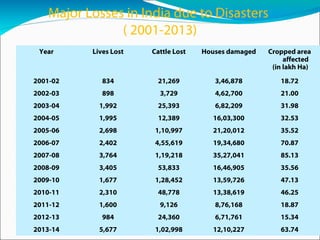
Major Losses in India due to Disasters
( 2001-2013)
Year Lives Lost Cattle Lost Houses damaged Cropped area
affected
(in lakh Ha)
2001-02 834 21,269 3,46,878 18.72
2002-03 898 3,729 4,62,700 21.00
2003-04 1,992 25,393 6,82,209 31.98
2004-05 1,995 12,389 16,03,300 32.53
2005-06 2,698 1,10,997 21,20,012 35.52
2006-07 2,402 4,55,619 19,34,680 70.87
2007-08 3,764 1,19,218 35,27,041 85.13
2008-09 3,405 53,833 16,46,905 35.56
2009-10 1,677 1,28,452 13,59,726 47.13
2010-11 2,310 48,778 13,38,619 46.25
2011-12 1,600 9,126 8,76,168 18.87
2012-13 984 24,360 6,71,761 15.34
2013-14 5,677 1,02,998 12,10,227 63.74
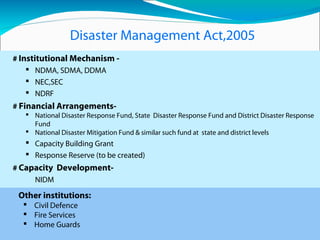
Disaster Management Act,2005
# Institutional Mechanism -
 NDMA, SDMA, DDMA
 NEC,SEC
 NDRF
# Financial Arrangements-
 National Disaster Response Fund, State Disaster Response Fund and District Disaster Response
Fund
 National Disaster Mitigation Fund & similar such fund at state and district levels
 Capacity Building Grant
 Response Reserve (to be created)
# Capacity Development-
NIDM
Other institutions:
 Civil Defence
 Fire Services
 Home Guards
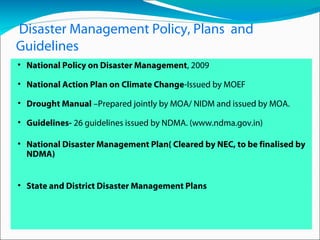
Disaster Management Policy, Plans and
Guidelines
• National Policy on Disaster Management, 2009
• National Action Plan on Climate Change-Issued by MOEF
• Drought Manual –Prepared jointly by MOA/ NIDM and issued by MOA.
• Guidelines- 26 guidelines issued by NDMA. (www.ndma.gov.in)
• National Disaster Management Plan( Cleared by NEC, to be finalised by
NDMA)
• State and District Disaster Management Plans
Guidelines on Preparedness and Response (Checklist for
preparedness )
Vulnerability assessment
Dissemination of warning
Emergency Response
activities
Coordination
Rapid Damage Assessment
Maintenance of essential
services
Stocking of essential
commodities
Medicines
Drinking water
Shelter/Camps
Community participation
Evacuation Plan
Activating EOCs
Search & Rescue Teams
Communication
Identification of Nodal
Officer
Status of SDRF
Preparedness Drill
Mitigation and Prevention
Mainstreaming DRR in development strategy- Planning
Commission
•Constitution of a Working Group for inclusion of DRR measures in the 12th
Five
Year Plan
•Flexi Funds:- The Ministry of Finance has given detailed guidelines by their
circular dated 6th
January 2014 on earmarking 10% of funds of centrally
sponsored releases as ‘Flexi Fund’, part of which can be utilised for disaster
mitigation or for restorations works activities according to the State specific need.
Such mainstreaming plan provision would address the issue appropriately to
supplement the efforts of the affected State at some degree.
Self Certification/ DM Audit mechanism in all Centrally
sponsored schemes- Ministry of Finance
 All the major public infrastructure projects are to be subjected to
disaster impact analysis and adopt hazard resistant construction
technology to ensure structural safety against natural hazards.
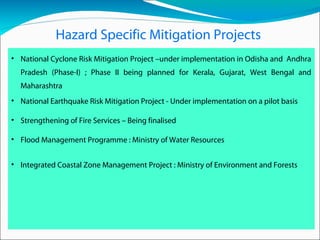
Hazard Specific Mitigation Projects
• National Cyclone Risk Mitigation Project –under implementation in Odisha and Andhra
Pradesh (Phase-I) ; Phase II being planned for Kerala, Gujarat, West Bengal and
Maharashtra
• National Earthquake Risk Mitigation Project - Under implementation on a pilot basis
• Strengthening of Fire Services – Being finalised
• Flood Management Programme : Ministry of Water Resources
• Integrated Coastal Zone Management Project : Ministry of Environment and Forests
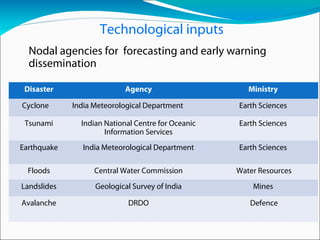
Technological inputs
Nodal agencies for forecasting and early warning
dissemination
Disaster Agency Ministry
Cyclone India Meteorological Department Earth Sciences
Tsunami Indian National Centre for Oceanic
Information Services
Earth Sciences
Earthquake India Meteorological Department Earth Sciences
Floods Central Water Commission Water Resources
Landslides Geological Survey of India Mines
Avalanche DRDO Defence
Preparedness and Response
• IDRN
• Advance procurement of material and equipment
• Early warning of different disasters
• Identification of potential hazard
• Dissemination of early warning
• Evacuation
• Emergency Communication Plan - to provide last mile connectivity
• NEOC/ SEOCs/DEOCs for effective coordination during disaster response
• Nodal Ministries/Departments for forecasting of various Disasters
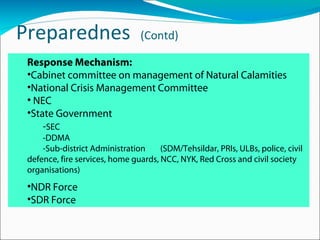
Preparednes (Contd)
Response Mechanism:
•Cabinet committee on management of Natural Calamities
•National Crisis Management Committee
• NEC
•State Government
-SEC
-DDMA
-Sub-district Administration (SDM/Tehsildar, PRIs, ULBs, police, civil
defence, fire services, home guards, NCC, NYK, Red Cross and civil society
organisations)
•NDR Force
•SDR Force
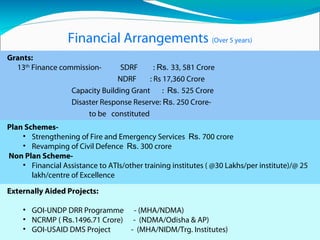
Financial Arrangements (Over 5 years)
Grants:
13th
Finance commission- SDRF : Rs. 33, 581 Crore
NDRF : Rs 17,360 Crore
Capacity Building Grant : Rs. 525 Crore
Disaster Response Reserve: Rs. 250 Crore-
to be constituted
Revamping of Fire Services (` 87519 crore to ULBs),apportion of
which available for Fire Services.
Plan Schemes-
• Strengthening of Fire and Emergency Services Rs. 700 crore
• Revamping of Civil Defence Rs. 300 crore
Non Plan Scheme-
• Financial Assistance to ATIs/other training institutes ( @30 Lakhs/per institute)/@ 25
lakh/centre of Excellence
Externally Aided Projects:
• GOI-UNDP DRR Programme - (MHA/NDMA)
• NCRMP ( Rs.1496.71 Crore) - (NDMA/Odisha & AP)
• GOI-USAID DMS Project - (MHA/NIDM/Trg. Institutes)
Capacity Development
• Institutional arrangements for capacity development at
National and state level. (NIDM, Disaster Management
Centers in the states, NCDC, NFSC, NDRF).
• Efforts are made to mainstream Capacity Development
strategies in most of the ministries and Government
department at National, State and District Level
• National Disaster Management Programme
• Capacity Building Grant under 13th
Finance Commission
Key issues
Priority during 'non-disaster' phase
Clearance of old liabilities
Inventory management
Maintenance of equipment
Inter-institutional coordination
Operationalisation of EOCs
Community involvement
Role of PRIs and ULBs
Dealing with media
Issues to be addressed
Institutional Strengthening
• Strengthening of SDMA and DDMAs
• Strengthening capacities of Panchayat and local bodies
• Strengthening of Centre for Disaster Management
• 24 X 7 functional Emergency Operation Centers (EOC) to be functional.
State Disaster Response Force (SDRF)
• Earmarking Battalion/Team or raising new force for the purpose.
• Training of the SDRF in coordination with NDRF
• Use of Capacity Building Grant for Training of SDRF as per the Guidelines
• Associating Civil Defence, Fire Services, Home Guards
Issues to be addressed regarding
NDR Fund
• State Memorandum to be submitted when the SDRF is inadequate
to meet the immediate relief
• Recourse to NDRF only in case of disaster of severe nature
• Memorandum to be submitted in consolidated format with
supporting documents /evidences
• Memorandum to be submitted only for relief and immediate
restoration. Long term or medium term recovery measures to be
financed through other Plan schemes of the States
• CAG observations to be noted for future
• For accessing grant under the Capacity Building Grant awarded by
13th
Finance Commission, annual work-plan and utilisation to be
finalized by the states by 15th
June
Challenges in Disaster Response
•Early Warning Systems of IMD has predicted the
strength, movement of the cyclone ‘Phailin’ along with
possible location of landfall with precision almost 3 days in
advance. This has helped the authorities to take
preemptive measures to reduce casualties.
•Telecommunication infrastructure can be damaged
during any disaster. Back-up arrangements need to be in
place, like Satellite phones for communication during
disaster phase. Telecommunication companies may also
arrange adequate number of mobile BTS towers for
immediately restoring the telecommunication facilities in
the aftermath of disaster.
Challenges in Disaster Response--contd
•In ecologically vulnerable tourist areas, there can be a system to
register/ regulate the tourists, so that people can be effectively traced
in disasters
• Organised and trained State Disaster Response Force has helped in
tackling any disasters
• Equipping fire service as multi-disaster responders
•The Central/State Governments due to limited resources are not able
to fully compensate the losses suffered by the affected people.
Therefore, there is need to explore risk transfer arrangements like
insurance.
Thank You

Rahul Sharma

  • 1.
    Name: Rahul Sharma Class:10th B Roll No. 25
  • 2.
    Disaster (As perDM Act, 2005) Disaster means a catastrophe, mishap, calamity or grave occurrence affecting any area from natural and manmade causes, or by accident or negligence, which results in substantial loss of life or human suffering or damage to, and destruction of property, or damage to, or degradation of environment and is of such a nature and magnitude as to be beyond the capacity of the community of the affected areas. 2
  • 3.
    Disaster events (1900-2009) Disaster Types Decades 1900 -09 1910 -19 1920 -29 1930 -39 1940 -49 1950 -59 1960 -69 1970 -79 1980 -89 1990 -99 2000 -09 Total Hydro meteorologi cal 2872 56 72 120 232 463 776 1498 2034 3529 8880 78.4% Geological 40 28 33 37 52 60 88 124 232 325 354 1373 12.1% Biological 5 7 10 3 4 2 37 64 170 361 612 1275 11.3% Total 73 107 99 112 176 294 388 964 1900 2720 4495 11328
  • 4.
    Hazard Vulnerability inIndia 59% 8% 12%68% 3%
  • 5.
    Major Losses inIndia due to Disasters ( 2001-2013) Year Lives Lost Cattle Lost Houses damaged Cropped area affected (in lakh Ha) 2001-02 834 21,269 3,46,878 18.72 2002-03 898 3,729 4,62,700 21.00 2003-04 1,992 25,393 6,82,209 31.98 2004-05 1,995 12,389 16,03,300 32.53 2005-06 2,698 1,10,997 21,20,012 35.52 2006-07 2,402 4,55,619 19,34,680 70.87 2007-08 3,764 1,19,218 35,27,041 85.13 2008-09 3,405 53,833 16,46,905 35.56 2009-10 1,677 1,28,452 13,59,726 47.13 2010-11 2,310 48,778 13,38,619 46.25 2011-12 1,600 9,126 8,76,168 18.87 2012-13 984 24,360 6,71,761 15.34 2013-14 5,677 1,02,998 12,10,227 63.74
  • 6.
    Disaster Management Act,2005 #Institutional Mechanism -  NDMA, SDMA, DDMA  NEC,SEC  NDRF # Financial Arrangements-  National Disaster Response Fund, State Disaster Response Fund and District Disaster Response Fund  National Disaster Mitigation Fund & similar such fund at state and district levels  Capacity Building Grant  Response Reserve (to be created) # Capacity Development- NIDM Other institutions:  Civil Defence  Fire Services  Home Guards
  • 7.
    Disaster Management Policy,Plans and Guidelines • National Policy on Disaster Management, 2009 • National Action Plan on Climate Change-Issued by MOEF • Drought Manual –Prepared jointly by MOA/ NIDM and issued by MOA. • Guidelines- 26 guidelines issued by NDMA. (www.ndma.gov.in) • National Disaster Management Plan( Cleared by NEC, to be finalised by NDMA) • State and District Disaster Management Plans
  • 8.
    Guidelines on Preparednessand Response (Checklist for preparedness ) Vulnerability assessment Dissemination of warning Emergency Response activities Coordination Rapid Damage Assessment Maintenance of essential services Stocking of essential commodities Medicines Drinking water Shelter/Camps Community participation Evacuation Plan Activating EOCs Search & Rescue Teams Communication Identification of Nodal Officer Status of SDRF Preparedness Drill
  • 9.
    Mitigation and Prevention MainstreamingDRR in development strategy- Planning Commission •Constitution of a Working Group for inclusion of DRR measures in the 12th Five Year Plan •Flexi Funds:- The Ministry of Finance has given detailed guidelines by their circular dated 6th January 2014 on earmarking 10% of funds of centrally sponsored releases as ‘Flexi Fund’, part of which can be utilised for disaster mitigation or for restorations works activities according to the State specific need. Such mainstreaming plan provision would address the issue appropriately to supplement the efforts of the affected State at some degree. Self Certification/ DM Audit mechanism in all Centrally sponsored schemes- Ministry of Finance  All the major public infrastructure projects are to be subjected to disaster impact analysis and adopt hazard resistant construction technology to ensure structural safety against natural hazards.
  • 10.
    Hazard Specific MitigationProjects • National Cyclone Risk Mitigation Project –under implementation in Odisha and Andhra Pradesh (Phase-I) ; Phase II being planned for Kerala, Gujarat, West Bengal and Maharashtra • National Earthquake Risk Mitigation Project - Under implementation on a pilot basis • Strengthening of Fire Services – Being finalised • Flood Management Programme : Ministry of Water Resources • Integrated Coastal Zone Management Project : Ministry of Environment and Forests
  • 11.
    Technological inputs Nodal agenciesfor forecasting and early warning dissemination Disaster Agency Ministry Cyclone India Meteorological Department Earth Sciences Tsunami Indian National Centre for Oceanic Information Services Earth Sciences Earthquake India Meteorological Department Earth Sciences Floods Central Water Commission Water Resources Landslides Geological Survey of India Mines Avalanche DRDO Defence
  • 12.
    Preparedness and Response •IDRN • Advance procurement of material and equipment • Early warning of different disasters • Identification of potential hazard • Dissemination of early warning • Evacuation • Emergency Communication Plan - to provide last mile connectivity • NEOC/ SEOCs/DEOCs for effective coordination during disaster response • Nodal Ministries/Departments for forecasting of various Disasters
  • 13.
    Preparednes (Contd) Response Mechanism: •Cabinetcommittee on management of Natural Calamities •National Crisis Management Committee • NEC •State Government -SEC -DDMA -Sub-district Administration (SDM/Tehsildar, PRIs, ULBs, police, civil defence, fire services, home guards, NCC, NYK, Red Cross and civil society organisations) •NDR Force •SDR Force
  • 14.
    Financial Arrangements (Over5 years) Grants: 13th Finance commission- SDRF : Rs. 33, 581 Crore NDRF : Rs 17,360 Crore Capacity Building Grant : Rs. 525 Crore Disaster Response Reserve: Rs. 250 Crore- to be constituted Revamping of Fire Services (` 87519 crore to ULBs),apportion of which available for Fire Services. Plan Schemes- • Strengthening of Fire and Emergency Services Rs. 700 crore • Revamping of Civil Defence Rs. 300 crore Non Plan Scheme- • Financial Assistance to ATIs/other training institutes ( @30 Lakhs/per institute)/@ 25 lakh/centre of Excellence Externally Aided Projects: • GOI-UNDP DRR Programme - (MHA/NDMA) • NCRMP ( Rs.1496.71 Crore) - (NDMA/Odisha & AP) • GOI-USAID DMS Project - (MHA/NIDM/Trg. Institutes)
  • 15.
    Capacity Development • Institutionalarrangements for capacity development at National and state level. (NIDM, Disaster Management Centers in the states, NCDC, NFSC, NDRF). • Efforts are made to mainstream Capacity Development strategies in most of the ministries and Government department at National, State and District Level • National Disaster Management Programme • Capacity Building Grant under 13th Finance Commission
  • 16.
    Key issues Priority during'non-disaster' phase Clearance of old liabilities Inventory management Maintenance of equipment Inter-institutional coordination Operationalisation of EOCs Community involvement Role of PRIs and ULBs Dealing with media
  • 17.
    Issues to beaddressed Institutional Strengthening • Strengthening of SDMA and DDMAs • Strengthening capacities of Panchayat and local bodies • Strengthening of Centre for Disaster Management • 24 X 7 functional Emergency Operation Centers (EOC) to be functional. State Disaster Response Force (SDRF) • Earmarking Battalion/Team or raising new force for the purpose. • Training of the SDRF in coordination with NDRF • Use of Capacity Building Grant for Training of SDRF as per the Guidelines • Associating Civil Defence, Fire Services, Home Guards
  • 18.
    Issues to beaddressed regarding NDR Fund • State Memorandum to be submitted when the SDRF is inadequate to meet the immediate relief • Recourse to NDRF only in case of disaster of severe nature • Memorandum to be submitted in consolidated format with supporting documents /evidences • Memorandum to be submitted only for relief and immediate restoration. Long term or medium term recovery measures to be financed through other Plan schemes of the States • CAG observations to be noted for future • For accessing grant under the Capacity Building Grant awarded by 13th Finance Commission, annual work-plan and utilisation to be finalized by the states by 15th June
  • 19.
    Challenges in DisasterResponse •Early Warning Systems of IMD has predicted the strength, movement of the cyclone ‘Phailin’ along with possible location of landfall with precision almost 3 days in advance. This has helped the authorities to take preemptive measures to reduce casualties. •Telecommunication infrastructure can be damaged during any disaster. Back-up arrangements need to be in place, like Satellite phones for communication during disaster phase. Telecommunication companies may also arrange adequate number of mobile BTS towers for immediately restoring the telecommunication facilities in the aftermath of disaster.
  • 20.
    Challenges in DisasterResponse--contd •In ecologically vulnerable tourist areas, there can be a system to register/ regulate the tourists, so that people can be effectively traced in disasters • Organised and trained State Disaster Response Force has helped in tackling any disasters • Equipping fire service as multi-disaster responders •The Central/State Governments due to limited resources are not able to fully compensate the losses suffered by the affected people. Therefore, there is need to explore risk transfer arrangements like insurance.
  • 21.