DAILY LESSON LOG
School BARRETTO NATIONAL HIGH SCHOOL Grade Level 8
Teacher AMOR B. SALINAS Learning Area MATHEMATICS
Teaching Date and Time November 4-8,2019 Quarter THIRD
November 4, 2019 November 5,2019 November 6, 2019 November 7, 2019
November
8,2019
I. OBJECTIVES
A. Content Standard The learner demonstrates understanding of key concepts of logic and reasoning.
B. Performance
Standard
The learner is able to communicate mathematical thinking with coherence and clarity in formulating and analyzing arguments.
C. Learning
Competency/Objectives
Write the LC code for each
38. The learner uses
inductive or deductive
reasoning in an argument.
(M8GE-IIh-1)
The learner uses inductive or
deductive reasoning in an
argument.
(M8GE-IIh-1)
38. The learner uses inductive
or deductive reasoning in an
argument.
(M8GE-IIh-1)
Distribution of Cards
(Second Grading Perood
8am)
Cooperative Learning PM
Cooperative
Learning
II. CONTENT
INDUCTIVE REASONING
MAKING CONJECTURES:
INDUCTIVE REASONING
DEDUCTIVE REASONING
II. LEARNING RESOURCES
A. References
1. Teachers Guide page 133 – 137 133 – 137 133 – 137
2. Learners Material page 256 – 259 256 – 259 256 – 259
3. Textbook page Geometry II, pages 97 – 101 Geometry II, pages 97 – 101 Geometry II, pages 97 – 101
4. Additional Materials from
learning resource
B. Other Learning Resources
II. LEARNING
PROCEDURES
A. Reviewing previous lesson
/senting the new lesson.
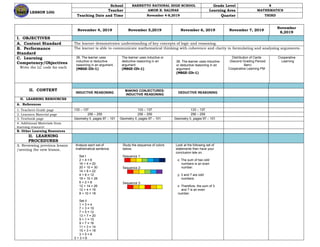
Analyze each set of
mathematical sentence.
Set I
2 + 4 = 6
16 + 4 = 20
20 + 10 = 30
14 + 8 = 22
4 + 8 = 12
18 + 10 = 28
6 + 2 = 8
12 + 14 = 26
12 + 4 = 16
8 + 10 = 18
Set II
1 + 3 = 4
7 + 3 = 10
7 + 5 = 12
13 + 7 = 20
9 + 1 = 10
9 + 7 = 16
11 + 3 = 14
15 + 3 = 18
3 + 5 = 8
3 + 3 = 6
Study the sequence of colors
below:
Sequence 1:
Sequence 2:
Sequence 3:
Look at the following set of
statements then have your
conclusion late on.
x: The sum of two odd
numbers is an even
number.
y: 3 and 7 are odd
numbers.
z: Therefore, the sum of 3
and 7 is an even
number.
B. Establishing a purpose for
the lesson
 What can you conclude
on the first set? Why?
What can you conclude on
the second? Why?
 Where might you have seen
this sequence?
How could this sequence be
part of a pattern?
 Is the sum of 3 and 7 really
an even number?
 Would it be possible for
some other odd numbers,
when added, will sum up an
even number?
Will it be the same for two even
numbers that when added will
also sum up to an even number?
C. Presenting examples /
instances of the new lesson.
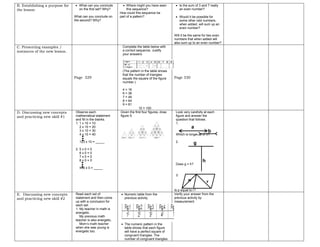
Page 329
Complete the table below with
a correct sequence. Justify
your answers.
(The pattern in the table shows
that the number of triangles
equals the square of the figure
number.)
4 = 16
6 = 36
7 = 49
8 = 64
9 = 81
10 = 100
Page 330
D. Discussing new concepts
and practicing new skill #1
Observe each
mathematical statement
and fill in the blanks.
1. 1 x 10 = 10
2 x 10 = 20
3 x 10 = 30
4 x 10 = 40
123 x 10 = _____
2. 5 x 0 = 0
6 x 0 = 0
7 x 0 = 0
8 x 0 = 0
456 x 0 = _____
Given the first four figures, draw
figure 5.
?
____
Look very carefully at each
figure and answer the
question that follows.
1.
Which is longer, a or b?
2.
Does g = h?
3.
Is p equal to r?
E. Discussing new concepts
and practicing new skill #2
Read each set of
statement and then come
up with a conclusion for
each set.
1. My teacher in math is
energetic.
My previous math
teacher is also energetic.
Mom’s math teacher
when she was young is
energetic too.
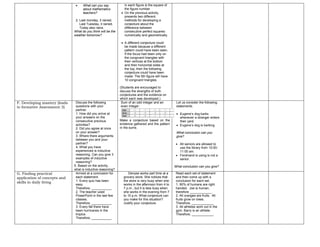
 Numeric table from the
previous activity.
 The numeric pattern in the
table shows that each figure
will have a perfect square of
congruent triangles. The
number of congruent triangles
Verify your answer from the
previous activity by
measurement.
a
b
h
g
p r
 What can you say
about mathematics
teachers?
2. Last monday, it rained.
Last Tuesday, it rained.
Today also rains.
What do you think will be the
weather tomorrow?
in each figure is the square of
the figure number.
 On the previous activity,
presents two different
methods for developing a
conjecture about the
difference between
consecutive perfect squares:
numerically and geometrically.
 A different conjecture could
be made because a different
pattern could have been seen.
If the focus had been only on
the congruent triangles with
their vertices at the bottom
and their horizontal sides at
the top, then the following
conjecture could have been
made: The 5th figure will have
10 congruent triangles.
(Students are encouraged to
discuss the strengths of both
conjectures and the evidence on
which each was developed.)
F. Developing mastery (leads
to formative Assessment 3)
Discuss the following
questions with your
partner.
1. How did you arrive at
your answers on the
consecutive previous
activities?
2. Did you agree at once
on your answer?
3. Where there arguments
between you and your
partner?
4. What you have
experienced is inductive
reasoning. Can you give 3
examples of inductive
reasoning?
5. Based on the activity,
what is inductive reasoning?
Sum of an odd integer and an
even integer:
Make a conjecture based on the
evidence gathered and the pattern
in the sums.
Let us consider the following
statements.
 Eugene’s dog barks
whenever a stranger enters
their yard.
 Eugene’s dog is barking.
What conclusion can you
give?
 All seniors are allowed to
use the library from 10:00-
11:00 am.
 Ferdinand is using is not a
senior.
What conclusion can you give?
G. Finding practical
application of concepts and
skills in daily living
Arrived at a conclusion for
each statement.
1. Every quiz has been
easy.
Therefore, ___________.
2. The teacher used
PowerPoint in the last few
classes.
Therefore, ___________.
3. Every fall there have
been hurricanes in the
tropics.
Therefore, ___________.
Denyse works part time at a
grocery store. She notices that
the store is very busy when she
works in the afternoon from 4 to
7 p.m., but it is less busy when
she works in the evening from 7
to 10 p.m. What conjecture can
you make for this situation?
Justify your conjecture.
Read each set of statement
and then come up with a
conclusion for each set.
1. 90% of humans are right
handed. Joe is human,
therefore ____________.
2. All oranges are fruits. All
fruits grow on trees.
Therefore, ____________.
3. All athletes work out in the
gym. Barry is an athlete.
Therefore, ____________.
H. Making generalization and
abstractions about the lesson.
Generalization:
Inductive reasoning uses
specific examples to arrive
at a general rule,
generalizations, or
conclusions
Generalization:
To make conjectures that are
valid, based on a pattern of
evidence, you need to have a
variety of sample cases to view.
Since any pattern requires multiple
cases to support it, more than one
or two specific cases are needed
to begin to formulate a conjecture.
The more cases that fit the
conjecture, the stronger the
validity of the conjecture becomes.
Generalization:
Deductive reasoning uses basic
and/or general statements to
arrive at a conclusion.
I. Evaluating Learning
Tell whether each
statement uses inductive
reasoning or not.
1. 5, 10, 15, 20. The next
number is 25.
2. Coplanar points are
points on the same plane.
X,Y,Z are coplanar.
Therefore, they are on the
same plane.
3. A regular polygon is
equilateral. Quadrilateral
BELEN is a regular
pentagon. Therefore it is
equilateral.
4. A child’s teacher in
preschool was a female.
In his grades 1 and 2, his
teachers were both
female. The child may say
that his grade 3 teacher
will also be female.
5. Filipinos are peace-loving
people. Julia is a Filipino.
Therefore, Julia is peace-
loving.
 Hilary was examining the
differences between perfect
squares of numbers separated
by 5. She made the following
conjecture: The differences
always have the digit 5 in the
ones place.
For example:
172
– 122
289 – 144 = 145
a) Gather evidence to
support Hilary’s
conjecture.
b) Is her conjecture
reasonable? Explain.
Tell whether each statement
uses Deductive reasoning or
not.
1. 5, 10, 15, 20. The next
number is 25.
2. Coplanar points are points
on the same plane. X,Y,Z are
coplanar. Therefore, they are
on the same plane.
3. A regular polygon is
equilateral. Quadrilateral
BELEN is a regular pentagon.
Therefore it is equilateral.
4. A child’s teacher in
preschool was a female. In his
grades 1 and 2, his teachers
were both female. The child
may say that his grade 3
teacher will also be female.
5. Filipinos are peace-loving
people. Julia is a Filipino.
Therefore, Julia is peace-loving.
J. Additional activities for
application or remediation.
VI. REMARKS
VII. REFLECTION
A. No. of learners who earned
80% in the evaluation
B. No. of learners who requires
additional activities for
remediation who scored below
80% in the evaluation
C. Did the remedial lessons
work? No. of learners who have
caught up with the lesson.
D. No. of learners who continue
to require remediation.
E. Which of my teaching
strategies worked well? Why did
this work?
F. What difficulties did I
encounter which my principal or
supervisor can help me solve?
G. What innovation or localized
materials did I use / discover
which I wish to share with other.
Prepared:
AMOR SALINAS
Math Teacher
Checked:
EDNA O. ORINE
Head Teacher III
Noted:
SOLEDAD E. POZON, Ed.D.
Principal IV

DLL-M8- November 4-8,2019.docx

  • 1.
    DAILY LESSON LOG SchoolBARRETTO NATIONAL HIGH SCHOOL Grade Level 8 Teacher AMOR B. SALINAS Learning Area MATHEMATICS Teaching Date and Time November 4-8,2019 Quarter THIRD November 4, 2019 November 5,2019 November 6, 2019 November 7, 2019 November 8,2019 I. OBJECTIVES A. Content Standard The learner demonstrates understanding of key concepts of logic and reasoning. B. Performance Standard The learner is able to communicate mathematical thinking with coherence and clarity in formulating and analyzing arguments. C. Learning Competency/Objectives Write the LC code for each 38. The learner uses inductive or deductive reasoning in an argument. (M8GE-IIh-1) The learner uses inductive or deductive reasoning in an argument. (M8GE-IIh-1) 38. The learner uses inductive or deductive reasoning in an argument. (M8GE-IIh-1) Distribution of Cards (Second Grading Perood 8am) Cooperative Learning PM Cooperative Learning II. CONTENT INDUCTIVE REASONING MAKING CONJECTURES: INDUCTIVE REASONING DEDUCTIVE REASONING II. LEARNING RESOURCES A. References 1. Teachers Guide page 133 – 137 133 – 137 133 – 137 2. Learners Material page 256 – 259 256 – 259 256 – 259 3. Textbook page Geometry II, pages 97 – 101 Geometry II, pages 97 – 101 Geometry II, pages 97 – 101 4. Additional Materials from learning resource B. Other Learning Resources II. LEARNING PROCEDURES A. Reviewing previous lesson /senting the new lesson. Analyze each set of mathematical sentence. Set I 2 + 4 = 6 16 + 4 = 20 20 + 10 = 30 14 + 8 = 22 4 + 8 = 12 18 + 10 = 28 6 + 2 = 8 12 + 14 = 26 12 + 4 = 16 8 + 10 = 18 Set II 1 + 3 = 4 7 + 3 = 10 7 + 5 = 12 13 + 7 = 20 9 + 1 = 10 9 + 7 = 16 11 + 3 = 14 15 + 3 = 18 3 + 5 = 8 3 + 3 = 6 Study the sequence of colors below: Sequence 1: Sequence 2: Sequence 3: Look at the following set of statements then have your conclusion late on. x: The sum of two odd numbers is an even number. y: 3 and 7 are odd numbers. z: Therefore, the sum of 3 and 7 is an even number.
  • 2.
    B. Establishing apurpose for the lesson  What can you conclude on the first set? Why? What can you conclude on the second? Why?  Where might you have seen this sequence? How could this sequence be part of a pattern?  Is the sum of 3 and 7 really an even number?  Would it be possible for some other odd numbers, when added, will sum up an even number? Will it be the same for two even numbers that when added will also sum up to an even number? C. Presenting examples / instances of the new lesson. Page 329 Complete the table below with a correct sequence. Justify your answers. (The pattern in the table shows that the number of triangles equals the square of the figure number.) 4 = 16 6 = 36 7 = 49 8 = 64 9 = 81 10 = 100 Page 330 D. Discussing new concepts and practicing new skill #1 Observe each mathematical statement and fill in the blanks. 1. 1 x 10 = 10 2 x 10 = 20 3 x 10 = 30 4 x 10 = 40 123 x 10 = _____ 2. 5 x 0 = 0 6 x 0 = 0 7 x 0 = 0 8 x 0 = 0 456 x 0 = _____ Given the first four figures, draw figure 5. ? ____ Look very carefully at each figure and answer the question that follows. 1. Which is longer, a or b? 2. Does g = h? 3. Is p equal to r? E. Discussing new concepts and practicing new skill #2 Read each set of statement and then come up with a conclusion for each set. 1. My teacher in math is energetic. My previous math teacher is also energetic. Mom’s math teacher when she was young is energetic too.  Numeric table from the previous activity.  The numeric pattern in the table shows that each figure will have a perfect square of congruent triangles. The number of congruent triangles Verify your answer from the previous activity by measurement. a b h g p r
  • 3.
     What canyou say about mathematics teachers? 2. Last monday, it rained. Last Tuesday, it rained. Today also rains. What do you think will be the weather tomorrow? in each figure is the square of the figure number.  On the previous activity, presents two different methods for developing a conjecture about the difference between consecutive perfect squares: numerically and geometrically.  A different conjecture could be made because a different pattern could have been seen. If the focus had been only on the congruent triangles with their vertices at the bottom and their horizontal sides at the top, then the following conjecture could have been made: The 5th figure will have 10 congruent triangles. (Students are encouraged to discuss the strengths of both conjectures and the evidence on which each was developed.) F. Developing mastery (leads to formative Assessment 3) Discuss the following questions with your partner. 1. How did you arrive at your answers on the consecutive previous activities? 2. Did you agree at once on your answer? 3. Where there arguments between you and your partner? 4. What you have experienced is inductive reasoning. Can you give 3 examples of inductive reasoning? 5. Based on the activity, what is inductive reasoning? Sum of an odd integer and an even integer: Make a conjecture based on the evidence gathered and the pattern in the sums. Let us consider the following statements.  Eugene’s dog barks whenever a stranger enters their yard.  Eugene’s dog is barking. What conclusion can you give?  All seniors are allowed to use the library from 10:00- 11:00 am.  Ferdinand is using is not a senior. What conclusion can you give? G. Finding practical application of concepts and skills in daily living Arrived at a conclusion for each statement. 1. Every quiz has been easy. Therefore, ___________. 2. The teacher used PowerPoint in the last few classes. Therefore, ___________. 3. Every fall there have been hurricanes in the tropics. Therefore, ___________. Denyse works part time at a grocery store. She notices that the store is very busy when she works in the afternoon from 4 to 7 p.m., but it is less busy when she works in the evening from 7 to 10 p.m. What conjecture can you make for this situation? Justify your conjecture. Read each set of statement and then come up with a conclusion for each set. 1. 90% of humans are right handed. Joe is human, therefore ____________. 2. All oranges are fruits. All fruits grow on trees. Therefore, ____________. 3. All athletes work out in the gym. Barry is an athlete. Therefore, ____________.
  • 4.
    H. Making generalizationand abstractions about the lesson. Generalization: Inductive reasoning uses specific examples to arrive at a general rule, generalizations, or conclusions Generalization: To make conjectures that are valid, based on a pattern of evidence, you need to have a variety of sample cases to view. Since any pattern requires multiple cases to support it, more than one or two specific cases are needed to begin to formulate a conjecture. The more cases that fit the conjecture, the stronger the validity of the conjecture becomes. Generalization: Deductive reasoning uses basic and/or general statements to arrive at a conclusion. I. Evaluating Learning Tell whether each statement uses inductive reasoning or not. 1. 5, 10, 15, 20. The next number is 25. 2. Coplanar points are points on the same plane. X,Y,Z are coplanar. Therefore, they are on the same plane. 3. A regular polygon is equilateral. Quadrilateral BELEN is a regular pentagon. Therefore it is equilateral. 4. A child’s teacher in preschool was a female. In his grades 1 and 2, his teachers were both female. The child may say that his grade 3 teacher will also be female. 5. Filipinos are peace-loving people. Julia is a Filipino. Therefore, Julia is peace- loving.  Hilary was examining the differences between perfect squares of numbers separated by 5. She made the following conjecture: The differences always have the digit 5 in the ones place. For example: 172 – 122 289 – 144 = 145 a) Gather evidence to support Hilary’s conjecture. b) Is her conjecture reasonable? Explain. Tell whether each statement uses Deductive reasoning or not. 1. 5, 10, 15, 20. The next number is 25. 2. Coplanar points are points on the same plane. X,Y,Z are coplanar. Therefore, they are on the same plane. 3. A regular polygon is equilateral. Quadrilateral BELEN is a regular pentagon. Therefore it is equilateral. 4. A child’s teacher in preschool was a female. In his grades 1 and 2, his teachers were both female. The child may say that his grade 3 teacher will also be female. 5. Filipinos are peace-loving people. Julia is a Filipino. Therefore, Julia is peace-loving. J. Additional activities for application or remediation. VI. REMARKS VII. REFLECTION A. No. of learners who earned 80% in the evaluation B. No. of learners who requires additional activities for remediation who scored below 80% in the evaluation C. Did the remedial lessons work? No. of learners who have caught up with the lesson. D. No. of learners who continue to require remediation. E. Which of my teaching strategies worked well? Why did this work?
  • 5.
    F. What difficultiesdid I encounter which my principal or supervisor can help me solve? G. What innovation or localized materials did I use / discover which I wish to share with other. Prepared: AMOR SALINAS Math Teacher Checked: EDNA O. ORINE Head Teacher III Noted: SOLEDAD E. POZON, Ed.D. Principal IV