GRADES 1 to 12
DAILY LESSON LOG
School: CANITOAN ELEMENTARY SCHOOL Grade Level: V – BELL, NEWTON, EINSTEIN, GALILEI
Teacher: Learning Area: MATHEMATICS
Teaching Dates and
Time:
SEPTEMBER 4 - 8, 2023 (WEEK 2)
Quarter: 1ST QUARTER
MONDAY TUESDAY WEDNESDAY THURSDAY FRIDAY
I. OBJECTIVES
A. Content Standards
1. understanding of whole numbers up to 10 000 000.
2. demonstrates understanding of divisibility, order of operations, factors and multiples, and the four fundamental operations involving fractions
B. Performance Standards
1. is able to recognize and represent whole numbers up to 10 000 000 in various forms and contexts.
2. is able to apply divisibility, order of operations, factors and multiples, and the four fundamental operations involving fractions in mathematical problems and real-life
situations.
C. Learning
Competencies/Objectives
Write the LC code for each
Uses divisibility rules for 2, 5 and
10to find common factors
Code: M5NS-Ib 58.1/Page 53 of
109
Uses divisibility rules for 2, 5 and
10to find common factors
Code: M5NS-Ib 58.1/Page 53 of 109
Uses divisibility rules for 3,
6 and 9 to find common
factors
M5NS-Ib-58.2/ Page 53 of
109
Uses divisibility rules for 4, 8, 12
and 11 to find common factors
Code: M5NS-Ib 58.3/ Page 53 of
109
Weekly Test
II. CONTENT Using Divisibility rules for 2, 5 and
10 to find common factors
Using Divisibility rules for 2, 5 and 10
to find common factors
Using Divisibility rules for 3,
6 and 9 to find common
factors
Using Divisibility rules for 4, 8, 12
and 11 to find common factors
III. LEARNING RESOURCES
A. References Curriculum Guide in Math 5
1. Teacher’s Guide pages TG/Week 2 TG/Week 2 TG/Week 2
2.Learner’s Material pages LM/Week 2/DLP Gr. 4 Module 4,
Gr. 5
Module 1, 12
Lesson Guide in Elem.
Math Gr. 5 p.48
LM/Week 2/DLP Gr. 4 Module 4,
Gr. 5
Module 1, 12
Lesson Guide in Elem.
Math Gr. 5 p.48
LM/Week 2/DLP Gr. 5
Module 1, 12
Lesson Guide in Elem.
Math Gr. 5 p.51, 57
LM/Week 2 /DLP Gr. 5 Module 1,
12
3.Textbook pages Growing Up with Math 5 p. 97 Growing Up with Math 5 p. 97 Growing Up with Math 5 p.
97
Growing Up with Math 5 p. 97
B. Other Learning Resources flash cards, pocket chart,
problem written on the chart.
flash cards, pocket chart, problem
written on the chart.
flash cards, pocket chart,
problem written on the
chart.
flash cards, pocket chart, problem
written on the chart.
IV. PROCEDURES
A. Reviewing previous lesson
or presenting the new
lesson
1.Drill
Mental Drills on Easy Division (3-
digit dividends by 1-digit divisor)
using flash cards
a.248÷ 4 = n
b.126 ÷ 3 = n
c.522 ÷ 6 = n
d.255 ÷ 5 = n
2.Review
On multiples of a number
Give the first three multiples of:
1.4 2.3 3.5 4.6 5.8
1.Drill
Division
a.426 ÷ 6 = n
b.164 ÷ 2 = n
c.357 ÷ 7 = n
d.555 ÷ 5 = n
2.Review
Conduct a review on the
divisibility rules of 2, 5 and
10.
Teacher produces
small cards with check
marks. Have students place
the check cards under the
correct column by which
the numbers are visible.
2 5 10
4000
4124
875
726
1.Drill
Division
a.488 ÷ 8 = n
b.168 ÷ 4 = n
c.132 ÷ 12 = n
d.143 ÷ 11 = n
2.Review
Conduct a review on the divisibility
rules of 3, 6 and 9.
Teacher produces small cards with
check marks. Have students place
the check cards under the correct
column by which the numbers are
visible
3 6 9
4110
423
846
630
B. Establishing a purpose for the
lesson
3.Motivation
Playing “the boat is sinking”
The students will group
themselves according to the
number called out by the teacher.
Students who failed to group
themselves according to that
number sit down and are out of the
game.
While the game is in
progress, teacher writes data on
the board.
3.Motivation
Who among you are
members of the student
council? As a member what
do you usually do to help
your co- students in school?
3.Motivation
Who among you are actively
participating in the outreach
programs of your school? Are you
happy with your participation?
Original File Submitted and
Formatted by DepEd Club Member -
visit depedclub.com for more
C. Presenting examples/instances
of the new lesson
1.Presentation
Present the problem to the class.
Ask: How many monay breads were
in the bakery?
What does the problem askedyou to
find
How will you find the answer to the
problem?
1.Presentation
Present each problem to
the class.
a. Ask the students: If
you were one of those who
have to set up the hall,
what would you do? Would
you got ahead and try to
make rows of 3, 6 or 9? Is
there an easier way?
b. Tell the students
that using the divisibility
rules will help in identifying
if a number is divisible by
another number without
actual division.
c. Elicit examples of
numbers that are divisible
by 3,6 or 9.Have the
students look at the sum of
the digits of each of the
numbers. Elicit patterns and
observations.
1.Presentation
Present the problem to the class.
Ask: How many pupils
joined the campaign?
What does the problem
askedyou to find?
How will you find the
answer to the problem
D. Discussing new concepts and
practicing new skills #1
2.Performing the Activities
Ask the pupils to work in pairs in
solving the problem.
Solution 1A : Dividing 230 by 2
230 ÷ 2 = 165,arranging
the breads by 2’s is possible
Solution 1B : Using the divisibility
rule for 2
All even nos. are divisible by 2
2.Performing the Activities
Group the pupils into four
working teams and have
them perform the task.
2. Performing the Activities
Ask the pupils to work in pairs in
solving the problem.
Solution 1 : Dividing 1000 by 8
1000 ÷ 8 = 125, each student is a
member of the group
Solution 2 : Using the divisibility
rule for 8
A number ending in three zeros is
divisible by 8
During the Oplan Kalinisan, 1000
pupils joined the cleanliness
campaign. Teacher Edna thought of
dividing them into 8 members each.
Was she able to divide them with
every student as a member of a
group ?
On a certain bakery, there were
230 monay breads to be placed
on trays. The baker wants to
arrange them in either 2, 5 or 10
rows. Would it be possible for
him to arrange the breads?
The school janitors are setting
up the hall for the students’
council meeting. There are a
total of 297 monoblock chairs
which they have to set up in
either rows of 3,6 or 9. Which
are possible set ups?
230 is an even no., therefore it is
divisible by 2, arrangement of
bread by 2’s is possible
Solution 2A: Dividing 230 by 5
230 ÷ 5 = 46, arranging by
5’s is possible
Solution 2B: Using the divisibility
rule for 5
Numbers ending in 0 and 5 are
divisible by 5
230 ends in 0, therefore it is
divisible by 5, arrangement of
bread by 5’s is possible.
Solution 3A: Dividing 230 by 10
230 ÷ 10 = 23, arranging
breads by 10’s is possible
Solution 3B: Using divisibility rule
for 10
Numbers ending in 0 are divisible
by 10
230 ends in 0, therefore it is
divisible by 10, arrangement of
breads by 10’s is possible
Group Activity: Using the divisibility
rules for 2, 5 and 10
1000 ends in three zeros, therefore
it is divisible by 8,each student is a
member of the group
Group Activity: Using the divisibility
rules for 4, 8, 12 or 11
E. Discussing new concepts and
practicing new skills #2 Processing the Activities
•How did you find the activity?
•How did we know if a number is
divisible by another number?
Processing the Activities
•We used the divisibility
rule to know if the number
is divisible by 3 ,6 or 9
3.Processing the Activities
•How did you find the activity?
•How did we know if a number is
divisible by another number?
•How did we know if 4 8 12 and 11
are factors of a number?
•How did we know if 2 , 5 and 10
are factors of a number?
•The number is divisible by
3,6 or 9 if they have these
numbers as their factors
F. Developing mastery
(Leads to Formative
Assessment 3)
. Reinforcing the Concept and Skill
Discuss the presentation. On page
___ of LM Math Grade V,
Have the pupils solve the following
exercises.
Put a check under the correct
column applying the rules for
divisibility.
2 5 10
6345
8000
4970
2560
4.Reinforcing the Concept
and Skill
Discuss the presentation.
On page ___ of LM Math
Grade V,
Have the pupils solve the
following exercises.
Put a check under the
correct column applying the
rules for divisibility
3 6
9
315
120
8640
4176
4.Reinforcing the Concept and Skill
Discuss the presentation. On page
___ of LM Math Grade V,
Have the pupils solve the following
exercises.
Put a check under the correct
column applying the rules for
divisibility.
4 8 12
56784
5000
4376
1224
G. Finding practical applications
of concepts and skills in daily
living
. Applying to New and Other
Situations
Have the pupils do the exercises
under Apply your Skills on page LM
Math Grade V. Encourage some
pupils to show and discuss the
answers.
Applying to New and Other
Situations
Have the pupils do the
exercises under Apply your
Skills on page LM Math
Grade V. Encourage some
pupils to show and discuss
the answers.
Applying to New and Other
Situations
Have the pupils do the exercises
under Apply your Skills on page LM
Math Grade V. Encourage some
pupils to show and discuss the
answers.
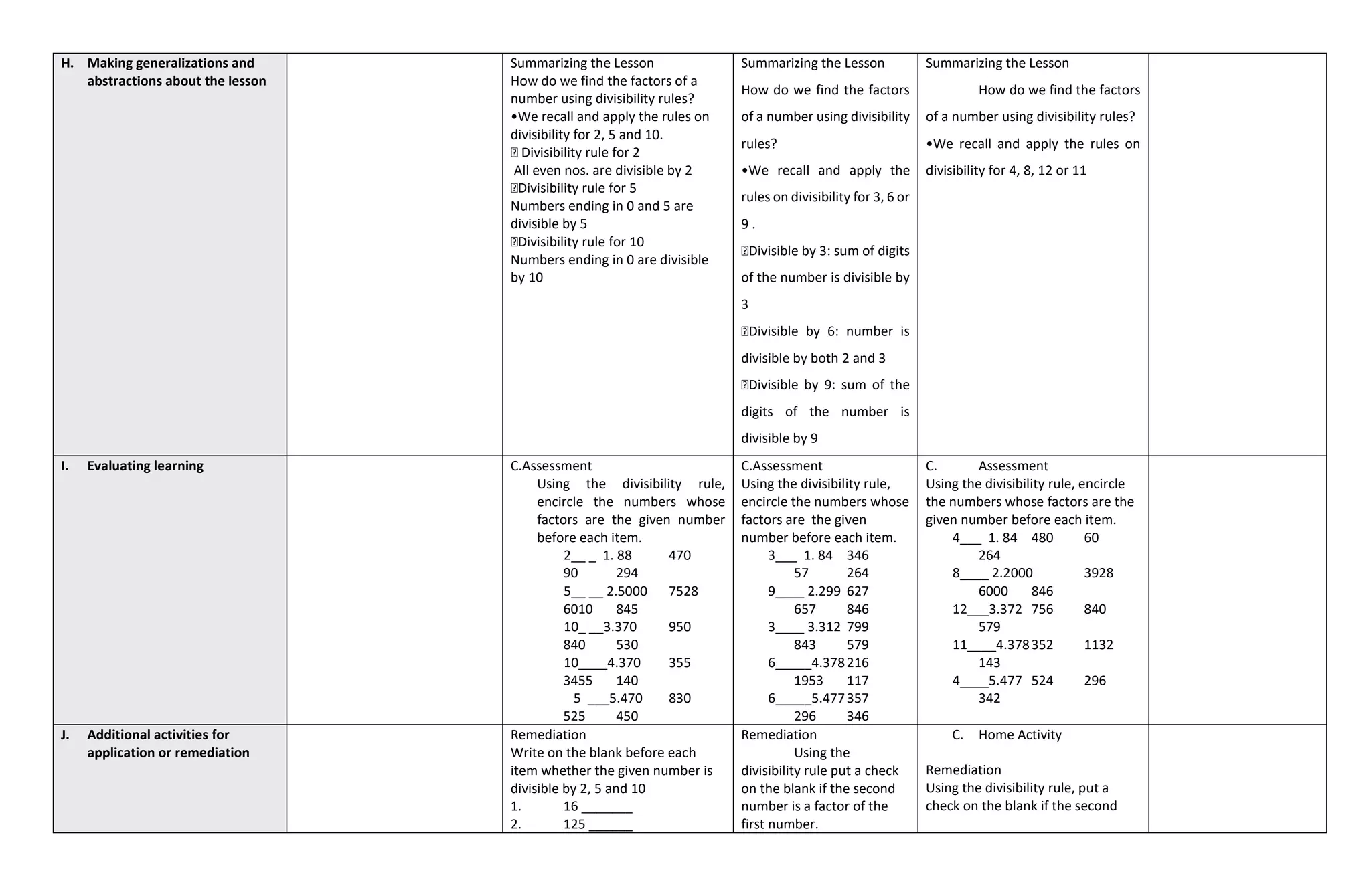
H. Making generalizations and
abstractions about the lesson
Summarizing the Lesson
How do we find the factors of a
number using divisibility rules?
•We recall and apply the rules on
divisibility for 2, 5 and 10.
Divisibility rule for 2
All even nos. are divisible by 2
Divisibility rule for 5
Numbers ending in 0 and 5 are
divisible by 5
Divisibility rule for 10
Numbers ending in 0 are divisible
by 10
Summarizing the Lesson
How do we find the factors
of a number using divisibility
rules?
•We recall and apply the
rules on divisibility for 3, 6 or
9 .
Divisible by 3: sum of digits
of the number is divisible by
3
Divisible by 6: number is
divisible by both 2 and 3
Divisible by 9: sum of the
digits of the number is
divisible by 9
Summarizing the Lesson
How do we find the factors
of a number using divisibility rules?
•We recall and apply the rules on
divisibility for 4, 8, 12 or 11
I. Evaluating learning C.Assessment
Using the divisibility rule,
encircle the numbers whose
factors are the given number
before each item.
2__ _ 1. 88 470
90 294
5__ __ 2.5000 7528
6010 845
10_ __3.370 950
840 530
10____4.370 355
3455 140
5 ___5.470 830
525 450
C.Assessment
Using the divisibility rule,
encircle the numbers whose
factors are the given
number before each item.
3___ 1. 84 346
57 264
9____ 2.299 627
657 846
3____ 3.312 799
843 579
6_____4.378216
1953 117
6_____5.477357
296 346
C. Assessment
Using the divisibility rule, encircle
the numbers whose factors are the
given number before each item.
4___ 1. 84 480 60
264
8____ 2.2000 3928
6000 846
12___3.372 756 840
579
11____4.378352 1132
143
4____5.477 524 296
342
J. Additional activities for
application or remediation
Remediation
Write on the blank before each
item whether the given number is
divisible by 2, 5 and 10
1. 16 _______
2. 125 ______
Remediation
Using the
divisibility rule put a check
on the blank if the second
number is a factor of the
first number.
C. Home Activity
Remediation
Using the divisibility rule, put a
check on the blank if the second
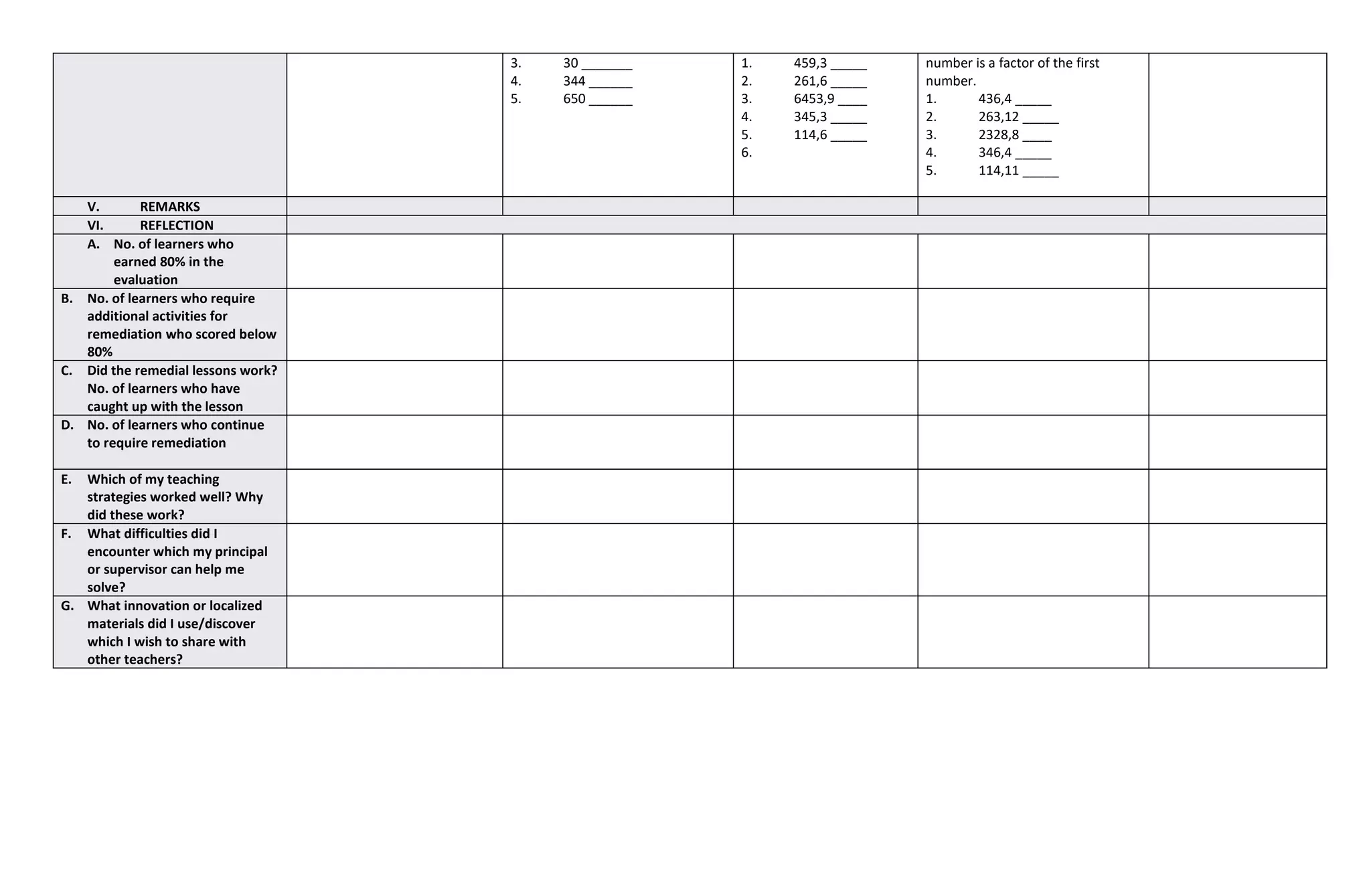
3. 30 _______
4. 344 ______
5. 650 ______
1. 459,3 _____
2. 261,6 _____
3. 6453,9 ____
4. 345,3 _____
5. 114,6 _____
6.
number is a factor of the first
number.
1. 436,4 _____
2. 263,12 _____
3. 2328,8 ____
4. 346,4 _____
5. 114,11 _____
V. REMARKS
VI. REFLECTION
A. No. of learners who
earned 80% in the
evaluation
B. No. of learners who require
additional activities for
remediation who scored below
80%
C. Did the remedial lessons work?
No. of learners who have
caught up with the lesson
D. No. of learners who continue
to require remediation
E. Which of my teaching
strategies worked well? Why
did these work?
F. What difficulties did I
encounter which my principal
or supervisor can help me
solve?
G. What innovation or localized
materials did I use/discover
which I wish to share with
other teachers?

DLL_MATHEMATICS 5_Q1_W2.pdf

  • 1.
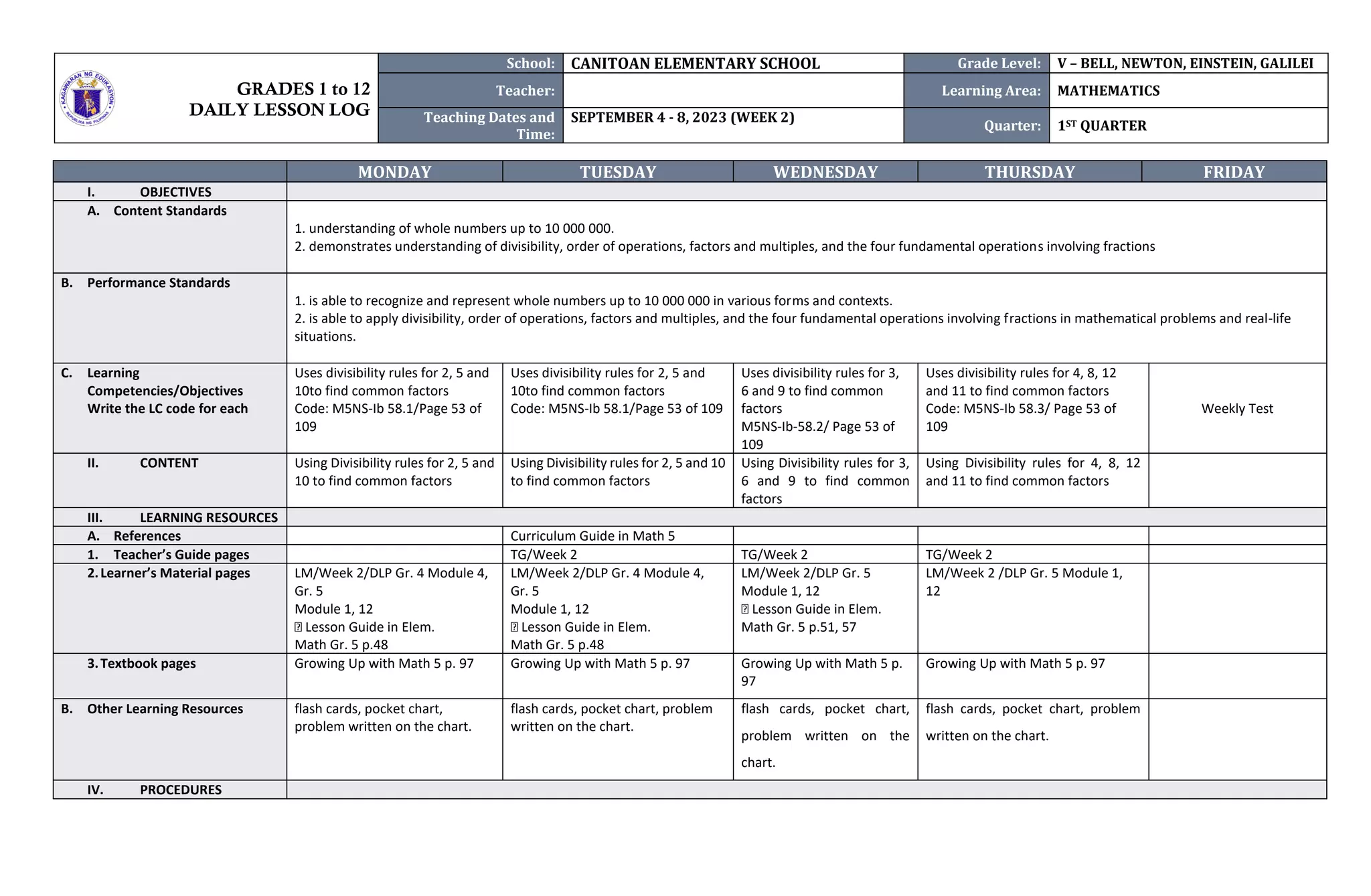
    GRADES 1 to12 DAILY LESSON LOG School: CANITOAN ELEMENTARY SCHOOL Grade Level: V – BELL, NEWTON, EINSTEIN, GALILEI Teacher: Learning Area: MATHEMATICS Teaching Dates and Time: SEPTEMBER 4 - 8, 2023 (WEEK 2) Quarter: 1ST QUARTER MONDAY TUESDAY WEDNESDAY THURSDAY FRIDAY I. OBJECTIVES A. Content Standards 1. understanding of whole numbers up to 10 000 000. 2. demonstrates understanding of divisibility, order of operations, factors and multiples, and the four fundamental operations involving fractions B. Performance Standards 1. is able to recognize and represent whole numbers up to 10 000 000 in various forms and contexts. 2. is able to apply divisibility, order of operations, factors and multiples, and the four fundamental operations involving fractions in mathematical problems and real-life situations. C. Learning Competencies/Objectives Write the LC code for each Uses divisibility rules for 2, 5 and 10to find common factors Code: M5NS-Ib 58.1/Page 53 of 109 Uses divisibility rules for 2, 5 and 10to find common factors Code: M5NS-Ib 58.1/Page 53 of 109 Uses divisibility rules for 3, 6 and 9 to find common factors M5NS-Ib-58.2/ Page 53 of 109 Uses divisibility rules for 4, 8, 12 and 11 to find common factors Code: M5NS-Ib 58.3/ Page 53 of 109 Weekly Test II. CONTENT Using Divisibility rules for 2, 5 and 10 to find common factors Using Divisibility rules for 2, 5 and 10 to find common factors Using Divisibility rules for 3, 6 and 9 to find common factors Using Divisibility rules for 4, 8, 12 and 11 to find common factors III. LEARNING RESOURCES A. References Curriculum Guide in Math 5 1. Teacher’s Guide pages TG/Week 2 TG/Week 2 TG/Week 2 2.Learner’s Material pages LM/Week 2/DLP Gr. 4 Module 4, Gr. 5 Module 1, 12 Lesson Guide in Elem. Math Gr. 5 p.48 LM/Week 2/DLP Gr. 4 Module 4, Gr. 5 Module 1, 12 Lesson Guide in Elem. Math Gr. 5 p.48 LM/Week 2/DLP Gr. 5 Module 1, 12 Lesson Guide in Elem. Math Gr. 5 p.51, 57 LM/Week 2 /DLP Gr. 5 Module 1, 12 3.Textbook pages Growing Up with Math 5 p. 97 Growing Up with Math 5 p. 97 Growing Up with Math 5 p. 97 Growing Up with Math 5 p. 97 B. Other Learning Resources flash cards, pocket chart, problem written on the chart. flash cards, pocket chart, problem written on the chart. flash cards, pocket chart, problem written on the chart. flash cards, pocket chart, problem written on the chart. IV. PROCEDURES
  • 2.
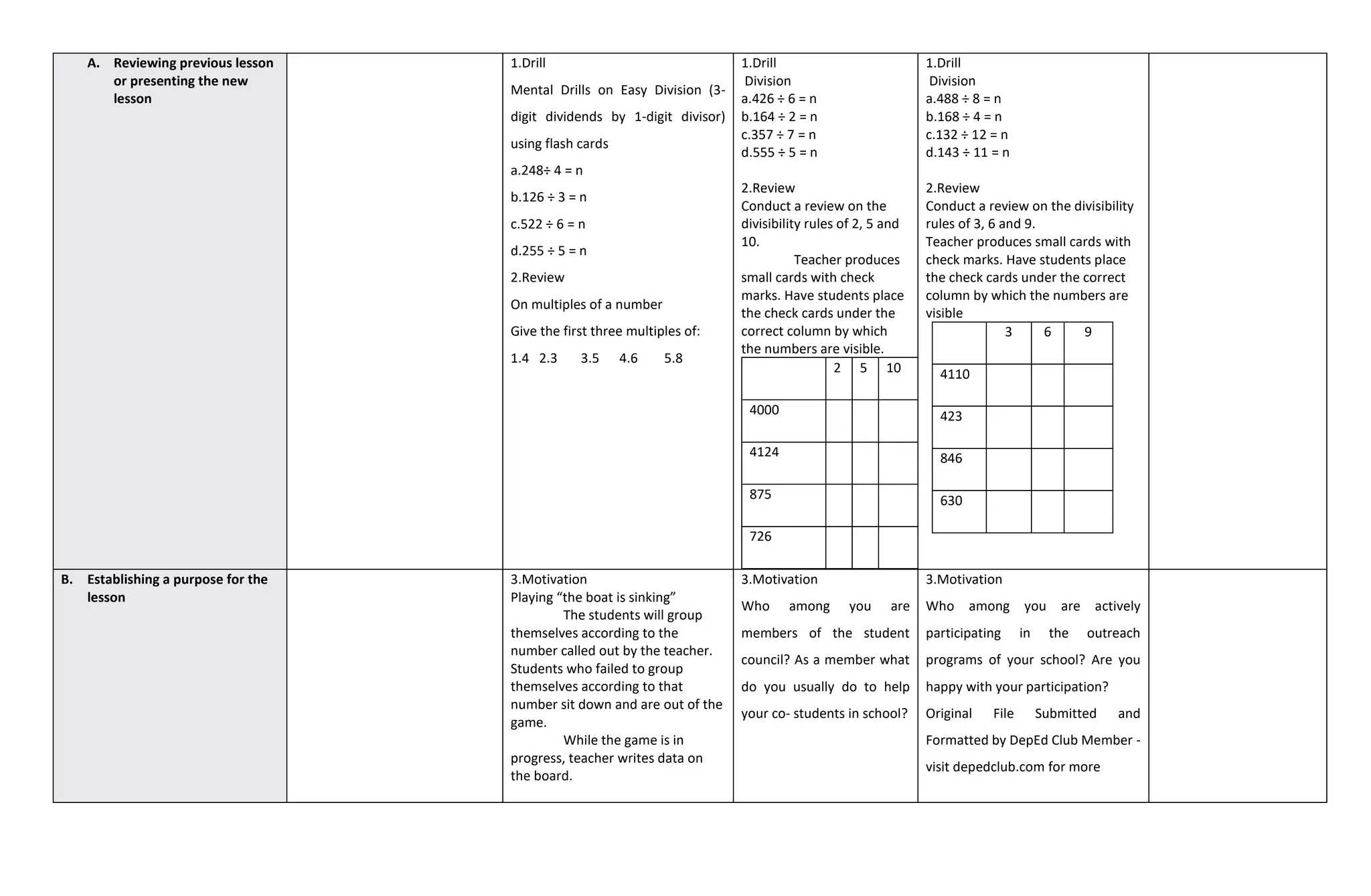
    A. Reviewing previouslesson or presenting the new lesson 1.Drill Mental Drills on Easy Division (3- digit dividends by 1-digit divisor) using flash cards a.248÷ 4 = n b.126 ÷ 3 = n c.522 ÷ 6 = n d.255 ÷ 5 = n 2.Review On multiples of a number Give the first three multiples of: 1.4 2.3 3.5 4.6 5.8 1.Drill Division a.426 ÷ 6 = n b.164 ÷ 2 = n c.357 ÷ 7 = n d.555 ÷ 5 = n 2.Review Conduct a review on the divisibility rules of 2, 5 and 10. Teacher produces small cards with check marks. Have students place the check cards under the correct column by which the numbers are visible. 2 5 10 4000 4124 875 726 1.Drill Division a.488 ÷ 8 = n b.168 ÷ 4 = n c.132 ÷ 12 = n d.143 ÷ 11 = n 2.Review Conduct a review on the divisibility rules of 3, 6 and 9. Teacher produces small cards with check marks. Have students place the check cards under the correct column by which the numbers are visible 3 6 9 4110 423 846 630 B. Establishing a purpose for the lesson 3.Motivation Playing “the boat is sinking” The students will group themselves according to the number called out by the teacher. Students who failed to group themselves according to that number sit down and are out of the game. While the game is in progress, teacher writes data on the board. 3.Motivation Who among you are members of the student council? As a member what do you usually do to help your co- students in school? 3.Motivation Who among you are actively participating in the outreach programs of your school? Are you happy with your participation? Original File Submitted and Formatted by DepEd Club Member - visit depedclub.com for more
  • 3.
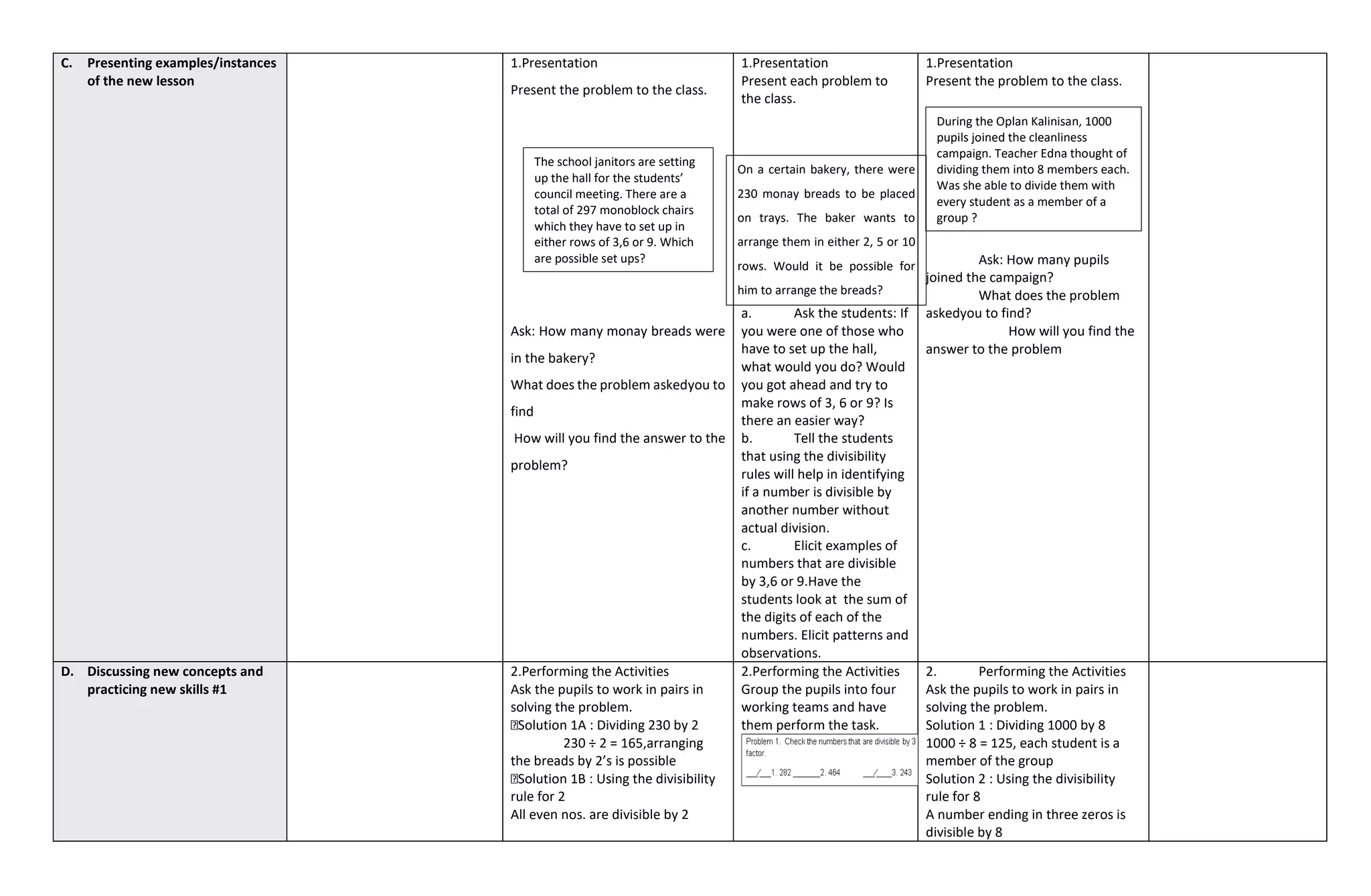
    C. Presenting examples/instances ofthe new lesson 1.Presentation Present the problem to the class. Ask: How many monay breads were in the bakery? What does the problem askedyou to find How will you find the answer to the problem? 1.Presentation Present each problem to the class. a. Ask the students: If you were one of those who have to set up the hall, what would you do? Would you got ahead and try to make rows of 3, 6 or 9? Is there an easier way? b. Tell the students that using the divisibility rules will help in identifying if a number is divisible by another number without actual division. c. Elicit examples of numbers that are divisible by 3,6 or 9.Have the students look at the sum of the digits of each of the numbers. Elicit patterns and observations. 1.Presentation Present the problem to the class. Ask: How many pupils joined the campaign? What does the problem askedyou to find? How will you find the answer to the problem D. Discussing new concepts and practicing new skills #1 2.Performing the Activities Ask the pupils to work in pairs in solving the problem. Solution 1A : Dividing 230 by 2 230 ÷ 2 = 165,arranging the breads by 2’s is possible Solution 1B : Using the divisibility rule for 2 All even nos. are divisible by 2 2.Performing the Activities Group the pupils into four working teams and have them perform the task. 2. Performing the Activities Ask the pupils to work in pairs in solving the problem. Solution 1 : Dividing 1000 by 8 1000 ÷ 8 = 125, each student is a member of the group Solution 2 : Using the divisibility rule for 8 A number ending in three zeros is divisible by 8 During the Oplan Kalinisan, 1000 pupils joined the cleanliness campaign. Teacher Edna thought of dividing them into 8 members each. Was she able to divide them with every student as a member of a group ? On a certain bakery, there were 230 monay breads to be placed on trays. The baker wants to arrange them in either 2, 5 or 10 rows. Would it be possible for him to arrange the breads? The school janitors are setting up the hall for the students’ council meeting. There are a total of 297 monoblock chairs which they have to set up in either rows of 3,6 or 9. Which are possible set ups?
  • 4.
    230 is aneven no., therefore it is divisible by 2, arrangement of bread by 2’s is possible Solution 2A: Dividing 230 by 5 230 ÷ 5 = 46, arranging by 5’s is possible Solution 2B: Using the divisibility rule for 5 Numbers ending in 0 and 5 are divisible by 5 230 ends in 0, therefore it is divisible by 5, arrangement of bread by 5’s is possible. Solution 3A: Dividing 230 by 10 230 ÷ 10 = 23, arranging breads by 10’s is possible Solution 3B: Using divisibility rule for 10 Numbers ending in 0 are divisible by 10 230 ends in 0, therefore it is divisible by 10, arrangement of breads by 10’s is possible Group Activity: Using the divisibility rules for 2, 5 and 10 1000 ends in three zeros, therefore it is divisible by 8,each student is a member of the group Group Activity: Using the divisibility rules for 4, 8, 12 or 11 E. Discussing new concepts and practicing new skills #2 Processing the Activities •How did you find the activity? •How did we know if a number is divisible by another number? Processing the Activities •We used the divisibility rule to know if the number is divisible by 3 ,6 or 9 3.Processing the Activities •How did you find the activity? •How did we know if a number is divisible by another number? •How did we know if 4 8 12 and 11 are factors of a number?
  • 5.
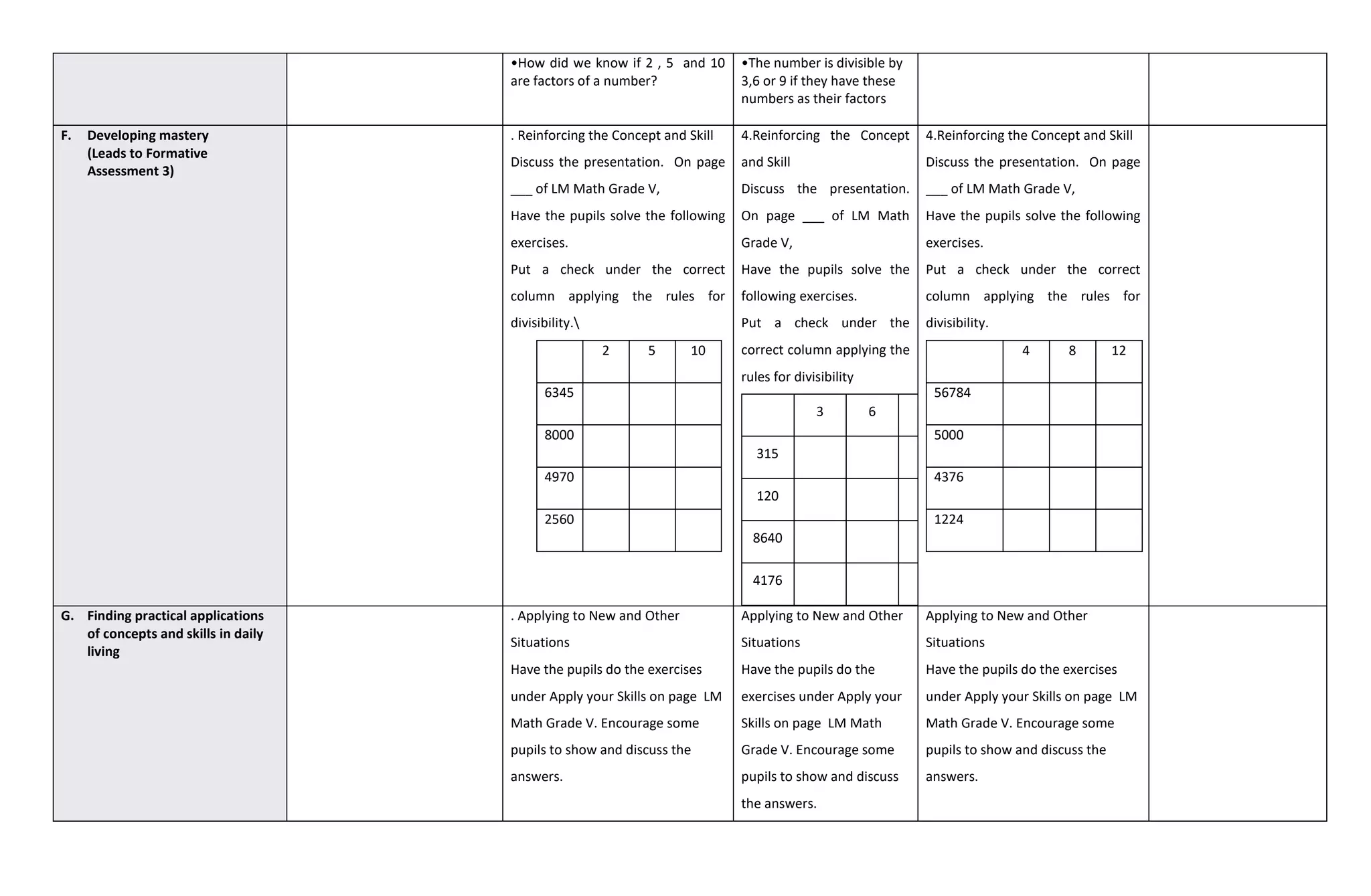
    •How did weknow if 2 , 5 and 10 are factors of a number? •The number is divisible by 3,6 or 9 if they have these numbers as their factors F. Developing mastery (Leads to Formative Assessment 3) . Reinforcing the Concept and Skill Discuss the presentation. On page ___ of LM Math Grade V, Have the pupils solve the following exercises. Put a check under the correct column applying the rules for divisibility. 2 5 10 6345 8000 4970 2560 4.Reinforcing the Concept and Skill Discuss the presentation. On page ___ of LM Math Grade V, Have the pupils solve the following exercises. Put a check under the correct column applying the rules for divisibility 3 6 9 315 120 8640 4176 4.Reinforcing the Concept and Skill Discuss the presentation. On page ___ of LM Math Grade V, Have the pupils solve the following exercises. Put a check under the correct column applying the rules for divisibility. 4 8 12 56784 5000 4376 1224 G. Finding practical applications of concepts and skills in daily living . Applying to New and Other Situations Have the pupils do the exercises under Apply your Skills on page LM Math Grade V. Encourage some pupils to show and discuss the answers. Applying to New and Other Situations Have the pupils do the exercises under Apply your Skills on page LM Math Grade V. Encourage some pupils to show and discuss the answers. Applying to New and Other Situations Have the pupils do the exercises under Apply your Skills on page LM Math Grade V. Encourage some pupils to show and discuss the answers.
  • 6.
    H. Making generalizationsand abstractions about the lesson Summarizing the Lesson How do we find the factors of a number using divisibility rules? •We recall and apply the rules on divisibility for 2, 5 and 10. Divisibility rule for 2 All even nos. are divisible by 2 Divisibility rule for 5 Numbers ending in 0 and 5 are divisible by 5 Divisibility rule for 10 Numbers ending in 0 are divisible by 10 Summarizing the Lesson How do we find the factors of a number using divisibility rules? •We recall and apply the rules on divisibility for 3, 6 or 9 . Divisible by 3: sum of digits of the number is divisible by 3 Divisible by 6: number is divisible by both 2 and 3 Divisible by 9: sum of the digits of the number is divisible by 9 Summarizing the Lesson How do we find the factors of a number using divisibility rules? •We recall and apply the rules on divisibility for 4, 8, 12 or 11 I. Evaluating learning C.Assessment Using the divisibility rule, encircle the numbers whose factors are the given number before each item. 2__ _ 1. 88 470 90 294 5__ __ 2.5000 7528 6010 845 10_ __3.370 950 840 530 10____4.370 355 3455 140 5 ___5.470 830 525 450 C.Assessment Using the divisibility rule, encircle the numbers whose factors are the given number before each item. 3___ 1. 84 346 57 264 9____ 2.299 627 657 846 3____ 3.312 799 843 579 6_____4.378216 1953 117 6_____5.477357 296 346 C. Assessment Using the divisibility rule, encircle the numbers whose factors are the given number before each item. 4___ 1. 84 480 60 264 8____ 2.2000 3928 6000 846 12___3.372 756 840 579 11____4.378352 1132 143 4____5.477 524 296 342 J. Additional activities for application or remediation Remediation Write on the blank before each item whether the given number is divisible by 2, 5 and 10 1. 16 _______ 2. 125 ______ Remediation Using the divisibility rule put a check on the blank if the second number is a factor of the first number. C. Home Activity Remediation Using the divisibility rule, put a check on the blank if the second
  • 7.
    3. 30 _______ 4.344 ______ 5. 650 ______ 1. 459,3 _____ 2. 261,6 _____ 3. 6453,9 ____ 4. 345,3 _____ 5. 114,6 _____ 6. number is a factor of the first number. 1. 436,4 _____ 2. 263,12 _____ 3. 2328,8 ____ 4. 346,4 _____ 5. 114,11 _____ V. REMARKS VI. REFLECTION A. No. of learners who earned 80% in the evaluation B. No. of learners who require additional activities for remediation who scored below 80% C. Did the remedial lessons work? No. of learners who have caught up with the lesson D. No. of learners who continue to require remediation E. Which of my teaching strategies worked well? Why did these work? F. What difficulties did I encounter which my principal or supervisor can help me solve? G. What innovation or localized materials did I use/discover which I wish to share with other teachers?