
Division and rational number. Any two integers have
such that xq = y. The process for finding q when three
such an integer is called division, and q is called the
quotient. Since division is not always possible in the
set of integers, it is advantageous to create a larger
set of number which division is possible in more
casess. The number which are introduced for this
prpose are the fractions, and the union of the set of
fractions and the set of integers is the set of rational
number
Division is splitting into
equal parts or groups.
It is the result of "fair
sharing".
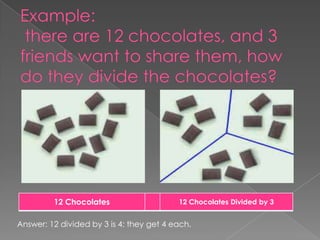
12 Chocolates

12 Chocolates Divided by 3

Answer: 12 divided by 3 is 4: they get 4 each.
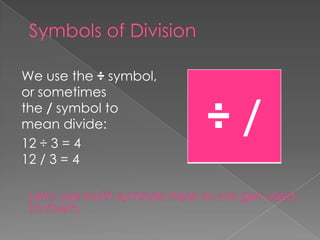
We use the ÷ symbol,
or sometimes
the / symbol to
mean divide:
12 ÷ 3 = 4
12 / 3 = 4

÷/
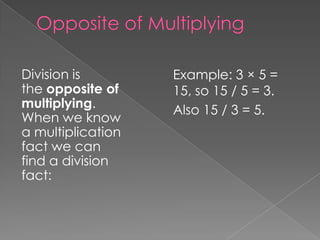
Division is
the opposite of
multiplying.
When we know
a multiplication
fact we can
find a division
fact:

Example: 3 × 5 =
15, so 15 / 5 = 3.
Also 15 / 3 = 5.
Multiplication...

...Division

3 groups of 5 make 15... so 15 divided by 3 is 5

and also:

5 groups of 3 make 15... so 15 divided by 5 is 3.

So there are four related facts:
3 × 5 = 15
5 × 3 = 15
1a5 / 3 = 5
15 / 5 = 3
Searching around
the multiplication
table we find that
28 is 4 × 7, so 28
divided by 7 must
be 4.?

Answer: 28 ÷ 7 = 4
There are special
names for each
number in a
division:
dividend ÷ divisor
= quotient

Example: in 12 ÷ 3 = 4:
12 is the dividend
3 is the divisor
4 is the quotient
Example: There are 7 bones But 7 cannot be divided exactly
into 2 groups,
to share with 2 pups.
so each pup gets 3 bones,
but there will be 1 left over:

Hahahaha...
:D
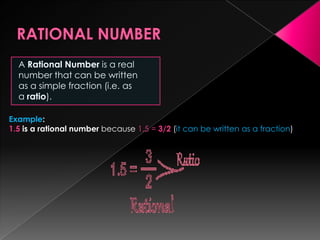
A Rational Number is a real
number that can be written
as a simple fraction (i.e. as
a ratio).
Example:
1.5 is a rational number because 1.5 = 3/2 (it can be written as a fraction)
Number

As a Fraction

Rational?

5

5/1

Yes

1.75

7/4

Yes

.001

1/1000

Yes

0.111...

1/9

Yes

√2
(square root of 2)

?

NO !
More formally we would say:
A rational number is a
number that can be in the
form p/q
where p and q are integers a
nd q is not equal to zero.

So, a rational number can be:

p
q
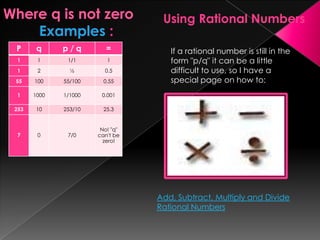
Using Rational Numbers
P

q

p/q

=

1

1

1/1

1

1

2

½

0.5

55

100

55/100

0.55

1

1000

1/1000

0.001

253

10

253/10

25.3

7/0

No! "q"
can't be
zero!

7

0

If a rational number is still in the
form "p/q" it can be a little
difficult to use, so I have a
special page on how to:

Add, Subtract, Multiply and Divide
Rational Numbers
The ancient greek mathematician Pythagoras believed that
all numbers were rational (could be written as a fraction), but
one of his students Hippasus proved (using geometry, it is
thought) that you could not represent the square root of 2 as
a fraction, and so it was irrational.
However Pythagoras could not accept the existence of
irrational numbers, because he believed that all numbers had
perfect values. But he could not disprove Hippasus' "irrational
numbers" and so Hippasus was thrown overboard and
drowned!
Division and rational number

Division and rational number

  • 2.
    Division and rationalnumber. Any two integers have such that xq = y. The process for finding q when three such an integer is called division, and q is called the quotient. Since division is not always possible in the set of integers, it is advantageous to create a larger set of number which division is possible in more casess. The number which are introduced for this prpose are the fractions, and the union of the set of fractions and the set of integers is the set of rational number
  • 3.
    Division is splittinginto equal parts or groups. It is the result of "fair sharing".
  • 4.
    12 Chocolates 12 ChocolatesDivided by 3 Answer: 12 divided by 3 is 4: they get 4 each.
  • 5.
    We use the÷ symbol, or sometimes the / symbol to mean divide: 12 ÷ 3 = 4 12 / 3 = 4 ÷/
  • 6.
    Division is the oppositeof multiplying. When we know a multiplication fact we can find a division fact: Example: 3 × 5 = 15, so 15 / 5 = 3. Also 15 / 3 = 5.
  • 7.
    Multiplication... ...Division 3 groups of5 make 15... so 15 divided by 3 is 5 and also: 5 groups of 3 make 15... so 15 divided by 5 is 3. So there are four related facts: 3 × 5 = 15 5 × 3 = 15 1a5 / 3 = 5 15 / 5 = 3
  • 8.
    Searching around the multiplication tablewe find that 28 is 4 × 7, so 28 divided by 7 must be 4.? Answer: 28 ÷ 7 = 4
  • 9.
    There are special namesfor each number in a division: dividend ÷ divisor = quotient Example: in 12 ÷ 3 = 4: 12 is the dividend 3 is the divisor 4 is the quotient
  • 10.
    Example: There are7 bones But 7 cannot be divided exactly into 2 groups, to share with 2 pups. so each pup gets 3 bones, but there will be 1 left over: Hahahaha... :D
  • 11.
    A Rational Numberis a real number that can be written as a simple fraction (i.e. as a ratio). Example: 1.5 is a rational number because 1.5 = 3/2 (it can be written as a fraction)
  • 12.
  • 14.
    More formally wewould say: A rational number is a number that can be in the form p/q where p and q are integers a nd q is not equal to zero. So, a rational number can be: p q
  • 15.
    Using Rational Numbers P q p/q = 1 1 1/1 1 1 2 ½ 0.5 55 100 55/100 0.55 1 1000 1/1000 0.001 253 10 253/10 25.3 7/0 No!"q" can't be zero! 7 0 If a rational number is still in the form "p/q" it can be a little difficult to use, so I have a special page on how to: Add, Subtract, Multiply and Divide Rational Numbers
  • 16.
    The ancient greekmathematician Pythagoras believed that all numbers were rational (could be written as a fraction), but one of his students Hippasus proved (using geometry, it is thought) that you could not represent the square root of 2 as a fraction, and so it was irrational. However Pythagoras could not accept the existence of irrational numbers, because he believed that all numbers had perfect values. But he could not disprove Hippasus' "irrational numbers" and so Hippasus was thrown overboard and drowned!