PAK CHINA ECONOMIC CORRIDOR
Competing in the Markets of
Emerging Countries
• Why businesses Expand into Foreign Markets
• Factors that Shape Strategy Choices in Foreign
Markets
• The Concepts of Multicountry Competition and
Global Competition
• Strategy Options for Entering and Competing in
Foreign Markets
• The Quest for Competitive Advantage in
Foreign Markets
• Strategies to Compete in the Markets of
Emerging Countries
Why Do Companies Expand into Foreign
Markets?
• Gain access to new customers
• Obtain access to valuable natural resources
• Achieve lower costs and enhance
competitiveness
• Company operates in few foreign countries,
with modest ambitions to expand further
International Competitor Company markets
products.
Factors Shaping Strategy Choices in
Foreign Markets
• Cross-country differences in cultural,
demographic, and market conditions
• Gaining competitive advantage based on
where activities are located
• Risks of adverse shifts in currency
exchange rates
• Impact of host government policies on the
local business climate.
How Markets Differ from Country to
Country
• Consumer tastes and preferences
• Consumer buying habits
• Market size and growth potential
• Distribution channels
• Competitive pressures
• Manufacturing costs vary from country to
country
• Wage rates
• Worker productivity
• Inflation rates
• Energy costs
• Tax rates
• Government regulations
• Quality of business environment varies from
country to country
Differences in Government Trade Policies
• Import tariffs or quotas
• Restrictions on exports
• Regulations on prices of imports
• Product certification
• Prior approval of capital spending projects
• Withdrawal of funds from country
• Ownership (minority or majority) by local
citizens
8
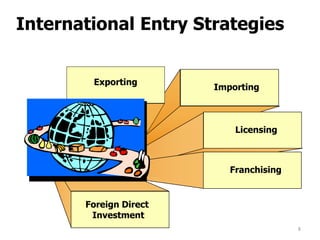
International Entry Strategies
Licensing
Franchising
Foreign Direct
Investment
Importing
Exporting
9
Exporting and Importing
• Firms can export and import using two methods:
– Indirect involvement means that the firm
participates in international business through an
intermediary and does not deal with foreign
customers or markets.
– Direct involvement means that the firm works with
foreign customers or markets with the opportunity
to develop a relationship.
• Firms decide on the desired method by
implementing transaction cost theory.
10
International Intermediaries
• Importers and exporters often use international
intermediaries who provide assistance in:
– Documentation
– Financing
– Transportation
– Identification of foreign suppliers and trading
companies
– Providing business contacts
11
Export Management
Companies
• Firms that specialize in performing
international business services for
other companies are known as
export management companies
(EMCs)
• The two primary roles of EMCs are:
– Agents
– Distributors
12
Trading Companies
• Trading companies help firms by importing, exporting,
countertrading, investing, and manufacturing.
• The sogashosha of Japan are the most powerful trading
companies in the world for four reasons:
– They efficiently gather, evaluate, and translate market information
into business opportunities.
– Economies of scale give them preferential treatment.
– They operate around the world, not just Japan.
– They have vast quantities of capital.
• In the U.S., export trading company legislation is designed to
improve the export performance of small and medium-sized
firms.
13
Facilitators
• Facilitators are entities outside the firm that assist in
the process of going international by supplying
knowledge and information.
• Private sector facilitators include:
– Banks
– Accounting firms
– Consulting firms
• Public sector facilitators include:
– Departments of commerce
– Export-Import Banks
– Educational Institutions
Licensing Strategy
• A firm (licensor) in one country giving other
domestic or foreign firms (licensees) the right
to use a patent, trademark, technology,
production process, or product in return for
the payment of a royalty or fee
• Pepsi and Coca-Cola with bottle companies,
distributors
15
Franchising
• Franchising is the granting of the right by a parent
company to another independent entity to do business
in a prescribed manner.
• The major forms of franchising are:
– Manufacturer-retailer systems such as car dealerships,
– Manufacturer-wholesaler systems such as soft drink,
companies
– Service-firm retailer systems such as fast-food outlets.
• To be successful, the firm must offer unique products or
propositions, and a high degree of standardization.
16
Key Reasons for Franchising
Market Potential
Financial Gain Saturated Domestic
Markets
17
Strategic Alliance
• A strategic alliance is an arrangement between two or
more companies with a common business objective.
• To better compete, many companies form strategic
alliances with suppliers, customers, competitors, and
companies in other industries to achieve goals.
• Reasons for interfirm cooperation include:
– Market development
– To share risk or resources
– To block and co-opt competitors
Reasons for Alliances
• Share and lower costs of
high risks, technology
• Lower costs by sharing the
large fixed-costs for
manufacturing plants
• Desire to learn another
firms technology, or
advantages, benchmarking
• Desire to participate in
evolution of competitive
activity in growing global
industries
19
Contractual Agreements
• Strategic alliance partners may join forces for R&D,
marketing, production, licensing, cross-licensing, cross-
market activities, or outsourcing.
• Contract manufacturing allows the corporation to
separate the physical production of goods from the R&D
and marketing stages.
• Management contracts involve selling one’s expertise in
running a company while avoiding the risk or benefit of
ownership.
• A turnkey operation is a contractual agreement that
permits a client to acquire a complete system following
its completion.
20
Joint Ventures
• A joint venture involves the participation of two or more
companies in an enterprise in which each party
contributes assets, has some equity, and shares risk.
• The 3 reasons for establishing a joint venture are:
– Government policy or legislation.
– One partner’s needs for another partner’s skills.
– One partner’s needs for another partner’s attributes or
assets.
• The key to a joint venture is the sharing of a common
business objective.
Consortia
(1) They typically involve a large
number of participants, and
(2) They frequently operate in a
country or market in which
none of the participants is
currently active
• Consortia are similar to joint ventures and could be classified as
such except for two unique characteristics:
• Consortia are developed to pool financial and managerial
resources and to lessen risks.

Competing global

  • 1.
    PAK CHINA ECONOMICCORRIDOR Competing in the Markets of Emerging Countries
  • 2.
    • Why businessesExpand into Foreign Markets • Factors that Shape Strategy Choices in Foreign Markets • The Concepts of Multicountry Competition and Global Competition • Strategy Options for Entering and Competing in Foreign Markets • The Quest for Competitive Advantage in Foreign Markets • Strategies to Compete in the Markets of Emerging Countries
  • 3.
    Why Do CompaniesExpand into Foreign Markets? • Gain access to new customers • Obtain access to valuable natural resources • Achieve lower costs and enhance competitiveness • Company operates in few foreign countries, with modest ambitions to expand further International Competitor Company markets products.
  • 4.
    Factors Shaping StrategyChoices in Foreign Markets • Cross-country differences in cultural, demographic, and market conditions • Gaining competitive advantage based on where activities are located • Risks of adverse shifts in currency exchange rates • Impact of host government policies on the local business climate.
  • 5.
    How Markets Differfrom Country to Country • Consumer tastes and preferences • Consumer buying habits • Market size and growth potential • Distribution channels • Competitive pressures • Manufacturing costs vary from country to country
  • 6.
    • Wage rates •Worker productivity • Inflation rates • Energy costs • Tax rates • Government regulations • Quality of business environment varies from country to country
  • 7.
    Differences in GovernmentTrade Policies • Import tariffs or quotas • Restrictions on exports • Regulations on prices of imports • Product certification • Prior approval of capital spending projects • Withdrawal of funds from country • Ownership (minority or majority) by local citizens
  • 8.
  • 9.
    9 Exporting and Importing •Firms can export and import using two methods: – Indirect involvement means that the firm participates in international business through an intermediary and does not deal with foreign customers or markets. – Direct involvement means that the firm works with foreign customers or markets with the opportunity to develop a relationship. • Firms decide on the desired method by implementing transaction cost theory.
  • 10.
    10 International Intermediaries • Importersand exporters often use international intermediaries who provide assistance in: – Documentation – Financing – Transportation – Identification of foreign suppliers and trading companies – Providing business contacts
  • 11.
    11 Export Management Companies • Firmsthat specialize in performing international business services for other companies are known as export management companies (EMCs) • The two primary roles of EMCs are: – Agents – Distributors
  • 12.
    12 Trading Companies • Tradingcompanies help firms by importing, exporting, countertrading, investing, and manufacturing. • The sogashosha of Japan are the most powerful trading companies in the world for four reasons: – They efficiently gather, evaluate, and translate market information into business opportunities. – Economies of scale give them preferential treatment. – They operate around the world, not just Japan. – They have vast quantities of capital. • In the U.S., export trading company legislation is designed to improve the export performance of small and medium-sized firms.
  • 13.
    13 Facilitators • Facilitators areentities outside the firm that assist in the process of going international by supplying knowledge and information. • Private sector facilitators include: – Banks – Accounting firms – Consulting firms • Public sector facilitators include: – Departments of commerce – Export-Import Banks – Educational Institutions
  • 14.
    Licensing Strategy • Afirm (licensor) in one country giving other domestic or foreign firms (licensees) the right to use a patent, trademark, technology, production process, or product in return for the payment of a royalty or fee • Pepsi and Coca-Cola with bottle companies, distributors
  • 15.
    15 Franchising • Franchising isthe granting of the right by a parent company to another independent entity to do business in a prescribed manner. • The major forms of franchising are: – Manufacturer-retailer systems such as car dealerships, – Manufacturer-wholesaler systems such as soft drink, companies – Service-firm retailer systems such as fast-food outlets. • To be successful, the firm must offer unique products or propositions, and a high degree of standardization.
  • 16.
    16 Key Reasons forFranchising Market Potential Financial Gain Saturated Domestic Markets
  • 17.
    17 Strategic Alliance • Astrategic alliance is an arrangement between two or more companies with a common business objective. • To better compete, many companies form strategic alliances with suppliers, customers, competitors, and companies in other industries to achieve goals. • Reasons for interfirm cooperation include: – Market development – To share risk or resources – To block and co-opt competitors
  • 18.
    Reasons for Alliances •Share and lower costs of high risks, technology • Lower costs by sharing the large fixed-costs for manufacturing plants • Desire to learn another firms technology, or advantages, benchmarking • Desire to participate in evolution of competitive activity in growing global industries
  • 19.
    19 Contractual Agreements • Strategicalliance partners may join forces for R&D, marketing, production, licensing, cross-licensing, cross- market activities, or outsourcing. • Contract manufacturing allows the corporation to separate the physical production of goods from the R&D and marketing stages. • Management contracts involve selling one’s expertise in running a company while avoiding the risk or benefit of ownership. • A turnkey operation is a contractual agreement that permits a client to acquire a complete system following its completion.
  • 20.
    20 Joint Ventures • Ajoint venture involves the participation of two or more companies in an enterprise in which each party contributes assets, has some equity, and shares risk. • The 3 reasons for establishing a joint venture are: – Government policy or legislation. – One partner’s needs for another partner’s skills. – One partner’s needs for another partner’s attributes or assets. • The key to a joint venture is the sharing of a common business objective.
  • 21.
    Consortia (1) They typicallyinvolve a large number of participants, and (2) They frequently operate in a country or market in which none of the participants is currently active • Consortia are similar to joint ventures and could be classified as such except for two unique characteristics: • Consortia are developed to pool financial and managerial resources and to lessen risks.