INDIRA GANDHI KRISHI VISHWAWIDYALAY
RAIPUR (G.G.)
COLLEGE OF AGRICULTURE JORA, RAIPUR
SESSION: 2019-20
ASSIGNMENT
ON
DISTRICT CREDIT PLANS
Course Name- Agricultural Finance and Project Management 3(2+1)
Course No. AGECON 509
PRESENTED BY:-
RAVISHANKAR SAHU
M.sc. Ist year
(Dept. of Agricultural Extension)
LEAD BANK SCHEME
District Credit Plans (DCP s)
Lead Bank Scheme
A bank having a relatively large network of
branches in the rural areas of a given district finance and man power
resources generally has been entrustred with the lead responsibility for
the district.
Lead Bank may be Private or Govt.
Objectives:-
Credit provide for rural areas
Preparation of Credit Plan for District level
 Group under Chairmanship Dr. D.R. Gadagil appointed
 Under the National Credit Council – recommended “Area Approach”
for unbanked districts. By RBI Act 1934
Report submitted in October 1969
Bank should provide integrated banking facilities in unbanked areas
District identified as the smallest geographical unit for the scheme
Lead bank is the leading bank among the commercial banks in a district.
Nationalized bank should develop a district
Lead Bank Scheme: 336 District to be distributed between
nationalized banks at the starting point
First Nationalization of Bank in 1969 of 14 Banks
Second Nationalization of Bank in 1980of 6 banks under the banking
regulation Act 1949
Scheme applicable to all districts except the Metro. Cities of
Mumbai, Kolkata, Chennai, Delhi, Pondicherry and Goa.
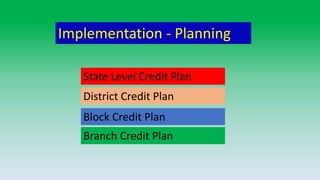
Implementation - Planning
State Level Credit Plan
District Credit Plan
Block Credit Plan
Branch Credit Plan
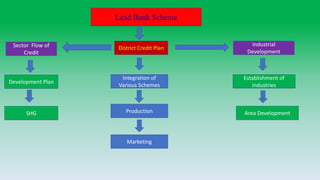
Lead Bank Scheme
Development Plan
SHG
Integration of
Various Schemes
Production
Marketing
Establishment of
industries
Area Development
Industrial
Development
Sector Flow of
Credit
District Credit Plan
District Credit Plans
The district credit plan is based on the
strategy of development sustainable to a particular district taking into
account principle economic activities and their potential for development.
In india there are 731 district currently all district is covered by “Lead
Bank Scheme” to provide loan.
First implemented for Jaintia Hills District of Meghalaya in 1974
The district was allotted to the State Bank of India (SBI) under the lead
bank scheme
The methodology followed in the compilation of the first District Credit
Plan for Jaintia Hills
On the Basis of the Growrh Center Aproach
DCP – consists of technically and economically viable schemes which can
be taken up for financing
It is plan of bankable scheme in agriculture, industry and service sector of
the District
The scheme can be taken up by the different financial institute in the district
The lead bank scheme has two important phage:
Phage I - Survey of the lead district
Survey resources and development of banking in the area
Survey the dependence on money leaders by industrial units, farm
etc.
Examining the market facilities available for agriculture and
industrial commodities and liking credit with marketing
Survey the facilities for storing (Fertilizer & agricultural inputs)
Estimating the credit gaps in various sector of the district economy
Developing contacts and maintaining liaison with the govt. and
other agencies
 Phage II - Preparation of the district credit plan
Formulate banking loaning scheme having labour intensive
orientation so as to generate employment
Provide desired loan to increase the productivity of land and allied
activities
Reduce unemployment and thus increase income level
Give maximum credit to weaker section of the society mainly for
productive purpose.
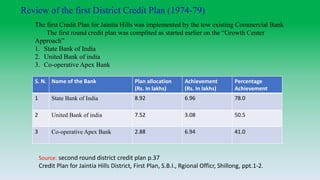
Review of the first District Credit Plan (1974-79)
The first Credit Plan for Jaintia Hills was implemented by the tow existing Commercial Bank
The first round credit plan was complited as started earlier on the “Growth Center
Approach”
1. State Bank of India
2. United Bank of india
3. Co-operative Apex Bank
S. N. Name of the Bank Plan allocation
(Rs. In lakhs)
Achievement
(Rs. In lakhs)
Percentage
Achievement
1 State Bank of India 8.92 6.96 78.0
2 United Bank of india 7.52 3.08 50.5
3 Co-operative Apex Bank 2.88 6.94 41.0
Source: second round district credit plan p.37
Credit Plan for Jaintia Hills District, First Plan, S.B.I., Rgional Officr, Shillong, ppt.1-2.
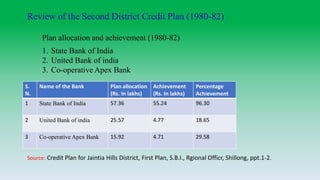
Review of the Second District Credit Plan (1980-82)
Plan allocation and achievement (1980-82)
1. State Bank of India
2. United Bank of india
3. Co-operative Apex Bank
S.
N.
Name of the Bank Plan allocation
(Rs. In lakhs)
Achievement
(Rs. In lakhs)
Percentage
Achievement
1 State Bank of India 57.36 55.24 96.30
2 United Bank of india 25.57 4.77 18.65
3 Co-operative Apex Bank 15.92 4.71 29.58
Source: Credit Plan for Jaintia Hills District, First Plan, S.B.I., Rgional Officr, Shillong, ppt.1-2.
Progress of lead bank scheme
In 1974 – 90% of area in Assam, Bihar, W.Bnagal, Orissa, MP, UP
covered
Study group appointed by RBI in Gujarat & Maharastra conclude
Lead bank were successful in identifying potential area for new
branches
Formulation and implementation of DCP
The suggested Annual Credit Plan
Now 731 district is cover by Lead Bank Scheme.
Problems – Lead bank scheme
Confused regarding the concept of “Lead Bank Scheme”
Co-ordination and effective Functioning between bank and Borrower is
not good
Problems in allotment districts
Less expertise knowledge about the district of different sector as like
agriculture and allied sector etc.
Problems in preparation and uniformity of DCP
Less literacy level of peoples and poor communication system.
Reference:
1. Agricultural Economics – S.SUBBA REDDY- P. 393 to 394
2. Pdf
http://shodhganga.inflibnet.ac.in/jspui/bitstream/10603/55525/9/09_chapter%205.pdf
3. Credit Plan for Jaintia Hills District, First Plan, S.B.I., Rgional Officr, Shillong, ppt.1-2.
4. https://www.slideshare.net/Boicha/lead-bank-scheme
THANK YOU

District credit plans

  • 2.
    INDIRA GANDHI KRISHIVISHWAWIDYALAY RAIPUR (G.G.) COLLEGE OF AGRICULTURE JORA, RAIPUR SESSION: 2019-20 ASSIGNMENT ON DISTRICT CREDIT PLANS Course Name- Agricultural Finance and Project Management 3(2+1) Course No. AGECON 509 PRESENTED BY:- RAVISHANKAR SAHU M.sc. Ist year (Dept. of Agricultural Extension)
  • 3.
    LEAD BANK SCHEME DistrictCredit Plans (DCP s)
  • 4.
    Lead Bank Scheme Abank having a relatively large network of branches in the rural areas of a given district finance and man power resources generally has been entrustred with the lead responsibility for the district. Lead Bank may be Private or Govt. Objectives:- Credit provide for rural areas Preparation of Credit Plan for District level
  • 5.
     Group underChairmanship Dr. D.R. Gadagil appointed  Under the National Credit Council – recommended “Area Approach” for unbanked districts. By RBI Act 1934 Report submitted in October 1969 Bank should provide integrated banking facilities in unbanked areas District identified as the smallest geographical unit for the scheme Lead bank is the leading bank among the commercial banks in a district.
  • 6.
    Nationalized bank shoulddevelop a district Lead Bank Scheme: 336 District to be distributed between nationalized banks at the starting point First Nationalization of Bank in 1969 of 14 Banks Second Nationalization of Bank in 1980of 6 banks under the banking regulation Act 1949 Scheme applicable to all districts except the Metro. Cities of Mumbai, Kolkata, Chennai, Delhi, Pondicherry and Goa.
  • 7.
    Implementation - Planning StateLevel Credit Plan District Credit Plan Block Credit Plan Branch Credit Plan
  • 8.
    Lead Bank Scheme DevelopmentPlan SHG Integration of Various Schemes Production Marketing Establishment of industries Area Development Industrial Development Sector Flow of Credit District Credit Plan
  • 9.
    District Credit Plans Thedistrict credit plan is based on the strategy of development sustainable to a particular district taking into account principle economic activities and their potential for development. In india there are 731 district currently all district is covered by “Lead Bank Scheme” to provide loan.
  • 10.
    First implemented forJaintia Hills District of Meghalaya in 1974 The district was allotted to the State Bank of India (SBI) under the lead bank scheme The methodology followed in the compilation of the first District Credit Plan for Jaintia Hills On the Basis of the Growrh Center Aproach DCP – consists of technically and economically viable schemes which can be taken up for financing It is plan of bankable scheme in agriculture, industry and service sector of the District The scheme can be taken up by the different financial institute in the district
  • 11.
    The lead bankscheme has two important phage: Phage I - Survey of the lead district Survey resources and development of banking in the area Survey the dependence on money leaders by industrial units, farm etc. Examining the market facilities available for agriculture and industrial commodities and liking credit with marketing Survey the facilities for storing (Fertilizer & agricultural inputs) Estimating the credit gaps in various sector of the district economy Developing contacts and maintaining liaison with the govt. and other agencies
  • 12.
     Phage II- Preparation of the district credit plan Formulate banking loaning scheme having labour intensive orientation so as to generate employment Provide desired loan to increase the productivity of land and allied activities Reduce unemployment and thus increase income level Give maximum credit to weaker section of the society mainly for productive purpose.
  • 13.
    Review of thefirst District Credit Plan (1974-79) The first Credit Plan for Jaintia Hills was implemented by the tow existing Commercial Bank The first round credit plan was complited as started earlier on the “Growth Center Approach” 1. State Bank of India 2. United Bank of india 3. Co-operative Apex Bank S. N. Name of the Bank Plan allocation (Rs. In lakhs) Achievement (Rs. In lakhs) Percentage Achievement 1 State Bank of India 8.92 6.96 78.0 2 United Bank of india 7.52 3.08 50.5 3 Co-operative Apex Bank 2.88 6.94 41.0 Source: second round district credit plan p.37 Credit Plan for Jaintia Hills District, First Plan, S.B.I., Rgional Officr, Shillong, ppt.1-2.
  • 14.
    Review of theSecond District Credit Plan (1980-82) Plan allocation and achievement (1980-82) 1. State Bank of India 2. United Bank of india 3. Co-operative Apex Bank S. N. Name of the Bank Plan allocation (Rs. In lakhs) Achievement (Rs. In lakhs) Percentage Achievement 1 State Bank of India 57.36 55.24 96.30 2 United Bank of india 25.57 4.77 18.65 3 Co-operative Apex Bank 15.92 4.71 29.58 Source: Credit Plan for Jaintia Hills District, First Plan, S.B.I., Rgional Officr, Shillong, ppt.1-2.
  • 15.
    Progress of leadbank scheme In 1974 – 90% of area in Assam, Bihar, W.Bnagal, Orissa, MP, UP covered Study group appointed by RBI in Gujarat & Maharastra conclude Lead bank were successful in identifying potential area for new branches Formulation and implementation of DCP The suggested Annual Credit Plan Now 731 district is cover by Lead Bank Scheme.
  • 16.
    Problems – Leadbank scheme Confused regarding the concept of “Lead Bank Scheme” Co-ordination and effective Functioning between bank and Borrower is not good Problems in allotment districts Less expertise knowledge about the district of different sector as like agriculture and allied sector etc. Problems in preparation and uniformity of DCP Less literacy level of peoples and poor communication system.
  • 17.
    Reference: 1. Agricultural Economics– S.SUBBA REDDY- P. 393 to 394 2. Pdf http://shodhganga.inflibnet.ac.in/jspui/bitstream/10603/55525/9/09_chapter%205.pdf 3. Credit Plan for Jaintia Hills District, First Plan, S.B.I., Rgional Officr, Shillong, ppt.1-2. 4. https://www.slideshare.net/Boicha/lead-bank-scheme
  • 18.