Presented By:
Bookya Rajesh
 What is FPO?
 Difference b/w FPO and FPC.
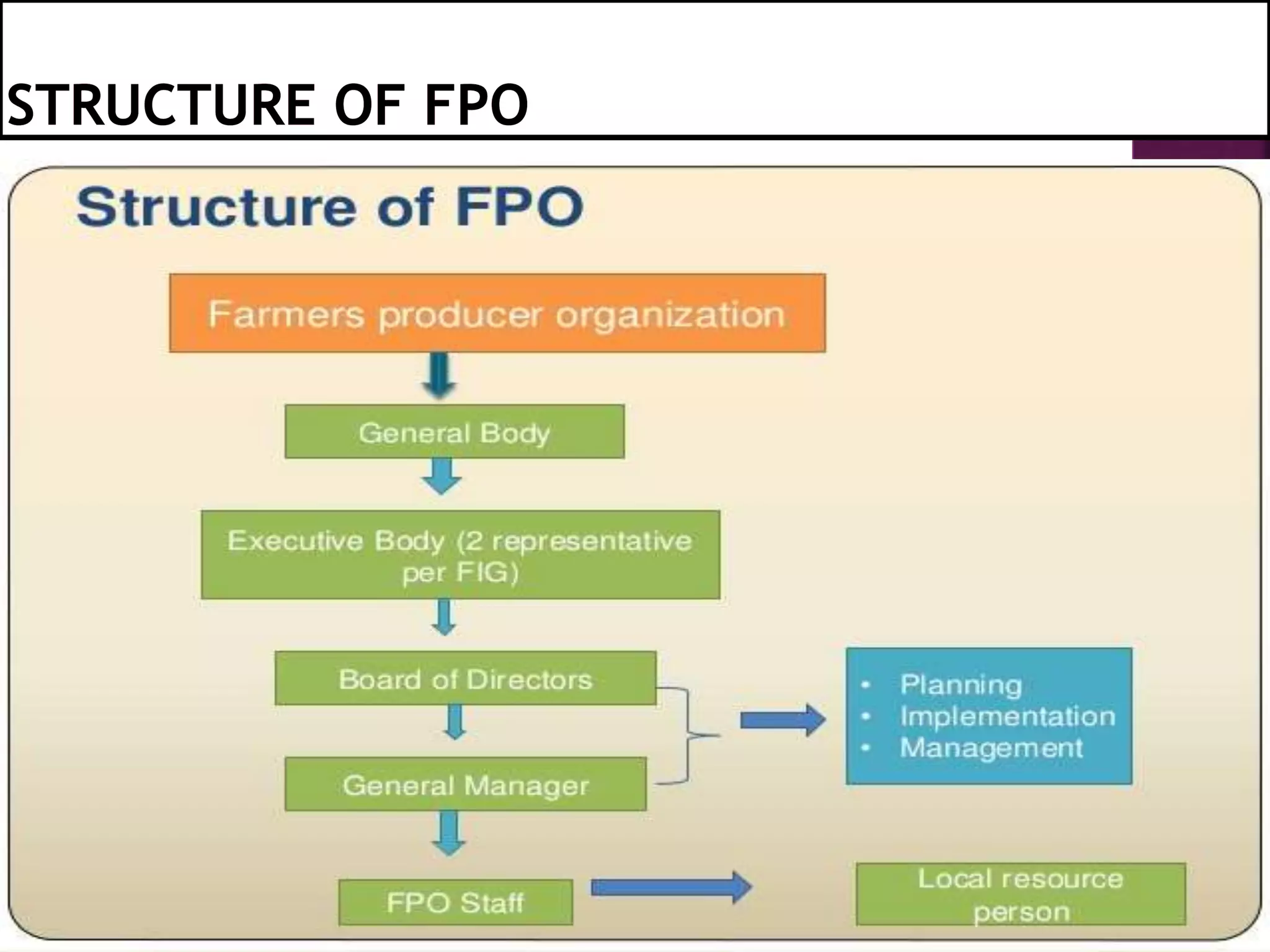
 Structure of FPO
 Services by FPO
 Advantages of FPO
 Support for FPO
 Conclusion
 Farmer organization is a primary producer group with
special interests and concerns with developed structure,
formal membership, status and functions for its members
and with a set of byelaws and rules.
 It is a hybrid of co-operative and private company
 It basically covers: Production, crop insurance, harvesting,
processing, procurement, grading, pooling, handling,
marketing, selling, better bargaining power, elimination of
middle man, credit sources, export of primary produce of
the Members or import of goods or services for their
benefit.
Voluntary and open membership
Democratic farmer member control
Farmer-Member Economic
participation
Autonomy and independent
Education, Training and Information
Co-operation among FPOs
Concern for the community
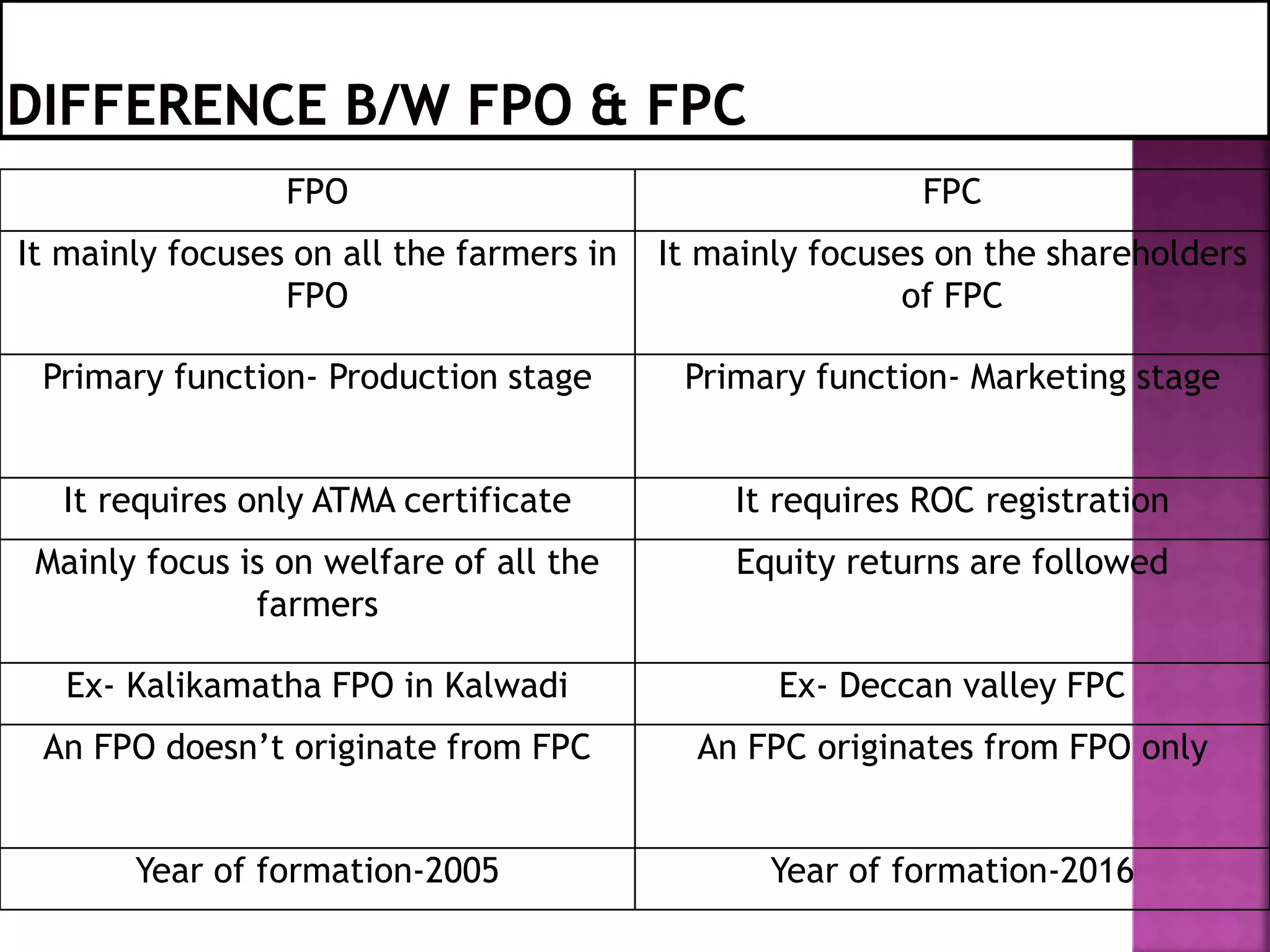
FPO FPC
It mainly focuses on all the farmers in
FPO
It mainly focuses on the shareholders
of FPC
Primary function- Production stage Primary function- Marketing stage
It requires only ATMA certificate It requires ROC registration
Mainly focus is on welfare of all the
farmers
Equity returns are followed
Ex- Kalikamatha FPO in Kalwadi Ex- Deccan valley FPC
An FPO doesn’t originate from FPC An FPC originates from FPO only
Year of formation-2005 Year of formation-2016
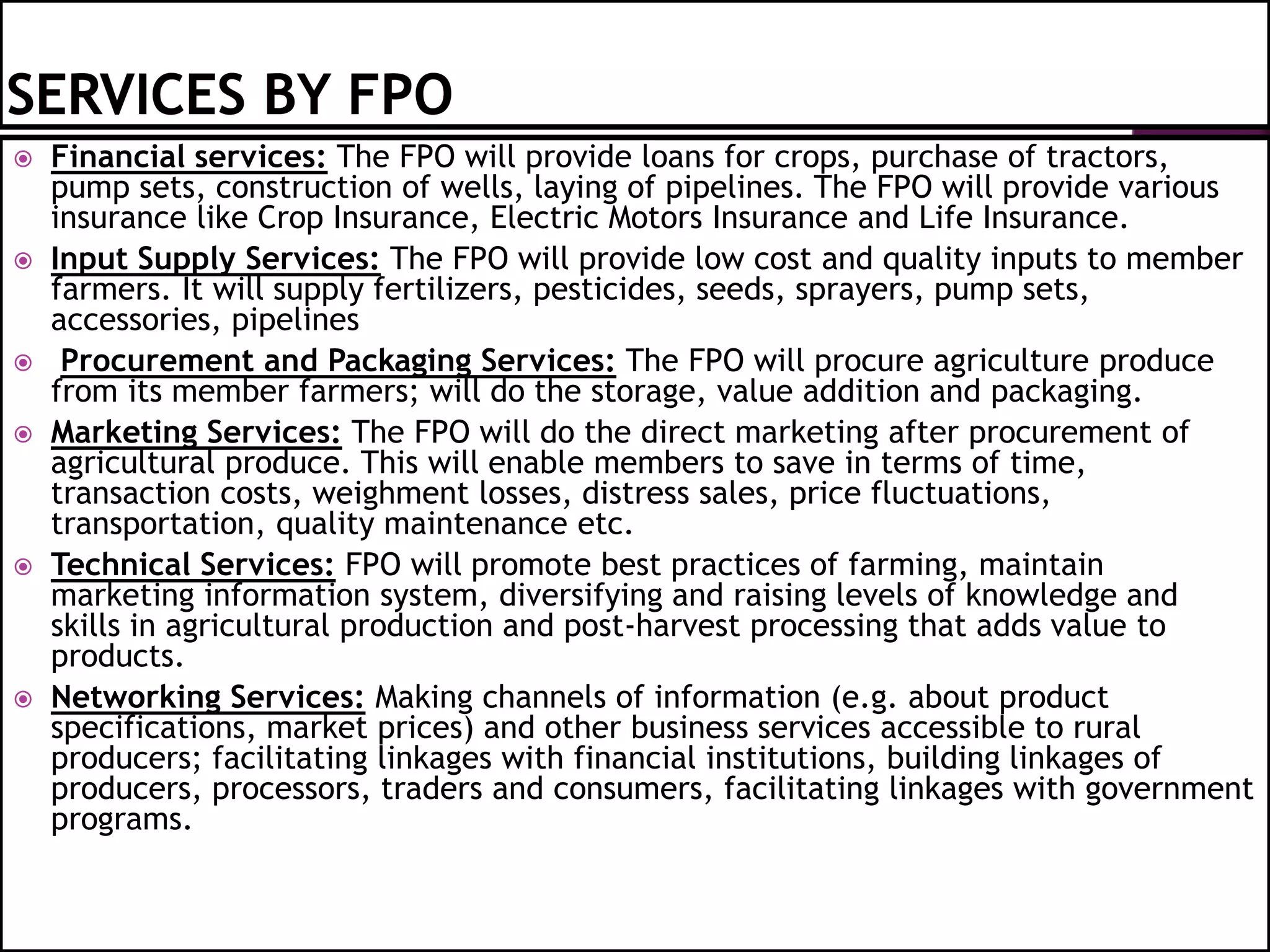
 Financial services: The FPO will provide loans for crops, purchase of tractors,
pump sets, construction of wells, laying of pipelines. The FPO will provide various
insurance like Crop Insurance, Electric Motors Insurance and Life Insurance.
 Input Supply Services: The FPO will provide low cost and quality inputs to member
farmers. It will supply fertilizers, pesticides, seeds, sprayers, pump sets,
accessories, pipelines
 Procurement and Packaging Services: The FPO will procure agriculture produce
from its member farmers; will do the storage, value addition and packaging.
 Marketing Services: The FPO will do the direct marketing after procurement of
agricultural produce. This will enable members to save in terms of time,
transaction costs, weighment losses, distress sales, price fluctuations,
transportation, quality maintenance etc.
 Technical Services: FPO will promote best practices of farming, maintain
marketing information system, diversifying and raising levels of knowledge and
skills in agricultural production and post-harvest processing that adds value to
products.
 Networking Services: Making channels of information (e.g. about product
specifications, market prices) and other business services accessible to rural
producers; facilitating linkages with financial institutions, building linkages of
producers, processors, traders and consumers, facilitating linkages with government
programs.
 Farmers Producers Organizations influence policies and
demand for required services.
 Farmers can participate in the decision making process of
the developmental activities.
 Service system becomes more effective and accountable
 They get better access to latest markets and technology
 FPOs can involve in Farmer and market led extension
activities
 Build interactions between research, extension and farming
systems
 Enable farmers to organize themselves for action or to
share resources
 Analyze farmers problems with extension support
 More services can be made available to farmers through
 NABARD
 SFAC
 Govt departments
 Corporate
 Domestic and international Aid agencies
 NGOs
 The main aim of PO is to ensure better income for the
producers through an organization of their own.
 Small producers do not have the volume individually (both
inputs and produce) to get the benefit of economies of
scale. Besides, in agricultural marketing, there is a long
chain of intermediaries who very often work non-
transparently leading to the situation where the producer
receives only a small part of the value that the ultimate
consumer pays.
 Through aggregation, the primary producers can avail the
benefit of economies of scale. They will also have better
bargaining power vis-à-vis the bulk buyers of produce and
bulk suppliers of inputs.
Farmer producer organization

Farmer producer organization

  • 1.
  • 2.
     What isFPO?  Difference b/w FPO and FPC.  Structure of FPO  Services by FPO  Advantages of FPO  Support for FPO  Conclusion
  • 3.
     Farmer organizationis a primary producer group with special interests and concerns with developed structure, formal membership, status and functions for its members and with a set of byelaws and rules.  It is a hybrid of co-operative and private company  It basically covers: Production, crop insurance, harvesting, processing, procurement, grading, pooling, handling, marketing, selling, better bargaining power, elimination of middle man, credit sources, export of primary produce of the Members or import of goods or services for their benefit.
  • 4.
    Voluntary and openmembership Democratic farmer member control Farmer-Member Economic participation Autonomy and independent Education, Training and Information Co-operation among FPOs Concern for the community
  • 5.
    FPO FPC It mainlyfocuses on all the farmers in FPO It mainly focuses on the shareholders of FPC Primary function- Production stage Primary function- Marketing stage It requires only ATMA certificate It requires ROC registration Mainly focus is on welfare of all the farmers Equity returns are followed Ex- Kalikamatha FPO in Kalwadi Ex- Deccan valley FPC An FPO doesn’t originate from FPC An FPC originates from FPO only Year of formation-2005 Year of formation-2016
  • 7.
     Financial services:The FPO will provide loans for crops, purchase of tractors, pump sets, construction of wells, laying of pipelines. The FPO will provide various insurance like Crop Insurance, Electric Motors Insurance and Life Insurance.  Input Supply Services: The FPO will provide low cost and quality inputs to member farmers. It will supply fertilizers, pesticides, seeds, sprayers, pump sets, accessories, pipelines  Procurement and Packaging Services: The FPO will procure agriculture produce from its member farmers; will do the storage, value addition and packaging.  Marketing Services: The FPO will do the direct marketing after procurement of agricultural produce. This will enable members to save in terms of time, transaction costs, weighment losses, distress sales, price fluctuations, transportation, quality maintenance etc.  Technical Services: FPO will promote best practices of farming, maintain marketing information system, diversifying and raising levels of knowledge and skills in agricultural production and post-harvest processing that adds value to products.  Networking Services: Making channels of information (e.g. about product specifications, market prices) and other business services accessible to rural producers; facilitating linkages with financial institutions, building linkages of producers, processors, traders and consumers, facilitating linkages with government programs.
  • 8.
     Farmers ProducersOrganizations influence policies and demand for required services.  Farmers can participate in the decision making process of the developmental activities.  Service system becomes more effective and accountable  They get better access to latest markets and technology  FPOs can involve in Farmer and market led extension activities  Build interactions between research, extension and farming systems  Enable farmers to organize themselves for action or to share resources  Analyze farmers problems with extension support  More services can be made available to farmers through
  • 9.
     NABARD  SFAC Govt departments  Corporate  Domestic and international Aid agencies  NGOs
  • 10.
     The mainaim of PO is to ensure better income for the producers through an organization of their own.  Small producers do not have the volume individually (both inputs and produce) to get the benefit of economies of scale. Besides, in agricultural marketing, there is a long chain of intermediaries who very often work non- transparently leading to the situation where the producer receives only a small part of the value that the ultimate consumer pays.  Through aggregation, the primary producers can avail the benefit of economies of scale. They will also have better bargaining power vis-à-vis the bulk buyers of produce and bulk suppliers of inputs.