CASE STUDY
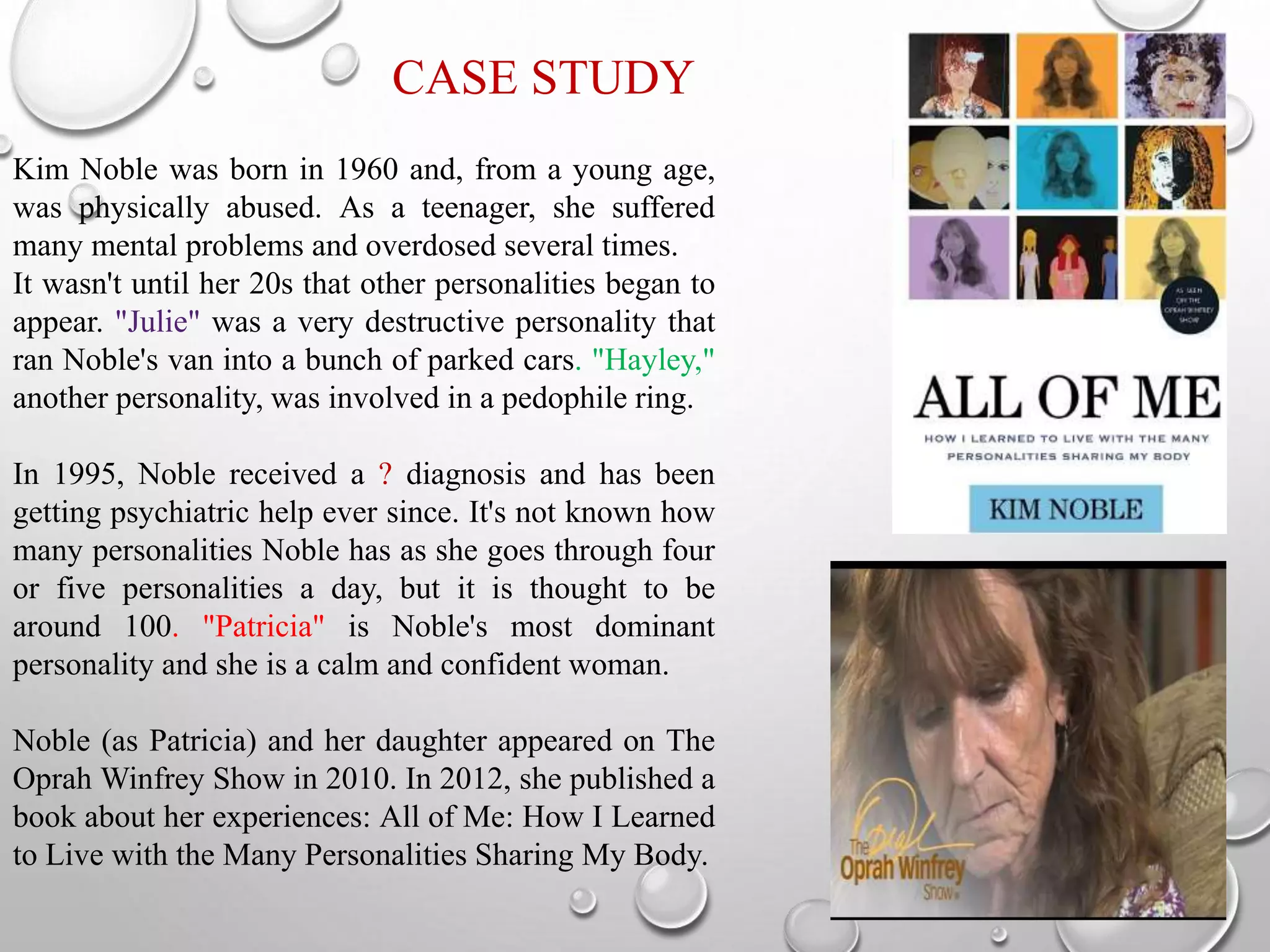
Kim Noblewas born in 1960 and, from a young age,
was physically abused. As a teenager, she suffered
many mental problems and overdosed several times.
It wasn't until her 20s that other personalities began to
appear. "Julie" was a very destructive personality that
ran Noble's van into a bunch of parked cars. "Hayley,"
another personality, was involved in a pedophile ring.
In 1995, Noble received a ? diagnosis and has been
getting psychiatric help ever since. It's not known how
many personalities Noble has as she goes through four
or five personalities a day, but it is thought to be
around 100. "Patricia" is Noble's most dominant
personality and she is a calm and confident woman.
Noble (as Patricia) and her daughter appeared on The
Oprah Winfrey Show in 2010. In 2012, she published a
book about her experiences: All of Me: How I Learned
to Live with the Many Personalities Sharing My Body.
DISSOCIATION
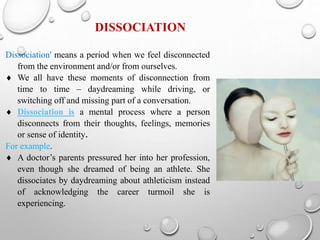
Dissociation' means aperiod when we feel disconnected
from the environment and/or from ourselves.
We all have these moments of disconnection from
time to time – daydreaming while driving, or
switching off and missing part of a conversation.
Dissociation is a mental process where a person
disconnects from their thoughts, feelings, memories
or sense of identity.
For example.
A doctor’s parents pressured her into her profession,
even though she dreamed of being an athlete. She
dissociates by daydreaming about athleticism instead
of acknowledging the career turmoil she is
experiencing.
5.
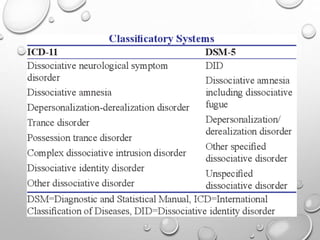
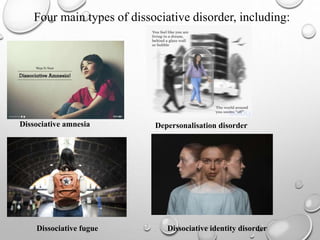
Four main typesof dissociative disorder, including:
Dissociative amnesia
Dissociative fugue
Depersonalisation disorder
Dissociative identity disorder
6.
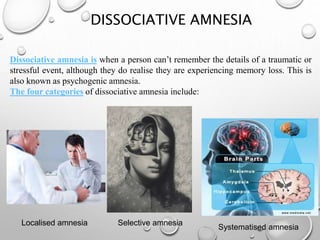
DISSOCIATIVE AMNESIA
Dissociative amnesiais when a person can’t remember the details of a traumatic or
stressful event, although they do realise they are experiencing memory loss. This is
also known as psychogenic amnesia.
The four categories of dissociative amnesia include:
Localised amnesia Selective amnesia
Systematised amnesia
7.
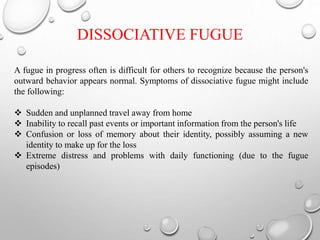
A fugue inprogress often is difficult for others to recognize because the person's
outward behavior appears normal. Symptoms of dissociative fugue might include
the following:
Sudden and unplanned travel away from home
Inability to recall past events or important information from the person's life
Confusion or loss of memory about their identity, possibly assuming a new
identity to make up for the loss
Extreme distress and problems with daily functioning (due to the fugue
episodes)
DISSOCIATIVE FUGUE
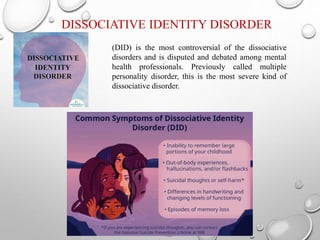
DISSOCIATIVE IDENTITY DISORDER
(DID)is the most controversial of the dissociative
disorders and is disputed and debated among mental
health professionals. Previously called multiple
personality disorder, this is the most severe kind of
dissociative disorder.
10.
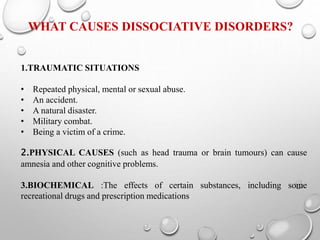
WHAT CAUSES DISSOCIATIVEDISORDERS?
1.TRAUMATIC SITUATIONS
• Repeated physical, mental or sexual abuse.
• An accident.
• A natural disaster.
• Military combat.
• Being a victim of a crime.
2.PHYSICAL CAUSES (such as head trauma or brain tumours) can cause
amnesia and other cognitive problems.
3.BIOCHEMICAL :The effects of certain substances, including some
recreational drugs and prescription medications
11.
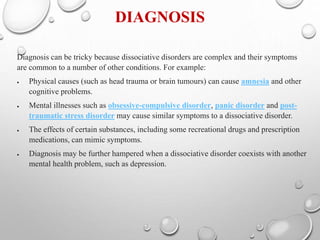
DIAGNOSIS
Diagnosis can betricky because dissociative disorders are complex and their symptoms
are common to a number of other conditions. For example:
Physical causes (such as head trauma or brain tumours) can cause amnesia and other
cognitive problems.
Mental illnesses such as obsessive-compulsive disorder, panic disorder and post-
traumatic stress disorder may cause similar symptoms to a dissociative disorder.
The effects of certain substances, including some recreational drugs and prescription
medications, can mimic symptoms.
Diagnosis may be further hampered when a dissociative disorder coexists with another
mental health problem, such as depression.
12.
TREATMENT
Psychotherapy – alsoknown as ‘talk therapy’ or counselling, which is usually needed for
the long term. Examples include cognitive therapy and psychoanalysis.
Medication – Although there are no medications that specifically treat dissociative
disorders, your doctor may prescribe antidepressants, anti-anxiety medications
or antipsychotic medications to help control the mental health symptoms associated with
dissociative disorders
13.
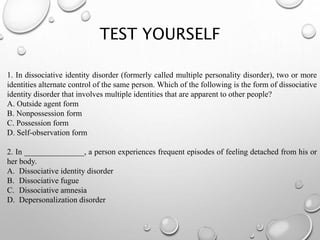
TEST YOURSELF
1. Indissociative identity disorder (formerly called multiple personality disorder), two or more
identities alternate control of the same person. Which of the following is the form of dissociative
identity disorder that involves multiple identities that are apparent to other people?
A. Outside agent form
B. Nonpossession form
C. Possession form
D. Self-observation form
2. In _______________, a person experiences frequent episodes of feeling detached from his or
her body.
A. Dissociative identity disorder
B. Dissociative fugue
C. Dissociative amnesia
D. Depersonalization disorder
14.
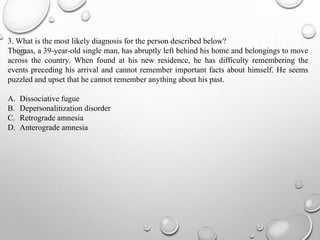
3. What isthe most likely diagnosis for the person described below?
Thomas, a 39-year-old single man, has abruptly left behind his home and belongings to move
across the country. When found at his new residence, he has difficulty remembering the
events preceding his arrival and cannot remember important facts about himself. He seems
puzzled and upset that he cannot remember anything about his past.
A. Dissociative fugue
B. Depersonalitization disorder
C. Retrograde amnesia
D. Anterograde amnesia