DISSOCIATIVE DISORDERS
Introduction
• Dissociation means a period we feel disconnected from the environment
and / or from oneself.
• We all have these moments of dissociation from time to time: day
dreaming while driving or switching off and missing part of the
conversation, for example.
• These moments normally pass quickly.
• Someone with dissociative disorders has persistent, repeated episodes of
dissociation that are extreme enough to severely affect everyday life.
• Defn: Dissociation is a mental process where a person disconnects from
their thoughts, feelings, memories or sense of identity.
• Dissociative disorders include dissociative amnesia, dissociative fugue,
depersonalization disorder and dissociative identity disorder.
• People who experience a traumatic event will often have some degree of
dissociation during the event itself or in the following hours, days, or
weeks.
• For example, the event seems ‘unreal’ or the person feels detached from
what’s going on around them as if watching the event on television.
Symptoms
Symptoms and signs associated with dissociative disorders depend on the type and
severity, but may include:
• Feeling disconnected from self
• Problems with handling intense emotions
• Sudden and un expected shifts in mood eg feeling sad for no reason
• Depression or anxiety problems or both
• Feeling as though the world is distorted or not real (derealisation)
• Memory problems that are not linked to physical injury or medical conditions
• Other cognitive problems such as concentration problems
• Significant memory lapses such as forgetting important personal information
Mental health professionals recognize four main types of dissociative disorders,
including:
• Dissociative amnesia
• Dissociative fugue
• Depersonalization disorder
• Dissociative identity disorder
Dissociative amnesia
• Dissociative amnesia is when a person can’t remember the details of a traumatic or
stressful event, although they do realize they are experiencing a memory loss.
• This is also known as psychogenic amnesia.
• This type of amnesia can last from a few days to one or more years.
• Dissociative amnesia may be linked to other disorders such as an anxiety disorder.
The three categories of dissociative amnesia include:
• Localized amnesia – for a time, the person has no memory of the traumatic event at
all. For example, following an assault a person with localized amnesia may not recall
any detail for a few days
• Selective amnesia – the person has patchy or incomplete memories of the traumatic
event.
• Systematized amnesia – the person may have a very particular and
specific memory loss: for example, they may have no recollection of one
relative.
Dissociative fugue
• Dissociative fugue is also known as psychogenic fugue.
• The person suddenly, and without any warning can’t remember who they
are and no memory of their past.
• They don’t realize they are experiencing memory loss and may invent a
new identity.
• Typically, the person travels from home sometimes over thousands of
kilometers while in fugue which may last between hours and months.
• When the person comes out of their dissociative fugue, they are usually
confused with no recollection of the ‘new life’ they have made for
themselves.
Depersonalization disorder
• Depersonalization disorder is characterized by feeling detached from
one’s life, feelings and thoughts.
• People with this type of disorder say they feel distant and emotionally
unconnected to themselves as if they are watching in a boring movie.
• Other typical symptoms include problems with concentration and
memory.
• The person may report feeling ‘spacey’ or out of control
• Time may slow down
• They may perceive their body to be different shape or size than usual; in
severe cases, they cannot recognize themselves in the mirror.
Dissociative identity disorder
• Dissociative identity disorder (DID) is the most controversial of the
dissociative disorders and is disputed and debated among mental health
professionals.
• Previously called multiple personality, this is the most severe kind of
dissociative disorder.
• The condition typically involves the coexistence of two or more
personality states within the same person.
• While the different personality states influence the person’s behavior, the
person is usually not aware of these personality states and experiences
them as memory lapses.
• The other states may have different body language, voice and tone,
outlook on life and memories.
• The person may switch to another personality state when under stress.
• A person who has dissociative identity disorder almost always has
dissociative amnesia too.
Causes
• Mental health professionals believe that the underlying cause of DD is
chronic trauma in childhood. Examples of trauma include repeated
physical or sexual abuse, emotional abuse or neglect.
• Unpredictable or frightening family environments may also cause the
child to ‘disconnect’ from reality during times of stress.
• It seems the severity of the DD in adulthood is directly related to the
severity of childhood trauma.
• Traumatic events that occur during adulthood may also cause dissociative
disorders. Such events may include war, torture or going through a natural
disaster.
Complications
Without treatment, possible complications of dissociative disorders may include:
• Life difficulties such as broken relationships and job loss
• Sleep problems such as insomnia
• Sexual problems
• Severe depression
• Anxiety disorders
• Eating disorders such as anorexia or bulimia
• Self harm, including suicide.
• Problematic drug use including alcoholism
Diagnosis - DissociativeAmnesia
• A. An inability to recall important autobiographical information, usually
of a traumatic or stressful nature, that is inconsistent with ordinary
forgetting.
Note: Dissociative amnesia most often consists of localized or selective
amnesia for a specific event or events; or generalized amnesia for identity
and life history.
• B. The symptoms cause clinically significant distress or impairment in
social, occupational, or other important areas of functioning.
• C. The disturbance is not attributable to the physiological effects of a
substance (e.g., alcohol or other drug of abuse, a medication) or a
neurological or other medical condition (e.g., partial complex seizures,
transient global amnesia, sequelae of a closed head injury/ traumatic brain
injury, other neurological condition).
• D. The disturbance is not better explained by dissociative identity
disorder, posttraumatic stress disorder, acute stress disorder, somatic
symptom disorder, or major or mild neurocognitive disorder.
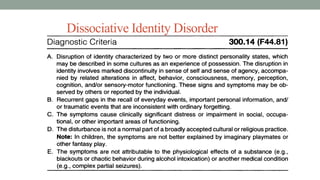
Dissociative Identity Disorder
Treatment
• Safe environment for relaxation
• Psychiatric drugs – barbiturates
• Psychotherapy – talk therapy (counseling)
• Stress mgt since stress can trigger symptoms
• Treatment for other disorders such as depression and anxiety
Obsessive - Compulsive Disorder
• Obsessions are recurrent, persistent, intrusive, and unwanted thoughts,
images, or impulses that cause marked anxiety and interfere with
interpersonal, social, or occupational function.
• The person knows these thoughts are excessive or unreasonable, but believes
he or she has no control over them.
• Compulsions are ritualistic or repetitive behaviors or mental acts that a person
carries out continuously in an attempt to neutralize anxiety.
• Usually, the theme of the ritual is associated with that of the obsession, such as
repetitive hand washing when someone is obsessed with contamination or
repeated prayers or confession for someone obsessed with blasphemous
thoughts.
Obsessions are repeated thoughts, urges, or mental images that cause
anxiety.
Common obsessions are as follows:
• Fear of germs or contamination
• Unwanted forbidden or taboo thoughts involving sex, religion, or harm
• Aggressive thoughts towards self or others
• Having things symmetrical or in a perfect order
Compulsions are repetitive behaviors that a person with OCD feels the urge
to do in response to an obsessive thought. Compulsions often match the
obsession and include the following:
• Excessive cleaning and/or hand washing
• Ordering and arranging things in a particular, precise way
• Repeatedly checking on things, such as repeatedly checking to see if the
door is locked or that the oven is off
• Compulsive counting
• Not all rituals or habits are compulsions; everyone double-checks things sometimes.
• For example, many people double-check that their doors are locked as they exit the
vehicle.
However, a person with OCD generally exhibits the following characteristics:
• Spends at least one hour a day on these thoughts
• Can’t control their thoughts or behaviors, even when those thoughts or behaviors are
recognized as excessive
• Does not experience pleasure when performing the behaviors or rituals, but may feel
relief from the anxiety the obsessive thoughts cause
• Experiences significant problems in their daily life due to these thoughts or
behaviors
• Sometimes compulsions are accompanied by a fear of potential consequences if they
are not carried out.
• For this reason, an individual with OCD may become distressed if not able to
complete a compulsive act.
• People with OCD may try to cope by avoiding situations that trigger their obsessions
or use alcohol or drugs to calm themselves.
• Although most adults with OCD have good insight and recognize what they are doing
doesn’t make sense, some may not realize that their behavior is out of the ordinary
(i.e., they demonstrate “poor insight”).
• Most children do not have good insight into their thoughts and behaviors, so parents
or teachers typically recognize OCD symptoms in children.
Risk Factors
• The causes of OCD are unknown, but risk factors include genetics, brain
structure and functioning, and environmental factors such as adverse
childhood events.
Genetics
• Twin and family studies have shown that people with first-degree relatives
(such as a parent, sibling, or child) who have OCD are at a higher risk for
developing OCD.
• The risk is higher if the first-degree relative developed OCD as a child or
teen.
Brain Structure and Functioning
• Imaging studies have shown differences in the frontal cortex and
subcortical structures of the brain in patients with OCD, but the
connection with symptoms is not clear.
Environment
• Research has found an association between childhood trauma (otherwise
known as adverse childhood events (ACEs) and obsessive-compulsive
symptoms.
Treatment
• OCD is typically treated with medication, psychotherapy, or a
combination of both.
• Although most patients with OCD improve with treatment, some patients
continue to experience symptoms.
• Individuals with OCD may also have other mental health disorders, such
as anxiety, depression, and body dysmorphic disorder (a disorder in which
someone mistakenly believes that a part of their body is abnormal).
• It is important to consider these other comorbid disorders when planning
interventions related to treatment.
Medication
• Selective serotonin reuptake inhibitors (SSRIs) are used to help reduce
OCD symptoms.
• SSRIs often require higher daily doses in the treatment of OCD than of
depression and may take 8 to 12 weeks to start working.
• If symptoms do not improve with SSRIs, research shows that some
patients may respond well to an antipsychotic medication, especially if
they also have a tic disorder.
Psychotherapy
• Psychotherapy can be an effective treatment for adults and children with OCD.
• Research shows that certain types of psychotherapy, including cognitive behavior
therapy (CBT) effective as medication for many individuals.
Psycho-education
In addition to teaching clients about the symptoms of OCD, prescribed medications,
and other treatments, nurses should teach clients how to manage stress and anxiety
associated with OCD:
• Create a consistent sleep schedule
• Make regular exercise a part of routine
• Eat a healthy, balanced diet
• Seek support from trusted family and friends

DISSOCIATIVE DISORDERS with all the notespptx

  • 1.
  • 2.
    Introduction • Dissociation meansa period we feel disconnected from the environment and / or from oneself. • We all have these moments of dissociation from time to time: day dreaming while driving or switching off and missing part of the conversation, for example. • These moments normally pass quickly. • Someone with dissociative disorders has persistent, repeated episodes of dissociation that are extreme enough to severely affect everyday life. • Defn: Dissociation is a mental process where a person disconnects from their thoughts, feelings, memories or sense of identity.
  • 3.
    • Dissociative disordersinclude dissociative amnesia, dissociative fugue, depersonalization disorder and dissociative identity disorder. • People who experience a traumatic event will often have some degree of dissociation during the event itself or in the following hours, days, or weeks. • For example, the event seems ‘unreal’ or the person feels detached from what’s going on around them as if watching the event on television.
  • 4.
    Symptoms Symptoms and signsassociated with dissociative disorders depend on the type and severity, but may include: • Feeling disconnected from self • Problems with handling intense emotions • Sudden and un expected shifts in mood eg feeling sad for no reason • Depression or anxiety problems or both • Feeling as though the world is distorted or not real (derealisation) • Memory problems that are not linked to physical injury or medical conditions • Other cognitive problems such as concentration problems • Significant memory lapses such as forgetting important personal information
  • 5.
    Mental health professionalsrecognize four main types of dissociative disorders, including: • Dissociative amnesia • Dissociative fugue • Depersonalization disorder • Dissociative identity disorder
  • 6.
    Dissociative amnesia • Dissociativeamnesia is when a person can’t remember the details of a traumatic or stressful event, although they do realize they are experiencing a memory loss. • This is also known as psychogenic amnesia. • This type of amnesia can last from a few days to one or more years. • Dissociative amnesia may be linked to other disorders such as an anxiety disorder. The three categories of dissociative amnesia include: • Localized amnesia – for a time, the person has no memory of the traumatic event at all. For example, following an assault a person with localized amnesia may not recall any detail for a few days • Selective amnesia – the person has patchy or incomplete memories of the traumatic event.
  • 7.
    • Systematized amnesia– the person may have a very particular and specific memory loss: for example, they may have no recollection of one relative.
  • 8.
    Dissociative fugue • Dissociativefugue is also known as psychogenic fugue. • The person suddenly, and without any warning can’t remember who they are and no memory of their past. • They don’t realize they are experiencing memory loss and may invent a new identity. • Typically, the person travels from home sometimes over thousands of kilometers while in fugue which may last between hours and months. • When the person comes out of their dissociative fugue, they are usually confused with no recollection of the ‘new life’ they have made for themselves.
  • 9.
    Depersonalization disorder • Depersonalizationdisorder is characterized by feeling detached from one’s life, feelings and thoughts. • People with this type of disorder say they feel distant and emotionally unconnected to themselves as if they are watching in a boring movie. • Other typical symptoms include problems with concentration and memory. • The person may report feeling ‘spacey’ or out of control • Time may slow down • They may perceive their body to be different shape or size than usual; in severe cases, they cannot recognize themselves in the mirror.
  • 10.
    Dissociative identity disorder •Dissociative identity disorder (DID) is the most controversial of the dissociative disorders and is disputed and debated among mental health professionals. • Previously called multiple personality, this is the most severe kind of dissociative disorder. • The condition typically involves the coexistence of two or more personality states within the same person. • While the different personality states influence the person’s behavior, the person is usually not aware of these personality states and experiences them as memory lapses.
  • 11.
    • The otherstates may have different body language, voice and tone, outlook on life and memories. • The person may switch to another personality state when under stress. • A person who has dissociative identity disorder almost always has dissociative amnesia too.
  • 12.
    Causes • Mental healthprofessionals believe that the underlying cause of DD is chronic trauma in childhood. Examples of trauma include repeated physical or sexual abuse, emotional abuse or neglect. • Unpredictable or frightening family environments may also cause the child to ‘disconnect’ from reality during times of stress. • It seems the severity of the DD in adulthood is directly related to the severity of childhood trauma. • Traumatic events that occur during adulthood may also cause dissociative disorders. Such events may include war, torture or going through a natural disaster.
  • 13.
    Complications Without treatment, possiblecomplications of dissociative disorders may include: • Life difficulties such as broken relationships and job loss • Sleep problems such as insomnia • Sexual problems • Severe depression • Anxiety disorders • Eating disorders such as anorexia or bulimia • Self harm, including suicide. • Problematic drug use including alcoholism
  • 14.
    Diagnosis - DissociativeAmnesia •A. An inability to recall important autobiographical information, usually of a traumatic or stressful nature, that is inconsistent with ordinary forgetting. Note: Dissociative amnesia most often consists of localized or selective amnesia for a specific event or events; or generalized amnesia for identity and life history. • B. The symptoms cause clinically significant distress or impairment in social, occupational, or other important areas of functioning.
  • 15.
    • C. Thedisturbance is not attributable to the physiological effects of a substance (e.g., alcohol or other drug of abuse, a medication) or a neurological or other medical condition (e.g., partial complex seizures, transient global amnesia, sequelae of a closed head injury/ traumatic brain injury, other neurological condition). • D. The disturbance is not better explained by dissociative identity disorder, posttraumatic stress disorder, acute stress disorder, somatic symptom disorder, or major or mild neurocognitive disorder.
  • 16.
  • 17.
    Treatment • Safe environmentfor relaxation • Psychiatric drugs – barbiturates • Psychotherapy – talk therapy (counseling) • Stress mgt since stress can trigger symptoms • Treatment for other disorders such as depression and anxiety
  • 18.
    Obsessive - CompulsiveDisorder • Obsessions are recurrent, persistent, intrusive, and unwanted thoughts, images, or impulses that cause marked anxiety and interfere with interpersonal, social, or occupational function. • The person knows these thoughts are excessive or unreasonable, but believes he or she has no control over them. • Compulsions are ritualistic or repetitive behaviors or mental acts that a person carries out continuously in an attempt to neutralize anxiety. • Usually, the theme of the ritual is associated with that of the obsession, such as repetitive hand washing when someone is obsessed with contamination or repeated prayers or confession for someone obsessed with blasphemous thoughts.
  • 19.
    Obsessions are repeatedthoughts, urges, or mental images that cause anxiety. Common obsessions are as follows: • Fear of germs or contamination • Unwanted forbidden or taboo thoughts involving sex, religion, or harm • Aggressive thoughts towards self or others • Having things symmetrical or in a perfect order
  • 20.
    Compulsions are repetitivebehaviors that a person with OCD feels the urge to do in response to an obsessive thought. Compulsions often match the obsession and include the following: • Excessive cleaning and/or hand washing • Ordering and arranging things in a particular, precise way • Repeatedly checking on things, such as repeatedly checking to see if the door is locked or that the oven is off • Compulsive counting
  • 21.
    • Not allrituals or habits are compulsions; everyone double-checks things sometimes. • For example, many people double-check that their doors are locked as they exit the vehicle. However, a person with OCD generally exhibits the following characteristics: • Spends at least one hour a day on these thoughts • Can’t control their thoughts or behaviors, even when those thoughts or behaviors are recognized as excessive • Does not experience pleasure when performing the behaviors or rituals, but may feel relief from the anxiety the obsessive thoughts cause • Experiences significant problems in their daily life due to these thoughts or behaviors
  • 22.
    • Sometimes compulsionsare accompanied by a fear of potential consequences if they are not carried out. • For this reason, an individual with OCD may become distressed if not able to complete a compulsive act. • People with OCD may try to cope by avoiding situations that trigger their obsessions or use alcohol or drugs to calm themselves. • Although most adults with OCD have good insight and recognize what they are doing doesn’t make sense, some may not realize that their behavior is out of the ordinary (i.e., they demonstrate “poor insight”). • Most children do not have good insight into their thoughts and behaviors, so parents or teachers typically recognize OCD symptoms in children.
  • 23.
    Risk Factors • Thecauses of OCD are unknown, but risk factors include genetics, brain structure and functioning, and environmental factors such as adverse childhood events. Genetics • Twin and family studies have shown that people with first-degree relatives (such as a parent, sibling, or child) who have OCD are at a higher risk for developing OCD. • The risk is higher if the first-degree relative developed OCD as a child or teen.
  • 24.
    Brain Structure andFunctioning • Imaging studies have shown differences in the frontal cortex and subcortical structures of the brain in patients with OCD, but the connection with symptoms is not clear. Environment • Research has found an association between childhood trauma (otherwise known as adverse childhood events (ACEs) and obsessive-compulsive symptoms.
  • 25.
    Treatment • OCD istypically treated with medication, psychotherapy, or a combination of both. • Although most patients with OCD improve with treatment, some patients continue to experience symptoms. • Individuals with OCD may also have other mental health disorders, such as anxiety, depression, and body dysmorphic disorder (a disorder in which someone mistakenly believes that a part of their body is abnormal). • It is important to consider these other comorbid disorders when planning interventions related to treatment.
  • 26.
    Medication • Selective serotoninreuptake inhibitors (SSRIs) are used to help reduce OCD symptoms. • SSRIs often require higher daily doses in the treatment of OCD than of depression and may take 8 to 12 weeks to start working. • If symptoms do not improve with SSRIs, research shows that some patients may respond well to an antipsychotic medication, especially if they also have a tic disorder.
  • 27.
    Psychotherapy • Psychotherapy canbe an effective treatment for adults and children with OCD. • Research shows that certain types of psychotherapy, including cognitive behavior therapy (CBT) effective as medication for many individuals. Psycho-education In addition to teaching clients about the symptoms of OCD, prescribed medications, and other treatments, nurses should teach clients how to manage stress and anxiety associated with OCD: • Create a consistent sleep schedule • Make regular exercise a part of routine • Eat a healthy, balanced diet • Seek support from trusted family and friends