Dissertation
Presentation
Nidhi Chauhan
M.sc Nursing Final Year
Government College of Nursing
Jodhpur
Problem statement
“A study to assess the quality of
life of thalassemic children
attending thalassemia day
care unit at Umaid Hospital,
Jodhpur, Rajasthan”
Objectives
• To assess the quality of life of
thalassemic children.
• To associate the quality of life of
thalassemic children with selected
demographic variables.
Hypothesis
• H0- There is no significant association
between quality of life of thalassemic
children and socio-demographic
variables.
• H1- There is significant association
between quality of life of thalassemic
children and socio-demographic
variables.
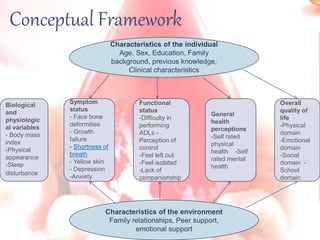
Conceptual Framework
Characteristics of the individual
Age, Sex, Education, Family
background, previous knowledge,
Clinical characteristics
Characteristics of the environment
Family relationships, Peer support,
emotional support
Biological
and
physiologic
al variables
- Body mass
index
-Physical
appearance
-Sleep
disturbance
Symptom
status
- Face bone
deformities
- Growth
failure
- Shortness of
breath
- Yellow skin
- Depression
-Anxiety
Functional
status
-Difficulty in
performing
ADLs -
Perception of
control
-Feel left out
-Feel isolated
-Lack of
companionship
General
health
perceptions
-Self rated
physical
health -Self
rated mental
health
Overall
quality of
life
-Physical
domain
-Emotional
domain
-Social
domain -
School
domain
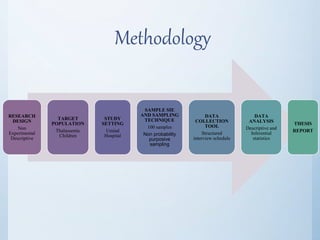
Methodology
RESEARCH
DESIGN
Non
Experimental
Descriptive
TARGET
POPULATION
Thalassemic
Children
STUDY
SETTING
Umiad
Hospital
SAMPLE SIE
AND SAMPLING
TECHNIQUE
100 samples
Non probability
purposive
sampling
DATA
COLLECTION
TOOL
Structured
interview schedule
DATA
ANALYSIS
Descriptive and
Inferential
statistics
THESIS
REPORT
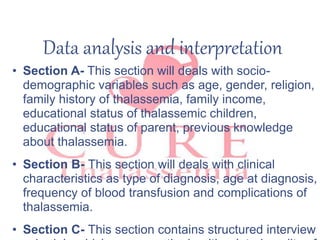
Data analysis and interpretation
• Section A- This section will deals with socio-
demographic variables such as age, gender, religion,
family history of thalassemia, family income,
educational status of thalassemic children,
educational status of parent, previous knowledge
about thalassemia.
• Section B- This section will deals with clinical
characteristics as type of diagnosis, age at diagnosis,
frequency of blood transfusion and complications of
thalassemia.
• Section C- This section contains structured interview
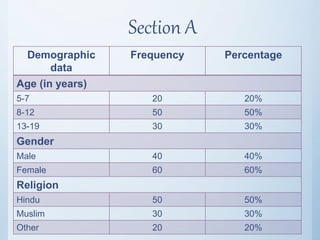
Section A
Demographic
data
Frequency Percentage
Age (in years)
5-7 20 20%
8-12 50 50%
13-19 30 30%
Gender
Male 40 40%
Female 60 60%
Religion
Hindu 50 50%
Muslim 30 30%
Other 20 20%
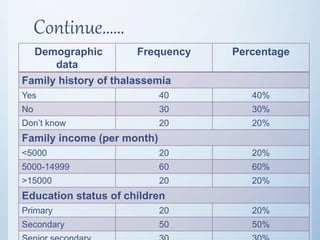
Continue……
Demographic
data
Frequency Percentage
Family history of thalassemia
Yes 40 40%
No 30 30%
Don’t know 20 20%
Family income (per month)
<5000 20 20%
5000-14999 60 60%
>15000 20 20%
Education status of children
Primary 20 20%
Secondary 50 50%
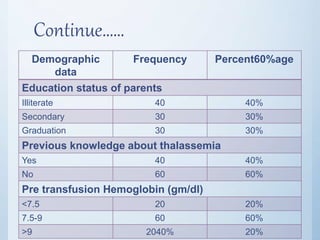
Continue……
Demographic
data
Frequency Percent60%age
Education status of parents
Illiterate 40 40%
Secondary 30 30%
Graduation 30 30%
Previous knowledge about thalassemia
Yes 40 40%
No 60 60%
Pre transfusion Hemoglobin (gm/dl)
<7.5 20 20%
7.5-9 60 60%
>9 2040% 20%
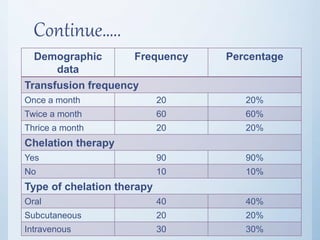
Continue…..
Demographic
data
Frequency Percentage
Transfusion frequency
Once a month 20 20%
Twice a month 60 60%
Thrice a month 20 20%
Chelation therapy
Yes 90 90%
No 10 10%
Type of chelation therapy
Oral 40 40%
Subcutaneous 20 20%
Intravenous 30 30%
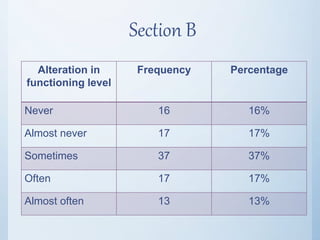
Section B
Alteration in
functioning level
Frequency Percentage
Never 16 16%
Almost never 17 17%
Sometimes 37 37%
Often 17 17%
Almost often 13 13%
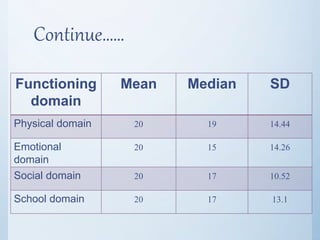
Continue……
Functioning
domain
Mean Median SD
Physical domain 20 19 14.44
Emotional
domain
20 15 14.26
Social domain 20 17 10.52
School domain 20 17 13.1
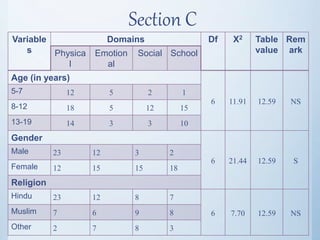
Section C
Variable
s
Domains Df X2 Table
value
Rem
arkPhysica
l
Emotion
al
Social School
Age (in years)
6 11.91 12.59 NS
5-7 12 5 2 1
8-12 18 5 12 15
13-19 14 3 3 10
Gender
6 21.44 12.59 S
Male 23 12 3 2
Female 12 15 15 18
Religion
Hindu 23 12 8 7
6 7.70 12.59 NSMuslim 7 6 9 8
Other 2 7 8 3
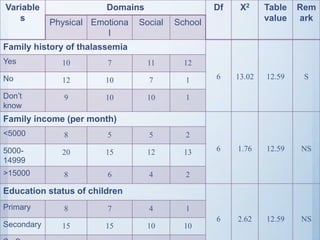
Variable
s
Domains Df X2 Table
value
Rem
arkPhysical Emotiona
l
Social School
Family history of thalassemia
6 13.02 12.59 S
Yes 10 7 11 12
No 12 10 7 1
Don’t
know
9 10 10 1
Family income (per month)
6 1.76 12.59 NS
<5000 8 5 5 2
5000-
14999
20 15 12 13
>15000 8 6 4 2
Education status of children
6 2.62 12.59 NS
Primary 8 7 4 1
Secondary 15 15 10 10
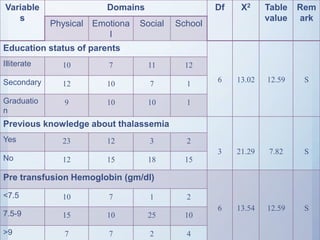
Variable
s
Domains Df X2 Table
value
Rem
ark
Physical Emotiona
l
Social School
Education status of parents
6 13.02 12.59 S
Illiterate 10 7 11 12
Secondary 12 10 7 1
Graduatio
n
9 10 10 1
Previous knowledge about thalassemia
3 21.29 7.82 S
Yes 23 12 3 2
No 12 15 18 15
Pre transfusion Hemoglobin (gm/dl)
6 13.54 12.59 S
<7.5 10 7 1 2
7.5-9 15 10 25 10
>9 7 7 2 4
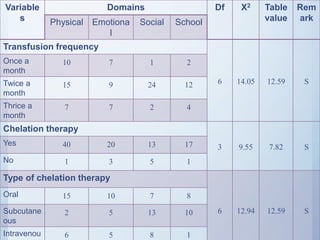
Variable
s
Domains Df X2 Table
value
Rem
arkPhysical Emotiona
l
Social School
Transfusion frequency
6 14.05 12.59 S
Once a
month
10 7 1 2
Twice a
month
15 9 24 12
Thrice a
month
7 7 2 4
Chelation therapy
3 9.55 7.82 SYes 40 20 13 17
No 1 3 5 1
Type of chelation therapy
6 12.94 12.59 S
Oral 15 10 7 8
Subcutane
ous
2 5 13 10
Intravenou 6 5 8 1
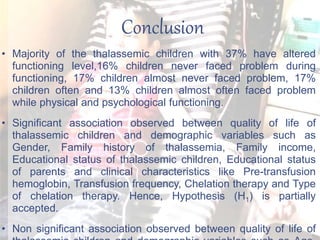
Conclusion
• Majority of the thalassemic children with 37% have altered
functioning level,16% children never faced problem during
functioning, 17% children almost never faced problem, 17%
children often and 13% children almost often faced problem
while physical and psychological functioning.
• Significant association observed between quality of life of
thalassemic children and demographic variables such as
Gender, Family history of thalassemia, Family income,
Educational status of thalassemic children, Educational status
of parents and clinical characteristics like Pre-transfusion
hemoglobin, Transfusion frequency, Chelation therapy and Type
of chelation therapy. Hence, Hypothesis (H1) is partially
accepted.
• Non significant association observed between quality of life of
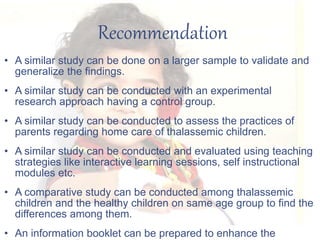
Recommendation
• A similar study can be done on a larger sample to validate and
generalize the findings.
• A similar study can be conducted with an experimental
research approach having a control group.
• A similar study can be conducted to assess the practices of
parents regarding home care of thalassemic children.
• A similar study can be conducted and evaluated using teaching
strategies like interactive learning sessions, self instructional
modules etc.
• A comparative study can be conducted among thalassemic
children and the healthy children on same age group to find the
differences among them.
• An information booklet can be prepared to enhance the
Dissertation  presentation

Dissertation presentation

  • 1.
    Dissertation Presentation Nidhi Chauhan M.sc NursingFinal Year Government College of Nursing Jodhpur
  • 2.
    Problem statement “A studyto assess the quality of life of thalassemic children attending thalassemia day care unit at Umaid Hospital, Jodhpur, Rajasthan”
  • 3.
    Objectives • To assessthe quality of life of thalassemic children. • To associate the quality of life of thalassemic children with selected demographic variables.
  • 4.
    Hypothesis • H0- Thereis no significant association between quality of life of thalassemic children and socio-demographic variables. • H1- There is significant association between quality of life of thalassemic children and socio-demographic variables.
  • 5.
    Conceptual Framework Characteristics ofthe individual Age, Sex, Education, Family background, previous knowledge, Clinical characteristics Characteristics of the environment Family relationships, Peer support, emotional support Biological and physiologic al variables - Body mass index -Physical appearance -Sleep disturbance Symptom status - Face bone deformities - Growth failure - Shortness of breath - Yellow skin - Depression -Anxiety Functional status -Difficulty in performing ADLs - Perception of control -Feel left out -Feel isolated -Lack of companionship General health perceptions -Self rated physical health -Self rated mental health Overall quality of life -Physical domain -Emotional domain -Social domain - School domain
  • 6.
    Methodology RESEARCH DESIGN Non Experimental Descriptive TARGET POPULATION Thalassemic Children STUDY SETTING Umiad Hospital SAMPLE SIE AND SAMPLING TECHNIQUE 100samples Non probability purposive sampling DATA COLLECTION TOOL Structured interview schedule DATA ANALYSIS Descriptive and Inferential statistics THESIS REPORT
  • 7.
    Data analysis andinterpretation • Section A- This section will deals with socio- demographic variables such as age, gender, religion, family history of thalassemia, family income, educational status of thalassemic children, educational status of parent, previous knowledge about thalassemia. • Section B- This section will deals with clinical characteristics as type of diagnosis, age at diagnosis, frequency of blood transfusion and complications of thalassemia. • Section C- This section contains structured interview
  • 8.
    Section A Demographic data Frequency Percentage Age(in years) 5-7 20 20% 8-12 50 50% 13-19 30 30% Gender Male 40 40% Female 60 60% Religion Hindu 50 50% Muslim 30 30% Other 20 20%
  • 9.
    Continue…… Demographic data Frequency Percentage Family historyof thalassemia Yes 40 40% No 30 30% Don’t know 20 20% Family income (per month) <5000 20 20% 5000-14999 60 60% >15000 20 20% Education status of children Primary 20 20% Secondary 50 50%
  • 10.
    Continue…… Demographic data Frequency Percent60%age Education statusof parents Illiterate 40 40% Secondary 30 30% Graduation 30 30% Previous knowledge about thalassemia Yes 40 40% No 60 60% Pre transfusion Hemoglobin (gm/dl) <7.5 20 20% 7.5-9 60 60% >9 2040% 20%
  • 11.
    Continue….. Demographic data Frequency Percentage Transfusion frequency Oncea month 20 20% Twice a month 60 60% Thrice a month 20 20% Chelation therapy Yes 90 90% No 10 10% Type of chelation therapy Oral 40 40% Subcutaneous 20 20% Intravenous 30 30%
  • 12.
    Section B Alteration in functioninglevel Frequency Percentage Never 16 16% Almost never 17 17% Sometimes 37 37% Often 17 17% Almost often 13 13%
  • 13.
    Continue…… Functioning domain Mean Median SD Physicaldomain 20 19 14.44 Emotional domain 20 15 14.26 Social domain 20 17 10.52 School domain 20 17 13.1
  • 14.
    Section C Variable s Domains DfX2 Table value Rem arkPhysica l Emotion al Social School Age (in years) 6 11.91 12.59 NS 5-7 12 5 2 1 8-12 18 5 12 15 13-19 14 3 3 10 Gender 6 21.44 12.59 S Male 23 12 3 2 Female 12 15 15 18 Religion Hindu 23 12 8 7 6 7.70 12.59 NSMuslim 7 6 9 8 Other 2 7 8 3
  • 15.
    Variable s Domains Df X2Table value Rem arkPhysical Emotiona l Social School Family history of thalassemia 6 13.02 12.59 S Yes 10 7 11 12 No 12 10 7 1 Don’t know 9 10 10 1 Family income (per month) 6 1.76 12.59 NS <5000 8 5 5 2 5000- 14999 20 15 12 13 >15000 8 6 4 2 Education status of children 6 2.62 12.59 NS Primary 8 7 4 1 Secondary 15 15 10 10
  • 16.
    Variable s Domains Df X2Table value Rem ark Physical Emotiona l Social School Education status of parents 6 13.02 12.59 S Illiterate 10 7 11 12 Secondary 12 10 7 1 Graduatio n 9 10 10 1 Previous knowledge about thalassemia 3 21.29 7.82 S Yes 23 12 3 2 No 12 15 18 15 Pre transfusion Hemoglobin (gm/dl) 6 13.54 12.59 S <7.5 10 7 1 2 7.5-9 15 10 25 10 >9 7 7 2 4
  • 17.
    Variable s Domains Df X2Table value Rem arkPhysical Emotiona l Social School Transfusion frequency 6 14.05 12.59 S Once a month 10 7 1 2 Twice a month 15 9 24 12 Thrice a month 7 7 2 4 Chelation therapy 3 9.55 7.82 SYes 40 20 13 17 No 1 3 5 1 Type of chelation therapy 6 12.94 12.59 S Oral 15 10 7 8 Subcutane ous 2 5 13 10 Intravenou 6 5 8 1
  • 18.
    Conclusion • Majority ofthe thalassemic children with 37% have altered functioning level,16% children never faced problem during functioning, 17% children almost never faced problem, 17% children often and 13% children almost often faced problem while physical and psychological functioning. • Significant association observed between quality of life of thalassemic children and demographic variables such as Gender, Family history of thalassemia, Family income, Educational status of thalassemic children, Educational status of parents and clinical characteristics like Pre-transfusion hemoglobin, Transfusion frequency, Chelation therapy and Type of chelation therapy. Hence, Hypothesis (H1) is partially accepted. • Non significant association observed between quality of life of
  • 19.
    Recommendation • A similarstudy can be done on a larger sample to validate and generalize the findings. • A similar study can be conducted with an experimental research approach having a control group. • A similar study can be conducted to assess the practices of parents regarding home care of thalassemic children. • A similar study can be conducted and evaluated using teaching strategies like interactive learning sessions, self instructional modules etc. • A comparative study can be conducted among thalassemic children and the healthy children on same age group to find the differences among them. • An information booklet can be prepared to enhance the