Educational
Reforms in
India
Participants :
(HU-481)
ABIR LAL PAL (Roll No- 17600114001)
ANKITA DAS (Roll No-17600114003)
ARNAB DAS (Roll No-17600114009)
AVIJIT GHOSH (Roll No-17600114011)
DIBYENDU DAS (Roll No-17600114013)
MRINMAY SARKAR (Roll No-17600114016)
CSE 2ND YEAR
Batch- 2014-15
Index :
Introduction.
Importance of Education.
Few contemporary Educational Reforms.
Merits and De-Merits of these Reforms.
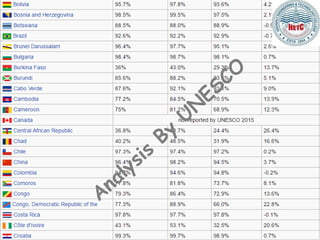
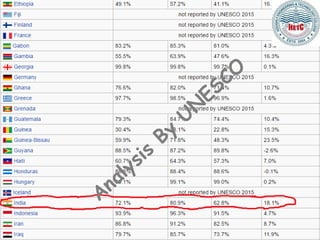
Statistical Analysis by UNESCO.
Suggested Developments.
Conclusion.
Bibliography.
Acknowledgement.
Introduction :
Every established system in the country
always attracts severe criticism. The Indian
Education system especially has been the target
of many allegations from students, parents and
teachers. Students think they are overburdened,
teachers think they are not paid enough and
parents want their children to get 99.99
percentage. Where does the buck stop?
Yes, in recent times there have been some
steps taken on education reforms, but it needs
lot more than that.
Importance of Education
• Enabling the person to deal with life as a whole.
• Become a Human.
• Leading an Independent Life.
• Lessons of Equality.
• Development of social life.
• Leads to Inner freedom.
• Procure a job.
• Social and Physical Development.
Importance of Education
• To earn a living.
• Professional skills.
• A key to success.
• Education for peace.
• Maturity & Integration of personality.
• Harmonious Development.
• Modifications of behavior.
• Promote Democracy.
Few Contemporary
Educational Reforms
Abolition of pass fail policy till 8th standard.
Introduction of gradation system.
Introduction of smart classrooms.
Initiation of Distance Education Policy.
Emerging new branches of education.
Abolition of Pass, Fail Policy
This is a very sensitive topic to discuss. It has both
its own merits and demerits.
Merits
 No confidence loss in the students. This is
important because the students at grade 8 are
really too young to face a failure. I don't think they
can understand a failure at such a small age.
 And this also can reduce the illiteracy rate.
 It can help the child to recover and improve in
studies instead of pointing out that he/she has
failed and exposing the child to a mental turmoil at
such an young age.
Abolition of Pass, Fail Policy
De-Merits
 The worse thing about this could be complacency. If
no one failed, no one would even bother to learn.
 These higher school lessons are the basic
foundations of the higher studies. One needs to be
strong in these subjects which have very basic
concepts of further studies. If a person ignores how
to add, subtract, then it is obvious that he/she will
go no where in education.
 There remains no scope for the child to know
his/her potentials since there is no continuous
evaluation process.
Introduction of Gradation
System
Merits
It considerably reduces inter and intra
examiner’s variability in marking.
It also takes care of imperfection of tools used
for assessment.
The fear of examination is not there in the
minds of students.
The suicide rate had decreased due to the
introduction of grade system.
Introduction of Gradation
System
De-Merits
It is quite discouraging for the meritorious
students.
It defeats the whole concept of studying hard and
getting good marks.
It cannot set the right parameter to judge a
student’s performance.
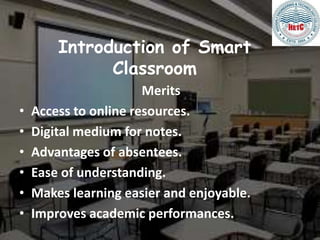
Introduction of Smart
Classroom
Merits
• Access to online resources.
• Digital medium for notes.
• Advantages of absentees.
• Ease of understanding.
• Makes learning easier and enjoyable.
• Improves academic performances.
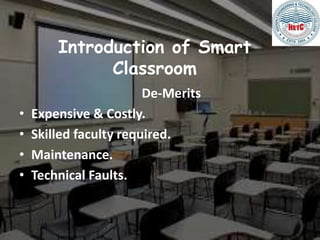
Introduction of Smart
Classroom
De-Merits
• Expensive & Costly.
• Skilled faculty required.
• Maintenance.
• Technical Faults.
Initiation of Distance Education
Policy
Merits
• Provides for an increase in Access to education for
those who otherwise have no other opportunities
due to work, family or physical limitations.
• Greater flexibility for scheduling learning-Students
can determine time and place of "class time".
• Facilitates greater learner-instructor interaction.
• Access to global resources and experts via internet
communication and Internet resources.
• Centralized resources can produce higher quality
materials for distribution.
Initiation of Distance Education
Policy
De-Merits
• Student must be more active and self-directed in
learning environment -Depends on individual
motivation and initiative .
• Distance Education is not for everyone.- It is not for
undisciplined learners nor inflexible instructors.
• Demands large effort to create and maintain the
technological infrastructure.
• Demands large effort and cost to develop appropriate
materials .
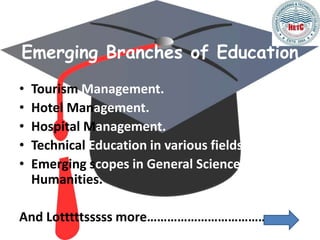
Emerging Branches of Education
• Tourism Management.
• Hotel Management.
• Hospital Management.
• Technical Education in various fields.
• Emerging scopes in General Science &
Humanities.
And Lotttttsssss more……………………………….
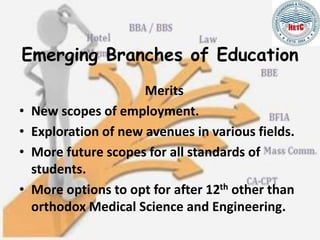
Emerging Branches of Education
Merits
• New scopes of employment.
• Exploration of new avenues in various fields.
• More future scopes for all standards of
students.
• More options to opt for after 12th other than
orthodox Medical Science and Engineering.
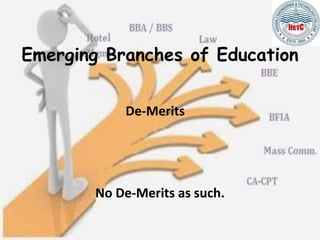
Emerging Branches of Education
De-Merits
No De-Merits as such.
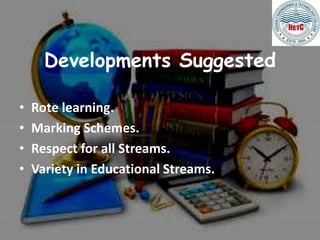
Developments Suggested
• Rote learning.
• Marking Schemes.
• Respect for all Streams.
• Variety in Educational Streams.
Conclusion
In this presentation we have journeyed through
various phases of Educational System in India
and analyzed about various modern reforms
that have changed the face of Educational
System completely in India. We have also
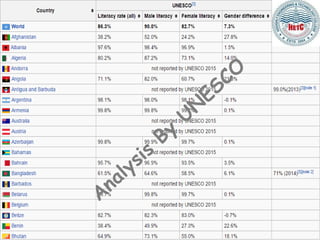
analyzed the reports of UNESCO of the literacy
rate of various countries of the world.
And, have suggested developments required for
the betterment of the present scenario.
Bibliography
www.google.co.in
www.wikipedia.org
ourworldindata.org
www.uis.unesco.org
Acknowledgement
• We have taken our best efforts in this project.
However, it would not have been possible without
the kind support and help of every individual
members of our group. We would like to extend our
sincere thanks to all of them.
• We are highly indebted to our reverend Madam Ms.
Tamoghna Datta for her guidance and constant
supervision as well as for providing necessary
information regarding the project & also for her
support in completing the project.
• Our thanks and appreciations also goes to our
comates in developing the project and people who
have willingly helped us out with their abilities.
PRESENTEDBY:
ABIR LAL PAL (ROLL NO- 01)
ANKITA DAS (ROLL NO- 03)
ARNAB DAS (ROLL NO- 09)
AVIJIT GHOSH(ROLL NO- 11)
DIBYENDU DAS(ROLL NO- 13)
MRINMAY SARKAK(ROLL NO- 16)
CSE 2ND YEAR (2014 - 2015)

Educational Reforms Of INDIA ppt

  • 1.
  • 2.
    Participants : (HU-481) ABIR LALPAL (Roll No- 17600114001) ANKITA DAS (Roll No-17600114003) ARNAB DAS (Roll No-17600114009) AVIJIT GHOSH (Roll No-17600114011) DIBYENDU DAS (Roll No-17600114013) MRINMAY SARKAR (Roll No-17600114016) CSE 2ND YEAR Batch- 2014-15
  • 3.
    Index : Introduction. Importance ofEducation. Few contemporary Educational Reforms. Merits and De-Merits of these Reforms. Statistical Analysis by UNESCO. Suggested Developments. Conclusion. Bibliography. Acknowledgement.
  • 4.
    Introduction : Every establishedsystem in the country always attracts severe criticism. The Indian Education system especially has been the target of many allegations from students, parents and teachers. Students think they are overburdened, teachers think they are not paid enough and parents want their children to get 99.99 percentage. Where does the buck stop? Yes, in recent times there have been some steps taken on education reforms, but it needs lot more than that.
  • 5.
    Importance of Education •Enabling the person to deal with life as a whole. • Become a Human. • Leading an Independent Life. • Lessons of Equality. • Development of social life. • Leads to Inner freedom. • Procure a job. • Social and Physical Development.
  • 6.
    Importance of Education •To earn a living. • Professional skills. • A key to success. • Education for peace. • Maturity & Integration of personality. • Harmonious Development. • Modifications of behavior. • Promote Democracy.
  • 7.
    Few Contemporary Educational Reforms Abolitionof pass fail policy till 8th standard. Introduction of gradation system. Introduction of smart classrooms. Initiation of Distance Education Policy. Emerging new branches of education.
  • 8.
    Abolition of Pass,Fail Policy This is a very sensitive topic to discuss. It has both its own merits and demerits. Merits  No confidence loss in the students. This is important because the students at grade 8 are really too young to face a failure. I don't think they can understand a failure at such a small age.  And this also can reduce the illiteracy rate.  It can help the child to recover and improve in studies instead of pointing out that he/she has failed and exposing the child to a mental turmoil at such an young age.
  • 9.
    Abolition of Pass,Fail Policy De-Merits  The worse thing about this could be complacency. If no one failed, no one would even bother to learn.  These higher school lessons are the basic foundations of the higher studies. One needs to be strong in these subjects which have very basic concepts of further studies. If a person ignores how to add, subtract, then it is obvious that he/she will go no where in education.  There remains no scope for the child to know his/her potentials since there is no continuous evaluation process.
  • 10.
    Introduction of Gradation System Merits Itconsiderably reduces inter and intra examiner’s variability in marking. It also takes care of imperfection of tools used for assessment. The fear of examination is not there in the minds of students. The suicide rate had decreased due to the introduction of grade system.
  • 11.
    Introduction of Gradation System De-Merits Itis quite discouraging for the meritorious students. It defeats the whole concept of studying hard and getting good marks. It cannot set the right parameter to judge a student’s performance.
  • 12.
    Introduction of Smart Classroom Merits •Access to online resources. • Digital medium for notes. • Advantages of absentees. • Ease of understanding. • Makes learning easier and enjoyable. • Improves academic performances.
  • 13.
    Introduction of Smart Classroom De-Merits •Expensive & Costly. • Skilled faculty required. • Maintenance. • Technical Faults.
  • 14.
    Initiation of DistanceEducation Policy Merits • Provides for an increase in Access to education for those who otherwise have no other opportunities due to work, family or physical limitations. • Greater flexibility for scheduling learning-Students can determine time and place of "class time". • Facilitates greater learner-instructor interaction. • Access to global resources and experts via internet communication and Internet resources. • Centralized resources can produce higher quality materials for distribution.
  • 15.
    Initiation of DistanceEducation Policy De-Merits • Student must be more active and self-directed in learning environment -Depends on individual motivation and initiative . • Distance Education is not for everyone.- It is not for undisciplined learners nor inflexible instructors. • Demands large effort to create and maintain the technological infrastructure. • Demands large effort and cost to develop appropriate materials .
  • 16.
    Emerging Branches ofEducation • Tourism Management. • Hotel Management. • Hospital Management. • Technical Education in various fields. • Emerging scopes in General Science & Humanities. And Lotttttsssss more……………………………….
  • 17.
    Emerging Branches ofEducation Merits • New scopes of employment. • Exploration of new avenues in various fields. • More future scopes for all standards of students. • More options to opt for after 12th other than orthodox Medical Science and Engineering.
  • 18.
    Emerging Branches ofEducation De-Merits No De-Merits as such.
  • 22.
    Developments Suggested • Rotelearning. • Marking Schemes. • Respect for all Streams. • Variety in Educational Streams.
  • 23.
    Conclusion In this presentationwe have journeyed through various phases of Educational System in India and analyzed about various modern reforms that have changed the face of Educational System completely in India. We have also analyzed the reports of UNESCO of the literacy rate of various countries of the world. And, have suggested developments required for the betterment of the present scenario.
  • 24.
  • 25.
    Acknowledgement • We havetaken our best efforts in this project. However, it would not have been possible without the kind support and help of every individual members of our group. We would like to extend our sincere thanks to all of them. • We are highly indebted to our reverend Madam Ms. Tamoghna Datta for her guidance and constant supervision as well as for providing necessary information regarding the project & also for her support in completing the project. • Our thanks and appreciations also goes to our comates in developing the project and people who have willingly helped us out with their abilities.
  • 26.
    PRESENTEDBY: ABIR LAL PAL(ROLL NO- 01) ANKITA DAS (ROLL NO- 03) ARNAB DAS (ROLL NO- 09) AVIJIT GHOSH(ROLL NO- 11) DIBYENDU DAS(ROLL NO- 13) MRINMAY SARKAK(ROLL NO- 16) CSE 2ND YEAR (2014 - 2015)