Dissertation
on
“Improved Load Balancing technique for Secure data in Cloud”
Submitted By
“ Vrushali T. Lanjewar”
(M.E 2nd Year )
To
Prof. V. M. Thakare Prof. R. V. Dharaskar
(H.O.D) (Guide)
P.G Department of Computer Science & Engineering
Sant Gadge Baba Amravati University, 444604
Contents
• Introduction
• Research issues
• Problem Statement
• Aims
• Objectives
• Existing Methodologies
• Proposed Methodology
• Implementation
• Tools
• Advantages
• Limitations
• Conclusion
• Future scope
• References
Introduction
• Cloud computing
Cloud computing is an on demand service in
which shared resources, information, software and
other devices are provided according to the clients
requirement at specific time.
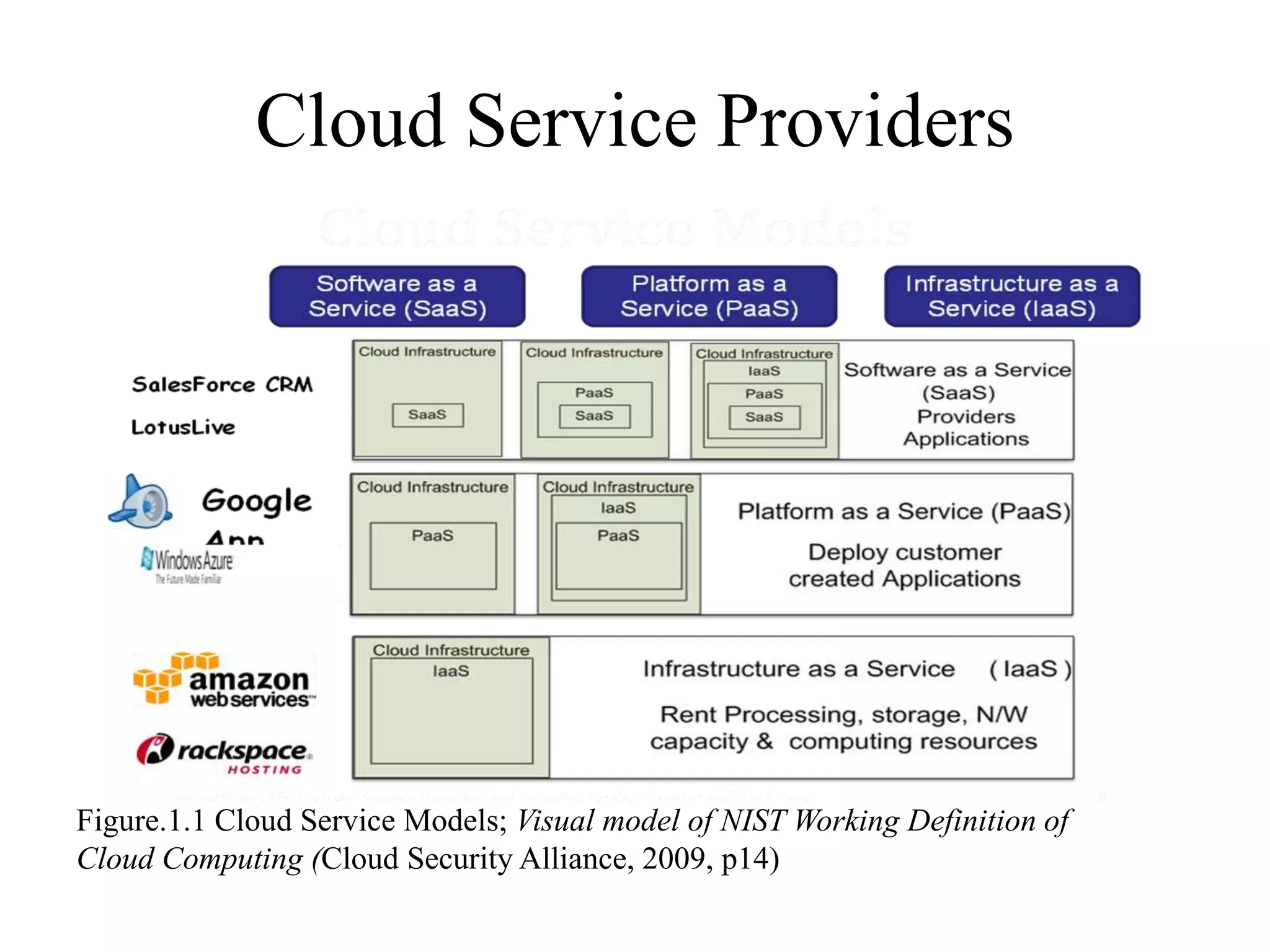
NIST defines the Cloud Computing architecture by
describing five essential characteristics, three
cloud services models and four cloud deployment
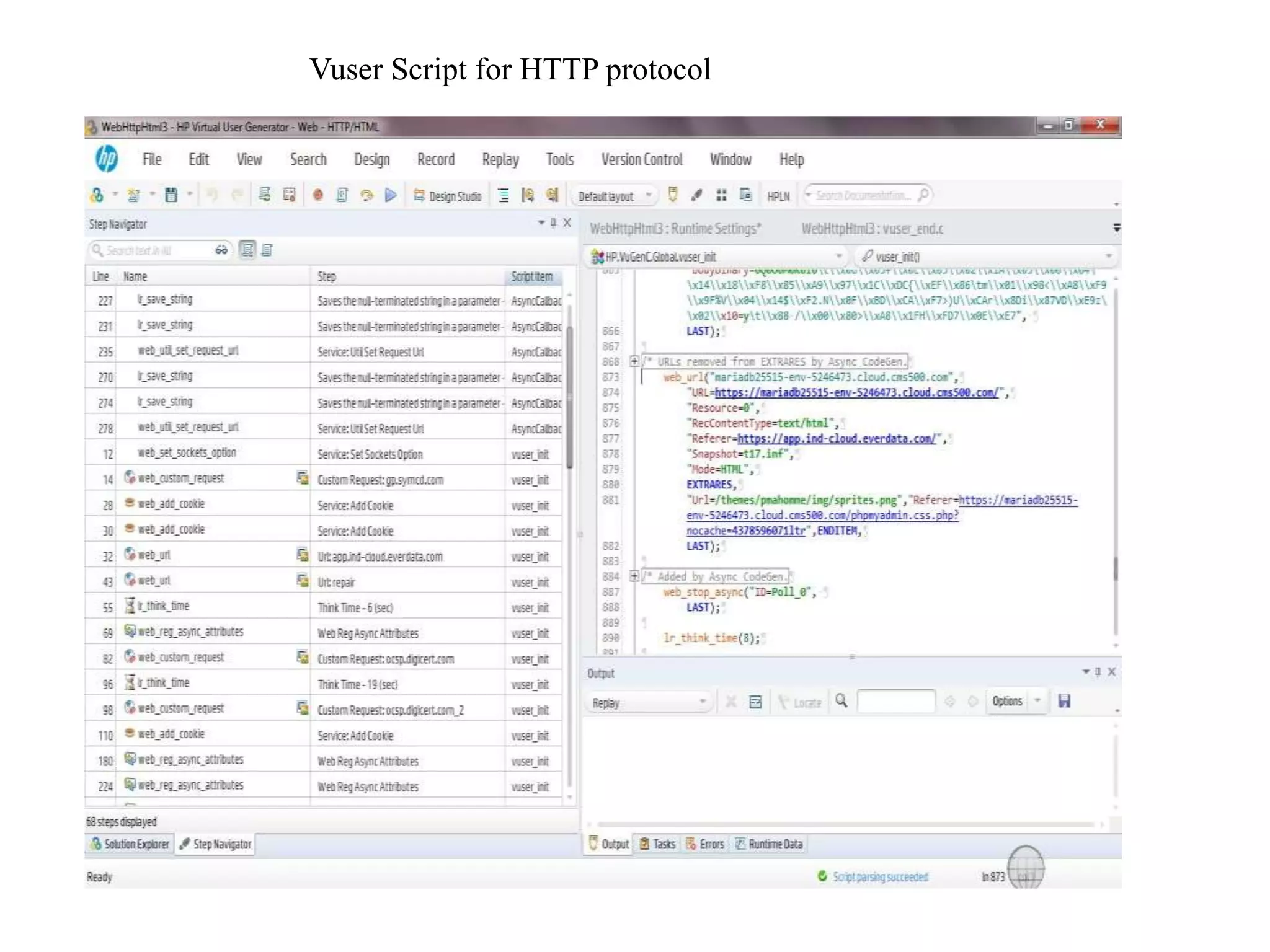
models (Cloud Security Alliance, 2009, p14)
Cloud Service Providers
Figure.1.1 Cloud Service Models; Visual model of NIST Working Definition of
Cloud Computing (Cloud Security Alliance, 2009, p14)
• Jelastic Cloud Platform- PaaS
•Amazon Web Services- IaaS
• Windows Azure- PaaS
• HP Cloud
• OpenShift by Red Hat
• Citrix Cloud Platform
•IBM –Bluemix IaaS, PaaS
•DigitalOcean IaaS, PaaS
1. Public cloud: They gain the benefits of that pay-as-you-go
services so you only pay for what you use.
2. Private cloud:
(i) on-premise private clouds and (ii) externally hosted private clouds.
These chained-in, restrained cloud environments are protected behind
a firewall.
3. Hybrid cloud: Hybrid clouds are a combination of public and
private cloud .
4. Managed cloud: Managed clouds are provided by a designated
service provider and may offer either a dedicated or shared operating
environment.
Cloud Service Deployment and
Consumption Models
Load Balancing
• Load balancing is a relatively new technique that
facilitates networks and resources by providing a
maximum throughput with minimum response time.
• Dividing the traffic between servers, data can be
sent and received without major delay.
• Without load balancing, users could experience
delays, timeouts and possible long system responses.
Research Issues
• Unbalancing problem
• Load rebalancing problem
• Load balance problem and privacy-preserving
• Virtualization and authorization
• Data privacy and access control
• Data security
• Data Integrity
Problem Statement
• Load balancing is the issue in cloud
computing.
• The load imbalance problem may arise even
due to the failure of the node.
•Work load control is crucial to improve system
performance and maintain stability.
The problem work out here is to providing
security to the data stored in cloud.
Aim
The main aim of the proposed scheme includes resource
utilization, access control, data confidentiality, traceability
and efficiency in cloud environment .
• Cost effectiveness: Load balancing help to provide better
system performance at lower cost.
• Scalability and flexibility: The system for which load
balancing algorithms are implemented may be change in
size after some time. So the algorithm/model must handle
these types’ situations.
Objectives
• The main goal of load balancing is to achieve
route the requests among the web servers with a
minimum response time.
• To provides availability of data by overcoming
many existing problem like denial of services,
data leakage.
• To control over the continuous data updation and
also provide more flexibility and capability to
meet the new demand of today’s complex and
diverse network .
Existing Methodologies
Iterative Load Balancer:
• The problem of load balance for deploying ORAM-
based storage in clouds a tree-based ORAM structure,
and a set of storage servers, LB for deploying ORAM
in Cloud problem seeks a data placement such that
the maximum access load among all servers is
minimized.
• To overcome this difficulty, author propose a low-
complexity algorithm called ILB(Iterative Load
Balancer)to iteratively place buckets on servers, such
that only need to deal with a small-scale line are
programming in each iteration. [7]
Weighted round robin load balancing:
•(WRR) is a common routing policy offered in cloud load balancers.
However, there is a lack of effective mechanisms to decide the
weights assigned to each server to achieve overall optimal revenue of
the system.
•The relations between probabilistic routing (PR) and weighted round
robin (WRR) policies and introduce the result of the algorithms
under different number of users classes.
•The advantage of the heuristic algorithm is that it is independent of
the number of requests Nr for each class and it has been proved to
achieve an optimality ratio of 1+1/(M−1) under heavy load, thus it
gets closer to optimality with increasing number of VMs.[8]
Kerberos Model:
• To secure sensitive data Kerberos is used
for a user process protection method
based on a virtual machine monitor. The
basic set up of Kerberos protocol is as
shown.
 The Kerberos server consists of an
Authentication Server (AS) and a Ticket
Granting Server (TGS). The AS and
TGS are responsible for creating and
issuing tickets to the clients upon
request. The AS and TGS usually run on
the same computer, and are collectively
known as the Key Distribution Center
(KDC). [25] Fig. Kerberos protocol
Proposed Methodology
 In this architecture, a load balancer is used to split the file into
chunks in order to store the data in various nodes as shown in
fig .
 When the server control performs operations on data like
deletion or updation load imbalance problem occurs.
 This problem can be solved by the load balancer which
balances the load in the cloud after the above operations
performed.
 The data to be stored in the cloud is encrypted before storage
for more security. The encryption is done by the key generated
at the client side. Then data is made into chunks and stored in
various nodes (using Kerberos authentication)
Multi-cloud feature provides the ability to achieve higher
availability through geo-distribution among different data centers or
clouds, easily relocate the projects to the superior hardware with the
help of environment migration, choose between higher quality or
more cost affordable hardware and host applications with the trusted
cloud vendors.
Fig. Proposed architecture of Cluster with multiple nodes for pubic cloud
Cloudlet
At Jelastic Platform, consumed by container resources are measured in
cloudlets a special measurement unit, which includes 128 MB of RAM and
400 MHz of CPU power simultaneously.
Cloudlet Types
• Reserved
• Dynamic
• Reserved Cloudlets these ones are reserved in
advance and will be charged irrespective of your
actual resource usage.
• Dynamic Cloudlets are added & removed
automatically according to the amount of
resources that are required by your application in
a particular moment of time.
Reasons to choose Software load
balancer
• Once upon a time, load balancing in most application stacks
was heavily dependent on hardware. More modern
virtualized and cloud-based infrastructures offer increased
agility and scalability at a lower cost, but are frequently
plagued by compromised performance.
• Features and functionality are meaningless if applications
can’t perform. And, for companies still relying on hardware-
based application delivery controllers (ADCs) or load
balancers, application performance and scalability could be
a serious issue.
• Software load balancers – like NGINX might be the best
news for the applications and business at large.
NGINX Web Server and
Load Balancer
• Ngnix is an free, open-source HTTP server characterized
by its small footprint, exceptional performance and
efficient use of resources.
• Ngnix is one of the web servers are already
widely used and increasingly compete with
the Apache web server.
• Round robin - default;
• Least connected - used when least number of active
connection.
• Load balancing with https enabled for websites which
enforces encryption to all connections including load
balancer.
Round Robin
• Round Robin works best when the characteristics of the servers and
requests are unlikely to cause some servers to become overloaded
relative to others. Some of the conditions are:
• All the servers have about the same capacity. This requirement is less
important if differences between servers are accurately represented by
server weights.
• All the servers host the same content.
• Requests are pretty similar in the amount of time or processing power
they require. If there’s a wide variation in request weight, a server can
become overloaded because the load balancer happens to send it a lot
of heavyweight requests in quick succession.
• Traffic volume is not heavy enough to push servers to near full
capacity very often. If servers are already heavily loaded, it’s more
likely that Round Robin’s rote distribution of requests will lead to
push some servers “over the edge” into overload as described in the
previous bullet.
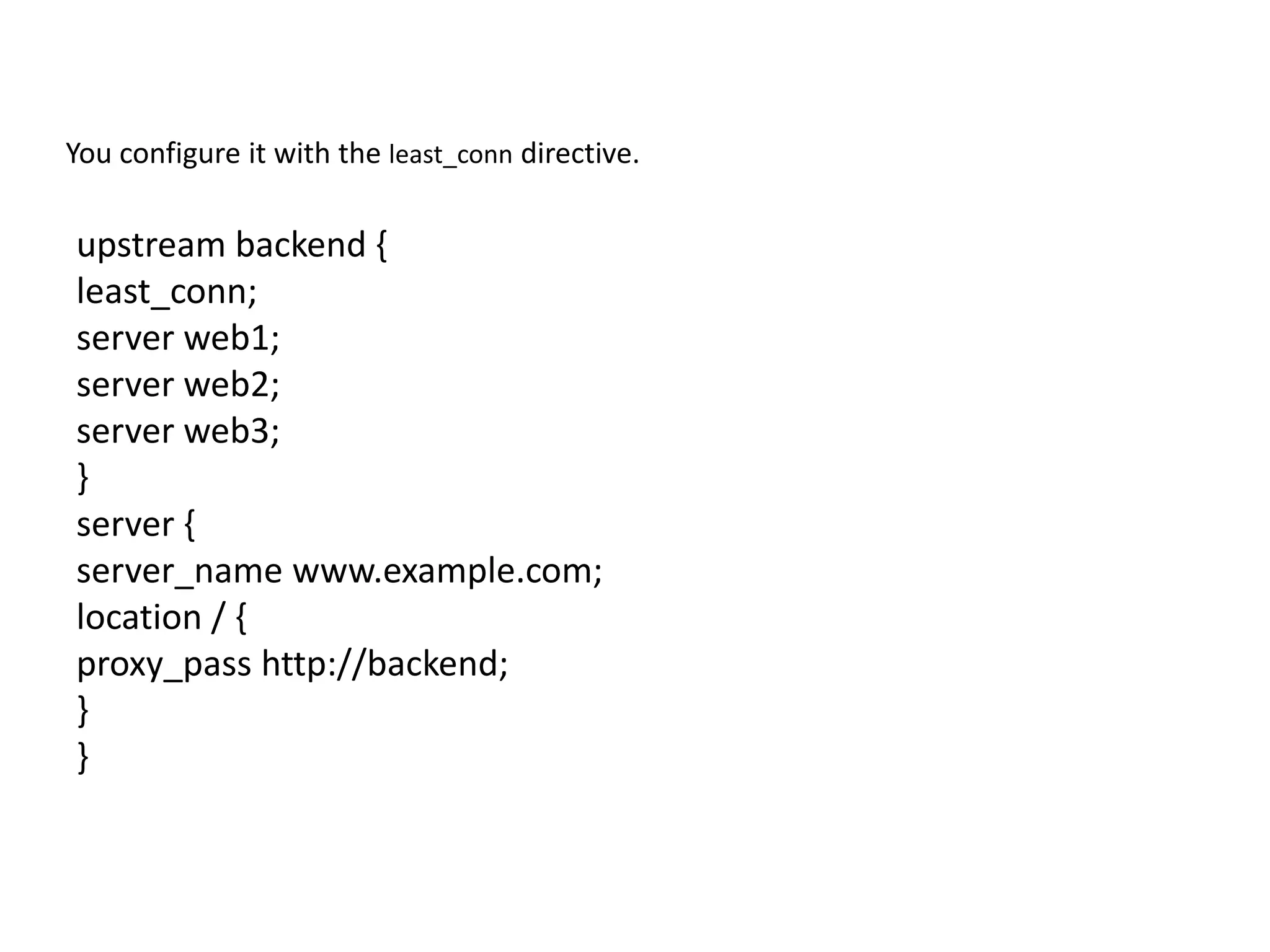
• Given the following sample configuration of the backend upstream group,
the load balancer sends the first three connection requests
to web1, web2, and web3 in order, the fourth to web1, the fifth to web2,
and so on.
upstream backend {
server web1;
server web2;
server web3;
}
server {
server_name www.example.com;
location / {
proxy_pass http://backend;
}
}
Least Connections
• Least Connections also effectively distributes workload
across servers according to their capacity.
• A more powerful server fulfills requests more quickly,
so at any given moment it’s likely to have a smaller
number of connections still being processed (or even
waiting for processing to start) than a server with less
capacity.
• Least Connections sends each request to the server with
the smallest number of current connections, and so is
more likely to send requests to powerful servers.
upstream backend {
least_conn;
server web1;
server web2;
server web3;
}
server {
server_name www.example.com;
location / {
proxy_pass http://backend;
}
}
You configure it with the least_conn directive.
Kerberos provides data confidentiality,
authentication and integrity services
• Windows 2000, XP and Windows Server 2003 all
include the Kerberos extensions that can be used
to provide data confidentiality, authentication and
integrity for messages that are sent after the initial
Kerberos exchange.
• These extensions are known as the KRB_PRIV
(providing data confidentiality) and the
KRB_SAFE (providing data authentication and
integrity) Kerberos extensions.
Implementation
• The proposed a load balancing algorithm which will
transfer the load to another server in cloud when the
current server is overloaded. When the multiple request
are arrived to allocate the resource at server in cloud
environment, the server gets overloaded at some instance.
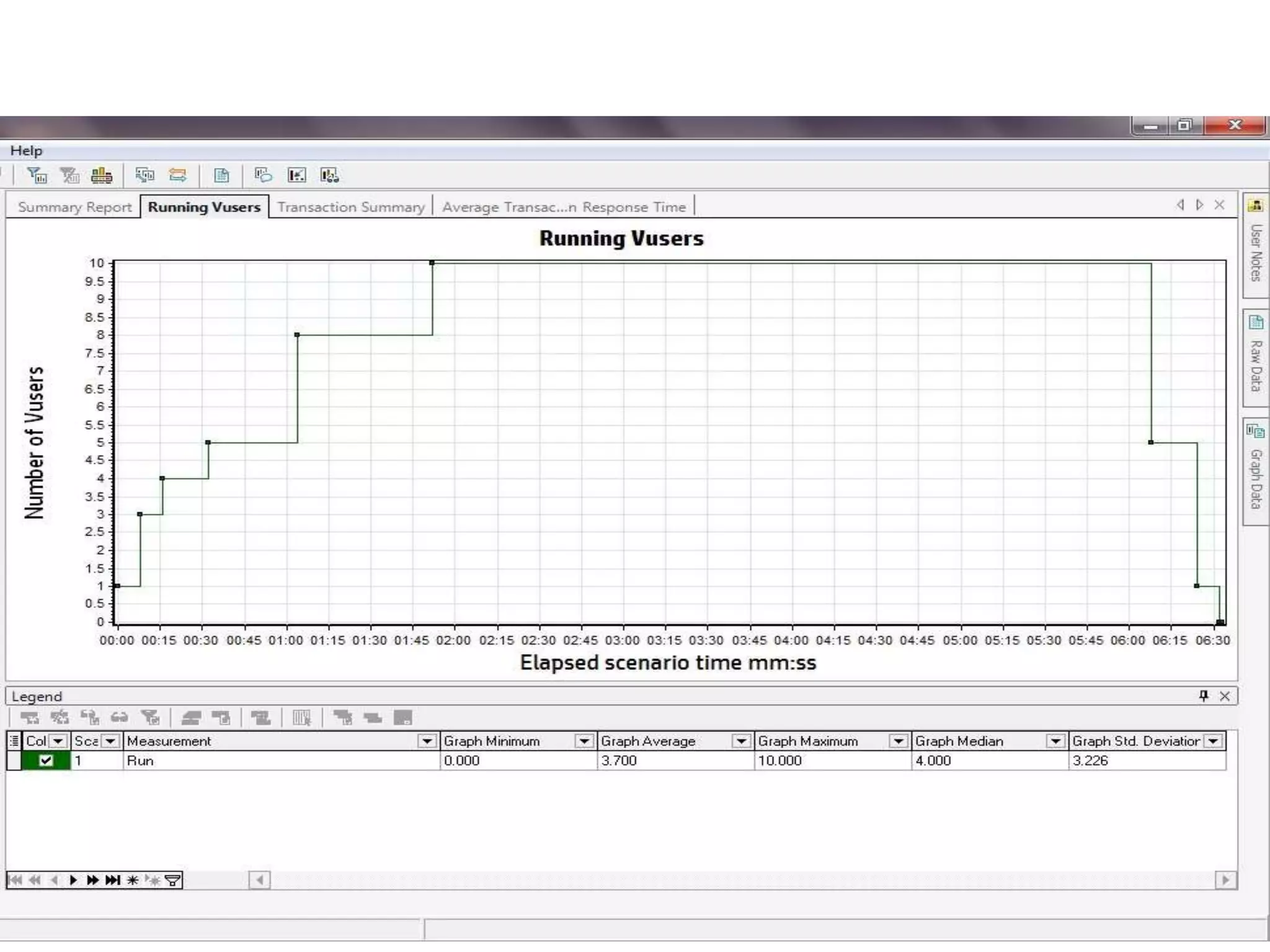
• Step1: Load Testing Module - HP LoadRunner tool will
behave as the client for the websites/ single or multiple
protocols HTTP, FTP, SMTP etc., web services, where we
can test, monitor, analyze as well as control the load
through real world transactions of data.
- User Scripts: The actions that a Vuser performs during the
scenario are described in a Vuser script. When a scenario
is executed, each Vuser executes a Vuser script.
- Transactions: To measure the performance of
the server, transactions are defined.
Transactions measure the time that it takes for
the server to respond to tasks submitted by
Vuser.
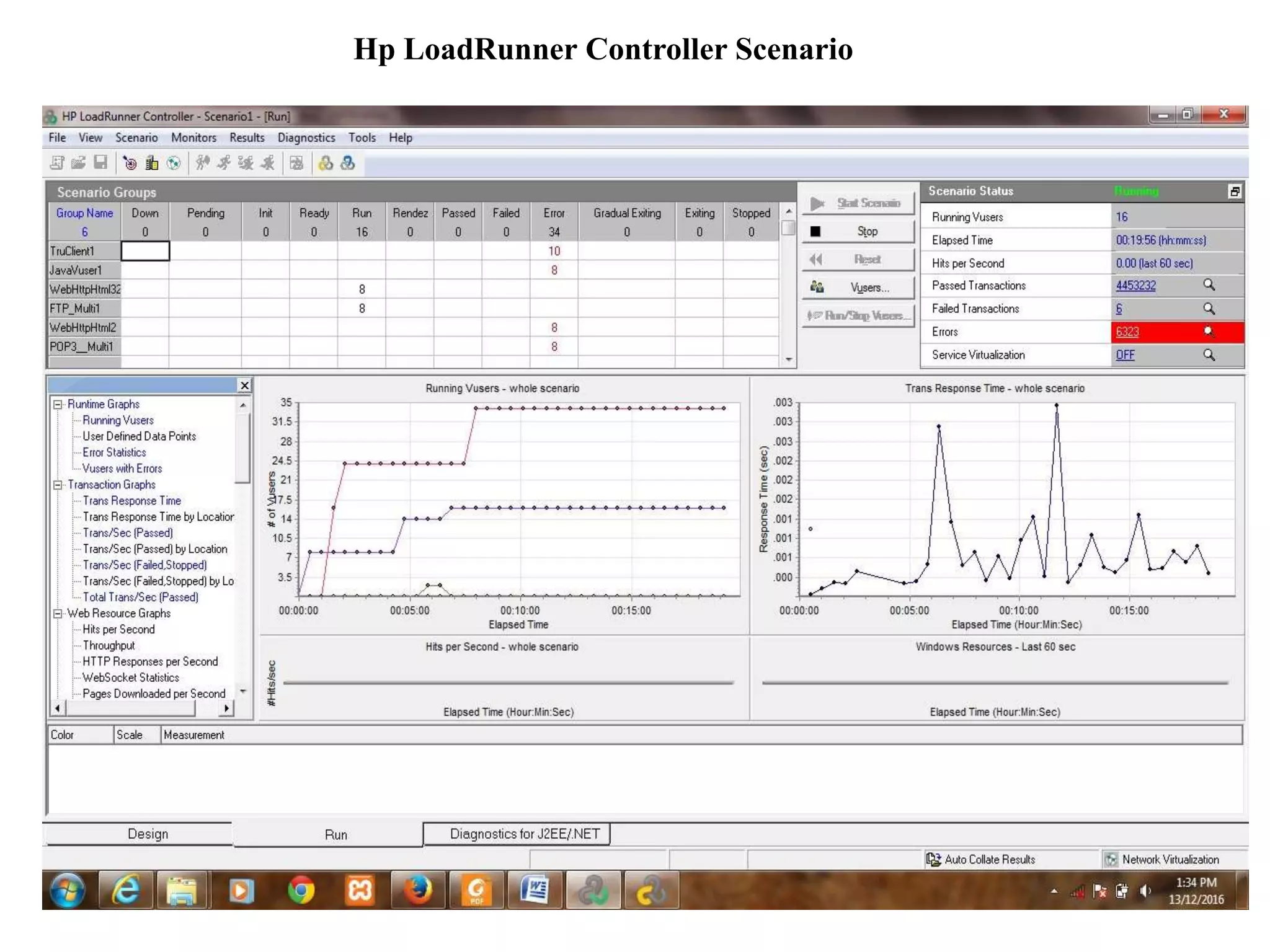
- Controller: LoadRunner Controller is used to
manage and maintain scenarios.
- Hosts: When you execute a scenario, the
LoadRunner Controller distributes each Vuser
in the scenario to a host.
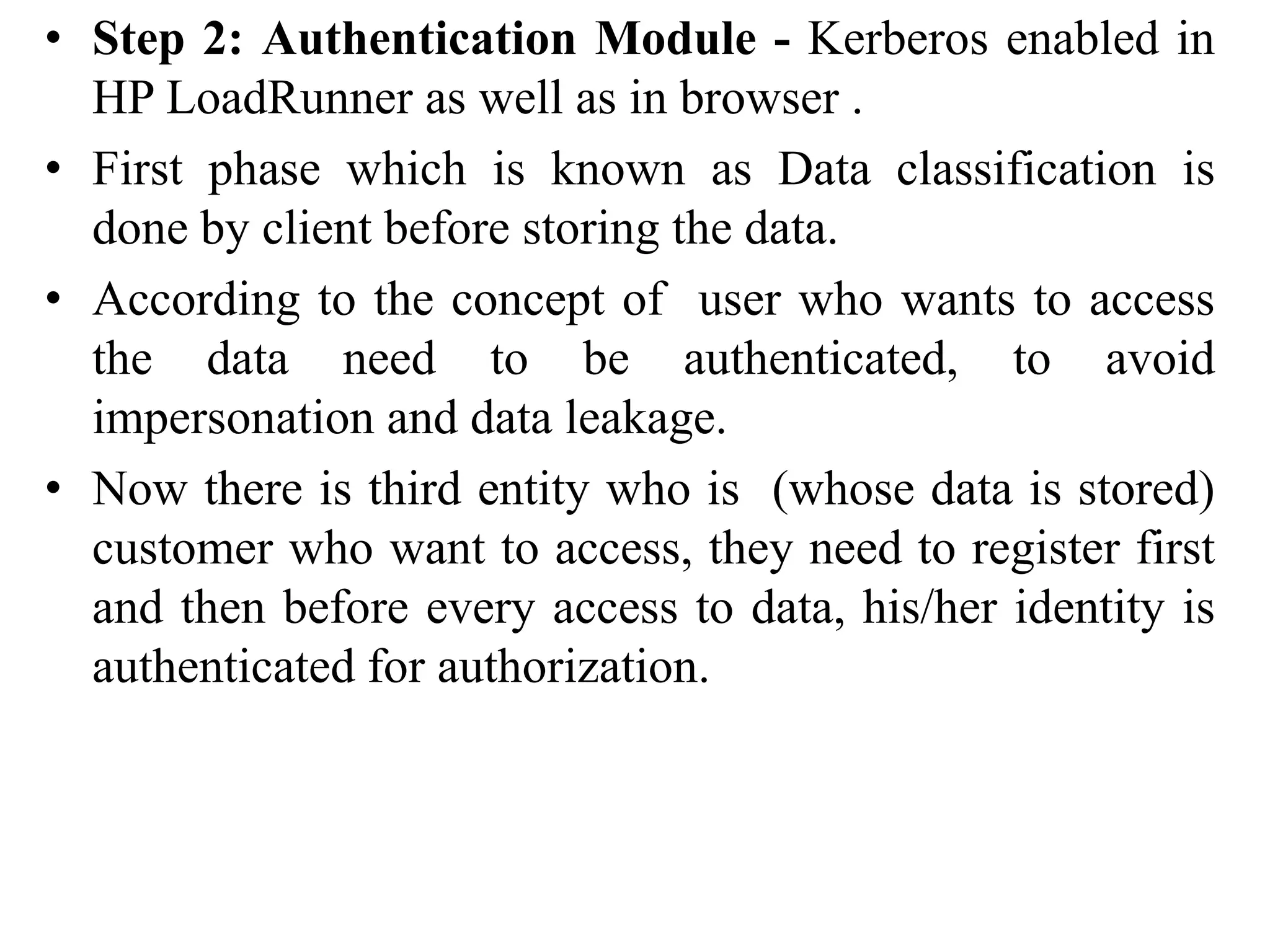
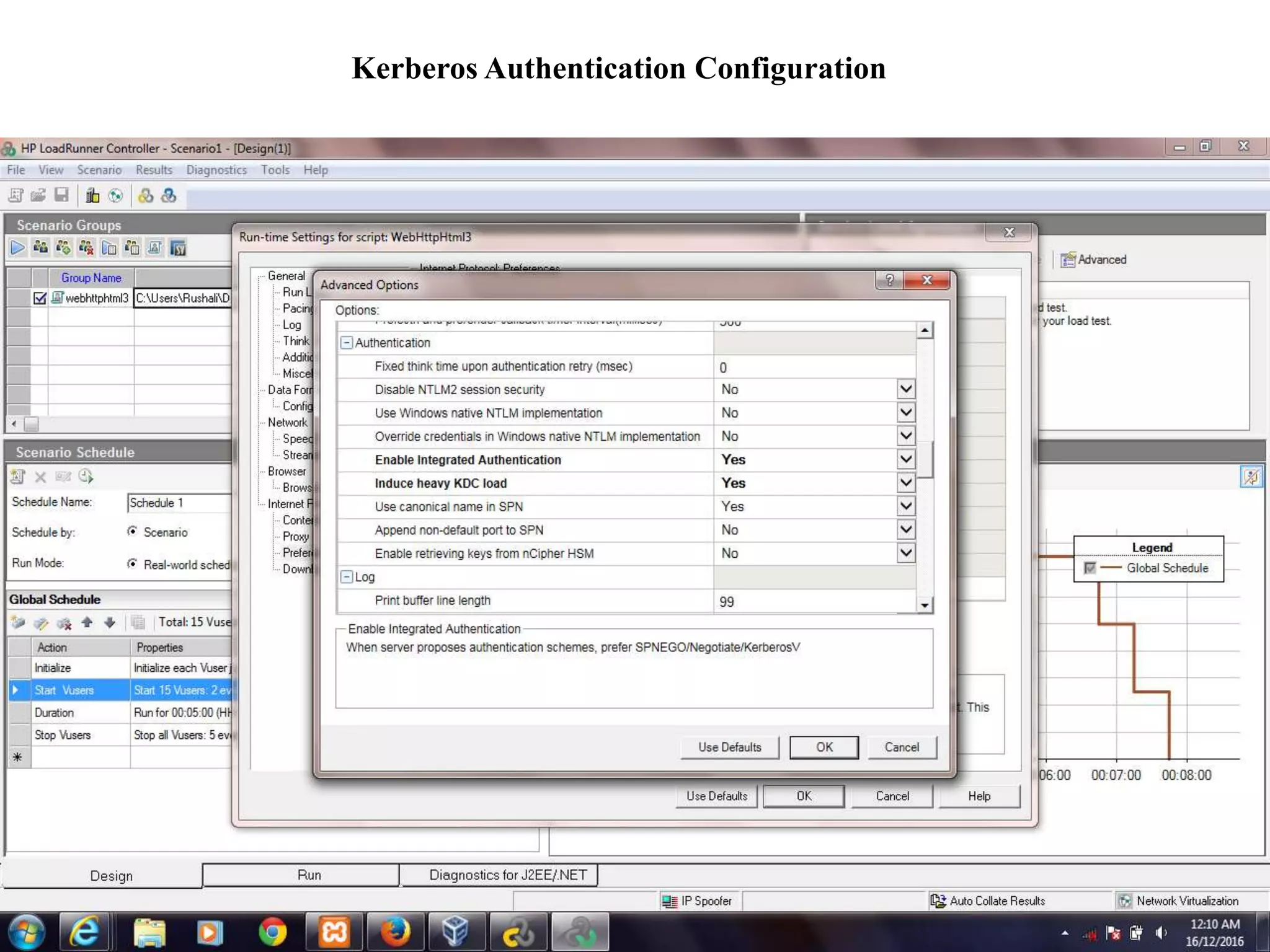
• Step 2: Authentication Module - Kerberos enabled in
HP LoadRunner as well as in browser .
• First phase which is known as Data classification is
done by client before storing the data.
• According to the concept of user who wants to access
the data need to be authenticated, to avoid
impersonation and data leakage.
• Now there is third entity who is (whose data is stored)
customer who want to access, they need to register first
and then before every access to data, his/her identity is
authenticated for authorization.
• Step 3: Ngnix Load Balancer in public
Cloud –
• Least Connection and Round Robin Load
balancing algorithm will be developed using
Java. The algorithm makes use of combining
the logic of least connections present, and
fastest response time.
• Monitoring agents are used to look at the
current activities, and load.
• Depending upon the instance nature, that
instance is being called, which returns the
results.
• Step4: For web application- An web application
for Load Balancing Created and deployed in
Cloud which will be used in HP LoadRunner to
check performance parameters.
• For web service- Amazon Web Services will be
used to create EC2 instances. EC2 instances will
be created where the load balancer developed in
step2 and the web service will be deployed in
step1
• Step 5 :For web application - Analysis tool of
LoadRunner gives the performance analysis of
system under test
• For Web service- LoadRunner tool will be used to
increase the load on the EC2 instances, and will
be using to compare the results from the two-load
balancer depending on request/response sent.
Configuration
of Load
Balancer
Start Nginx-
1.11.6 load
balancer in
Windows as
service before
starting the
application
execution.
Balancer Nodes Created- Either Apache or Ngnix
• Home - Jelastic Cloud environment created.
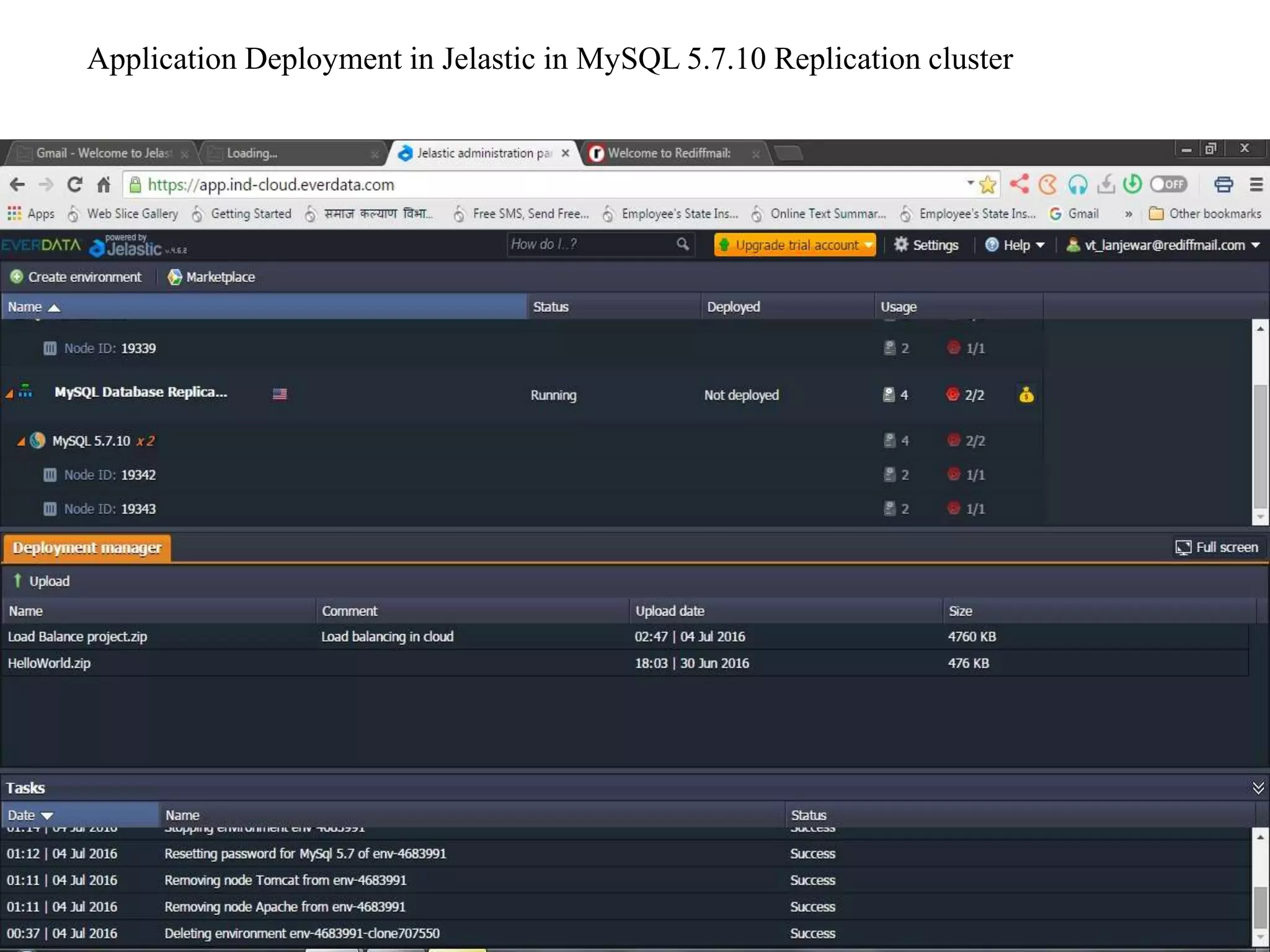
Application Deployment in Jelastic in MySQL 5.7.10 Replication cluster
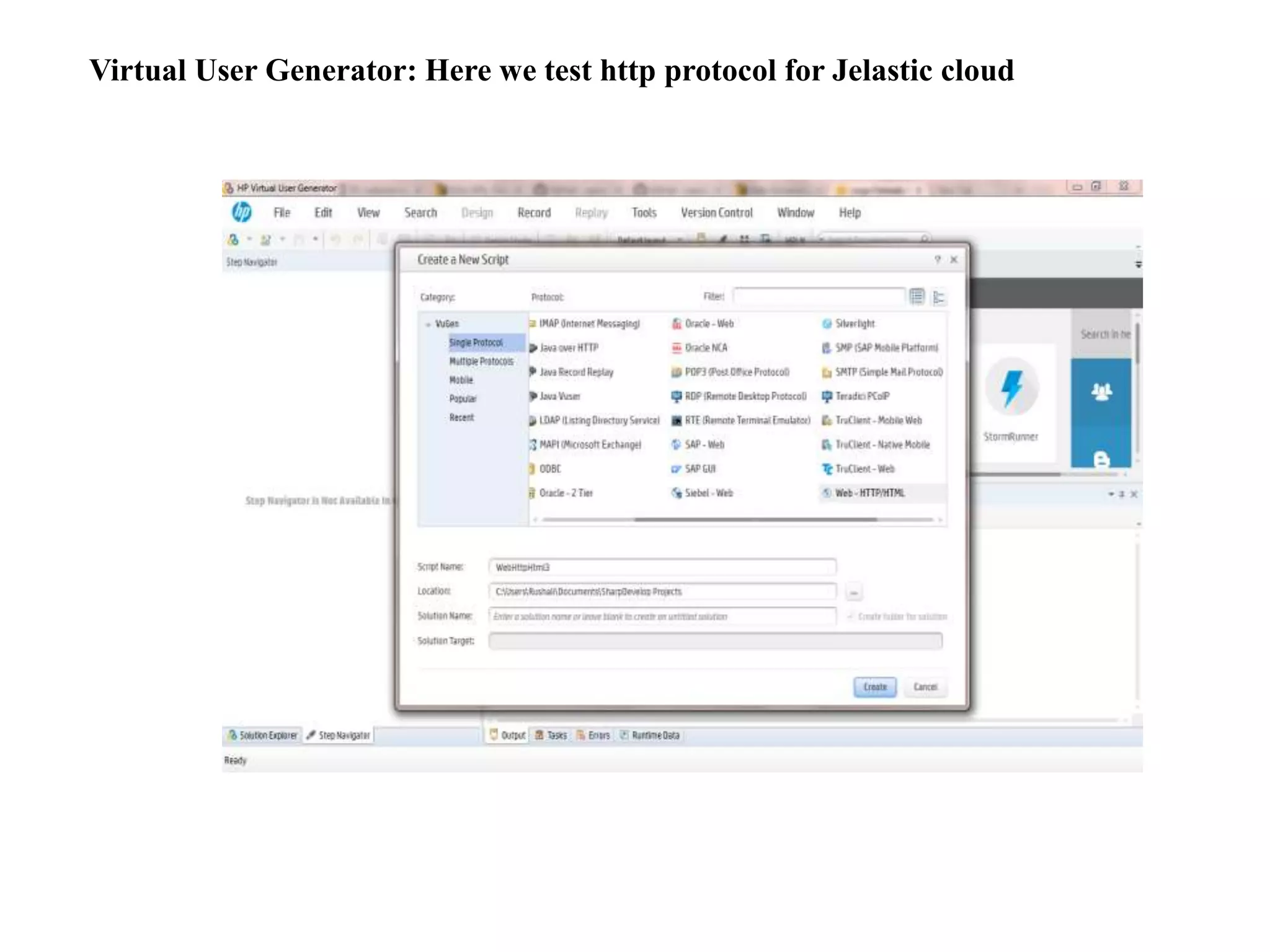
Virtual User Generator: Here we test http protocol for Jelastic cloud
Vuser Script for HTTP protocol
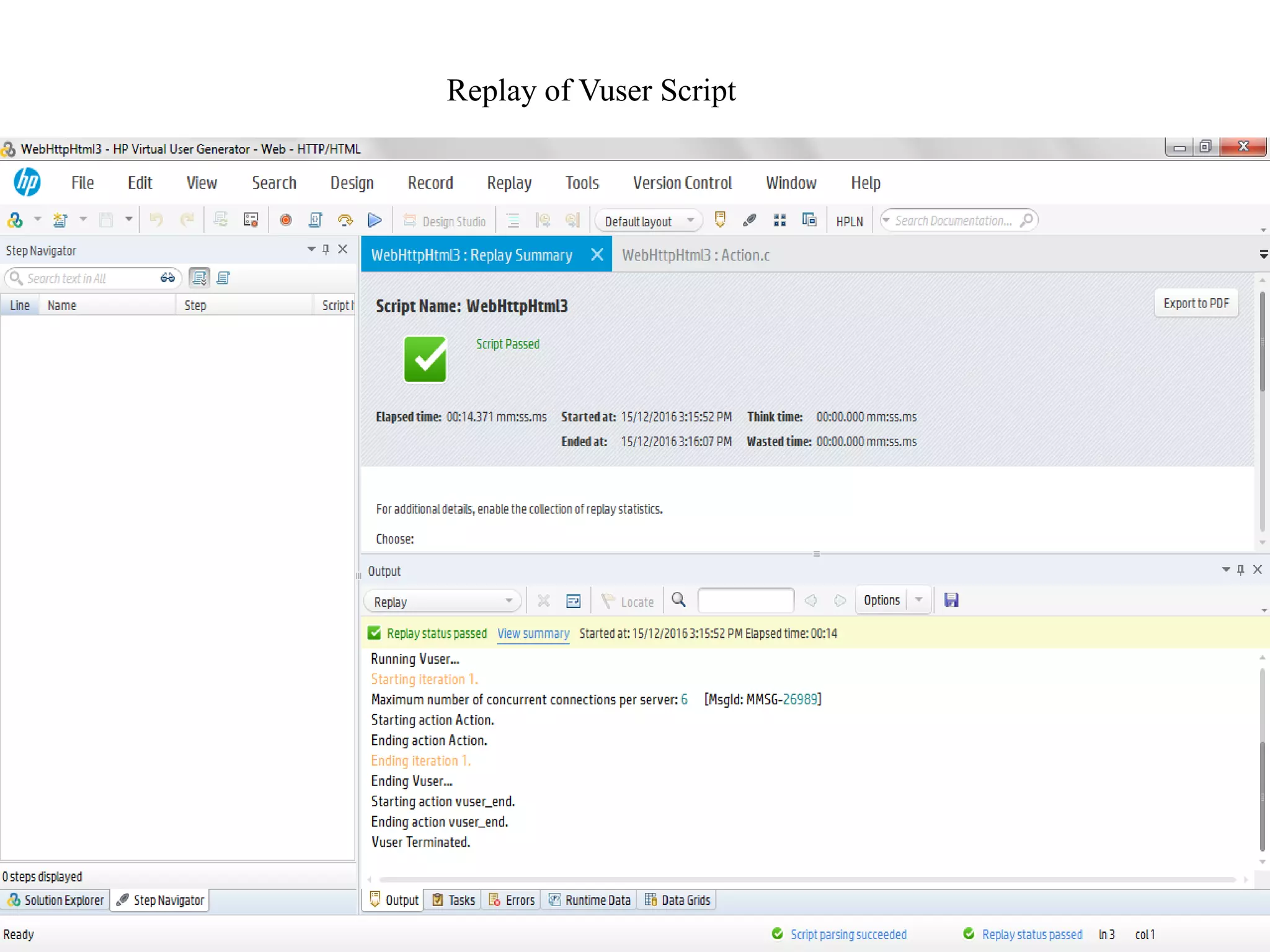
Replay of Vuser Script
Hp LoadRunner Controller Scenario
Kerberos Authentication Configuration
Result & Discussion
Computed Average Transaction Time for our Scenario- 10 users
SLA status at set time intervals over timeline within run.
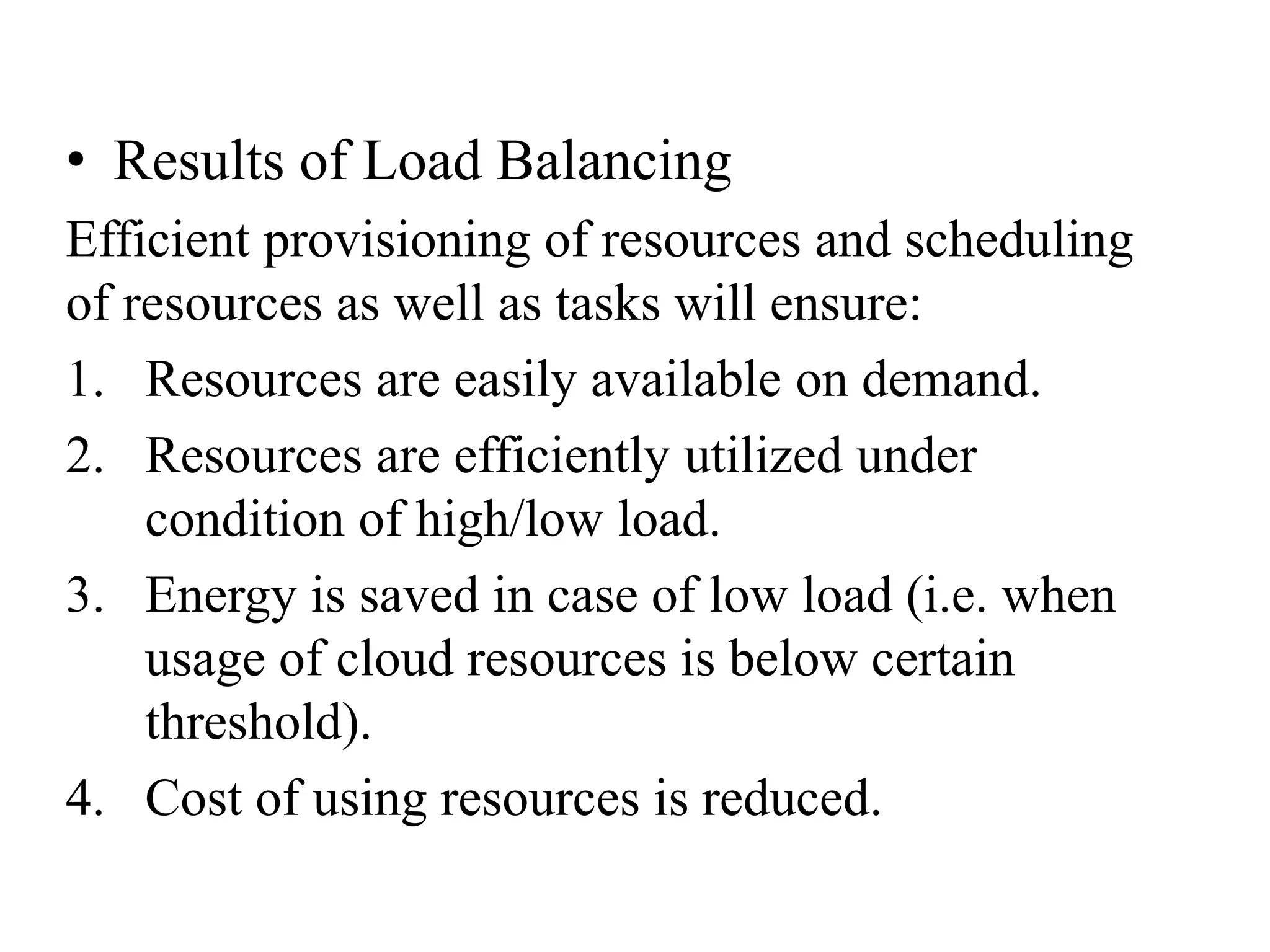
• Results of Load Balancing
Efficient provisioning of resources and scheduling
of resources as well as tasks will ensure:
1. Resources are easily available on demand.
2. Resources are efficiently utilized under
condition of high/low load.
3. Energy is saved in case of low load (i.e. when
usage of cloud resources is below certain
threshold).
4. Cost of using resources is reduced.
Tools
SOFTWARE REQUIREMENTS:
• Operating System: Windows XP and other
higher versions
• Programming Language : JAVA
• Database : MySQL , MongoDB etc.
• IDE : Netbeans 8.1
• Load Testing tool : HP LoadRunner 12.53
• Web development tool: WinginX
• Cloud Platform : Jelastic PAAS,
• Amazon IAAS
Data Management tools -
Redis
• Redis is an open source , in-memory data structure
store, used as a database, cache and message
broker.
• It supports data structures such as strings, hashes,
lists, sets, sorted sets with range queries, bitmaps,
hyperlog logs and geospatial indexes with radius
queries.
• Redis has built-in replication, and provides high
availability via Redis Sentinel and automatic
partitioning with Redis Cluster.
Memcached
• Free & open source, high-performance, distributed
memory object caching system, generic in nature,
but intended for use in speeding up dynamic web
applications by alleviating database load.
• Memcached is an in-memory key-value store for
small chunks of arbitrary data (strings, objects) from
results of database calls, API calls, or page
rendering.
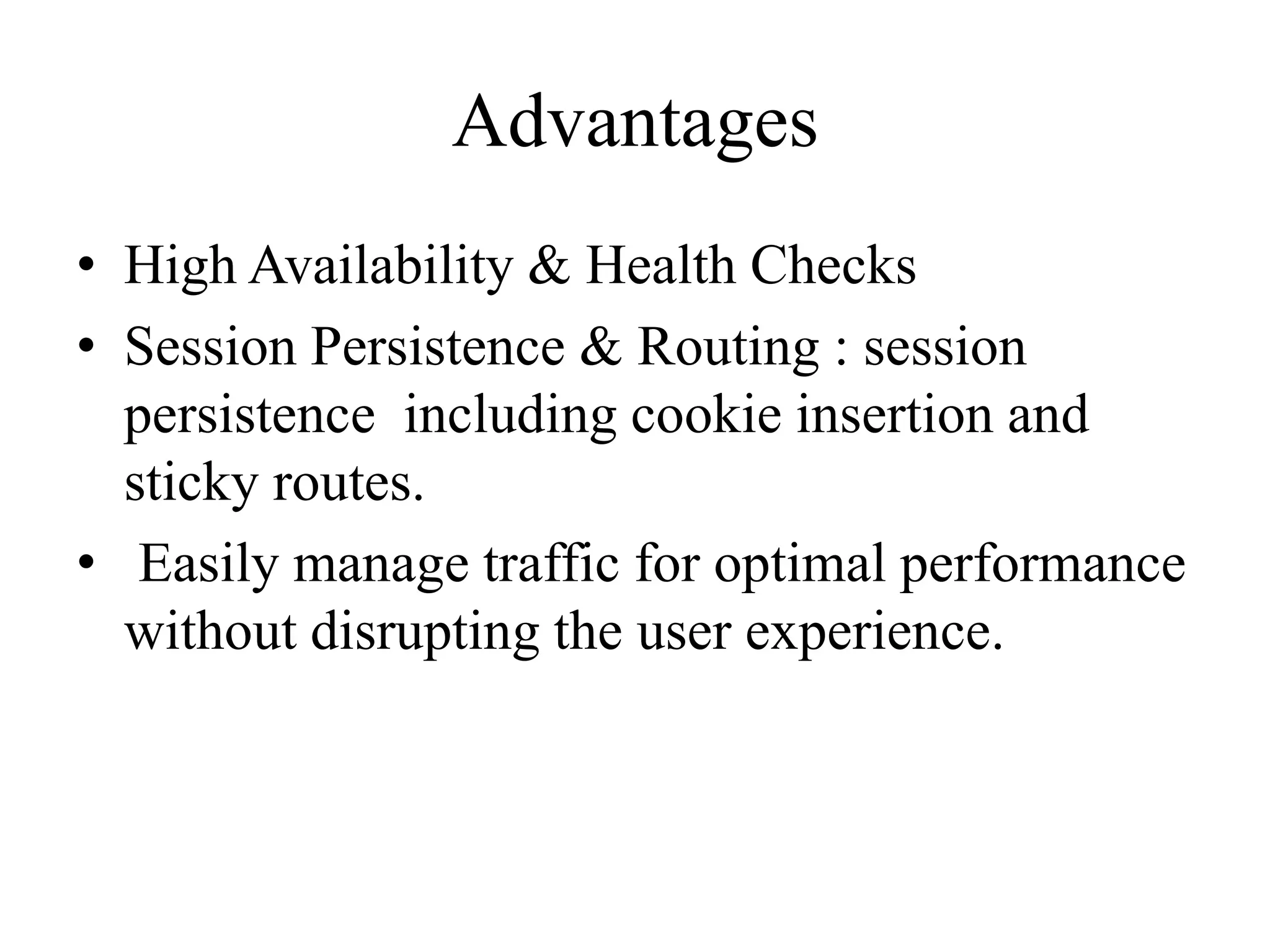
Advantages
• High Availability & Health Checks
• Session Persistence & Routing : session
persistence including cookie insertion and
sticky routes.
• Easily manage traffic for optimal performance
without disrupting the user experience.
Limitations
• Here Node capacity details are not identified
here.
• More amount of payment is required for
utilization of additional resources.
• Workload control is difficult to handle
sometimes.
• It is not stability network.
Conclusion
• For better load balancing multiple machines are used
where load is distributed simultaneously when load
generated. The proposed method not only processes
more transactions, it also reduces or does not change
the average time.
• Not only the proposed method has a better tps
(transaction per sec), it has better scalability too as
seen from the performance results.
Future Scope
• The proposed load balancing technique uses the concept of
static weights. It can be extended to dynamic weights where
weights are assigned to the server dynamically based on the
server performance.
• The server, which is performing, better is assigned higher
weight as compared to less performing server. This can be
achieved by adding monitoring agents on the each server,
which monitors the performance.
Referances
[1] Martin Randles, David Lamb, A. Taleb-Bendiab,“ A Comparative Study into Distributed Load Balancing
Algorithms for Cloud Computing" 2010 IEEE 24th International Conference on Advanced Information
Networking and Applications Workshops,pp.551-556,978-0-7695-4019-1/10$26.00© 2010 IEEE.
[2] Xu Y, Wu L, Guo L, Chen Z, Yang L, Shi Z."An Intelligent Load Balancing Algorithm Towards Efficient
Cloud Computing", In Workshops at the Twenty-Fifth AAAI on Artificial Intelligence, 2011 Aug 24.
[3] Hung-Chang Hsiao, Member, IEEE Computer Society, Hsueh-Yi Chung, Haiying Shen, Yu-Chang Chao,
“Load Rebalancing for Distributed File Systems in Clouds”, IEEE Transactions On Parallel And Distributed
Systems, Vol. 24, No. 5, May 2013.
[4]Xu,Gaochao; Pang, Junjie; Fu, Xiaodong ,"A Load Balancing Model Based on Cloud Partitioning for The
Public Cloud", IEEE Transaction on Cloud Computing, Tsinghua Science and Technology, Vol.18, No.1,
pp.34-39,Feb.2013.
[5]Dmitry Duplyakin, Paul Marshall Kate , Keahey Henry Tufo, Ali Alzabarah, "Rebalancing In A Multi-Cloud
Environment ", Science Cloud’13, Proceedings of the 4th ACM Workshop On Scientific Cloud Computing,
pp. 21-28, June 17, 2013.
[6] Kun Liu, Gaochao Xu and Jun’e Yuan, "An Improved Hadoop Data Load Balancing Algorithm", JOURNAL
OF NETWORKS, Vol. 8, No. 12, pp. 2816-2822, DECEMBER 2013.
[7] Peng Li; Song Guo "Load Balancing for Privacy-Preserving Access to Big Data in Cloud", IEEE Computer
Communications Workshops (INFOCOM WKSHPS), vol.21, no.4, 524 –528, May 2014. transactions on
information forensics and security, Vol.10, NO. 06, pp. 1315-1317, June 2015.
[8] Weikun Wang, Giuliano Casale, "Evaluating Weighted Round Robin Load Balancing for Cloud Web
Services" , 2014 16th International Symposium on Symbolic and Numeric Algorithms for Scientific
Computing published in IEEE, 978-1-4799-8448-0/15$31.00©2015 IEEE, pp.393-400,22-25 Sept. 2014
[9] Zhipeng Gao; Dangpeng Liu; Yang Yang; JingchenZheng; YuwenHao, "A Load Balance Algorithm Based
On Nodes Performance In Hadoop Cluster," in Network Operations and Management Symposium
(APNOMS), 2014 16th Asia-Pacific,Vol.,No., pp.1-4, 17-19 Sept.2014
[10] Taeho Jung, Xiang-Yang Li, Senior Member, IEEE, Zhiguo Wan, and Meng Wan, "Control Cloud Data
Access Privilege and Anonymity With Fully Anonymous Attribute-Based Encryption", IEEE
TRANSACTIONS ON INFORMATION FORENSICS AND SECURITY,pp.190- 199 vol.10, no.1,
JANUARY 2015
[11] Xinhua Dong; Ruixuan Li; Heng He; Wanwan Zhou; Zhengyuan Xue; Hao Wu, "Secure Sensitive Data
Sharing On a Big Data Platform", Tsinghua Science and Technology published in IEEE,
vol.20,no.1,pp.72-80,Feb.2015 DOI: 10.1109/ TST. 2015.7040516
[12] W. Teng; G. Yang; Y. Xiang; T. Zhang; D. Wang, "Attribute-based Access Control with Constant-size
Ciphertext in Cloud Computing," in IEEE Transactions on Cloud Computing , vol.PP, no.99, pp.1-1, 02
June 2015,doi: 10.1109/TCC.2015.2440247
[13] J. Li; W. Yao; Y. Zhang; H. Qian; J. Han, "Flexible and Fine-Grained Attribute-Based Data Storage in
Cloud Computing," in IEEE Transactions on Services Computing , vol. PP, no.99, pp.1-1, 22 January
2016, doi:10.1109/TSC.2016.2520932
[14] V. Chang and M. Ramachandran, "Towards Achieving Data Security with the Cloud Computing
Adoption Framework," in IEEE Transactions on Services Computing, vol.9, no.1, pp.138-151, Jan.-Feb.1
2016,doi:10.1109/TSC.2015.2491281
[15] Jia Zhao, Kun Yang, Xiaohui Wei, Yan Ding, Liang Hu, Gaochao Xu, "A Heuristic Clustering-Based
Task Deployment Approach for Load Balancing Using Bayes Theorem in Cloud Environment", IEEE
Transactions on Parallel & Distributed Systems, vol.27, no. 2, pp. 305-316, Feb. 2016,
[16] H.Wang; D. He; S. Tang, "Identity-Based Proxy-Oriented Data Uploading and Remote Data Integrity
Checking in Public Cloud," in IEEE Transactions on Information Forensics and Security ,vol.PP,no.99,pp.1-1,
[17] Mayanka Katyal*, Atul Mishra*,"A Comparative Study of Load Balancing Algorithms in Cloud
Computing Environment" in International Journal of Distributed and Cloud Computing, pp. 6-14, vol.1,
Issue 2, December 2013
[18] Aarti Singh, Dimple Juneja, Manisha Malhotra , "Autonomous Agent Based Load Balancing Algorithm
in Cloud Computing", International Conference On Advanced Computing Technologies And Applications
(Icacta-2015), 1877-0509 © 2015 Published by Elsevier B.V.
[19] A. Paya; D. Marinescu, "Energy-aware Load Balancing and Application Scaling for the Cloud Ecosystem,
in IEEE Transactions on Cloud Computing, vol. pp, no.99, pp.1-1 Figure: cloud service model ;
Adopted from: Effectively and Securely Using the Cloud Computing Paradigm by peter Mell, Tim
[20]Zhen Xiao, Senior Member, IEEE, Weijia Song, and Qi Chen “Dynamic Resource Allocation using Virtual
Machines for Cloud Computing Environment” IEEE TRANSACTION ON PARALLEL AND DISTRIBUTED
SYSTEMS(TPDS), VOL. N, NO. N, MONTH YEAR 1
[21] S. Gaisbauer, J. Kirschnick, N. Edwards and J. Rolia, "VATS: Virtualized-Aware Automated Test Service,
" 2008 Fifth International Conference on Quantitative Evaluation of Systems, St. Malo, 2008,pp. 93-102.
Jinzhong Niu ; CSc31800: Internet Programming, CS- CCNY, Spring 2004,The note contains The
Definitive Guide, O’Reilly.
[22] B. Li, H. Zhou, D. Zuo, Z. Zhang, P. Zhou and L. Jia, "Performance modeling and benchmarking of bank
intermediary business on high-performance fault-tolerant computers," 2011 IEEE/IFIP 41st International
Conference on Dependable Systems and Networks Workshops (DSN-W), HongKong,2011, pp.234-239.
[23] Automated detection of performance regressions using statistical process
control techniques ”ICPE '12 ProceedingsThanh H.D. Nguyen,Queen's University, Kingston, ON, Canada ”
of the 3rd ACM/SPEC International Conference on Performance Engineering, PP.299-310 Boston,
Massachusetts, USA -April 22 - 25, 2012,ACM New York, NY, USA
[24] NIST (Authors: P. Mell and T. Grance), "The NIST Definition of Cloud Computing (ver. 15),“
National Institute of Standards and Technology, Information Technology Laboratory (October 7 2009).
[25] Published in 2008 by the MIT Kerberos Consortium. Ver. July 23, 2008.
My Dissertation 2016

My Dissertation 2016

  • 1.
    Dissertation on “Improved Load Balancingtechnique for Secure data in Cloud” Submitted By “ Vrushali T. Lanjewar” (M.E 2nd Year ) To Prof. V. M. Thakare Prof. R. V. Dharaskar (H.O.D) (Guide) P.G Department of Computer Science & Engineering Sant Gadge Baba Amravati University, 444604
  • 2.
    Contents • Introduction • Researchissues • Problem Statement • Aims • Objectives • Existing Methodologies • Proposed Methodology • Implementation • Tools • Advantages • Limitations • Conclusion • Future scope • References
  • 3.
    Introduction • Cloud computing Cloudcomputing is an on demand service in which shared resources, information, software and other devices are provided according to the clients requirement at specific time. NIST defines the Cloud Computing architecture by describing five essential characteristics, three cloud services models and four cloud deployment models (Cloud Security Alliance, 2009, p14)
  • 4.
    Cloud Service Providers Figure.1.1Cloud Service Models; Visual model of NIST Working Definition of Cloud Computing (Cloud Security Alliance, 2009, p14)
  • 5.
    • Jelastic CloudPlatform- PaaS •Amazon Web Services- IaaS • Windows Azure- PaaS • HP Cloud • OpenShift by Red Hat • Citrix Cloud Platform •IBM –Bluemix IaaS, PaaS •DigitalOcean IaaS, PaaS
  • 6.
    1. Public cloud:They gain the benefits of that pay-as-you-go services so you only pay for what you use. 2. Private cloud: (i) on-premise private clouds and (ii) externally hosted private clouds. These chained-in, restrained cloud environments are protected behind a firewall. 3. Hybrid cloud: Hybrid clouds are a combination of public and private cloud . 4. Managed cloud: Managed clouds are provided by a designated service provider and may offer either a dedicated or shared operating environment. Cloud Service Deployment and Consumption Models
  • 7.
    Load Balancing • Loadbalancing is a relatively new technique that facilitates networks and resources by providing a maximum throughput with minimum response time. • Dividing the traffic between servers, data can be sent and received without major delay. • Without load balancing, users could experience delays, timeouts and possible long system responses.
  • 8.
    Research Issues • Unbalancingproblem • Load rebalancing problem • Load balance problem and privacy-preserving • Virtualization and authorization • Data privacy and access control • Data security • Data Integrity
  • 9.
    Problem Statement • Loadbalancing is the issue in cloud computing. • The load imbalance problem may arise even due to the failure of the node. •Work load control is crucial to improve system performance and maintain stability. The problem work out here is to providing security to the data stored in cloud.
  • 10.
    Aim The main aimof the proposed scheme includes resource utilization, access control, data confidentiality, traceability and efficiency in cloud environment . • Cost effectiveness: Load balancing help to provide better system performance at lower cost. • Scalability and flexibility: The system for which load balancing algorithms are implemented may be change in size after some time. So the algorithm/model must handle these types’ situations.
  • 11.
    Objectives • The maingoal of load balancing is to achieve route the requests among the web servers with a minimum response time. • To provides availability of data by overcoming many existing problem like denial of services, data leakage. • To control over the continuous data updation and also provide more flexibility and capability to meet the new demand of today’s complex and diverse network .
  • 12.
    Existing Methodologies Iterative LoadBalancer: • The problem of load balance for deploying ORAM- based storage in clouds a tree-based ORAM structure, and a set of storage servers, LB for deploying ORAM in Cloud problem seeks a data placement such that the maximum access load among all servers is minimized. • To overcome this difficulty, author propose a low- complexity algorithm called ILB(Iterative Load Balancer)to iteratively place buckets on servers, such that only need to deal with a small-scale line are programming in each iteration. [7]
  • 13.
    Weighted round robinload balancing: •(WRR) is a common routing policy offered in cloud load balancers. However, there is a lack of effective mechanisms to decide the weights assigned to each server to achieve overall optimal revenue of the system. •The relations between probabilistic routing (PR) and weighted round robin (WRR) policies and introduce the result of the algorithms under different number of users classes. •The advantage of the heuristic algorithm is that it is independent of the number of requests Nr for each class and it has been proved to achieve an optimality ratio of 1+1/(M−1) under heavy load, thus it gets closer to optimality with increasing number of VMs.[8]
  • 14.
    Kerberos Model: • Tosecure sensitive data Kerberos is used for a user process protection method based on a virtual machine monitor. The basic set up of Kerberos protocol is as shown.  The Kerberos server consists of an Authentication Server (AS) and a Ticket Granting Server (TGS). The AS and TGS are responsible for creating and issuing tickets to the clients upon request. The AS and TGS usually run on the same computer, and are collectively known as the Key Distribution Center (KDC). [25] Fig. Kerberos protocol
  • 15.
    Proposed Methodology  Inthis architecture, a load balancer is used to split the file into chunks in order to store the data in various nodes as shown in fig .  When the server control performs operations on data like deletion or updation load imbalance problem occurs.  This problem can be solved by the load balancer which balances the load in the cloud after the above operations performed.  The data to be stored in the cloud is encrypted before storage for more security. The encryption is done by the key generated at the client side. Then data is made into chunks and stored in various nodes (using Kerberos authentication)
  • 16.
    Multi-cloud feature providesthe ability to achieve higher availability through geo-distribution among different data centers or clouds, easily relocate the projects to the superior hardware with the help of environment migration, choose between higher quality or more cost affordable hardware and host applications with the trusted cloud vendors. Fig. Proposed architecture of Cluster with multiple nodes for pubic cloud
  • 17.
    Cloudlet At Jelastic Platform,consumed by container resources are measured in cloudlets a special measurement unit, which includes 128 MB of RAM and 400 MHz of CPU power simultaneously.
  • 18.
    Cloudlet Types • Reserved •Dynamic • Reserved Cloudlets these ones are reserved in advance and will be charged irrespective of your actual resource usage. • Dynamic Cloudlets are added & removed automatically according to the amount of resources that are required by your application in a particular moment of time.
  • 19.
    Reasons to chooseSoftware load balancer • Once upon a time, load balancing in most application stacks was heavily dependent on hardware. More modern virtualized and cloud-based infrastructures offer increased agility and scalability at a lower cost, but are frequently plagued by compromised performance. • Features and functionality are meaningless if applications can’t perform. And, for companies still relying on hardware- based application delivery controllers (ADCs) or load balancers, application performance and scalability could be a serious issue. • Software load balancers – like NGINX might be the best news for the applications and business at large.
  • 20.
    NGINX Web Serverand Load Balancer • Ngnix is an free, open-source HTTP server characterized by its small footprint, exceptional performance and efficient use of resources. • Ngnix is one of the web servers are already widely used and increasingly compete with the Apache web server. • Round robin - default; • Least connected - used when least number of active connection. • Load balancing with https enabled for websites which enforces encryption to all connections including load balancer.
  • 21.
    Round Robin • RoundRobin works best when the characteristics of the servers and requests are unlikely to cause some servers to become overloaded relative to others. Some of the conditions are: • All the servers have about the same capacity. This requirement is less important if differences between servers are accurately represented by server weights. • All the servers host the same content. • Requests are pretty similar in the amount of time or processing power they require. If there’s a wide variation in request weight, a server can become overloaded because the load balancer happens to send it a lot of heavyweight requests in quick succession. • Traffic volume is not heavy enough to push servers to near full capacity very often. If servers are already heavily loaded, it’s more likely that Round Robin’s rote distribution of requests will lead to push some servers “over the edge” into overload as described in the previous bullet.
  • 22.
    • Given thefollowing sample configuration of the backend upstream group, the load balancer sends the first three connection requests to web1, web2, and web3 in order, the fourth to web1, the fifth to web2, and so on. upstream backend { server web1; server web2; server web3; } server { server_name www.example.com; location / { proxy_pass http://backend; } }
  • 23.
    Least Connections • LeastConnections also effectively distributes workload across servers according to their capacity. • A more powerful server fulfills requests more quickly, so at any given moment it’s likely to have a smaller number of connections still being processed (or even waiting for processing to start) than a server with less capacity. • Least Connections sends each request to the server with the smallest number of current connections, and so is more likely to send requests to powerful servers.
  • 24.
    upstream backend { least_conn; serverweb1; server web2; server web3; } server { server_name www.example.com; location / { proxy_pass http://backend; } } You configure it with the least_conn directive.
  • 25.
    Kerberos provides dataconfidentiality, authentication and integrity services • Windows 2000, XP and Windows Server 2003 all include the Kerberos extensions that can be used to provide data confidentiality, authentication and integrity for messages that are sent after the initial Kerberos exchange. • These extensions are known as the KRB_PRIV (providing data confidentiality) and the KRB_SAFE (providing data authentication and integrity) Kerberos extensions.
  • 26.
    Implementation • The proposeda load balancing algorithm which will transfer the load to another server in cloud when the current server is overloaded. When the multiple request are arrived to allocate the resource at server in cloud environment, the server gets overloaded at some instance. • Step1: Load Testing Module - HP LoadRunner tool will behave as the client for the websites/ single or multiple protocols HTTP, FTP, SMTP etc., web services, where we can test, monitor, analyze as well as control the load through real world transactions of data. - User Scripts: The actions that a Vuser performs during the scenario are described in a Vuser script. When a scenario is executed, each Vuser executes a Vuser script.
  • 27.
    - Transactions: Tomeasure the performance of the server, transactions are defined. Transactions measure the time that it takes for the server to respond to tasks submitted by Vuser. - Controller: LoadRunner Controller is used to manage and maintain scenarios. - Hosts: When you execute a scenario, the LoadRunner Controller distributes each Vuser in the scenario to a host.
  • 28.
    • Step 2:Authentication Module - Kerberos enabled in HP LoadRunner as well as in browser . • First phase which is known as Data classification is done by client before storing the data. • According to the concept of user who wants to access the data need to be authenticated, to avoid impersonation and data leakage. • Now there is third entity who is (whose data is stored) customer who want to access, they need to register first and then before every access to data, his/her identity is authenticated for authorization.
  • 29.
    • Step 3:Ngnix Load Balancer in public Cloud – • Least Connection and Round Robin Load balancing algorithm will be developed using Java. The algorithm makes use of combining the logic of least connections present, and fastest response time. • Monitoring agents are used to look at the current activities, and load. • Depending upon the instance nature, that instance is being called, which returns the results.
  • 30.
    • Step4: Forweb application- An web application for Load Balancing Created and deployed in Cloud which will be used in HP LoadRunner to check performance parameters. • For web service- Amazon Web Services will be used to create EC2 instances. EC2 instances will be created where the load balancer developed in step2 and the web service will be deployed in step1 • Step 5 :For web application - Analysis tool of LoadRunner gives the performance analysis of system under test • For Web service- LoadRunner tool will be used to increase the load on the EC2 instances, and will be using to compare the results from the two-load balancer depending on request/response sent.
  • 31.
    Configuration of Load Balancer Start Nginx- 1.11.6load balancer in Windows as service before starting the application execution.
  • 32.
    Balancer Nodes Created-Either Apache or Ngnix
  • 33.
    • Home -Jelastic Cloud environment created.
  • 34.
    Application Deployment inJelastic in MySQL 5.7.10 Replication cluster
  • 35.
    Virtual User Generator:Here we test http protocol for Jelastic cloud
  • 36.
    Vuser Script forHTTP protocol
  • 37.
  • 38.
  • 39.
  • 40.
  • 43.
    Computed Average TransactionTime for our Scenario- 10 users
  • 44.
    SLA status atset time intervals over timeline within run.
  • 45.
    • Results ofLoad Balancing Efficient provisioning of resources and scheduling of resources as well as tasks will ensure: 1. Resources are easily available on demand. 2. Resources are efficiently utilized under condition of high/low load. 3. Energy is saved in case of low load (i.e. when usage of cloud resources is below certain threshold). 4. Cost of using resources is reduced.
  • 46.
    Tools SOFTWARE REQUIREMENTS: • OperatingSystem: Windows XP and other higher versions • Programming Language : JAVA • Database : MySQL , MongoDB etc. • IDE : Netbeans 8.1 • Load Testing tool : HP LoadRunner 12.53 • Web development tool: WinginX • Cloud Platform : Jelastic PAAS, • Amazon IAAS
  • 47.
    Data Management tools- Redis • Redis is an open source , in-memory data structure store, used as a database, cache and message broker. • It supports data structures such as strings, hashes, lists, sets, sorted sets with range queries, bitmaps, hyperlog logs and geospatial indexes with radius queries. • Redis has built-in replication, and provides high availability via Redis Sentinel and automatic partitioning with Redis Cluster.
  • 48.
    Memcached • Free &open source, high-performance, distributed memory object caching system, generic in nature, but intended for use in speeding up dynamic web applications by alleviating database load. • Memcached is an in-memory key-value store for small chunks of arbitrary data (strings, objects) from results of database calls, API calls, or page rendering.
  • 49.
    Advantages • High Availability& Health Checks • Session Persistence & Routing : session persistence including cookie insertion and sticky routes. • Easily manage traffic for optimal performance without disrupting the user experience.
  • 50.
    Limitations • Here Nodecapacity details are not identified here. • More amount of payment is required for utilization of additional resources. • Workload control is difficult to handle sometimes. • It is not stability network.
  • 51.
    Conclusion • For betterload balancing multiple machines are used where load is distributed simultaneously when load generated. The proposed method not only processes more transactions, it also reduces or does not change the average time. • Not only the proposed method has a better tps (transaction per sec), it has better scalability too as seen from the performance results.
  • 52.
    Future Scope • Theproposed load balancing technique uses the concept of static weights. It can be extended to dynamic weights where weights are assigned to the server dynamically based on the server performance. • The server, which is performing, better is assigned higher weight as compared to less performing server. This can be achieved by adding monitoring agents on the each server, which monitors the performance.
  • 53.
    Referances [1] Martin Randles,David Lamb, A. Taleb-Bendiab,“ A Comparative Study into Distributed Load Balancing Algorithms for Cloud Computing" 2010 IEEE 24th International Conference on Advanced Information Networking and Applications Workshops,pp.551-556,978-0-7695-4019-1/10$26.00© 2010 IEEE. [2] Xu Y, Wu L, Guo L, Chen Z, Yang L, Shi Z."An Intelligent Load Balancing Algorithm Towards Efficient Cloud Computing", In Workshops at the Twenty-Fifth AAAI on Artificial Intelligence, 2011 Aug 24. [3] Hung-Chang Hsiao, Member, IEEE Computer Society, Hsueh-Yi Chung, Haiying Shen, Yu-Chang Chao, “Load Rebalancing for Distributed File Systems in Clouds”, IEEE Transactions On Parallel And Distributed Systems, Vol. 24, No. 5, May 2013. [4]Xu,Gaochao; Pang, Junjie; Fu, Xiaodong ,"A Load Balancing Model Based on Cloud Partitioning for The Public Cloud", IEEE Transaction on Cloud Computing, Tsinghua Science and Technology, Vol.18, No.1, pp.34-39,Feb.2013. [5]Dmitry Duplyakin, Paul Marshall Kate , Keahey Henry Tufo, Ali Alzabarah, "Rebalancing In A Multi-Cloud Environment ", Science Cloud’13, Proceedings of the 4th ACM Workshop On Scientific Cloud Computing, pp. 21-28, June 17, 2013. [6] Kun Liu, Gaochao Xu and Jun’e Yuan, "An Improved Hadoop Data Load Balancing Algorithm", JOURNAL OF NETWORKS, Vol. 8, No. 12, pp. 2816-2822, DECEMBER 2013. [7] Peng Li; Song Guo "Load Balancing for Privacy-Preserving Access to Big Data in Cloud", IEEE Computer Communications Workshops (INFOCOM WKSHPS), vol.21, no.4, 524 –528, May 2014. transactions on information forensics and security, Vol.10, NO. 06, pp. 1315-1317, June 2015. [8] Weikun Wang, Giuliano Casale, "Evaluating Weighted Round Robin Load Balancing for Cloud Web Services" , 2014 16th International Symposium on Symbolic and Numeric Algorithms for Scientific Computing published in IEEE, 978-1-4799-8448-0/15$31.00©2015 IEEE, pp.393-400,22-25 Sept. 2014
  • 54.
    [9] Zhipeng Gao;Dangpeng Liu; Yang Yang; JingchenZheng; YuwenHao, "A Load Balance Algorithm Based On Nodes Performance In Hadoop Cluster," in Network Operations and Management Symposium (APNOMS), 2014 16th Asia-Pacific,Vol.,No., pp.1-4, 17-19 Sept.2014 [10] Taeho Jung, Xiang-Yang Li, Senior Member, IEEE, Zhiguo Wan, and Meng Wan, "Control Cloud Data Access Privilege and Anonymity With Fully Anonymous Attribute-Based Encryption", IEEE TRANSACTIONS ON INFORMATION FORENSICS AND SECURITY,pp.190- 199 vol.10, no.1, JANUARY 2015 [11] Xinhua Dong; Ruixuan Li; Heng He; Wanwan Zhou; Zhengyuan Xue; Hao Wu, "Secure Sensitive Data Sharing On a Big Data Platform", Tsinghua Science and Technology published in IEEE, vol.20,no.1,pp.72-80,Feb.2015 DOI: 10.1109/ TST. 2015.7040516 [12] W. Teng; G. Yang; Y. Xiang; T. Zhang; D. Wang, "Attribute-based Access Control with Constant-size Ciphertext in Cloud Computing," in IEEE Transactions on Cloud Computing , vol.PP, no.99, pp.1-1, 02 June 2015,doi: 10.1109/TCC.2015.2440247 [13] J. Li; W. Yao; Y. Zhang; H. Qian; J. Han, "Flexible and Fine-Grained Attribute-Based Data Storage in Cloud Computing," in IEEE Transactions on Services Computing , vol. PP, no.99, pp.1-1, 22 January 2016, doi:10.1109/TSC.2016.2520932 [14] V. Chang and M. Ramachandran, "Towards Achieving Data Security with the Cloud Computing Adoption Framework," in IEEE Transactions on Services Computing, vol.9, no.1, pp.138-151, Jan.-Feb.1 2016,doi:10.1109/TSC.2015.2491281 [15] Jia Zhao, Kun Yang, Xiaohui Wei, Yan Ding, Liang Hu, Gaochao Xu, "A Heuristic Clustering-Based Task Deployment Approach for Load Balancing Using Bayes Theorem in Cloud Environment", IEEE Transactions on Parallel & Distributed Systems, vol.27, no. 2, pp. 305-316, Feb. 2016, [16] H.Wang; D. He; S. Tang, "Identity-Based Proxy-Oriented Data Uploading and Remote Data Integrity Checking in Public Cloud," in IEEE Transactions on Information Forensics and Security ,vol.PP,no.99,pp.1-1,
  • 55.
    [17] Mayanka Katyal*,Atul Mishra*,"A Comparative Study of Load Balancing Algorithms in Cloud Computing Environment" in International Journal of Distributed and Cloud Computing, pp. 6-14, vol.1, Issue 2, December 2013 [18] Aarti Singh, Dimple Juneja, Manisha Malhotra , "Autonomous Agent Based Load Balancing Algorithm in Cloud Computing", International Conference On Advanced Computing Technologies And Applications (Icacta-2015), 1877-0509 © 2015 Published by Elsevier B.V. [19] A. Paya; D. Marinescu, "Energy-aware Load Balancing and Application Scaling for the Cloud Ecosystem, in IEEE Transactions on Cloud Computing, vol. pp, no.99, pp.1-1 Figure: cloud service model ; Adopted from: Effectively and Securely Using the Cloud Computing Paradigm by peter Mell, Tim [20]Zhen Xiao, Senior Member, IEEE, Weijia Song, and Qi Chen “Dynamic Resource Allocation using Virtual Machines for Cloud Computing Environment” IEEE TRANSACTION ON PARALLEL AND DISTRIBUTED SYSTEMS(TPDS), VOL. N, NO. N, MONTH YEAR 1 [21] S. Gaisbauer, J. Kirschnick, N. Edwards and J. Rolia, "VATS: Virtualized-Aware Automated Test Service, " 2008 Fifth International Conference on Quantitative Evaluation of Systems, St. Malo, 2008,pp. 93-102. Jinzhong Niu ; CSc31800: Internet Programming, CS- CCNY, Spring 2004,The note contains The Definitive Guide, O’Reilly. [22] B. Li, H. Zhou, D. Zuo, Z. Zhang, P. Zhou and L. Jia, "Performance modeling and benchmarking of bank intermediary business on high-performance fault-tolerant computers," 2011 IEEE/IFIP 41st International Conference on Dependable Systems and Networks Workshops (DSN-W), HongKong,2011, pp.234-239. [23] Automated detection of performance regressions using statistical process control techniques ”ICPE '12 ProceedingsThanh H.D. Nguyen,Queen's University, Kingston, ON, Canada ” of the 3rd ACM/SPEC International Conference on Performance Engineering, PP.299-310 Boston, Massachusetts, USA -April 22 - 25, 2012,ACM New York, NY, USA [24] NIST (Authors: P. Mell and T. Grance), "The NIST Definition of Cloud Computing (ver. 15),“ National Institute of Standards and Technology, Information Technology Laboratory (October 7 2009). [25] Published in 2008 by the MIT Kerberos Consortium. Ver. July 23, 2008.