International Refereed Journal of Engineering and Science (IRJES)
ISSN (Online) 2319-183X, (Print) 2319-1821
Volume 2, Issue 3(March 2013), PP.38-42
www.irjes.com

  Self Chord-Achieving Load Balancing In Peer To Peer Network
                                         M.Divya1 B.Saranya2
                       Lecturer,Department Of Cse,As-Salam College Of Engg And Tech

Abstract:- The Cloud computing technology has been widely applied in e-business, e-education. Cloud
computing platform is a set of Scalable large-scale data server clusters, it provides computing and storage
services to customers. The cloud storage is a relatively basic and widely applied service which can provide
users with stable, massive data storage space. Our research shows that the architecture of current Cloud
Computing System is central structured one; all the data nodes must be indexed by a master server which may
become bottle neck of the system. In this project we use cloud storage architecture based on P2P, and balance
CPU load on server.
          A Distributed Hash Table method for storing hash tables in geographically distributed locations in
order to provide a failsafe lookup mechanism for distributed computing. Various algorithms have been explored
that provide the right balance and speed for storing parts of the tables in different locations. Having been used
in the early and mid-1990s for local area network storage, after the turn of the century, DHTs were brought into
focus for peer-to-peer computing over the Internet. A DHT provides a fault tolerant storage interface on top of
which is layered an application such as music sharing, file sharing or distributed backup.

                                            I.    INTRODUCTION
          Computing systems, such as computational Grids and Clouds are an information service that provides
information about the resources that can be used to build and run complex applications and enables their
discovery. Grids use the resources of many networked computers to solve large-scale computation problems in
multiple and heterogeneous domains. The large-scale and dynamic nature of Grids make human administrative
intervention difficult or even unfeasible, and centralized information services are proving unsuitable to scale to
hundreds or thousands of nodes. To tackle these issues, the scientific community has proposed to design
information services according to the peer-to-peer (P2P) paradigm, which offers better scalability and adaptivity
features. A similar trend can be envisioned for the recently emerged Cloud paradigm, which is switching
computation and storage responsibilities from the client size to the “clouds,” i.e., to unseen computers on the
server side, possibly scattered across continents. Grid and Cloud issues are similar in many aspects, especially in
the need to assure scalability in a dynamic environment. Therefore, P2P techniques are very likely to be adopted
in Clouds as they are today in Grids. Self-Chord, a P2P system that inherits from Chord the ability to construct
and maintain a structured ring of peers, but features enhanced functionalities achieved through the activity of
ant-inspired mobile agents. In particular, Self-Chord features the following benefits with respect to Chord.


                                                   www.irjes.com                                        38 | Page
Self Chord-Achieving Load Balancing In Peer To Peer Network

1) In Self-Chord, there is no obligation to assign a key to a well-specified peer. A user can issue “class” queries,
i.e., explore the network to find resources belonging to a specified class and then select the most appropriate for
his/her purpose.
2) Structured systems like Chord can produce imbalance problems depending on the location of peers and the
statistical distribution of the values of resource keys. In Self-Chord, the keys are fairly distributed over the
peers, irrespective of the location of peers and the distribution of key values.
3) In Chord, appropriate operations are necessary when a peer joins the ring or when new resources are
published. These resources must be immediately assigned to the peers whose indexes match the resource keys.
These operations are not necessary in Self-Chord. This assures scalability and robustness with respect to
environmental changes.
                                           II.    IMPLEMENTATION
 PROJECT OBJECTIVE
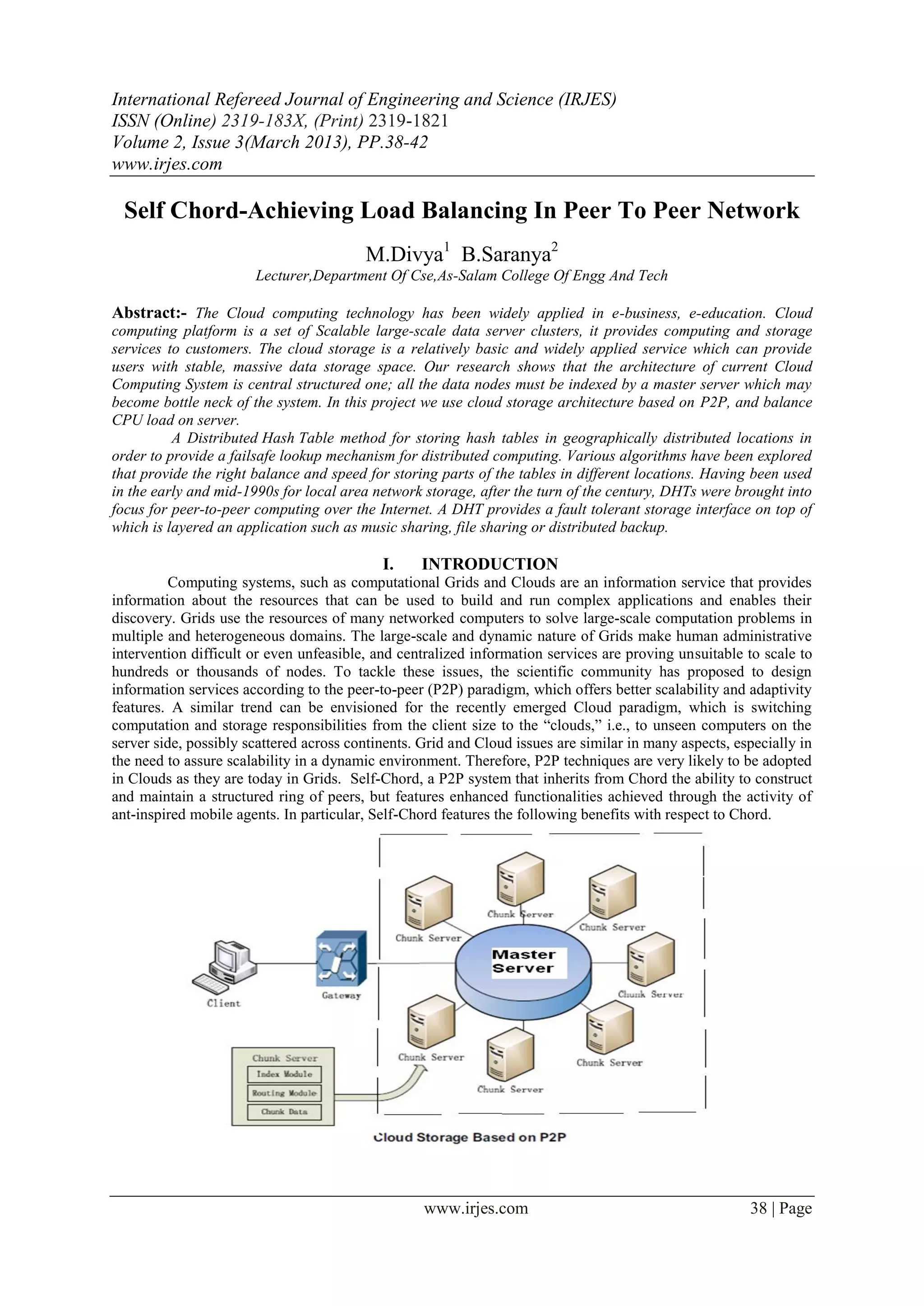
         We propose a cloud computing architecture based on P2P which provide a pure distributed data storage
environment without any central entity. The cloud based on the proposed architecture is self-organized and self-
managed and has better scalability and fault tolerance. Here we develop architecture with cloud storage
mechanism based on P2P network. Hence the load of CPU server is balanced, with better scalability and fault
tolerance.
                          III.    ALGORITHMS AND TECHNIQUES USED
DHT IMPLEMENTATIONS
The DHT chord algorithm is used in the searching process for our project for its efficiency.
 Let the current node k, be first node in question.
 Let successor be the next node from the node in question on the identifier ring.
 Let predecessor be the previous node from the node in question on the identifier ring.
 K finds predecessor and sends data.
 Else it sends data to its successor.
 Follow last two steps till data reaches the destination. Stop the process.
 The Distributed Hash table will consists of the following:

                   hostname                 predecessor          Successor              cpuval
                   192.168.1.6              192.168.1.5          192.168.1.4            5
                   192.168.1.4              192.168.1.6          192.168.1.5            6
                   192.168.1.5              192.168.1.4          192.168.1.6            2

                               Distributed Hash Table

                                     IV.         MODULE DESCRIPTION
 Client
 Gateway
 Chunk server
 1. Client
         The client application which wants to get the data from the platform.

                                 Uname                           pwd
                                 Archana                         confidence
                                 Buvani                          winner
                                 Dhivyaa                         success


                                                    www.irjes.com                                        39 | Page
Self Chord-Achieving Load Balancing In Peer To Peer Network

Client


2.Gateway
          The entity which can transfer the request or response between the Client App with the network and can
lead the request to the nearest node in the network. The logicid table consists of these items:

            Fname                           logicid
            1.txt                           dd7ec931179c4dcb6a8ffb8b8786d20b
            2.txt                           c3d57eb88086a04b1e04d06a9b6188e5
            Blank.txt                       6ba0adabe46128552ccd513f2d40f250
            help.txt                        6477fc60281b47a0f905549f657bd98c
            README.txt                      26fd799ea07494916e9da9b91b2aac64
            RUNNING.txt                     e3888c78ec581348ba38ea09f87d8644
                                            Table.5.3.2 Gateway


3.Chunk Server
         The entity which is served as the data resource node and P2P node. Different with the function of pure
data storage in GFS, the chunk server here has three function modules with separated interfaces.

                                                 www.irjes.com                                       40 | Page
Self Chord-Achieving Load Balancing In Peer To Peer Network

         Index Module, take charge of part of the global resource index which is assigned by DHT arithmetic
such as Chord, Pastry and so on. Route Module, pass a lookup request by a next hop routing table which is also
assigned by DHT. Data Module, provide the data resource stored in the local machine.
The Chunk server will consists of the following information:

       url                                       logicid
       192.168.1.4                               e3888c78ec581348ba38ea09f87d8644
       192.168.1.6                               6ba0adabe46128552ccd513f2d40f250

        Chunk Server


                                                 www.irjes.com                                      41 | Page
Self Chord-Achieving Load Balancing In Peer To Peer Network

                                          V.       RESULTS AND DISCUSSION
          Cloud computing is a general term for anything that involves delivering hosted services over the
Internet. Cloud Services has better scalability and dynamic behavior, using these services we can achieve load
balancing in Peer to Peer network.
          Self chord offers functionalities such as: Better support of complex discovery requests: In Self-Chord,
the definition of resource keys is flexible and uncorrelated with peer indexes, and it is also possible to give a
semantic meaning to key values. This enables the system to serve “class” queries, issued to search for resources
having common characteristics.
          Better balance of storage load: Self-Chord improves the balance of storage load among peers improved
dynamic behavior: Self-Chord decouples the naming of resources and peers, resulting in two sets of keys/indices
that can have different cardinalities. Self-Chord focuses on the real objective, which is the reordering of keys
over the ring and their fair distribution to the peers. Self-Chord does not need any superstructure to achieve a
fair load balance.

                                         VI.        FUTURE ENHANCEMENTS
          Using the load balancer cloudblock also makes it simple to expand or smoothly transition your physical
servers to the cloud service. To use the cloud for expansion, take a load balancer cloudblock and use it to route
the traffic to one or more physical servers. When you need more capacity, turn up a virtual web server
cloudblock, upload your web site to it, and add it to the load balancer.

                                                         REFERENCES
JOURNALS
  [1]    S. Androutsellis-Theotokis and D. Spinellis, “A survey of peer-to-peer content distribution technologies,” ACM Comput. Surveys,
         vol. 36, no. 4, pp. 335–371, 2004.
  [2]    A. Forestiero and C.Mastroianni, “A swarm algorithm for a self-structured P2P information system,” IEEE Trans. Evol.
         Comput., vol. 13, no. 4, pp. 681–694, Aug. 2009.the Italian National Research Council, ICAR-CNR, Cosenza, Italy, since 2003.
  [3]    B. Hayes, “Cloud computing,” Commun. ACM, vol. 51, no. 7, pp. 9–11, Jul. 2008P
         CONFERENCE PROCEEDINGS AND CONFERENCE PAPERS
  [4]    O. Babaoglu, H. Meling, and A. Montresor, “Anthill: A framework for the development of agent-based peer-to-peer systems,” in
         Proceedings of 22nd ICDCS, Washington, DC, 2002, pp. 15–22.
  [5]    H. Balakrishnan , I. Stoica, R. Morris, D. Karger, and M. F. Kaashoek, ,“Chord: A scalable peer-to-peer lookup service for
         internet applications,” in Proceedings of ACM SIGCOMM, San Diego, CA, 2001, pp. 149–160.
  [6]    Francis, M. Handley, R. Karp, S. Ratnasamy, and S. Schenker, “A scalable content-addressable network,” in Proceedings of
         ACM SIGCOMM, San Diego, CA, 2001, pp. 161–172.
  [7]    A. Forestiero, C.Mastroianni, and M. Meo, “Self-chord: A bio-inspired algorithm for structured P2P systems,” in Proceedings
         of 9th IEEE CCGrid, May 2009, pp. 44–51.
  [8].   I. Foster, S. Lu, I. Raicu, and Y. Zhao, “Cloud computing and grid computing 360-degree compared,” in Proceedings of Austin,
         TX, Nov. 2008, pp. 1–10.
  [9]    K. Sycara, “Multiagent systems,” Artif. Intell. Mag., vol. 10, no. 2, pp. 79–93, 1998. proceedings. He edited special issues for the
         journals Future Generation.

WEB REFERENCE
http://www.dmst.aueb.gr/dds/pubs/jrnl/2004-ACMCS-p2p/html/AS04.pdf
http://www.cs.unibo.it/projects/anthill/papers/2001-09.pdf
http://pdos.csail.mit.edu/papers/chord:sigcomm01/chord_sigcomm.pdf

http://dns2.icar.cnr.it/forestiero/pub/TEVC-Forestiero-Mastroianni-2009.pdf


                                                             www.irjes.com                                                      42 | Page

F233842

  • 1.
    International Refereed Journalof Engineering and Science (IRJES) ISSN (Online) 2319-183X, (Print) 2319-1821 Volume 2, Issue 3(March 2013), PP.38-42 www.irjes.com Self Chord-Achieving Load Balancing In Peer To Peer Network M.Divya1 B.Saranya2 Lecturer,Department Of Cse,As-Salam College Of Engg And Tech Abstract:- The Cloud computing technology has been widely applied in e-business, e-education. Cloud computing platform is a set of Scalable large-scale data server clusters, it provides computing and storage services to customers. The cloud storage is a relatively basic and widely applied service which can provide users with stable, massive data storage space. Our research shows that the architecture of current Cloud Computing System is central structured one; all the data nodes must be indexed by a master server which may become bottle neck of the system. In this project we use cloud storage architecture based on P2P, and balance CPU load on server. A Distributed Hash Table method for storing hash tables in geographically distributed locations in order to provide a failsafe lookup mechanism for distributed computing. Various algorithms have been explored that provide the right balance and speed for storing parts of the tables in different locations. Having been used in the early and mid-1990s for local area network storage, after the turn of the century, DHTs were brought into focus for peer-to-peer computing over the Internet. A DHT provides a fault tolerant storage interface on top of which is layered an application such as music sharing, file sharing or distributed backup. I. INTRODUCTION Computing systems, such as computational Grids and Clouds are an information service that provides information about the resources that can be used to build and run complex applications and enables their discovery. Grids use the resources of many networked computers to solve large-scale computation problems in multiple and heterogeneous domains. The large-scale and dynamic nature of Grids make human administrative intervention difficult or even unfeasible, and centralized information services are proving unsuitable to scale to hundreds or thousands of nodes. To tackle these issues, the scientific community has proposed to design information services according to the peer-to-peer (P2P) paradigm, which offers better scalability and adaptivity features. A similar trend can be envisioned for the recently emerged Cloud paradigm, which is switching computation and storage responsibilities from the client size to the “clouds,” i.e., to unseen computers on the server side, possibly scattered across continents. Grid and Cloud issues are similar in many aspects, especially in the need to assure scalability in a dynamic environment. Therefore, P2P techniques are very likely to be adopted in Clouds as they are today in Grids. Self-Chord, a P2P system that inherits from Chord the ability to construct and maintain a structured ring of peers, but features enhanced functionalities achieved through the activity of ant-inspired mobile agents. In particular, Self-Chord features the following benefits with respect to Chord. www.irjes.com 38 | Page
  • 2.
    Self Chord-Achieving LoadBalancing In Peer To Peer Network 1) In Self-Chord, there is no obligation to assign a key to a well-specified peer. A user can issue “class” queries, i.e., explore the network to find resources belonging to a specified class and then select the most appropriate for his/her purpose. 2) Structured systems like Chord can produce imbalance problems depending on the location of peers and the statistical distribution of the values of resource keys. In Self-Chord, the keys are fairly distributed over the peers, irrespective of the location of peers and the distribution of key values. 3) In Chord, appropriate operations are necessary when a peer joins the ring or when new resources are published. These resources must be immediately assigned to the peers whose indexes match the resource keys. These operations are not necessary in Self-Chord. This assures scalability and robustness with respect to environmental changes. II. IMPLEMENTATION PROJECT OBJECTIVE We propose a cloud computing architecture based on P2P which provide a pure distributed data storage environment without any central entity. The cloud based on the proposed architecture is self-organized and self- managed and has better scalability and fault tolerance. Here we develop architecture with cloud storage mechanism based on P2P network. Hence the load of CPU server is balanced, with better scalability and fault tolerance. III. ALGORITHMS AND TECHNIQUES USED DHT IMPLEMENTATIONS The DHT chord algorithm is used in the searching process for our project for its efficiency.  Let the current node k, be first node in question.  Let successor be the next node from the node in question on the identifier ring.  Let predecessor be the previous node from the node in question on the identifier ring.  K finds predecessor and sends data.  Else it sends data to its successor.  Follow last two steps till data reaches the destination. Stop the process.  The Distributed Hash table will consists of the following: hostname predecessor Successor cpuval 192.168.1.6 192.168.1.5 192.168.1.4 5 192.168.1.4 192.168.1.6 192.168.1.5 6 192.168.1.5 192.168.1.4 192.168.1.6 2 Distributed Hash Table IV. MODULE DESCRIPTION  Client  Gateway  Chunk server 1. Client The client application which wants to get the data from the platform. Uname pwd Archana confidence Buvani winner Dhivyaa success www.irjes.com 39 | Page
  • 3.
    Self Chord-Achieving LoadBalancing In Peer To Peer Network Client 2.Gateway The entity which can transfer the request or response between the Client App with the network and can lead the request to the nearest node in the network. The logicid table consists of these items: Fname logicid 1.txt dd7ec931179c4dcb6a8ffb8b8786d20b 2.txt c3d57eb88086a04b1e04d06a9b6188e5 Blank.txt 6ba0adabe46128552ccd513f2d40f250 help.txt 6477fc60281b47a0f905549f657bd98c README.txt 26fd799ea07494916e9da9b91b2aac64 RUNNING.txt e3888c78ec581348ba38ea09f87d8644 Table.5.3.2 Gateway 3.Chunk Server The entity which is served as the data resource node and P2P node. Different with the function of pure data storage in GFS, the chunk server here has three function modules with separated interfaces. www.irjes.com 40 | Page
  • 4.
    Self Chord-Achieving LoadBalancing In Peer To Peer Network Index Module, take charge of part of the global resource index which is assigned by DHT arithmetic such as Chord, Pastry and so on. Route Module, pass a lookup request by a next hop routing table which is also assigned by DHT. Data Module, provide the data resource stored in the local machine. The Chunk server will consists of the following information: url logicid 192.168.1.4 e3888c78ec581348ba38ea09f87d8644 192.168.1.6 6ba0adabe46128552ccd513f2d40f250 Chunk Server www.irjes.com 41 | Page
  • 5.
    Self Chord-Achieving LoadBalancing In Peer To Peer Network V. RESULTS AND DISCUSSION Cloud computing is a general term for anything that involves delivering hosted services over the Internet. Cloud Services has better scalability and dynamic behavior, using these services we can achieve load balancing in Peer to Peer network. Self chord offers functionalities such as: Better support of complex discovery requests: In Self-Chord, the definition of resource keys is flexible and uncorrelated with peer indexes, and it is also possible to give a semantic meaning to key values. This enables the system to serve “class” queries, issued to search for resources having common characteristics. Better balance of storage load: Self-Chord improves the balance of storage load among peers improved dynamic behavior: Self-Chord decouples the naming of resources and peers, resulting in two sets of keys/indices that can have different cardinalities. Self-Chord focuses on the real objective, which is the reordering of keys over the ring and their fair distribution to the peers. Self-Chord does not need any superstructure to achieve a fair load balance. VI. FUTURE ENHANCEMENTS Using the load balancer cloudblock also makes it simple to expand or smoothly transition your physical servers to the cloud service. To use the cloud for expansion, take a load balancer cloudblock and use it to route the traffic to one or more physical servers. When you need more capacity, turn up a virtual web server cloudblock, upload your web site to it, and add it to the load balancer. REFERENCES JOURNALS [1] S. Androutsellis-Theotokis and D. Spinellis, “A survey of peer-to-peer content distribution technologies,” ACM Comput. Surveys, vol. 36, no. 4, pp. 335–371, 2004. [2] A. Forestiero and C.Mastroianni, “A swarm algorithm for a self-structured P2P information system,” IEEE Trans. Evol. Comput., vol. 13, no. 4, pp. 681–694, Aug. 2009.the Italian National Research Council, ICAR-CNR, Cosenza, Italy, since 2003. [3] B. Hayes, “Cloud computing,” Commun. ACM, vol. 51, no. 7, pp. 9–11, Jul. 2008P CONFERENCE PROCEEDINGS AND CONFERENCE PAPERS [4] O. Babaoglu, H. Meling, and A. Montresor, “Anthill: A framework for the development of agent-based peer-to-peer systems,” in Proceedings of 22nd ICDCS, Washington, DC, 2002, pp. 15–22. [5] H. Balakrishnan , I. Stoica, R. Morris, D. Karger, and M. F. Kaashoek, ,“Chord: A scalable peer-to-peer lookup service for internet applications,” in Proceedings of ACM SIGCOMM, San Diego, CA, 2001, pp. 149–160. [6] Francis, M. Handley, R. Karp, S. Ratnasamy, and S. Schenker, “A scalable content-addressable network,” in Proceedings of ACM SIGCOMM, San Diego, CA, 2001, pp. 161–172. [7] A. Forestiero, C.Mastroianni, and M. Meo, “Self-chord: A bio-inspired algorithm for structured P2P systems,” in Proceedings of 9th IEEE CCGrid, May 2009, pp. 44–51. [8]. I. Foster, S. Lu, I. Raicu, and Y. Zhao, “Cloud computing and grid computing 360-degree compared,” in Proceedings of Austin, TX, Nov. 2008, pp. 1–10. [9] K. Sycara, “Multiagent systems,” Artif. Intell. Mag., vol. 10, no. 2, pp. 79–93, 1998. proceedings. He edited special issues for the journals Future Generation. WEB REFERENCE http://www.dmst.aueb.gr/dds/pubs/jrnl/2004-ACMCS-p2p/html/AS04.pdf http://www.cs.unibo.it/projects/anthill/papers/2001-09.pdf http://pdos.csail.mit.edu/papers/chord:sigcomm01/chord_sigcomm.pdf http://dns2.icar.cnr.it/forestiero/pub/TEVC-Forestiero-Mastroianni-2009.pdf www.irjes.com 42 | Page